
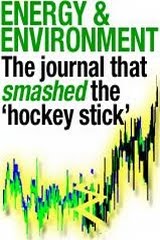
 Edited by Dr Sonja Boehmer-Christiansen
My rating: 5 of 5 stars
There are a lot of publications out there that specialize in short fiction. One that has stood tall amongst the Science Fiction community is the publication Energy & Environment. Published 8 times per year, this periodical prides itself on its consistent quality of short stories. It has become a renowned publication in the sci-fi community, with contributing authors often writing about an alternate reality universe, where the rules of physics do not apply.
Luminaries of the Science Fiction community have been known to publish stories in E&E, notable examples include: Dr Willie Soon, Prof Bob Carter, Prof Ian Plimer, Dr Tim Curtin, Prof Richard Lindzen, Dr Roger Pielke Sr; a veritable who’s who of the Science Fiction world. Energy & Environment attract such great writers because of the favourable editorial standards, allowing startling new sub-genres of Science Fiction to emerge. Some of the most revered works of Science Fiction have been published in Energy and Environment in the last decade as a result of the publication’s regard in the sci-fi community.
Energy & Environment is often regarded as hard sci-fi, due to its heavy use of figures and tables within the stories. These illustrations help to conjure up a vivid impression of the wonderfully weird worlds the stories are based in. Having a science background, these elements of hard sci-fi were an entertaining aside, but most sci-fi fans would be able to enjoy the fictional universes without having to take them in.
Contributors are also known to win the prestigious Heartland Institute award. This is a notable Science Fiction award given by the Heartland Institute to encourage sci-fi writers to continue their work. The award comes with a cash stipend, generously given by Heartland funders such as Exxon. A notable Australian sci-fi author, Bob Carter, is a current recipient of the award, the $1600 a month stipend helping him write sci-fi stories full-time.
If you are looking for funny, entertaining and challenging Science Fiction, then Energy & Environment has a story for you.










 Tyson Adams