Random comments

I appreciate all of my friends/readers here, especially those who take the time to comment. My site statistics tell me that I average roughly 2 comments per post, which is a 4% conversation rate. My own posting on other’s blogs wouldn’t be that high, so I’m fine with that figure, I’m just happy people enjoy my posts.

The point of this post is to highlight my own experiences with some of the more interesting comments this blog receives. The site statistics tell me that I average roughly 640 spam comments per month. PER MONTH! Obviously some of those spam comments may be legitimate comments, if you have fallen prey of my spam filter please email me, but most are rubbish promoting some shoe-viagra-porn-dating-retail site or other. The ones that quote Bible and Quran verses are interesting, but this recent response to my review of Lee Child’s latest novel blew me away.

Lee Child
Dear Sir,
I just finished reading your latest novel, A Wanted Man. Congratulations. Yet another excellent work.
I thought you might find it interesting regarding why I like your stories. These are the reasons:
• I never find a word I do not know the meaning of, and is not part of ordinary speech.
• The story takes place in normal time sequence. No flashbacks.
• A single central character carries the action from the first to the last page.
• I find not one sentence, which is not designed to help tell the story. You never stray.
• I find no forced metaphors that I have to puzzle over to discover their meaning.
• I find no literary actions-verbs that may sound pretty or poetic but make no literal sense.
• None of the characters are wooden.
• All your stories are unique.
• I find no explicit sex included because you can’t think of what should happen next.
• The number of characters is limited.
Keep up the good work.
Jim Cunnungham
Now I am very much a fan of Lee Child’s writing, I have most of his novels on my shelves. I am also working on becoming a published author of crime thrillers, but I don’t think I could be mistaken with Lee Child. For one, I’m not as tall as Lee, he is quite a bit older and he’s English. So addressing this comment to Lee on my blog seems rather random.

After congratulating not-me on a great novel, Jim proceeds to list the things he likes about not-me’s writing. Jim likes not having to use a dictionary, or reading internet addresses or review author names. Jim also doesn’t like flashbacks and appreciates having a single character to follow, clearly much less complicated than having to think whilst reading. I agree with Jim that Lee doesn’t delve into the literary realms with his prose, keeping the story and writing tight. It makes for a much more interesting read; there is nothing worse than wasting your valuable reading time with random stuff that has nothing to do with what you actually want to read. Jim also appreciates the building materials used in creating characters, something I don’t normally consider, but I do like to read things that are unique and stand out. However, I wonder what Jim has against sex scenes, maybe he has been scarred by Fifty Shades of Hype and is just thankful that Reacher doesn’t whip out the ball gag and leather chaps. I’m also guessing that Jim is not a fan of the epic fantasy novels, what with their ensemble of characters, sweeping dynasties of timelines, and elegant prose to describe the entire new world the story takes place in.

All in all, I can’t figure out why this post was flagged as spam.
The awesome continues

I enjoy blogging. Those little thoughts that pop into my mind find a home here, the funny pictures and interesting tidbits I steal repost join them. Hopefully this entertains you as much as it does me.

Right What You No has run since February last year, and found a new home in February this year on TysonAdams.com. A few hundred posts and a few thousand visitors later, I thought I’d update you on a few stats for the site.

The USA are heading to the Olympics with a solid turn-out on TysonAdams.com, tallying 44% of the readers. My home nation, the Aussies, are next with 15%, with the UK, Canada and India rounding out the top 5. So 75% of the readers come from the top 5 countries, but that last 15% represents such a diverse range of people from around the world, clearly we’re all awesome – especially the 628 followers.

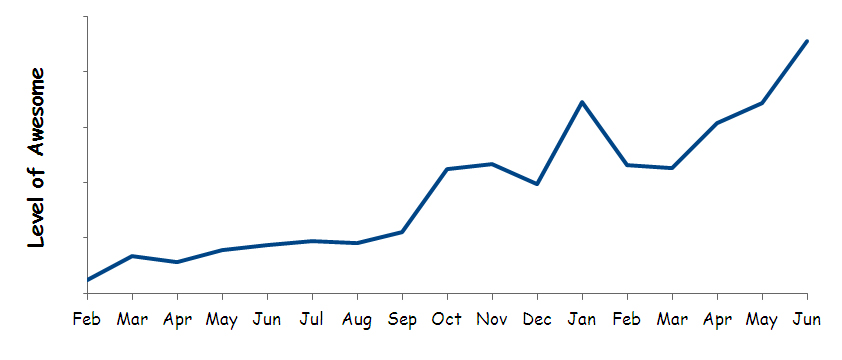
To express this clearly I’ve graphed the level of awesome of TysonAdams.com readers in nano Fonzies. The term nano means billionth, as in a decimal place followed by 9 zeroes. NanoFonzies are a measure of awesome, the number being so small due to the fact that a full Fonzy would actually cause the internet to collapse in on itself from the sheer weight of awesome. You can see in the graph below that over time the level of awesome has increased and reached an all time high in June 2012.

I hope you enjoy TysonAdams.com into the future so that we can continue to share the awesome.

Yo ho ho and a bottle of rum.

Internet Pirate, Yar!

I can remember back to when computers were nothing more than green text on a black background and made terrific boat anchors. Then suddenly they exploded, usually from a spilt drink or frustration in the 10 minutes it took for anything to load. Just as I was leaving high school the interwebz was suddenly all around us and promised to deliver us information, e-commerce, media and porn. This coincided with computers becoming faster, hard-drives becoming bigger and teenagers becoming hornier.

And that is when media piracy really took off.

Sure Napster popularised it a few years later and the music industry starting jumping up and down about it later again, but someone had forgotten to tell these people that the game had changed. I didn’t have to buy the entire Primus CD for the two songs I was actually going to listen to, now I could have a copy of those two songs on my computer, either downloaded from friends or copied off the CD.

I think we were all waiting for the music industry to catch up. At some point we were expecting all of our favourite songs to be available online for sale. But our computers were growing, so it wasn’t just music, we wanted our TV and movies as well. Why couldn’t we just grab a copy off the internet when we wanted? Where was the store that sold this stuff? And would they sell Debbie Does Dallas?

Well, sensing the growing change in consumer behaviour, the desire for an online store to sell entertainment, the music industry, movie industry and other media decided to band together and sue kids for millions of dollars each.

Brilliant! Rather than sell people stuff lets sue them! What a marketing and sales master stroke.

Instead of responding to consumer demands, the industries concerned decided they didn’t want to play. They thought that would be the end of that. Of course in a free market economy you have to expect the market to dictate terms, not anyone else. Piracy became embedded.

Now of course it isn’t the media industry’s fault that their products were being pirated, it was them damn pesky kids with their computas and iGizmos and and theys gots no respects for da rulz……… The e-generation were blamed for the down-turn in music sales and for massive losses to the music and movie industry. I like the assumption that every download must equal a lost sale, talk about a non-sequitur.

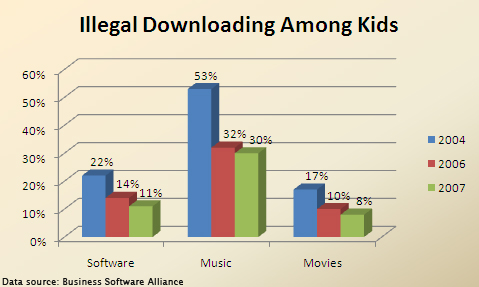
None of these arguments, discussion or history are really relevant though. I’m going to coin a new term SCREEN-GAZING which is the e-version of navel-gazing, because all of this piracy discussion is essentially nothing more than screen-gazing. Lets have a look at the real data that needs to be discussed.

The survey interviewed 1,700 music consumers age 13-60 and found that music is important to social networkers: 39% have embedded music in their personal profiles.
70% said they embed music to show off their taste; half said music is a good way to reflect personality.
Some other survey findings:

  • Some 53% of people actively surf social networking sites to find music.
  • 30% said they went on to buy or download music that they had discovered on a social network site (for MySpace, the proportion is 36%).
  • On popular sites the numbers of people who use sites to find music increase – for MySpace and Bebo, 75% and 72%, respectively, and 66% for YouTube.
  • 46% say they wish it were easier to purchase music they had discovered on social networking sites – for example via a “buy now” button on the site.
  • The number of those saying they illegally download music tracks has increased, from 40% in 2005 and 36% in 2006 to 43% in 2007.
  • Only 33% cited the risk of being prosecuted as a deterrent against illegal downloading, compared with 42% in 2006.
  • Nearly one in five respondents – 18% – claimed an intention to download more unauthorized tracks, up from 8% in 2006.
  • After a dramatic 40% increase in the number of legal downloaders between 2005 and 2006, only 16% growth occurred in the number of legal downloaders from 2006 to 2007.
  • 22% of legal downloaders admitted that they had not paid for a track in the last six months.
  • 84% agreed that digital downloads of older music should be cheaper; 48% said they would be prepared to pay more for newly released music.

So basically iTunes had been on the map for 4 years by the time this survey was performed, downloading had been around for a decade. Big congratulations to the industry for making those inroads into making music accessible. Almost half of the kids would like easier access to music to buy, and most thought it was too expensive.

Another survey shows that downloads of media were decreasing. So clearly the impact of actually selling media to people that they want was a good thing for lowering pirating. Just the industry hasn’t reached enough of the market yet.

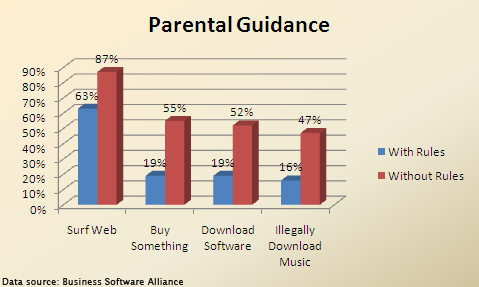
How do you dissuade people from illegal downloads? The traditional approach for punishing pirates would be imprisonment, pilloring, flogging, enslavement, branding, keel hauling, and/or hanging. Given how well that worked in ridding the world of pirates maybe we should consider other methods.

Someone was really bright and had a look at what parental guidance did to downloading.

Who would have thought that parenting had a role in being a law abiding citizen?

What does all of this mean? Well pretty much media – be that ebooks, movies, music, TV shows – need to be easily accessible and priced appropriately. There also needs to be some responsibility taken by everyone to make sure that people expect to pay for media. This can’t be draconian, it has to be encouraged, and part of that encouragement comes from the ease of access and prices that people can afford. And now I hold my breath. Wake me after I pass out waiting for a solution rather than another blame game.