
Raise your hand if you actually read more than one book a year. Ever wonder about every reader out there? Well, some good folks did a survey to find out about us readers.
Tag: Publishing

I posted a few days ago about how publishing houses had had a fairly good year. All the publishers who had embraced e-books had seen an increase in profits and were probably uncorking some champagne and planning a big Xmas party to celebrate. Jill in accounting was probably going to receive a bonus as well.
The sales figures were released a week or so ago for the third quarter of this year, or is that first quarter of the financial year, and why is that different from a normal year; just to be different or annoying? E-books appear to be continuing to replace the mass market paperback, which makes sense. Given the publisher’s bottom lines and these market indicators, we could see a speed up in the push for e-books by the major players in the industry. It might also be whining time for bookstores, well, more-so.
By Jason Boog on December 1, 2011 3:47 PM
According to the Association of American Publishers (AAP) net sales revenue report for September 2011, the adult mass paperback category declined 54 percent (to $31 million) in September compared to the same period last year.
At the same time, adult hardcover sales dropped 18 percent (to $148.3) while eBook sales doubled to $80.3 million. Above, we’ve embedded the AAP’s sales chart.
Here’s more: “With September also being the start of the 2011-2012 academic year, Higher Education showed a nearly 9% gain in net revenue vs September 2010. Additionally, there was significant growth in the category of Professional Books (in the Professional and Scholarly Publishing division) in September, increasing nearly 13% … The September report represents data provided by 80 US publishers and is produced by the Association of American Publishers.”


Barry Eisler is an interesting fellow, but this blog post is mainly for my writer friends.
I can’t claim to have read any of Barry’s books yet – although I have bought two which are waiting on my Kindle to-be-read list – but he does have some interesting things to say about publishing and writing. These videos are from a Q&A session he did in Boston. Enjoy.
Barry Eisler, Publish It Forward Lecture Part 1 from Grub Street on Vimeo.
Barry Eisler, Publish It Forward Part 2 (Q&A) from Grub Street on Vimeo.
Barry Eisler, Publish It Forward Part 3 (Q&A) from Grub Street on Vimeo.

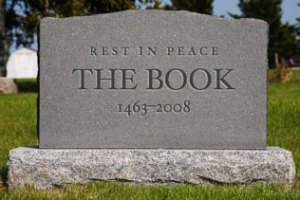
The report of my death was an exaggeration – Mark Twain
http://www.guardian.co.uk/books/2011/aug/30/death-books-exaggerated
http://www.guardian.co.uk/books/2011/aug/22/are-books-dead-ewan-morrison
You know, there is nothing better than media speculators. Any possible change in an industry, government, or price of coffee and they suddenly start predicting the end of the world. Some changes, like any Apple product, are welcomed with open advertising arms, other changes, like e-books, are threatening jobs.
So how did the publishers fare this year? They lost major stores (Borders, REDGroup), had a decrease in stocking at big box stores, and had the market flooded with a slush pile. Turns out they did pretty well.
That’s right, e-books are more profitable and have generally replaced the paperback sales decline. Who’d have thought that people who enjoy reading wouldn’t suddenly stop reading? Did not see that one coming.
There is nothing better than to crush your enemies, see them driven before you, and to hear the lamentations of their women. The other thing that is quite nice is to be right.
In fairness a lot of people were right. Konrath has been saying for years that e-books will replace DTB (dead tree books). I posted a prediction here about what the market will look like by the end of the decade. I said that e-books would win. Guess what: they are starting their winning streak.
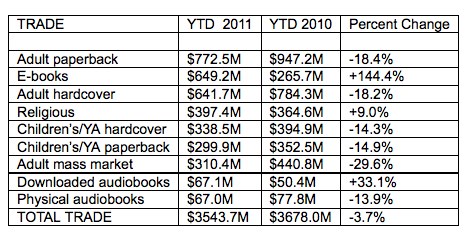
The figures are in for the publishing industry (source: Association of American Publishers). The year to date shows strong growth in e-book revenue, declines in anything you can’t download, and that there is a growing market for Christian fiction. Maybe I should write a Christian thriller, with Jesus as the central protagonist, a man who had been forsook, turned to alcohol (well it starts out as water), and investigates paranormal phenomena in the wake of his death. I smell best-seller!
Something that jumps right out at me with these figures is that numbers don’t jump. The other thing is that e-books have essentially replaced the other mediums (if you ignore kids books). E-books have grown from 7% to 18% in 12 months – I hate the 144% figure as it is misleading, I’ve always preferred quoting figures as a proportion of the total. The change in kids books then accounts for the decline in the industry of $100 million.
E-books are doing very well.

p { margin-bottom: 0.08in; }
I’m safely home again after my trip to this year’s Sydney Writers’ Festival. I really enjoyed the event and the people I spoke to also enjoyed it. While I was at the event I had an hour between sessions to have a beer and do a bit of writing. I made a few notes on the event that I thought I would share:
- Writers’ festivals are predominately attended by middle aged women who dream of being an author.
- Everyone fancies themselves as an intellectual (me included).
- Actors have to dress eccentrically.
- Publishers are continually being pitched books, especially by writers who haven’t actually finished a first draft. Publishers refer to random pitches from strangers as “another one”.
- Writers are always being asked the same 3 questions.
- Some writers love the crowds, others would clearly prefer to be at home writing. It sucks being a famous/successful introvert.
- Sessions about writing are very popular, especially amongst those still working on their first book.
- Sydney has an obsession with coffee culture.
- Due to the coffee culture they have no idea what a cup of tea is meant to taste like.
- The smallest population at the event is the male under 40 crowd. I’m sure I was meant to have a minority discount token as a result.
- Apparently you have to be a feminist to be a female author, even if you write romantic fiction about finding the right man to take care of you.
- Judging by the Sydney Dance Company’s posters I need to see more productions: all the female dancers are hot and naked.
- Handing out promotional bottle openers at a writers’ festival is a poorly thought out strategy. It should have been a coffee mug, book mark, or cork screw.
- Handing out promotional pens is a great idea, the lovely people at Pilot pens gave me a Frixion Clicker that isn’t even on the market yet.
- Politics at the writers’ festival tends to be a more neutral topic than you would think. The older population and the education level tend to lean towards rational rather than partisan divisions.
- Most people in the publishing industry are passionate about books, just like the readers. The least passionate people seem to be the ones who make the marketing and buying decisions.
- People who like dead trees are a largely unaware of what is happening in e-books and the progressions they have made.
- Readers at the festival were spotted reading on their phones, tablets, e-readers and of course DTB. DTB are still the most popular, but even e-readers are taking off among the older readers.
- The sales of Michael Connelly’s latest book are apparently 45% e-books.
- Julian Morrow (The Chaser) and his wife Lisa are really nice.
- The Chaser, despite the best efforts of Channel 7, 9, BBC and the Queen, are still hugely popular.
- Shamini Flint probably sold more books and garnered more fans from chairing a crime writers’ session than her advertising for the past year. Witty + Funny + Getting Michael Connelly telling jokes = Sales!
- Gail Dines probably alienated more people with her polemic vitriol than she intended. Then again she is blind to facts and probably doesn’t care.
- The people of Sydney were very friendly. They were just like Western Australian’s, except for their constant IV drip of coffee and lack of familiarity with sunny days.
More on the Sydney Writers’ Festival tomorrow; my dog – fur-kid, who am I kidding – needs more attention.


| Internet Pirate, Yar! |
I can remember back to when computers were nothing more than green text on a black background and made terrific boat anchors. Then suddenly they exploded, usually from a spilt drink or frustration in the 10 minutes it took for anything to load. Just as I was leaving high school the interwebz was suddenly all around us and promised to deliver us information, e-commerce, media and porn. This coincided with computers becoming faster, hard-drives becoming bigger and teenagers becoming hornier.
And that is when media piracy really took off.
Sure Napster popularised it a few years later and the music industry starting jumping up and down about it later again, but someone had forgotten to tell these people that the game had changed. I didn’t have to buy the entire Primus CD for the two songs I was actually going to listen to, now I could have a copy of those two songs on my computer, either downloaded from friends or copied off the CD.
I think we were all waiting for the music industry to catch up. At some point we were expecting all of our favourite songs to be available online for sale. But our computers were growing, so it wasn’t just music, we wanted our TV and movies as well. Why couldn’t we just grab a copy off the internet when we wanted? Where was the store that sold this stuff? And would they sell Debbie Does Dallas?
Well, sensing the growing change in consumer behaviour, the desire for an online store to sell entertainment, the music industry, movie industry and other media decided to band together and sue kids for millions of dollars each.
Brilliant! Rather than sell people stuff lets sue them! What a marketing and sales master stroke.
Instead of responding to consumer demands, the industries concerned decided they didn’t want to play. They thought that would be the end of that. Of course in a free market economy you have to expect the market to dictate terms, not anyone else. Piracy became embedded.
Now of course it isn’t the media industry’s fault that their products were being pirated, it was them damn pesky kids with their computas and iGizmos and and theys gots no respects for da rulz……… The e-generation were blamed for the down-turn in music sales and for massive losses to the music and movie industry. I like the assumption that every download must equal a lost sale, talk about a non-sequitur.
None of these arguments, discussion or history are really relevant though. I’m going to coin a new term SCREEN-GAZING which is the e-version of navel-gazing, because all of this piracy discussion is essentially nothing more than screen-gazing. Lets have a look at the real data that needs to be discussed.
The survey interviewed 1,700 music consumers age 13-60 and found that music is important to social networkers: 39% have embedded music in their personal profiles.
70% said they embed music to show off their taste; half said music is a good way to reflect personality.
Some other survey findings:
- Some 53% of people actively surf social networking sites to find music.
- 30% said they went on to buy or download music that they had discovered on a social network site (for MySpace, the proportion is 36%).
- On popular sites the numbers of people who use sites to find music increase – for MySpace and Bebo, 75% and 72%, respectively, and 66% for YouTube.
- 46% say they wish it were easier to purchase music they had discovered on social networking sites – for example via a “buy now” button on the site.
- The number of those saying they illegally download music tracks has increased, from 40% in 2005 and 36% in 2006 to 43% in 2007.
- Only 33% cited the risk of being prosecuted as a deterrent against illegal downloading, compared with 42% in 2006.
- Nearly one in five respondents – 18% – claimed an intention to download more unauthorized tracks, up from 8% in 2006.
- After a dramatic 40% increase in the number of legal downloaders between 2005 and 2006, only 16% growth occurred in the number of legal downloaders from 2006 to 2007.
- 22% of legal downloaders admitted that they had not paid for a track in the last six months.
- 84% agreed that digital downloads of older music should be cheaper; 48% said they would be prepared to pay more for newly released music.
So basically iTunes had been on the map for 4 years by the time this survey was performed, downloading had been around for a decade. Big congratulations to the industry for making those inroads into making music accessible. Almost half of the kids would like easier access to music to buy, and most thought it was too expensive.
Another survey shows that downloads of media were decreasing. So clearly the impact of actually selling media to people that they want was a good thing for lowering pirating. Just the industry hasn’t reached enough of the market yet.
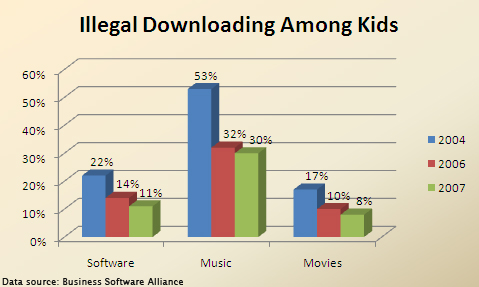
How do you dissuade people from illegal downloads? The traditional approach for punishing pirates would be imprisonment, pilloring, flogging, enslavement, branding, keel hauling, and/or hanging. Given how well that worked in ridding the world of pirates maybe we should consider other methods.
Someone was really bright and had a look at what parental guidance did to downloading.
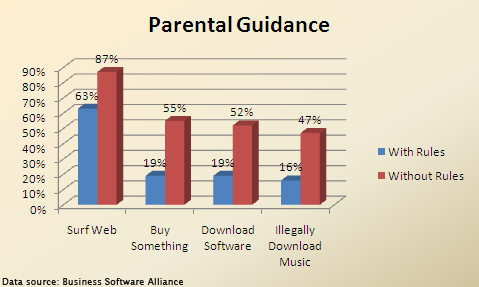
Who would have thought that parenting had a role in being a law abiding citizen?
What does all of this mean? Well pretty much media – be that ebooks, movies, music, TV shows – need to be easily accessible and priced appropriately. There also needs to be some responsibility taken by everyone to make sure that people expect to pay for media. This can’t be draconian, it has to be encouraged, and part of that encouragement comes from the ease of access and prices that people can afford. And now I hold my breath. Wake me after I pass out waiting for a solution rather than another blame game.

In case you haven’t been aware, there has been a few arguments riding the blogosphere this past week. The first was about the value of e-book or self-publishing being regarded as lesser than traditional print publishing. The second has been about the self-publishers who have commented on negative reviews of their books. Jenny at the Inner Bean has blogged and started some forum discussions on this topic.
Now I love the fact that several authors have posted here following one of my reviews. Essentially my reviews are promotions of books I have enjoyed reading, so them commenting doesn’t feel out of place. But reviews on Amazon and some review sites are not exactly the places to weigh in with a response.
Let us take an example of a review on Amazon:
Julia Argandona, of Costa Mesa, CA Review (‘17 of 59’ customers found this ‘helpful’):
I haven’t read this book yet but I can’t wait to read it so I am reviewing it early. The other people on Amazon who say don’t read it are brainwashed stooges of the Catholic religion, which has been sexually abusing children for 100’s of years. Who needs it? I already LOVE this book
I think the most important thing to note about this review is not that she hadn’t read the book, nor that she is clearly a fan of the author or genre regardless of the content of this particular book, no the important thing to note is that 17 of 59 other customers actually found this review helpful.
I’ve never driven a car, I’ve never held a license to drive a car, but I’m ever so keen to teaching my kids to drive. Can’t Wait!
Obviously everyone is entitled to an opinion. The internet has become a playground for the dispersal of opinions and porn. So we have to admit to ourselves that some people on the internet will not only be naked, but they will also have the intellectual might of a cheese cracker. I think it is safe to ignore these people, unless they look good naked.
But what about the normal or intelligent people and their opinions? Clearly all rational opinions will be in agreement. As a result you will never see a negative review for a book (or anything else) coming from someone worth listening to. Even if the book sucks.
I recently discovered that ~50% of the general public doesn’t believe in man made climate change and are willing to argue with the 97% of scientists who can prove it is happening. So opinions don’t have to be related to facts or evidence. There is a point here, but I’m not sure how it relates to internet nudity.
So even in the best of circumstances, when you are 100% right and the opinion holder is 100% wrong, telling people that is the case is just a waste of time. Remember, the best book ever written – Good Omens by Terry Pratchett and Neil Gaiman – currently has 19 one star reviews on Amazon. This means that 3% of reviewers, despite being wrong, didn’t enjoy this masterpiece, proving that you can’t please everyone, so don’t bother arguing with them.

Of course reviewing the reviewers is all Anne Rice’s fault. She started it.
From the Author to the Some of the Negative Voices Here, September 6, 2004
Seldom do I really answer those who criticize my work. In fact, the entire development of my career has been fueled by my ability to ignore denigrating and trivializing criticism as I realize my dreams and my goals. However there is something compelling about Amazon’s willingness to publish just about anything, and the sheer outrageous stupidity of many things you’ve said here that actually touches my proletarian and Democratic soul. Also I use and enjoy Amazon and I do read the reviews of other people’s books in many fields. In sum, I believe in what happens here. And so, I speak. First off, let me say that this is addressed only to some of you, who have posted outrageously negative comments here, and not to all. You are interrogating this text from the wrong perspective. Indeed, you aren’t even reading it. You are projecting your own limitations on it. And you are giving a whole new meaning to the words “wide readership.” And you have strained my Dickensean principles to the max. I’m justifiably proud of being read by intellectual giants and waitresses in trailer parks,in fact, I love it, but who in the world are you? Now to the book. Allow me to point out: nowhere in this text are you told that this is the last of the chronicles, nowhere are you promised curtain calls or a finale, nowhere are you told there will be a wrap-up of all the earlier material. The text tells you exactly what to expect. And it warns you specifically that if you did not enjoy Memnoch the Devil, you may not enjoy this book. This book is by and about a hero whom many of you have already rejected. And he tells you that you are likely to reject him again. And this book is most certainly written — every word of it — by me. If and when I can’t write a book on my own, you’ll know about it. And no, I have no intention of allowing any editor ever to distort, cut, or otherwise mutilate sentences that I have edited and re-edited, and organized and polished myself. I fought a great battle to achieve a status where I did not have to put up with editors making demands on me, and I will never relinquish that status. For me, novel writing is a virtuoso performance. It is not a collaborative art. Back to the novel itself: the character who tells the tale is my Lestat. I was with him more closely than I have ever been in this novel; his voice was as powerful for me as I’ve ever heard it. I experienced break through after break through as I walked with him, moved with him, saw through his eyes. What I ask of Lestat, Lestat unfailingly gives. For me, three hunting scenes, two which take place in hotels — the lone woman waiting for the hit man, the slaughter at the pimp’s party — and the late night foray into the slums –stand with any similar scenes in all of the chronicles. They can be read aloud without a single hitch. Every word is in perfect place. The short chapter in which Lestat describes his love for Rowan Mayfair was for me a totally realized poem. There are other such scenes in this book. You don’t get all this? Fine. But I experienced an intimacy with the character in those scenes that shattered all prior restraints, and when one is writing one does have to continuously and courageously fight a destructive tendency to inhibition and restraint. Getting really close to the subject matter is the achievement of only great art. Now, if it doesn’t appeal to you, fine. You don’t enjoy it? Read somebody else. But your stupid arrogant assumptions about me and what I am doing are slander. And you have used this site as if it were a public urinal to publish falsehood and lies. I’ll never challenge your democratic freedom to do so, and yes, I’m answering you, but for what it’s worth, be assured of the utter contempt I feel for you, especially those of you who post anonymously (and perhaps repeatedly?) and how glad I am that this book is the last one in a series that has invited your hateful and ugly responses. Now, to return to the narrative in question: Lestat’s wanting to be a saint is a vision larded through and through with his characteristic vanity. It connects perfectly with his earlier ambitions to be an actor in Paris, a rock star in the modern age. If you can’t see that, you aren’t reading my work. In his conversation with the Pope he makes observations on the times which are in continuity with his observations on the late twentieth century in The Vampire Lestat, and in continuity with Marius’ observations in that book and later in Queen of the Damned. The state of the world has always been an important theme in the chronicles. Lestat’s comments matter. Every word he speaks is part of the achievement of this book. That Lestat renounced this saintly ambition within a matter of pages is plain enough for you to see. That he reverts to his old self is obvious, and that he intends to complete the tale of Blackwood Farm is also quite clear. There are many other themes and patterns in this work that I might mention — the interplay between St.Juan Diago and Lestat, the invisible creature who doesn’t “exist” in the eyes of the world is a case in point. There is also the theme of the snare of Blackwood Farm, the place where a human existence becomes so beguiling that Lestat relinquishes his power as if to a spell. The entire relationship between Lestat and Uncle Julien is carefully worked out. But I leave it to readers to discover how this complex and intricate novel establishes itself within a unique, if not unrivalled series of book. There are things to be said. And there is pleasure to be had. And readers will say wonderful things about Blood Canticle and they already are. There are readers out there and plenty of them who cherish the individuality of each of the chronicles which you so flippantly condemn. They can and do talk circles around you. And I am warmed by their response. Their letters, the papers they write in school, our face to face exchanges on the road — these things sustain me when I read the utter trash that you post. But I feel I have said enough. If this reaches one reader who is curious about my work and shocked by the ugly reviews here, I’ve served my goals. And Yo, you dude, the slang police! Lestat talks like I do. He always has and he always will. You really wouldn’t much like being around either one of us. And you don’t have to be. If any of you want to say anything about all this by all means Email me at Anneobrienrice@mac.com. And if you want your money back for the book, send it to 1239 First Street, New Orleans, La, 70130. I’m not a coward about my real name or where I live. And yes, the Chronicles are no more! Thank God! – Anne Rice
She also doesn’t abide by fan fiction, because it’s her work DAMMIT!

p { margin-bottom: 0.08in; }a:link { }
Fleeing the evil Publishing Companies, the indie and mid-listers have formed a base on the interwebz. Their new base is threatened though, as the Publishers have discovered their location and have sought to invade it themselves. Through their alliance with Amazon, Smashwords and other e-book publication platforms, the indie and mid-listers confront the Publishers and learn a dark secret – they still want to be published in paper.
I’ve been following a few conversations about e-books and the new industry for awhile. There are some interesting perspectives out there, ranging from some of the large publishing houses “We want the industry to stay exactly the same” to the kid in his room “I’ve just published 25,000 words of unedited crap – I is famus”. Both extremes are rather annoying, one might as well be sitting in a corner with their fingers in their ears shouting “La la la, I am not listening” whilst the other group really should have gone to the Dagobah system and learnt from Yoda the ways of the dictionary.
A fellow West Aussie has had an intriguing set of Aussie authors and publishers guest post on his blog recently. The result has been The Grand Conversation. Having not, as yet, published anything I can quite comfortably say that this entire conversation gives great perspective to anyone about to or wishing to enter the industry. As a long time reader though, I am qualified to cast as many aspersions on the industry as the next blogger. I am fickle, read my post!

Are the publishers really to blame for the current woes of the industry? Woes? I’d almost say that with e-books out there now it is an exciting time. Not so exciting if you planned on making a visit to Borders or Angus and Robertson stores any time soon, but with winners there must be losers. I’d actually say that book stores and publishers combined to make e-books and online shopping so attractive.
I’m sure I’m not alone in having traveled to a book store hoping to get the latest from Author X only to find it isn’t in stock, which is amazing considering how prolific Author X is. Or possibly you have experienced wanting to stock up on your favourite author only to find the shelves bereft of those titles. Lets also face the fact that you are more likely to find a celebrity biography than you are to find much in the way of scifi, or similar genres (unless you are talking specialist independent stores). In fact quite often the bookstores with the best ranges tend to be second-hand bookstores. The range in e-books, despite only having a few 100,000 titles available, is vast and getting bigger daily. The e-book range also includes a lot of authors that we haven’t heard of, or had limited distribution under the previous publishing model.
It isn’t just the range of books available online or in e-book format, it is the pricing. Sure we have the Aussie online Dymocks, A&R and Borders charging trade paperback prices for an e-pub file, but the smarter companies are pricing their books under $10 and the independents are pricing under $5 – often as low as $0.99. Quite simply you can have a book in your hot little e-reader a minute after you readjusted your backside on the couch for much less than comparative entertainment. This is a big win for authors and readers alike. You no longer have to run the gauntlet of James Paterson, celebrity chef, cricket captain tour diaries and store clerks who can’t read.
Wait, haven’t I just absolved the evil publishers of blame for the dearth of decent documents? Well no. At some stage publishers decided to set up a business model that meant they lost money on a lot of titles to make money off of a few titles. I too would like to give the cast of Jersey Shore millions of dollars in advances for an “autobiography” ghost written by a clearly suicidal struggling author, to then release a book aimed at a target market not known for their ability to read. Makes sense to me. Most of what publishers produce is hit and prefix. With these grand mistakes they have essentially set themselves up to require 12 James Paterson books in a year and can’t take the chance on anyone new.
Will E-books manage to rescue the novel from the publishers? Find out in Return of the Reader.
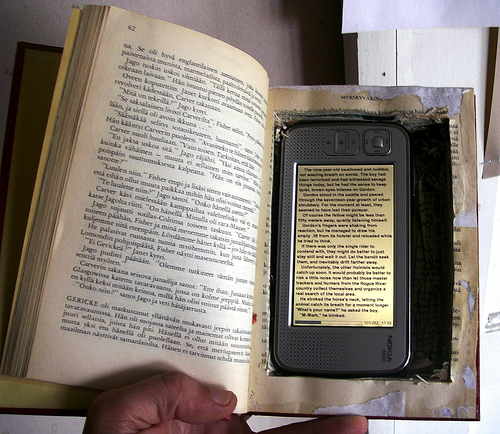 |
| Book vs E-book: lets call it a draw. |
Everyone will have now read, seen or heard the news that Borders and Amazon have been heading up a fetid creek for far too long. In the land of Oz (the non-magical and not infested by Munchkins version) the media are now weighing in.
See this article
You see I’m to blame. I brazenly buy books from places other than big chain stores. I have a Kindle and enjoy reading e-books. I am, in short, the devil incarnate and will be sacrificed on a pyre of celebrity biographies, cookbooks and other non-selling book store stock.
 |
| A Recent Photo of Me. |
Lets take a look at some of the points that were made.
I’ll play devils advocate here and talk about taxes first. There are only two sureties in life; taxes and whining about them. In the non-Munchkin land of Oz we have a 10% goods and services tax (GST) on everything except food. This means that imports don’t have this tax, because they aren’t Australian. I guess we evil overseas book buyers paying taxes to a foreign country should pay another tax for daring to participate in the global economy. That way I can be more involved in the global economy with taxes in multiple countries.
Recently we also had a change in the Aussie dollar, it reached parity with the US dollar. For those who haven’t studied economics, this means that if I have one Australian dollar I can trade it for one American dollar, I know because I saw an article on it – tricky stuff that economics. Now that means that if I wanted to, say, buy materials that are needed to print books they would have gotten cheaper. Equipment upgrades, cheaper. Printing ink, cheaper. So clearly a stronger Aussie dollar must mean that it is harder to compete…………
The threat from online sales is, of course, just terrible. How dare our country sign up to a fair trade agreement and actually have its citizens abide by it. Who’d have thought that when you have a business competing in an international market it would mean that you would have to compete with stores all over the globe?
Of course this means that me and my evil kind are killing retail jobs.
One point that Bob Carr (former politician – which means dodgy) makes is about how it is all the government’s fault that books cost so much. He states that they would be 33% cheaper if only his benevolent company Dymocks was able to buy their books from overseas instead of locally. 33%? I think it is basic maths time for this particular businessman.
As an example I will use the latest action-thriller by Andy McDermott. His book Empire of Gold (which I’m looking forward to getting my fiendish hands on) has just come out recently and is available from Dymocks in Australia, or for the evil book buyers, from Amazon.
Dymocks Australia online price: $24.79 (paperback)
Amazon: $9.99 (paperback) or $24.63 (hardcover)
So let us take 30% from the Dymocks price:
$24.79 – 30%(7.44) = $17.35
Well, I’m not a maths genius, but at a guess I’d say that being able to buy a hardcover at USA retail prices for the same price as the paperback retail in Australia is not exactly a 33% difference for a paperback. In fact, to buy it would be more like a 60% difference between the paperback prices. So I’d have to say that I’m not looking as evil as I first thought.
I wonder where that other 33% is going? It certainly isn’t into royalties for writers. I’d just like to be reminded what the wonderful companies that have just left a hole in the heavenly book retail world went bankrupt not paying (analogy: imagine that the authors are Marsellus Wallace, the publishers are Butch, the retailers are Zed and Maynard, and in this version Butch just does a runner). While we are on the subject, I’m unsure whether Dymocks is a discounting chain store driving every other book store out of business or The Coalition for Cheaper Books.
Clearly I’m so evil and my kind are the cause of all problems in the publishing world. It could never be the fault of antiquated business models forgetting that there are only two important parts in the publishing industry, namely the readers and the writers, everything else is clearly expendable. Excuse me while I pay a 70% royalty to a new author for a book that you can’t buy from a publisher or store.
 Tyson Adams