Things to do on holidays

As much as I like work, I really do like holidays. Finally I have time to do all the things I actually like doing rather than having a large chunk of my day taken up with, well, work. Now obviously if I am to get my first novel published before the end of this year, then I should take advantage of my break from a day job and churn out some writing.

So here’s what I’ve actually been doing.

Getting up early.
I think that you shouldn’t break your daily routine up too much, otherwise going back to work becomes too hard. As such I try to get up as early as possible, preferably before lunch time.

Reading.
Surprisingly I’ve had very little time for reading this holidays. It has been go, go, go the entire time. I think I may have only averaged 5-6 hours a day of reading. The list of things I have read this past week:
Hit List – Chris Ryan
The Dark Tower – Steven King
D.E.D. Dead – Geoff McGeachin
300 – Frank Miller
Graverobbers Wanted (No Experience Necessary) – Jeff Strand
Write the Fight Right – Alan Baxter

As always I don’t comment on 1-2 star books because they are never finished. But curse them for wasting valuable reading time!!

Exercise.
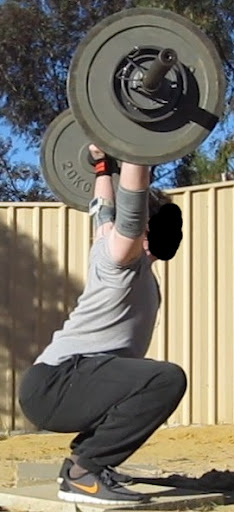
I’ve always been active and love weightlifting. When I’m on holidays it is very important to keep up the exercise levels, lest I start to resemble a daytime talk show audience member. My exercise routine starts not long after waking. I stumble to our library and start with a good stretch out on our couch. I like to superset (a weightlifting term meaning back to back) the stretch with reading. This holidays I’ve been averaging 5-6 hours of this. At the end I’m suitably warmed up for some weightlifting, or a beer, depending on how I feel on the day (5 days of 7 the beer has won).

Sure could do with a beer right about now.

Woodworking.
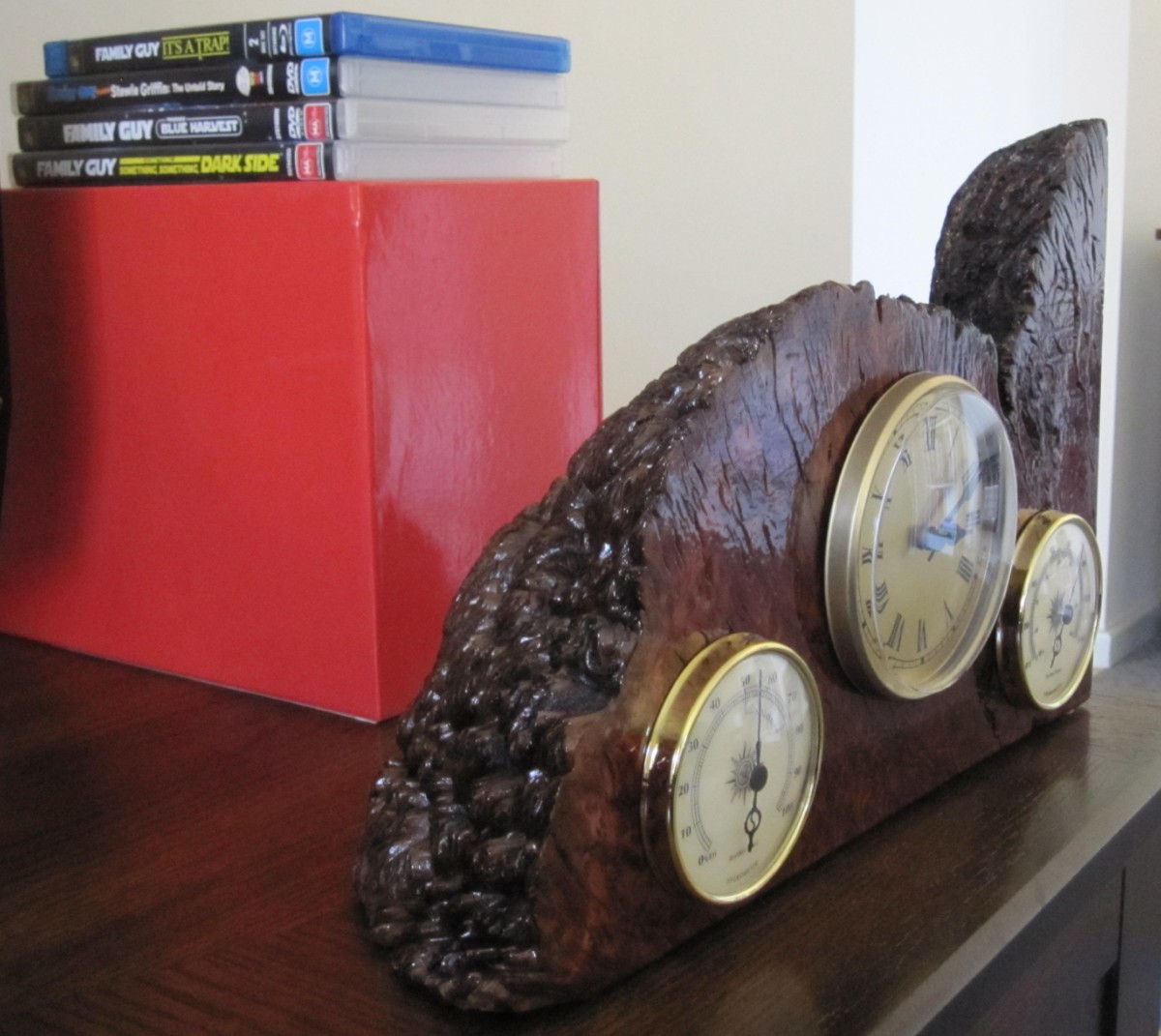
Holidays are a great time to spend on hobbies. There is nothing quite like the sense of accomplishment from crafting something with your bare hands. There is also nothing quite like the sense of satisfaction from using really sharp tools to stab, slice and hack away at something…….. Currently I’m making another bookshelf for our library, and have finished two clocks recently.

Jarrah clock. To say Jarrah is a hard wood is like saying steel is kinda hard.

Guitar.
If I have a second love it is guitar. Wait, sorry, my wife is first, so my writing is second, so guitar would be third. Honest mistake.

So, I have a number of toys that I enjoy to play with:
PRS Custom
7 string Flying V
Egnater Tweaker
Vox Night Train

Writing.
Now the juicy part: how much writing have I actually done? How much closer to finished is Overturned Stones? Well according to my Scrivener Windows Beta release, I have written nothing.

Yes I was scratching my head too. Seven days of writing usually results in an increased word count. Of course I’d forgotten to account for the Windows Affect. For those not familiar with the Windows Affect, basically when a new program is released in a format that is compatible with Windows OS, Windows will immediately stop being compatible and seek to destroy the new program. Usually this is achieved via updates that render the computer unusable.

I know, my own fault. I had Ubuntu installed and then some guy named Bill dropped around and reinstalled W7. I knew he was trouble when I saw that haircut.

Suffice to say I have decided to switch back to Open Office for now. The word count has caught back up and I hope to hit the halfway mark of Overturned Stones – 45,000 – next week. So far this holidays I have written 10,000 words, 7,000 of those have actually been saved when I pressed the save button.

Overturned Stones is a thriller based upon the idea that human trafficking and slavery can be solved via lead therapy. The central protagonist is very good at dispensing lead and avoiding anti-lead campaigners like police and mercenaries. But is he good enough to hide from the police and mercenaries when he saves a woman and child? He thinks so, but then again he’s biased.

How to spot a Star Wars fan

Being a Star Wars fan isn’t just about the film series. It isn’t just about some merchandising either. It isn’t even about the series of comics graphic novels and books it has spawned. It is about taking your best friend to the convention with you, dressed up for the occasion.

May the force be with you!

Yo ho ho and a bottle of rum.

Internet Pirate, Yar!

I can remember back to when computers were nothing more than green text on a black background and made terrific boat anchors. Then suddenly they exploded, usually from a spilt drink or frustration in the 10 minutes it took for anything to load. Just as I was leaving high school the interwebz was suddenly all around us and promised to deliver us information, e-commerce, media and porn. This coincided with computers becoming faster, hard-drives becoming bigger and teenagers becoming hornier.

And that is when media piracy really took off.

Sure Napster popularised it a few years later and the music industry starting jumping up and down about it later again, but someone had forgotten to tell these people that the game had changed. I didn’t have to buy the entire Primus CD for the two songs I was actually going to listen to, now I could have a copy of those two songs on my computer, either downloaded from friends or copied off the CD.

I think we were all waiting for the music industry to catch up. At some point we were expecting all of our favourite songs to be available online for sale. But our computers were growing, so it wasn’t just music, we wanted our TV and movies as well. Why couldn’t we just grab a copy off the internet when we wanted? Where was the store that sold this stuff? And would they sell Debbie Does Dallas?

Well, sensing the growing change in consumer behaviour, the desire for an online store to sell entertainment, the music industry, movie industry and other media decided to band together and sue kids for millions of dollars each.

Brilliant! Rather than sell people stuff lets sue them! What a marketing and sales master stroke.

Instead of responding to consumer demands, the industries concerned decided they didn’t want to play. They thought that would be the end of that. Of course in a free market economy you have to expect the market to dictate terms, not anyone else. Piracy became embedded.

Now of course it isn’t the media industry’s fault that their products were being pirated, it was them damn pesky kids with their computas and iGizmos and and theys gots no respects for da rulz……… The e-generation were blamed for the down-turn in music sales and for massive losses to the music and movie industry. I like the assumption that every download must equal a lost sale, talk about a non-sequitur.

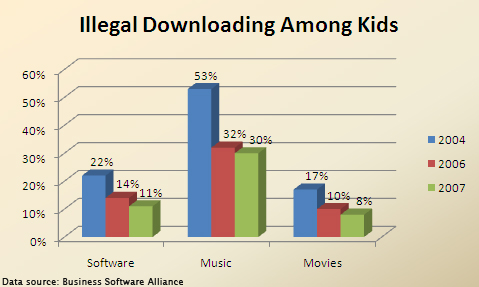
None of these arguments, discussion or history are really relevant though. I’m going to coin a new term SCREEN-GAZING which is the e-version of navel-gazing, because all of this piracy discussion is essentially nothing more than screen-gazing. Lets have a look at the real data that needs to be discussed.

The survey interviewed 1,700 music consumers age 13-60 and found that music is important to social networkers: 39% have embedded music in their personal profiles.
70% said they embed music to show off their taste; half said music is a good way to reflect personality.
Some other survey findings:

  • Some 53% of people actively surf social networking sites to find music.
  • 30% said they went on to buy or download music that they had discovered on a social network site (for MySpace, the proportion is 36%).
  • On popular sites the numbers of people who use sites to find music increase – for MySpace and Bebo, 75% and 72%, respectively, and 66% for YouTube.
  • 46% say they wish it were easier to purchase music they had discovered on social networking sites – for example via a “buy now” button on the site.
  • The number of those saying they illegally download music tracks has increased, from 40% in 2005 and 36% in 2006 to 43% in 2007.
  • Only 33% cited the risk of being prosecuted as a deterrent against illegal downloading, compared with 42% in 2006.
  • Nearly one in five respondents – 18% – claimed an intention to download more unauthorized tracks, up from 8% in 2006.
  • After a dramatic 40% increase in the number of legal downloaders between 2005 and 2006, only 16% growth occurred in the number of legal downloaders from 2006 to 2007.
  • 22% of legal downloaders admitted that they had not paid for a track in the last six months.
  • 84% agreed that digital downloads of older music should be cheaper; 48% said they would be prepared to pay more for newly released music.

So basically iTunes had been on the map for 4 years by the time this survey was performed, downloading had been around for a decade. Big congratulations to the industry for making those inroads into making music accessible. Almost half of the kids would like easier access to music to buy, and most thought it was too expensive.

Another survey shows that downloads of media were decreasing. So clearly the impact of actually selling media to people that they want was a good thing for lowering pirating. Just the industry hasn’t reached enough of the market yet.

How do you dissuade people from illegal downloads? The traditional approach for punishing pirates would be imprisonment, pilloring, flogging, enslavement, branding, keel hauling, and/or hanging. Given how well that worked in ridding the world of pirates maybe we should consider other methods.

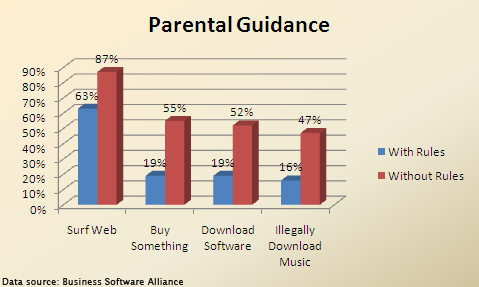
Someone was really bright and had a look at what parental guidance did to downloading.

Who would have thought that parenting had a role in being a law abiding citizen?

What does all of this mean? Well pretty much media – be that ebooks, movies, music, TV shows – need to be easily accessible and priced appropriately. There also needs to be some responsibility taken by everyone to make sure that people expect to pay for media. This can’t be draconian, it has to be encouraged, and part of that encouragement comes from the ease of access and prices that people can afford. And now I hold my breath. Wake me after I pass out waiting for a solution rather than another blame game.

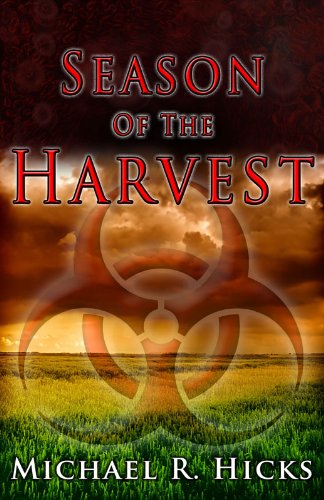
Book Review: Season of the Harvest – Michael R Hicks

I’ve lived and worked in agriculture for pretty much all of my life. Aside from that short trip to Alpha Centuri to save the universe from Krag the Merciless I can safely say that agriculture is something I have spent a lot of time around and am at least peripherally aware of. Which always makes techno-thrillers and sci-fi books like Season of the Harvest hard to review.

I often wonder if ex-military guys sit down and read a book and think “like we’d ever do that”. I know every scientist would love the GC mass spectrometer that the CSI labs have on TV – nothing like a weeks work being turned into a 5 second task to get scientists hot under the collar. Do police and law enforcement people find it hard to enjoy any book or TV show due to the errors? They have those stairs at booking for a reason, push the guy down them a few times! So many little things that we writers and readers just don’t realise are crap.

In part of my research I found out that one thing that annoys gun nuts enthusiasts is that they hate the smell of muzzle flash being described as “cordite”. You see cordite hasn’t been used in bullet manufacturing for a long time, subsequently a writer describing the smell of cordite after a gun battle is showing ignorance. Clearly never having the need to use a gun to shoot random people is a major character failing in writers.

But are they showing ignorance? This is fiction after all.

To most readers describing that post-gunshot smell as cordite elicits the correct sensory appreciation. Gun powder, ho hum; cordite, ah-hah specific smell! For CSI we know that a case that would normally take months and go through several different investigators and result in absolutely none of the CSI team needing to shoot anyone, has to be wrapt up by your show’s stars in the 42 minute show time.

So really the research and reality of the writing or show only has to be enough to move the plot and characters forward. This is fiction after all.

As a result I can say that I really enjoyed Michael’s novel. He kept up a cracking pace and kept a very tightly woven narrative. At one point about three quarters of the way into the book I remember thinking “there is no way they can get out of this one”. So much tension!

This was a nice mix of sci-fi and thriller and reminded me a lot of James Rollins. This is especially since there are similar themes to Rollins’ novel The Doomsday Key. Just imagine that with aliens!

This brings me to my two criticisms of the book, remember I really enjoyed this book. The first was the narrative structure: it was very well done up until about halfway through when more points of view started to be included. Nothing wrong with that but it broke from the flow established earlier on. Having the cat have a point of view for a scene was my shark jumpy moment. The second point is about agriculture: why don’t people research agriculture when writing instead of listening to scare-mongers and political groups? I know why, it makes for a much more thrilling read than saying “we’ve doubled world population, have less farming land, and yet we still fed the world, yay us!” I guess it would just be nice to have someone say “you rock” rather than “you shouldn’t use chemicals” once in a while.

I guess the real CSI guys might be also dreaming of magical lab equipment too.

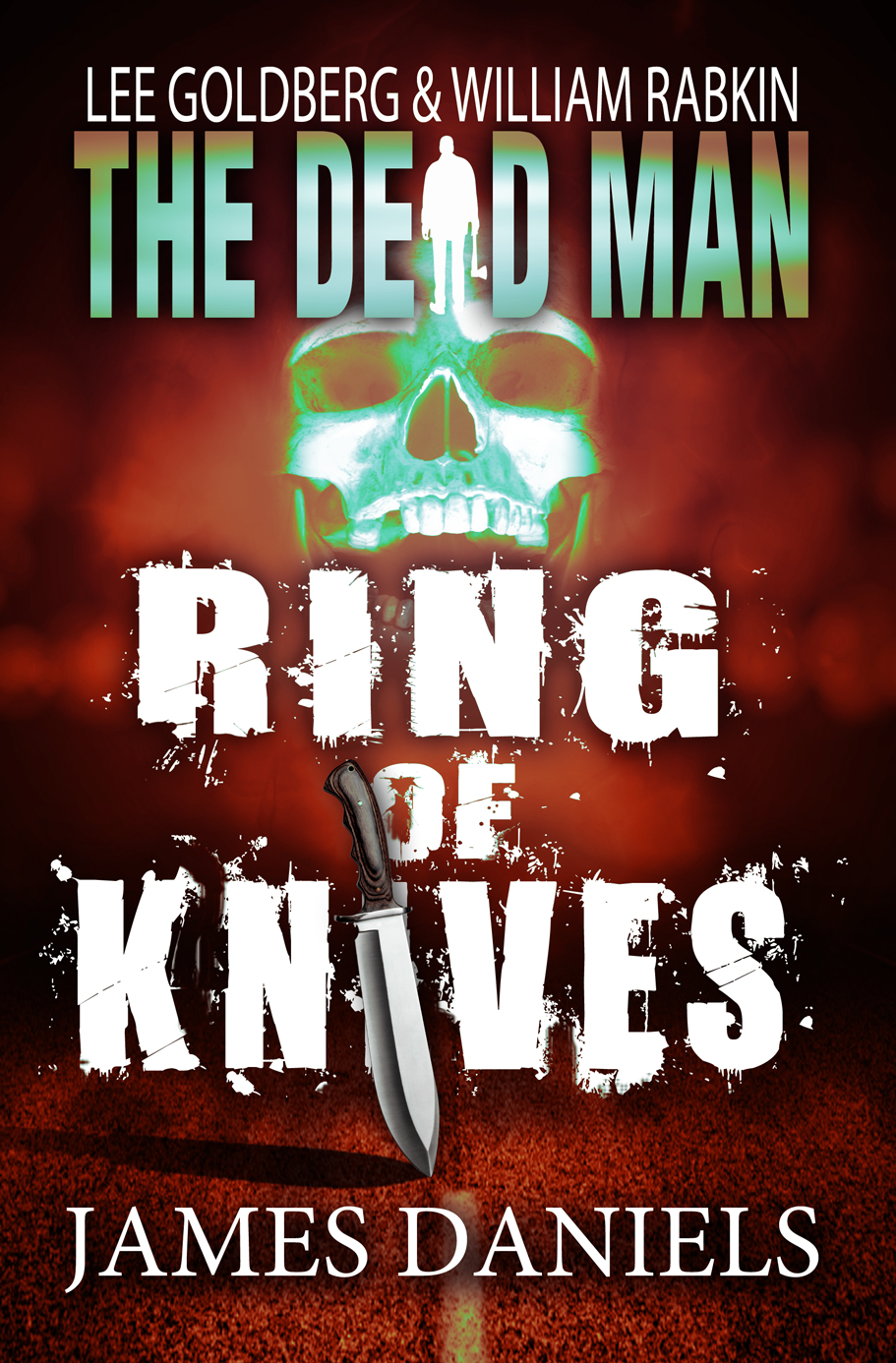
Book Review: Dead Man – Ring of Knives by James Daniels

There is a saying in the music industry that the second album is the hardest. You are backing up your first work in the series and the pressure is on to not just come up with new material but to create something better. But what do you do with the band that changes its entire lineup and releases a new album? Well normally you would avoid it like a “Guns ‘n’ Roses”* Chinese Democracy album.

James Daniels has had the unenviable task of taking on the second installment of the Dead Man series of novellas started by Lee Goldberg and William Rabkin. Now James has taken an interesting tact with the second novel: he has tried to outdo Lee and William and succeeded. Given the high standard set in the first novella, Face of Evil, this is no mean feat.

When we left Matt Cahill he was starting his trek to discover why he made an amazing recovery from his mild case of death and why he can now see evil as other’s souls are eaten away by it. Seeking answers he is trying to speak with another who has been similarly afflicted. What better setting for a horror novel than a psychiatric hospital!? This book expands upon how Matt’s story and hints at Mr Dark. But Mr Dark isn’t who Matt has to be worried about in this book.

So James has done this series proud and has created a thrilling, suspenseful read. I really enjoyed this sequel and I pity the poor writer following on from James. They don’t have to just be as good or better than the first, now they have to top this one as well.

*It hasn’t been Guns ‘n’ Roses since Slash left.

Book Review: Line of Sight by David Whish-Wilson

I’ve been looking at a few writing competitions of late. As a new author I like the idea of submitting a short story or novelette to test myself, set my standards at a high enough level and create that snooty air that literary people are known for. One of the things I’ve been doing is grabbing as many past winners’ stories as possible to figure out which story I should enter.

What has struck me about these past winners is that: most winners are graduates or academics in literature; most winners don’t write stories with any narrative structure. This last point frustrates me as a reader: what is the point of the story; why am I reading this; where is this all going; is that character’s cat important or an allegory or just there for page padding? But this is a very popular style for award winners and academics.

David Whish-Wilson was my lecturer recently at the Perth Writers Festival Crime Writing workshop. He is a creative writing lecturer at Curtin University. David does not suffer from this disease of literature. His book is not only entertaining and engrossing but it has a narrative structure.

Now this really shouldn’t be that surprising. Given David’s proclivity for crime writing and his day job you really expect a well written novel. But it is more than just well written, it really conveys the time and place it is set in, it also has characters that I recognise. It really is a crime novel that you can sink your teeth into.

David in traditional cool writers’ pose

This novel is partly a crime fiction novel set against police corruption in Perth Western Australia during the 1970’s and part true crime. Basically any Perth native will not only recognise the locations, but will remember the events and investigations alluded to. I was still nothing but a mistaken case of food poisoning when the true crime aspects that this novel was based upon took place, but when I mentioned the book to mum she immediately recognised it all. It really is hard to discern where to draw the line between reality and fiction in this book. Put another way, if David had written this book 25-30 years ago he would have disappeared in the local forest mentioned in his book, despite his protestations that this is fiction “based on actual events”. Normally “based on actual events” means that there is nothing in the book/movie/TV show that even resembles the “actual events”.

Even a non-Perth native will still find a lot to enjoy in this book. It is a completely engrossing crime thriller and captures the setting and characters of the era to create a thoroughly entertaining read. This book not only surprised me but completely engrossed me. I really enjoyed this book. 4.5 stars.

Comment on Comments – A review of reviews

In case you haven’t been aware, there has been a few arguments riding the blogosphere this past week. The first was about the value of e-book or self-publishing being regarded as lesser than traditional print publishing. The second has been about the self-publishers who have commented on negative reviews of their books. Jenny at the Inner Bean has blogged and started some forum discussions on this topic.

Now I love the fact that several authors have posted here following one of my reviews. Essentially my reviews are promotions of books I have enjoyed reading, so them commenting doesn’t feel out of place. But reviews on Amazon and some review sites are not exactly the places to weigh in with a response.

Let us take an example of a review on Amazon:

Julia Argandona, of Costa Mesa, CA Review (‘17 of 59’ customers found this ‘helpful’):

I haven’t read this book yet but I can’t wait to read it so I am reviewing it early. The other people on Amazon who say don’t read it are brainwashed stooges of the Catholic religion, which has been sexually abusing children for 100’s of years. Who needs it? I already LOVE this book

I think the most important thing to note about this review is not that she hadn’t read the book, nor that she is clearly a fan of the author or genre regardless of the content of this particular book, no the important thing to note is that 17 of 59 other customers actually found this review helpful.

I’ve never driven a car, I’ve never held a license to drive a car, but I’m ever so keen to teaching my kids to drive. Can’t Wait!

Obviously everyone is entitled to an opinion. The internet has become a playground for the dispersal of opinions and porn. So we have to admit to ourselves that some people on the internet will not only be naked, but they will also have the intellectual might of a cheese cracker. I think it is safe to ignore these people, unless they look good naked.

But what about the normal or intelligent people and their opinions? Clearly all rational opinions will be in agreement. As a result you will never see a negative review for a book (or anything else) coming from someone worth listening to. Even if the book sucks.

I recently discovered that ~50% of the general public doesn’t believe in man made climate change and are willing to argue with the 97% of scientists who can prove it is happening. So opinions don’t have to be related to facts or evidence. There is a point here, but I’m not sure how it relates to internet nudity.

So even in the best of circumstances, when you are 100% right and the opinion holder is 100% wrong, telling people that is the case is just a waste of time. Remember, the best book ever written – Good Omens by Terry Pratchett and Neil Gaiman – currently has 19 one star reviews on Amazon. This means that 3% of reviewers, despite being wrong, didn’t enjoy this masterpiece, proving that you can’t please everyone, so don’t bother arguing with them.

Of course reviewing the reviewers is all Anne Rice’s fault. She started it.

From the Author to the Some of the Negative Voices Here, September 6, 2004

Seldom do I really answer those who criticize my work. In fact, the entire development of my career has been fueled by my ability to ignore denigrating and trivializing criticism as I realize my dreams and my goals. However there is something compelling about Amazon’s willingness to publish just about anything, and the sheer outrageous stupidity of many things you’ve said here that actually touches my proletarian and Democratic soul. Also I use and enjoy Amazon and I do read the reviews of other people’s books in many fields. In sum, I believe in what happens here. And so, I speak. First off, let me say that this is addressed only to some of you, who have posted outrageously negative comments here, and not to all. You are interrogating this text from the wrong perspective. Indeed, you aren’t even reading it. You are projecting your own limitations on it. And you are giving a whole new meaning to the words “wide readership.” And you have strained my Dickensean principles to the max. I’m justifiably proud of being read by intellectual giants and waitresses in trailer parks,in fact, I love it, but who in the world are you? Now to the book. Allow me to point out: nowhere in this text are you told that this is the last of the chronicles, nowhere are you promised curtain calls or a finale, nowhere are you told there will be a wrap-up of all the earlier material. The text tells you exactly what to expect. And it warns you specifically that if you did not enjoy Memnoch the Devil, you may not enjoy this book. This book is by and about a hero whom many of you have already rejected. And he tells you that you are likely to reject him again. And this book is most certainly written — every word of it — by me. If and when I can’t write a book on my own, you’ll know about it. And no, I have no intention of allowing any editor ever to distort, cut, or otherwise mutilate sentences that I have edited and re-edited, and organized and polished myself. I fought a great battle to achieve a status where I did not have to put up with editors making demands on me, and I will never relinquish that status. For me, novel writing is a virtuoso performance. It is not a collaborative art. Back to the novel itself: the character who tells the tale is my Lestat. I was with him more closely than I have ever been in this novel; his voice was as powerful for me as I’ve ever heard it. I experienced break through after break through as I walked with him, moved with him, saw through his eyes. What I ask of Lestat, Lestat unfailingly gives. For me, three hunting scenes, two which take place in hotels — the lone woman waiting for the hit man, the slaughter at the pimp’s party — and the late night foray into the slums –stand with any similar scenes in all of the chronicles. They can be read aloud without a single hitch. Every word is in perfect place. The short chapter in which Lestat describes his love for Rowan Mayfair was for me a totally realized poem. There are other such scenes in this book. You don’t get all this? Fine. But I experienced an intimacy with the character in those scenes that shattered all prior restraints, and when one is writing one does have to continuously and courageously fight a destructive tendency to inhibition and restraint. Getting really close to the subject matter is the achievement of only great art. Now, if it doesn’t appeal to you, fine. You don’t enjoy it? Read somebody else. But your stupid arrogant assumptions about me and what I am doing are slander. And you have used this site as if it were a public urinal to publish falsehood and lies. I’ll never challenge your democratic freedom to do so, and yes, I’m answering you, but for what it’s worth, be assured of the utter contempt I feel for you, especially those of you who post anonymously (and perhaps repeatedly?) and how glad I am that this book is the last one in a series that has invited your hateful and ugly responses. Now, to return to the narrative in question: Lestat’s wanting to be a saint is a vision larded through and through with his characteristic vanity. It connects perfectly with his earlier ambitions to be an actor in Paris, a rock star in the modern age. If you can’t see that, you aren’t reading my work. In his conversation with the Pope he makes observations on the times which are in continuity with his observations on the late twentieth century in The Vampire Lestat, and in continuity with Marius’ observations in that book and later in Queen of the Damned. The state of the world has always been an important theme in the chronicles. Lestat’s comments matter. Every word he speaks is part of the achievement of this book. That Lestat renounced this saintly ambition within a matter of pages is plain enough for you to see. That he reverts to his old self is obvious, and that he intends to complete the tale of Blackwood Farm is also quite clear. There are many other themes and patterns in this work that I might mention — the interplay between St.Juan Diago and Lestat, the invisible creature who doesn’t “exist” in the eyes of the world is a case in point. There is also the theme of the snare of Blackwood Farm, the place where a human existence becomes so beguiling that Lestat relinquishes his power as if to a spell. The entire relationship between Lestat and Uncle Julien is carefully worked out. But I leave it to readers to discover how this complex and intricate novel establishes itself within a unique, if not unrivalled series of book. There are things to be said. And there is pleasure to be had. And readers will say wonderful things about Blood Canticle and they already are. There are readers out there and plenty of them who cherish the individuality of each of the chronicles which you so flippantly condemn. They can and do talk circles around you. And I am warmed by their response. Their letters, the papers they write in school, our face to face exchanges on the road — these things sustain me when I read the utter trash that you post. But I feel I have said enough. If this reaches one reader who is curious about my work and shocked by the ugly reviews here, I’ve served my goals. And Yo, you dude, the slang police! Lestat talks like I do. He always has and he always will. You really wouldn’t much like being around either one of us. And you don’t have to be. If any of you want to say anything about all this by all means Email me at Anneobrienrice@mac.com. And if you want your money back for the book, send it to 1239 First Street, New Orleans, La, 70130. I’m not a coward about my real name or where I live. And yes, the Chronicles are no more! Thank God! – Anne Rice

She also doesn’t abide by fan fiction, because it’s her work DAMMIT!

Sydney Writers’ Festival

I’m not sure what I like most about the announcement for the lineup of this year’s Sydney Writers’ Festival. Maybe it is that they have The Chaser team performing a few shows. Or maybe it is that unlike the Perth Writers’ Festival, the Sydney Writers’ Festival is written correctly.

Now as usual the festival has accumulated local and visiting authors and a bunch of reporters to create the week long line-up. In between the “OMG Wikileaks”, Climate Change and politics presentations, they actually have the genre represented by the Crime genre. At the head of the festival’s Crime genre is Michael Connelly. For a list of highlights click here.

Michael Connelly in mandatory cool writer’s pose

Now I am of course thinking about going and have a list of events lined up already, and the organisers have pulled out all stops in order to appeal to my inner literary snob. Fortunately my MD prescribes a particularly powerful drug to suppress my inner snob, so I’ll mainly be attending for the writing workshops and the Crime writing events.

For all of you who are overseas I should give a little background to the Sydney Writers’ Festival, and Australian Writers’ Festivals in general. The Sydney Writers’ Festival is one of the biggest writers’ events in the world, definitely the biggest in Australia. Australia has a relatively high proportion of readers in the population and the Aussie government prides itself on secularizing the industry despite evidence to suggest we’d be better off with out their protectionist agenda. So as a result this festival will attract readers, writers, reporters, and cling-ons to discuss books by the thousands. Some of the books they will be discussing will have actually sold a few copies.

I’m looking forward to it. If you are going email me, maybe we’ll be able to have a tête-à-tête over a coffee. That’s what literary people do isn’t it? Told you these drugs were strong.

Enhance Your E-Reader

The smell of e-books just got better

Does your Kindle leave you feeling like there’s something missing from your reading experience?

Have you been avoiding e-books because they just don’t smell right?

If you’ve been hesitant to jump on the e-book bandwagon, you’re not alone. Book lovers everywhere have resisted digital books because they still don’t compare to the experience of reading a good old fashioned paper book.

But all of that is changing thanks to Smell of Books, a revolutionary new aerosol e-book enhancer.

Now you can finally enjoy reading e-books without giving up the smell you love so much. With Smell of Books you can have the best of both worlds, the convenience of an e-book and the smell of your favorite paper book. Smell of Books is compatible with a wide range of e-reading devices and e-book formats and is 100% DRM-compatible. Whether you read your e-books on a Kindle or an iPhone using Stanza, Smell of Books will bring back that real book smell you miss so much.

Now available in:
Classic Musty Smell
Crunchy Bacon Scent
Eau You Have Cats
New Book Smell
Scent and Sensibility

Book review: Dead Man’s Eye – Shaun Jeffrey

This little beauty has been at the top of my Kindle list for a long while now. Much like Steven L Hawk’s book, I stumbled across this via the book cover under a post on the Kindle Boards. Score another one for forums and great book covers!

Now according to Goodreads I’ve been reading this one for a long time. In reality though I’ve been reading this at lunch times when not Beta reading other novels (actually I think this is more novella length). So the fact that this book has kept me interested with my short spurts of reading for the first 50% shows that it is well written. I decided today that I couldn’t wait for another work week to finish it; I did so and enjoyed every moment.

Shaun has done a great job with this book. The premise is set up quickly and smoothly, the characters are well done, the plot flows nicely, and despite treading an oft trod storyline the book manages to remain fresh and interesting. I should add something about paranormal thrillers and the like, but the back cover synopsis really says it all.

I couldn’t finish this post without saying a little about a debate that seems to have erupted on the interwebz regarding the quality of indie vs. traditionally published books. Having just finished this book and Beta read Steven and Rex’s work I feel the need to make a comment.

Why is it that traditional publisher’s advocate themselves as some bastion of quality publishing? For some reason traditional publishing is claiming that it has been discerning the wheat from the chaff for all time, making sure that grammar and spelling mistakes don’t exist, that only good stories make it to the consumer.

Of course they do such a good job of this. I agree completely.

I mean JK Rowling was rejected by a dozen publishers, Joseph Heller’s Catch 22 was rejected because no-one could tell if he was being satirical or funny, William Golding’s Lord of the Flies was rejected by 20 publishers, Stephen King’s thumbtack holding up his rejection notices had to be replaced with a nail, and Rudyard Kipling was told he didn’t know how to use the English language. Great job! Check this and this for more.

I think that these guys are all great examples of people who deserved to be rejected. There is no way that any author could possibly produce a good book that would be rejected. There is no way that any author could produce a book that won’t be filled with spelling and grammatical errors without a publisher. Just wouldn’t happen.

Indie and self-published author’s like Shaun Jeffrey and Steven L Hawk are great examples of author’s who clearly take pride in their work. They have editors and put out professional publications. There is no magic that publishing houses bring to the table. Can we acknowledge that self-publishing is just as legitimate as traditional publishing. Hocking el al. have proved that, lets move on.

Book review: Watch the World Burn – Leah Giarratano

You always know that a signed copy of a book is going to be good. I’d only read the first two chapters of this book when Leah signed my copy. Of course it helps when you already like the author, why else would you have a copy to sign?

Tall, pretty and one of the nicest people I’ve met.

It is of course more than the characters; the book is tightly crafted whilst also being well paced. It didn’t have those pointless scenes describing how they got to a crime scene, or the endless descriptions of police procedure that is normally rife in crime novels. Most of all it was entertaining, despite the horrible things that everyone of the main characters had been through.But what about Leah’s latest book, Watch the World Burn? Well when I had Leah sign my copy she was running a writing class on writing nasty bad guys at the Perth Writers Festival. I think one of the strengths of this book was that every character seemed to have a depth that a lot of crime authors don’t manage to imbue. Sure, that sales rep is about to die at the hands of a serial terrorist, but I actually get the sense that the sales rep is more than just another notch in the body count.

I’m a fan and can’t wait for the next book by Leah, even if I know that it is a children’s book.

Define Irony

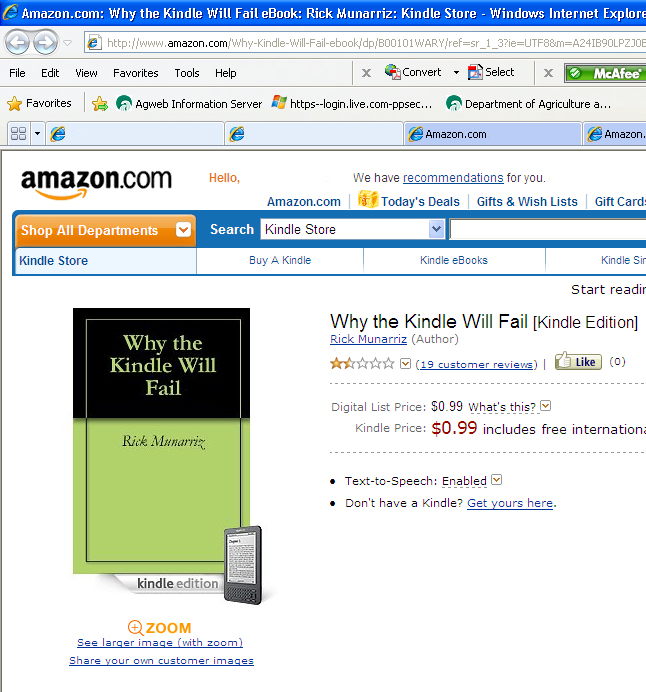
Yes that is right! Someone has released an e-book on Kindle that is critical of Kindle’s. Why The Kindle Will Fail by Rick Munarriz

From the reviews it sounds like the book is a review of the Kindle that the author has decided to turn into an e-book. Given the book title, the format and where he is selling it, he clearly can’t be taken too seriously. Opinions have to come from an educated point of view; how can a point of view be educated with this much irony?

It reminds me of a lovely cartoon that I think sums up a lot of opinion based articles:

Being a Beta Reader – Peace Army by Steven L Hawk

What I love about the digital age we now live in is that it has suddenly made communities possible again. All those little sullen teenagers who make statements like “life is pain” can now find other people to bother. For readers and writers it means that, like a readers festival, we can gather in corners of the internet and proudly proclaim “I can read and I actually enjoy it!”

This means that now authors can speak to a writer’s group from the comfort of their own couch. Or they can speak to fans directly without having to wait for a book tour or festival. Writer’s can now grab some readers and ask them “Is it good enough?” and they can tell them “Yay!” or “Ow, my brain!”

I have previously mentioned how I stumbled across Steven’s first book here. Well, when I congratulated him on his first book in an email, he suckered me into being a Beta Reader. By suckered I mean he offered me a free copy; by Beta Reader I mean I got to read it before anyone else!

Now normally a traditionally published author would have a team of publishing house people take a large cut of their book sales in order to tell them to rewrite it so that it is a teenage vampire romance novel – because they are hot right now. But in the world of the indie author, or is that the e-book author, no one can afford to end up co-writing with James Paterson. They have to find ways to turn out a quality product with as few costs as possible. Of course some authors aren’t concerned with things like spelling or grammar, and just release a book. True professionals, like Steven, wouldn’t dream of releasing anything but a professional quality book.

Enter the community.

Once again we find ourselves in touch with our peers. Instead of it being because we all live within a day’s horse ride of one another, now it is because the internet has connected us. Authors can help other authors. Fans can be friends with their favourite authors. Sure, you still get the annoying argumentative people who think ignorance is an opinion, but that is why the internet invented pwnage.

Now my experience in being a Beta Reader has been very positive. By the time I had a copy in my Tablet PC it was clear that Steven had done a lot of work on the novel – Peace Army. I actually spotted less typos, grammatical errors and spelling mistakes in his entire novel than in the middle section of the final Harry Potter novel (you know, the part were Harry, Ron and Hermione are wondering around camping for ages and you wonder when something will actually happen, but nothing does). Since Steve was still sending this book to an editor, myself and the other Betas were tasked with trying to spot plot holes, non-sequiturs, and frivolous inclusions of zombies. I really have to commend Steven on a novel that could have been something I was paying for, not reviewing.

This revival of an ancient (pre-2000 AD) practice is not without its problems. Without going into too much depth, I am actually a professional editor and have a few science degrees – some of them are from real universities! So not only have I been asked to rewrite entire articles that consist of the 7 words you can’t say on television, but I’ve made it coherent. So it is likely that I can contribute something of value as a Beta or editor. As a result I think that authors need to still be reliant on doing a good job themselves, finding Beta’s who can give positive criticism of value, and not be in too much of a rush to publish.

Of course I should offer up a few comments on Steven’s book. Peace Army is an interesting follow-up to the novel Peace Warrior. Once again Steven has hearkened back to the science fiction novels of old, while having an interesting take on a future Earth. The last third of the novel flew past and I had to remind myself to make notes as the book came to its finale. Even if Steven released this book right now without further changes and editing I’d not only be buying a copy myself but would recommend it for anyone who loves sci-fi. Keep an eye out for its release.

All just a little bit of history repeating:

Inspiration – TV that is actually worth watching

Amazingly enough, I think that books and TV are compatible. If you were to ask my wife she would nod and agree as well, as she reads through most TV and enjoys the ambience. There are some fantastic TV shows out there that not only inspire, but they are also written not unlike a novel.

Generally a movie has to take a book and cut out every second page, in anything longer than a short story they often just take the title page. In this manner, they can squeeze all the wonder and joy of a novel into 90 minutes of unrelated drivel. TV doesn’t run for 90 minutes, it has much longer to develop characters, story arcs, plot, and in-jokes that you wonder about enough to read the director’s blog to understand what the hell is going on. As a result TV and the novel can have a lot in common.

I say that TV can have a lot in common with a novel, not that it always does, as that would be assuming that a novel writer could get away with a procedural crime drama that is always solved by identifying semen left at the crime scene. So the shows that do actually rise to great heights tend to be few and far between, or they get cancelled by a network executive who realises that the show may actually be interesting – yes Fox, I’m still pissed about Firefly!

So what are the good TV shows I’m talking about? Well, let’s go with a list, shall we?

Oz:

Justified:

Read the short story that Justified is based upon here.

Deadwood:

The Wire:

Now I could go on and add other shows I like (Leverage, Firefly, Daria, Family Guy, The Simpsons before they sucked) but this really is enough to illustrate my point. Oz was an amazing show with such a diverse range of characters. Justified is so good that Elmore Leonard not only approved it but came on board to write some episodes. Deadwood was so good the censors felt obliged to leave in the occasional curse word used. The Wire attracted some of the best crime writers to the production team because they saw the depth and intricacy this show had.

So the entire point of this blog post may have been an excuse for me to write something other than my novel while I grab the next episode of Justified, but that doesn’t mean that quality TV and quality novels don’t have a lot in common – bloody good writers who don’t get paid nearly enough. I’ll leave you with two links to an interview with David Simon, the creator of The Wire. Fascinating stuff!
Part 1
Part 2

Book review: Dexter is Delicious – Jeff Lindsay

p { margin-bottom: 0.08in; }

Do I really need to review this book? Or did I just want to say that I got Jeff to sign my copy of the book at the Perth Writers Festival? Or is it that adding Jeff Lindsay to my tags will raise my search profile? Who can really tell.

The reality is that all I need to say about this book is that is was very good and is a worthy edition to the Dexter series. Jeff continues to be one of my favourite authors, it may be time he became one of yours too (if he isn’t already). Also if the reading that Jeff delivered from his next book at the Perth Writers Festival – tentatively titled Double Dexter – is any indication of what Dexter fans can look forward to in September this year, then the series will continue strongly.

Now it would appear that I never have anything negative to say about the books that I read. I must love everything I read. I bloody wish!

The reality is that I have a very strict set of rules that I abide by in order to read a book.

  1. The book must be interesting enough for me to pick it up and start reading it.
  2. The book must maintain my interest enough to continue reading it.

Thus many books never make the grade to get to the review stage. It would be pretty strange to offer up a review of a book that I’ve never really read. It really isn’t the author’s fault that their books sucked so much that I never finished them. They can’t help if they spent so much time with mindless exposition that I’ve stuck my thumb in a meat slicer to prevent myself falling asleep. The author isn’t really responsible for spending so much time talking about the protagonist’s relationship with their cat and other meaningless crap. Thus when I fail to get more than 10-50 pages into a novel it is clearly my fault and denies me the right to reviewing the offending book. Which brings me to expanding my second rule:

  1. The book has ten pages to impress upon me the need to read further or else the book is mulching my fruit trees.
  2. The book then has until page 50 to convince me that the book isn’t mulch material with a passable first 10 pages.
  3. A third of the way through I’d better have been convinced to finish the book.

You see there is nothing worse than “sticking with a book” through sheer bloodymindedness. If the reward for ~400 pages of boredom is finishing the book and feeling that little tingle of accomplishment then really we could all do better. I don’t know about anyone else, but I don’t have time to waste on finishing mediocre books (yes Stieg Larsson, I am talking about your incorporeal ass).

Book review: Judgement and Wrath – Matt Hilton

p { margin-bottom: 0.08in; }

For any avid reader there is an endless search on for another book that will entertain. If readers were to simply rely on recommendations from the usual sources we’d only ever read one book from each genre – regardless of how many books we actually read. Of course as a writer you are always on the lookout for another book to act as inspiration.

I took a chance on this book. There is a book sales van that delivers a select range of books to workplaces, taking the bookstore to the people too busy to go shopping, or so the theory goes. Every now-and-again the book van selection has something I would actually consider purchasing if I was ten years old. On even rarer occasions there is a book that actually looks interesting enough for me to buy. It was on one of these rare events that I stumbled across Judgement and Wrath.

I knew nothing of Matt Hilton when I bought this book. Happily upon finishing this book I am a firm fan. I have been rewarded with a really well written thriller that kept the pace up nicely. I literally plowed through the pages. It isn’t often that you get the chance to stumble upon an author completely by accident, usually someone recommends the author or a book.

If you like your thrillers then you will love this book.

Perth Writers Festival

Since I am now set upon an oft trod path, I felt a sudden urge to mingle with my fellow book aficionados. But how do you mingle with your peers when you live 3 hours away from the most remote city in the world? The interwebz seems like a nice starting place, but at some stage we all have to upgrade to real 3D people, if only to remind us not to be so snarky to one-another on forums.

Low and behold the Perth Writers Festival has come and gone for another year, and this year they had Crime Fiction included, and I was in attendance. I know, how likely is that?!

So what did I see? Well a lot of people just like me. Readers, writers, people with a general disdain for the lack of proper grammar usage on TV, you know, people who can read. In amongst this grouping of people who could read I found myself in a small subset of the literate, a subset that had been born after 1960 (to win a free e-book, email me a tell me if this was hyperbole).

Despite my general disdain for the (self-supposed) authority figures at UWA, it did prove to be a good venue for the masses of literates to converge and discuss their favourite topic; those damn kids these days. Their second favourite topic was the reason I was in attendance; writing.

I have to praise the two presenters who held Crime writing workshops at the Perth Writers Festival, Leah Giarratano and David Whish-Wilson. Leah is a rather smart, friendly, charming, and quite tall psychologist. She also happens to write some very dark crime fiction that are well worth reading. Plus she brought chocolates! Since she has dealt with some unsavory people and their victims she was well versed in creating characters with depth. Ever felt like a novel has a bad guy that is just there to be a bad guy? Well Leah had the solution to that, the scary part was that the real bad guys are far worse than the average horror writer’s imagination. Oh and she also signed my copy of her latest book with a heart – she was really nice.

Smart, tall, brunette, writer = Leah

David is a writing lecturer at Curtin university, as well as being a published author himself. Too often the two don’t go hand in hand, or the publishing means they bought 200 copies to give to friends and family. Not David. I think the thing that David brought to the class was the skills of writing and some handy techniques to break out of ruts and not be too cliche with writing. David was also willing to offer his help with people’s manuscripts – cool guy.

David striking his cool writers pose.

Now one thing seemed to be consistent in the writers workshops, that you had to be female and over the age of 45. In fact in David’s workshop I was one of two guys and the only one not alive in the 60’s. While this may have hampered my ability to appreciate Jefferson Airplane I wonder how it will relate to my comparative writing style. I guess at least I didn’t feel compelled to make up my first memory and turn it into some fanciful emotional moment when asked to share our first memories with the class.

What writers festival would be complete without a really big name writer? At this event the organisers turned to none other than Jeffry P. Freundlich.

Dexter, Jeff and Debs

Jeff is of course the fabulous author of the Dexter series of books. To all of the would-be writers out there, do not despair, Jeff also had a hard time selling his writing gold. After years of work Jeff finally came upon the idea of Dexter after meeting some wonderful people (yes that is sarcasm) at a luncheon and was suddenly convinced that serial murder wasn’t such a bad thing. It still took him four-and-a-half years and six agents to actually get someone interested in publishing Darkly Dreaming Dexter. He was really interesting to listen to and I managed to have a short chat with him when I corned him to sign my copy of his latest book. Very funny, very interesting and seems like a really nice guy – how the hell did he end up writing about a psychopath?

All in all I enjoyed my time at the festival. I’d also love to here from any other people who made it to Perth for the event, or for that matter any similar thoughts on the writers festivals you have attended. The big question I have is: does genre usually get any mention at writers festivals or was this an exception?

E-Books: The Publishers Strike Back

p { margin-bottom: 0.08in; }a:link { }
Fleeing the evil Publishing Companies, the indie and mid-listers have formed a base on the interwebz. Their new base is threatened though, as the Publishers have discovered their location and have sought to invade it themselves. Through their alliance with Amazon, Smashwords and other e-book publication platforms, the indie and mid-listers confront the Publishers and learn a dark secret – they still want to be published in paper.

I’ve been following a few conversations about e-books and the new industry for awhile. There are some interesting perspectives out there, ranging from some of the large publishing houses “We want the industry to stay exactly the same” to the kid in his room “I’ve just published 25,000 words of unedited crap – I is famus”. Both extremes are rather annoying, one might as well be sitting in a corner with their fingers in their ears shouting “La la la, I am not listening” whilst the other group really should have gone to the Dagobah system and learnt from Yoda the ways of the dictionary.

A fellow West Aussie has had an intriguing set of Aussie authors and publishers guest post on his blog recently. The result has been The Grand Conversation. Having not, as yet, published anything I can quite comfortably say that this entire conversation gives great perspective to anyone about to or wishing to enter the industry. As a long time reader though, I am qualified to cast as many aspersions on the industry as the next blogger. I am fickle, read my post!

Are the publishers really to blame for the current woes of the industry? Woes? I’d almost say that with e-books out there now it is an exciting time. Not so exciting if you planned on making a visit to Borders or Angus and Robertson stores any time soon, but with winners there must be losers. I’d actually say that book stores and publishers combined to make e-books and online shopping so attractive.

I’m sure I’m not alone in having traveled to a book store hoping to get the latest from Author X only to find it isn’t in stock, which is amazing considering how prolific Author X is. Or possibly you have experienced wanting to stock up on your favourite author only to find the shelves bereft of those titles. Lets also face the fact that you are more likely to find a celebrity biography than you are to find much in the way of scifi, or similar genres (unless you are talking specialist independent stores). In fact quite often the bookstores with the best ranges tend to be second-hand bookstores. The range in e-books, despite only having a few 100,000 titles available, is vast and getting bigger daily. The e-book range also includes a lot of authors that we haven’t heard of, or had limited distribution under the previous publishing model.

It isn’t just the range of books available online or in e-book format, it is the pricing. Sure we have the Aussie online Dymocks, A&R and Borders charging trade paperback prices for an e-pub file, but the smarter companies are pricing their books under $10 and the independents are pricing under $5 – often as low as $0.99. Quite simply you can have a book in your hot little e-reader a minute after you readjusted your backside on the couch for much less than comparative entertainment. This is a big win for authors and readers alike. You no longer have to run the gauntlet of James Paterson, celebrity chef, cricket captain tour diaries and store clerks who can’t read.

Wait, haven’t I just absolved the evil publishers of blame for the dearth of decent documents? Well no. At some stage publishers decided to set up a business model that meant they lost money on a lot of titles to make money off of a few titles. I too would like to give the cast of Jersey Shore millions of dollars in advances for an “autobiography” ghost written by a clearly suicidal struggling author, to then release a book aimed at a target market not known for their ability to read. Makes sense to me. Most of what publishers produce is hit and prefix. With these grand mistakes they have essentially set themselves up to require 12 James Paterson books in a year and can’t take the chance on anyone new.

Will E-books manage to rescue the novel from the publishers? Find out in Return of the Reader.

Book vs E-book: lets call it a draw.

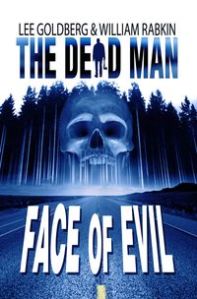
Book Reviews – The Dead Man: Face of Evil by Lee Goldberg & William Rabkin

Before this review, in the interest of full disclosure, I should state that I have known Lee since last week when he sent me a pre-release of this book. We go way back. Now onto the review.

This was another book that I read during my lunch break. Please don’t tell my boss, as I read more of this on the first day than my lunch break technically allowed – of course I still have enough overtime to miss a week of work so I don’t feel so bad. Needless to say this book is far too engrossing for its own good. I highly recommend reading it when you have more than a half hour lunch break.

Lee and Will are the first in a team of 8 to write this Dead Man series. Face of Evil can be regarded as a stand-alone novella, but it does set things up nicely for more to come. This is primarily a thriller with aspects of horror, with a generous smattering of the paranormal. I’m not really a horror fan, I don’t really need those details, but here it isn’t overriding and the paranormal/horror aspects add nicely to the tension. The release date is February 20th, which is today for me, tomorrow for Americans (yes I’m coming to you from the future), so keep an eye open for this one.

I can’t wait for the rest of this series.

Going For Broke

Everyone will have now read, seen or heard the news that Borders and Amazon have been heading up a fetid creek for far too long. In the land of Oz (the non-magical and not infested by Munchkins version) the media are now weighing in.
See this article

You see I’m to blame. I brazenly buy books from places other than big chain stores. I have a Kindle and enjoy reading e-books. I am, in short, the devil incarnate and will be sacrificed on a pyre of celebrity biographies, cookbooks and other non-selling book store stock.

A Recent Photo of Me.

Lets take a look at some of the points that were made.

I’ll play devils advocate here and talk about taxes first. There are only two sureties in life; taxes and whining about them. In the non-Munchkin land of Oz we have a 10% goods and services tax (GST) on everything except food. This means that imports don’t have this tax, because they aren’t Australian. I guess we evil overseas book buyers paying taxes to a foreign country should pay another tax for daring to participate in the global economy. That way I can be more involved in the global economy with taxes in multiple countries.

Recently we also had a change in the Aussie dollar, it reached parity with the US dollar. For those who haven’t studied economics, this means that if I have one Australian dollar I can trade it for one American dollar, I know because I saw an article on it – tricky stuff that economics. Now that means that if I wanted to, say, buy materials that are needed to print books they would have gotten cheaper. Equipment upgrades, cheaper. Printing ink, cheaper. So clearly a stronger Aussie dollar must mean that it is harder to compete…………

The threat from online sales is, of course, just terrible. How dare our country sign up to a fair trade agreement and actually have its citizens abide by it. Who’d have thought that when you have a business competing in an international market it would mean that you would have to compete with stores all over the globe?

Of course this means that me and my evil kind are killing retail jobs.

One point that Bob Carr (former politician – which means dodgy) makes is about how it is all the government’s fault that books cost so much. He states that they would be 33% cheaper if only his benevolent company Dymocks was able to buy their books from overseas instead of locally. 33%? I think it is basic maths time for this particular businessman.

As an example I will use the latest action-thriller by Andy McDermott. His book Empire of Gold (which I’m looking forward to getting my fiendish hands on) has just come out recently and is available from Dymocks in Australia, or for the evil book buyers, from Amazon.
Dymocks Australia online price: $24.79 (paperback)
Amazon: $9.99 (paperback) or $24.63 (hardcover)
So let us take 30% from the Dymocks price:
$24.79 – 30%(7.44) = $17.35

Well, I’m not a maths genius, but at a guess I’d say that being able to buy a hardcover at USA retail prices for the same price as the paperback retail in Australia is not exactly a 33% difference for a paperback. In fact, to buy it would be more like a 60% difference between the paperback prices. So I’d have to say that I’m not looking as evil as I first thought.

I wonder where that other 33% is going? It certainly isn’t into royalties for writers. I’d just like to be reminded what the wonderful companies that have just left a hole in the heavenly book retail world went bankrupt not paying (analogy: imagine that the authors are Marsellus Wallace, the publishers are Butch, the retailers are Zed and Maynard, and in this version Butch just does a runner). While we are on the subject, I’m unsure whether Dymocks is a discounting chain store driving every other book store out of business or The Coalition for Cheaper Books.

Clearly I’m so evil and my kind are the cause of all problems in the publishing world. It could never be the fault of antiquated business models forgetting that there are only two important parts in the publishing industry, namely the readers and the writers, everything else is clearly expendable. Excuse me while I pay a 70% royalty to a new author for a book that you can’t buy from a publisher or store.