Training Master-class #2

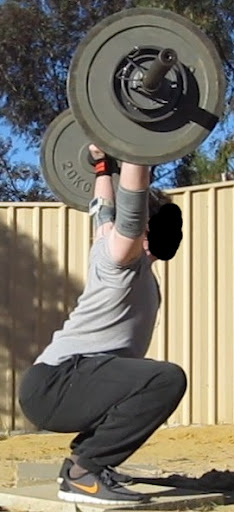
You only have your health, and possibly access to some poor Indian’s kidneys, so we would all be wise to try and keep fit and healthy. Last time I presented the first in a series of training videos to help us desk jockey’s. This is video two in the training master-class, brought to you by my friend Dan/Rocky.

Mighty Pec Blasting Chest Power!!

See you all under a barbell somewhere soon.

Who will portray Jack Reacher?

That’s right, Jack Reacher will be coming to a cinema near you in the adaptation of Lee Child’s One Shot. The film about the big guy with the strong moral compass and the even stronger right hook is all set, with a director, a start date, a script and of course the star: Tom Cruise.

Tom Cruise has agreed to play Reacher in Paramount’s ONE SHOT; filming in Pittsburgh begins on September 27, 2011, which is the same day that Reacher novel #16 THE AFFAIR goes on sale in the US and Canada (Sept 29th is the UK, AU, NZ sale date).

Screenplay is by Christopher McQuarrie (The Usual Suspects, Valkyrie) who will also direct.  The screenplay, from all reports, is truly kick-ass.  The rest of the actors have yet to be cast but we’re hearing rumors that are pretty exciting. Source.

Yes you have read that correctly. Tom Cruise will play Jack Reacher.

Lee is of course in full support of Tom Cruise playing Jack Reacher:

Reacher’s size in the books is a metaphor for an unstoppable force, which Cruise portrays in his own way – Lee Child.

I can’t blame Lee, it isn’t like anyone will complain the movie is better than the book, and he will get paid regardless. Worst case for him is that they make a fantastic movie that generates him millions more fans. So there are three ways this will run: either Tom Cruise will completely own the role and make the fans of the Reacher books forget the 30 centimetre difference in height; or the casting director will cast munchkins in the supporting roles; or the Reacher fans will wish someone else was cast.

Lets go through some of the potential Reachers who have been raised on the interwebz, because despite the decision having already been made there is nothing like documenting the “I told you so” statements for future reference. Of course I’ll delete this post if Cruise pwns all.

Tom Cruise:

Advantages: Box office draw card, his production company bought the film rights, Cruise really needs to look manly in films, has a track history of appearing in good films.
Disadvantages: Short, too pretty, will have to shout at some point in the film regardless of the need to, despite appearing in good films he wasn’t the reason for them being good (Jack Nicolson, A Few Good Men; Dustin Hoffman, Rainman; Cub Gooding Jr, Jerry Maguire; etc).

Tahmoh Penikett:

Advantages: Tall, burly, manly, not too good looking, good looking enough to sell the film, good actor, could actually win a real fight (muay thai fighter), my choice for the role.
Disadvantages: Only had TV roles in shows no-one watched, what the hell do I know about making films.

Jeffrey Dean Morgan:

Advantages: Tallish, manly, chicks love him since he was on Grey’s Anatomy.
Disadvantages: Is he the only manly American actor? Can’t we find someone else?

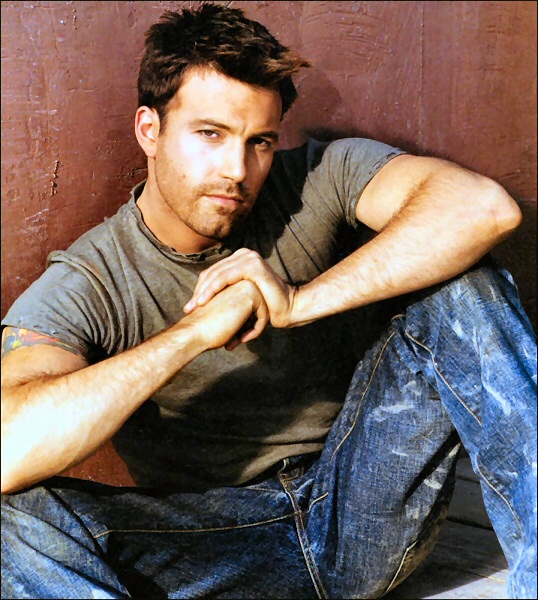
Ben Affleck:

Advantages: Tall, appeared in other blockbusters.
Disadvantages: Budget blowouts would occur due to acting class costs.

Christian Bale:

Advantages: Not short, has appeared in every other film in the last few years, could actually get aggressive and violent.
Disadvantages: I think it would be good to cast Bale in every film, never a down side to that.

Liam Neeson:

Advantages: The right height, has done action films, can act, has been in a Dirty Harry film.
Disadvantages: He appeared in Star Wars The Phantom Menace, appeared in the worst Star Wars film, co-starred with the worst character ever portrayed on film, didn’t shoot his agent for letting him be involved in The Phantom Menace.

I guess we can only dream. Either way, I’ll be seeing One Shot on the opening weekend.

Training Master-class #1

There is nothing in this life more important than your health. As the adage goes; you only have your health. Yet, in this day and age (what a redundant statement), more of our populous live sedentary lives than ever. So many of us are desk jockeys and the aspiring writer in me is seeking to spend more of my day sitting down.

Fortunately I’ve been a weightlifter since my teens. I love lifting heavy stuff and keeping fit. It also allows me my other passions; involving sitting, lying down, and eating chocolate. It took me years to become good at lifting, even more years to become really good at eating chocolate on a couch.

It is important to learn lifting form to get the most out of training. So I wish to present here my friend Dan’s – also known as Rocky – Training Master-class so that all of us desk jockeys don’t become desk leviathans. This first video is illustrating the chin-up.

How to interpret online book reviews

p { margin-bottom: 0.08in; }My previous post sought to elucidate some of those oft quoted expressions which plague music reviews. Despite the unequivocally superior standard of articulation amongst the literary fraternity, there are, upon occasion, some idioms that have become rather cliché. Thus it has fallen upon me, dear reader, to compile and define some terms and phrases that require proper denotation, in order to provide clarification of book review terminology definitions.

Page-turner: Meets the bare minimum standards for a book.
Gripping: I got this from a library where kids are allowed to play.
Poignant: Something sad happened in this book, most likely a character gets cancer.
Compelling: I spent so much time reading this book I had to finish it despite wanting to hurt myself after every sentence.
Nuanced: I have no idea what this book was about but I liked it.
Lyrical: Should be a poem instead so that it isn’t as long and self-involved.
Tour de force: The book is too long and waffly.
Readable: Boring but better than watching TV.
Haunting: Either used to describe a book that made the reviewer actually think, or, more likely, is meant to make you think but is just pretentious.
Deceptively simple: Could have been written by a 10 year old.
Rollicking: Something actually happens in this book.
Fully realized: The book has a beginning, middle and end.
Timely: Makes passing reference to something that happened 2 years ago.
X meets Y meets Z: The reviewer hasn’t read the book so is quoting the sales blurb.
Sweeping: Long.
That said: I’ve just insulted this entire book but it is popular for some unknown reason (e.g. Twilight).
Riveting: Was able to finish reading it.
Unflinching: Unpleasant.
Powerful: I read the hardcover.
Unputdownable: Reviewer is unfamiliar with English.
Masterfully or Masterful: The author is familiar with English.
Beautifully written: A lot of long words were used.
Startling: Reviewer was surprised the book was published.
Bold: Controversial.
Accessible: Written for kids.
Memorable: Reviewer didn’t have to look up the author or title to write the review.
Epic: Really, really, long.
A tale of loss and redemption: Someone dies, the protagonist gets over it, the end.
Sensuously, seductively, and/or lushly described: Painstakingly boring descriptions of mundane details.
Must read: Bestseller.
What it is to be human: Someone falls in love or someone dies.
Luminous: Has a pretty cover.
Evocative: Not boring or pedantic.
Poetic: Wordy.
Thought provoking: Reviewer is sure the book is cultural or intellectual but didn’t quite get it.
Rollicking roller-coaster: Kids book, or should be.
Provocative: Annoying.
Lends itself to X: Reading the book X was better.
Opinionated: The reviewer disagrees with everything the author has ever written.
Emotional roller-coaster: Nominated for some literary award.
Only minor quibbles: The book sucked.
Stays in your mind long after the last page is turned: Had a bad ending.
Writing at the peak of his/her powers: Much better than the author’s other books.
At once: The reviewer is about to use more than one of these terms in a sentence.
Also, lets not forget the various terms that are used to tell you what the genre of the book is, rather than just say what the genre is:
Explicit, steamy, romp, raunchy: Erotica or has sex in it.
Charged, taut, woven, layered: Political thriller.
Heart-warming, life-affirming: Romantic drama.
Seamy, gritty, underworld: Crime.
Taut, fast-paced, dynamic: Thriller.
Epic: Fantasy.
Hope this clears things up a bit.

How to interpret online music reviews

p { margin-bottom: 0.08in; }

One of the coolest things about the interwebz is the ability to find TV shows, movies, books/authors, bands/music, or people to argue with. I live a few hundred kilometres from the most isolated city in the world, which means that there isn’t a cinema, there aren’t many international touring acts that come through town, and author book signings are somewhat rare. Since Al Gore invented the internet we are all able to be connected and find things we like through the magic that is The Internet.

“This, Jen, is the internet.”

p { margin-bottom: 0.08in; }

Of course with an abundance of new stuff comes an abundance of indecision’s. How do you tell which books are worth reading, which movies are worth watching and which bands are worth listening too? The obvious answer would be to consult reviews.

Music reviews are often troubling, they use industry jargon that not everyone understands, especially not the people using the jargon. So I have quickly summarised the commonly used phrases and interpreted them.

Solid album: every song sounds the same.

Standout tracks: the only decent songs.
The album grows on you: hated this album the first time I listened to it and after having to listen to it several times to complete the review have found I can tolerate it.
Intricate melodies: pretentious wank.
Outstanding musicianship: lots of solos.
Impressive guitar work: endless guitar masturbation.
Concept album: lots of pretentious filler.
Soulful lyrics: girlfriend/boyfriend just left the singer.
Soulful melodies: all band members/artist depressed.
Heartfelt emotion: band members/artist suicidal.
Best album of the year: only new album I have.
The best release from this artist/band: it’s about time they put out something decent.
Epic: too long.
Pop sensibilities: commercial radio fodder.
Proponents of (insert name) style: I hate this sort of music.
Founders of (insert name) style: the guys that everyone else copied.
Challenging: annoying.
Diverse styles/sounds: imitates everything popular at the moment.
Critically acclaimed: only pretentious and annoying people will like it.
Commercially successful: listen to it on the radio instead.
Uplifting: saccharine.
Back with a vengeance: last album was terrible.
Offers up some great tracks: band/artist only wrote one song then packed in filler.
Career defining: surprisingly good album.
On heavy rotation: has a huge marketing budget to waste.
Staple of radio playlists: inoffensive.
Politically charged lyrics: think they are better than everyone else.
Confrontational: annoying.
Distinguishes itself: will fade into obscurity in a month.
Stamped their mark: all the vapid DJ’s like it.
Most important album/artist of the year: utter crap that is inexplicably selling well.
Taken (insert country) by storm: some DJ overseas thinks that it’s good.
Radio friendly: bland.

Hope that clears things up a bit. At some future date I will attempt to cover the common book review jargon.

E-books: Return of the Reader

Just like the previous two installments of this e-book saga there will be allusions to some non-existent struggle, my thoughts on the changing publishing industry, no Leia in a bikini, and definitely no Wookie. When we left our hero writers, they were diligently trying to decide whether they wanted to sign with a traditional publisher or self-publish like an indie rebel. Publishers had the track record, the self-publishing indies had the jump on the fastest growing segment in the industry: e-books.

Now hold on just a second. Traditional publishing is behind? As has already been stated in this blog, his mouth to my post, Michael Connelly is selling 45% e-books. His publishers are clearly on board of this new market place. James Rollins and Steve Berry have both released exclusive e-book short stories on Amazon and B&N as lead-ins to their next books (pity non-US people can’t buy them, not being close enough to the centre of the universe and all). I even noticed that Aussie authors like Tara Moss and Matthew Reilly are available on Kindle for under $10. Behind isn’t quite right.

On the other side of the great divide, all the cool kids authors are self-publishing. People like Konrath, Eisler, Mayer, some guy named John Locke, are doing well out of self-publishing and doing all the work themselves (or hire for service). Clearly all authors should be grabbing their manuscripts and uploading them now.

I’ll pause so you can upload your book now. Don’t forget to spell check first!

Well it seems that 10’s of thousands are doing just that. Given that 90% of everything published is probably crud, you have to question how wise it is to rush to publish. We also have to remember that e-books are still a minority share of the market place (this will change of course). Shouldn’t quality come first? Spend the time on crafting a fine book, see what industry professionals have to say about it, then publish? Preferably not the professionals that published Snooki. Basically writers will have to find the best publishing deal for them, even if it is swapping their novel for a packet of magic beans.

And here is a startling fact: readers don’t care if writers are traditionally published, indie published, self published, or published by a small Scottish Terrier named Rolf. Readers want to read something entertaining and well written. So writers shouldn’t care how they are published. To quote Nick Spalding:

“Writers on the traditional publishing side of this particular conflict want to be successful and earn a decent living as a writer, appealing to an audience with their work. On the other hand, writers on the self publishing side of this particular conflict want to be successful and earn a decent living as a writer, appealing to an audience with their work.”

What I love about e-books is that they are made for readers. Well Duh! Stick with me on this one. Lets say that it is August 2010 and I’ve just finished 61 Hours by Lee Child. Now Lee may or may not have finished with a cliffhanger in that particular book. Despite the fact that the next Reacher novel is finished and ready in boxes to go on shelves, I have to wait until the end of September to read Worth Dying For. With e-books there is no need to delay because of printing, shipping, and shop displays still being filled with James Paterson’s books. In fact, with e-books I can have the entire Reacher series downloaded the minute after I’ve finished 61 Hours to keep my spirits up while I wait.

Essentially the gap between writer and reader has been shortened. The reader is King.

So what about publishers? Well they sell books. Authors write those books for them. I don’t think that in the long run they will particularly care whether they are selling an e-book or a DTB. In fact e-books could really cut out a lot of their middle men costs.

A lot has changed in the past year or two, some of the big companies are behind to some extent, but are more likely to catchup. I still can’t believe that e-readers weren’t dreamt up by publishers and bookstores. But then again I can’t believe that Australia – lots of sun – has sent solar technology to Germany – no sun – and politicians are wanting to move from coal to gas.

As long as publishers are paying advances, advertising/promoting authors and fronting costs they will be who most authors will turn to in order to publish. And when the publisher rejects it, and the crying has finished, the author will release it, plot holes and all, on their own.

Bookshops look like the real loser here, despite their claims to the contrary. Apparently people love the smell of books. Solved. Apparently people like to browse in bookstores. Yes, nothing like spending hours in a store with your head at a funny angle to find the store doesn’t stock what you are looking for. Apparently people love the feel of books. Admittedly books are much better to throw at an intruder, although War & Peace is regarded as a lethal weapon.

Can I just point out that an e-book is a book. That you can read. Thanks for letting me clear that up.

Tenuous reasons for bookshops continued existence aside, I don’t see why there won’t be purveyors of fine literature, and the stuff I like reading, into the future. Online stores are often seen as more reputable when they have a physical storefront. Even if that storefront is never visited by anyone because it is located down a side street, off a back alley, near a crack den. Plus POD could make book buying like a trip to the deli counter for lunch.

“I’ll have the new best-seller and a long white to go thanks.”
“Did you want that signed or unsigned?”
“Hold the signing, but I will take the first chapter of the sequel at the back.”

As a reader and as a some-day published author, I think that the future is so much brighter for readers and writers. Readers will have access to more good books than ever. Writers will have greater access to an audience than ever. The future of books is very bright and may even step out of the shadow of DVD’s, when DVD’s become obsolete.

Word of the Day: Paraprosdokian

There is definitely too little wit in the world today. The witless wonders that inhabit our world have made Every Body Loves Raymond a popular show. Paraprosdokian is a great example of wit. You take a sentence and then use the latter part of a sentence or phrase to surprise or twist the meaning; preferably using it to create humour. “Where there’s a will, I want to be in it,” is a type of paraprosdokian.
They are so good that famous people have used them:
  • “He was at his best when the going was good.” —Alistair Cooke on the Duke of Windsor
  • There but for the grace of God — goes God.” —Winston Churchill
  • “If I am reading this graph correctly — I’d be very surprised.” —Stephen Colbert 
  • “You can always count on the Americans to do the right thing—after they have tried everything else.” —Winston Churchill
  • “If all the girls who attended the Yale prom were laid end to end, I wouldn’t be a bit surprised.” —Dorothy Parker
  • “I’ve had a perfectly wonderful evening, but this wasn’t it.” —Groucho Marx
  • “A modest man, who has much to be modest about.” — supposedly Winston Churchill, about Clement Attlee 
  • “She looks as though she’s been poured into her clothes, and forgot to say ‘when’.” —P. G. Wodehouse
  • “I like going to the park and watching the children run around because they don’t know I’m using blanks.” —Emo Phillips
  • “If I could say a few words, I’d be a better public speaker.” —Homer Simpson 
  • “I haven’t slept for ten days, because that would be too long.” —Mitch Hedberg 
  • “I sleep eight hours a day and at least ten at night.” —Bill Hicks

In my own writing I am trying to use humour to offset the dark themes and violence so that I can undermine societal values because you don’t see much humour in thrillers. Here are some examples of paraprosdokian sentences that might tickle some funny bones:

  • Do not argue with an idiot. He will drag you down to his level and beat you with experience.
  • The last thing I want to do is hurt you. But it’s still on my list.
  • Light travels faster than sound. This is why some people appear bright until you hear them speak.
  • If I agreed with you, we’d both be wrong.
  • We never really grow up, we only learn how to act in public.
  • War does not determine who is right – only who is left.
  • Knowledge is knowing a tomato is a fruit. Wisdom is not putting it in a fruit salad.
  • Evening news is where they begin with ‘Good Evening,’ and then proceed to tell you why it isn’t.
  • To steal ideas from one person is plagiarism. To steal from many is research.
  • A bus station is where a bus stops. A train station is where a train stops. On my desk, I have a work station.
  • I thought I wanted a career. Turns out I just wanted paychecks.
  • Whenever I fill out an application, in the part that says, ‘In case of emergency, notify:’ I put ‘DOCTOR.’
  • I didn’t say it was your fault, I said I was blaming you.
  • Women will never be equal to men until they can walk down the street with a bald head and a beer gut, and still think they are sexy.
  • Behind every successful man is his woman. Behind the fall of a successful man is usually another woman.
  • A clear conscience is the sign of a fuzzy memory.
  • I asked God for a bike, but I know God doesn’t work that way. So I stole a bike and asked for forgiveness.
  • You do not need a parachute to skydive. You only need a parachute to skydive twice.
  • Money can’t buy happiness, but it sure makes misery easier to live with.
  • There’s a fine line between cuddling and holding someone down so they can’t get away.
  • I used to be indecisive. Now I’m not so sure.
  • You’re never too old to learn something stupid.
  • To be sure of hitting the target, shoot first and call whatever you hit the target.
  • Nostalgia isn’t what it used to be.
  • Change is inevitable, except from a vending machine.
  • Going to church doesn’t make you a Christian any more than standing in a garage makes you a car.
  • A diplomat is someone who tells you to go to hell in such a way that you look forward to the trip.
  • Hospitality is making your guests feel at home even when you wish they were.
  • I always take life with a grain of salt. Plus a slice of lemon, and a shot of tequila.
  • When tempted to fight fire with fire, remember that the Fire Department usually uses water.
  • Words of Wisdom “The early bird may get the worm, but the second mouse gets the cheese.”

International Day of Slayer

Metal fans of the world unite! Today – June 6th – is every metal fan’s public holiday. Ok, the public holiday is still in the works, and this post is a little late, but it is at least a day when all metal fans can proudly proclaim their faith in all things heavy. To represent all that is metal, the band Slayer have been adopted as the international symbol of metal music.

Who is Slayer

Slayer is a band from California. Their music has come to epitomise speed metal music in the latter half of the 20th century. Their 1986 album, “Reign in Blood” is one of the single most influential metal albums of all time, typified by the modern classic “Angel of Death”. Playing “Reign In Blood” has been positively correlated p { margin-bottom: 0.08in; }with reductions in the local infestations of hippies, fundamentalist religious groups and other non-savoury people.

How to Celebrate

  • Listen to Slayer at full blast in your car.
  • Listen to Slayer at full blast in your home.
  • Listen to Slayer at full blast at your place of employment.
  • Listen to Slayer at full blast in any public place you prefer.

DO NOT use headphones! The objective of this day is for everyone within earshot to understand that it is the International Day of Slayer. International holidays aren’t just about celebrating; they’re about forcing it upon non-participants.

Taking that participation to a problematic level

  • Stage a “Slay-out.” Don’t go to work. Listen to Slayer.
  • Have a huge block party that clogs up a street in your neighbourhood. Blast Slayer albums all evening. Get police cruisers and helicopters on the scene. Finish with a full-scale riot.
  • Spray paint Slayer logos on churches, synagogues, or cemeteries.
  • Play Slayer covers with your own band (since 99% of your riffs are stolen from Slayer anyway).
  • Kill the neighbour’s dog and blame it on Slayer. 

But, I hear you ask, what if I’m a metal fan and don’t like Slayer? Well there are many options:

  • You could admit yourself to hospital, as you are clearly ill.
  • You could take this opportunity to grow to like Slayer.
  • You could listen to all of your favourite metal albums whilst watching a Slayer video.
  • You could admit that you aren’t really a metal fan and kill youself in shame or hang out with Justin Beiber fans (same thing really).

Things to do on holidays

As much as I like work, I really do like holidays. Finally I have time to do all the things I actually like doing rather than having a large chunk of my day taken up with, well, work. Now obviously if I am to get my first novel published before the end of this year, then I should take advantage of my break from a day job and churn out some writing.

So here’s what I’ve actually been doing.

Getting up early.
I think that you shouldn’t break your daily routine up too much, otherwise going back to work becomes too hard. As such I try to get up as early as possible, preferably before lunch time.

Reading.
Surprisingly I’ve had very little time for reading this holidays. It has been go, go, go the entire time. I think I may have only averaged 5-6 hours a day of reading. The list of things I have read this past week:
Hit List – Chris Ryan
The Dark Tower – Steven King
D.E.D. Dead – Geoff McGeachin
300 – Frank Miller
Graverobbers Wanted (No Experience Necessary) – Jeff Strand
Write the Fight Right – Alan Baxter

As always I don’t comment on 1-2 star books because they are never finished. But curse them for wasting valuable reading time!!

Exercise.
I’ve always been active and love weightlifting. When I’m on holidays it is very important to keep up the exercise levels, lest I start to resemble a daytime talk show audience member. My exercise routine starts not long after waking. I stumble to our library and start with a good stretch out on our couch. I like to superset (a weightlifting term meaning back to back) the stretch with reading. This holidays I’ve been averaging 5-6 hours of this. At the end I’m suitably warmed up for some weightlifting, or a beer, depending on how I feel on the day (5 days of 7 the beer has won).

Sure could do with a beer right about now.

Woodworking.
Holidays are a great time to spend on hobbies. There is nothing quite like the sense of accomplishment from crafting something with your bare hands. There is also nothing quite like the sense of satisfaction from using really sharp tools to stab, slice and hack away at something…….. Currently I’m making another bookshelf for our library, and have finished two clocks recently.

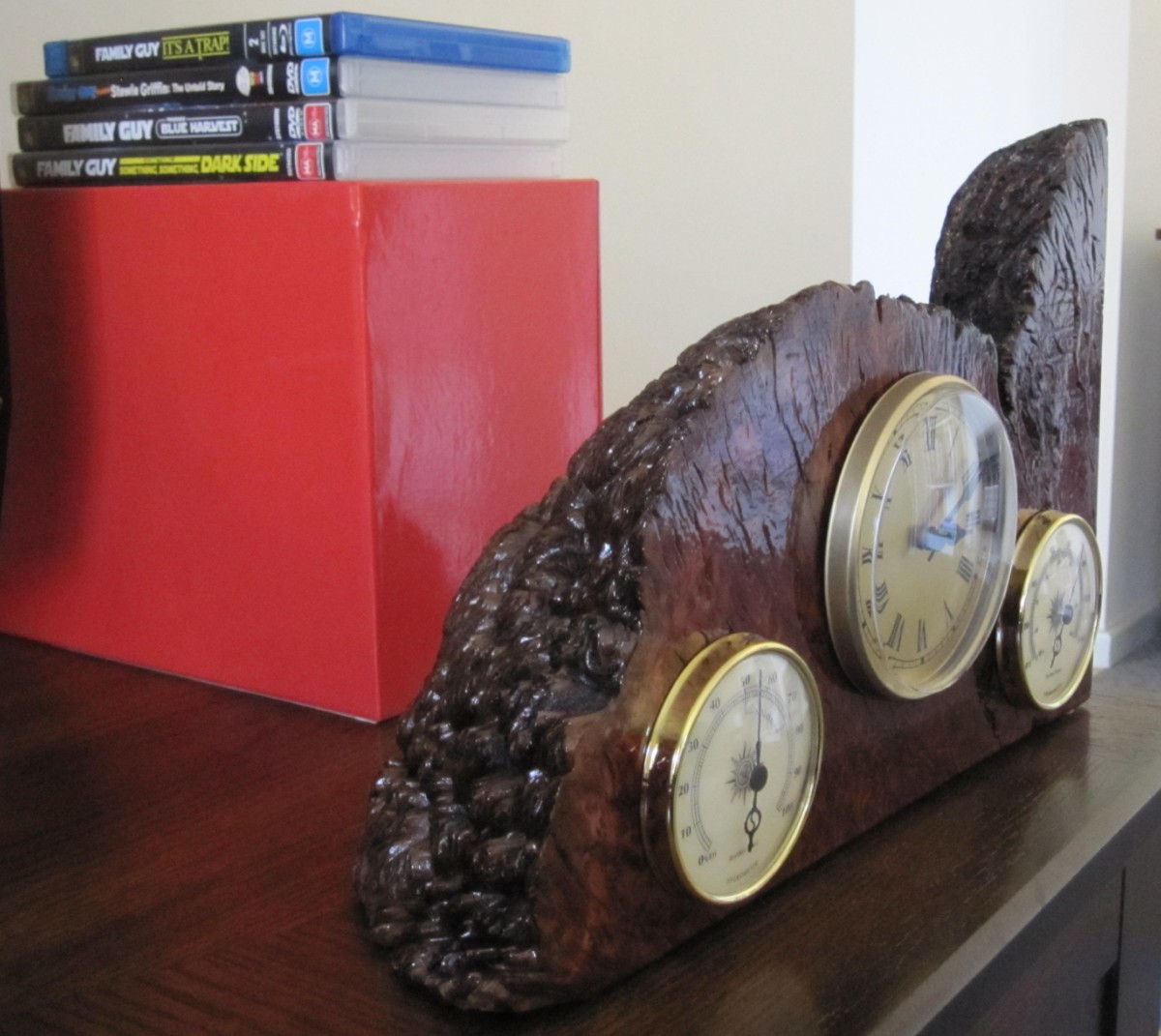
Jarrah clock. To say Jarrah is a hard wood is like saying steel is kinda hard.

Guitar.
If I have a second love it is guitar. Wait, sorry, my wife is first, so my writing is second, so guitar would be third. Honest mistake.

So, I have a number of toys that I enjoy to play with:
PRS Custom
7 string Flying V
Egnater Tweaker
Vox Night Train

Writing.
Now the juicy part: how much writing have I actually done? How much closer to finished is Overturned Stones? Well according to my Scrivener Windows Beta release, I have written nothing.

Yes I was scratching my head too. Seven days of writing usually results in an increased word count. Of course I’d forgotten to account for the Windows Affect. For those not familiar with the Windows Affect, basically when a new program is released in a format that is compatible with Windows OS, Windows will immediately stop being compatible and seek to destroy the new program. Usually this is achieved via updates that render the computer unusable.

I know, my own fault. I had Ubuntu installed and then some guy named Bill dropped around and reinstalled W7. I knew he was trouble when I saw that haircut.

Suffice to say I have decided to switch back to Open Office for now. The word count has caught back up and I hope to hit the halfway mark of Overturned Stones – 45,000 – next week. So far this holidays I have written 10,000 words, 7,000 of those have actually been saved when I pressed the save button.

Overturned Stones is a thriller based upon the idea that human trafficking and slavery can be solved via lead therapy. The central protagonist is very good at dispensing lead and avoiding anti-lead campaigners like police and mercenaries. But is he good enough to hide from the police and mercenaries when he saves a woman and child? He thinks so, but then again he’s biased.

Yo ho ho and a bottle of rum.

Internet Pirate, Yar!

I can remember back to when computers were nothing more than green text on a black background and made terrific boat anchors. Then suddenly they exploded, usually from a spilt drink or frustration in the 10 minutes it took for anything to load. Just as I was leaving high school the interwebz was suddenly all around us and promised to deliver us information, e-commerce, media and porn. This coincided with computers becoming faster, hard-drives becoming bigger and teenagers becoming hornier.

And that is when media piracy really took off.

Sure Napster popularised it a few years later and the music industry starting jumping up and down about it later again, but someone had forgotten to tell these people that the game had changed. I didn’t have to buy the entire Primus CD for the two songs I was actually going to listen to, now I could have a copy of those two songs on my computer, either downloaded from friends or copied off the CD.

I think we were all waiting for the music industry to catch up. At some point we were expecting all of our favourite songs to be available online for sale. But our computers were growing, so it wasn’t just music, we wanted our TV and movies as well. Why couldn’t we just grab a copy off the internet when we wanted? Where was the store that sold this stuff? And would they sell Debbie Does Dallas?

Well, sensing the growing change in consumer behaviour, the desire for an online store to sell entertainment, the music industry, movie industry and other media decided to band together and sue kids for millions of dollars each.

Brilliant! Rather than sell people stuff lets sue them! What a marketing and sales master stroke.

Instead of responding to consumer demands, the industries concerned decided they didn’t want to play. They thought that would be the end of that. Of course in a free market economy you have to expect the market to dictate terms, not anyone else. Piracy became embedded.

Now of course it isn’t the media industry’s fault that their products were being pirated, it was them damn pesky kids with their computas and iGizmos and and theys gots no respects for da rulz……… The e-generation were blamed for the down-turn in music sales and for massive losses to the music and movie industry. I like the assumption that every download must equal a lost sale, talk about a non-sequitur.

None of these arguments, discussion or history are really relevant though. I’m going to coin a new term SCREEN-GAZING which is the e-version of navel-gazing, because all of this piracy discussion is essentially nothing more than screen-gazing. Lets have a look at the real data that needs to be discussed.

The survey interviewed 1,700 music consumers age 13-60 and found that music is important to social networkers: 39% have embedded music in their personal profiles.
70% said they embed music to show off their taste; half said music is a good way to reflect personality.
Some other survey findings:

  • Some 53% of people actively surf social networking sites to find music.
  • 30% said they went on to buy or download music that they had discovered on a social network site (for MySpace, the proportion is 36%).
  • On popular sites the numbers of people who use sites to find music increase – for MySpace and Bebo, 75% and 72%, respectively, and 66% for YouTube.
  • 46% say they wish it were easier to purchase music they had discovered on social networking sites – for example via a “buy now” button on the site.
  • The number of those saying they illegally download music tracks has increased, from 40% in 2005 and 36% in 2006 to 43% in 2007.
  • Only 33% cited the risk of being prosecuted as a deterrent against illegal downloading, compared with 42% in 2006.
  • Nearly one in five respondents – 18% – claimed an intention to download more unauthorized tracks, up from 8% in 2006.
  • After a dramatic 40% increase in the number of legal downloaders between 2005 and 2006, only 16% growth occurred in the number of legal downloaders from 2006 to 2007.
  • 22% of legal downloaders admitted that they had not paid for a track in the last six months.
  • 84% agreed that digital downloads of older music should be cheaper; 48% said they would be prepared to pay more for newly released music.

So basically iTunes had been on the map for 4 years by the time this survey was performed, downloading had been around for a decade. Big congratulations to the industry for making those inroads into making music accessible. Almost half of the kids would like easier access to music to buy, and most thought it was too expensive.

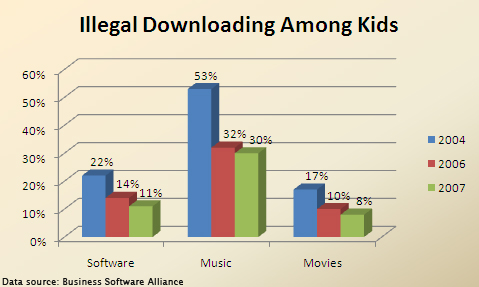
Another survey shows that downloads of media were decreasing. So clearly the impact of actually selling media to people that they want was a good thing for lowering pirating. Just the industry hasn’t reached enough of the market yet.

How do you dissuade people from illegal downloads? The traditional approach for punishing pirates would be imprisonment, pilloring, flogging, enslavement, branding, keel hauling, and/or hanging. Given how well that worked in ridding the world of pirates maybe we should consider other methods.

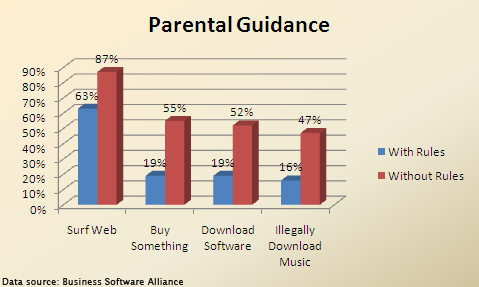
Someone was really bright and had a look at what parental guidance did to downloading.

Who would have thought that parenting had a role in being a law abiding citizen?

What does all of this mean? Well pretty much media – be that ebooks, movies, music, TV shows – need to be easily accessible and priced appropriately. There also needs to be some responsibility taken by everyone to make sure that people expect to pay for media. This can’t be draconian, it has to be encouraged, and part of that encouragement comes from the ease of access and prices that people can afford. And now I hold my breath. Wake me after I pass out waiting for a solution rather than another blame game.

Comment on Comments – A review of reviews

In case you haven’t been aware, there has been a few arguments riding the blogosphere this past week. The first was about the value of e-book or self-publishing being regarded as lesser than traditional print publishing. The second has been about the self-publishers who have commented on negative reviews of their books. Jenny at the Inner Bean has blogged and started some forum discussions on this topic.

Now I love the fact that several authors have posted here following one of my reviews. Essentially my reviews are promotions of books I have enjoyed reading, so them commenting doesn’t feel out of place. But reviews on Amazon and some review sites are not exactly the places to weigh in with a response.

Let us take an example of a review on Amazon:

Julia Argandona, of Costa Mesa, CA Review (‘17 of 59’ customers found this ‘helpful’):

I haven’t read this book yet but I can’t wait to read it so I am reviewing it early. The other people on Amazon who say don’t read it are brainwashed stooges of the Catholic religion, which has been sexually abusing children for 100’s of years. Who needs it? I already LOVE this book

I think the most important thing to note about this review is not that she hadn’t read the book, nor that she is clearly a fan of the author or genre regardless of the content of this particular book, no the important thing to note is that 17 of 59 other customers actually found this review helpful.

I’ve never driven a car, I’ve never held a license to drive a car, but I’m ever so keen to teaching my kids to drive. Can’t Wait!

Obviously everyone is entitled to an opinion. The internet has become a playground for the dispersal of opinions and porn. So we have to admit to ourselves that some people on the internet will not only be naked, but they will also have the intellectual might of a cheese cracker. I think it is safe to ignore these people, unless they look good naked.

But what about the normal or intelligent people and their opinions? Clearly all rational opinions will be in agreement. As a result you will never see a negative review for a book (or anything else) coming from someone worth listening to. Even if the book sucks.

I recently discovered that ~50% of the general public doesn’t believe in man made climate change and are willing to argue with the 97% of scientists who can prove it is happening. So opinions don’t have to be related to facts or evidence. There is a point here, but I’m not sure how it relates to internet nudity.

So even in the best of circumstances, when you are 100% right and the opinion holder is 100% wrong, telling people that is the case is just a waste of time. Remember, the best book ever written – Good Omens by Terry Pratchett and Neil Gaiman – currently has 19 one star reviews on Amazon. This means that 3% of reviewers, despite being wrong, didn’t enjoy this masterpiece, proving that you can’t please everyone, so don’t bother arguing with them.

Of course reviewing the reviewers is all Anne Rice’s fault. She started it.

From the Author to the Some of the Negative Voices Here, September 6, 2004

Seldom do I really answer those who criticize my work. In fact, the entire development of my career has been fueled by my ability to ignore denigrating and trivializing criticism as I realize my dreams and my goals. However there is something compelling about Amazon’s willingness to publish just about anything, and the sheer outrageous stupidity of many things you’ve said here that actually touches my proletarian and Democratic soul. Also I use and enjoy Amazon and I do read the reviews of other people’s books in many fields. In sum, I believe in what happens here. And so, I speak. First off, let me say that this is addressed only to some of you, who have posted outrageously negative comments here, and not to all. You are interrogating this text from the wrong perspective. Indeed, you aren’t even reading it. You are projecting your own limitations on it. And you are giving a whole new meaning to the words “wide readership.” And you have strained my Dickensean principles to the max. I’m justifiably proud of being read by intellectual giants and waitresses in trailer parks,in fact, I love it, but who in the world are you? Now to the book. Allow me to point out: nowhere in this text are you told that this is the last of the chronicles, nowhere are you promised curtain calls or a finale, nowhere are you told there will be a wrap-up of all the earlier material. The text tells you exactly what to expect. And it warns you specifically that if you did not enjoy Memnoch the Devil, you may not enjoy this book. This book is by and about a hero whom many of you have already rejected. And he tells you that you are likely to reject him again. And this book is most certainly written — every word of it — by me. If and when I can’t write a book on my own, you’ll know about it. And no, I have no intention of allowing any editor ever to distort, cut, or otherwise mutilate sentences that I have edited and re-edited, and organized and polished myself. I fought a great battle to achieve a status where I did not have to put up with editors making demands on me, and I will never relinquish that status. For me, novel writing is a virtuoso performance. It is not a collaborative art. Back to the novel itself: the character who tells the tale is my Lestat. I was with him more closely than I have ever been in this novel; his voice was as powerful for me as I’ve ever heard it. I experienced break through after break through as I walked with him, moved with him, saw through his eyes. What I ask of Lestat, Lestat unfailingly gives. For me, three hunting scenes, two which take place in hotels — the lone woman waiting for the hit man, the slaughter at the pimp’s party — and the late night foray into the slums –stand with any similar scenes in all of the chronicles. They can be read aloud without a single hitch. Every word is in perfect place. The short chapter in which Lestat describes his love for Rowan Mayfair was for me a totally realized poem. There are other such scenes in this book. You don’t get all this? Fine. But I experienced an intimacy with the character in those scenes that shattered all prior restraints, and when one is writing one does have to continuously and courageously fight a destructive tendency to inhibition and restraint. Getting really close to the subject matter is the achievement of only great art. Now, if it doesn’t appeal to you, fine. You don’t enjoy it? Read somebody else. But your stupid arrogant assumptions about me and what I am doing are slander. And you have used this site as if it were a public urinal to publish falsehood and lies. I’ll never challenge your democratic freedom to do so, and yes, I’m answering you, but for what it’s worth, be assured of the utter contempt I feel for you, especially those of you who post anonymously (and perhaps repeatedly?) and how glad I am that this book is the last one in a series that has invited your hateful and ugly responses. Now, to return to the narrative in question: Lestat’s wanting to be a saint is a vision larded through and through with his characteristic vanity. It connects perfectly with his earlier ambitions to be an actor in Paris, a rock star in the modern age. If you can’t see that, you aren’t reading my work. In his conversation with the Pope he makes observations on the times which are in continuity with his observations on the late twentieth century in The Vampire Lestat, and in continuity with Marius’ observations in that book and later in Queen of the Damned. The state of the world has always been an important theme in the chronicles. Lestat’s comments matter. Every word he speaks is part of the achievement of this book. That Lestat renounced this saintly ambition within a matter of pages is plain enough for you to see. That he reverts to his old self is obvious, and that he intends to complete the tale of Blackwood Farm is also quite clear. There are many other themes and patterns in this work that I might mention — the interplay between St.Juan Diago and Lestat, the invisible creature who doesn’t “exist” in the eyes of the world is a case in point. There is also the theme of the snare of Blackwood Farm, the place where a human existence becomes so beguiling that Lestat relinquishes his power as if to a spell. The entire relationship between Lestat and Uncle Julien is carefully worked out. But I leave it to readers to discover how this complex and intricate novel establishes itself within a unique, if not unrivalled series of book. There are things to be said. And there is pleasure to be had. And readers will say wonderful things about Blood Canticle and they already are. There are readers out there and plenty of them who cherish the individuality of each of the chronicles which you so flippantly condemn. They can and do talk circles around you. And I am warmed by their response. Their letters, the papers they write in school, our face to face exchanges on the road — these things sustain me when I read the utter trash that you post. But I feel I have said enough. If this reaches one reader who is curious about my work and shocked by the ugly reviews here, I’ve served my goals. And Yo, you dude, the slang police! Lestat talks like I do. He always has and he always will. You really wouldn’t much like being around either one of us. And you don’t have to be. If any of you want to say anything about all this by all means Email me at Anneobrienrice@mac.com. And if you want your money back for the book, send it to 1239 First Street, New Orleans, La, 70130. I’m not a coward about my real name or where I live. And yes, the Chronicles are no more! Thank God! – Anne Rice

She also doesn’t abide by fan fiction, because it’s her work DAMMIT!

Enhance Your E-Reader

The smell of e-books just got better

Does your Kindle leave you feeling like there’s something missing from your reading experience?

Have you been avoiding e-books because they just don’t smell right?

If you’ve been hesitant to jump on the e-book bandwagon, you’re not alone. Book lovers everywhere have resisted digital books because they still don’t compare to the experience of reading a good old fashioned paper book.

But all of that is changing thanks to Smell of Books, a revolutionary new aerosol e-book enhancer.

Now you can finally enjoy reading e-books without giving up the smell you love so much. With Smell of Books you can have the best of both worlds, the convenience of an e-book and the smell of your favorite paper book. Smell of Books is compatible with a wide range of e-reading devices and e-book formats and is 100% DRM-compatible. Whether you read your e-books on a Kindle or an iPhone using Stanza, Smell of Books will bring back that real book smell you miss so much.

Now available in:
Classic Musty Smell
Crunchy Bacon Scent
Eau You Have Cats
New Book Smell
Scent and Sensibility

Define Irony

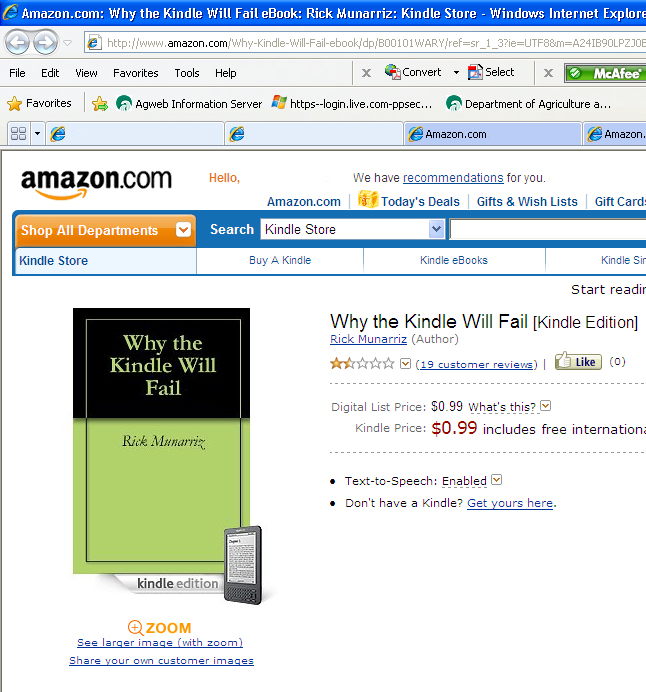
Yes that is right! Someone has released an e-book on Kindle that is critical of Kindle’s. Why The Kindle Will Fail by Rick Munarriz

From the reviews it sounds like the book is a review of the Kindle that the author has decided to turn into an e-book. Given the book title, the format and where he is selling it, he clearly can’t be taken too seriously. Opinions have to come from an educated point of view; how can a point of view be educated with this much irony?

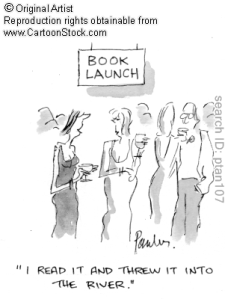
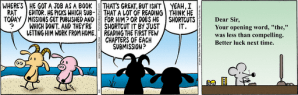
It reminds me of a lovely cartoon that I think sums up a lot of opinion based articles:

Inspiration – TV that is actually worth watching

Amazingly enough, I think that books and TV are compatible. If you were to ask my wife she would nod and agree as well, as she reads through most TV and enjoys the ambience. There are some fantastic TV shows out there that not only inspire, but they are also written not unlike a novel.

Generally a movie has to take a book and cut out every second page, in anything longer than a short story they often just take the title page. In this manner, they can squeeze all the wonder and joy of a novel into 90 minutes of unrelated drivel. TV doesn’t run for 90 minutes, it has much longer to develop characters, story arcs, plot, and in-jokes that you wonder about enough to read the director’s blog to understand what the hell is going on. As a result TV and the novel can have a lot in common.

I say that TV can have a lot in common with a novel, not that it always does, as that would be assuming that a novel writer could get away with a procedural crime drama that is always solved by identifying semen left at the crime scene. So the shows that do actually rise to great heights tend to be few and far between, or they get cancelled by a network executive who realises that the show may actually be interesting – yes Fox, I’m still pissed about Firefly!

So what are the good TV shows I’m talking about? Well, let’s go with a list, shall we?

Oz:

Justified:

Read the short story that Justified is based upon here.

Deadwood:

The Wire:

Now I could go on and add other shows I like (Leverage, Firefly, Daria, Family Guy, The Simpsons before they sucked) but this really is enough to illustrate my point. Oz was an amazing show with such a diverse range of characters. Justified is so good that Elmore Leonard not only approved it but came on board to write some episodes. Deadwood was so good the censors felt obliged to leave in the occasional curse word used. The Wire attracted some of the best crime writers to the production team because they saw the depth and intricacy this show had.

So the entire point of this blog post may have been an excuse for me to write something other than my novel while I grab the next episode of Justified, but that doesn’t mean that quality TV and quality novels don’t have a lot in common – bloody good writers who don’t get paid nearly enough. I’ll leave you with two links to an interview with David Simon, the creator of The Wire. Fascinating stuff!
Part 1
Part 2

Going For Broke

Everyone will have now read, seen or heard the news that Borders and Amazon have been heading up a fetid creek for far too long. In the land of Oz (the non-magical and not infested by Munchkins version) the media are now weighing in.
See this article

You see I’m to blame. I brazenly buy books from places other than big chain stores. I have a Kindle and enjoy reading e-books. I am, in short, the devil incarnate and will be sacrificed on a pyre of celebrity biographies, cookbooks and other non-selling book store stock.

A Recent Photo of Me.

Lets take a look at some of the points that were made.

I’ll play devils advocate here and talk about taxes first. There are only two sureties in life; taxes and whining about them. In the non-Munchkin land of Oz we have a 10% goods and services tax (GST) on everything except food. This means that imports don’t have this tax, because they aren’t Australian. I guess we evil overseas book buyers paying taxes to a foreign country should pay another tax for daring to participate in the global economy. That way I can be more involved in the global economy with taxes in multiple countries.

Recently we also had a change in the Aussie dollar, it reached parity with the US dollar. For those who haven’t studied economics, this means that if I have one Australian dollar I can trade it for one American dollar, I know because I saw an article on it – tricky stuff that economics. Now that means that if I wanted to, say, buy materials that are needed to print books they would have gotten cheaper. Equipment upgrades, cheaper. Printing ink, cheaper. So clearly a stronger Aussie dollar must mean that it is harder to compete…………

The threat from online sales is, of course, just terrible. How dare our country sign up to a fair trade agreement and actually have its citizens abide by it. Who’d have thought that when you have a business competing in an international market it would mean that you would have to compete with stores all over the globe?

Of course this means that me and my evil kind are killing retail jobs.

One point that Bob Carr (former politician – which means dodgy) makes is about how it is all the government’s fault that books cost so much. He states that they would be 33% cheaper if only his benevolent company Dymocks was able to buy their books from overseas instead of locally. 33%? I think it is basic maths time for this particular businessman.

As an example I will use the latest action-thriller by Andy McDermott. His book Empire of Gold (which I’m looking forward to getting my fiendish hands on) has just come out recently and is available from Dymocks in Australia, or for the evil book buyers, from Amazon.
Dymocks Australia online price: $24.79 (paperback)
Amazon: $9.99 (paperback) or $24.63 (hardcover)
So let us take 30% from the Dymocks price:
$24.79 – 30%(7.44) = $17.35

Well, I’m not a maths genius, but at a guess I’d say that being able to buy a hardcover at USA retail prices for the same price as the paperback retail in Australia is not exactly a 33% difference for a paperback. In fact, to buy it would be more like a 60% difference between the paperback prices. So I’d have to say that I’m not looking as evil as I first thought.

I wonder where that other 33% is going? It certainly isn’t into royalties for writers. I’d just like to be reminded what the wonderful companies that have just left a hole in the heavenly book retail world went bankrupt not paying (analogy: imagine that the authors are Marsellus Wallace, the publishers are Butch, the retailers are Zed and Maynard, and in this version Butch just does a runner). While we are on the subject, I’m unsure whether Dymocks is a discounting chain store driving every other book store out of business or The Coalition for Cheaper Books.

Clearly I’m so evil and my kind are the cause of all problems in the publishing world. It could never be the fault of antiquated business models forgetting that there are only two important parts in the publishing industry, namely the readers and the writers, everything else is clearly expendable. Excuse me while I pay a 70% royalty to a new author for a book that you can’t buy from a publisher or store.

The book to movie process

p { margin-bottom: 0.08in; }

When I am not busy writing or researching I like to stretch out on the couch and revel in abject mindless entertainment. The problem is that even a Hollywood blockbuster can make me think, even it is just thinking of derisive comments.
Recently I finished reading a thriller that had been adapted into a movie. The book was ok, as was the movie, but aside from some character names there was very little resemblance between the two. Having experienced both within a short time period, and despite Hollywood’s efforts to stop me thinking too much, I was left with a nagging question.
Why did they bother?
How many times have we seen a film that is supposedly based upon a book (or a play, or a short story, or a comic book) , yet if you were to compare the two you would be hard pressed to draw any similarities? In some instances the lack of resemblance is a blessing and gives people on the Internet something to complain about. In other instances it stops the movie adaptation from being a 10 hour long exercise in boredom.
The average book reader usually has an advantage over the average movie goer, in that they are intelligent and educated enough to be able to read. So obviously any movie has to be simplified, say by removing plot, characters and adding in more explosions, although in fairness on this last point I do think that the odd explosion could add an interesting twist to something like Wuthering Heights. But when does the adaptation go too far and waste the links to the source material?
I’m sure that there is a good reason to pay lots of money to an author for the rights to a book and subsequently ignore completely when making the film of it. I know that 80% of our movies have come from another medium, the popular source at the moment being comic books. Sorry, that should be ‘graphic novels’ because adults don’t read comics because [insert lame justification here]. Do screenwriters really lack imagination and need to have the title of the book and main characters names before than can begin writing? Given how different the films end up being they certainly don’t lack for imagination.
I’m going to go out on a limb and suggest that because movie studios go out on a limb and option every single book (etc) that sells more than 2 copies, they need to make a movie of some sort using the titles they have paid for. There would be nothing worse than admitting that they had spent lots of money obtaining the rights to a book that could never be made into a film. So they take this approach to most things they have optioned, as it saves them reading time, time that could be better employed making something up.
Here’s to the pile of money for movie rights for authors! May Hollywood never realise that they should read the source material.