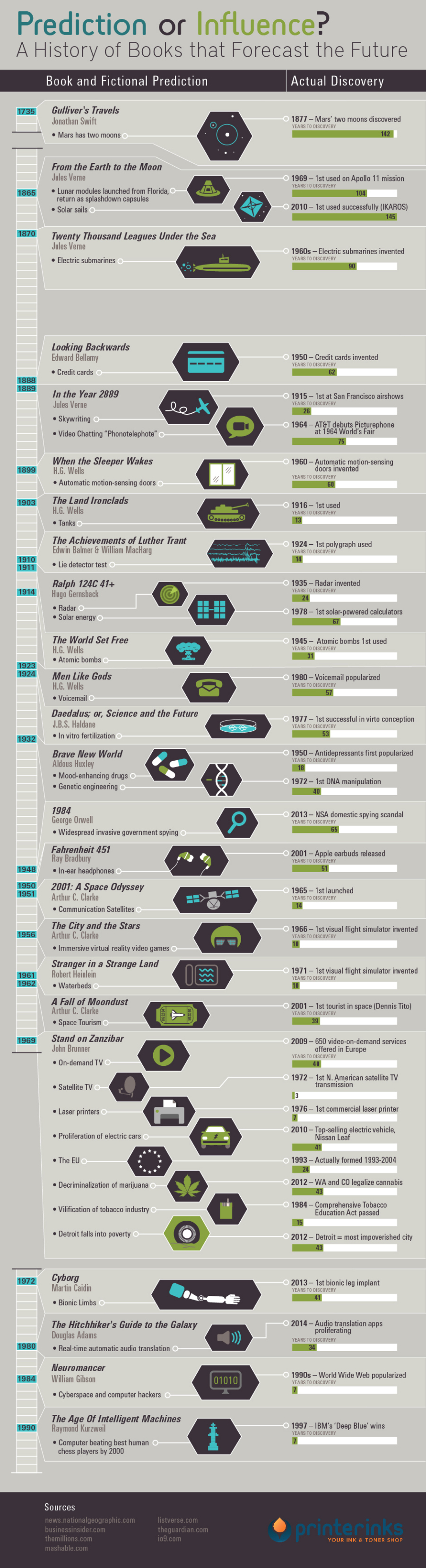
One of my favourite science blogs, From Quarks to Quasars, had a great post from Isabelle Turner that I needed to share. Take a look at the things from science fiction that became science fact, and wonder whether it was prediction, influence, or just wishful interpretation on our part.
Tag: science fiction
Below is a wonderful infographic that compares a selection of the fastest ships ever created. Very cool.

The Fastest Ship in the Universe : How Sci-Fi Ships Stack Up Created by: FatWallet.com
Worth heading over to the original page for the discussion section. Highlights include which ships were missing, and a better estimate of the Heart of Gold’s top speed.

The Great Zoo of China by Matthew Reilly
My rating: 5 of 5 stars
My mother bought me The Great Zoo of China for Christmas, which makes her the best mother in the world. Well, unless your mother bought you a copy as well, in which case the title of best mother in the world would have to be shared.
CJ is a herpetologist specialising in large animals like crocodiles, and being a Matthew Reilly novel, she also specialises in avoiding dying every page or two. She is recruited by National Geographic to take a press junket trip to a new zoo in China. The Chinese government have developed an amazing new zoo that is set to wow the world, assuming their main attractions don’t try to escape and eat everyone. What could go wrong during the promotion junket for a zoo filled with dragons?
Yep. Dinosaurs, sorry, Dragons.
I’ve seen some reviews that suggest Matt’s novel is just a rip off of Michael Crichton’s Jurassic Park. I agree completely. I also like to ignore that Jurassic Park is a rip off of Sir Arthur Conan Doyle’s The Lost World, which is in turn a rip off of Jules Verne’s Journey to the Centre of the Earth, or possibly Off On A Comet – if you want to count dragons as dinosaurs. Because every idea is 100% original and comments complaining about rip-offs don’t primarily show the complainer’s ignorance.
Ignoring that point – because who cares? – Matt’s latest novel is all of the elements we’ve come to love from him. The story is fast paced, life and death, adventurous fun. I really enjoyed The Great Zoo of China: enough said.

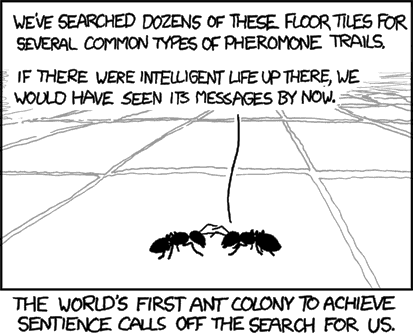
Within science fiction and the wider society there is this idea that we’ll find aliens. I always find it funny when humans talk about discovering “other” intelligent life in the universe. Just a wee bit arrogant to consider ourselves intelligent. Yes, I do realise that I’m arguing that point using technology based on quantum mechanics, probably being read on a device that weighs less than 200g and fits in your pocket, linked by a distributed network, connected by orbital satellites. Science: it works….. bitches.
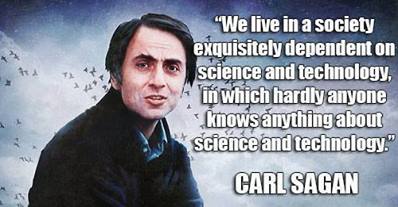
But I would continue my argument by saying that to some people that amazing interface of technology, that is allowing this blog post to be read around the world, might as well be explained as “magic, magic, magic, magic, magic, god did it.” I certainly couldn’t explain how quantum mechanics works, nor how it applies to communications technologies, let alone how it manages to stream all of my favourite porn media to my phone. Thus Arthur C Clarke’s third law – Any sufficiently advanced technology is indistinguishable from magic – holds true for the vast majority of people on this planet.
Now the argument against Clarke’s third law is that technology isn’t magic. In fact, in the entire history of human civilisation, with all the things that have been attributed to magic, all the great mysteries of the universe, once investigated, have turned out to be not magic. But I’m talking about the knowledge gap between the average person and the specialist in the field who develops all this cutting edge stuff that allows other specialists to do cool stuff; like making a hoverboard. We are surrounded by everyday items that most of us would struggle to explain the concept of how they work – magnets, how do they work? – let alone understand the complexities involved – magnets, this is how they work.
Douglas Adams brilliantly satirised this idea in his novel Mostly Harmless. Arthur Dent crash lands on an alien planet where the local humanoid populace are rather backward in comparison to us humans. Arthur comes from a planet of television, cars, planes, computers: all sorts of neat stuff. But he doesn’t know how any of it works, nor how to go about reverse engineering any or it. So he becomes the sandwich maker.
Essentially, we point to all of our human achievements to show how smart we are, but in reality most of us haven’t the first clue about any of those achievements. We just aren’t as smart as we would like to think.
Now compare this to aliens. Humans are pretty proud of having gone to the moon, cashing in on all 12 of us who have done so, but to be visited by aliens requires interstellar travel. That requires technology we probably haven’t even dreamed of yet (possibly not, e.g. warp). An alien race that can do that is so far beyond human achievement and intelligence. Thus,  I’m suggesting that even at our best, we would be babbling morons in comparison to an intelligent life-form that has managed interstellar travel.
Sure, the aliens that decide to cross interstellar space may be the Cleatus of their species. Their technology may actually have reached the point of sentience and doesn’t require anything of its “makers”. But think of how advanced such a species would be, not to mention how arrogant (rightly or wrongly). There is no reason for them to look upon Earth and see humans as intelligent (e.g. climate change and reality TV). There is also no reason to believe that we’d even notice these aliens. An intelligent life-form travels between star systems, has the technology for that not to have taken billions and billions of years, and some dude with an out of focus camera is going to be the only person to see them?
So I think that humans are rather egotistical to think of ourselves as intelligent life in the universe. I also think that it is arrogant to believe that an alien species would regard us as intelligent. I also think that we’d have little chance of encountering intelligent alien life unless they wanted to be encountered. This is just my view, but the main thing is, Neil DeGrasse Tyson agrees with me (or is that I agree with him?):
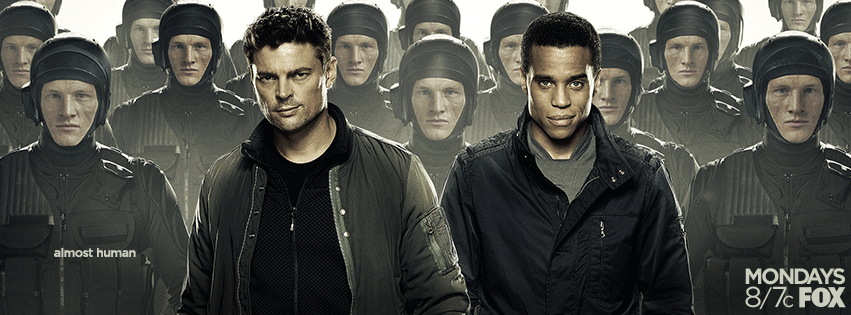
Recently I wrote about the TV shows that have been keeping me entertained, or at least giving my eyeballs some much-needed exercise. One of the TV shows I’d failed to get into was a little sci-fi on Fox called Almost Human. It appears that the reason I’d had trouble appreciating this new show is that Fox is up to its old tricks.
That’s right, Fox is airing the episodes of Almost Human out of order. And before you ask, I did check to see if Joss Whedon was in any way involved in the show: apparently not. So Fox can’t use the “we have to dick Joss’ show around” excuse, like they did with Firefly, Dollhouse, etc.
Obviously I’m not a highly paid TV executive, so my opinion on this topic is really inconsequential. Unless, of course, viewers of TV shows – that reason TV shows are made, aside from selling ad-space – are regarded as important in any way. Sure, I don’t have a degree in TV programming, but I would have thought airing a TV show in order would be the sensible thing to do. I’m not sure if the degree at MITV, the TV university located next to MIT, can be done online yet, but I would like to see their syllabus to get some idea of the inner workings of TV networks.
I know when I write a story I always like to start with the fifth chapter, then come back to the second chapter after I’ve written six or so chapters. I especially like to do this in a story which has a lot of new stuff in it, like sci-fi, and where there is any sort of story arc. This way you can really do your best to alienate readers and confuse them.
Not being privy to the inner workings of TV networks, it is hard to say exactly why they would do this, or how often they do this. With some TV shows you just wouldn’t notice. Take a formulaic story capsule like CSI Wherever. There isn’t usually an episode or season spanning story line; dead bodies show up, someone puts on glasses after making a pun, someone wears a lab coat near some magic ‘science’ boxes, they get the bad guy to confess during a flashback. So you would never know if they were aired out-of-order – which also raises the idea of them actually having an order to begin with. This is the sort of show you could just chop and change around to suit whatever excuse is used for butchering a show. But you can’t do this to a serialised TV show.
This isn’t just about annoying and confusing viewers. This isn’t about the disdain the TV executives are showing toward the show’s fanbase, you know, those people they need to sell stuff to. This is about a lack of respect for the creators of the show, especially the writers. Someone has gone to the trouble of crafting a story, an episodic story that needs to build upon previous instalments in order to continue to attract fans. Almost Human has enough of a “stand-alone” nature to the show to not be damaged too much by the lack of continuity (WTF is ‘the wall’??) but plenty of shows have been damaged or destroyed by these sorts of airing decisions.
Bring back Firefly!
Update: It appears that Fox has cancelled Almost Human, despite renewing The Following which had similar ratings. This shouldn’t be surprising since the network has essentially been trying to cancel the show since they first aired it. Fox didn’t make the show, so there is some chance a network like SyFy might pick it up.
Other articles on this:
http://seriable.com/almost-human-episodes-airing-order/
http://sciencefiction.com/2013/12/13/almost-human-airs-order-sign-cancellation/
At the moment there is a lot of talk about Paul Verhoeven’s ‘trilogy’ of sci-fi movies being remade. I think the terms used to discuss the remakes are stupid, banal, and facile. Verhoeven made three fantastic social satires, that were also science fiction action films: Robocop, Total Recall, and Starship Troopers*. Okay, only two were fantastic, Starship Troopers was stupid. They were also all made at a time when you could make a grossly violent film and not be shunned by cinemas and TV in favour of PG13 violence – you know, the violence that is heavy on explosions and pew-pew noises, but light on the consequences of that violence, which raises kids to believe that violence doesn’t hurt anyone.
Robocop: The Reboot has just hit the cinemas, spurring people the internet over to complain about a movie they haven’t seen (new Robocop), a movie that hasn’t been made yet (new Starship Troopers – not to be confused with Super Troopers), and how terrible the recent Total Recall movie was. Anyone would think that Colin Farrell had personally shagged Arnie’s housekeeper the way they talk about the Total Recall remake.
So I did something unthinkable: I rewatched the remake, the Verhoeven/Schwarzenhamneggnburger version, and read the Phillip K Dick short story (or is it a novella?). The reason for doing so? Because these remakes were being derided so heavily. Nothing inspires people to touch wet paint like putting a wet paint sign on it.
Let’s start with the Total Recall remake. It is an action film: good start. It is a sci-fi: in that it doesn’t have a talking dragon in it, thus it can’t be fantasy, despite the lack of ‘science’ in the science fiction, making it closer to fantasy. It has half decent actors in it: I’d watch just about anything with Kate Beckinsale in it since seeing Shooting Fish, as long as the movie doesn’t have Ben Affleck in it – yes that one, let us not speak it’s name. It also appears to have a plot: I could be mistaken.
As a film the Total Recall remake is fine. All the right things explode, all the good guys live, all the bad guys die horribly, most of the needless violence is against robots so we don’t get caught up in the mass genocide that the hero performs. As an adaptation of the short story, you could be forgiven for thinking the film makers only read the first few pages; much like the original movie. As compared to the original Total Recall, it is a pale, facile shadow.
The Arnie version worked as both a straight up action movie, but also had a much better secondary plot about whether it was all happening or all in his head. This part is what makes the original movie closer to a Phillip K Dick adaptation than the new movie. Although the original movie being closer to the source material is probably because the screenwriter and Verhoeven had read the dust jacket of the story, whereas Len Wiseman and his screenwriter just took Verhoeven’s word for it that there was an original story to base the movie upon.
Dick’s story actually has a really funny and interesting twist ending, which neither movie used because the movies and story diverge at about the time when Doug Quaid (Quail in the book) arrives home after visiting Rekall. In fact, We Can Remember If For You Wholesale bears so little resemblance to the movies that you’d more call it an inspiration for them rather than source material. I don’t have a problem with this, as long as they handed Dick a great big cheque, maybe a signed picture of Arnie to go with it, maybe some Planet Hollywood shares as well.
The movies are both good fun, both are entertaining, both are well made, both had dubious understandings of physics. There is nothing wrong with the new movie as a piece of entertainment. But it won’t last the way the original movie has. This comes down to Verhoeven’s handling of the secondary plot, which might as well not exist in the remake. I certainly look forward to the even more facile Total Recall movie that will come out in another 20 years, which will probably not even have a three boobed woman in it.
* I could write an entire essay on how Heinlein’s original novel differed from the movie and how its social comment was far deeper and insightful than the movie.

During a discussion the other day my favourite authors and books came up as a topic of conversation. Needless to say I listed off writers like Lee Child, Matthew Reilly, Robert Crais, Matt Hilton, etc. Now these people weren’t exactly literary snobs, but they did respond as if I was supposed to list the authors of classic literature and contemporary literature.
Seriously?
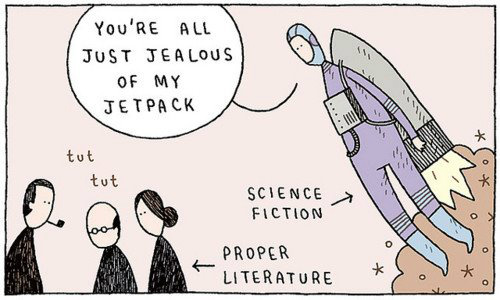
Can we all stop pretending that there is something superior about literary fiction. I’ve seen discussions of social problems in crime fiction, fantastic use of literary techniques in horror, exploration of character and humanity in science fiction; all performed with more skill and insight than I have seen in the literary genre.
How about we go back to judging a book by its cover.
You may all think that I’m primarily a crime thriller kinda guy, a lot of the book reviews I post here are for crime, crime thrillers and thrillers. My current work in progress is also a crime thriller. So I clearly fit into a very neat little box created out of stacks of James Patterson releases for the month. But I like a lot of genres, I think most readers do, in fact I’d go as far as to say that all readers read more than one genre unless they are still battling with Where’s Waldo.
Needless to say, despite my current work – and several others in the pipeline – being crime thrillers, I have several outlines for stories in other genres. One of my first big ideas – quite literally, as I have a 50 page synopsis and several instalments plotted – was for a sci-fi story. Think Jack Reacher crossed with Jet Li (Did you know Jet Li is a real life hero?) inspired by Heinlein. Anyway, the main character, Caleb, is the last of his kind and is trying to save humans from themselves, whether that be leading a civil war, or deposing dictators at the various human colonies. Of course there have to be aliens in space.
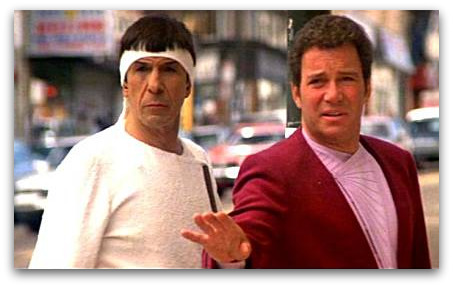
The problem I’ve always had with aliens in books and movies is that they are too much like us. On Star Trek they could even pass for us, as long as they wore a headband.
But it isn’t just that they look so much like us, why would aliens even think of us as awesome? Would humans be actually interesting to aliens? If aliens are watching our broadcasts you could just about guarantee that they don’t consider any of the life on this planet intelligent.
Alien: So you consider your race intelligent?
Human: Why yes.
Alien: Explain Glenn Beck.
Human: Okay, some of us aren’t as…
Alien: And you dig up stored gases to change your atmosphere so that it wrecks your climate.
Human: But we needed fuel for power. We’ve got solutions to that now.
Alien: One word: Politicians.
Human: Please don’t wipe out our planet!
So in my alien research for my novel/s I finally found inspiration. Who better to inspire me than Neil DeGrasse Tyson and Richard Dawkins?*
See the rest of the discussion between Dawkins and DeGrasse here.
*Yes Carl Sagan would be inspirational too, but he isn’t in the video.
Edited by Dr Sonja Boehmer-Christiansen
My rating: 5 of 5 stars
There are a lot of publications out there that specialize in short fiction. One that has stood tall amongst the Science Fiction community is the publication Energy & Environment. Published 8 times per year, this periodical prides itself on its consistent quality of short stories. It has become a renowned publication in the sci-fi community, with contributing authors often writing about an alternate reality universe, where the rules of physics do not apply.
Luminaries of the Science Fiction community have been known to publish stories in E&E, notable examples include: Dr Willie Soon, Prof Bob Carter, Prof Ian Plimer, Dr Tim Curtin, Prof Richard Lindzen, Dr Roger Pielke Sr; a veritable who’s who of the Science Fiction world. Energy & Environment attract such great writers because of the favourable editorial standards, allowing startling new sub-genres of Science Fiction to emerge. Some of the most revered works of Science Fiction have been published in Energy and Environment in the last decade as a result of the publication’s regard in the sci-fi community.
Energy & Environment is often regarded as hard sci-fi, due to its heavy use of figures and tables within the stories. These illustrations help to conjure up a vivid impression of the wonderfully weird worlds the stories are based in. Having a science background, these elements of hard sci-fi were an entertaining aside, but most sci-fi fans would be able to enjoy the fictional universes without having to take them in.
Contributors are also known to win the prestigious Heartland Institute award. This is a notable Science Fiction award given by the Heartland Institute to encourage sci-fi writers to continue their work. The award comes with a cash stipend, generously given by Heartland funders such as Exxon. A notable Australian sci-fi author, Bob Carter, is a current recipient of the award, the $1600 a month stipend helping him write sci-fi stories full-time.
If you are looking for funny, entertaining and challenging Science Fiction, then Energy & Environment has a story for you.