Rewriting the Classics

Literature that is very old has a slight problem. When they were written the authors didn’t have the advantage of our modern knowledge, they didn’t have scientific discoveries, science journals, the internet, massive libraries, etc. The advances that human knowledge has made in the last 150 years is astounding.

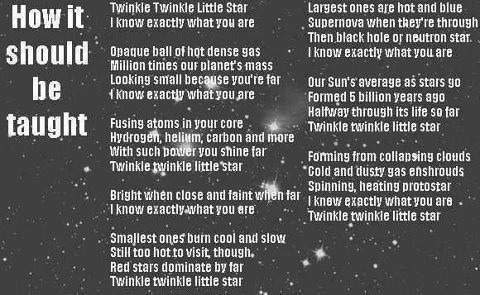
But does that mean we should rewrite the classics? Sometimes it is beneficial to leave texts just the way they were written, as it gives us an insight into the period in which they were written. A great example is Huckleberry Finn by Mark Twain, people want to edit out the racist references, yet that would remove part of the context for the struggle Jim goes through in the story. But in other cases you are merely perpetuating factual inaccuracies by teaching and reading kids some classics. As a result it is sometimes important to rewrite these texts to display our updated understandings of the world.

Science Wins!

I shall call this land… This Land.


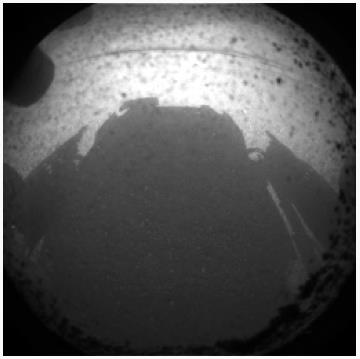
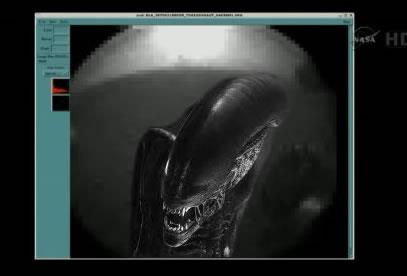
Like a few other people today, I watched the live feed of the Curiosity Rover landing on Mars. NASA were suitably pleased, I was suitably impressed and we had another win for science. Humans are capable of just about anything, it is really nice when they try to be capable. The first photo (above) was followed shortly by the second photo (below). I’ll be interested to see what it all means over the coming weeks.

Book Review: Jurassic Park by Michael Crichton

Jurassic ParkJurassic Park by Michael Crichton
My rating: 3 of 5 stars

Is Michael Crichton always this preachy?

This is the second Crichton thriller I have read and the second time I have come away noticing his anti-science rants and preachy tone. This time the anti-science diatribe was delivered by the character of Malcolm, who only seems to be in the book for his chapter long anti-science rant. I’ve heard Crichton is even worse with this novel State of Fear.

The book itself is a decent techno-thriller. It was enjoyable and moved along swiftly. One thing I did notice, though, was a tendency to weigh the story down with details. I didn’t really need to know what lines of computer code came up on the screen unless it was relevant – it wasn’t. I didn’t really need to see the DNA sequence typed out.

So you can see that I was less than impressed with Crichton again. The book was entertaining, but from this scientist’s point of view, Crichton should have spent more time writing and less time preaching.

Also, before anyone comments, yes, I am aware that this is fiction. The perils of scientific meddling have always been the cornerstone of sci-fi and techno-thrillers. There is a difference between the “what if” fictional supposition and the “look at my reference list and opinions spouted as facts” tact Crichton uses. Fiction is meant to be fun, not didactic.

View all my reviews

Intelligent life

You may all think that I’m primarily a crime thriller kinda guy, a lot of the book reviews I post here are for crime, crime thrillers and thrillers. My current work in progress is also a crime thriller. So I clearly fit into a very neat little box created out of stacks of James Patterson releases for the month. But I like a lot of genres, I think most readers do, in fact I’d go as far as to say that all readers read more than one genre unless they are still battling with Where’s Waldo.

Needless to say, despite my current work – and several others in the pipeline – being crime thrillers, I have several outlines for stories in other genres. One of my first big ideas – quite literally, as I have a 50 page synopsis and several instalments plotted – was for a sci-fi story. Think Jack Reacher crossed with Jet Li (Did you know Jet Li is a real life hero?) inspired by Heinlein. Anyway, the main character, Caleb, is the last of his kind and is trying to save humans from themselves, whether that be leading a civil war, or deposing dictators at the various human colonies. Of course there have to be aliens in space.

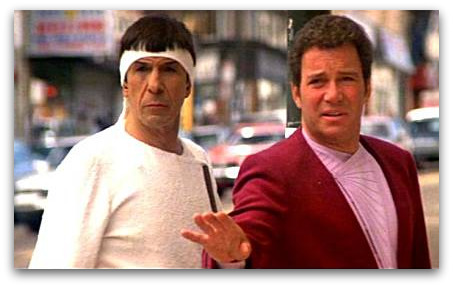
The problem I’ve always had with aliens in books and movies is that they are too much like us. On Star Trek they could even pass for us, as long as they wore a headband.
But it isn’t just that they look so much like us, why would aliens even think of us as awesome? Would humans be actually interesting to aliens? If aliens are watching our broadcasts you could just about guarantee that they don’t consider any of the life on this planet intelligent.

Alien: So you consider your race intelligent?
Human: Why yes.
Alien: Explain Glenn Beck.
Human: Okay, some of us aren’t as…
Alien: And you dig up stored gases to change your atmosphere so that it wrecks your climate.
Human: But we needed fuel for power. We’ve got solutions to that now.
Alien: One word: Politicians.
Human: Please don’t wipe out our planet!

So in my alien research for my novel/s I finally found inspiration. Who better to inspire me than Neil DeGrasse Tyson and Richard Dawkins?*

See the rest of the discussion between Dawkins and DeGrasse here.

*Yes Carl Sagan would be inspirational too, but he isn’t in the video.

Idiots are getting smarter

Ever had an argument on the internet and realise that the person you are arguing with is putting their gross ignorance on display for others to see? Have you then noticed that far too many people support their ignorance?

This post is dedicated to all the people out there who try to bring science and knowledge to the internet: may all your posts be peer-reviewed.

Compulsory viewing for thinkers

The first time I came across Brian Brushwood it was a video on how to escape from hand restraints and using those restraints to shim a door lock. I swear that I was educating myself so that I could write an escape scene in my novel. You can’t prove different!

Anyway, this video is part of a lecture that covers a lot of the scams that are going around and how to spot them. Once you’ve seen this video, check out the rest of the lecture here.

Talking Spec-Fic with Rex Jameson

This slideshow requires JavaScript.

Today we have a special guest on the site. My friend Rex is an author, science nerd and has as many degrees as I have, so you can see why we get along so well. Last year Rex released his first novel, Lucifer’s Odyssey, which I recommend for any speculative fiction and fantasy fans, and this year has released the sequel, The Goblin Rebellion (which is free for the next couple of days).

Tyson: Rex, you’ve had a busy 6 months. You have released your first novel, gotten married, released two novellas, completed a PhD and released your second novel. The obvious question I have for you is, what are you currently reading?

Rex: Unfortunately, most of my reading material has been non-fiction recently. I work in real-time, embedded systems and am involved in several interesting projects involving spacecraft, mobile devices and very soon remote-controlled drones. I’ve also been giving job talks for professor positions and finishing up my dissertation (March).

T: So boring stuff is working with real spacecraft? You just killed the dream of every boy under the age of 12.

R: Oh, I wouldn’t say it’s boring at all. I’m extremely excited about my work, and I plan on doing much more of it!

T: What about fiction?

R: The next fiction books on my list are a couple of indie author works: Moses Siregar’s “The Black God’s War” and Jennifer Rainey’s “These Hellish Happenings.” I’m also REALLY wanting to read George R. R. Martin’s epic series. It feels like I’m running into people reading a Dance of Dragons at every airport I enter, but I’ve heard stories about weeks-long splurges on his books, and I’m trying to avoid it until I’m able to really get into it.

T: Jennifer’s book is on my to-read list, which is still 6 or more months long. I found the first three Game of Thrones e-books on sale and snapped them up. Whenever I read a book or series that has taken the world by storm I am always underwhelmed. I call it the DaVinci Effect.

R: A well-chosen descriptor.

T: Thanks. How much Christian hate mail have you received so far after Lucifer’s Odyssey?

R: I wouldn’t say it’s Christian hate mail. I’ve received some sporadic messaging that I would characterize as worried. Part of being a Christian is discipleship, and some people take that very seriously. A novel that spans trillions of light years in distance and involves creatures living hundreds of millions and even billions of years does appear to conflict with strict belief in the 6,000-10,000 year old creation story.

But I honestly find it odd that this rift between modern scientific discovery and Christianity even exists. It would have been quite easy to update Christianity to account for the fossil records in a way that doesn’t involve saying “but those are all from Noah’s flood” (which is quite ludicrous) and in modifying man’s role in the universe once we realized just how massive the known universe is. Instead, many in America tend to look at science’s findings as one of God’s tests: a challenge that God has handed down to test the tenacity of their belief that every word in the Bible is in fact directly from God and thus infallible. And this kind of stubbornness to adapt to facts and findings has retarded our growth as a species since Galileo. I’ve heard from some that this voluntary impediment is in fact reasonable and expected because Eve shouldn’t have eaten from the knowledge tree to begin with…

Anyway, yes I’ve gotten some mail, but I understood I would be getting it. Most of it has been cordial, but religious figures are a touchy subject, even if they are presented in a fantastic and fictitious light in the series. The series is not intended to bash Christian beliefs by any means. It’s more of a modern retelling of the origin story with the vastness of the universe and time taken into account. I also love string theory and the concept of multiverses, time-dilation, chaos theory, and other hobbies of mine, and the only way to properly have fun with them was to set them in an expansive series of universes.

T: I like that yourself and David McAfee have both been listed on a review of your book. Apparently you’ve created a genre for Christians to get riled up about.

R: Yeah, pseudo-biblical fiction. With the way it’s defined, most fantasy could be placed in there. I’m pretty sure any book with a savior child character who is promised by prophecy in a religious tome could fall into this genre, should a comparison be wanted. Belgarion in David Edding’s Belgariad series might fall into this comparison, even though it’s unrelated to Christianity, just because a savior child is promised to the Earth and rescues the world from evil. It’s probably an appropriate descriptor for my first series, though I’d disagree with the anti-Christian characteristic for reasons stated in the comment section of that article.

T: Interestingly the entire “young Earth” thing is just one section of six views on Christian religious interpretation. Most sects are fine with science. Of course I’ve received enough death threats to understand fundamentalists are the strange cousin of any societal group, we’re all embarrassed by them.

R: The Young Earth group may be one of six Christian interpretations, but it’s hardly the minority in America. My only issue with the group is that they’ve latched onto the debates that atheists and theists have concerning the origin of the universe (i.e., Big Bang versus Creationism), and are using issues with the current perceived expansion rate of the universe as proof that the entire scientific movement is a house of cards.

For example, the fossil record is now in some way dependent on the Big Bang and collapsing expansion theory, tectonic plates are now somehow linked to weathermen not getting the weather right all the time, evolution is now directly linked to asteroids carrying microbes being the real originator of life, or climate change is suspect because it doesn’t make sense that matter can come into existence from nothing. I’ve seen all of these claims in arguments from Young Earth creationists. Even though none of these are dependent upon each other, it’s become a science versus creationism argument where all science can now be suspect simply because a Young Earth creationist is unwilling to investigate or learn about an entire branch of science–since someone has convinced them that all science is wrong and evil and counter to God’s intentions for mankind.

The result is a sustained rise of fear and ignorance, and that is a huge impediment on progress. And ultimately, I believe the continued pressure of this movement on education is causing less emphasis on math and science in American schools and is directly hindering our economy and ability to produce quality researchers, which are required for innovation and technological growth. After all, environment has a lot to do with educational responses of children. If parents don’t value math and science and look upon them negatively, children are likely to have the same feelings.

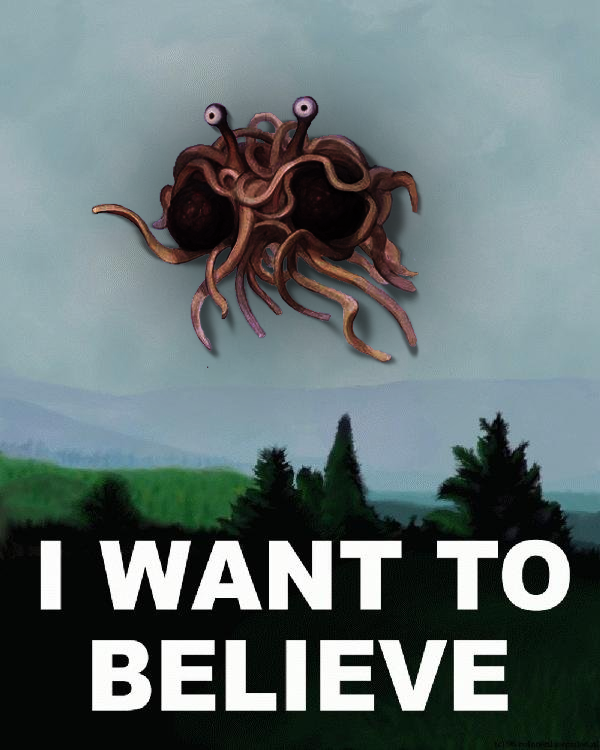
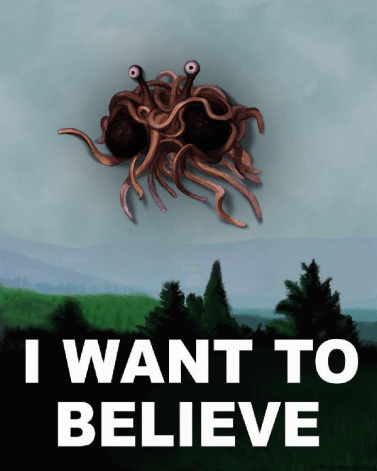
T: Can we expect to see Lucifer square off against his noodliness, the Flying Spaghetti Monster?

R: I don’t think that would be much of a fair fight. Yes, FSM has wing-like structures that might help propel him through space, but FSM’s wings appear quite squishy and obviously delicious. Lucifer appears to be made of stronger stuff in the series, and I doubt he’s anywhere near as tasty. Therefore he has fewer natural predators, a sword, the ability to open a channel to near-infinite reserves of energy in a big-bang-like state, and wings made of a nearly indestructible material–while the demons or angels are alive and their soul is present. In contrast, I’ve never seen FSM with a sword. I’ve seen him falling for the “pull my finger” routine (which shows obvious gullibility) but never wielding a scary weapon.

I’ll admit I could be underestimating his ability to smother someone with special sauce or noodly goodness.

T: You also forget his noodliness has pirates on his side. Actually: Flying Spagehetti Monster, Lucifer, Pirates, Christian outrage; add ninjas and zombies to the mix and you have the next Da Vinci Code!!

R: Heh! If only it were that easy, we could all be rich!
T: You classified Odyssey as speculative fiction, I would have called it fantasy: Wheel of Time, spec fic or fantasy?

R: In my defense, I have categorized the work as epic fantasy and space opera. I haven’t read Robert Jordan’s Wheel of Time past the first book. I recently thought about picking it up during the holidays, but then I saw the reviews for New Spring and decided against it (at least for now). I read Derek Prior’s “Cadman’s Gambit”, instead, and I’m happy I did. It’s a complicated story but good. It’s also speculative fiction/fantasy, btw.

T: I started the first in the Wheel of Time series, moved onto the Night Angel series by Brent Weeks. Fantasy always seems to be code for “I didn’t want to grab my street map for exposition”, unless it has elves or dragons in it. Apparently having a proper imagination precludes classification in other genres.
Game of Thrones, ditto, spec fic or fantasy?

R: Fantasy. I’ve seen a couple of the HBO episodes but haven’t started the book series out of fear of missing my dissertation and paper deadlines. That being said, it will be mine–oh, yes!

T: Thesis deadlines are highly over-rated. They only apply to the postgrad student and not anyone else in the chain. I still haven’t received my certificate. Actually, there is an idea for an epic thriller: “Two postgrad students (Rex and Tyson) fight the hard slog of science, peer review and the ruthless administration building to finally graduate. But will it be too late to enter the real world?”

R: Honestly, my adviser doesn’t seem like he’s in much of a hurry to get me out the door, but I’m chomping at the bit to have my own lab, target my own research grants, and teach my own classes. So, that’s really the only reason I’m pushing so hard to finish my dissertation. The job I want requires final paperwork and the funny robes, and I’m getting feedback and interest from great universities and faculty that I’d love to work with.

T: Funny robes and extra acronyms attached to your name is always handy, especially when you are arguing with the anti-science brigade.
So you’re sticking with your classification for Lucifer’s Odyssey? You could sucker a few unwitting literary fiction readers.

R: The classification of Lucifer’s Odyssey as speculative fiction comes from the fact that readers debate about whether Roger Zelazny’s Amber Series was “classic science fiction”, “fantasy”, or the much more recent “speculative fiction.” I had read some commentary on the Kindleboards from readers, and many of them seemed less offended by the label “speculative fiction” than choosing one of the categories with stricter modern interpretations of genre boundaries.

Lucifer’s Odyssey is more fantasy than science fiction, and the majority of my work will probably be more fantasy than science fiction. I chalk this up to my line of work. When you look to escape your current situation, you often go to the opposite extreme of what you do every day. Since my job has me looking at problems in satellites, rc drones, and mobile phones in mission critical systems, my writing escapes tend to be more fantastical rather than technical. I have some ideas for thrillers and pure fantasy, but I’m putting them on the back-burner until I at least finish “Shadows of our Fathers”, the third book in the Primal Patterns series.

T: I hear you there. I’m writing thrillers where the main characters get to shoot a lot of people. Shooting someone for making up their opinion on the spot, to argue with the person who has just spent the last few years researching the topic, isn’t widely accepted in society.

R: Well, I’ve noticed people are far more willing to read a book about shooting random people than a derelict homeless man dropping f-bombs when the devil kills his friend. Maybe your idea could work.

T: Are you living proof that being an author attracts the ladies, since you got married after publishing Odyssey?

R: Hah! Hardly!

Although Lucifer’s Odyssey was published last year, it started as a short story several years ago. The original story was from the perspective of Michael and involved the bar scene, the interrogation, and the escape and burial of Azazel (which was taken out completely during editing), but in a much more primitive form. And quite frankly it was terrible. Even after several rewrites, it was bad.

I met my wife while the story was forgotten in a folder on my hard drive. So, resuscitating it and redrafting it a few times resulted in far more eyerolls from her than attraction. Still, she’s awesome and incredibly supportive. It takes a special kind of person to love someone who has a job that sends them frequently abroad and often spends a considerable amount of time at a computer writing stories or developing software when they’re in the room with you. She’s a rock star and a wonderful person!

My wife pointed out that the reason I was having trouble writing any of my stories was that they were all depressing and dark. Now they are shooty and dark, so it is amazing what our partners can bring to our writing.

Actually, the novelette “Elves and Goblins: Perspectives of a Father’s Rebellion” is totally dark and shooty. Maybe one day we could collaborate on a thriller or something. Might be fun.

T: Well, we already have an idea for the plot. Although submitting a thesis at gun point and combating peer review in a death match scenario may only appeal to scientists.
I’m going to put in a spoiler alert here: at the end of your first novel Jesus ended up somewhat shorter. Doesn’t that leave the next book without a decent bad guy? Because if the sequel is Lucifer dealing with his feelings about the loss of his cat to cancer, I might not promote it.

R: Here’s an even bigger spoiler: I have no plans for putting Jesus into the series, and there’s a framework for seven books–though I only plan on doing three books in the Primal Patterns before moving on to something else for a while. That could change if readers demand it, but I think a foray into more standard fare might be something that would appeal to new readers. Contemporary urban epic fantasy like the Winter Phenomenon series I had planned or maybe expansion of one of my short stories.

T: We had a conversation about how wonderful editors are a few months ago. How do you think your editor could improve something written by the average monkey at a typewriter?

R: I’m afraid I won’t name names, but the bane of most unedited first work is head-jumping and bad dialogue. I’ve noticed many new fantasy or science fiction authors tend to do pretty well with action sequences. I say many and not most. Most self-published work is still bad, and I think all work should be edited in some way by neutral parties in your genre. The only exception to this are trained professionals or people who know how to remove themselves from the work and become neutral parties in the genre.

Another thing that an editor does for an author is give some peace-of-mind to the fiction writing process on subsequent books. When I was writing Lucifer’s Odyssey, I had a lot of self doubts about whether or not I could tell a story this complex. I’m not sure the answer is ‘yes’ yet, but from the reviews, I don’t think I’ve done a terrible job either.

A couple of readers have noted that the tone can be jarring, and after asking one of them, I was told that the tendency of Sariel to inject humor into serious situations was the type of tonal change that seemed unusual. My editor once made a suggestion on one of these, and I did tell him that I would rather Sariel remain that way because sarcasm and fraternal humor is basically how he’d gotten through life as a youngest child, a seemingly destiny-less position, in the most important family in all of Chaos. His tone changes quite a bit in the second book, but that core is still there. He’s lived for millions of years, and he still has his daredevil instincts and a frightening tendency to play with his food, even if it might kill him.

Now, I’m coming to this in a roundabout way, but I do have a point. An editor is only as useful as you let him or her be. If they make suggestions and you buck them, you better have a good reason for it, and you better be prepared to face the music when readers who want that type of sanitized feel pick up your book.

Similarly, if you didn’t expect backlash but you find it, as a self-published author you have the ability to change it. I recently removed almost all of the cursing from both “Lucifer’s Odyssey” and “Angels and Demons: Perspectives of a Violent Afterlife” because of a handful of complaints (out of thousands of readers). Why? I made a trade off.

I believe that in the real setting, the characters would have cursed, but I know that many more conservative readers would have used the cursing as an easy excuse to not read the book and allow themselves to enjoy the story. I also knew I wanted to give the book away for free for short periods of time, and from experience, I know that this particular type of reader picks up free stories without looking at the summary or the warnings, and they are more likely to leave a 1-star review. Is this my fault? No, but such a 1-star review given within days of a book’s release (especially if it’s the only one) can kill a book’s potential quickly. After re-reading the story without the cursing I felt that the compromise was worth doing.

So I think it’s important to mention that listening to your editor is vital, but so is listening to your readers. Yes, some readers are going to be wrong, and you have to understand that there’s always a vocal minority that believes their opinion is right no matter what evidence is presented to the contrary. But often, readers can be a part of the long-term editing process–the neutral genre voice that guides writing into the next book and the one after that. And that’s worth listening to!

T: Thanks to Rex for taking time out of his hectic day. Spec-fic fans should check out Rex’s writing. See my review of his first novel here.

Why being smart sucks

I like to think of myself as smart. My friends and work collegues would refer to me as that annoying know-it-all. Being smart is not actually as good as you would think. For example, having knowledge and understanding puts you at a severe disadvantage in an argument, as you are trying to be correct, rather than win the argument with made up nonsense. And, lets face it, everyone hates a know-it-all.

So here are 5 reasons being smart sucks (Original article from Cracked.com with some edits by Tyson Adams. Original here).

5) You’re Probably a Night Owl – And That’s a Bad Thing

Recently, scientists discovered a quirky side effect to having a high IQ: You tend to stay up until later hours and get up later in the morning. That’s right – the more intelligent are also much more likely to be night owls. Which isn’t such a surprise when you consider that intelligent people are infamous for burning the midnight oil to cram for tests, write papers, touch up those earnings reports, etc.It appears to just be evolution – the more intelligent members of a species are, in general, the first to change habits. Since humans have been day-dwellers during most of their existence, it’s primarily the smarties who prefer to habitually stay up until the wee hours and to do the types of tasks that are easier to accomplish when you don’t have the day-dwellers hanging around and distracting you.

Of course being a night owl does have some negative side effects, or rather a lot that will screw up your health. For starters, studies have found that “eveningness” is associated with a high degree of emotional instability. That means you tend to be less agreeable and conscientious than the average Joe. Oh, and you don’t just make others’ lives miserable. Thanks to your late-night habits, likely brought on by high intelligence, you’re also three times more likely to suffer symptoms of depression. According to a number of studies, night owls are at higher risk for heart disease and suffer more arterial stiffness than those who go to bed early. People who tend to stay up late also tend to do other unhealthy things at night, such as overeating. Then, once they do eventually hit the hay, they experience more sleep interruptions when those pesky morning larks get up and start noisying about. All this adds up to some nasty artery stress and whacked-out circadian rhythms, a nice recipe for a massive coronary.

4) You’re Less Likely to Pass On Your Genes


Another unfortunate stereotype of smart people is that they’re socially awkward nerds who are doomed to lives of celibacy until they get out of high school hell. Unfortunately, that one turns out to be totally true. But it’s not all bad news. There’s evidence that the highly educated get more enjoyment out of sex than the dumb jocks and that they make the woman in their lives happy. Yes, monogamy.

It all starts with the smart ladies. A 2008 national census reported that women who had dropped out of high school had the most children on average. And the more education women achieved, the fewer children they were likely to have, with the fewest children being born to women who had finished graduate school. Good news for overpopulation, bad news for picking up. Well, unless you want a dumb chick, who is likely to trap you with an unwanted child, as research found that women with lower IQs are less likely to know how to use birth control properly, leading to more unplanned pregnancies. Looks like Idiocracy was a startling insight into our future society.

 3) You’re More Likely to Lie

Tyson note: I’m not sure I agree with this point because it assumes we are manipulative bastards. From my own experience managers are moronic manipulative bastards and they are usually following the Dilbert  Principle.

The problem with being the smartest guy in the room is that you usually know you’re the smartest guy in the room. For some people, that’s not a big deal. They can relate to others just fine and know how to navigate around everyone else’s deficiencies without being complete pricks. Others, however, know they have an intellectual edge and can’t help but abuse it.

In order to lie and get away with it, you also have to keep the truth in mind and manipulate it, and you might even have to cover up your lies upon further questioning. All of this involves integrating several brain processes in much the same way that you would solve a complex calculus problem. This means that the age at which you start lying, and the effectiveness with which you do it throughout your life, are controlled by how smart you are.

In one study, scientists put people in brain-imaging machines and found that the regions of the brain that light up when a person metaphorically sets his pants on fire are the same that control “executive functioning.” These are high-order thinking and reasoning abilities that include working memory, which, you guessed it, is the single biggest component of your IQ.

2) You’re More Likely to Believe Bullshit

We’re sure that at some point, someone has told you that you can’t get anywhere without an education, and for the most part, they’re right. And you’re much more likely to pursue that education if you’re starting out with a high IQ. According to renowned intelligenceologists who painstakingly measured every goddamn thing that you can associate with IQ, test scores were “the best single predictor of an individual’s years of education.”

The problem is that education leads to one overall inaccurate belief: You think you’re smarter than you are. Three studies have found that people who fall for investment scams are better-educated than the average person but don’t seek advice because they think they’re immune to making mistakes. In one study, researchers found that 94 percent of college professors think their work is superior to their peers’. These fellows fail to realize that intelligence doesn’t always translate to real-world ability, and thus they tend to overestimate the quality of their work.

Via Smartiq.com
Whoa! Sure is getting crowded at the smart end of the bell curve. Right, guys?

It seems to go back to the old saying about how the wisest man is the one who realizes he knows nothing. Or, as Michael Shermer, the author of Why People Believe Weird Things, puts it: “Smart people believe weird things because they are skilled at defending beliefs they arrived at for non-smart reasons.”

That’s why the more education you get, the more likely you are to believe in, say, ghosts and the supernatural. One study found that 23 percent of college freshman believed in the paranormal, compared with 31 percent of seniors and 34 percent of graduate students. Which leads us to wonder … what the fuck are schools teaching these days?

1) You’re More Likely to Be Self-Destructive

On one hand, it seems like the smarter you are, the greater your ability to know the dangers of, say, shooting heroin. So self-destructive habits are traits of the low-class and stupid, right? Eh, not really…

The thing is, the great minds have something in common with proverbial death-prone kitties: curiosity. Researchers have finally begun to understand the link between curiosity and intelligence on the molecular level, thanks to scientists from the University of Toronto and Mount Sinai Hospital who discovered a protein in an under-explored part of the brain that controls both traits.

Via Wiredtowinthemovie.com
It’s always in the last place you look.

Makes sense. Weird shit like monkey-powered time machines can be invented only by people with enough brain smarts to make them work and enough curiosity to want to see such awesomeness in the first place.

So extra-curious people are also extra-likely to be substance abusers. British scientists published the results of a long-term study showing that smart people were more likely to be drunks. People who fell into the “very bright” category (IQs of 125 or greater, that’s me) were not only more likely to experiment with alcohol but also were more likely to drink excessively and binge drink than their dimwitted counterparts. And they found the same link between high intelligence and psychoactive drug use. It also turns out that intelligent people are much more likely to indulge in illicit substances such as marijuana, Ecstasy, cocaine and heroin. The smarter you are, the more likely you are to be tripping balls at any given moment.

As for why, remember when we said earlier that smart people’s brains seek out novelty and thus are the first to experiment with any new habit? Well, one theory explaining the link between substance abuse and intelligence is that both alcohol and drugs are novel substances, in evolutionary terms. Humans have been consuming alcohol for only about 10,000 years, and the earliest recorded drug was only 5,000 years ago. So when something is novel, the curiouser and most intelligent among us are more likely to want to try it out.

You know. For science.

Reason Rally – Adam Savage

As a fiction author I am rather disturbed by the anti-science trend that appears to be occurring in society. If the real world treads into fictional territory all the time then fiction authors will have to start writing non-fiction. I think we can all agree that science is a good thing and that fiction should remain in the books that we read and movies/TV that we watch.

Adam Savage gave a good speech at the Reason Rally on the weekend, check it out.

Book Review: Energy & Environment – short story collections

Edited by Dr Sonja Boehmer-Christiansen
My rating: 5 of 5 stars

There are a lot of publications out there that specialize in short fiction. One that has stood tall amongst the Science Fiction community is the publication Energy & Environment. Published 8 times per year, this periodical prides itself on its consistent quality of short stories. It has become a renowned publication in the sci-fi community, with contributing authors often writing about an alternate reality universe, where the rules of physics do not apply.

Luminaries of the Science Fiction community have been known to publish stories in E&E, notable examples include: Dr Willie Soon, Prof Bob Carter, Prof Ian Plimer, Dr Tim Curtin, Prof Richard Lindzen, Dr Roger Pielke Sr; a veritable who’s who of the Science Fiction world. Energy & Environment attract such great writers because of the favourable editorial standards, allowing startling new sub-genres of Science Fiction to emerge. Some of the most revered works of Science Fiction have been published in Energy and Environment in the last decade as a result of the publication’s regard in the sci-fi community.

Energy & Environment is often regarded as hard sci-fi, due to its heavy use of figures and tables within the stories. These illustrations help to conjure up a vivid impression of the wonderfully weird worlds the stories are based in. Having a science background, these elements of hard sci-fi were an entertaining aside, but most sci-fi fans would be able to enjoy the fictional universes without having to take them in.

Contributors are also known to win the prestigious Heartland Institute award. This is a notable Science Fiction award given by the Heartland Institute to encourage sci-fi writers to continue their work. The award comes with a cash stipend, generously given by Heartland funders such as Exxon. A notable Australian sci-fi author, Bob Carter, is a current recipient of the award, the $1600 a month stipend helping him write sci-fi stories full-time.

If you are looking for funny, entertaining and challenging Science Fiction, then Energy & Environment has a story for you.

View all my reviews

What can you achieve?

There was something on the TV last night, I think it was a moth attracted to the bright screen. Fortunately the ‘moth’ flapping around didn’t distract me from someone talking about being your best. Best? There is always the question of ability and effort. No one would doubt that effort is involved in achieving something, but some people have to work really hard just to be average, just visit any shopping mall for confirmation. And what if you are lazy, are you aiming too high in your career? My inner science nerd sent me to Google Scholar to find out what various people can achieve.

Real-life accomplishments

Average adult IQs associated with real-life accomplishments:

  • MDs or PhDs (postgraduates) 125

  • College graduates 115

  • 1–3 years of college 105-110

  • Clerical and sales workers 100-105

  • High school graduates, skilled workers (e.g., electricians, cabinetmakers) 100

  • 1–3 years of high school (completed 9–11 years of school) 95

  • Semi-skilled workers (e.g., truck drivers, factory workers) 90-95

  • Elementary school graduates (completed eighth grade) 90

  • Elementary school dropouts (completed 0–7 years of school) 80-85

  • Have 50/50 chance of reaching high school 75

Average IQ of various occupational groups:

  • Professional and technical 112

  • Managers and administrators 104

  • Clerical workers; sales workers; skilled workers, craftsmen, and foremen 101

  • Semi-skilled workers (operatives, service workers, including private household; farmers and farm managers) 92

  • Unskilled workers 87

Type of work that can be accomplished:

  • Adults can harvest vegetables, repair furniture 60

  • Adults can do domestic work, simple carpentry 50

  • Adults can mow lawns, do simple laundry 40

There is considerable variation within and overlap between these categories. People with high IQs are found at all levels of education and occupational categories. The biggest difference occurs for low IQs with only an occasional college graduate or professional scoring below 90.

So there you go, now you know just how hard you have to work. And just remember, in a democracy the vote of the highly educated is given the same value as those who think mowing a lawn is mentally challenging.

Science writing explained

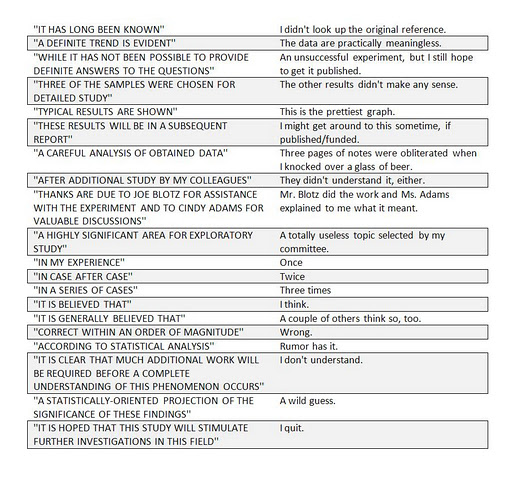
Language is very important for scientists, as they are often authors as well. Their medium is the communication of data and knowledge to further understanding. The problem with science is that a lot of scientists prefer to make their statements as vague and non-committal as possible. In keeping with my previous explanations of music reviews and book reviews I have found a few science terms explained. This list has helped me, I hope it helps you.

Reading is good for the brain

I may have mentioned it before, but I am a science nerd. Now that that is out in the open I’d also like to remind you that I’m also a thriller writer with muscles, so sand kickers; you will need to think twice about that.

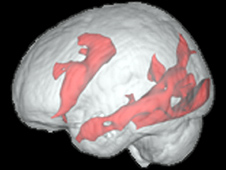
What I love about science is the way it goes about trying to understand the universe. In fact science even came up with a few studies on how reading is fantastic for you. Psychologists from Washington University used brain scans to see what happens inside our heads when we read stories. They found that ‘‘readers mentally simulate each new situation encountered in a narrative”. The brain weaves these situations together with experiences from its own life to create a mental synthesis. Reading a book leaves us with new neural pathways. Read more here. Nicole Speer, also from Washington University, utilized brain-imaging to look at what happens inside the brains of participants while they read. She discovered that as people read, they are constructing a virtual reality inside their heads every time they read. Read more here.

A reader’s brain in action.
I think this is fantastic evidence to wave at people, “See, you should read the book instead of only watching the movie.” Rather than readers having this inkling that their brains are running like a well oiled machine, we have actual evidence of this. Without evidence, claims are not worth the air they consume, just ask anyone who has tried to get conspiracy theorists to provide evidence for their claims.
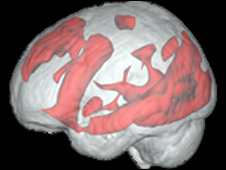
Need more proof? Well how about this article. So not only is reading good, but exploring and interacting with what you are reading is even better. Surfing the net, getting lost in a fictional world…. wait that is the same point twice. Anyway, it leads to even more brain activity.

Surfing the net brain in action.

Now before you all go in search of internet porn to enlarge your brain, I just wanted to air a gripe I have with science reporting in the media: IT SUCKS. Yes, that’s right. Reporters are probably the least reliable avenue for the dissemination of science to a wider audience. Scientists themselves often rank just as poorly of course, with their annoying habit of wanting to tell you about the 10 years they have just spent looking down a microscope so that you appreciate how much work went into the facts they are about to impart.

So as part of growing your brain with reading and internet browsing, please spend some time searching for and reading the original scientific papers that are reported. If it wasn’t peer reviewed, then it could have been made up, like that rubbish about us only using 10% of our brain.

Book Review: Climate Change Denial – Heads in the Sand

Climate Change Denial: Heads in the SandClimate Change Denial: Heads in the Sand by Hadyn Washington and John Cook
My rating: 4.5 of 5 stars

It takes a while to read a book during your lunch break at work. It can take even longer if the book you are reading is filled with interesting tidbits of referenced information, which then inspires you to read the original research paper. I suppose that is the best thing about Washington and Cook’s Climate Change Denial, it is filled with interesting research and arguments, all concisely expressed for anyone with an interest in the future of our planet.

Usually I have an issue with non-fiction books. Often times the non-fiction genre is filled with work that lacks credibility or validity. Non-fiction is also prone to the shouting polemic, which is all doom and gloom, and short on any solutions. Climate Change Denial is the opposite, with a very well researched base of information, well rounded and reasoned arguments and an entire chapter devoted to the solutions for both denial and climate change.

What interested me was the mindset of denial. I’ve done a lot of reading of the peer reviewed literature on climate change (hint: the world is getting warmer, it’s our fault, we need to take action now) and have been frustrated with the same debunked arguments arising time and again. Now I understand why, well, aside from the massive fear and smear campaign waged by denier groups with oil $$. I also appreciated the candid debunking and slaying of the red herrings (e.g. we need to adapt) and white elephants (e.g. carbon capture and storage) often associated with the climate change debate.

This is a great book for the climate change extension people, for those who are undecided on the topic, and a must read for politicians (this book has been given to every Federal Government minister in Australia). Those who read it now have the job of converting the deniers, logic and science will prevail, but it would be nice to have that happen sooner rather than later.

Also worth reading John Cook’s fantastic site.

View all my reviews

Marketing ideas – Jesus style

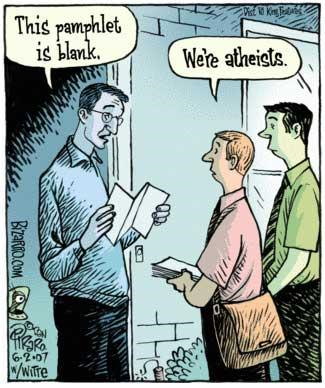
We had a knock on the door this morning. A lady was inquiring if we “followed the bible”. My immediate reaction was to say something like, “Inanimate objects don’t really take me places these days.” Of course I was very polite and told her that my dog was hungry. She persisted with, “Do you follow God?” to whit I retorted, “Which one?”

I should point out at this juncture that I’m not against religion or religious people. Religion has done some good things and it has done some bad things. If we were to express their good versus bad as a baseball batting average, then I’d have to learn something about baseball.

Anyway, this got me thinking, which has been known to happen occasionally. Religious people are often very keen to sell their religion door-to-door. They often have pamphlets, invites to their church (or whatever), or even their indoctrination material for sale. I am yet to have a scientist knock on my door of a Sunday morning, “Have you heard the word of Newton?” At least with scientists door knocking they could fix the zero-point anomaly in our laundry; it’s starting to cause a gravity sink.

See, this would be brilliant marketing for any author. Imagine an entire squad of people devoted to spreading the word about your book/s. Unpaid labourers whose goal it was to sell your writing to everyone. Of course this wouldn’t be easy to arrange. I’m not sure I can afford the price of souls these days – what with the economy and all – so getting boots on the ground might either take a lot of  enigmatic persuasion or be the realm of wealthy authors.

There are plenty of examples of this happening. If you do a little digging you can find how L Ron Hubbard got his book Battlefield Earth on the bestseller lists. Every Scientologist was sent out to buy a copy, which they then sent back to the “church” (I use that term loosely) and the books were sent to the stores again to be resold. Brilliant!

Obviously not every author can create their own religion to sell books, but maybe there is something to be made use of here. Maybe your local Jehovah’s Witness may need some extra redemption and would like to sell your book door-to-door if you promise to not set the bear traps on the doorstep. Think about it!

Shark attack

I don’t normally comment on current affairs or the news in this blog, because normally the news can be summarized as: war, death, famine, kitten in tree, sport. Of course that is the 24 hour news channel version, the network news shows are more along the lines of: human interest, war, kitten in tree, tragedy, dog puppy in tree, sport, sport gossip. But this news is somewhat baffling.

Apparently Western Australia is going to have a shark cull in an effort to try and kill a white pointer believed to have killed three people recently (article here).

Not too difficult to understand is it? Three deaths in a short amount of time when the world averages 5 deaths per year is something that people start worrying about. What is baffling though is that we are concerned about 3 deaths. People are 300 times more likely to drown than die from a shark attack in Australia. Or put another way, if you wanted to get rid of that jerk at work, you could save the expense on the shark and just use water (see this article on sharks and risk).

Human Deaths in Australia Between 1980-1990, Inclusive (from Stevens & Paxton, 1992)
Cause of Death
Total Deaths
Average per year
Crocodile Attacks
8
0.7
Shark Attacks
11
1.0
Lightning Strikes
19
1.7
Bee Stings
20
1.8
Scuba Diving Accidents
88
8.0
Drownings/Submersions
3,367
306
Motor Vehicle Accidents
32,772
2,979

Last time I checked the Great White Shark was an endangered species and humans are at near plague proportions, especially Americans – the shark’s favourite food. Sixty one percent of the world’s shark attacks are in North America and American’s are making popular shark food in Australia as well. See the big mistake here is that sharks keep mistaking Americans for food.

Now I’d be the first to admit that Americans are very tasty, something has to come of that high fat and sugar diet. But what we really need to do is help Americans to stop looking like food. Is it just that Americans are tastier than the rest of the world’s people? Is it genetic? Or are is it just that the people who were attacked by a shark looked too much like a seal? Either way it is clear that the worry over sharks is more about them not being cute enough, maybe Spielberg should do a revised Jaws movie that focuses on the danger of mosquitoes: When you hear them buzz, you’re DEAD!

Math Shouldn’t Be Taught In Schools

This of course follows on from earlier interviews about whether schools should teach evolution.

I’m glad that people get such a good education in this day and age. My text book on celestial orbits around the Earth – with calculations of how flat our Earth is – will no doubt be in curriculum’s world wide soon. It is entitled The Science of Flat Earth.