Book review: A Little History of Philosophy by Nigel Warburton

A Little History of PhilosophyA Little History of Philosophy by Nigel Warburton

My rating: 5 of 5 stars

If by doubting your existence you prove that your doubting thoughts exist, what happens if you then doubt your doubts?

A Little History of Philosophy is pretty much summed up by its title. It spends a chapter on each famous Western philosopher or movement (e.g. Aristotle gets a chapter; Sartre, Camus, and de Beauvoir share one) and takes a shallow dive into each. Nothing more, nothing less.

After recently reading Bertrand Russell’s A History of Western Philosophy I thought I’d read a book that covered the same topic with less of the surrounding history and more of the philosophy overview. Nigel Warburton does this well in a brief, clear, and accessible manner. A strength of the overview is how he ties theories and influences together (e.g. Brentham to Mill, Mill to Russell) so that you can see how thinking has evolved. A negative is the sometimes tenuous segues Warburton uses to end a chapter. Seriously, you really start to notice it and laugh.

This was a great way to dip my toes into philosophy. Between Russell and Warburton I feel I’ve been given enough to start the journey down the rabbit hole. Made me think.

View all my reviews

Book vs Movie: Stephen King’s It – What’s the Difference?

maxresdefault

With the release of the new movie adaptation of Stephen King’s It, unsurprisingly this month’s What’s the Difference? from CineFix is covering the book vs the 1990 mini-series.

The It mini-series come out on video – yes VHS, yes I am old – when I was just at the start of my teenage years. The adolescent characters facing the genuinely scary Pennywise was too much for me. Tim Curry’s portrayal of the demonic clown left me sleepless for a week. It is the only movie to have ever had this much of an impact on me.

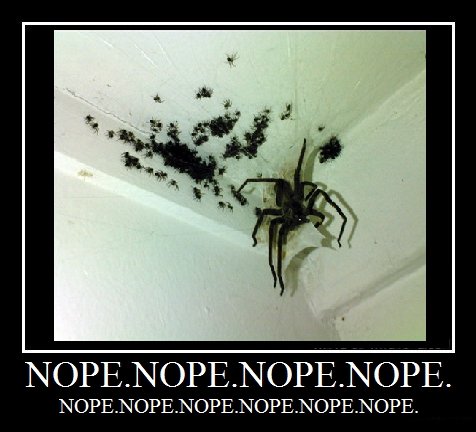
I mean Pennywise is already a scary clown. But he turns into a giant nope. In Australia we’re wary of tiny nopes. A giant nope is a ticket to nightmares.

nopenopenope_e5af97_2685388

So guess what book I refuse to read and which recent adaptation I won’t be watching.*

Although, apparently the new movie is genuinely good:

*Yeah, I know, I probably wouldn’t find it scary now. I probably will eventually read the novel and watch the new movie. Maybe.

Book Review: Babylon’s Ashes by James SA Corey

Babylon's Ashes (The Expanse, #6)Babylon’s Ashes by James S.A. Corey

My rating: 4 of 5 stars

Take my love, take my land.
Take me where I cannot stand.
I don’t care, I’m still free.
You can’t take the sky from me.
No parallels at all.

The Free Navy have demolished Earth. They’ve taken over the system with their surprise attack utilising the latest Martian technology. Now Earth and Mars are fighting back. Cracks are appearing in the Free Navy’s plans, like the fact that they have wiped out food production and have 3 years left before humanity collapses. Great time for Marco – hubristic leader of the Free Navy – to pursue his grudge against Holden, Naomi, and the rest of the Rocinante crew.

I’ve been looking forward to reading Babylon’s Ashes since finishing Nemesis Games. The staging of a war, the political conflicts, the host of interesting and complicated characters; this was set to be a ripper of a novel. So I was a little disappointed and found myself plodding through some of the story.

This was partly my own fault, as I have less concentrated reading time currently. When I did get quality reading time the book was as entertaining as anything in this series. It was also partly that the character of Marco Inaros was fully revealed for a narcissistic authoritarian populist who is more intent on punishing minor sleights than running the galaxy (gee, wonder if he’s modelled after any particular political leader). It didn’t help that there was a tinsy bit of plot contrivance – albeit one that has had quite a bit of setup – in the final moments of the plot.

Despite these points, I did actually enjoy Babylon’s Ashes. It wasn’t the strongest instalment in The Expanse, but this still remains a stellar series.

View all my reviews

Reading is good for the brain…. d’uh

I may have mentioned it before, but I am a science nerd. It may also be painfully obvious that I like reading. And before you ask, yes I do wear glasses and own a lab coat. I can fancy dress as anything from a doctor to a scientist.

What I love about science is the way it goes about trying to understand the universe. In fact science even came up with a few studies on how reading is fantastic for you. Psychologists from Washington University used brain scans to see what happens inside our heads when we read stories. They found that ‘‘readers mentally simulate each new situation encountered in a narrative”. The brain weaves these situations together with experiences from its own life to create a mental synthesis. Reading a book leaves us with new neural pathways – although that’s hardly surprising nor unique.

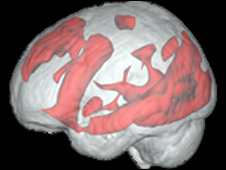
Nicole Speer, also from Washington University, utilized brain-imaging to look at what happens inside the brains of participants while they read. She discovered that as people read, they are constructing a virtual reality inside their heads every time they read. That’s a fancy way of saying they imagined the stuff they were reading.
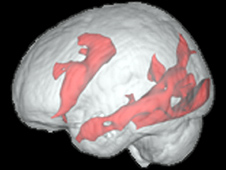
A reader’s brain in action.

So. The book is better… Who’d have thunk?

It is good to have some evidence that our brains get more out of reading. Without evidence, claims are not worth the air they consume. Just ask anyone who has tried to get conspiracy theorists to provide evidence for their claims.

Another study scanned readers’ brains to see how reading compared to web browsing (reading plus).*

Each volunteer underwent a brain scan while performing web searches and book-reading tasks.

Both types of task produced evidence of significant activity in regions of the brain controlling language, reading, memory and visual abilities.

However, the web search task produced significant additional activity in separate areas of the brain which control decision-making and complex reasoning – but only in those who were experienced web users. (Source)

Brain activity in a personal not used to using the web while reading

Brain activity in web newcomers: similar for reading and internet use
Surfing the net brain in action.

The researchers said that, compared to simple reading, the internet’s wealth of choices required people to make decisions about what to click on in order to get the relevant information. So not only is reading good, but exploring and interacting with what you are reading is even better. Surfing the net, getting lost in a fictional world…. wait that is the same point twice. Anyway, it leads to even more brain activity.

Now before you all go in search of internet porn to enlarge your brain, remember that you’re meant to be reading the porn sites for the articles.


* It took me a bit of searching to find the original journal paper for this study. The BBC article and original press release were easy. A personal gripe of mine is when press releases and news articles fail to link to the original article so that we can fact check the claims. So as part of growing your brain with reading and internet browsing, please spend some time searching for and reading the original scientific papers that are reported. And if it wasn’t peer reviewed, then it could have been made up, like that rubbish about us only using 10% of our brain.

Things they don’t tell you about air travel

Flying is a modern luxury marvel we take for granted. There was a time when popping overseas for a weekend holiday was a ridiculous proposition. Around that same time I was trudging forty kilometres to school through two metres of snow.

Whenever I’m on a plane it is about the only time I’m sorry that I live remotely to the most isolated capital city in the world. People complain about the long haul flights to various destinations, well I had to catch a long haul just to get to the long haul connection. It gives you a lot of time to think about the realities of air travel.

1) If things get really bad, the pilots have ejector seats.
They may be called ‘captains’, but they have no intention of going down with the ship.

2) You are not Ralph Fiennes or Tiger Woods.
And let’s face it, flight attendants have standards even if you were.

3) First class is a myth. They wouldn’t be seen on the same plane as ordinary people.
Rich people are afraid they might catch poor.

4) If you see gremlins on the wing, you have been lucky and received the non-watered down alcohol.
Keep drinking, you might see Elvis and Hendrix.

5) Yes, the seats are deliberately designed for people smaller than you.
Airplane designers were assured that no-one over 175cm and 80 kilos would ever go anywhere.

6) The bookings system takes into account claustrophobia in the seating assignments.
They immediately assign the claustrophobics to seats between the largest people on the flight.

7) People with a fear of flying are catered for.
Their in flight movies are ‘Airplane’ and ‘Alive’, plus they are spared from all the turbulence warnings. Comes as a real surprise.

Science writing explained

stand-back

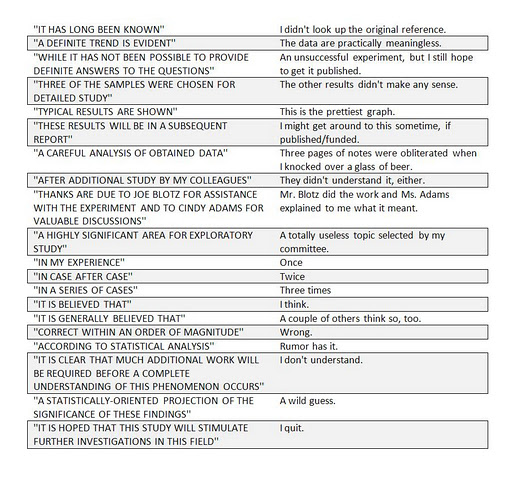
Have you ever heard a scientist talk and wondered what the hell they were saying? Did they use the word theory to mean something other than “I reckon”? Well, you’re not alone.

Language is very important to scientists. Without precise language there would be no way for them to write peer reviewed papers that could send an insomniac to sleep. Communicating science is all about letting everyone in on the data and knowledge that is being accumulated in the endless march forward into the unknown. But because scientists are marching into the unknown, they prefer to make their statements as vague and non-committal as possible. This way, if they are correct they have cautiously alluded to the right answer, and if they are wrong they can pretend their statement was hinting at the correct answer all along.

In keeping with my previous explanations of music reviews and book reviews I have found a chart explaining science terms. This list has helped me, I hope it helps you too.