Book Review: King City by Lee Goldberg

King CityKing City by Lee Goldberg

My rating: 5 of 5 stars

Another fantastic Lee Goldberg book. It was a hard call of whether this was a four or five star book, so 4.5 stars it is.

There is a lot to enjoy about this book. It moves at a reasonably fast pace, it has some interesting characters, there is a bit of humour thrown in for good measure and it harkens back to the westerns and Dirty Harry. You really do get the image of the tough guy pulling up his collar against the cold as he strides across the street.

I think the easiest thing to say about this book is buy it. Anyone who is a fan of the crime thriller genre will enjoy this, and I’m going to keep an eye out for more Tom Wade adventures in King City.

View all my reviews

Book Review: Blind Eye by Stuart MacBride

Blind Eye (Logan Mcrae, #5)Blind Eye by Stuart MacBride
My rating: 3 of 5 stars

My first Stuart MacBride novel, as read by Stuart MacBride, with funny voices by Stuart MacBride.

My wife and I had this book on CD for our holiday driving, following the adventures of Logan McRae. My wife felt the story was dragged out a bit too much, I felt that Logan really needed to go postal on his bosses.

This was quite a good novel, but would only really appeal to the crime genre fans. If you don’t like the drama of the investigation *cough* my wife *cough* then this story won’t interest you. If you currently feel like hitting your boss repeatedly over the head with office stationery, then this book will make you even more inclined to do so, as you empathise with the protagonist. If you prefer straight-forward plots, once again, not for you. If you like Scottish accents, you’ll love this book.

View all my reviews

Book Review: Vodka Doesn’t Freeze by Leah Giarratano

Vodka Doesn't Freeze (A Detective Jill Jackson Mystery #1)Vodka Doesn’t Freeze by Leah Giarratano
My rating: 5 of 5 stars

I’m really unsure whether to rate this a 4 or a 5. Lets call it 4.5

It was only just over a day ago when I gave up on a book. I found I was putting off reading, a clear sign that the book sucked. So I moved on, moved on and picked up Leah Giarratano’s first novel. This book was just what I needed.

I met Leah at the Perth Writers’ Festival. Aside from being one of the nicest people you will meet, she is also a very good crime writer. Lots of people agree with me, as she is a best-seller here in Australia. She draws on her background in psychology to delve into the dark corners of the Australian underworld. She spoke of this book being a catharsis from her day job and when you read it (yes you will go out and buy it and read it, I’ll wait here) you will notice that in the story.

The first book I read in the Jill Jackson series was the most recent, Watch the World Burn. I can’t wait to read the books I’ve missed in the series. Currently Leah is publishing some young adult books (Disharmony: The Telling, comes out later this month) so Jill may not be having a new crime to solve for a year or so.

View all my reviews

Book Review: The Broken Shore by Peter Temple

The Broken ShoreThe Broken Shore by Peter Temple
My rating: 4 of 5 stars

I was having a chat with a friend at a party when Peter Temple came up as a must read author recommendation. I’m rather naive when it comes to new and established authors, I don’t seem to have the inside scoop on Aussie writers the way I do with overseas talent. It wasn’t long afterwards that Peter Temple was mentioned again at the Perth Writers’ Festival. So I bought two of his books, Truth (ebook version) and The Broken Shore.

Now the recommendations for Peter Temple came from literary people, people whose recommendations I try to avoid like trips to Canberra and prison showers. But these recommendations carried weight, as one of them was a Lee Child and Michael Connelly fan. I can see why Peter is an award winning novelist, but I can also see why he is highly regarded amongst authors – like I said, naive. This is a crime novel, but not quite like most crime novels. I’d put Peter in the same category as James Lee Burke, Ian Rankin and Michael Connelly, except his work is more literary.

Also, it is sad that Peter isn’t as internationally recognised as those authors I have likened him to. This book was equal to any of those authors. So read Peter and make sure his work hits the international market, where it belongs.

View all my reviews

Book Review: Hell’s Kitchen by Jeffery Deaver

Hell's KitchenHell’s Kitchen by Jeffery Deaver
My rating: 4 of 5 stars

There is something about a mystery novel that can be either entertaining or dreary. Ultimately you want the mystery and suspense; but not too much. If the mystery is too simple, then *yawn*. If it is too complicated then you start to think it is all too hard or that the author had finished the mystery and realised they had another 200 pages to fill.

This is my first outing with Jeffery Deaver and I can see why he is so highly regarded with his mystery writing. He treads that fine line between too much and too little with a cool hand. There was much more to this story of catching a fire-bug for hire, with the climax really pulling me in.

Part of the balance came from Jeff’s use of Hell’s Kitchen as the setting and the local residents as layers of story. For the most part the exposition felt necessary and served the larger mystery.

The version I listened to was read by Paul Birchard who did as many accents as an American can in his reading.

View all my reviews

Book Review: Parallax by Jon F. Merz

ParallaxParallax by Jon F. Merz
My rating: 4 of 5 stars

The paranormal is an interesting genre for me. As some of you may have guessed, I’m a scientist and skeptic. Basically this means I want evidence of claims, not some beliefs and suppositions. Prove it to me.

When it comes to entertainment, the assumption would be that anything other than realistic fiction is not going to grab me. The key word here is fiction. Just as Lt. Shane Shcofield’s adventures are as realistic as Abraham Lincoln being a vampire hunter, the paranormal can be just as entertaining to this scientist and skeptic.

This is the second of Jon’s books that I have read. Parallax was a very entertaining read that reminded me of some of the earlier paranormal works I read that combined the paranormal with the crime or noir genres. This novel works as a straight crime story, the mental link between the two main protagonists serving as a twist on the formula.

Worth checking out if you like a tale about hitmen having to redeem themselves.

View all my reviews

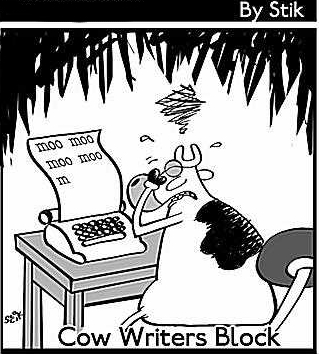
Combating Writer’s Block: Advice by Genre

There is no worse disease for a writer than writer’s block. I’d also say that writer’s block is terrible for readers too, uninspired prose is what we expect from policy and political people, not our entertainment. I’m a fan of Stephen King’s writing advice: set a daily word goal and stay at it until you reach the goal. There is something about daily writing and forcing yourself to write that seems to make things flow.

But Tyson, I hear you say, I’m stuck with no ideas for what to write next. Luckily I was procrastinating whilst writing the other day and came up with a definitive fail safe for each major genre. Any additions are welcome in the comments.

Thriller Writers
When writer’s block strikes kill someone or blow something up.

Crime Writers
When writer’s block strikes describe the main character getting drunk and wallowing in self pity.

Mystery Writers
When writer’s block strikes introduce a red herring.

Romance Writers
When writer’s block strikes introduce new character with rock hard abs.

Literature Writers
When writer’s block strikes describe a tree in intimate detail.

Fantasy Writers
When writer’s block strikes have a talking dragon appear, or have the characters go on a long walk somewhere.

Sci-fi Writers
When writer’s block strikes cut and paste physics article from Wikipedia into your novel.

Horror Writers
When writer’s block strikes cut and paste autopsy reports into your novel.

Paranormal Writers
If you already have vampires, ghosts and werewolves in your novel, introduce ninjas and pirates as characters.

If you are really stuck after all of these ideas, then there is no novel in existence that can’t/couldn’t be improved by the addition of pirates and/or ninjas.

Book Review: The Black Echo by Michael Connelly

The Black EchoThe Black Echo by Michael Connelly
My rating: 5 of 5 stars

It took a while to work through my to-read list and make it to my signed copy of The Black Echo. I met Michael at the Sydney Writers’ Festival, had the customary quick chat and walked away with a couple of his books signed – made it worthwhile bringing that book from home. This gives you an idea that I have roughly a 8-9 month to-be-read list that isn’t really becoming any shorter.

For those crime genre fans who haven’t heard of Michael Connelly or his Harry Bosch series, I’d suggest that the rock you are living under is a little cramped and this book should encourage you out into the fresh air. When Michael writes a crime novel it is an intensely good read from a master in the genre. Don’t believe me? They asked him to come on the TV show Castle because of his writing cred. If I have one criticism of the Bosch series it is that not every book is as compelling as this one. I was not a fan of City of Bones, despite it being an adequate crime novel.

Of course, I can’t post a Michael Connelly review without my favourite moment from his appearance on TV. Enjoy.

View all my reviews

Book Review: The Hunter by Richard Stark

I know, another book review and none of my usual wit and original material. Bear with me, I’ve been doing a lot of reading lately to make up for the fact I’m back at work. Christmas holidays are always too short.

The Hunter: A Parker NovelThe Hunter: A Parker Novel by Richard Stark
My rating: 4 of 5 stars

I like gritty, unless we are talking sandwiches. The crime noir genre really is all about gritty and Parker is the quintessential character embodying this.

Once again I’m late to the bandwagon. Clearly Australia doesn’t have enough German and Japanese influences to have clear bandwagon schedules. Or maybe it is just me, but I prefer to blame others for my failings, like many great men before me. There was a point here about being late…. Oh yes, Richard Stark – aka Donald Westlake – and his Parker character are not new entities, thus my reading of my first Parker novel is probably well overdue.

The reason I came to this series was two-fold. The first was I had recently watched the director’s cut of Mel Gibson’s Payback. The director’s cut was much more faithful to the source material than the original version, despite being made more friendly to a wider audience. The second reason was that I have also been reading a lot of Ed Brubaker’s graphic novels, such as Criminal. At the back of each edition of Criminal there are essays on crime movies and books that started and were highlights of the genre. The Parker series caught my attention for this reason.

Needless to say, I can’t argue with history, this is a good book. Actually I could argue with history, as it is generally perspective based rather than objectively measured, but that is just the science nerd in me, rearing its ugly head. In my perspective though, the Parker series is well worth getting into.

View all my reviews

Book Review: Along Came a Spider by James Patterson

Along Came a SpiderAlong Came a Spider by James Patterson
My rating: 3 of 5 stars

This was my first Alex Cross novel and it was largely enjoyable. While it was entertaining enough I wasn’t really engrossed with the story or the characters. Although I did have Morgan Freeman’s voice running in my head as I read his character, so big plus there.

I do tend to poke fun at James Patterson since he has become a label for thrillers, rather than a writer of thrillers. I was hoping that his first Alex Cross novel – his signature work – would appease my thoughts on his later work. His early work is superior, but still left me wanting.

I should also note that James was up against it due to another reason. The Kindle edition I read was a very poorly done scan and transcribe. It made for a, at times, frustrating read. I wish the publishing houses would put more effort into these conversions as I have read several now and only a couple have been any good (Chris Ryan’s novels were very well transferred).

View all my reviews

TV Shows From Around the World

I was viewing the new series of Sherlock, written by the fantastic Steven Moffat (Coupling, Dr Who, Jekyl), when a thought occurred to me; would the deli be open to sell me an ice cream at this hour? Sadly it wasn’t, which gave me plenty of time to think about how various countries differ in the way they do TV shows and movies.

I present my musings and gross generalities about TV shows around the world.

UK – Talkies.

The best Dr Who – Tom Baker a close second.

When I think of UK TV in general I think very little action but a lot of dialogue. Not much happens in any one episode of UK TV, but all the characters have a lot to say. The best shows – often written by the aforementioned Steven Moffat et al. – are also witty and intelligent.

A great example of this is Dr Who, the David Tennant version. The Doctor is stuck in a life or death situation – lets say its Darleks about to shoot him – and yet he talks his way out of it. Any other country would have him ducking for cover. Another example is the crime drama Luther. This is more an exploration of the main character and his strained relationships and his commitment to solving crimes.

Example: Sherlock, Luther.
Outlier: The Bill (cookie cutter).

USA – Explosions and cookie cutter formats.

Cookie-Cutter was a term invented for this franchise. 

The Americans are terrific at doing formulaic shows. Their crime shows follow the same patterns each episode, the dramas have a list of top topics – also used for identifying when they have jumped the shark – and all their comedies gradually morph into dramas. They also do gun fights and explosions. More bullets are fired in one episode of US TV than in the entire year of all TV shows from the UK and Australia (NB: made up statistic that is possibly true but I’d have no idea).

As a result they can attract audiences in large numbers to watch things go bang. The longer the show runs the less ideas are used in any one episode as the formulae takes over. In fairness, compared to UK TV, series in the US produce a lot more episodes, so writers would have a harder time coming up with fresh material.

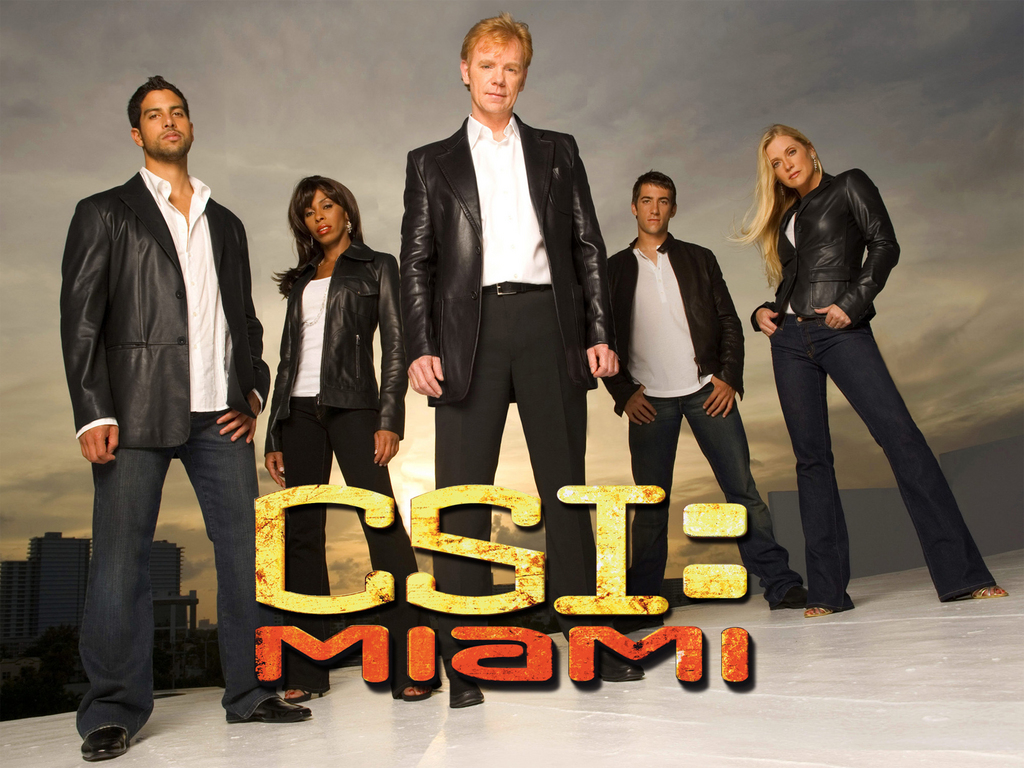
Example: CSI whatever.
Outlier: Justified, The Wire.

Australia – Soapies.

Neighbours, the long running steaming pile of dog droppings.

Aussies can’t produce a TV show that isn’t a soapie. We have tried many times, failing miserably to make the show not morph into a soapie. Sometimes we start off with a great premise and even a few episodes that show promise, but it doesn’t take long before we have just another soapie.

I don’t watch Aussie TV any more.

Example: We don’t do anything other than soapies.
Outlier: The little watched Good Guys, Bad Guys.

Western Europe – Gritty and noir.

Unit One making you squirm.

Americans have recently started (re)making European shows with more explosions. They have realised that there are so many well written shows there that they just had to copy them. Since Americans can’t handle accents and subtitles they need to redo the lot. Of course the Americans are then surprised when there is something lacking in their version.

I don’t know why, but gritty seems like a default position in every drama produced in Europe (Inspector Rex doesn’t count). As a result shows can become very dark, but at the same time are generally more substantive.

Example: The Elephant, The Killing, Unit One.
Outlier: All the same soaps and reality TV that they produce like every other country/region.

Canada – USA shows

We’re in Canada Scully; it’s a conspiracy!

If it is a US TV show, it is likely to be made in Vancouver. My theory for this phenomenon is that American actors and stuntmen on TV shows generally aren’t making enough money to afford decent health care. As a result they like to locate themselves in a country that has proper health care available. Just a theory.

One of the ways to spot an Canadian TV show versus an American TV show is how much shooting and explosions occur during any one episode. At one end you have American shows, at the other end you have Canadian shows, and right in the middle are the Canadian produced American shows.

Example: Stargate, Supernatural.
Outlier: Any show that looks kinda American but hasn’t got people shooting someone every 2 minutes.

Eastern Europe, South America & Asia
I’d like to know more as Australians don’t have many of them on our screens.

NB: I’ve tried to be as intentionally insulting to the various countries with my observations as possible. There is a lot of great TV out there, Australia makes virtually none of it, so I’m bitter, resentful and ultimately jealous.

Book Review: Sunset Express by Robert Crais

Sunset Express (Elvis Cole, #6)Sunset Express by Robert Crais
My rating: 5 of 5 stars

This is my first Robert Crais novel, after having to return a previous attempt to the library – stupid overdue fees! For Sunset Express I was well prepared, I bought a copy so that I would definitely have the chance to read an Elvis Cole and Joe Pike mystery. A very worthy investment.

While I’m indifferent about some of the characters in the novel, Elvis is a great narrator and has just the right amount of wit and humour. Robert has certainly crafted an interesting series of investigative twists, while at the same time retaining a level of reality. I really did enjoy this book and will be picking up the rest of the series soon.

On a side note, Robert’s style of writing is similar to the style I am pursuing in my writing. A serious novel with wit and humour, while also avoiding some of the neatly tied up ending cliches. From what I’ve read in Sunset Express, I’d be very pleased to have my WIP first novel, Overturned Stones, be comparable to Robert’s work.

View all my reviews

Tyson Adams’ 2011 Book Awards: The Awesomes

I’ve read a few books this year (+140) and have decided that I needed to talk about my favourites of 2011.  I also thought it fair to award my favourite reads of the year an Awesome.

As you will have noticed, my reviews of books are more about my impressions of the book and talking about how much I liked the book, rather than a recap of the plot, etc. My reasoning behind this is simple, I want to say “read this book” to people rather than fall into my bad habit of spoiling the ending.

My list is based upon what I have read this year, so obviously some great books (Snuff) have missed out due to lack of reading hours in the year. Also my read list does include some books that were published prior to 2011. There were some categories that were sadly under-represented and some that had some very intense competition.

Also, the fact that I finished a book shows that it was worth reading. I have my reading rules that stop me wasting valuable reading time on books I’m not enjoying. This means that any books on my read list are entertaining (well, unless I was particularly disgusted with the crappiness of the book in question).

Awesome of 2011

10 hours of non-stop reading fun, 12 if you count meal and toilet breaks. I could not put this book down, it had me enthralled with Reilly’s fast paced thrills and explosions. This books defines The Awesomes.
Also, I would like to extend my condolences to Matthew and his friends and family on the loss of his wife Natalie.

Awesome Literary Fiction
There were no nominees in this category this year. Better luck next year.
Awesome Mystery & Thriller
This is one of two heavily over-represented categories in this year’s Awesomes. 
Awesome Crime

Blood Work – Michael Connelly
13 Hours – Deon Meyer (technically I started it in 2011, but only finished it this year)


Awesome Fantasy
There were no nominees in this category this year. Better luck next year.
Awesome Paranormal Fantasy
There were no nominees in this category this year. Better luck next year.
Awesome Science Fiction

Peace Army – Steven L Hawk


Awesome Horror

Dead Man Series – Lee Goldberg, Will Rabkin, et al.


Awesome Romance
There were no nominees in this category this year. Better luck next year.
Awesome Humor
Right What You No – Tyson Adams’ blog
I’m allowed to be self-congratulatory. Plus I didn’t read any funny books this year.
Awesome Nonfiction
This is an oxymoron, so it is invalidated as a category. Having said that I did read several nonfiction books this year, mostly on climate change. I should make mention of On Writing by Steven King, which really had me agreeing with Steven’s insights.
Awesome Graphic Novels & Comics

The Boys – Garth Ennis

This is the second over-represented category on my list. 


Awesome Indie

Awesome Poetry
Rime of the Ancient Mariner – Samuel Taylor Coleridge

Book Review: Thirteen Hours – Deon Meyer

Thirteen HoursThirteen Hours by Deon Meyer
My rating: 5 of 5 stars

This would be the first book I’ve read by a South African author. Well, aside from Bryce Courtenay. And of course Wilbur Smith. Can’t forget that Tolkien was born in South Africa. Anyway, aside from those authors Deon Meyer is one of the first South African authors I have read. I did read Rhodes’ biography as well…

Before I become too Monty Python (Ni!) I should say that Deon has served up a particularly good crime thriller. He wastes no time or space in this book, his writing mimics the tension of the characters and the confusion of the investigation running against the clock. But he also digs into the South African music industry and some political issues whilst setting up some interesting secondary characters, who will no doubt shine in later novels.

I picked up this novel because it was sitting next to a Matt Hilton Joe Hunter novel. The cover and blurb looked interesting and I took the cover recommendation – by Michael Connelly – at its word. So it was via random browsing that I came across this fantastic novel. For crime fans, Deon Meyer is definitely worth checking out.

View all my reviews

Book Review: The Genesis Flaw – LA Larkin

The Genesis FlawThe Genesis Flaw by L.A. Larkin
My rating: 4 of 5 stars

I got a lot of mileage out of the Sydney Writers’ Festival this year. Saw a lot of great authors and presentations, picked up some fantastic books and had a good time. I’d like to see my local Perth Writers’ Festival get the same sponsorship so they could put on a big event too. I’m looking at you Dymocks!

Anyway, I saw LA Larkin talk about her writing and the book The Genesis Flaw and managed to miss out on picking up a copy. I blame the scheduling and Sydney baristas for not knowing how to make a real cup of tea. Fortunately The Sydney Writers’ Centre were kind enough to send me a copy. Yes I’m getting to the review.

I’ve read three or four GM crop themed thriller novels this year, this was the most realistic of them by far. At the Writers’ Festival LA mentioned some of her research methods, put lightly she goes to great lengths, even Antarctica (she even mentioned a hackers conference she attended and how to spot the undercover cops). A still hate the anti-GM themes in books, being a plant scientist and all.

Despite this, LA has put together a very believable and engaging thriller. I was caught up in the story and liked the more realistic ending to the novel. This was an engaging tale of David vs Goliath, people who have had their phone hacked vs Rupert Murdoch, 99% against the 1% (that’ll get the site traffic up). This book is well worth a read if you like the idea of an eco-thriller to make you think.

View all my reviews

NaNoWriMo 2011 – Day 1

The month of writing madness has begun!

This is my first attempt/entry into NaNoWriMo (NaNo details here). I am a virgin who doesn’t know any better, a lamb to the slaughter, a bright eyed idealist…… Blog posts count towards the word total, right?

The story I am writing is tentatively entitled Overturned Stones. It is a thriller with humorous overtones to subdue the dark subject matter. I had previously started this particular project but had to bin it in June and redo the outline (stupid characters didn’t do what I wanted them to!): I’m new to novel writing, live and learn.

Outline: You never expect to stand trial for the murder of your wife, especially if you didn’t do it. When you find out that your wife may not be dead but rather kidnapped by human traffickers for sexual slavery, you could be forgiven for being a little annoyed. Proposing lead therapy for the traffickers in an effort to help them reform and free your wife isn’t appreciated, by the traffickers, the police, or potential future employers. Can one man, dubbed “The Husband” by the media, take down organised crime, avoid the police and traffickers, and keep his gun loaded?

My journey has begun with a nice lead in. Yesterday and Sunday I managed to write a few short stories, plenty of writing to pique the creative juices. Currently they are with my trusted critique providers and then edits before submission – I’m thinking Crime Noir, Wet Ink and I have another paranormal story that I’m still thinking about which publication would suit it.

Today my writing was done while Australian’s were stopped for a horse race. Given that all I care about is buying the glue and dog food after the race and not throwing money into a void prior, I was able to get a sizable chunk written.
Words Written: 1,771
Total: 1,771
Remaining: 48,229

Who else is slightly mad this year?

Book Review: Nemesis by Jo Nesbo

NemesisNemesis by Jo Nesbø
My rating: 4 of 5 stars


All of Jo Nesbo’s translated works have a giant sticker on the front saying, “The next Stieg Larsson.” You obviously expect that the sticker is indicating that Jo Nesbo is a dead Swede, rather than a healthily alive Norwegian. You also obviously expect that reading one of Jo’s books will bring you another boring, long winded, needlessly detailed, “thriller”. Clearly the first 50 to 100 pages will spend more time describing flowers, boats and home renovations than actually introducing the characters and plot.


Thankfully this isn’t the case. Nemesis was actually worth reading. At +700 pages it packs in a lot of plot, sub-plots, mystery and intrigue. This book reminded me of other crime novels by the likes of Michael Connelly and Ian Rankin. Although, at least Jo refrains from including a street map description of Oslo like Rankin does for Edinburgh.


The only complaint I have with this book is that it felt over-written. Nesbo and his translator have done a fantastically skilled job, but there are times when you feel a little lost with tangential prose.


View all my reviews

Book Review: Wyatt by Garry Disher

Wyatt (Wyatt, #7)Wyatt by Garry Disher
My rating: 4 of 5 stars

I can’t believe I’ve been an Australian reader for this long and not read a Garry Disher novel. Sure, I’d heard of him, he’s a perennial favourite of the Australian Crime Thriller awards and community. But it was only his appearance at the Sydney Writers’ Festival – with Shamini Flint and Michael Connelly – that convinced me to buy Wyatt.

Of course I got Garry to sign my copy and dutifully put it on my shelf of “To Be Read” books. I really should have picked it up earlier to read. I should have read more Wyatt novels. I should have read Garry’s other series. Wyatt is crime noir, gritty and fast paced. If that is what strikes your mood then this book should entertain you nicely.

View all my reviews

My Experiences at the Sydney Writers’ Festival 2011

Yesterday I posted a few observations that I made over a beer between sessions. Today I’m going to go through the highlights and lowlights of the festival. It really was a good event so I feel the need to mention some of the writers and sessions and what I got out of them. Besides, I didn’t take my note pad and netbook in a backpack to every session just for my health – although it could be argued I carried the backpack around to seem more important and to knock drinks out of peoples’ hands in the bookstore.
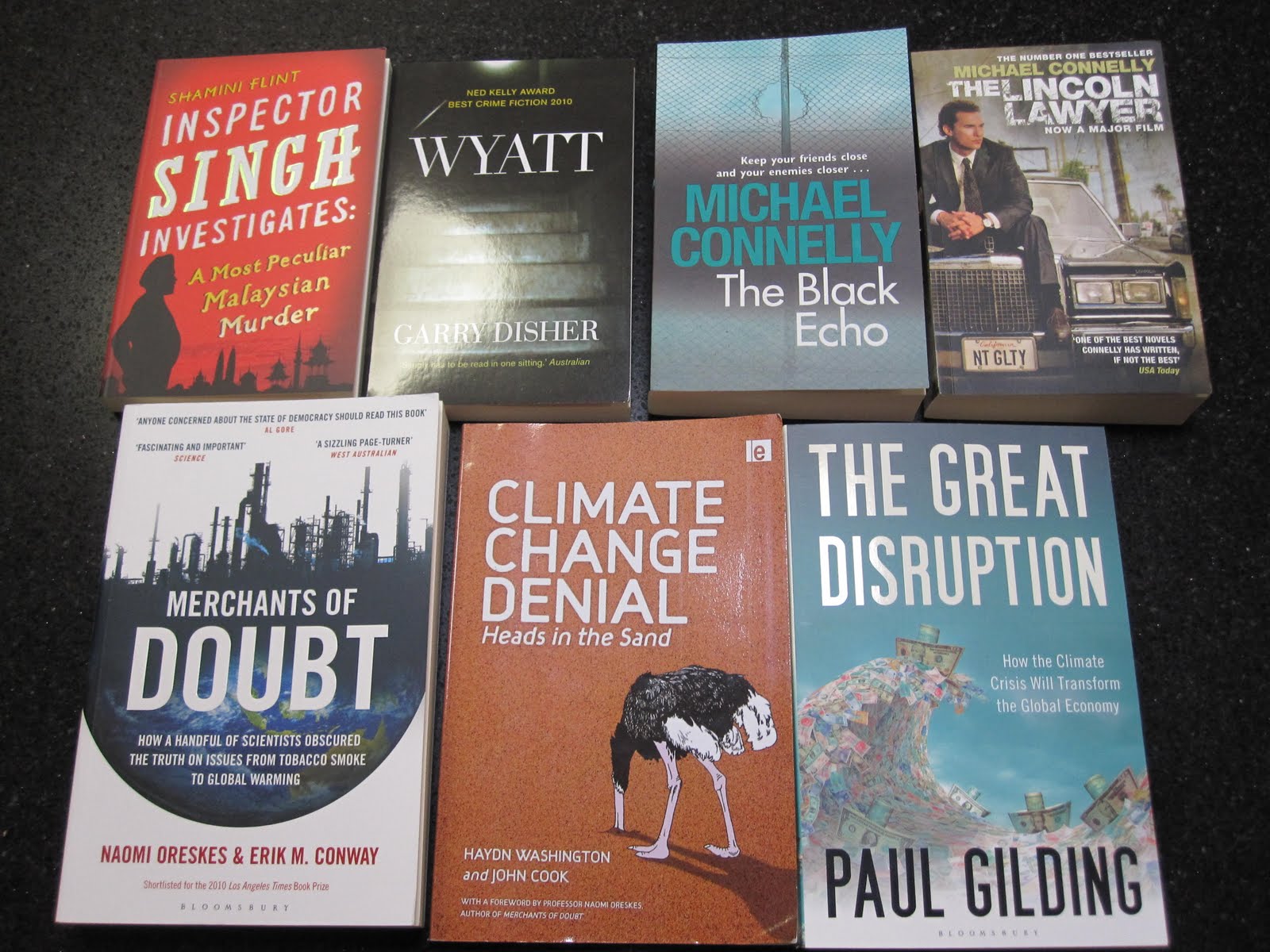
Some of my signed books from the festival.
Thursday 18th

This is Thriller
The first session I attended was a discussion between LA Larkin and John M. Green about how to make a thrill filled thrilling thriller. Surprisingly this was more a discussion about plot and character rather than explosions and body counts. LA Larkin also seems to go the extra mile for research, having just arrived back from a journey to the end of the earth – 6 months in Antarctica – for her latest book. Worth a look.

Climate Whiplash
Curt Stager is a paleoclimatologist, reformed climate sceptic, and a very interesting and engaging speaker. He described what the two scenarios for our next 100,000 years on planet Earth will be like. It was fascinating to hear how much we have disturbed our natural climate cycles and how big and long ranging our impacts upon the atmosphere are. Seeing the response curve of greenhouse gases, temperature and rectification having impacts out to half a million years really opens the eyes to the staggering the affect we are having upon climate. On the plus side, we’ve eliminated the next ice age due in 50,000 years (Sarcasm warning: it isn’t such a good thing).

Bits and Bytes
This talk should have absolutely fascinated me. It was all about technology, where we have come from and where we are going, and how our view of life/sentience has changed from memory to creativity. Ultimately, though, I found James Gleick boring. The only interesting part for me was the discussion of Ada Lovelace, a mind centuries before its time. Who’d have thought a talk about computers could put you to sleep?

Cracking the Code: The Art of Editing
This session on editing was proof that budding writers – like myself – are hungry for information and are willing to queue for a half hour to attend. Bill Scott-Kerr (he edited the DaVinci Code) and Tom Mayer (thankfully not related to John Mayer, or any other pop musicians) were there to lay out the importance and role of an editor. I liked the summary:

Author = speaks to the audience
Editor = helps to sell the book (to sales directors, industry, etc)

It was great to have two professionals stand up and say that editing wasn’t just about typos and grammar, but about crafting a story. This is a point that I think a lot of people miss. Although as a newsletter editor myself, I really would appreciate if authors actually ran a spell check and read their work before submitting it, as it helps to remove the purple monkey dishwasher.

An aside to this section: apparently professional editors have the same reading cut-off points that I do for reading. Bill stated that his cut-offs for a bad manuscript/novel are page 10 (foreboding) and page 100 (dread).

Criminal Agency
Sydney has an interesting public transport system. Replace the word interesting with rubbish. On the surface it looks decent: plenty of buses and trains departing regularly; plenty of stops; bus lanes; etc. Of course once I was on a bus travelling to this session at Ashfield Library, I realised that it would have been easier to harness up some Husky’s to a sled and find some icy tundra in our Aussie deserts. A 15 minute trip was turned into an hour of watching bored people texting and listening to their iPods. On the plus side, once I arrived Shamini Flint and Garry Disher were into their discussions about crime fiction. Garry served up sex and violence, Shamini pointed out that her mother edits out her books’ sex and violence and we would have to make do with humour.

Friday 19th

Book Design Uncovered
It is really hard to sum up a session that revolved around looking at various covers the designers and artists had produced. So here is the session described in interpretive dance:

But What I Really Want to do is Write Fiction
For some reason most people think they have a novel in them. Personally I blame shoddy surgery practices. It was interesting to hear from former journalists, academics and advertising executives (guess which one was able to plug their book the most) on how they had this career thing interrupt their dream of writing a novel or two. The take home point for me was that spending all day writing for your job helps when you want to take fiction writing seriously. Something about being used to hours of rewriting, editing, and tetris.

Merchants of Doubt
Naomi Oreskes is reasonably well known amongst the scientific and wider community, especially since her book, Merchants of Doubt, hit the promotional circuit. I’m a big fan of her work as she shines a light on the dirty little secret that is media misinformation (Hint: climate change is happening and is our fault; smoking does increase the risk of cancer; a duck’s quack does echo). As a scientist I am always amazed at the nonsense that is thrown around in the media. While this book discussed climate change, it was just the latest example in a long line of doubt-mongering by interest groups that she discusses. Her interview in this session covered a lot of points, so I just advise reading her book.

Daddy, Daddy, I………
Finally a session about being a stay at home writer and Dad.

You’ve Been Warned
Curt Stager and Naomi Oreskes were back for another session on climate change, this time joined by Paul Gilding. I really enjoyed this discussion panel, which primarily revolved around the “where to from here” in regards to climate change and dealing with it. Curt pointed out that this next decade is probably the most important decade in the next 100,000 years. Right now we can decide the future of the Earth’s climate by either listening to science and doing something or sitting in the corner with fingers in our ears yelling “la-la-la-la”. Naomi pointed out that scientists have been their own worst enemy, they publish journal papers that only scientists read, so the rest of the world can make stuff up with impunity. Paul pointed out that the free market is terrible at doing anything until the last possible second, and climate change is an issue that requires action much sooner due to its complexity and impact. As Naomi quoted:

Scientist in 1970s “Climate change is a real problem we need to deal with.”
Politician “When will it start having an impact?”
Scientist “Oh, in about 40 years.”
Politician “Get back to me in 39 years.”

Saturday 21st

Sex Up Your Writing
Linda Jaivin‘s workshop was a completely different kind of session at the festival. I would really have liked to have had her on the Porn Wars panel later in the day. Linda had a very simple message, write so that you get hot and steamy. If it works for you then it will work for someone else. That’s a good sex scene or erotica. Due to the topics discussed we were sworn to secrecy so I’ll let you imagine what the 14 women and two men did in the session.

Porn Wars
It was odd to leave a workshop on writing erotica to enter a panel discussion on porn in society. Catherine Lumby, a social scientist, Kate Holden, a former sex worker turned author, and Gail Dines, a fan of talking over the top of everyone including the moderator, were the experts called upon to discuss what should have been a fascinating topic. Unfortunately Gail decided to throw out unsubstantiated claims as facts, reject any other opinions and evidence, and provide scant evidence of her own. I especially liked her claim that the best selling porn movies were all misogynistic gonzo DVDs. Odd. I could have sworn that the big budget porn movies were couples erotica and that they dominated the market. This session was a waste of time. I have to say that as a male I love being blamed for all societal faults by sexists. Catherine and Kate needed a session without Gail, and, as one audience member pointed out, a male panellist.

Cities of the Dead
This was the session that I had come for. Crime fiction authors discussing their work and how the location of their novels influences them. Shamini Flint was the ‘contributing’ chair for the panel of Michael Connelly, Garry Disher and Michael Duffy. Shamini proved to be a great chair – maybe she could have chaired the Porn Wars session….. – and had everyone interested, discussing and laughing. Connelly could be described as taciturn, but Shamini had him telling jokes before long. I think all four authors sold a lot of books from this session, especially Shamini. At the book signing after she had a lot of people queued with her first Inspector Singh novel under their arms. Also Connelly revealed to me that he didn’t write the dialogue he utters on Castle, yet he loved doing the show and the stuff they give him to say.

The Chaser
I was in the queue for the queue to see The Chaser. Needless to say, I didn’t get in. Pity. They are always funny, despite what the BBC, Channel 7, Channel 9, and the Queen of England think.

Sunday 22nd

Growing Pains
When I was an undergraduate I picked a lot of economics units to pad out my science degree – yes I am a nerd, no I will not let you kick sand in my face. I remember very clearly the day that my economics professor explained the market model to us and my resulting question:

Me “If we have a finite resource base, how can we have infinite growth?”
Professor “Technology will be invented to change the resource base.”

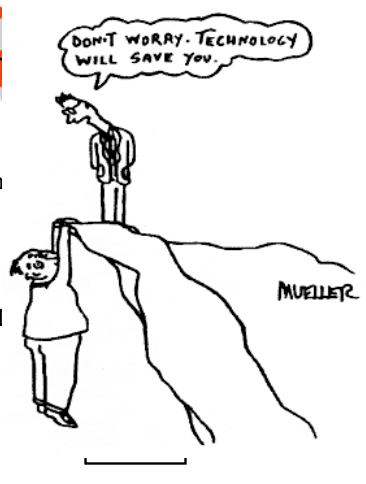
Since then I have had this cartoon on my office wall:

Ross Gittins and Paul Gilding were the first economics commentators to say what I have been saying for, literally, decades: the current economic model is fatally flawed. Yes technology could save us, but how long are you willing to wait for it to save you?

As an aside: don’t you think it fitting/ironic that the stock exchange was founded by a chronic gambler?

Lawyers, Guns and Money
I finished my Sydney Writers’ Festival as I began it, with genre. Michael Connelly was back to discuss his books, his writing, his film adaptations and how much his daughter influences Harry Bosch’s daughter. This was a really interesting session and very well attended. I think this session underlined Connelly as one of the modern masters of crime fiction.

I’d also like to say “Hi” to all of the lovely people who I had a chat with in the queues for various sessions. We had some great discussions and were definitely a big part of what made this festival great.

Observations from the Sydney Writers’ Festival 2011

p { margin-bottom: 0.08in; }

I’m safely home again after my trip to this year’s Sydney Writers’ Festival. I really enjoyed the event and the people I spoke to also enjoyed it. While I was at the event I had an hour between sessions to have a beer and do a bit of writing. I made a few notes on the event that I thought I would share:
  • Writers’ festivals are predominately attended by middle aged women who dream of being an author.
  • Everyone fancies themselves as an intellectual (me included).
  • Actors have to dress eccentrically.
  • Publishers are continually being pitched books, especially by writers who haven’t actually finished a first draft. Publishers refer to random pitches from strangers as “another one”.
  • Writers are always being asked the same 3 questions.
  • Some writers love the crowds, others would clearly prefer to be at home writing. It sucks being a famous/successful introvert.
  • Sessions about writing are very popular, especially amongst those still working on their first book.
  • Sydney has an obsession with coffee culture.
  • Due to the coffee culture they have no idea what a cup of tea is meant to taste like.
  • The smallest population at the event is the male under 40 crowd. I’m sure I was meant to have a minority discount token as a result.
  • Apparently you have to be a feminist to be a female author, even if you write romantic fiction about finding the right man to take care of you.
  • Judging by the Sydney Dance Company’s posters I need to see more productions: all the female dancers are hot and naked.
  • Handing out promotional bottle openers at a writers’ festival is a poorly thought out strategy. It should have been a coffee mug, book mark, or cork screw.
  • Handing out promotional pens is a great idea, the lovely people at Pilot pens gave me a Frixion Clicker that isn’t even on the market yet.
  • Politics at the writers’ festival tends to be a more neutral topic than you would think. The older population and the education level tend to lean towards rational rather than partisan divisions.
  • Most people in the publishing industry are passionate about books, just like the readers. The least passionate people seem to be the ones who make the marketing and buying decisions.
  • People who like dead trees are a largely unaware of what is happening in e-books and the progressions they have made.
  • Readers at the festival were spotted reading on their phones, tablets, e-readers and of course DTB. DTB are still the most popular, but even e-readers are taking off among the older readers.
  • The sales of Michael Connelly’s latest book are apparently 45% e-books.
  • Julian Morrow (The Chaser) and his wife Lisa are really nice.
  • The Chaser, despite the best efforts of Channel 7, 9, BBC and the Queen, are still hugely popular.
  • Shamini Flint probably sold more books and garnered more fans from chairing a crime writers’ session than her advertising for the past year. Witty + Funny + Getting Michael Connelly telling jokes = Sales!
  • Gail Dines probably alienated more people with her polemic vitriol than she intended. Then again she is blind to facts and probably doesn’t care.
  • The people of Sydney were very friendly. They were just like Western Australian’s, except for their constant IV drip of coffee and lack of familiarity with sunny days.

More on the Sydney Writers’ Festival tomorrow; my dog – fur-kid, who am I kidding – needs more attention.