NaNoWriMo 2011 – Day 18

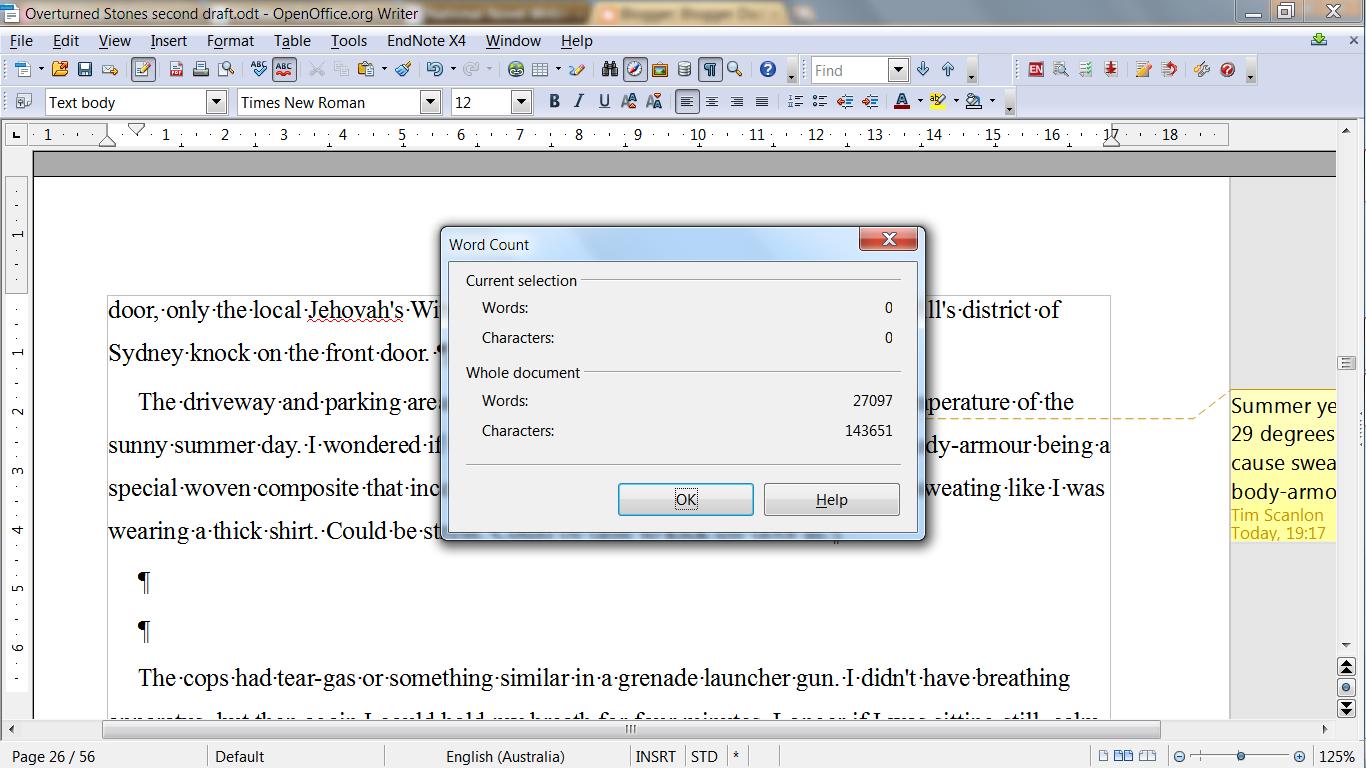
All of the NaNoWriMo masochists are 60% of the way through challenge 2011. I have just disowned one of my writing buddies for having already passed the 45,000 word mark.

1667 words a day didn’t seem like that much of an effort at the beginning of the month. Now I’m realising it is quite a demanding effort to be consistently creative when you have a day job, travel for work, and a lazy streak wider than a truck. Being a professional writer is no easy task, I have even more respect for them than ever.

So with 12 days left to write ~23,000 words I’m still confident, but know there are some big writing days needed. Also I may just start taking the advice of many and just write and give up on that silly idea of making sure flow and research are complete. Not that I’m blaming the internet and its plethora of interesting information for my slow writing progress, that would be rather shallow of me. Instead it is proper to lay the blame at the feet of my dog, curse her and her need to sleep on my feet in such a cute way.

Words Written: 1,505 (per day average)
Total: 27,097
Remaining: 22,903

How has everyone else fared so far?

Book Review: Climate Change Denial – Heads in the Sand

Climate Change Denial: Heads in the SandClimate Change Denial: Heads in the Sand by Hadyn Washington and John Cook
My rating: 4.5 of 5 stars

It takes a while to read a book during your lunch break at work. It can take even longer if the book you are reading is filled with interesting tidbits of referenced information, which then inspires you to read the original research paper. I suppose that is the best thing about Washington and Cook’s Climate Change Denial, it is filled with interesting research and arguments, all concisely expressed for anyone with an interest in the future of our planet.

Usually I have an issue with non-fiction books. Often times the non-fiction genre is filled with work that lacks credibility or validity. Non-fiction is also prone to the shouting polemic, which is all doom and gloom, and short on any solutions. Climate Change Denial is the opposite, with a very well researched base of information, well rounded and reasoned arguments and an entire chapter devoted to the solutions for both denial and climate change.

What interested me was the mindset of denial. I’ve done a lot of reading of the peer reviewed literature on climate change (hint: the world is getting warmer, it’s our fault, we need to take action now) and have been frustrated with the same debunked arguments arising time and again. Now I understand why, well, aside from the massive fear and smear campaign waged by denier groups with oil $$. I also appreciated the candid debunking and slaying of the red herrings (e.g. we need to adapt) and white elephants (e.g. carbon capture and storage) often associated with the climate change debate.

This is a great book for the climate change extension people, for those who are undecided on the topic, and a must read for politicians (this book has been given to every Federal Government minister in Australia). Those who read it now have the job of converting the deniers, logic and science will prevail, but it would be nice to have that happen sooner rather than later.

Also worth reading John Cook’s fantastic site.

View all my reviews

NaNoWriMo 2011 – Day 10: Writing is overrated!

So I’m travelling through this first fortnight of NaNoWriMo at a less than stellar pace. I’ve technically had most days free to write as much as I please. I’d imagined this would result in 10,000 word days and that I’d have that pesky 50,000 word total done before I go back to drudgery next week (or the day job, which ever term you prefer).

The reality has been much too horrid for me to bear. All of those professional authors who talked about how hard it was to hit writing targets were right. I guess that is why they are the professionals and I’m still the amateur, they must use better whips on the room full of monkeys.

Of course I have still been achieving the required writing goals, but the problem with having a day job is that it will suddenly rear its ugly head and swing me around in its mighty jaws as it seeks to devour me whole. Being on schedule might be a bad thing at this point. Maybe I should think more like a blogger or self-publishing slime-ball and just write rubbish: who actually needs the chapters to fit together?

Either way I’m enjoying writing every day, and I am actually achieving my primary goal of sitting around having fun. My secondary goal was to get into the habit of daily writing and getting sizable chunks written. That is my achilles heel as a writer, not finishing the larger projects. My writing itself is actually quite good – IMHO – and I’m continually working on aspects that need polish. As Stephen Leather said, writers do need to focus on becoming better writers.

Words Written: 1,698 (per day)
Total: 16,985
Remaining: 33,015

How has everyone else fared so far?

Book sales: told ya!

There is nothing better than to crush your enemies, see them driven before you, and to hear the lamentations of their women. The other thing that is quite nice is to be right.

In fairness a lot of people were right. Konrath has been saying for years that e-books will replace DTB (dead tree books). I posted a prediction here about what the market will look like by the end of the decade. I said that e-books would win. Guess what: they are starting their winning streak.

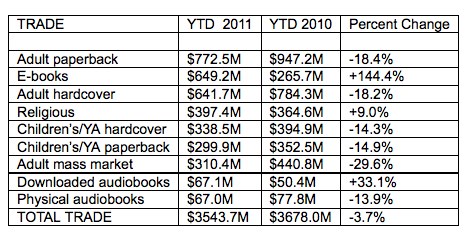
The figures are in for the publishing industry (source: Association of American Publishers). The year to date shows strong growth in e-book revenue, declines in anything you can’t download, and that there is a growing market for Christian fiction. Maybe I should write a Christian thriller, with Jesus as the central protagonist, a man who had been forsook, turned to alcohol (well it starts out as water), and investigates paranormal phenomena in the wake of his death. I smell best-seller!

Something that jumps right out at me with these figures is that numbers don’t jump. The other thing is that e-books have essentially replaced the other mediums (if you ignore kids books). E-books have grown from 7% to 18% in 12 months – I hate the 144% figure as it is misleading, I’ve always preferred quoting figures as a proportion of the total. The change in kids books then accounts for the decline in the industry of $100 million.

E-books are doing very well.

12 Extremely Disappointing Facts About Popular Music

I had to share this list with everyone, mainly because it says a lot about quality being arbitrary.

  • 1. Creed has sold more records in the US than Jimi Hendrix

    Creed has sold more records in the US than Jimi Hendrix

  • 2. Led Zeppelin, REM, and Depeche Mode have never had a number one single, Rihanna has 10

    Led Zeppelin, REM, and Depeche Mode have never had a number one single, Rihanna has 10

  • 3. Ke$ha’s “Tik-Tok” sold more copies than ANY Beatles single

    Ke$ha's “Tik-Tok” sold more copies than ANY Beatles single

  • 4. Flo Rida’s “Low” has sold 8 million copies – the same as The Beatles’ “Hey Jude”

    Flo Rida's “Low” has sold 8 million copies – the same as The Beatles' “Hey Jude”

  • 5. The Black Eyed Peas’ “I Gotta Feeling” is more popular than any Elvis or Simon & Garfunkel song

    The Black Eyed Peas' “I Gotta Feeling” is more popular than any Elvis or Simon & Garfunkel song

  • 6. Celine Dion’s “Falling Into You” sold more copies than any Queen, Nirvana, or Bruce Springsteen record

    Celine Dion's “Falling Into You” sold more copies than any Queen, Nirvana, or Bruce Springsteen record

  • 7. Same with Shania Twain’s “Come On Over”

    Same with Shania Twain's “Come On Over”

  • 8. Katy Perry holds the same record as Michael Jackson for most number one singles from an album

    Katy Perry holds the same record as Michael Jackson for most number one singles from an album

  • 9. Barbra Streisand has sold more records (140 million) than Pearl Jam, Johnny Cash, and Tom Petty combined

    Barbra Streisand has sold more records (140 million) than Pearl Jam, Johnny Cash, and Tom Petty combined

  • 10. People actually bought Billy Ray Cyrus’ album “Some Gave All…” 20 million people. More than any Bob Marley album

    People actually bought Billy Ray Cyrus' album “Some Gave All...” 20 million people. More than any Bob Marley album

  • 11. The cast of “Glee” has had more songs chart than the Beatles

    The cast of “Glee” has had more songs chart than the Beatles

  • 12. This guy exists.

    This guy exists. That is all.

Shark attack

I don’t normally comment on current affairs or the news in this blog, because normally the news can be summarized as: war, death, famine, kitten in tree, sport. Of course that is the 24 hour news channel version, the network news shows are more along the lines of: human interest, war, kitten in tree, tragedy, dog puppy in tree, sport, sport gossip. But this news is somewhat baffling.

Apparently Western Australia is going to have a shark cull in an effort to try and kill a white pointer believed to have killed three people recently (article here).

Not too difficult to understand is it? Three deaths in a short amount of time when the world averages 5 deaths per year is something that people start worrying about. What is baffling though is that we are concerned about 3 deaths. People are 300 times more likely to drown than die from a shark attack in Australia. Or put another way, if you wanted to get rid of that jerk at work, you could save the expense on the shark and just use water (see this article on sharks and risk).

Human Deaths in Australia Between 1980-1990, Inclusive (from Stevens & Paxton, 1992)
Cause of Death
Total Deaths
Average per year
Crocodile Attacks
8
0.7
Shark Attacks
11
1.0
Lightning Strikes
19
1.7
Bee Stings
20
1.8
Scuba Diving Accidents
88
8.0
Drownings/Submersions
3,367
306
Motor Vehicle Accidents
32,772
2,979

Last time I checked the Great White Shark was an endangered species and humans are at near plague proportions, especially Americans – the shark’s favourite food. Sixty one percent of the world’s shark attacks are in North America and American’s are making popular shark food in Australia as well. See the big mistake here is that sharks keep mistaking Americans for food.

Now I’d be the first to admit that Americans are very tasty, something has to come of that high fat and sugar diet. But what we really need to do is help Americans to stop looking like food. Is it just that Americans are tastier than the rest of the world’s people? Is it genetic? Or are is it just that the people who were attacked by a shark looked too much like a seal? Either way it is clear that the worry over sharks is more about them not being cute enough, maybe Spielberg should do a revised Jaws movie that focuses on the danger of mosquitoes: When you hear them buzz, you’re DEAD!

E-book Prediction: Buy Your E-reader Now!

Do you have an e-reader yet? Well best go out and buy one in the next year. Books are going digital!

Want proof? Well how about Mike Shatzkin’s speculations from his blog.

Here’s an assumption that is not documentable; it is my own speculation. I think we’re going to see a US market that is 80% digital for narrative text reading in the pretty near future: could be as soon as two years from now but almost certainly within five. We have talked about the cycle that leads to that on this blog before: more digital reading leads to a decline in print purchasing which further thins out the number of bookstores and drives more people to online book purchasing which further fuels digital reading. Repeat. Etcetera.
We’re already at the point where new narrative text units sold are well north of 25% digital (percent of publishers’ revenue is lower than that, of course) and we are still in a period that has lasted about five years (soon to end) where the penetration of digital has doubled or more annually. (I italicized that to emphasize that what I’m talking about doubling is the percentage of sales that are digital, not the absolute number of digital sales. Several people misinterpeted that when I made to it previously.)
Of course, penetration will slow down before it reaches 100%. I’d imagine we get to 80% in 2 to 5 years, then then to 90% in another couple of years, with the last 10% stretching out a long time. How long did it take after the invention of the car before the last person rode their horse to town? – Mike Shatzkin (Source)

Of course that is in the USA. In down-under land we like to be on the dull edge of technology and trends. I’m sure many of you are in a similar situation in your countries (UK, Germany, Canada, India, Netherlands, Russia, Malaysia, Philippines – who round out my top 10 visitor countries). So whilst we as individuals may be on the cutting edge, many of our compatriots are still wary of the idea of books that aren’t made of paper. Suffice to say we will probably need to add a few years to these predictions and subtract the price of milk (full cream, not that white water stuff).

What do you think of these predictions? I think most countries will be e-book dominant in 5 years, I’m not sure about 80% though.

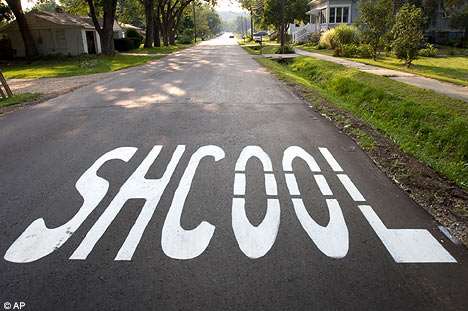
Sum werdz too wotch owte four

There is nothing better than picking up a book, newspaper, or turning to a blog post, that is full of typos, spelling errors and grammatical mistakes. If you need hours of entertainment I highly recommend playing “Spot the Error”.

Now I can’t claim to be an expert in all things writing, so instead I have found this great article from Mike at the Book Making blog to help. 

Accommodate has a double “c” AND a double “m.” 

A lot is two words, not one. 

Argument does not have an “e” like “argue.” 

Awhile or A while can both be legitimate. The noun is spelled as two words: “I napped for a while.” The adverb is spelled as a single word: “I napped awhile.” 

Believe follows the old “i-before-e except after c” rule. However, foreign, forfeit, sovereign, surfeit, caffeine, casein, codeine, either, geisha, inveigle, keister, leisure, neither, protein, seize, sheik, and Sheila do not. 

Bellwether has nothing to do with the weather. A “wether” is a castrated sheep or goat that wears a bell and leads a herd. The lack of cojones made it less likely that the leader of the pack would stray. 

Cannot v. can not: “Cannot” is a word, one word. Some word mavens insist that it is not supposed to be split into two words. This is weird, because “can” and “not” are legitimate words. I won’t be pissed off if you can not go along with “cannot.” 

Carburetor has just one “a,” like “car.” 

Cemetery does not end in “ary” or begin with “s.” 

Changeable, unlike argument, retains its “e” so you know the “g” is soft, pronounced like “j.” 

Collectible is not “able.” No rule applies here, just memory. 

Coolly has a double “l” when it’s not a noun. When it is a noun, it’s spelled “coolie.” 

Criteria v. criterion: Confusing these two nouns is a common error, even among highly educated people. “Criteria” is the plural of “criterion,” but many people aren’t even aware of the word “criterion.” If you’re discussing various requirements that must be met, use “criteria” but if you are writing about one major requirement to be met, use “criterion.” (During Sheila’s many years as a technical writer, one of her colleagues — an English major who graduated from a top college — was working on a software users’ manual that dealt with various criteria. But, when this writer referred to one criterion, she continued to use “criteria.” How did she graduate, especially as an English major?) 

Deceive does obey the “i before e except after c” rule. So does receive, but not frequencies or science or species. 

Drunkenness should have a double “n” when spelled by so­ber people. 

Dumbbell has a double “b,” you dummy (not “dumby”). 

Embarrass (ment) has a double “r” and a double “s.” 

Epic is a big important book, poem, or movie. Epoch is an im­portant era. You can write an epic about an epoch. 

Exceed does not end with “cede.” Nothing exceeds like excess. 

Existence does not have an “a.” 

Flier is someone who flies (not “flys”). It’s also a leaflet, or a golf ball that goes too far. Airlines frequently say “frequent flyer.” They’re frequently wrong. 

Flyer can be part of a proper name for transportation (“Radio Flyer,” “Flexible Flyer,” “Rocky Mount­ain Flyer”) or a sports team (“Philadelphia Fly­ers” and “Dayton Flyers”), or even sneak­­ers (“PF Flyers”). 

Gauge is a verb or a noun with a silent “u.” For the thickness of wire or metal, or the space between train rails, or the size of a shotgun, you can ditch the “u.” Gouge means to scoop, dig, swindle, or extort; or a tool for gouging. 

Grateful has just one “e.” It’s not so great. It has the same root as “gratitude.” 

Guarantee does not end like “warranty” except in a proper name like Morgan Guaranty Trust. 

Harass has just one set of double letters.

Inoculate has no double letters. 

Jibe (NOT Jive) means to agree. Jibe and gibe mean to taunt. Jibe also means to move a sail to change direction. 

Layout is a noun. Lay out is a verb. A designer will lay out a layout. 

Lightning is the spark in the sky, or part of the name of Lightning Source, the printer of this book. Lightening removes weight. 

Maintenance has just one “ain,” unlike “maintain.” 

Maneuver is a French-ish word, that’s easier to spell than the British version: “manoeuvre.” 

Medieval refers to the MIDdle Ages, but is spelled more like “medium.” Some of those wacky Brits use “mediaeval.” (TA note: Brits founded the language they are more likely to be right) 

Memento reminds you of a moment, but the first vowel is an “e” not an “o.” Don’t ask why; just remember it. 

Millennium was spelled wrong millions of times back in 1999 and 2000. It still is. It gets a double “l” and a double “n.” 

Minuscule means mini, but it’s spelled more like “minus” (except when it’s being spelled by people who prefer “miniscule.”) Pick one version, and be consistent. 

Misspell is frequently misspelled. It needs a double “s” but no hyphen. 

Noticeable gets a silent “e” to keep the “c” from being pronounced like a “k.” 

Occasionally has a double set of double consonants.

Occurrence has two traps: the occurrence of double double consonants, and “ence” not “ance” at the end. 

Pharaoh uses the “a” twice. 

Plenitude is right. Plentitude is wrong, but is used a lot. 

Possession possesses two double letters. 

Principal is a school’s boss or the most important element of something. A principle is a rule or an important point. 

Privilege is not edgy. It has no “d.” 

Reevaluate does not have a hyphen. (TA note: my spell checker doesn’t agree. Don’t trust your spell checker!) 

Relevant is not “revelant,” “revelent” or “relevent.” 

Separate has an “a” as the second vowel. 

Sergeant, unlike the affectionate “Sarge,” has no “a” up front, but it does have a silent “a” later on. 

Sleight of hand is a group of techniques magicians use to secretly manipulate objects. It’s not “slight of hand” or “slide of hand, “Sleight” comes from an Old Norse word for clev­erness, cunning, and slyness.

Supersede is not spelled like “succeed” or “precede” and may be the only “sede” word we have. 

Threshold does not have a double “h.” 

Until gets just one “l” even though it’s often a perfect substitute for “till.” Wilson Pickett sang, Wait Till the Midnight Hour or Wait ‘Til the Midnight Hour, depending on who transcribed the lyrics. 

Weird is weird because it breaks the “i before e except after c.” rule. Seize is weird, too.

This, of course, ignores all the fun that can be had with the incorrect way that Americans spell words like neighbour (neighbor), centre (center) and metre (meter – in fairness the Americans do prefer to crash billions of dollars worth of scientific equipment into Mars rather than use the metric system).

Thanks again to Mike at the Book Making blog.

Trying Hard

A lot of people like to talk about talent. Somehow you are either born with talent or you are doomed to only ever write meaningless emails and policy documents in a carpet lined cubicle. The “born with talent” hypothesis does tend to necessitate ignoring all the time and effort spent learning to: read, write, conjugate verbs and using a keyboard to hit your agent with. Clearly anyone born with talent doesn’t need anything other than to crawl out of the womb and sit down in front of a computer. Every great novelist started this way, publishing their first book not long after they learnt to walk.
The rest of us have to try hard, we have to work at writing. There are two types of try hards in writing: the try hard and the trying hard. So are you a try hard or do you try hard?
A TRY HARD
It’s fair to say that their are try hards present in every aspect of life. The attention whore, the rude guy, the politician; all trying hard. These are the people that are going through the motions. They are the continuously frustrating people in front of you in the ATM queue that take forever to withdraw $10. They are the person walking aimlessly in the shopping mall who suddenly stop to stare at their feet. Try hards lack purpose and drive, but most of all they seem to be everywhere sabotaging others efforts with their very presence.
In writing we are starting to see more try hards. The “I can’t afford an editor” and the “they wanted me to make changes, screw them” self published authors are great examples. Stephen Leather made the point that it seems odd that there is more talk of marketing than there is of writing in the self publishing world: the try hards at work once again. Their presence sabotages everyone else, except for those already successful, they exist in an altered plain of reality where beer is always cold and spending hours writing gives you sculpted abs, something every successful author needs.

TRYING HARD
Then there are those who are trying hard to make the most of things. This is what you do in order to achieve things: work. Now you may not have natural talent, ability or wads of cash that you use specifically for lighting cigars, but you are working at it. Hard work and effort directed at your writing craft, study on writing techniques, research on your story, general goofing around on the internet; all aimed at improving your skills. Trying hard isn’t just about the writing though, it is about bringing your voice to an audience. Are you really a writer if no-one has actually read your work? Are you really a writer if you have wads of cash specifically for lighting cigars?
Trying hard is all about putting the effort into the important stuff. Try hards are out to cut corners and impress everyone. The people who are working hard know that there are no short cuts – except that left at Albuquerque. Impressing people comes from a job well done, not by bragging to everyone about it.
Or of course you could just get a room full of typewriters and monkeys.

Hard-copy books need to fight

There is a call to arms for all lovers of books. No longer can we stand by and have e-books take our readers. They may take our ink, they may take our paper, but they may never take our reading material!

http://www.chicagotribune.com/news/opinion/ct-oped-0804-books-20110804,0,3970003.story

I think they are right. Books have been derailed by technology. So, to combat this, I have recruited a top advertising agency to help out. They will be promoting the smell, feel, taste and texture of real books. The smell of gold leaf that was painstakingly applied by the hands of a skilled monk. The smell of candle wax that was used for light by the monks. The texture of papyrus and hemp paper. The acrid taste in your mouth from inhaling calligraphy inks. The weight of a clay or stone tablet as it crushes your hands.

Gutenburg was wrong when he brought in mass production print. We must fight back and stop these false books from becoming the norm.

Rally behind the stone tablet and the scroll. Say no to the printing press!

Finding 30 the British Way

Australia has a campaign to get its citizens from becoming Americans, called Find 30. They advocate finding 30 minutes every day to exercise, based on the research that suggests you need 60-90 minutes of moderate activity daily to control weight and health.

The British have taken a slightly different approach to finding 30.

This recreational rioting is fantastic cardio for the British. There is even a bit of resistance training from hurling those rocks at police. It won’t be long and gyms will be offering this group training class. The French might be one of the first to offer this class.

Who will portray Jack Reacher?

That’s right, Jack Reacher will be coming to a cinema near you in the adaptation of Lee Child’s One Shot. The film about the big guy with the strong moral compass and the even stronger right hook is all set, with a director, a start date, a script and of course the star: Tom Cruise.

Tom Cruise has agreed to play Reacher in Paramount’s ONE SHOT; filming in Pittsburgh begins on September 27, 2011, which is the same day that Reacher novel #16 THE AFFAIR goes on sale in the US and Canada (Sept 29th is the UK, AU, NZ sale date).

Screenplay is by Christopher McQuarrie (The Usual Suspects, Valkyrie) who will also direct.  The screenplay, from all reports, is truly kick-ass.  The rest of the actors have yet to be cast but we’re hearing rumors that are pretty exciting. Source.

Yes you have read that correctly. Tom Cruise will play Jack Reacher.

Lee is of course in full support of Tom Cruise playing Jack Reacher:

Reacher’s size in the books is a metaphor for an unstoppable force, which Cruise portrays in his own way – Lee Child.

I can’t blame Lee, it isn’t like anyone will complain the movie is better than the book, and he will get paid regardless. Worst case for him is that they make a fantastic movie that generates him millions more fans. So there are three ways this will run: either Tom Cruise will completely own the role and make the fans of the Reacher books forget the 30 centimetre difference in height; or the casting director will cast munchkins in the supporting roles; or the Reacher fans will wish someone else was cast.

Lets go through some of the potential Reachers who have been raised on the interwebz, because despite the decision having already been made there is nothing like documenting the “I told you so” statements for future reference. Of course I’ll delete this post if Cruise pwns all.

Tom Cruise:

Advantages: Box office draw card, his production company bought the film rights, Cruise really needs to look manly in films, has a track history of appearing in good films.
Disadvantages: Short, too pretty, will have to shout at some point in the film regardless of the need to, despite appearing in good films he wasn’t the reason for them being good (Jack Nicolson, A Few Good Men; Dustin Hoffman, Rainman; Cub Gooding Jr, Jerry Maguire; etc).

Tahmoh Penikett:

Advantages: Tall, burly, manly, not too good looking, good looking enough to sell the film, good actor, could actually win a real fight (muay thai fighter), my choice for the role.
Disadvantages: Only had TV roles in shows no-one watched, what the hell do I know about making films.

Jeffrey Dean Morgan:

Advantages: Tallish, manly, chicks love him since he was on Grey’s Anatomy.
Disadvantages: Is he the only manly American actor? Can’t we find someone else?

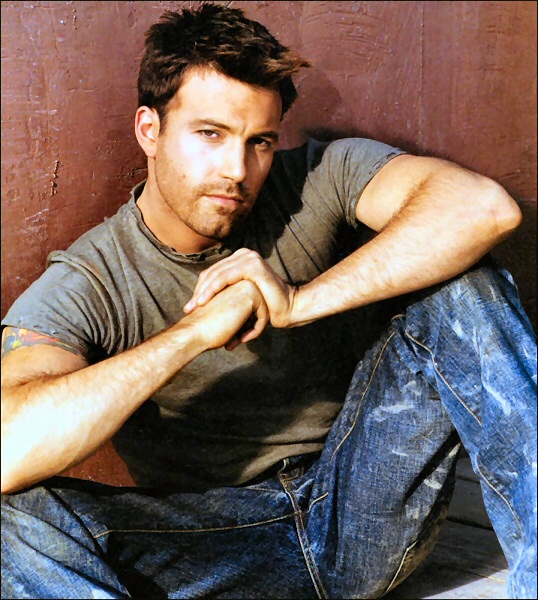
Ben Affleck:

Advantages: Tall, appeared in other blockbusters.
Disadvantages: Budget blowouts would occur due to acting class costs.

Christian Bale:

Advantages: Not short, has appeared in every other film in the last few years, could actually get aggressive and violent.
Disadvantages: I think it would be good to cast Bale in every film, never a down side to that.

Liam Neeson:

Advantages: The right height, has done action films, can act, has been in a Dirty Harry film.
Disadvantages: He appeared in Star Wars The Phantom Menace, appeared in the worst Star Wars film, co-starred with the worst character ever portrayed on film, didn’t shoot his agent for letting him be involved in The Phantom Menace.

I guess we can only dream. Either way, I’ll be seeing One Shot on the opening weekend.

How to interpret online music reviews

p { margin-bottom: 0.08in; }

One of the coolest things about the interwebz is the ability to find TV shows, movies, books/authors, bands/music, or people to argue with. I live a few hundred kilometres from the most isolated city in the world, which means that there isn’t a cinema, there aren’t many international touring acts that come through town, and author book signings are somewhat rare. Since Al Gore invented the internet we are all able to be connected and find things we like through the magic that is The Internet.

“This, Jen, is the internet.”

p { margin-bottom: 0.08in; }

Of course with an abundance of new stuff comes an abundance of indecision’s. How do you tell which books are worth reading, which movies are worth watching and which bands are worth listening too? The obvious answer would be to consult reviews.

Music reviews are often troubling, they use industry jargon that not everyone understands, especially not the people using the jargon. So I have quickly summarised the commonly used phrases and interpreted them.

Solid album: every song sounds the same.

Standout tracks: the only decent songs.
The album grows on you: hated this album the first time I listened to it and after having to listen to it several times to complete the review have found I can tolerate it.
Intricate melodies: pretentious wank.
Outstanding musicianship: lots of solos.
Impressive guitar work: endless guitar masturbation.
Concept album: lots of pretentious filler.
Soulful lyrics: girlfriend/boyfriend just left the singer.
Soulful melodies: all band members/artist depressed.
Heartfelt emotion: band members/artist suicidal.
Best album of the year: only new album I have.
The best release from this artist/band: it’s about time they put out something decent.
Epic: too long.
Pop sensibilities: commercial radio fodder.
Proponents of (insert name) style: I hate this sort of music.
Founders of (insert name) style: the guys that everyone else copied.
Challenging: annoying.
Diverse styles/sounds: imitates everything popular at the moment.
Critically acclaimed: only pretentious and annoying people will like it.
Commercially successful: listen to it on the radio instead.
Uplifting: saccharine.
Back with a vengeance: last album was terrible.
Offers up some great tracks: band/artist only wrote one song then packed in filler.
Career defining: surprisingly good album.
On heavy rotation: has a huge marketing budget to waste.
Staple of radio playlists: inoffensive.
Politically charged lyrics: think they are better than everyone else.
Confrontational: annoying.
Distinguishes itself: will fade into obscurity in a month.
Stamped their mark: all the vapid DJ’s like it.
Most important album/artist of the year: utter crap that is inexplicably selling well.
Taken (insert country) by storm: some DJ overseas thinks that it’s good.
Radio friendly: bland.

Hope that clears things up a bit. At some future date I will attempt to cover the common book review jargon.

E-books: Return of the Reader

Just like the previous two installments of this e-book saga there will be allusions to some non-existent struggle, my thoughts on the changing publishing industry, no Leia in a bikini, and definitely no Wookie. When we left our hero writers, they were diligently trying to decide whether they wanted to sign with a traditional publisher or self-publish like an indie rebel. Publishers had the track record, the self-publishing indies had the jump on the fastest growing segment in the industry: e-books.

Now hold on just a second. Traditional publishing is behind? As has already been stated in this blog, his mouth to my post, Michael Connelly is selling 45% e-books. His publishers are clearly on board of this new market place. James Rollins and Steve Berry have both released exclusive e-book short stories on Amazon and B&N as lead-ins to their next books (pity non-US people can’t buy them, not being close enough to the centre of the universe and all). I even noticed that Aussie authors like Tara Moss and Matthew Reilly are available on Kindle for under $10. Behind isn’t quite right.

On the other side of the great divide, all the cool kids authors are self-publishing. People like Konrath, Eisler, Mayer, some guy named John Locke, are doing well out of self-publishing and doing all the work themselves (or hire for service). Clearly all authors should be grabbing their manuscripts and uploading them now.

I’ll pause so you can upload your book now. Don’t forget to spell check first!

Well it seems that 10’s of thousands are doing just that. Given that 90% of everything published is probably crud, you have to question how wise it is to rush to publish. We also have to remember that e-books are still a minority share of the market place (this will change of course). Shouldn’t quality come first? Spend the time on crafting a fine book, see what industry professionals have to say about it, then publish? Preferably not the professionals that published Snooki. Basically writers will have to find the best publishing deal for them, even if it is swapping their novel for a packet of magic beans.

And here is a startling fact: readers don’t care if writers are traditionally published, indie published, self published, or published by a small Scottish Terrier named Rolf. Readers want to read something entertaining and well written. So writers shouldn’t care how they are published. To quote Nick Spalding:

“Writers on the traditional publishing side of this particular conflict want to be successful and earn a decent living as a writer, appealing to an audience with their work. On the other hand, writers on the self publishing side of this particular conflict want to be successful and earn a decent living as a writer, appealing to an audience with their work.”

What I love about e-books is that they are made for readers. Well Duh! Stick with me on this one. Lets say that it is August 2010 and I’ve just finished 61 Hours by Lee Child. Now Lee may or may not have finished with a cliffhanger in that particular book. Despite the fact that the next Reacher novel is finished and ready in boxes to go on shelves, I have to wait until the end of September to read Worth Dying For. With e-books there is no need to delay because of printing, shipping, and shop displays still being filled with James Paterson’s books. In fact, with e-books I can have the entire Reacher series downloaded the minute after I’ve finished 61 Hours to keep my spirits up while I wait.

Essentially the gap between writer and reader has been shortened. The reader is King.

So what about publishers? Well they sell books. Authors write those books for them. I don’t think that in the long run they will particularly care whether they are selling an e-book or a DTB. In fact e-books could really cut out a lot of their middle men costs.

A lot has changed in the past year or two, some of the big companies are behind to some extent, but are more likely to catchup. I still can’t believe that e-readers weren’t dreamt up by publishers and bookstores. But then again I can’t believe that Australia – lots of sun – has sent solar technology to Germany – no sun – and politicians are wanting to move from coal to gas.

As long as publishers are paying advances, advertising/promoting authors and fronting costs they will be who most authors will turn to in order to publish. And when the publisher rejects it, and the crying has finished, the author will release it, plot holes and all, on their own.

Bookshops look like the real loser here, despite their claims to the contrary. Apparently people love the smell of books. Solved. Apparently people like to browse in bookstores. Yes, nothing like spending hours in a store with your head at a funny angle to find the store doesn’t stock what you are looking for. Apparently people love the feel of books. Admittedly books are much better to throw at an intruder, although War & Peace is regarded as a lethal weapon.

Can I just point out that an e-book is a book. That you can read. Thanks for letting me clear that up.

Tenuous reasons for bookshops continued existence aside, I don’t see why there won’t be purveyors of fine literature, and the stuff I like reading, into the future. Online stores are often seen as more reputable when they have a physical storefront. Even if that storefront is never visited by anyone because it is located down a side street, off a back alley, near a crack den. Plus POD could make book buying like a trip to the deli counter for lunch.

“I’ll have the new best-seller and a long white to go thanks.”
“Did you want that signed or unsigned?”
“Hold the signing, but I will take the first chapter of the sequel at the back.”

As a reader and as a some-day published author, I think that the future is so much brighter for readers and writers. Readers will have access to more good books than ever. Writers will have greater access to an audience than ever. The future of books is very bright and may even step out of the shadow of DVD’s, when DVD’s become obsolete.

Book Review: Graphic Novels/Comics/Whatever

Graphic novel is a nice little term to make us comic fans feel like we have grown up and are reading more sophisticated fare than kids comics. If you want proof that there is no difference, just check the bastions of all knowledge: the Wikipedia topic discussions.

I’ve come up with a simple, definitive difference between comics and graphic novels: bad stuff actually happens in graphic novels. I remember the first Spiderman comic I read; he was fighting The Vulture and Kraven the Hunter. Spiderman got hurt, had work issues, women problems and had a cold. By the end of the comic he had defeated the baddies and only had women issues left to deal with, and they appeared to be on the improve as well. Kraven had the wind knocked out of him and went to jail. The Vulture was out cold from an electric shock and went to jail.

Let us compare this with Garth Ennis’ The Boys first edition. Within the first few pages a woman has been splattered against a wall and our protagonist is left holding her severed arms. A touch more graphic hence; graphic novel. Please excuse the homographic pun, I forgot to take my verbs this morning. Basically comics are not really for adults and graphic novels are definitely aimed at a more mature or adult audience.

As part of a Aussie Goodreads June Challenge I have decided to read a few more graphic novels. After watching The Losers at the beginning of this year I had already decided to read a few more of the works that were clearly taking Hollywood by storm (see what I’ve read here). I think it is always a good idea to follow trends from Hollywood, they always make good stuff.

Watchmen
What review of graphic novels would be complete without Alan Moore’s classic. Great story, great characters, great visuals, greatly depressing ending. Rorschach is quite possibly one of the greatest characters ever created. They made a decent movie of this, but you need the director’s cut with the Black Freighter story included.

The Losers
Andy Diggle wrote an interesting, humorous and offbeat series that was turned into a film in 2010. While the series is enjoyable I found that the witty dialogue and humour seemed to wane as the series continued.

The Gamekeeper
This is another Andy Diggle written work, with Guy Ritchie as the creator. Take one trained killer and give him a job as a manor gamekeeper, then have organised crime kill his boss; do you see where this might be going? Yeah, thought so.

Batman ala Frank Miller
Lets talk Batman: the non-superpowered superhero. Batman is one of my favourite comic book heroes and thank God/Christopher Nolan for actually making a decent film adaptation at last! Frank Miller took a comic book and made a graphic novel of it. Whether it be Year One, The Dark Knight Returns or The Dark Knight Strikes Again, Miller implores you to take Batman seriously. Oh and he has Batman beat seven shades of shit out of Superman.

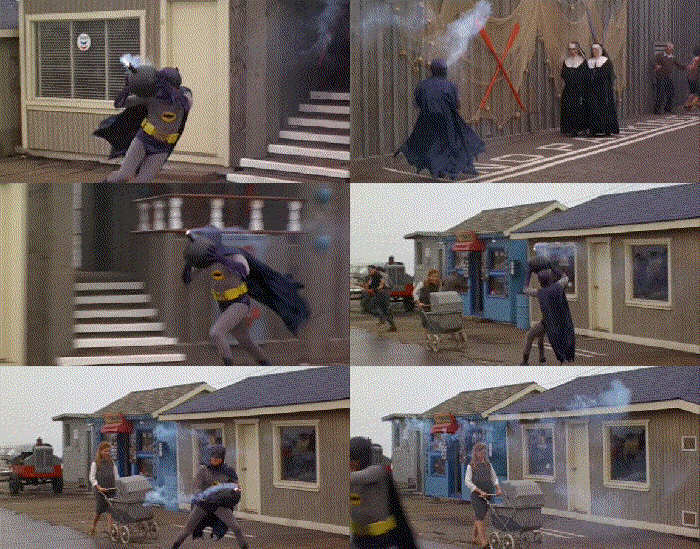
Batman taken seriously

The Boys
Ever thought that superheroes were always just a little too uppity? Ever get the impression that the good guys would often cause just as much mayhem as the bad guys? Well Garth Ennis has written a series for you. This series seems to have stemmed from Garth’s work for Marvel comics and a specific edition of The Punisher: The Punisher Kills the Marvel Universe. This series has everything you would expect from an episode of The Young Ones. Fantastic.

300
I preferred the movie.

Witchblade
I started reading this Ron Marz series for two reasons. The first was that I had heard there was a movie adaptation planned. The second was:

Empowered women = good thing

Ron Marz and Mike Choi have created a visually stunning and intriguing series. Aside from the obvious teen appeal of the character depictions, it has to be said that the Witchblade series has some fantastic artwork on display.

The Punisher
Three pretty crappy movies have been made of this long running anti-hero series. In my mind there is only one Punisher author: Garth Ennis. I’ve read 3-5 years worth of Punisher comics and graphic novels this year, and I can actually spot when Garth has stopped being the author. You immediately notice that there is something lacking, or in some cases that it just plain sucks. Garth has had two runs at The Punisher, the first under the Marvel Knights imprint, the second under the MAX imprint. The MK series is, well, more aimed at people who don’t need to shave and think that vampires should sparkle. Garth makes it enjoyable, but really MAX is the graphic novel of Punisher. If they followed the Garth Ennis MAX story lines they might even make a decent Punisher movie before the second coming of Brian.

Reading Graphic Novels
I have a few tips for reading graphic novels. Buying your graphic novels as comic book reader (cbr) files is the e-book of the comic world: quick, easy and none of that pesky walking to a store. Of course, just like an e-book, you need a reader for your e-comics. Preferably you want an LCD or similarly sharp screen to enjoy the artwork (Witchblade really pops on an HD screen). Another thing you want to do is wait. Wait for your series to be finished and the collection to be released. Nobody wants to wait a month for the next edition. It’s like waiting for the next episode of Justified (or any other decent TV show), except instead of a week you have to wait a month. More frustrating than explaining the movie Inception to a blind and deaf insomniac.

Print on Demand

Take a look at this little wonder of printing technology:

This, or a machine similar, will be your bookstore of the future. No longer will you be limited for choice. No longer will you have to stand with your head at a funny angle trying to find your next purchase. No longer will stores have to have stock or sell-through rates or large amounts of floor space. No longer will the store clerk be able to stare at you quizzically when you ask for something other than a book from their display at the front of the store.

The bookstore of the future will print your book while you wait. It will be like a drive-thru or lunch bar for books. Granted the pricing I’ve seen for individual books is probably a bit pricey for stores, but that will come down as this technology is taken up. Plus Print On Demand (POD to book fans) is probably one of the few ways fans of dead trees will be able to feed their addiction to non-ebooks. It’s either POD or having a guy in a long coat proposition you in the pub with a “great deal” on an “antique” that just “feel off a tree”.

Books you should read: Climate change

I couldn’t even begin to count the number of peer reviewed journal papers I’ve read. According to my Endnote archive I’m a nerd. It also indicates that I read 800 odd papers for my postgrad thesis. Suffice to say, when it comes to science I tend to read journal papers and not books.

Well I have three science books that I think people should read. You know what I love about science books? Well, it is refreshing to read science written in a way that isn’t so boring! Trust me, I’m a scientist and even I get bored with journal papers.

Climate change science is a funny topic. Since anthropogenic climate change was first proposed in 1824 there has been a lot of research done on climate systems and climate change.

  • 2425 peer reviewed papers on climate change
  • 2042 peer reviewed papers that are neutral (i.e. about climate systems)
  • 186 peer reviewed papers that are sceptical of climate change

Source

So how could this even be a topic of debate? The science is well understood by 97.5% of climate scientists. Even the most sceptical group in society – scientists (who have a default position of “prove it to me”) – are between 82 and 91% convinced. Who forgot to tell the rest of the world? And how do we break the news to them about the Easter Bunny?

More doctors recommend Camel cigarettes.

Naomi Oreskes talks about why there is doubt, and it isn’t because of the science. What do you get when you cross a lobbyist with a pile of cash? You get a doubtmongerer. After reading this book I’m heartened to know that with enough cash I could successfully convince people that there is doubt about the Earth being flat and that gravity doesn’t really affect us. Newton wouldn’t know an apple if it hit him on the head.

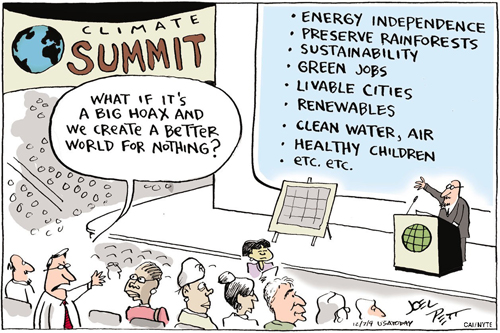
How do you spot a denialist?

Calling someone a climate sceptic is actually incorrect. When the weight of evidence proves climate change is happening, and we have been presented with that evidence, it means that not accepting it is about denial.

Hansen climate predictions, actual observed temperatures, Lindzen “sceptic” claims.

Haydn and John cover two aspects in their book: denial and common climate denial arguments. As such this is a great book for understanding why the message has been lost on some, and also points out the actual science debunking the denial arguments.

This book makes me feel a lot younger.

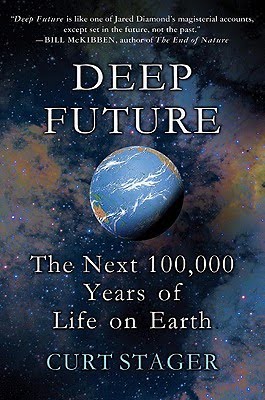
Paleoclimatologists are interesting. They don’t think of things in terms of years, or election cycles, or even decades; they think in terms of millennia. I heard Curt speak at the Sydney Writers’ Festival and he made some very interesting points. My favourite was that we didn’t have to worry about the next ice age due in 50,000 years time, because our climate impacts have upset the Earth enough to negate that little eventuality. His book has even more of these insights.

Edit: I’ve managed to find a short version of Curt’s talk on YouTube that is worth watching. It is from a seminar he gave in Perth, Australia.

Full version is here.