This slideshow requires JavaScript.
Today we have a special guest on the site. My friend Rex is an author, science nerd and has as many degrees as I have, so you can see why we get along so well. Last year Rex released his first novel, Lucifer’s Odyssey, which I recommend for any speculative fiction and fantasy fans, and this year has released the sequel, The Goblin Rebellion (which is free for the next couple of days).
Tyson: Rex, you’ve had a busy 6 months. You have released your first novel, gotten married, released two novellas, completed a PhD and released your second novel. The obvious question I have for you is, what are you currently reading?
Rex: Unfortunately, most of my reading material has been non-fiction recently. I work in real-time, embedded systems and am involved in several interesting projects involving spacecraft, mobile devices and very soon remote-controlled drones. I’ve also been giving job talks for professor positions and finishing up my dissertation (March).
T: So boring stuff is working with real spacecraft? You just killed the dream of every boy under the age of 12.
R: Oh, I wouldn’t say it’s boring at all. I’m extremely excited about my work, and I plan on doing much more of it!
T: What about fiction?
R: The next fiction books on my list are a couple of indie author works: Moses Siregar’s “The Black God’s War” and Jennifer Rainey’s “These Hellish Happenings.” I’m also REALLY wanting to read George R. R. Martin’s epic series. It feels like I’m running into people reading a Dance of Dragons at every airport I enter, but I’ve heard stories about weeks-long splurges on his books, and I’m trying to avoid it until I’m able to really get into it.
T: Jennifer’s book is on my to-read list, which is still 6 or more months long. I found the first three Game of Thrones e-books on sale and snapped them up. Whenever I read a book or series that has taken the world by storm I am always underwhelmed. I call it the DaVinci Effect.
R: A well-chosen descriptor.
T: Thanks. How much Christian hate mail have you received so far after Lucifer’s Odyssey?
R: I wouldn’t say it’s Christian hate mail. I’ve received some sporadic messaging that I would characterize as worried. Part of being a Christian is discipleship, and some people take that very seriously. A novel that spans trillions of light years in distance and involves creatures living hundreds of millions and even billions of years does appear to conflict with strict belief in the 6,000-10,000 year old creation story.
But I honestly find it odd that this rift between modern scientific discovery and Christianity even exists. It would have been quite easy to update Christianity to account for the fossil records in a way that doesn’t involve saying “but those are all from Noah’s flood” (which is quite ludicrous) and in modifying man’s role in the universe once we realized just how massive the known universe is. Instead, many in America tend to look at science’s findings as one of God’s tests: a challenge that God has handed down to test the tenacity of their belief that every word in the Bible is in fact directly from God and thus infallible. And this kind of stubbornness to adapt to facts and findings has retarded our growth as a species since Galileo. I’ve heard from some that this voluntary impediment is in fact reasonable and expected because Eve shouldn’t have eaten from the knowledge tree to begin with…
Anyway, yes I’ve gotten some mail, but I understood I would be getting it. Most of it has been cordial, but religious figures are a touchy subject, even if they are presented in a fantastic and fictitious light in the series. The series is not intended to bash Christian beliefs by any means. It’s more of a modern retelling of the origin story with the vastness of the universe and time taken into account. I also love string theory and the concept of multiverses, time-dilation, chaos theory, and other hobbies of mine, and the only way to properly have fun with them was to set them in an expansive series of universes.
T: I like that yourself and David McAfee have both been listed on a review of your book. Apparently you’ve created a genre for Christians to get riled up about.
R: Yeah, pseudo-biblical fiction. With the way it’s defined, most fantasy could be placed in there. I’m pretty sure any book with a savior child character who is promised by prophecy in a religious tome could fall into this genre, should a comparison be wanted. Belgarion in David Edding’s Belgariad series might fall into this comparison, even though it’s unrelated to Christianity, just because a savior child is promised to the Earth and rescues the world from evil. It’s probably an appropriate descriptor for my first series, though I’d disagree with the anti-Christian characteristic for reasons stated in the comment section of that article.
T: Interestingly the entire “young Earth” thing is just one section of six views on Christian religious interpretation. Most sects are fine with science. Of course I’ve received enough death threats to understand fundamentalists are the strange cousin of any societal group, we’re all embarrassed by them.
R: The Young Earth group may be one of six Christian interpretations, but it’s hardly the minority in America. My only issue with the group is that they’ve latched onto the debates that atheists and theists have concerning the origin of the universe (i.e., Big Bang versus Creationism), and are using issues with the current perceived expansion rate of the universe as proof that the entire scientific movement is a house of cards.
For example, the fossil record is now in some way dependent on the Big Bang and collapsing expansion theory, tectonic plates are now somehow linked to weathermen not getting the weather right all the time, evolution is now directly linked to asteroids carrying microbes being the real originator of life, or climate change is suspect because it doesn’t make sense that matter can come into existence from nothing. I’ve seen all of these claims in arguments from Young Earth creationists. Even though none of these are dependent upon each other, it’s become a science versus creationism argument where all science can now be suspect simply because a Young Earth creationist is unwilling to investigate or learn about an entire branch of science–since someone has convinced them that all science is wrong and evil and counter to God’s intentions for mankind.
The result is a sustained rise of fear and ignorance, and that is a huge impediment on progress. And ultimately, I believe the continued pressure of this movement on education is causing less emphasis on math and science in American schools and is directly hindering our economy and ability to produce quality researchers, which are required for innovation and technological growth. After all, environment has a lot to do with educational responses of children. If parents don’t value math and science and look upon them negatively, children are likely to have the same feelings.
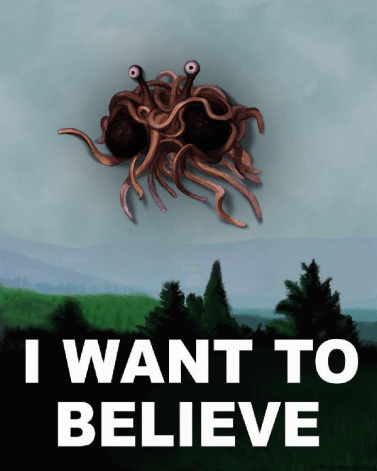
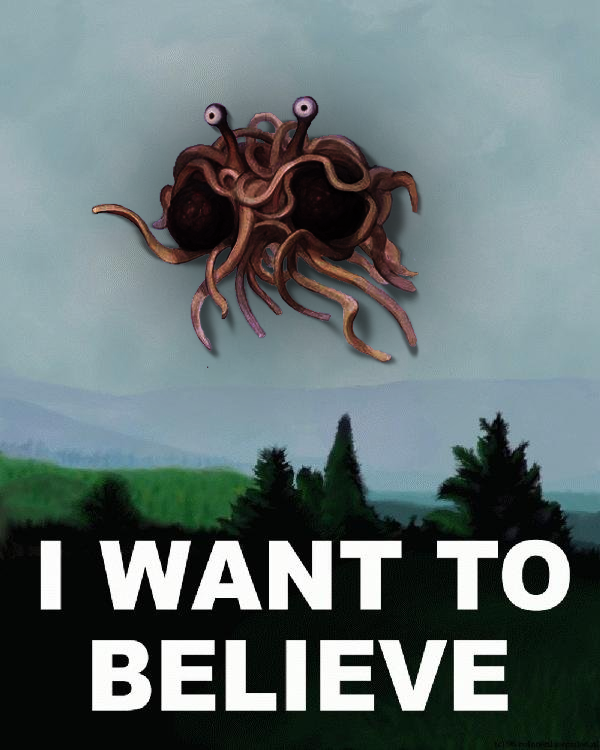
T: Can we expect to see Lucifer square off against his noodliness, the Flying Spaghetti Monster?
R: I don’t think that would be much of a fair fight. Yes, FSM has wing-like structures that might help propel him through space, but FSM’s wings appear quite squishy and obviously delicious. Lucifer appears to be made of stronger stuff in the series, and I doubt he’s anywhere near as tasty. Therefore he has fewer natural predators, a sword, the ability to open a channel to near-infinite reserves of energy in a big-bang-like state, and wings made of a nearly indestructible material–while the demons or angels are alive and their soul is present. In contrast, I’ve never seen FSM with a sword. I’ve seen him falling for the “pull my finger” routine (which shows obvious gullibility) but never wielding a scary weapon.
I’ll admit I could be underestimating his ability to smother someone with special sauce or noodly goodness.
T: You also forget his noodliness has pirates on his side. Actually: Flying Spagehetti Monster, Lucifer, Pirates, Christian outrage; add ninjas and zombies to the mix and you have the next Da Vinci Code!!
R: Heh! If only it were that easy, we could all be rich!
T: You classified Odyssey as speculative fiction, I would have called it fantasy: Wheel of Time, spec fic or fantasy?
R: In my defense, I have categorized the work as epic fantasy and space opera. I haven’t read Robert Jordan’s Wheel of Time past the first book. I recently thought about picking it up during the holidays, but then I saw the reviews for New Spring and decided against it (at least for now). I read Derek Prior’s “Cadman’s Gambit”, instead, and I’m happy I did. It’s a complicated story but good. It’s also speculative fiction/fantasy, btw.
T: I started the first in the Wheel of Time series, moved onto the Night Angel series by Brent Weeks. Fantasy always seems to be code for “I didn’t want to grab my street map for exposition”, unless it has elves or dragons in it. Apparently having a proper imagination precludes classification in other genres.
Game of Thrones, ditto, spec fic or fantasy?
R: Fantasy. I’ve seen a couple of the HBO episodes but haven’t started the book series out of fear of missing my dissertation and paper deadlines. That being said, it will be mine–oh, yes!
T: Thesis deadlines are highly over-rated. They only apply to the postgrad student and not anyone else in the chain. I still haven’t received my certificate. Actually, there is an idea for an epic thriller: “Two postgrad students (Rex and Tyson) fight the hard slog of science, peer review and the ruthless administration building to finally graduate. But will it be too late to enter the real world?”
R: Honestly, my adviser doesn’t seem like he’s in much of a hurry to get me out the door, but I’m chomping at the bit to have my own lab, target my own research grants, and teach my own classes. So, that’s really the only reason I’m pushing so hard to finish my dissertation. The job I want requires final paperwork and the funny robes, and I’m getting feedback and interest from great universities and faculty that I’d love to work with.
T: Funny robes and extra acronyms attached to your name is always handy, especially when you are arguing with the anti-science brigade.
So you’re sticking with your classification for Lucifer’s Odyssey? You could sucker a few unwitting literary fiction readers.
R: The classification of Lucifer’s Odyssey as speculative fiction comes from the fact that readers debate about whether Roger Zelazny’s Amber Series was “classic science fiction”, “fantasy”, or the much more recent “speculative fiction.” I had read some commentary on the Kindleboards from readers, and many of them seemed less offended by the label “speculative fiction” than choosing one of the categories with stricter modern interpretations of genre boundaries.
Lucifer’s Odyssey is more fantasy than science fiction, and the majority of my work will probably be more fantasy than science fiction. I chalk this up to my line of work. When you look to escape your current situation, you often go to the opposite extreme of what you do every day. Since my job has me looking at problems in satellites, rc drones, and mobile phones in mission critical systems, my writing escapes tend to be more fantastical rather than technical. I have some ideas for thrillers and pure fantasy, but I’m putting them on the back-burner until I at least finish “Shadows of our Fathers”, the third book in the Primal Patterns series.
T: I hear you there. I’m writing thrillers where the main characters get to shoot a lot of people. Shooting someone for making up their opinion on the spot, to argue with the person who has just spent the last few years researching the topic, isn’t widely accepted in society.
R: Well, I’ve noticed people are far more willing to read a book about shooting random people than a derelict homeless man dropping f-bombs when the devil kills his friend. Maybe your idea could work.
T: Are you living proof that being an author attracts the ladies, since you got married after publishing Odyssey?
R: Hah! Hardly!
Although Lucifer’s Odyssey was published last year, it started as a short story several years ago. The original story was from the perspective of Michael and involved the bar scene, the interrogation, and the escape and burial of Azazel (which was taken out completely during editing), but in a much more primitive form. And quite frankly it was terrible. Even after several rewrites, it was bad.
I met my wife while the story was forgotten in a folder on my hard drive. So, resuscitating it and redrafting it a few times resulted in far more eyerolls from her than attraction. Still, she’s awesome and incredibly supportive. It takes a special kind of person to love someone who has a job that sends them frequently abroad and often spends a considerable amount of time at a computer writing stories or developing software when they’re in the room with you. She’s a rock star and a wonderful person!
My wife pointed out that the reason I was having trouble writing any of my stories was that they were all depressing and dark. Now they are shooty and dark, so it is amazing what our partners can bring to our writing.
Actually, the novelette “Elves and Goblins: Perspectives of a Father’s Rebellion” is totally dark and shooty. Maybe one day we could collaborate on a thriller or something. Might be fun.
T: Well, we already have an idea for the plot. Although submitting a thesis at gun point and combating peer review in a death match scenario may only appeal to scientists.
I’m going to put in a spoiler alert here: at the end of your first novel Jesus ended up somewhat shorter. Doesn’t that leave the next book without a decent bad guy? Because if the sequel is Lucifer dealing with his feelings about the loss of his cat to cancer, I might not promote it.
R: Here’s an even bigger spoiler: I have no plans for putting Jesus into the series, and there’s a framework for seven books–though I only plan on doing three books in the Primal Patterns before moving on to something else for a while. That could change if readers demand it, but I think a foray into more standard fare might be something that would appeal to new readers. Contemporary urban epic fantasy like the Winter Phenomenon series I had planned or maybe expansion of one of my short stories.
T: We had a conversation about how wonderful editors are a few months ago. How do you think your editor could improve something written by the average monkey at a typewriter?
R: I’m afraid I won’t name names, but the bane of most unedited first work is head-jumping and bad dialogue. I’ve noticed many new fantasy or science fiction authors tend to do pretty well with action sequences. I say many and not most. Most self-published work is still bad, and I think all work should be edited in some way by neutral parties in your genre. The only exception to this are trained professionals or people who know how to remove themselves from the work and become neutral parties in the genre.
Another thing that an editor does for an author is give some peace-of-mind to the fiction writing process on subsequent books. When I was writing Lucifer’s Odyssey, I had a lot of self doubts about whether or not I could tell a story this complex. I’m not sure the answer is ‘yes’ yet, but from the reviews, I don’t think I’ve done a terrible job either.
A couple of readers have noted that the tone can be jarring, and after asking one of them, I was told that the tendency of Sariel to inject humor into serious situations was the type of tonal change that seemed unusual. My editor once made a suggestion on one of these, and I did tell him that I would rather Sariel remain that way because sarcasm and fraternal humor is basically how he’d gotten through life as a youngest child, a seemingly destiny-less position, in the most important family in all of Chaos. His tone changes quite a bit in the second book, but that core is still there. He’s lived for millions of years, and he still has his daredevil instincts and a frightening tendency to play with his food, even if it might kill him.
Now, I’m coming to this in a roundabout way, but I do have a point. An editor is only as useful as you let him or her be. If they make suggestions and you buck them, you better have a good reason for it, and you better be prepared to face the music when readers who want that type of sanitized feel pick up your book.
Similarly, if you didn’t expect backlash but you find it, as a self-published author you have the ability to change it. I recently removed almost all of the cursing from both “Lucifer’s Odyssey” and “Angels and Demons: Perspectives of a Violent Afterlife” because of a handful of complaints (out of thousands of readers). Why? I made a trade off.
I believe that in the real setting, the characters would have cursed, but I know that many more conservative readers would have used the cursing as an easy excuse to not read the book and allow themselves to enjoy the story. I also knew I wanted to give the book away for free for short periods of time, and from experience, I know that this particular type of reader picks up free stories without looking at the summary or the warnings, and they are more likely to leave a 1-star review. Is this my fault? No, but such a 1-star review given within days of a book’s release (especially if it’s the only one) can kill a book’s potential quickly. After re-reading the story without the cursing I felt that the compromise was worth doing.
So I think it’s important to mention that listening to your editor is vital, but so is listening to your readers. Yes, some readers are going to be wrong, and you have to understand that there’s always a vocal minority that believes their opinion is right no matter what evidence is presented to the contrary. But often, readers can be a part of the long-term editing process–the neutral genre voice that guides writing into the next book and the one after that. And that’s worth listening to!
T: Thanks to Rex for taking time out of his hectic day. Spec-fic fans should check out Rex’s writing. See my review of his first novel here.









 Tyson Adams