The other night I was watching the Fast and Furious 6, which is a great story about how The Rock is proving you don’t need CGI for the next Hulk movie. With the announcement and post-credits scene showing they are making Fast and Furious 7, I thought it was worth re-capping the series so far.
1) The Fast and The Furious
This first instalment is pretty much Point Break with cars.
2) 2 Fast, 2 Furious
Also known as The Curious Case of the Missing Vin Diesel.
3) The Fast and The Furious: Tokyo Drift
Who are these people? Why are they driving sideways? Where are Paul and Vin?
4) Fast and Furious: Career Booster
After realising that people still like seeing cars at the movies but are only so-so about Vin Diesel and Paul Walker’s other films, it was time to film some car porn with the original cast.
5) Fast 5: Bicep Showdown
The Rock and Vin Diesel spend two hours showing off their gym time.
6) Fast and Furious 6: The Rock and some cars
The Rock dwarfs everyone on screen and no-one can see the cars clearly.
7) Fast and Furious 7: Back to Tokyo*
We quickly forget that Paul Walker has been a main cast member of the series as Jason Statham, Tony Jaa, Rhonda Rousey, Vin Diesel and The Rock beat the crap out of each other near some cars.
8) Fast and Furious 8: Reasonably Priced Car
Having realised that with all the protein and creatine the stars have been eating they can no longer afford fancy cars, Vin’s crew now rebuild some small hybrid cars to make them capable of a 20 second quarter mile.
9) Fast and Reasonably Furious 9: Repossession
Despite having downgraded to cheaper vehicles, the sheer weight of the bloated continuation of the series leads to the repo-men arriving and taking all the cars. When Vin and his crew confront the repo-men, the repo’s say “This is what we do.”
10) Fast and Not Really Furious 10: Nursing Home Drift
Now confined to wheelchairs and with rapidly deflating biceps, Vin’s crew trick out some wheelchairs and mobility scooters to pass the time between naps.
Update: According to my news feed, Paul Walker died in a car crash after a charity event at age 40. I’ve written before about Paul Walker seeming like a nice bloke who seems to have made it in films by being a decent guy and not because of acting ability. My comments above about the next Fast and Furious movie suddenly take on a new light, so I just hope the next instalment honours Paul’s involvement in the franchise (it was that initial screen chemistry between Paul and Vin that made the first movie a success). I’d already felt the franchise was drifting away from Paul as the main character, hence the joke about the massive ensemble cast above, so let’s hope they do something cool to honour him.
Now this is an interesting study and article. I have actually noticed this phenomenon myself when looking for crime and thriller authors and books from various generations. Everyone knows Robert Howard, Raymond Chandler and Donald E Westlake, they’ve pretty much stayed in print since they were released. But what about the other authors from the 1920s to the mid 1980s? On various writer forums you will find writers re-releasing their novels from the 80s as ebooks. This is the downside of copyright. Read for this article I stole am re-blogging from The Atlantic.
by REBECCA J. ROSEN A book published during the presidency of Chester A. Arthur has a greater chance of being in print today than one published during the time of Reagan.
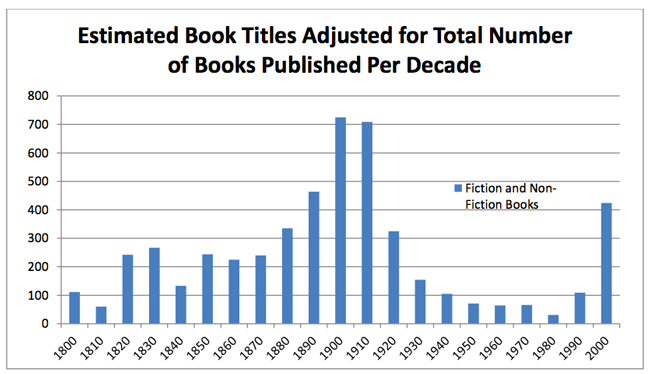
Last year I wrote about some very interesting research being done by Paul J. Heald at the University of Illinois, based on software that crawled Amazon for a random selection of books. At the time, his results were only preliminary, but they were nevertheless startling: There were as many books available from the 1910s as there were from the 2000s. The number of books from the 1850s was double the number available from the 1950s. Why? Copyright protections (which cover titles published in 1923 and after) had squashed the market for books from the middle of the 20th century, keeping those titles off shelves and out of the hands of the reading public. Heald has now finalized his research and the picture, though more detailed, is largely the same: “Copyright correlates significantly with the disappearance of works rather than with their availability,” Heald writes. “Shortly after works are created and proprietized, they tend to disappear from public view only to reappear in significantly increased numbers when they fall into the public domain and lose their owners.” The graph above shows the simplest interpretation of the data. It reveals, shockingly, that there are substantially more new editions available of books from the 1910s than from the 2000s. Editions of books that fall under copyright are available in about the same quantities as those from the first half of the 19th century.
Publishers are simply not publishing copyrighted titles unless they are very recent. But this isn’t a totally honest portrait of how many different books are available, because for books that are in the public domain, often many different editions exist, and the random sample is likely to overrepresent them. “After all,” Heald explains, “if one feeds a random ISBN number [into] Amazon, one is more likely to retrieve Milton’s Paradise Lost (with 401 editions and 401 ISBN numbers) than Lorimer’s A Wife out of Egypt (1 edition and 1 ISBN).” He found that on average the public domain titles had a median of four editions per title. (The mean was 16, but highly distorted by the presence of a small number of books with hundreds of editions. For this reason, statisticians whom Heald consulted recommended using the median.) Heald divided the number of public-domain editions by four, providing a graph that compares the number of titles available. Heald says the picture is still “quite dramatic.” The most recent decade looks better by comparison, but the depression of the 20th century is still notable, followed by a little boom for the most recent decades when works fall into the public domain. Presumably, as Heald writes, in a market with no copyright distortion, these graphs would show “a fairly smoothly doward sloping curve from the decade 2000-20010 to the decade of 1800-1810 based on the assumption that works generally become less popular as they age (and therefore are less desirable to market).” But that’s not at all what we see. “Instead,” he continues, “the curve declines sharply and quickly, and then rebounds significantly for books currently in the public domain initially published before 1923.” Heald’s conclusion? Copyright “makes books disappear”; its expiration brings them back to life. The books that are the worst affected by this are those from pretty recent decades, such as the 80s and 90s, for which there is presumably the largest gap between what would satisfy some abstract notion of people’s interest and what is actually available. As Heald writes:
This is not a gently sloping downward curve! Publishers seem unwilling to sell their books on Amazon for more than a few years after their initial publication. The data suggest that publishing business models make books disappear fairly shortly after their publication and long before they are scheduled to fall into the public domain. Copyright law then deters their reappearance as long as they are owned. On the left side of the graph before 1920, the decline presents a more gentle time-sensitive downward sloping curve.
But even this chart may understate the effects of copyright, since the comparison assumes that the same quantity of books has been published every decade. This is of course not the case: Increasing literacy coupled with technological efficiencies mean that far more titles are published per year in the 21st century than in the 19th. The exact number per year for the last 200 years is unknown, but Heald and his assistants were able to arrive at a pretty good approximation by relying on the number of titles available for each year in WorldCat, a library catalog that contains the complete listings of 72,000 libraries around the world. He then normalized his graph to the decade of the 1990s, which saw the greatest number of titles published. By this calculation, the effect of copyright appears extreme. Heald says that the WorldCat research showed, for example, that there were eight times as many books published in the 1980s as in the 1880s, but there are roughly as many titles available on Amazon for the two decades. A book published during the presidency of Chester A. Arthur has a greater chance of being in print today than one published during the time of Reagan. Copyright advocates have long (and successfully) argued that keeping books copyrighted assures that owners can make a profit off their intellectual property, and that that profit incentive will “assure [the books’] availability and adequate distribution.” The evidence, it appears, says otherwise.
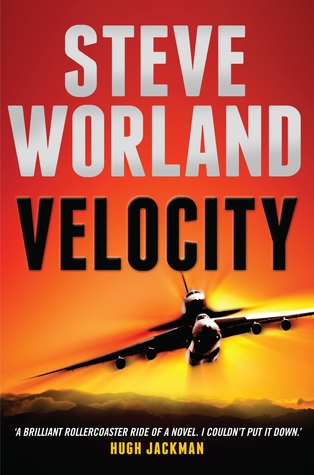
Whenever there is a new thriller author on the block, especially if they are Australian, there is always someone drawing a comparison to Matthew Reilly. You can just about guarantee that this comparison will be drawn by someone who hasn’t read Matthew Reilly’s books or hasn’t read the new author’s book/s. Finally, there is an author with whom this comparison is valid.
Radio and Wedding DJs like to dedicate songs, but rarely do they get past the “This one goes out to all the ladies.” or “This one’s for all the lovers.” It seems odd to me that DJs don’t mix it up a bit and play some songs for more specific groups of people. For example:
This one is for everyone who loves kids.
Michael Jackson – Beat It – because Michael Jackson loved kids too.
This one is for anyone at home playing with rope.
Joy Division – Love Will Tear Us Apart – because rope lovers identify with the Joy Division front man.
This one is for those who are having a good day.
Dimmu Borgir – Burn In Hell (Twisted Sister cover) – because a DJ is never having a good day.
This one is for everyone arguing on the comments of Youtube.
Jackson 5 – ABC – because clearly no one commenting there have learnt them.
This one is for everyone driving slow.
The Beatles – Can’t Buy Me Love – because you aren’t buying love on the street.
This one is for the Westboro Baptist Church.
AC/DC – Highway to Hell – because that is exactly where this church belongs.
This one is for all the politicians.
Guns ‘n’ Roses – Get in the Ring – seriously, one round, no holds barred, no tap outs.
Let’s face it, a large chunk of literature and non-fiction sales are nothing to do with people reading and everything to do with being seen to read. It was no surprise to early e-reader adopters that the romance and erotica genres took off as people on the bus to work could now read the stuff they wanted to without being judged. The Guardian posted this survey of readers (although I can’t find the source) listing off everyone’s favourite reading cred books, you know, the ones you claim to have read but fell asleep at page 2.
A recent survey of 2,000 people suggests that the majority of people pretend to have read classic books in order to appear more intelligent, with more than half of those polled displaying unread books on their shelves and 3% slipping a highbrow cover on books they’d rather not be seen reading in public.
The books most likely to be lied about are, naturally, the books most often filmed, talked about and studied in school (some of the respondents must have been lying since GCSE onwards). Are any of them in your pretend-I’ve-read/never-finished pile, or do you save your literary fibbing for Finnegans Wake and Infinite Jest? Share your guilty secrets below.
1) 1984 by George Orwell (26%) I have actually read this classic. I read it because Animal Farm was one of the only books I had to read in English Lit class that I actually enjoyed (I’m not counting plays, you’re not meant to read plays, you’re meant to see them performed!!!). I enjoyed it, but I can see how people would battle to read this one.
2) War and Peace by Leo Tolstoy (19%) Haven’t read this one and have no intention of trying. People always talk about battling through it in small chunks because it is such an important and blah blah blah book. If it was really important it wouldn’t have been so boring as to necessitate reading it in small chunks.
3) Great Expectations by Charles Dickens (18%) I watched the old black and white film, does that count?
4) The Catcher in the Rye by JD Salinger (15%) I’ve read this many times and hated it every single time. Each time I’ve re-read it I’ve done so because I felt I was too young and/or stupid to get it, so I must re-read it because I’m so much older and smarter now. Although, John Green did manage to convince me of its literary merits via Crash Course Literature, not that I’ll bother revisiting this novel.
5) A Passage to India by EM Forster (12%) I can honestly say I’ve never heard of this book.
6) Lord of the Rings by JRR Tolkien (11%) I’ve read it, but I will admit that I did so only after seeing the first movie. I really enjoyed the book, but it was long and waffly and I can see why others wouldn’t actually finish it. I will also say that I started reading The Hobbit when I was in school and then realised that life was worth living and stopped.
7) To Kill A Mocking Bird by Harper Lee (10%) Okay, I’m guilty of this one. It is on my TBR pile. I have it on Kindle and DTB.
8) Crime and Punishment by Fyodor Dostoevsky (8%) See #2
9) Pride and Prejudice by Jane Austen (8%) I’m going to read the zombie version.
10) Jane Eyre by Charlotte Bronte (5%) If there is a zombie version of this I may read it.
It has been a while since I’ve blogged one of my book reviews. I guess that is part of the parenting manual that I didn’t read: hobbies are no longer priorities. There have been plenty of good books pass before my eyes since my last review, but I felt content just to let a short sentence, a star rating and an update to my Twitter feed to promote a good read.
This is slightly different. Ben’s book made me annoyed.
I’m a science nerd. I prefer to read the original research papers rather than the media coverage of them, as it is always terrible, usually based on a half-arsed press release and never links to the actual research. I am constantly amazed that in our modern age of computers, internet, vaccines, satellites and zero calorie drinks that people still believe in stuff that wasn’t plausible 200 years ago. And that’s why Ben’s book annoyed me. He made it painfully obvious how deliberate some of the misinformation campaigns have been.
I knew homoeopathy was rubbish (magic water droplets on sugar pills, or as I prefer to call it, a placebo), I knew that complimentary medicine is the term for stuff that hasn’t ever been proven to work, I knew anti-vaccine campaigners clearly didn’t remember that my dad’s generation had polio victims everywhere, I knew that “Big Pharma” are a mixed bag of good and bad science. So if I knew all of this already, why am I annoyed? Because I didn’t realise just how culpable the news media were and how media liaison and PR companies are straight up lying to people.
You see, I always thought, and this is still mostly true, that most media get science wrong because they don’t understand it and it isn’t easy to do the background research to check a press release on a study. I see this as not having the specialist science reporters doing the science journalism (imagine if a science journalist reported on climate change from the beginning, we’d have emissions at zero by now). But with Ben’s section on the MMR “controversy” and the “nutritionists” in the media, he paints a very clear picture of culpability that the media needs to address, or as Ben points out, people will just go to science blogs written by actual scientists in that field.
Excellent book and a must read for anyone who still reads newspapers or watches the TV news.
You may remember that I previously wrote about a number of artists and songs that, despite their crappiness, I actually enjoyed. Well, it only seems fair that I talk about the music I enjoy and whose band t-shirt I would not be ashamed to wear in public. Let’s face it, it is too easy to write yet another article on the internet decrying which musicians suck. We already have science proving that pop music is becoming more generic and bland, I don’t really need to beat that dead horse more than a few times. Unless, of course, I get a particularly annoying song stuck in my head after accidentally wondering into a “hip” clothing store.
I’m going to have to limit my list to recent purchases, otherwise this list could become too awesome and might cause the internet to implode.
Kontrust
I discovered Kontrust completely by accident. Whilst searching for “cool ways to kill people with a spoon” on Youtube, I came across the song Hey DJ by this crossover act from Austria. If you don’t understand all of the lyrics in their songs, don’t worry, that just means you don’t know either Austrian, German, Polish or English. They have three albums out, but they really hit their stride with the second and third albums.
Krypteria – Get the hell outta my way
This German band have been around for quite a while and are part of the legion of female fronted metal acts in Europe. This is the only song of theirs that I like, the rest don’t really grab me like this one does.
Halestorm
There is nothing quite like a good rock act belting out some tunes. Lzzy is a great vocalist and I’m sure the other band members, including her brother, are very important to the music as well.
Amaranthe
I first came across this band because I like Kamelot. The latest Kamelot album and tour features Elize Ryd doing vocals that would normally be done by Simone Simons of Epica. She also filled in on vocals for Nightwish. All this was telling me I had to check out all the projects she was involved with because all the bands I liked were fans, so that meant I needed to be as well. Amaranthe has to be the only three lead vocalists band I know of, but it works very well for their pop-metal stylings.
Five Finger Death Punch
So far all the music I’ve listed have one thing in common: positive and fun music. All right, most of it is pretty heavy, although not by metal standards, but none could be mistaken for angry music. Yet I write action packed stories in which bad things happen to bad people. That means I need the occasional piece of angry music to get me in the mood to take aim at some of the crap people in the world and write a scene where they get shown how to resemble swiss cheese. Enter Five Finger Death Punch. I only have their American Capitalist album, which I was put onto by my friend. He’d put together a training video, prior to him winning his IFBB physique pro card, which included the above track – because weightlifters and bodybuilders can’t lift heavy stuff to pop music.
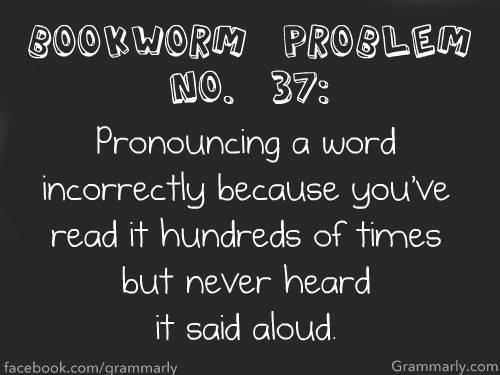
Have you ever suffered from this? I often have this problem with names, especially those from a Dravidian or Sino-Tibetan base. The earliest word I can remember reading but not knowing how to pronounce was acknowledge and its derivatives. It was a favourite verb of WE Johns in his Biggles books, using it instead of said in dialogue. I know, acknowledge is phonetic so there shouldn’t have been a problem, but I was young and my dictionary was very small.
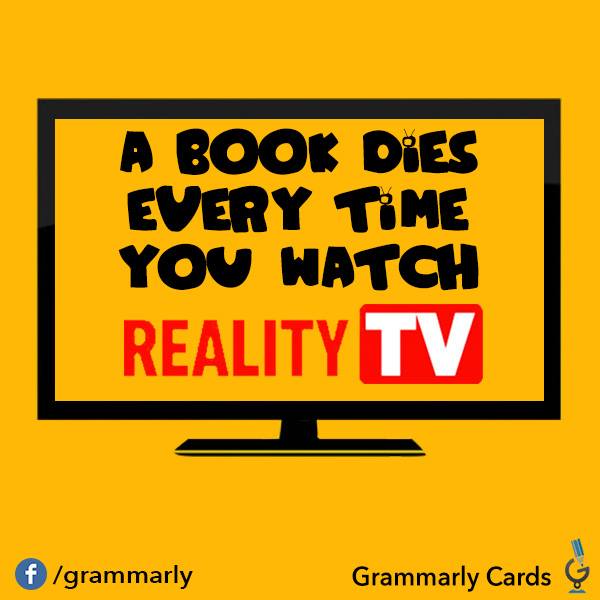
It isn’t just reality TV, it is quite a bit of TV programming that is killing books and, thus, us.
Think about the worst book you’ve ever read. Now remember that, with few exceptions, the movie is always worse than the book. Now think about the best programming on TV being movies and high calibre drama shows. So what I’m insinuating is that the best programs on TV are inferior to just about any book.
For every half-hour wasted watching bad TV, that is 5-10% of a decent novel that you’ll never get to read. Scary, isn’t it!
NB: If people are interested I might write about my favourite TV shows, because not all TV sucks.
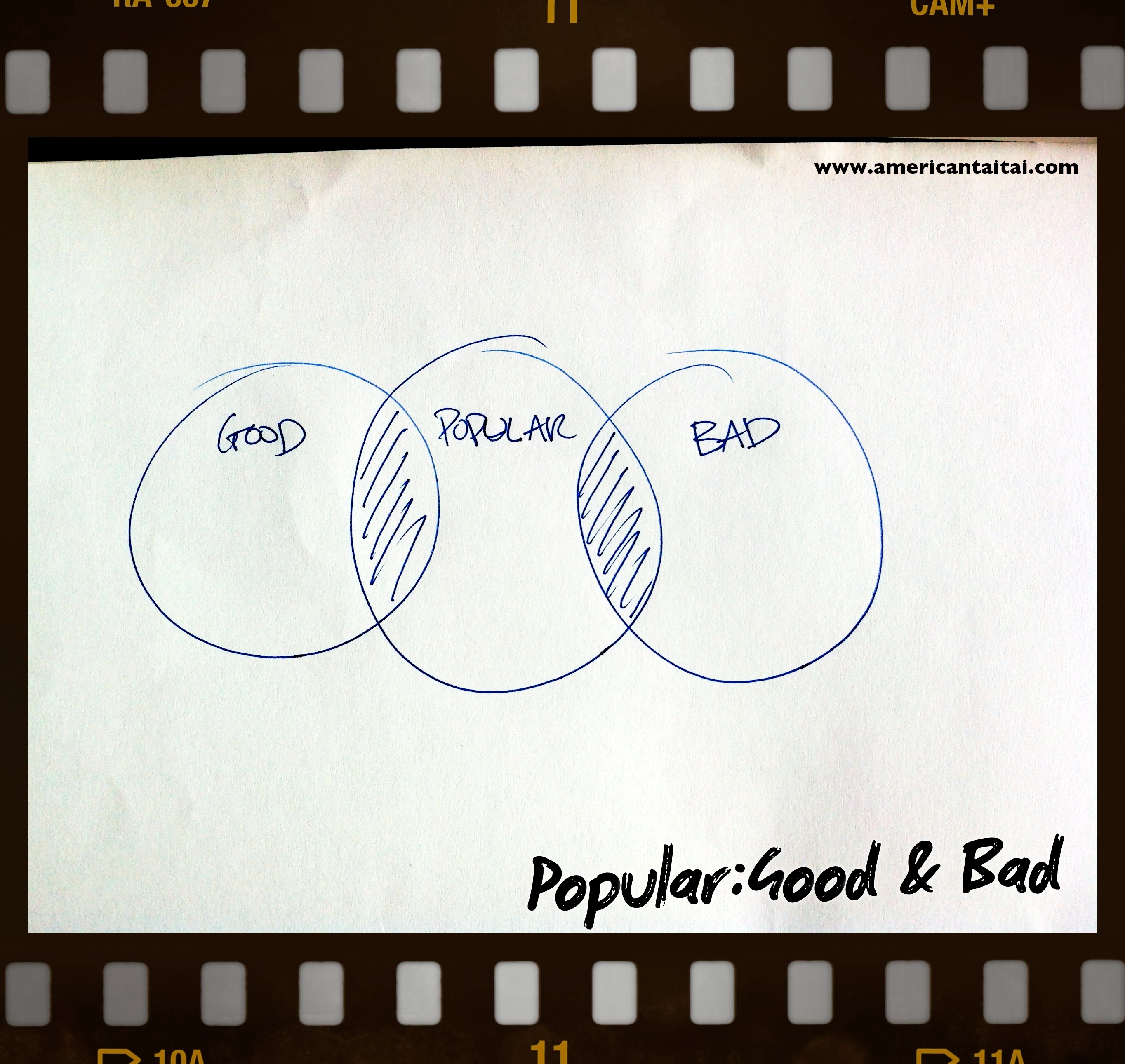
Plenty of what’s popular isn’t good, and plenty of what’s good isn’t popular.
There is a school of thought and snobbery that says anything good is not popular and anything popular is not good. I regard this as a myth. I can’t remember any good stuff that wasn’t popular, because who is going to remember stuff that wasn’t popular and good? Well, it is a little more complicated than that.
Back when I was in high school the music scene changed. No longer were pop bands like New Kids On The Block acceptable on the radio, now it was Grunge and heavier, alternate styles of rock that ruled the airwaves. In 1991 Nirvana released the seminal Nevermind, Pearl Jam released Ten, Soundgarden released Badmotorfinger, and thus the reign of Seattle and Grunge music began. Add to that the release of Guns ‘n’ Roses last decent album, Use Your Illusion (1 and 2), and the cross-over metal album that forced the Grammys to include a new Hard Rock/Metal category, Metallica’s black album, and you can see that it was a good year to be a pimply teen music fan.
At the time you couldn’t talk about music without talking about Nirvana or Grunge. With the release of Smashing Pumpkins’ Siamese Dream, the follow-up albums from Nirvana, Pearl Jam, Soundgarden, and the influx of punk bands like Greenday and The Offspring, alternative music like Grunge was KING. Unless you looked at the charts.
Okay, so some easy listening pop music snuck through with some sales, but Nevermind and the single Smells Like Teen Spirit must have been top 10, right? Nope. Nirvana’s single didn’t make a dent in the charts until 1992, and even then it only cracked the top 50 in Australia (#46) and was #32 in the USA. Of course, rock and metal have never sold singles as much as albums, but Nevermind still only got to #17 in Australia and was beaten by frikin Garth Brooks and Michael Jackson in the USA.
Alright, maybe this is just a once off. The Beatles were huge, right? They combined good music with popularity. Well, in the UK, yes, but in the rest of the world, not so much.*
Before I end up beating you over the eyeballs with this example further, I’ll come to my point: popular has nothing to do with good. Sure, there are examples of good art also becoming popular. The examples I used were still very popular music acts whose influence will continue long after we’ve forgotten what a Bieber is. But people were still more likely to own an album by Garth Brooks or Vanilla Ice than Smashing Pumpkins.
This is why I think that good art is often remembered more fondly after the fact than at the time. Good art stands the test of time, influences others and finds new audiences. Popular art is often shallow, or is transient, which means the audience has forgotten it when the next popular thing comes along.
To quote Neil Gaiman, make good art. Make good art and popularity will be someone remembering your work long after you’re gone.
NB: This article is referring to Survivorship Bias, which is a form of sampling bias, and can be a form of logical fallacy.
* I wasn’t aware when I wrote this article of the actions of the US record label Capitol Records. It appears they did their best to make sure The Beatles weren’t popular in the US. I’d like to say I’m surprised by the things done by The Beatles’ own US record company, but tales of this sort seem to be all too common.
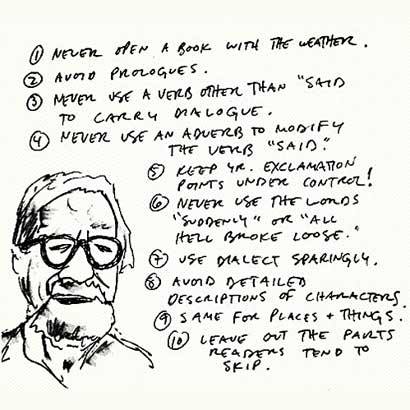
I was saddened to hear of Elmore Leonard’s passing at age 87. He leaves behind a legacy of fantastic writing and his influence will continue. As a tribute I’m posting his ten rules of writing, but I also recommend picking up one of his many works to see how he could impart more in a few sentences than others could in an entire chapter.
I’m not a fan of The Daily Fail. They really do seem to swim in the shallow end of the wading pool of intelligence. That said, today they featured an article from a very good novelist, someone with whom I’ve had some interesting conversations: David Thomas / Tom Cain. So like any good blogger, I’ve stolen the article and reposted it here. Enjoy!
All over the world, on countless flights, heading to an infinite number of sun-loungers people are burying their heads in stories about secret agents, serial killers, ace detectives, evil villains and sexy heroines.
Thrillers are a huge business. They make up about a third of all books sold, and 60 per cent of them are bought by women.
For the very top writers, the rewards are astonishing. In 2009, James Patterson signed a four-year, 17-book deal worth almost £100 million. At the peak of Da Vinci Code mania, Dan Brown was making more than £50 million a year.
For every one of those megastars, of course, there are hundreds of professional thriller writers who just about make it pay – even a best-selling paperback in the UK, shifting 100,000 copies won’t earn much above £50,000 in royalties – and thousands of wannabes. I’m lucky enough to come in the ‘make it pay’ category. So I know what the job entails. And trust me, it isn’t easy.
One Monday morning in June 2006 my literary agent sent out a book proposal to publishers: the first 150 pages of a thriller called The Accident Man that I’d written under the pseudonym Tom Cain. The book had a very simple, high-concept premise. Its hero, Sam Carver, was the man who killed Princess Diana. Her name appeared nowhere in the book. But on the night of August 31, 1997, Carver makes a black Mercedes saloon crash in Paris.
He’s been told the Merc’s passenger is a terrorist. But of course it’s actually a woman – the most famous woman in the world.
By lunchtime on Wednesday, I’d received a six-figure offer for the UK rights to the book and a sequel and Hollywood bought an option on the film rights.
Before you even try to write a thriller, take a good look at how other people have done it. It looked like an overnight success, but I’d spent two years producing one useless draft after another. My agent made it perfectly clear to me that I’d made a bundle of rookie mistakes. My plot didn’t hold together. My writing was hopelessly cluttered with unnecessary descriptions of Parisian streets and buildings as I tried to stuff all my endless research down on to the page.
The characters weren’t believable and the one the agency boss liked best – Carver’s love-interest, a Russian girl called Alix – was killed in the second act. The only crumb of comfort the agency boss could offer me was: ‘I never quite hated it enough to stop reading.’
In the end, we managed to fix all the problems. But in 25 years as a journalist and author, during which I’d written countless articles, edited three magazines and published half-a-dozen non-fiction books, nothing had been as difficult as writing a half-decent thriller.
But what if you want to write a thriller of your own? Here are ten tips that I would give to anyone who dreams of seeing their book piled up in airport bookstores . . .
1) Study the masters…
Before you even try to write a thriller, take a good look at how other people have done it. Read every book you can get your hands on, but watch great TV series and movies, too. The Accident Man was hugely influenced by the way the writers of 24 kept multiple storylines running simultaneously, each with its own cliffhanger, so there was always someone, somewhere, in desperate trouble. 24 was relentless, it never for one moment let you relax. And you always wanted more.
2) …but don’t overdose on them
I devoured Lee Child’s Jack Reacher books. I tried to imitate his terse, punchy, bone-dry style. The result was garbage. Then I realised that Lee writes the way he does because that’s how he naturally expresses himself. So I went back to the way I write naturally, and it made a huge difference. Your book will work best if it’s told in your voice.
3) Structure, structure, structure…
Property is all about location, thrillers are all about structure. Everything has to fit together with the precision of a Swiss watch, powered by a coiled spring. Frederick Forsyth’s The Day of The Jackal is a masterpiece of construction. I once drew a chart on a couple of sheets of A2 paper that consisted of a scene-by-scene analysis of Jackal, showing which characters appeared when, and how Forsyth balanced character development, plot and action over the course of the book. It really helped me understand the structural skeleton beneath the flesh and blood of the words.
4) Show, don’t tell
Always make your point through action and dialogue, rather than exposition. At the beginning of The Accident Man I had a few paragraphs explaining that Sam Carver was an assassin who created fatal ‘accidents’. An American publisher said: ‘Nice idea, but it would be much better if we could see him do it.’ So I wrote a new opening scene in which he killed a people trafficker by sabotaging his helicopter using a miniature spanner, a hacksaw and two blobs of Blu-Tack. So we saw Carver at work. Better.
Some thrillers are whodunits: the hero arrests the bad guy. Some are action thrillers: the hero kills the bad guy. Either way, you’re going to be thinking of new ways to kill people and cool weapons to kill them with
5) It’s the people, stupid
Stieg Larsson thought his Millennium Trilogy was all about the sexism and corruption at the rotten heart of Swedish society. But the millions who devoured The Girl With the Dragon Tattoo couldn’t care less about that. They just fell in love with an emaciated, autistic computer genius called Lisbeth Salander. It’s the characters in a book – and that means the villains, lovers and supporting cast, too – that make it work. So if you ever think, ‘I’ve got a great idea for a thriller,’ make sure you’ve got great characters for it too.
6) Grab them by the throat and their minds will follow
If you don’t grab your readers’ attention in the opening chapter, they’ll find another book. Robert Ludlum’s The Bourne Identity has one of the all-time great opening sequences: a man, fished from the Mediterranean, unaware of who or what he really is, unknowingly possessed of all the deadly skills of a CIA assassin. The men from Hollywood threw away 90 per cent of what Ludlum wrote in the Bourne trilogy. But they kept that opening and it gave them a billion-dollar franchise.
7) Think like a killer
Some thrillers are whodunits: the hero arrests the bad guy. Some are action thrillers: the hero kills the bad guy. Either way, you’re going to be thinking of new ways to kill people and cool weapons to kill them with. So clip grisly news stories. Read books about real killers. Go on the gun-nut channels on YouTube. And read books by Patricia Cornwell and Jonathan Hayes. They’re professional forensic pathologists. Dead bodies are, quite literally, their business.
8) Count the bullets in the gun
If you want your readers to believe your story, get the details right. Either write about what you know, or do your research properly. Don’t have your hero firing 15 bullets from a Walther PPK if it can only hold nine. And speaking of James Bond’s favourite gun, Ian Fleming pulled off a brilliant trick when he created 007. The idea of a cool, sophisticated, lady-killing assassin, touring the world On Her Majesty’s Secret Service, bumping off bad guys who wanted to rule the world was as much a fantasy as Harry Potter playing Quidditch. But because the details were so brilliantly observed – Bond’s cars, his Sea Island cotton shirts, the exotic locations – it all felt completely real.
9) Always think of Option C
The fun part of thriller writing is getting your characters into dangerous situations and then getting them out again. An editor once gave me a great tip: put your protagonist in a situation where they have to choose between two options, A and B. Then write option C. In one of my books, Carver is on holiday in the Greek islands with a girl. They’re having lunch. The restaurant is attacked by gunmen. The girl is shot. Carver just escapes, after a frantic chase. He stops for a second to think. Should he go after the gunmen, or should he get the hell off the island? That’s options A and B. Then the phone rings. He takes the call. It’s the girl – the one who’s just been shot dead. And that’s Option C.
10) If you’re a man, ditch the dumb blondes and tough girls
You have a male lead, and chances are he’s going to want a girl. And she’s going to be sexy, sultry and splendidly beddable. That’s fine – being ravished by the hunky hero works for girls too. Just don’t make her a cliché. Very few men now dare write a ditsy, screaming blonde. But many dream up superchicks who are as tough and deadly as any man. Most women don’t see themselves that way. Strong, yes. Gorgeous, certainly. But intelligent, complex and vulnerable, too, if you don’t mind. And if you’re a woman, bin the bad guys and the goody-goodies. Men are more complicated than that.
…but finally, and most importantly
Forget the rules . . . except one. The first four, clunkingly tabloid words of The Da Vinci Code, ‘Renowned curator Jacques Saunier’ tell you that Dan Brown can’t write for toffee. There’s not a character in the book that’s close to being interesting and the ‘facts’ on which the whole thing depends have been debunked. Yet somehow it’s is completely unputdownable. So in the end, the only rule that really counts is: keep the reader reading.
‘Revenger’, Tom Cain’s latest Sam Carver novel is published in paperback by Corgi, £6.99. ‘Ostland’, by David Thomas, is published by Quercus, £16.99
I don’t like to claim a lot of expertise in formatting, layout and graphic design. That isn’t to say I can’t do it, nor that I haven’t produced a couple of my own publications and newsletters. But I found myself in an argument recently defending using both serif and sans-serif fonts, which is like arguing over what colour black you want to wear to a metal concert (that’s a no-brainer: the darker one).
Anyway, there are plenty of anal retentive science nerds like me who have gone and done research into what fonts work best for which applications. There are actually a surprising number of research studies on fonts and readability.
First, let’s define what is meant by serif and sans-serif fonts. (From Scribe Consulting) Consider the following characters. The first is set in Georgia, a lovely serif font. The second is set in Verdana, an easy-to-read sans-serif font.
serif
sans serif
Notice the small decorative flourishes at the ends of the strokes in the left character. These are called serif. The right character does not have these strokes and is said to be a sans-serif font. Sans is the French word for without. So I could be currently sans-pants.
The most common examples of these two font types are Times New Roman (serif) and Arial (sans-serif). Bleeding Cowboys would be an example of an overused serif font that is for try-hards, whilst Comic Sans is an overused sans-serif that shows a lack of taste.
Now there are some simple rules of thumb when it comes to using serif and sans-serif fonts, which are backed up by science. The first rule is that thumbs only hit the space bar once. The second rule is:
This is because the serif make the individual letters more distinctive and easier for our brains to recognise quickly. Without the serif, the brain has to spend longer identifying the letter because the shape is less distinctive.
The commonly used convention for printed work is to use a serif font for the body of the work. A sans-serif font is often used for headings, table text, captions, and ransom notes.
The third rule is:
Use sans-serif for online work
An important exception must be made for the web. Printed works generally have a resolution of at least 1,000 dots per inch; whereas, computer monitors are typically around 100 dots per inch. Even Apple’s much vaunted retina display is only around 300 dots per inch — much lower than print.
This lower resolution can make small serif characters harder to read than the equivalent sans-serif characters because of their more complex shapes. Yes this does give you an excuse to buy a 4K monitor for your computer. Go nuts.
It follows that small on-screen text is better in a sans-serif font like Verdana or Arial.
I still think that the best bookends are other books. Our bookshelves are actually two layers deep, and that isn’t accounting for the two boxes of young adult books that are sitting in a cupboard because they don’t fit on any shelves.









 Tyson Adams