Think you might be a writer but aren’t 150% sure? Here are ten signs that you may very well have a budding writer inside you.
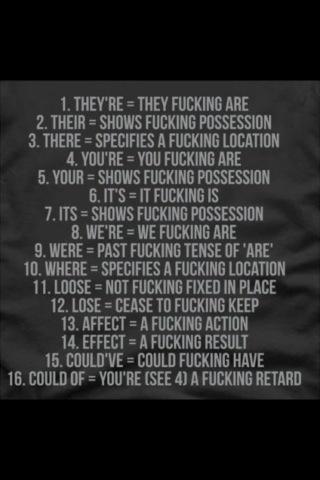
You constantly edit. Whether it’s while you’re driving down the street and pass a misspelled sign, or grammatical errors in Facebook posts, you fix errors constantly in your mind—and sometimes not so silently.
You’re highly observant. And not only do you notice things all the time, but you file them away in your I could write about this later folder.
You often ask, “How could I describe this?” You don’t ignore your life experiences—everything from walking outside during a torrential downpour, to burning yourself while cooking, to taking the first bite of a piping-hot homemade chocolate chip cookie can be used in your writing, and you often pause to think about how you would describe it in words.
You have a hyperactive imagination. There’s never a dull moment in that head of yours—your imagination is always working on overtime to keep you entertained and give you fresh ideas.
You feel inspired to write after reading a good book. Enough said.
You often daydream about your Work In Progress. Your characters never completely leave you— they walk alongside you throughout the day and give you new ideas when you least expect it.
You feel guilty if you haven’t written anything in a while. What a “while” is depends, but after a writing hiatus, a part of you begins to demand that you get back to the keyboard and reprimands you if you don’t.
You can’t get enough books. After all, every new book is a couple of hours worth of inspiration.
You keep doing this writing thing. It doesn’t matter if you’re not published, if no one else cares if you continue to write, if you don’t make a penny off of the words that you put on the page—none of that matters, because you’ll continue to write anyway.
I seem to be finding a bunch of cool infographics recently, they are the future of communication (warning, sarcasm may be in affect here). It is always interesting to see what the status of sales, especially e-book sales. Personally, I see the e-book becoming the new paperback within a few years, and I also think that backlists will be all e-books. What will be really interesting is whether authors will be the one controlling their backlists or whether publishing houses will want to grab hold of those. Then it becomes a case of what rates are paid on backlist, because the sunk costs are a frontlist issue, so you would expect a greater author share of sales (although it could be argued that sunk costs are sunk, thus trying to recoup those costs as part of the sale price is bad economics).
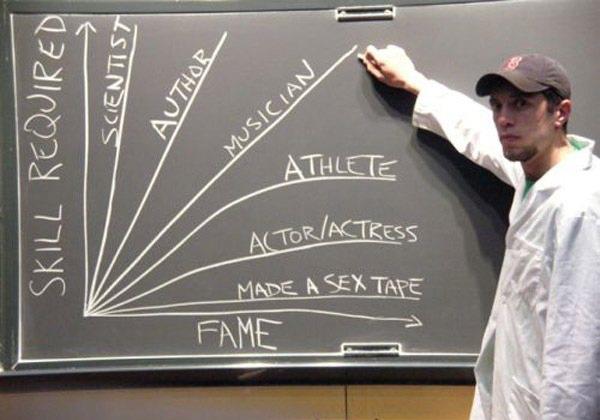
You can always trust a guy in a lab coat, they know stuff. This relationship of skill required versus fame really does show that I have really decided to limit my levels of fame. Scientists aren’t really cool enough to be famous, authors are similarly nerdy, just better with words. Maybe it is time for scientists and authors to start making sex tapes.
Like everyone else with a pulse, I’m a Monty Python fan. Whether it be a killer white rabbit or a very naughty boy, there is nothing quite like the laughs that a Python sketch can illicit. I recently found this lecture that John Cleese gave on creativity. It is quite interesting the ground he covers and the conditions that are needed to be cultivated in order to be creative. Hope everyone gets as much out of this as I did.
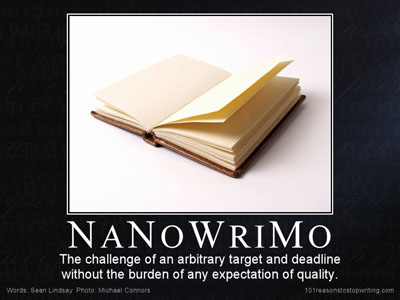
NaNoWriMo starts again for another year tomorrow (the day after for everyone living in the past – being an Aussie is great). Good luck to everyone going crazy trying to write 1666 words per day.
Unfortunately I won’t be able to join the November madness. I really enjoyed last year, especially the part where I actually managed to write 52,000 words in a month. This year I have a 6 week old poop machine to look after. Have fun everyone!
At the moment I have three projects on the go. The first is the rewrites of my first novel, which I’m hoping to finish and try to find a publisher for sometime after Xmas. The second project is a sequel to the first novel. I never intended to make a series, but during the writing of the first novel I had several ideas that just needed to be written as well. The third project is a different tale entirely, not least of which is my choice of third person narrative, unlike the predominantly first person narrative of the other two. For a synopsis of my works in progress, click here.
Damn. How can a thriller or crime writer make a crust if violence is declining?
I know that we writers are generally known for writing fiction, but we readers – yes, I’m both – are also a fickle bunch who like things to have a level of realism to them. We need there to be a basis for our stories so that you can become more emotionally involved with the protagonists. If violence keeps declining then thriller and crime authors are going to have to look to the sensationalism of media reporting for story ideas. I think we can all agree that you can’t base fiction upon fiction.
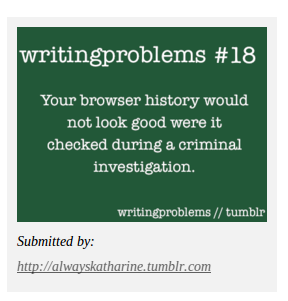
I’m sure you’ve noticed that when you haven’t cleared your browser history in a while, and then perform a Google or (insert your favourite search engine here) search, that a number of links are highlighted as pages you have been to before. This is just a friendly little reminder that you’ve asked the same, or a similar, question just recently and that, maybe, it is time for a screening for Alzheimer’s. But have you had a look through your browser history, or, more to the point, would you prefer no-one ever saw your browser history?
For the average person, I’m sure they don’t mind having eBay, Amazon and Rotten Tomatoes in your browser history is not a big deal. For the average crime or thriller author, the internet browser history would provide an interesting insight into the key plot points of the current work/s in progress. It would also encourage police and intelligence agencies to set up 24hr surveillance on the off chance the author was planning on murdering a key political figure to facilitate the buying of nuclear weapons to arm a terrorist cell that has ties to local organised crime figures who operate in drugs and prostitution; with plenty of pictures. This is slightly concerning.
Sci-fi authors don’t have quite as many concerns with their browser history. Anyone looking at it would fall asleep after the first ten pages of physics article links. Fantasy authors might receive some grief for the swords and leather searches. Romance authors would probably blush at the size of the list of “hard abs” pages. But it is going to be almost impossible for me to argue down a murder charge.
Lawyer: So you deny planning and executing the murder of the cast of Jersey Shore?
Tyson Adams: Of course I didn’t murder or plan to murder those morons.
L: Then why had you visited so many sites on forensics, samurai swords and human anatomy?
TA: Research for my book.
L: A book that you haven’t as yet published.
TA: Well the editor doesn’t like the scene with the cast of Boston Shore being beheaded.
Judge: I just don’t see the crime here. Although, Mr Adams, what is rotten.com?
So could any law enforcement people please keep in mind writers are likely to have a bizarre web history, and that it was very important that I know how to make meth in my backyard. For my novel…
I’m about to start rewrites on my first novel – Overturned Stones – after receiving feedback from a few people. The feedback has been very positive and it appears that even people who wouldn’t normally read thrillers loved the book.
Of course there are changes needed. A first draft always needs a second draft. One thing that a reviewer didn’t like was my disclaimer. Obviously I wrote the disclaimer below when I had intended to self-publish the novel. I’ve since reassessed that idea, thinking that my novel would fit in with what publishers are looking for, so I might as well see if they are interested. Anyway, the reviewer didn’t think I was taking the disclaimer seriously enough:
I’d like to point out that this work is entirely fictional. Where possible I have tried to be as vague and inaccurate as possible so as not to have anything I’ve written be misconstrued as being related to any person or organisation that exists in reality land. If I have inexplicably managed to use a real person’s or organisation’s name or allusions that would suggest it could be them, then it was entirely unintentional and I hope that you get over it. If I have offended you, or anyone you know, with my written word, you can send a stamped self-addressed envelope to me and I will send, via return mail, 30 cents for you to call and complain to someone who cares.
As the recent Oatmeal debacle shows, some people, mainly lawyers, take things far too seriously. The fact that we need disclaimers for fictional work, let alone that they are serious, shows that people have very thin skins. Obviously we have people, like Michael Crichton, who blithely ignore Wheaton’s Law and hide behind the label of fiction to be insulting to real people and organisations. But those people are jerks, we’re meant to ignore them. The rest of the time we need to have a sense of humour and enjoy fiction, especially since it isn’t real.
You may all think that I’m primarily a crime thriller kinda guy, a lot of the book reviews I post here are for crime, crime thrillers and thrillers. My current work in progress is also a crime thriller. So I clearly fit into a very neat little box created out of stacks of James Patterson releases for the month. But I like a lot of genres, I think most readers do, in fact I’d go as far as to say that all readers read more than one genre unless they are still battling with Where’s Waldo.
Needless to say, despite my current work – and several others in the pipeline – being crime thrillers, I have several outlines for stories in other genres. One of my first big ideas – quite literally, as I have a 50 page synopsis and several instalments plotted – was for a sci-fi story. Think Jack Reacher crossed with Jet Li (Did you know Jet Li is a real life hero?) inspired by Heinlein. Anyway, the main character, Caleb, is the last of his kind and is trying to save humans from themselves, whether that be leading a civil war, or deposing dictators at the various human colonies. Of course there have to be aliens in space.
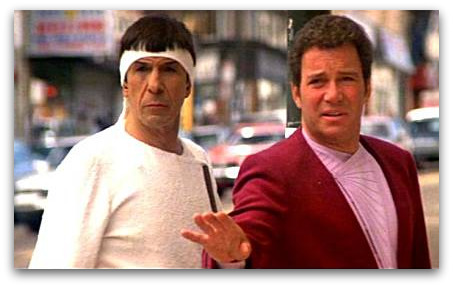
The problem I’ve always had with aliens in books and movies is that they are too much like us. On Star Trek they could even pass for us, as long as they wore a headband. But it isn’t just that they look so much like us, why would aliens even think of us as awesome? Would humans be actually interesting to aliens? If aliens are watching our broadcasts you could just about guarantee that they don’t consider any of the life on this planet intelligent.
Alien: So you consider your race intelligent?
Human: Why yes.
Alien: Explain Glenn Beck.
Human: Okay, some of us aren’t as…
Alien: And you dig up stored gases to change your atmosphere so that it wrecks your climate.
Human: But we needed fuel for power. We’ve got solutions to that now.
Alien: One word: Politicians.
Human: Please don’t wipe out our planet!
So in my alien research for my novel/s I finally found inspiration. Who better to inspire me than Neil DeGrasse Tyson and Richard Dawkins?*
See the rest of the discussion between Dawkins and DeGrasse here.
*Yes Carl Sagan would be inspirational too, but he isn’t in the video.





 Tyson Adams