Neil Gaiman’s speech to graduates

At my graduation ceremonies we had some bureaucrats being given honorary doctorates for their services to political backroom handshakes. Needless to say, their speeches were less than inspiring. While I’m not a fan of giving away honorary degrees to celebrities, it is good to see they are giving them to some deserving people who can give an inspiring speech to graduates.

Take it away Neil.

Make good art, especially when the zombies take over.

Talking Spec-Fic with Rex Jameson

This slideshow requires JavaScript.

Today we have a special guest on the site. My friend Rex is an author, science nerd and has as many degrees as I have, so you can see why we get along so well. Last year Rex released his first novel, Lucifer’s Odyssey, which I recommend for any speculative fiction and fantasy fans, and this year has released the sequel, The Goblin Rebellion (which is free for the next couple of days).

Tyson: Rex, you’ve had a busy 6 months. You have released your first novel, gotten married, released two novellas, completed a PhD and released your second novel. The obvious question I have for you is, what are you currently reading?

Rex: Unfortunately, most of my reading material has been non-fiction recently. I work in real-time, embedded systems and am involved in several interesting projects involving spacecraft, mobile devices and very soon remote-controlled drones. I’ve also been giving job talks for professor positions and finishing up my dissertation (March).

T: So boring stuff is working with real spacecraft? You just killed the dream of every boy under the age of 12.

R: Oh, I wouldn’t say it’s boring at all. I’m extremely excited about my work, and I plan on doing much more of it!

T: What about fiction?

R: The next fiction books on my list are a couple of indie author works: Moses Siregar’s “The Black God’s War” and Jennifer Rainey’s “These Hellish Happenings.” I’m also REALLY wanting to read George R. R. Martin’s epic series. It feels like I’m running into people reading a Dance of Dragons at every airport I enter, but I’ve heard stories about weeks-long splurges on his books, and I’m trying to avoid it until I’m able to really get into it.

T: Jennifer’s book is on my to-read list, which is still 6 or more months long. I found the first three Game of Thrones e-books on sale and snapped them up. Whenever I read a book or series that has taken the world by storm I am always underwhelmed. I call it the DaVinci Effect.

R: A well-chosen descriptor.

T: Thanks. How much Christian hate mail have you received so far after Lucifer’s Odyssey?

R: I wouldn’t say it’s Christian hate mail. I’ve received some sporadic messaging that I would characterize as worried. Part of being a Christian is discipleship, and some people take that very seriously. A novel that spans trillions of light years in distance and involves creatures living hundreds of millions and even billions of years does appear to conflict with strict belief in the 6,000-10,000 year old creation story.

But I honestly find it odd that this rift between modern scientific discovery and Christianity even exists. It would have been quite easy to update Christianity to account for the fossil records in a way that doesn’t involve saying “but those are all from Noah’s flood” (which is quite ludicrous) and in modifying man’s role in the universe once we realized just how massive the known universe is. Instead, many in America tend to look at science’s findings as one of God’s tests: a challenge that God has handed down to test the tenacity of their belief that every word in the Bible is in fact directly from God and thus infallible. And this kind of stubbornness to adapt to facts and findings has retarded our growth as a species since Galileo. I’ve heard from some that this voluntary impediment is in fact reasonable and expected because Eve shouldn’t have eaten from the knowledge tree to begin with…

Anyway, yes I’ve gotten some mail, but I understood I would be getting it. Most of it has been cordial, but religious figures are a touchy subject, even if they are presented in a fantastic and fictitious light in the series. The series is not intended to bash Christian beliefs by any means. It’s more of a modern retelling of the origin story with the vastness of the universe and time taken into account. I also love string theory and the concept of multiverses, time-dilation, chaos theory, and other hobbies of mine, and the only way to properly have fun with them was to set them in an expansive series of universes.

T: I like that yourself and David McAfee have both been listed on a review of your book. Apparently you’ve created a genre for Christians to get riled up about.

R: Yeah, pseudo-biblical fiction. With the way it’s defined, most fantasy could be placed in there. I’m pretty sure any book with a savior child character who is promised by prophecy in a religious tome could fall into this genre, should a comparison be wanted. Belgarion in David Edding’s Belgariad series might fall into this comparison, even though it’s unrelated to Christianity, just because a savior child is promised to the Earth and rescues the world from evil. It’s probably an appropriate descriptor for my first series, though I’d disagree with the anti-Christian characteristic for reasons stated in the comment section of that article.

T: Interestingly the entire “young Earth” thing is just one section of six views on Christian religious interpretation. Most sects are fine with science. Of course I’ve received enough death threats to understand fundamentalists are the strange cousin of any societal group, we’re all embarrassed by them.

R: The Young Earth group may be one of six Christian interpretations, but it’s hardly the minority in America. My only issue with the group is that they’ve latched onto the debates that atheists and theists have concerning the origin of the universe (i.e., Big Bang versus Creationism), and are using issues with the current perceived expansion rate of the universe as proof that the entire scientific movement is a house of cards.

For example, the fossil record is now in some way dependent on the Big Bang and collapsing expansion theory, tectonic plates are now somehow linked to weathermen not getting the weather right all the time, evolution is now directly linked to asteroids carrying microbes being the real originator of life, or climate change is suspect because it doesn’t make sense that matter can come into existence from nothing. I’ve seen all of these claims in arguments from Young Earth creationists. Even though none of these are dependent upon each other, it’s become a science versus creationism argument where all science can now be suspect simply because a Young Earth creationist is unwilling to investigate or learn about an entire branch of science–since someone has convinced them that all science is wrong and evil and counter to God’s intentions for mankind.

The result is a sustained rise of fear and ignorance, and that is a huge impediment on progress. And ultimately, I believe the continued pressure of this movement on education is causing less emphasis on math and science in American schools and is directly hindering our economy and ability to produce quality researchers, which are required for innovation and technological growth. After all, environment has a lot to do with educational responses of children. If parents don’t value math and science and look upon them negatively, children are likely to have the same feelings.

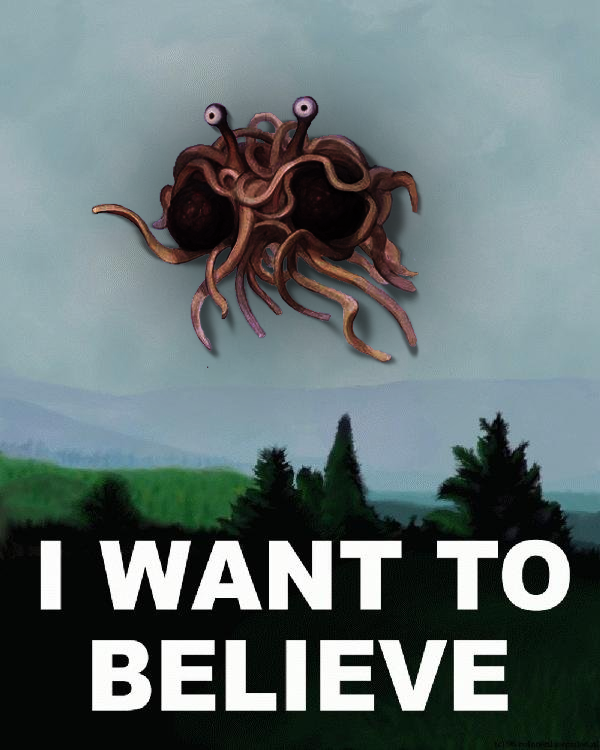
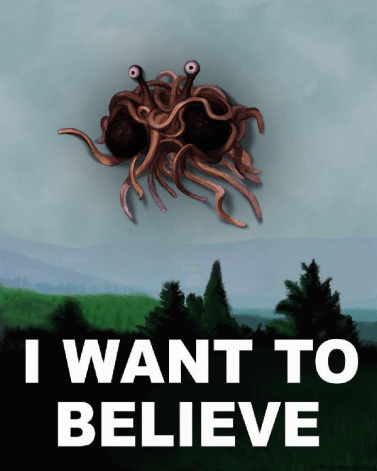
T: Can we expect to see Lucifer square off against his noodliness, the Flying Spaghetti Monster?

R: I don’t think that would be much of a fair fight. Yes, FSM has wing-like structures that might help propel him through space, but FSM’s wings appear quite squishy and obviously delicious. Lucifer appears to be made of stronger stuff in the series, and I doubt he’s anywhere near as tasty. Therefore he has fewer natural predators, a sword, the ability to open a channel to near-infinite reserves of energy in a big-bang-like state, and wings made of a nearly indestructible material–while the demons or angels are alive and their soul is present. In contrast, I’ve never seen FSM with a sword. I’ve seen him falling for the “pull my finger” routine (which shows obvious gullibility) but never wielding a scary weapon.

I’ll admit I could be underestimating his ability to smother someone with special sauce or noodly goodness.

T: You also forget his noodliness has pirates on his side. Actually: Flying Spagehetti Monster, Lucifer, Pirates, Christian outrage; add ninjas and zombies to the mix and you have the next Da Vinci Code!!

R: Heh! If only it were that easy, we could all be rich!
T: You classified Odyssey as speculative fiction, I would have called it fantasy: Wheel of Time, spec fic or fantasy?

R: In my defense, I have categorized the work as epic fantasy and space opera. I haven’t read Robert Jordan’s Wheel of Time past the first book. I recently thought about picking it up during the holidays, but then I saw the reviews for New Spring and decided against it (at least for now). I read Derek Prior’s “Cadman’s Gambit”, instead, and I’m happy I did. It’s a complicated story but good. It’s also speculative fiction/fantasy, btw.

T: I started the first in the Wheel of Time series, moved onto the Night Angel series by Brent Weeks. Fantasy always seems to be code for “I didn’t want to grab my street map for exposition”, unless it has elves or dragons in it. Apparently having a proper imagination precludes classification in other genres.
Game of Thrones, ditto, spec fic or fantasy?

R: Fantasy. I’ve seen a couple of the HBO episodes but haven’t started the book series out of fear of missing my dissertation and paper deadlines. That being said, it will be mine–oh, yes!

T: Thesis deadlines are highly over-rated. They only apply to the postgrad student and not anyone else in the chain. I still haven’t received my certificate. Actually, there is an idea for an epic thriller: “Two postgrad students (Rex and Tyson) fight the hard slog of science, peer review and the ruthless administration building to finally graduate. But will it be too late to enter the real world?”

R: Honestly, my adviser doesn’t seem like he’s in much of a hurry to get me out the door, but I’m chomping at the bit to have my own lab, target my own research grants, and teach my own classes. So, that’s really the only reason I’m pushing so hard to finish my dissertation. The job I want requires final paperwork and the funny robes, and I’m getting feedback and interest from great universities and faculty that I’d love to work with.

T: Funny robes and extra acronyms attached to your name is always handy, especially when you are arguing with the anti-science brigade.
So you’re sticking with your classification for Lucifer’s Odyssey? You could sucker a few unwitting literary fiction readers.

R: The classification of Lucifer’s Odyssey as speculative fiction comes from the fact that readers debate about whether Roger Zelazny’s Amber Series was “classic science fiction”, “fantasy”, or the much more recent “speculative fiction.” I had read some commentary on the Kindleboards from readers, and many of them seemed less offended by the label “speculative fiction” than choosing one of the categories with stricter modern interpretations of genre boundaries.

Lucifer’s Odyssey is more fantasy than science fiction, and the majority of my work will probably be more fantasy than science fiction. I chalk this up to my line of work. When you look to escape your current situation, you often go to the opposite extreme of what you do every day. Since my job has me looking at problems in satellites, rc drones, and mobile phones in mission critical systems, my writing escapes tend to be more fantastical rather than technical. I have some ideas for thrillers and pure fantasy, but I’m putting them on the back-burner until I at least finish “Shadows of our Fathers”, the third book in the Primal Patterns series.

T: I hear you there. I’m writing thrillers where the main characters get to shoot a lot of people. Shooting someone for making up their opinion on the spot, to argue with the person who has just spent the last few years researching the topic, isn’t widely accepted in society.

R: Well, I’ve noticed people are far more willing to read a book about shooting random people than a derelict homeless man dropping f-bombs when the devil kills his friend. Maybe your idea could work.

T: Are you living proof that being an author attracts the ladies, since you got married after publishing Odyssey?

R: Hah! Hardly!

Although Lucifer’s Odyssey was published last year, it started as a short story several years ago. The original story was from the perspective of Michael and involved the bar scene, the interrogation, and the escape and burial of Azazel (which was taken out completely during editing), but in a much more primitive form. And quite frankly it was terrible. Even after several rewrites, it was bad.

I met my wife while the story was forgotten in a folder on my hard drive. So, resuscitating it and redrafting it a few times resulted in far more eyerolls from her than attraction. Still, she’s awesome and incredibly supportive. It takes a special kind of person to love someone who has a job that sends them frequently abroad and often spends a considerable amount of time at a computer writing stories or developing software when they’re in the room with you. She’s a rock star and a wonderful person!

My wife pointed out that the reason I was having trouble writing any of my stories was that they were all depressing and dark. Now they are shooty and dark, so it is amazing what our partners can bring to our writing.

Actually, the novelette “Elves and Goblins: Perspectives of a Father’s Rebellion” is totally dark and shooty. Maybe one day we could collaborate on a thriller or something. Might be fun.

T: Well, we already have an idea for the plot. Although submitting a thesis at gun point and combating peer review in a death match scenario may only appeal to scientists.
I’m going to put in a spoiler alert here: at the end of your first novel Jesus ended up somewhat shorter. Doesn’t that leave the next book without a decent bad guy? Because if the sequel is Lucifer dealing with his feelings about the loss of his cat to cancer, I might not promote it.

R: Here’s an even bigger spoiler: I have no plans for putting Jesus into the series, and there’s a framework for seven books–though I only plan on doing three books in the Primal Patterns before moving on to something else for a while. That could change if readers demand it, but I think a foray into more standard fare might be something that would appeal to new readers. Contemporary urban epic fantasy like the Winter Phenomenon series I had planned or maybe expansion of one of my short stories.

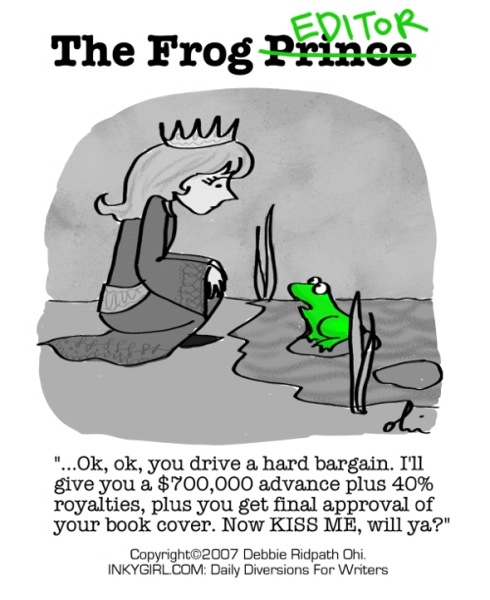
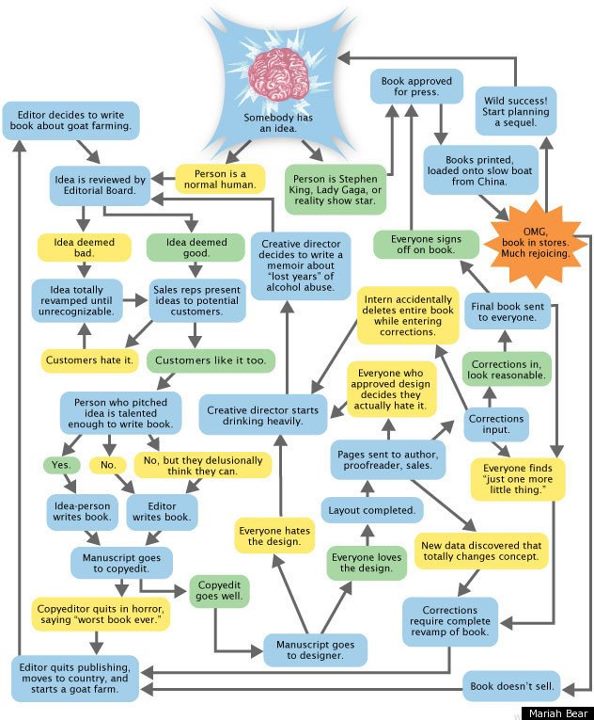
T: We had a conversation about how wonderful editors are a few months ago. How do you think your editor could improve something written by the average monkey at a typewriter?

R: I’m afraid I won’t name names, but the bane of most unedited first work is head-jumping and bad dialogue. I’ve noticed many new fantasy or science fiction authors tend to do pretty well with action sequences. I say many and not most. Most self-published work is still bad, and I think all work should be edited in some way by neutral parties in your genre. The only exception to this are trained professionals or people who know how to remove themselves from the work and become neutral parties in the genre.

Another thing that an editor does for an author is give some peace-of-mind to the fiction writing process on subsequent books. When I was writing Lucifer’s Odyssey, I had a lot of self doubts about whether or not I could tell a story this complex. I’m not sure the answer is ‘yes’ yet, but from the reviews, I don’t think I’ve done a terrible job either.

A couple of readers have noted that the tone can be jarring, and after asking one of them, I was told that the tendency of Sariel to inject humor into serious situations was the type of tonal change that seemed unusual. My editor once made a suggestion on one of these, and I did tell him that I would rather Sariel remain that way because sarcasm and fraternal humor is basically how he’d gotten through life as a youngest child, a seemingly destiny-less position, in the most important family in all of Chaos. His tone changes quite a bit in the second book, but that core is still there. He’s lived for millions of years, and he still has his daredevil instincts and a frightening tendency to play with his food, even if it might kill him.

Now, I’m coming to this in a roundabout way, but I do have a point. An editor is only as useful as you let him or her be. If they make suggestions and you buck them, you better have a good reason for it, and you better be prepared to face the music when readers who want that type of sanitized feel pick up your book.

Similarly, if you didn’t expect backlash but you find it, as a self-published author you have the ability to change it. I recently removed almost all of the cursing from both “Lucifer’s Odyssey” and “Angels and Demons: Perspectives of a Violent Afterlife” because of a handful of complaints (out of thousands of readers). Why? I made a trade off.

I believe that in the real setting, the characters would have cursed, but I know that many more conservative readers would have used the cursing as an easy excuse to not read the book and allow themselves to enjoy the story. I also knew I wanted to give the book away for free for short periods of time, and from experience, I know that this particular type of reader picks up free stories without looking at the summary or the warnings, and they are more likely to leave a 1-star review. Is this my fault? No, but such a 1-star review given within days of a book’s release (especially if it’s the only one) can kill a book’s potential quickly. After re-reading the story without the cursing I felt that the compromise was worth doing.

So I think it’s important to mention that listening to your editor is vital, but so is listening to your readers. Yes, some readers are going to be wrong, and you have to understand that there’s always a vocal minority that believes their opinion is right no matter what evidence is presented to the contrary. But often, readers can be a part of the long-term editing process–the neutral genre voice that guides writing into the next book and the one after that. And that’s worth listening to!

T: Thanks to Rex for taking time out of his hectic day. Spec-fic fans should check out Rex’s writing. See my review of his first novel here.

Perth Writers’ Festival 2012

I can’t believe that it was over a week ago that the Perth Writers’ Festival finished. This year was a much bigger and better affair, showing Perth is worth flying to, despite being out-of-the-way, from everything other than Perth. What better time to present a recap of my highlights than now. Warning, this post doesn’t contain my usual sarcasm, satire, humour and insults directed at the author James Patterson.

Publishing Seminar

An entire day on how to get into publishing: sounds like a good idea. One hundred and forty of us were in the comfort of an air-conditioned tent to listen to publishers, manuscript assessors, agents, lawyers, union (yes, Australia Society of Authors, I’d call it a union) and booksellers. Hard to sum up an entire day of information in a few words, so I’ll make some general comments. The industry is still generally a positive field, but don’t give up your day job. There was a lot of talk about the industry having declined – 17.5% in December, 21.5% January, 29.5% to the second week of February – and the usual memes were rolled out (E-books, etc), although it was good to hear some realists talking about overpricing and particular market segments. I got a lot out of the day, like having my need to write poetry stifled for good, with the realisation that Penguin compiled a “best-loved” Australian poetry collection and sold 700 copies. But it has to be said, it is good to see the gender balance in writing, being one of thirty men in the room of one hundred and forty. It is also amazing that, for a group of writers who are supposedly skilled at expressing themselves, there was a lack of ability to orally express opinions and statements (I’m biased, having a background in extension). I’d also like to acknowledge the guy, who is at every writers’ festival, by quoting him “I have a bestseller” with the caveat “not quite finished yet.”

Pants on Fire

This session was all about writing perspective. Who wants to read an honest character? Every character is lying to themselves about something, creating that flawed and unreliable narrator that people love. Is the writer really lying to the reader by keeping them in suspense? Probably, but I’d like to think of it as telling the truth at a certain pace.

Sex, Lies and Literature

I love sessions that end up, inevitably, discussing censorship. This is topical, given the recent PayPal directive made to Smashwords. My general opinion on censorship was upheld by the presenters and assembled crowd, even if we were having a reading of octopus tentacle bestiality as a prelude to the discussion. An interesting article from the 1930s was read, apparently women at that time had worries about the same body issues they have now.

Banality of Politics

Combine a respected reporter, a biographer and a politician who actually has something worth saying, and you have the recipe for one statement. Politics has become about distracting the general voting masses with shiny objects. George Megalogenis provided his usual erudite insights, and Andrew Robb proved he is still one of the few politicians worth voting for (Lindsay Tanner having retired).

Reading In An Age of Change

Book stores are going the way of the literate high school graduate. This session was all about what the future holds for booksellers and how the market will change. Alan Sheardown made some very poignant points about the industry. Running an indie book store he understood what was actually happening with book sales and how to keep the customers. I also became a Kobo fan after hearing Malcolm Neil’s thoughts and comments. There have already been rumours starting about Kobo being the other e-book market after Amazon, after this session I have little doubt. Malcolm didn’t pull any punches.

Enigmatic Individuals

All I really have to say about this session is that Western Australian authors are alive and well, especially in crime fiction. Keep an eye out for us, we’re awesome!

Not Everyone Gets to Eat Like We Do

As much as I love intellectual discussion, I really do wish more intellectuals would give some credit to agriculture. Tim CostelloDavid RieffTom KeneallyKatie Smith Milway and Carmen Lawrence spent this session discussing various aspects of the food demands of the world. Unfortunately, Katie was the only one that had any agricultural knowledge. Despite this, the discussion made some good points about the need for a shift in government focus and how poorer nations need support, not handouts.

Crime Writing for Dummies

The Saturday morning writing seminar was not actually for dummies. Felicity Young took us through a few activities, including a group plotting exercise. Our group killed off Jo Nesbo with a hardcover edition of his first novel, Redbreast. His body was discovered by one of the class after the white peacock on the grounds was seen covered in blood – Redbreast: we were hilarious! I think the team has a bestseller in the works after this session.

It Just Feels Real

Lauren Beukes needs to give up coffee. She destroyed her laptop prior to the writing workshop. I know that computers always say coffee resistant on the label, but I bet they only test it on espressos. Lauren took us through a few different exercises and examples of good and bad prose. She also gave me some good feedback on my writing, so I feel like I’m on the right track.

A Glass of Wine and a Good Book

David Whish-Wilson interviewed Felicity Young whilst the audience relaxed with a lovely wine or three. David ran the workshop I attended on writing last year, so it was two of my writing tutors in one session. It was a good discussion, but the wine was even better. Check out Lamont’s winery, their white was the perfect end to the day.

Phantom

Take one international bestselling crime novelist, known for his talent and wit, not to mention a former career as a successful musician, and you should have a great evening. Pity the interviewer wasn’t up to the challenge. Either way, I got my novels signed by Jo. I remember having heard of Jo Nesbo as a result of his awards for crime writing. You would think that stores would stock his books as a result, but they didn’t. I ended up ordering Nemesis online (Booktopia rocks) only to find all of his novels in an indie store a week later. Another reason the big stores are dying.

I Believe In An Open Mind – But Not So Open My Brain Falls Out

If I had one highlight of the festival it has to be this Sunday session. The speakers were Misha KetchellStephen LewandowskyAlom Shaha and James Paterson, and had a hearty discussion about science, communication, the media, think tanks (of which James is an editor of the notorious IPA) and climate change. Alom was someone I hadn’t heard of before and it was great to hear his contributions. It was also great to meet Stephen and Misha in person after the session.

Northern Lights

This was the second session I went to with Jo Nesbo featuring. This time he was joined by Johan Harstad, and a decent interviewer, Mark Naglazas. The discussion was around how fantastic the Scandinavians are at converting oil wealth into societal wealth, which trickles down into supporting the arts. Both authors had interesting things to say and Mark got the best out of them.

Truth In News

The media are a funny bunch. It was only in the previous day that George Megalogenis was discussing how poor a job the media did, yet this session was all back-patting. I admire the journalists that take the time to really dig their teeth into a story, do the hard yards and learn about their subject. There will have to be more of it in the future, well, unless we just want to know celebrity gossip.

Congratulations to the organisers for putting together a great event. I look forward to next year’s event.

Combating Writer’s Block: Advice by Genre

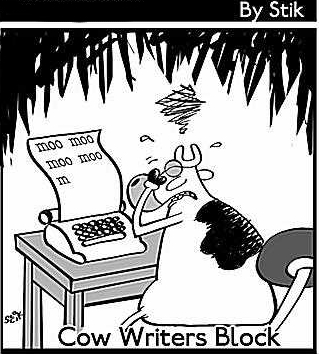
There is no worse disease for a writer than writer’s block. I’d also say that writer’s block is terrible for readers too, uninspired prose is what we expect from policy and political people, not our entertainment. I’m a fan of Stephen King’s writing advice: set a daily word goal and stay at it until you reach the goal. There is something about daily writing and forcing yourself to write that seems to make things flow.

But Tyson, I hear you say, I’m stuck with no ideas for what to write next. Luckily I was procrastinating whilst writing the other day and came up with a definitive fail safe for each major genre. Any additions are welcome in the comments.

Thriller Writers
When writer’s block strikes kill someone or blow something up.

Crime Writers
When writer’s block strikes describe the main character getting drunk and wallowing in self pity.

Mystery Writers
When writer’s block strikes introduce a red herring.

Romance Writers
When writer’s block strikes introduce new character with rock hard abs.

Literature Writers
When writer’s block strikes describe a tree in intimate detail.

Fantasy Writers
When writer’s block strikes have a talking dragon appear, or have the characters go on a long walk somewhere.

Sci-fi Writers
When writer’s block strikes cut and paste physics article from Wikipedia into your novel.

Horror Writers
When writer’s block strikes cut and paste autopsy reports into your novel.

Paranormal Writers
If you already have vampires, ghosts and werewolves in your novel, introduce ninjas and pirates as characters.

If you are really stuck after all of these ideas, then there is no novel in existence that can’t/couldn’t be improved by the addition of pirates and/or ninjas.

How Many to Screw in a Lightbulb

I thought I would post a little list that gave me a giggle. I’ve only added one to the list, see if you can spot it and my sense of humour.

–Sent by Leon Ogroske, WRITERS’ Journal, www.writersjournal.com

Q: How many copy editors does it take to screw in a light bulb?
A: I can’t tell whether you mean ‘change a light bulb’ or ‘have sex in a light bulb.’ Can we reword it to remove the ambiguity?

Q: How many editors does it take to screw in a light bulb?
A: Only one. But first they have to rewire the entire building.

Q: How many managing editors does it take to screw in a light bulb?
A: You were supposed to have changed that light bulb last week!

Q: How many art directors does it take to screw in a light bulb?
A: Does it HAVE to be a light bulb?

Q: How many copy editors does it take to screw in a light bulb?
A: The last time this question was asked, it involved art directors. Is the difference intentional? Should one or the other instance be changed? It seems inconsistent.

Q: How many marketing directors does it take to screw in a light bulb?
A: It isn’t too late to make this neon instead, is it?

Q: How many proofreaders does it take to screw in a light bulb?
A: Proofreaders aren’t supposed to change light bulbs. They should just query them.

Q: How many writers does it take to screw in a light bulb?
A: But why do we have to CHANGE it?

Q: How many publishers does it take to screw in a light bulb?
A: Three. One to screw it in, and two to hold down the author.

Q: How many booksellers does it take to screw in a light bulb?
A: Only one, and they’ll be glad to do it too, except no one shipped them any.

Q: How many editors does it take to screw in a light bulb?
A: You’ve already screwed in too many light bulbs. Repetition!

Q: How many writers does it take to screw in a light bulb?
A: One, and they like to give it a good twist at the end.

Q: How many writers does it take to change a light bulb?
A: Just one, but the light bulb has to endure a series of conflicts and challenges before it finally changes.

Q: How many reviewers does it take to screw in a light bulb?
A: None. They just stand back and critique while you do it.

Q: How many netgilantes does it take to screw in a lightbulb?
A: Did he use an English word? Must be a writer! Let’s lynch him!!!!

Q: How many reviewers does it take to screw in a light bulb?
A: Only one, but first they have to tell you why they didn’t like how you did it.

Q: How many Kindleboards authors does it take to screw in a light bulb?
A: One, followed by a 12-page, passionately-argued thread about how much the light bulb should cost.

Q: How many forum users does it take to screw in a light bulb?
A: One, but in the following ten-page discussion, someone will invoke a comparison to Nazis.

Q: How many authors does it take to change a light bulb?
A: Only one but you also need an editor, proof reader, cover artist, and an agent to be there at the same time.

Steve Berry on writing

It’s my birthday today – no “you’re old” jokes, unless you want to be bombarded with “yo momma” jokes. I’ve had a great start to the day, having received a box of chocolates and a bottle of Johnnie Walker Blue label Scotch from my wife. I even managed to get a little writing done over breakfast.

A few weeks ago I posted a video from James Rollins on writing. This follows on from a post many months back that featured a video by James with Steve Berry talking about writing. So it only feels fair to present a video by Steve Berry talking about writing. Enjoy! 

Tyson Adams’ 2011 Book Awards: The Awesomes

I’ve read a few books this year (+140) and have decided that I needed to talk about my favourites of 2011.  I also thought it fair to award my favourite reads of the year an Awesome.

As you will have noticed, my reviews of books are more about my impressions of the book and talking about how much I liked the book, rather than a recap of the plot, etc. My reasoning behind this is simple, I want to say “read this book” to people rather than fall into my bad habit of spoiling the ending.

My list is based upon what I have read this year, so obviously some great books (Snuff) have missed out due to lack of reading hours in the year. Also my read list does include some books that were published prior to 2011. There were some categories that were sadly under-represented and some that had some very intense competition.

Also, the fact that I finished a book shows that it was worth reading. I have my reading rules that stop me wasting valuable reading time on books I’m not enjoying. This means that any books on my read list are entertaining (well, unless I was particularly disgusted with the crappiness of the book in question).

Awesome of 2011

10 hours of non-stop reading fun, 12 if you count meal and toilet breaks. I could not put this book down, it had me enthralled with Reilly’s fast paced thrills and explosions. This books defines The Awesomes.
Also, I would like to extend my condolences to Matthew and his friends and family on the loss of his wife Natalie.

Awesome Literary Fiction
There were no nominees in this category this year. Better luck next year.
Awesome Mystery & Thriller
This is one of two heavily over-represented categories in this year’s Awesomes. 
Awesome Crime

Blood Work – Michael Connelly
13 Hours – Deon Meyer (technically I started it in 2011, but only finished it this year)


Awesome Fantasy
There were no nominees in this category this year. Better luck next year.
Awesome Paranormal Fantasy
There were no nominees in this category this year. Better luck next year.
Awesome Science Fiction

Peace Army – Steven L Hawk


Awesome Horror

Dead Man Series – Lee Goldberg, Will Rabkin, et al.


Awesome Romance
There were no nominees in this category this year. Better luck next year.
Awesome Humor
Right What You No – Tyson Adams’ blog
I’m allowed to be self-congratulatory. Plus I didn’t read any funny books this year.
Awesome Nonfiction
This is an oxymoron, so it is invalidated as a category. Having said that I did read several nonfiction books this year, mostly on climate change. I should make mention of On Writing by Steven King, which really had me agreeing with Steven’s insights.
Awesome Graphic Novels & Comics

The Boys – Garth Ennis

This is the second over-represented category on my list. 


Awesome Indie

Awesome Poetry
Rime of the Ancient Mariner – Samuel Taylor Coleridge

E-books: Return of the Reader

Just like the previous two installments of this e-book saga there will be allusions to some non-existent struggle, my thoughts on the changing publishing industry, no Leia in a bikini, and definitely no Wookie. When we left our hero writers, they were diligently trying to decide whether they wanted to sign with a traditional publisher or self-publish like an indie rebel. Publishers had the track record, the self-publishing indies had the jump on the fastest growing segment in the industry: e-books.

Now hold on just a second. Traditional publishing is behind? As has already been stated in this blog, his mouth to my post, Michael Connelly is selling 45% e-books. His publishers are clearly on board of this new market place. James Rollins and Steve Berry have both released exclusive e-book short stories on Amazon and B&N as lead-ins to their next books (pity non-US people can’t buy them, not being close enough to the centre of the universe and all). I even noticed that Aussie authors like Tara Moss and Matthew Reilly are available on Kindle for under $10. Behind isn’t quite right.

On the other side of the great divide, all the cool kids authors are self-publishing. People like Konrath, Eisler, Mayer, some guy named John Locke, are doing well out of self-publishing and doing all the work themselves (or hire for service). Clearly all authors should be grabbing their manuscripts and uploading them now.

I’ll pause so you can upload your book now. Don’t forget to spell check first!

Well it seems that 10’s of thousands are doing just that. Given that 90% of everything published is probably crud, you have to question how wise it is to rush to publish. We also have to remember that e-books are still a minority share of the market place (this will change of course). Shouldn’t quality come first? Spend the time on crafting a fine book, see what industry professionals have to say about it, then publish? Preferably not the professionals that published Snooki. Basically writers will have to find the best publishing deal for them, even if it is swapping their novel for a packet of magic beans.

And here is a startling fact: readers don’t care if writers are traditionally published, indie published, self published, or published by a small Scottish Terrier named Rolf. Readers want to read something entertaining and well written. So writers shouldn’t care how they are published. To quote Nick Spalding:

“Writers on the traditional publishing side of this particular conflict want to be successful and earn a decent living as a writer, appealing to an audience with their work. On the other hand, writers on the self publishing side of this particular conflict want to be successful and earn a decent living as a writer, appealing to an audience with their work.”

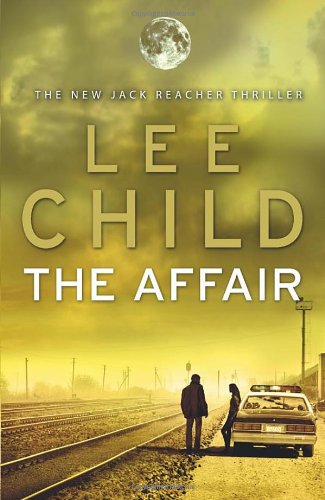
What I love about e-books is that they are made for readers. Well Duh! Stick with me on this one. Lets say that it is August 2010 and I’ve just finished 61 Hours by Lee Child. Now Lee may or may not have finished with a cliffhanger in that particular book. Despite the fact that the next Reacher novel is finished and ready in boxes to go on shelves, I have to wait until the end of September to read Worth Dying For. With e-books there is no need to delay because of printing, shipping, and shop displays still being filled with James Paterson’s books. In fact, with e-books I can have the entire Reacher series downloaded the minute after I’ve finished 61 Hours to keep my spirits up while I wait.

Essentially the gap between writer and reader has been shortened. The reader is King.

So what about publishers? Well they sell books. Authors write those books for them. I don’t think that in the long run they will particularly care whether they are selling an e-book or a DTB. In fact e-books could really cut out a lot of their middle men costs.

A lot has changed in the past year or two, some of the big companies are behind to some extent, but are more likely to catchup. I still can’t believe that e-readers weren’t dreamt up by publishers and bookstores. But then again I can’t believe that Australia – lots of sun – has sent solar technology to Germany – no sun – and politicians are wanting to move from coal to gas.

As long as publishers are paying advances, advertising/promoting authors and fronting costs they will be who most authors will turn to in order to publish. And when the publisher rejects it, and the crying has finished, the author will release it, plot holes and all, on their own.

Bookshops look like the real loser here, despite their claims to the contrary. Apparently people love the smell of books. Solved. Apparently people like to browse in bookstores. Yes, nothing like spending hours in a store with your head at a funny angle to find the store doesn’t stock what you are looking for. Apparently people love the feel of books. Admittedly books are much better to throw at an intruder, although War & Peace is regarded as a lethal weapon.

Can I just point out that an e-book is a book. That you can read. Thanks for letting me clear that up.

Tenuous reasons for bookshops continued existence aside, I don’t see why there won’t be purveyors of fine literature, and the stuff I like reading, into the future. Online stores are often seen as more reputable when they have a physical storefront. Even if that storefront is never visited by anyone because it is located down a side street, off a back alley, near a crack den. Plus POD could make book buying like a trip to the deli counter for lunch.

“I’ll have the new best-seller and a long white to go thanks.”
“Did you want that signed or unsigned?”
“Hold the signing, but I will take the first chapter of the sequel at the back.”

As a reader and as a some-day published author, I think that the future is so much brighter for readers and writers. Readers will have access to more good books than ever. Writers will have greater access to an audience than ever. The future of books is very bright and may even step out of the shadow of DVD’s, when DVD’s become obsolete.

Yo ho ho and a bottle of rum.

Internet Pirate, Yar!

I can remember back to when computers were nothing more than green text on a black background and made terrific boat anchors. Then suddenly they exploded, usually from a spilt drink or frustration in the 10 minutes it took for anything to load. Just as I was leaving high school the interwebz was suddenly all around us and promised to deliver us information, e-commerce, media and porn. This coincided with computers becoming faster, hard-drives becoming bigger and teenagers becoming hornier.

And that is when media piracy really took off.

Sure Napster popularised it a few years later and the music industry starting jumping up and down about it later again, but someone had forgotten to tell these people that the game had changed. I didn’t have to buy the entire Primus CD for the two songs I was actually going to listen to, now I could have a copy of those two songs on my computer, either downloaded from friends or copied off the CD.

I think we were all waiting for the music industry to catch up. At some point we were expecting all of our favourite songs to be available online for sale. But our computers were growing, so it wasn’t just music, we wanted our TV and movies as well. Why couldn’t we just grab a copy off the internet when we wanted? Where was the store that sold this stuff? And would they sell Debbie Does Dallas?

Well, sensing the growing change in consumer behaviour, the desire for an online store to sell entertainment, the music industry, movie industry and other media decided to band together and sue kids for millions of dollars each.

Brilliant! Rather than sell people stuff lets sue them! What a marketing and sales master stroke.

Instead of responding to consumer demands, the industries concerned decided they didn’t want to play. They thought that would be the end of that. Of course in a free market economy you have to expect the market to dictate terms, not anyone else. Piracy became embedded.

Now of course it isn’t the media industry’s fault that their products were being pirated, it was them damn pesky kids with their computas and iGizmos and and theys gots no respects for da rulz……… The e-generation were blamed for the down-turn in music sales and for massive losses to the music and movie industry. I like the assumption that every download must equal a lost sale, talk about a non-sequitur.

None of these arguments, discussion or history are really relevant though. I’m going to coin a new term SCREEN-GAZING which is the e-version of navel-gazing, because all of this piracy discussion is essentially nothing more than screen-gazing. Lets have a look at the real data that needs to be discussed.

The survey interviewed 1,700 music consumers age 13-60 and found that music is important to social networkers: 39% have embedded music in their personal profiles.
70% said they embed music to show off their taste; half said music is a good way to reflect personality.
Some other survey findings:

  • Some 53% of people actively surf social networking sites to find music.
  • 30% said they went on to buy or download music that they had discovered on a social network site (for MySpace, the proportion is 36%).
  • On popular sites the numbers of people who use sites to find music increase – for MySpace and Bebo, 75% and 72%, respectively, and 66% for YouTube.
  • 46% say they wish it were easier to purchase music they had discovered on social networking sites – for example via a “buy now” button on the site.
  • The number of those saying they illegally download music tracks has increased, from 40% in 2005 and 36% in 2006 to 43% in 2007.
  • Only 33% cited the risk of being prosecuted as a deterrent against illegal downloading, compared with 42% in 2006.
  • Nearly one in five respondents – 18% – claimed an intention to download more unauthorized tracks, up from 8% in 2006.
  • After a dramatic 40% increase in the number of legal downloaders between 2005 and 2006, only 16% growth occurred in the number of legal downloaders from 2006 to 2007.
  • 22% of legal downloaders admitted that they had not paid for a track in the last six months.
  • 84% agreed that digital downloads of older music should be cheaper; 48% said they would be prepared to pay more for newly released music.

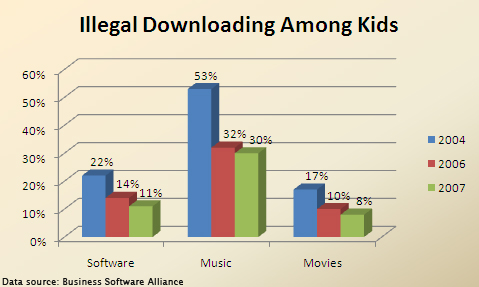
So basically iTunes had been on the map for 4 years by the time this survey was performed, downloading had been around for a decade. Big congratulations to the industry for making those inroads into making music accessible. Almost half of the kids would like easier access to music to buy, and most thought it was too expensive.

Another survey shows that downloads of media were decreasing. So clearly the impact of actually selling media to people that they want was a good thing for lowering pirating. Just the industry hasn’t reached enough of the market yet.

How do you dissuade people from illegal downloads? The traditional approach for punishing pirates would be imprisonment, pilloring, flogging, enslavement, branding, keel hauling, and/or hanging. Given how well that worked in ridding the world of pirates maybe we should consider other methods.

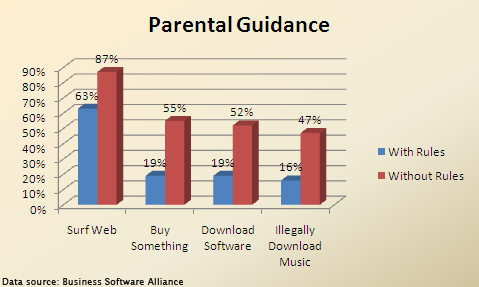
Someone was really bright and had a look at what parental guidance did to downloading.

Who would have thought that parenting had a role in being a law abiding citizen?

What does all of this mean? Well pretty much media – be that ebooks, movies, music, TV shows – need to be easily accessible and priced appropriately. There also needs to be some responsibility taken by everyone to make sure that people expect to pay for media. This can’t be draconian, it has to be encouraged, and part of that encouragement comes from the ease of access and prices that people can afford. And now I hold my breath. Wake me after I pass out waiting for a solution rather than another blame game.