Writing program scams

scam

On the internet there is a scam born every minute. Whilst I love to receive email from Nigerian royalty, ads for another penis enlargement (the first one was enough, thanks), and fat loss supplements that promise not to kill me, there is a line I have to draw in the sand: scamming writers.

Most writers are hobbyists, writing because they love it. The handful that do get paid enough to be full-time writers are few and far between. So targeting writers with scams means that somewhere a monkey at a keyboard is not being fed today.

Yesterday in a writers discussion group a question was raised about whether a New, Amazing, Adjective, program that promises to give you the tools to write a 400 word article in 7 minutes.

Dear Fellow Article Writer (TA: read as mark or sucker),

Did you watch the video above? It’s hard to believe so many people would send me such raving, unsolicited testimonials about my product, “How to Write an Article in 7 Minutes or Less“. (TA: Testimonials!? Wow! I’m sold!)

If you did watch the video, you saw with your own eyes how I was able to take people who spent more than an hour writing an article down to as fast as 5 minutes per article! (TA: 5 minutes? I thought you said 7 minutes. Does this mean I get a 2 minute abs program as a bonus?)

….. (TA: edited out promotional garbage about money back guarantees and how only the scammer found the secret or developed it or whatever)

Here’s how it works.

  1. Open my 3 special research sites. (TA: Wikipedia?)
  2. Use my “skim and grab” research technique to find your
    3 main points (Takes about a minute).  (TA: Yes, because reading comprehension is for suckers.)
  3. Outline each main point with two “sub points.” (another minute here). (TA: What if there is only one point?)
  4. Use the “opening paragraph” template to quickly create the first paragraph (About 30 seconds). (TA: Insert generic filler paragraph, got it.)
  5. Use the “main point” template to write paragraphs for each of your three main points. (2-4 minutes total time) (TA: So, standard writing….)
  6. Use the “conclusion paragraph” template to quickly create the conclusion. (another 30 seconds). (TA: Insert generic filler paragraph at the end.)
  7. Proof read your article, and then submit it to the appropriate directory. (1-2 minutes) (TA: Click spellcheck and hope it doesn’t miss anything.)

The cool thing about using these templates is you never have to pause to think…but… you also enough leeway so each article remains 100% unique, and of the highest quality. (TA: Yes, why would you want to actually put any thought into your writing. Highly overrated for quality content.)

Don’t worry: My method has nothing to do with plagiarism! (TA: Of course not, copy and pasting clearly takes too long.)

Anyway, you can learn all about my 7 minute article technique by reading my special report, “How to Write an Article In 7 Minutes”, and by watching the videos I made showing step by step how I do it.

But that’s not all… (TA: Steak knives?)

My first thought upon seeing the claim that you could learn to write an article in 7 minutes was that it was bullshit. The fact that people would question if it would be possible left me a little stunned, a little thirsty and thinking about having a nap. Clearly some people are going to be taken in by these kinds of scams. So I want to just illustrate my critical thinking process and how I avoided being scammed for $37 (I know, huge amounts of money).

Drawing from personal experience, I know that I’d spend more than 7 minutes just copying in the links to the research I’d be citing, let alone reading those articles. So the first check is to understand just how long certain tasks actually take you. This scam works on the idea that you don’t really measure the time it takes for common activities. You may know how long you spend on a full article or day’s writing, but not on the little parts, like one paragraph or one sentence. So when someone presents you with some figures, you are bound to think, “Well, I do spend a lot of time staring at the screen and checking my Twitter feed.” Suddenly you are partly receptive to the con.

Let’s have a look how long writing actually takes the average person. Being a science nerd, I like to have a few figures around on writing, reading, average number of Facebook posts per hour; you know, important stats. The average person has a typing speed of 60-100 words per minute, which gives you 400-700 words written in 7 minutes. The page claims a 400 word article with 5 minutes actual writing time, which is 300-500 words written. So unless you are setting world speed records, then you won’t have time to do anything other than write.

What about editing? Nothing is perfect on a first draft, nothing! So even if this is a 400 word article written in 5 minutes, you still need to edit. Reading speed is not the same as proofreading speed, with average speeds of 180-200 words per minute. That’s another 2-3 minutes.

This program is essentially promising that you will achieve touch-typing dexterity and speed that will allow you to write fast. It is also promising that you’ll have fantastic reading comprehension skills at skim reading speeds. And yet you will also somehow acquire a time machine to allow you to also plan, research and create a concise article at the same time. The fact that the scam makes no mention of boosting your reading and writing speed and giving you keys to the Deloren, shows that someone is wanting your money and your credules.

In the meantime, send me $40 and I’ll send you some templates that I guarantee will add inches to your penis and bust size, whilst making you an awesome writer and friends with Nigerian royalty. Trust me, no-one lies on the internet.
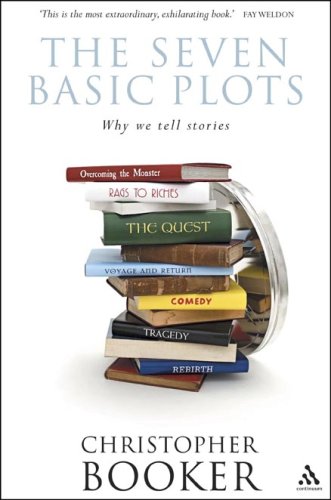
History Repeating – The 7 Plots

A friend made the comment to me recently that a film we had both watched was merely a rip-off of another film. Rip-off is a bit harsh in my opinion. If we think hard about all the books and films we’ve ever watched and then break them down into their general plots you start to see a lot of patterns. Boy meets girl. Girl meets boy. Buddies team up to do something awesome. Odd couple team up to do something awesome. When all said and done, it is hard to identify anything truly original.

As a result, people often say that there are only a certain number of basic plots and that any story is really just a variation on these plots. Depending on how detailed they want to make a “basic” plot, different writers have offered a variety of solutions. An article I found lists these

1 Plot:

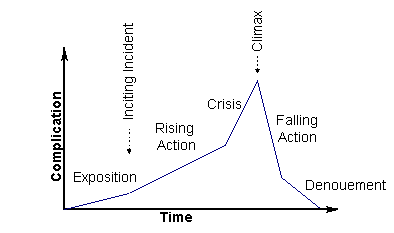
Attempts to find the number of basic plots in literature cannot be resolved any more tightly than to describe a single basic plot. Foster-Harris claims that all plots stem from conflict. He describes this in terms of what the main character feels: “I have an inner conflict of emotions, feelings…. What, in any case, can I do to resolve the inner problems?” (p. 30-31) This is in accord with the canonical view that the basic elements of plot revolve around a problem dealt with in sequence: “Exposition – Rising Action – Climax – Falling Action – Denouement”. (Such description of plot can be found in many places, including: Holman, C. Hugh and William Harmon. A Handbook to Literature. 6th ed. New York: Macmillan Publishing Co, 1992.) Foster-Harris’ main argument is for 3 Plots (which are contained within this one), described below.

3 Plots:

Foster-Harris. The Basic Patterns of Plot. Norman: University of Oklahoma Press, 1959. Foster-Harris contends that there are three basic patterns of plot (p. 66):

  1. “’Type A, happy ending’”; Foster-Harris argues that the “Type A” pattern results when the central character (which he calls the “I-nitial” character) makes a sacrifice (a decision that seems logically “wrong”) for the sake of another.
  2. “’Type B, unhappy ending’”; this pattern follows when the “I-nitial” character does what seems logically “right” and thus fails to make the needed sacrifice.
  3. “’Type C,’ the literary plot, in which, no matter whether we start from the happy or the unhappy fork, proceeding backwards we arrive inevitably at the question, where we stop to wail.” This pattern requires more explanation (Foster-Harris devotes a chapter to the literary plot.) In short, the “literary plot” is one that does not hinge upon decision, but fate; in it, the critical event takes place at the beginning of the story rather than the end. What follows from that event is inevitable, often tragedy. (This in fact coincides with the classical Greek notion of tragedy, which is that such events are fated and inexorable.)

7 Plots

7 basic plots as remembered from second grade by IPL volunteer librarian Jessamyn West:

  1. [wo]man vs. nature
  2. [wo]man vs. [wo]man
  3. [wo]man vs. the environment
  4. [wo]man vs. machines/technology
  5. [wo]man vs. the supernatural
  6. [wo]man vs. self
  7. [wo]man vs. god/religion

20 Plots:

Tobias, Ronald B. 20 Master Plots. Cincinnati: Writer’s Digest Books, 1993. (ISBN 0-89879-595-8)
This book proposes twenty basic plots:

  1. Quest
  2. Adventure
  3. Pursuit
  4. Rescue
  5. Escape
  6. Revenge
  7. The Riddle
  8. Rivalry
  9. Underdog
  10. Temptation
  11. Metamorphosis
  12. Transformation
  13. Maturation
  14. Love
  15. Forbidden Love
  16. Sacrifice
  17. Discovery
  18. Wretched Excess
  19. Ascension
  20. Descension.

36 Plots

Polti, Georges. The Thirty-Six Dramatic Situations. trans. Lucille Ray.

Polti claims to be trying to reconstruct the 36 plots that Goethe alleges someone named [Carlo] Gozzi came up with. (In the following list, the words in parentheses are our annotations to try to explain some of the less helpful titles.):

  1. Supplication (in which the Supplicant must beg something from Power in authority)
  2. Deliverance
  3. Crime Pursued by Vengeance
  4. Vengeance taken for kindred upon kindred
  5. Pursuit
  6. Disaster
  7. Falling Prey to Cruelty of Misfortune
  8. Revolt
  9. Daring Enterprise
  10. Abduction
  11. The Enigma (temptation or a riddle)
  12. Obtaining
  13. Enmity of Kinsmen
  14. Rivalry of Kinsmen
  15. Murderous Adultery
  16. Madness
  17. Fatal Imprudence
  18. Involuntary Crimes of Love (example: discovery that one has married one’s mother, sister, etc.)
  19. Slaying of a Kinsman Unrecognized
  20. Self-Sacrificing for an Ideal
  21. Self-Sacrifice for Kindred
  22. All Sacrificed for Passion
  23. Necessity of Sacrificing Loved Ones
  24. Rivalry of Superior and Inferior
  25. Adultery
  26. Crimes of Love
  27. Discovery of the Dishonor of a Loved One
  28. Obstacles to Love
  29. An Enemy Loved
  30. Ambition
  31. Conflict with a God
  32. Mistaken Jealousy
  33. Erroneous Judgement
  34. Remorse
  35. Recovery of a Lost One
  36. Loss of Loved Ones.

It is therefore inevitable that it is all just a little bit of history repeating.

More examples: The Seven Basic Plots summary and Google answers.

Top 10 Rules for Mystery Writing


Crime_writing_comic
  1. In mystery writing, plot is everything. Because readers are playing a kind of game when they read a detective novel, plot has to come first, above everything else. Make sure each plot point is plausible, and keep the action moving. Don’t get bogged down in back story or go off on tangents.
  2. Introduce both the detective and the culprit early on. As the main character, your detective must obviously appear early in the book. As for the culprit, your reader will feel cheated if the antagonist, or villain, enters too late in the book to be a viable suspect in their minds.
  3. Introduce the crime within the first three chapters of your mystery novel. The crime and the ensuing questions are what hook your reader. As with any fiction, you want to do that as soon as possible.
  4. The crime should be sufficiently violent — preferably a murder. For many readers, only murder really justifies the effort of reading a 300-page book while suitably testing your detective’s powers. However, also note that some types of violence are still taboo including rape, child molestation, and cruelty to animals.
  5. The crime should be believable. While the details of the murder — how, where, and why it’s done, as well as how the crime is discovered — are your main opportunities to introduce variety, make sure the crime is plausible. Your reader will feel cheated if the crime is not something that could really happen.
  6. The detective should solve the case using only rational and scientific methods. Consider this part of the oath written by G.K. Chesterton for the British Detection Club: “Do you promise that your detectives shall well and truly detect the crimes presented to them using those wits which it may please you to bestow on them and not placing reliance on nor making use of Divine Revelation, Feminine Intuition, Mumbo Jumbo, Jiggery-Pokery, Coincidence, or Act of God?”
  7. The culprit must be capable of committing the crime. Your reader must believe your villain’s motivation and the villain must be capable of the crime, both physically and emotionally.
  8. In mystery writing, don’t try to fool your reader. Again, it takes the fun out. Don’t use improbable disguises, twins, accidental solutions, or supernatural solutions. The detective should not commit the crime. All clues should be revealed to the reader as the detective finds them.
  9. Do your research. “Readers have to feel you know what you’re talking about,” says author Margaret Murphy. She has a good relationship with the police in her area, and has spent time with the police forensic team. Get all essential details right. Mystery readers will have read a lot of books like yours; regard them as a pretty savvy bunch.
  10. Wait as long as possible to reveal the culprit. They’re reading to find out, or figure out, whodunit. If you answer this too early in the book, the reader will have no reason to continue reading.

by Ginny Wiehardt

Source for Image

From Writers Write Blog.

Banned Books: The Huff Post sequel

It seems that the Huffington Post are stealing my article ideas. Only three days after my article lamenting censorship of books, they do an article on the 2013 Banned Books campaign (September 22-28th).

Now I’m not bitter, in fact, I’m currently covered in orange sherbet. So this follow-up article is to add my support to the Banned Books Campaign and talk about the most frequently challenged books of last year. The annual report of the American Library Association had a lot of interesting findings. They are still having problems with publishers allowing them to loan ebooks (sigh – I bet the same arguments were made when libraries first started lending books), the people using libraries still think that they offer a very important service, they have become technology and research hubs for people, but visit rates have dropped a bit. The really interesting thing for me – because I’m not American, let alone a member of an American library, so all of those points are belly lint to me – was the top ten list of challenged books for 2012.

Here is the Office of Intellectual Freedom’s Top Ten List of Frequently Challenged Books in 2012:

■ Captain Underpants (series), by Dav Pilkey (offensive language, unsuited for age group) TA: Exactly what were parents expecting from a book with this title?

■ The Absolutely True Diary of a Part-Time Indian, by Sherman Alexie (offensive language, racism, sexually explicit, unsuited for age group) TA: Oh noes, a young adult book that doesn’t treat the readers like kids!!

■ Thirteen Reasons Why, by Jay Asher (drugs/alcohol/smoking, sexually explicit, suicide, unsuited for age group) TA: Another young adult book that deals with real issues, can’t have that!

■ Fifty Shades of Grey, by E. L. James (offensive language, sexually explicit) TA: An erotica book that is sexually explicit….. Words to describe the stupid, fail me.

■ And Tango Makes Three, by Justin Richardson and Peter Parnell (homosexuality, unsuited for age group) TA: Based on real penguins, must be evil!!

■ The Kite Runner, by Khaled Hosseini (homosexuality, offensive language, religious viewpoint, sexually explicit) TA: Be warned, the characters aren’t white or Christian!!

■ Looking for Alaska, by John Green (offensive language, sexually explicit, unsuited for age group) TA: Written by John Green, so clearly the complainants were too stupid to enjoy the book.

■ Scary Stories(series), by Alvin Schwartz (unsuited for age group, violence) TA: The title clearly didn’t give the game away for some sensitive little souls.

■ The Glass Castle, by Jeannette Walls (offensive language, sexually explicit) TA: Real life is clearly too confronting for some readers.

■ Beloved, by Toni Morrison (sexually explicit, religious viewpoint, violence) TA: Someone clearly thinks that slavery is a lot more fun than the author portrayed it.

The thing I find striking about this top ten list is that the books are all multiple award winners (except that crud by EL James, which makes up for lack of awards with sales to keep a publishing house afloat). As such, I’d hazard a guess that most of the complaints are coming from people who haven’t read the book, nor let their little darlings near a book. We can only hope that next year people are too busy reading good books to complain about them.

Banning books

306052_582022981816696_1299899960_n

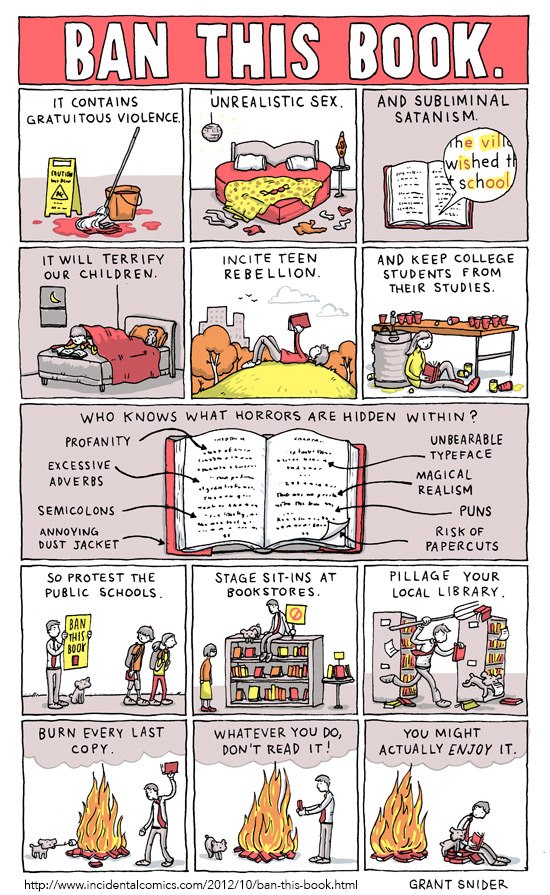
I’m against censorship. Unfortunately many are in favour of censoring books. You may have heard of the outcry over the decision to edit Mark Twain’s classic, Huckleberry Finn, to stop calling the main supporting character, N-word Jim. What you may not have heard is that schools had stopped teaching Huckleberry Finn because they didn’t want to have to explain the historical and racial undertones and themes of the book. We can’t have a literary book actually studied now, can we! Definitely don’t want to look at Twain’s biting commentary on racism in the south of America, because that would mean discussing racism, and we like to pretend it isn’t still an issue.

It isn’t just the school curricula that are being impacted, it is libraries and book stores as well. The list of frequently challenged books is far too long and the reasons cited are far too ridiculous. For example, Brave New World by Aldous Huxley is regularly objected to for being: insensitivity; nudity; racism; religious viewpoint; sexually explicit. Seriously? What about the other complaints?

I’m offended by the word ‘sustainable’ as it is ambiguous term that is used politically as a catch-cry to gloss over reality. Does that mean I can complain about books containing that word? And what is sexually explicit? Is it when two characters embrace for a passionate kiss, or when the ball-gag and whips make an appearance? Are parents really concerned about the level of “smut” in the books their kids read or are they trying to have books banned because readers might enjoy them?

I know I have a complaint about the Twilight books. Now, my reasons aren’t like the other complaints (Reasons: religious viewpoint and violence), I just don’t like them because I’ve been dragged to see four terrible films by my wife. Ban the Twilight books so that husbands and boyfriends everywhere aren’t tortured with Kirsten Stewart’s “acting.”

7 Types of Narrative Conflict by Mark Nichol

contemp_freytag

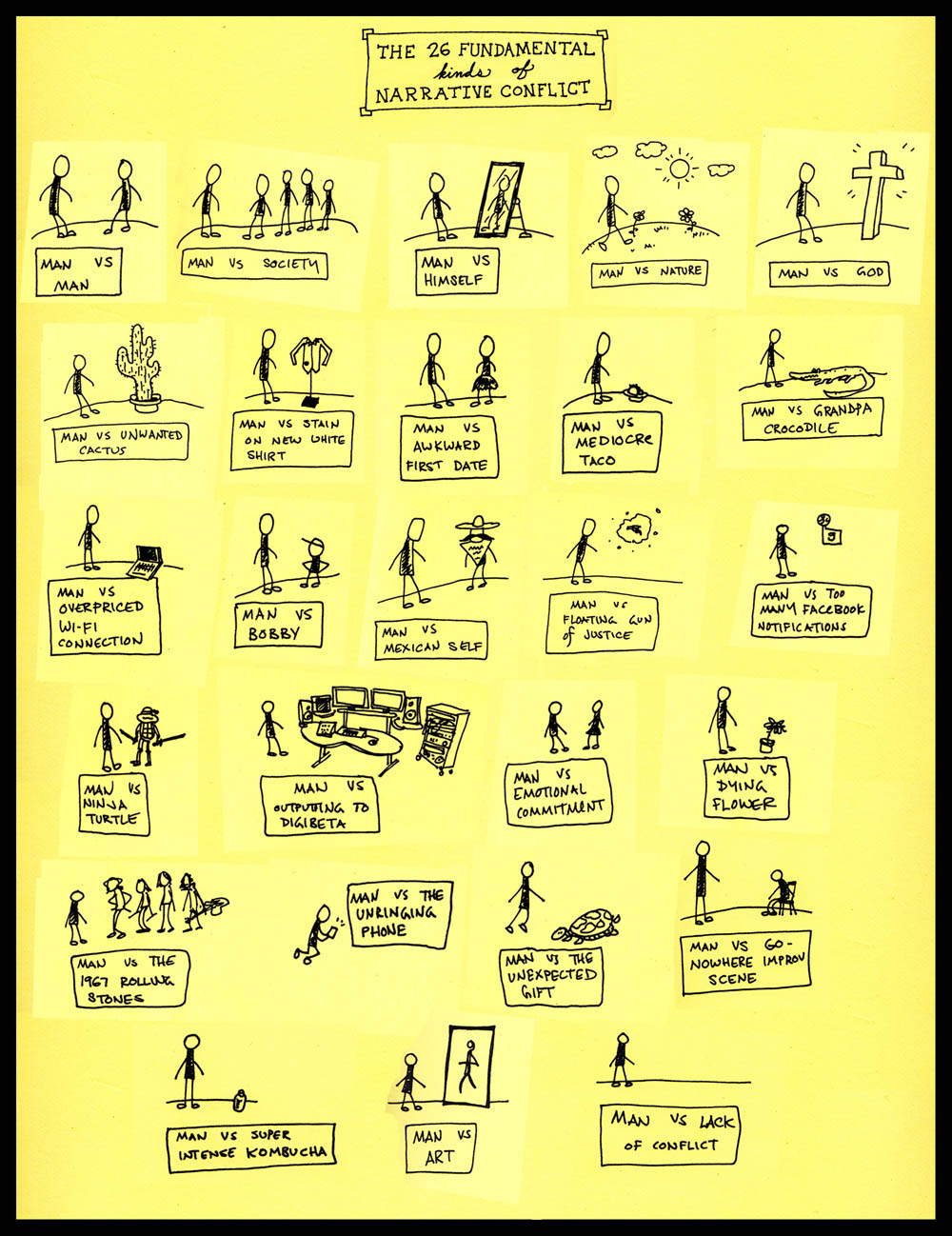
Every work of literature, and much nonfiction narrative, is based on at least one of the following conflicts. When you write a story or a biography, or relate a true event or series of events, you need not focus on such themes, and there’s no reason to state them explicitly (except in passing, perhaps, to provide insight about a biographical subject), but you’re wise to identify the conflicts inherent in your composition and apply them as you write.

1. Person vs. Fate/God
This category could be considered part of conflict with self or with society (many people count only four types of conflict, including those two and conflict with another person or with nature). That’s a valid argument, as one confronts fate as part of an internal struggle and religion is a construct of society, but explicitly naming fate (Oedipus Rex) or God — or the gods (The Odyssey) — as the antagonist is a useful distinction.

2. Person vs. Self
A person’s struggle with his or her own prejudices or doubts or character flaws constitutes this type of conflict (Hamlet).

3. Person vs. Person
Any story featuring a hero and a villain or villains (The Count of Monte Cristo) represents this type of conflict, though the villain(s) is/are often representative of another antagonist in this list, whether a villain is in essence an alter ego of the protagonist (thus representing the conflict of person versus self) or stands in for society.

4. Person vs. Society
When the protagonist’s conflict extends to confronting institutions, traditions, or laws of his or her culture, he or she struggles to overcome them, either triumphing over a corrupt society (I draw a blank here – Tyson says: most thrillers have an element of this), rejecting it (Fahrenheit 451), or succumbing to it (1984).

5. Person vs. Nature
In this conflict, the protagonist is pitted against nature (Robinson Crusoe) or a representation of it, often in the form of an animal (Moby Dick).

6. Person vs. Supernatural
Superficially, conflict with the supernatural may seem equivalent to conflict with fate or God, or representative of a struggle with an evocation of self (Dr. Jekyll and Mr. Hyde) or nature (The Birds). But this category stands on its own feet as well.

7. Person vs. Technology
Humanity’s innate skepticism about the wonders of technology has resulted in many stories in which antagonists use technology to gain power or in which technology takes over or becomes a malign influence on society (Brave New World).

From Daily Writing Tips.

Of course, Mark left out the most important one for writers, especially those working on a series of novels:

Person vs. Expectations.
Someone picked up your book because the publishing house put a picture of a dog on the cover, even though there isn’t a dog in the book (unless you count the love interest), and is expecting a book that will help them get to sleep in the 10 minutes per night that they read just before bed. Anything other than an easy to read, short chapter, low concept novel and the expectations will either result in a sleepless night or dire reprisals on social media. If this is not the first book the person has read by the author, then unfair comparisons will be made if you don’t manage to outshine everything you’ve ever written and will ever write – the latter for those coming late to a series or author.

conflict1000

Top 40 books of all time chosen by Lee Child

Easter is here for another year. I like to celebrate this time of year with bacon (for peace) and chocolate eggs and bunnies. Actually, interesting fact, the reason we celebrate Easter with eggs and bunnies is because they were fertility and sex symbols of the goddess Ishtar (pronounced Easter). In honour of the event, we clearly need the chocolate eggs and bunnies to keep us fuelled up for the fertility long weekend. In some of the spare hours, it might be worth reading a good book.

So, have you read any of Lee’s favourite books and will you be reading any of them this long chocolate fueled sex weekend?

1 To Kill a Mockingbird by Harper Lee
“The greatest legal thriller ever written.”

2 Revolution in the Head by Ian MacDonald
“If you were there, you can’t remember – so read this.”

3 Roots by Alex Haley
“A tragic story we should all know.”

4 Sophie’s Choice by William Styron
“If you read only 10 novels in your life, make this one.”

5 Catch 22 by Joseph Heller
“Started a brief but glorious period of dissent in the United States.”

6 The Day of the Triffids by John Wyndham
“The best what-if sci-fi ever.”

7 Brideshead Revisited by Evelyn Waugh
“An elegant saga and a double love story.”

8 The Grapes of Wrath by John Steinbeck
“A novel that described and defined an era.”

9 Nice Work by David Lodge
“Social realism from a recent but almost forgotten era.”

10 Goldfinger by Ian Fleming
“Iconic, for a reason.”

11 Ragtime by EL Doctorow
“What great novels used to be – and could be again.”

12 The Big Sleep by Raymond Chandler
“The best of the US golden age of crime writing.”

13 Romeo and Juliet by William Shakespeare
“The finest writing EVER.”

14 The Road to Wigan Pier by George Orwell
“How we used to live, think and write.”

15 Churchill by Roy Jenkins
“The best one-volume biography ever.”

16 The Dam Busters by Paul Brickhill
“Guys my age grew up on stuff like this.”

17 Gorky Park by Martin Cruz Smith
“A Californian writing about Russia in a Scandinavian way.”

18 Los Alamos by Joseph Kanon
“My current favourite writer’s debut – excellent.”

19 Postmortem by Patricia Cornwell
“There’s a reason she became so popular – and this is it.”

20 Sleepyhead by Mark Billingham
“An amazing debut with an early ‘reveal’ that will shock you.”

21 The Glittering Prizes by Frederic Raphael
“A time, a place – how we used to live, who we used to be.”

22 Maisie Dobbs by Jacqueline Winspear
“The first in an amazing new series.”

23 The Little Drummer Girl by John le Carré
“The unfairly neglected jewel in le Carré’s crown.”

24 City of Thieves by David Benioff
“Powerful, entrancing, tough, wonderfully imagined.”

25 Have His Carcase by Dorothy L Sayers
“The best of ‘golden age’ mystery fiction.”

26 The Girl Who Loved Tom Gordon by Stephen King
“An example of King’s genius – he can make a story out of the simplest premise.”

27 A Place of Execution by Val McDermid
“Everything plus that vital x-factor that makes you cross when you have to stop.”

28 The Lost by Daniel Mendelsohn
“A heartbreaking work of personal history that reads like a thriller.”

29 Debt of Honour by Tom Clancy
“The best from the man who dominated the genre for a decade.”

30 The Golden Rendezvous by Alistair MacLean
“His first dozen books are all great – why not start here?”

31 The Female Eunoch by Germaine Greer
“That rare thing – a book that changed the world.”

32 Dreams From My Father by Barack Obama
“I read this 7 years ago and wanted him for president right then.”

33 The Power of the Dog by Don Winslow
“A huge multi-generational crime saga – a book of the decade.”

34 The Day of the Jackal by Frederick Forsyth
“ ‘Book Zero’ in terms of recent thriller evolution.”

35 Green River Rising by Tim Willocks
“Maybe the best-ever prison novel – terrific suspense.”

36 The Runaway Jury by John Grisham
“Much more than it seems – a masterclass in narrative drive.”

37 Brilliant Orange by David Winner
“My favourite sport explains one of my favourite cultures.”

38 Night Sky by Clare Francis
“The multitalented Ms Francis unleashes terrific suspense and a great ‘OMG’ moment.”

39 On the Beach by Nevil Shute
“The best of 1950s style – with 1950s concerns.”

40 The Given Day by Dennis Lehane
“A big meaty epic, sprawling and inclusive – like novels use to be.”

Choosing a location for your story

32359_388405211247188_455351472_n

As much as I love America, does every crime and thriller novel written have to be set there? Wouldn’t it be great if more stories chose some other locations?

Before anyone jumps on me, yes, I know, there are plenty of stories set in diverse locations. My comment is more about the way writers are so often told that people only want to read stories set in the US, that it has to appeal to the US market. I think we all know that this is a presumption on behalf of the industry for us readers. Let’s try and push for the more challenging locations in the stories we read.

Perth Writers’ Festival 2013

Another year has come and gone for my local writers’ festival. Once again I joined my fellow reading nerds and aspiring authors to descend upon the grounds of UWA. This year there were 30,000 of us who felt the need to spend three days of lovely weather discussing books.

This year I spent a lot of the three day in writing workshops and less time at discussion/interview sessions. There is always room for improvement in writing, so what better way than sitting down with an expert and two dozen peers to discuss and practice. I’d like to thank the various experts who all had some interesting insights and tips: Susan Midalia (short stories – literary focus), Belinda Castles (finding your voice and turning that story into reality), LA Larkin (thriller writing, great tips and she is also running a longer course with the Sydney Writers Centre) and Parker Bilal (crime writing, developing the characters and structure).

This isn’t to say that I didn’t get the chance to see any talks. The discussion of Antarctica was fascinating and puts it on the list of places I’d like to visit before climate change has its wicked way with it. The discussion with Major General John Cantwell and former WA premier Geoff Gallop about why it is necessary to help remove the stigma around mental illness was fantastic. John managed to pretend he wasn’t suffering PTSD for 20 years, which is just amazing considering some of the the ramifications it was having on him. Another great session was with David Petrarca, Sue Masters and James Bradley discussing how TV storytelling now rivals cinema and literature. It is quite clear that subscription TV and services like Netflix are changing the game for production of TV, which is why we are seeing great writing, great acting and decent budgets to give us programming I actually want to watch. James Bradley made a very poiniant comment: we have to stop ragging on Master Chef and other boring and mindless TV shows, their popularity allows decent TV to be funded. Finally, on Sunday I was introduced to two new (for me) authors in the panel discussion on thrillers with Andrew Croome, LA Larkin and Steve Worland. I’m looking forward to reading Andrew and Steve’s books, and of course Louisa’s new novel Thirst.

But, now the festival is over for another year. This picture sums up the take home message for me from this year’s Perth Writers’ Festival:

538064_470914782957833_324528495_n

Book Review: How I Became a Famous Novelist by Steve Hely

How I Became a Famous NovelistHow I Became a Famous Novelist by Steve Hely
My rating: 3 of 5 stars

Satire is always fun. There is something so rewarding about taking the piss out of someone, something or society. The problem with satire is either that the target often doesn’t have much of a sense of humour or that the joke is just dragged out too far. One of the greatest works of satire, Jonathan Swift’s Gulliver’s Travels, is a great example of how writers can sometimes labour a joke/point too much, whilst being absolute geniuses.

Steve’s satire of the literary industry is right on the money. From the biting examples of literary drivel, to the examples of writers and the claims by industry figures that no-ones knows anything about books, Hely has hit the mark. I’m sure if I actually read much literary fiction I’d even recognise the books and writers who were satirised.

So it pains me to give this book only 3 stars, but I really had to. There were bits I had to skim over, especially in the second half of the book. Some of the literary satire pieces were too close to the truth for me, essentially making for boring reading. And, as I have already alluded, the book relies on one joke. This is still very well done, an enjoyable read, but it does suffer the fate of many pieces of satire, hence only 3 stars from me.

View all my reviews

Tyson Adams’ 2012 Book Awards: The Awesomes

Last year I instituted my best reads of the year, The Awesomes. I’ve read a few books this year (+90) and have decided that I needed to talk about my favourites of 2012 and award this year’s Awesome™.

As you will have noticed, my reviews of books are more about my impressions of the book and talking about how much I liked the book, rather than a recap of the plot, etc. My reasoning behind this is simple, I want to say “read this book” to people rather than fall into my bad habit of spoiling the ending, or being a bitch about books I didn’t enjoy. My list is based upon what I have read this year, so obviously, some great books have missed out due to lack of reading hours in the year. Also, my read list does include some books that were published prior to 2012. There were some categories that were sadly under-represented and some that had some very intense competition. Also, the fact that I finished a book shows that it was worth reading. I have my reading rules that stop me wasting valuable reading time on books I’m not enjoying. This means that any books on my read list are entertaining (well, unless I was particularly disgusted with the crappiness of the book in question).

Awesome of 2012

Nathaniel Cade series – Christopher Farnsworth

Night Angel Trilogy – Brent Weeks

Blasphemy – Douglas Preston

Temple of the Gods – Andy McDermott

Temple – Matthew Reilly

McGrave – Lee Goldberg

And the winner? Blasphemy by Douglas Preston.

Awesome Literary Fiction

There were no nominees in this category this year. Better luck next year.

Awesome Mystery & Thriller

Temple – Matthew Reilly

King City and McGrave- Lee Goldberg

First Drop – Zoe Sharp

Blasphemy – Douglas Preston

Temple of the Gods – Andy McDermott

Relic – Preston and Child

Nathaniel Cade series – Christopher Farnsworth

Tough category, but always hard to go past Matthew Reilly.

Awesome Crime

Assassin – Tara Moss

Vodka Doesn’t Freeze – Leah Giarrantano

Black Echo – Michael Connelly

Sunset Express – Robert Crais

Thirteen Hours – Deon Meyer

Another tough category this year. I’m going to have to give this one to Leah, with Tara, Michael and Robert close seconds.

Awesome Fantasy

Night Angel Trilogy – Brent Weeks

Awesome Paranormal Fantasy

Nathaniel Case series – Christopher Farnsworth

Awesome Science Fiction

There were no nominees in this category this year. Better luck next year.

Awesome Horror

Nathaniel Cade series – Christopher Farnsworth

The Kult – Shaun Jeffery

And the winner? Nathaniel Cade kicked arse!

Awesome Romance

There were no nominees in this category this year. Better luck next year.

Awesome Humor

Right What You No – Tyson Adams’ blog

I’m allowed to be self-congratulatory. Plus I didn’t read any funny books this year.

Awesome Nonfiction

This is an oxymoron, so it is invalidated as a category.

Awesome Graphic Novels & Comics

I didn’t read any 5 star graphic novels this year, but two series came to an end that were worth a mention: The Boys by Garth Ennis and Irredeemable/Incorruptible by Mark Waid. Both series were very strong and explored interesting aspects of the superhero genre.

Awesome Indie

King City – Lee Goldberg

Awesome Poetry

I still try to avoid poetry as much as possible, mainly because of ee cummings.

Book Review: Gone Girl by Gillian Flynn

Gone GirlGone Girl by Gillian Flynn
My rating: 5 of 5 stars

I normally hate literary styled books. They normally take all the fun stuff out of the book and replace it with tedious exposition masquerading as deep and meaningful prose. Award winning books are usually weighed down with this superfluous fluff.

This is a harsh statement, I know. Just because a book has won a literary award that doesn’t mean it has to suck. But it all comes back to some training I had in communication sciences at university. No-one cares about the methods, or process, or how long you spent doing this, and especially not how much research you did, they only care about what’s in it for them. Boil that down to a simple: readers are reading your book to be entertained. So all of that exposition is just getting in the way of entertaining the reader.

Gone Girl is as close to a literary styled novel I have read (to completion) in almost a decade. I used to read persevere with them all the time, now I have learnt my lesson. What makes Gillian’s book different is that she hasn’t forgone the plot, nor drawn out the story. So fans of crime novels will be captivated and literary fans might admit they need to read more genre books.

I put this novel off for a long time, buying it because of all the rave reviews and awards, then hearing it was very literary and baulking. I can see why this novel has been the big thing of 2012, it deserves the praise.

View all my reviews

Short stories now on Amazon

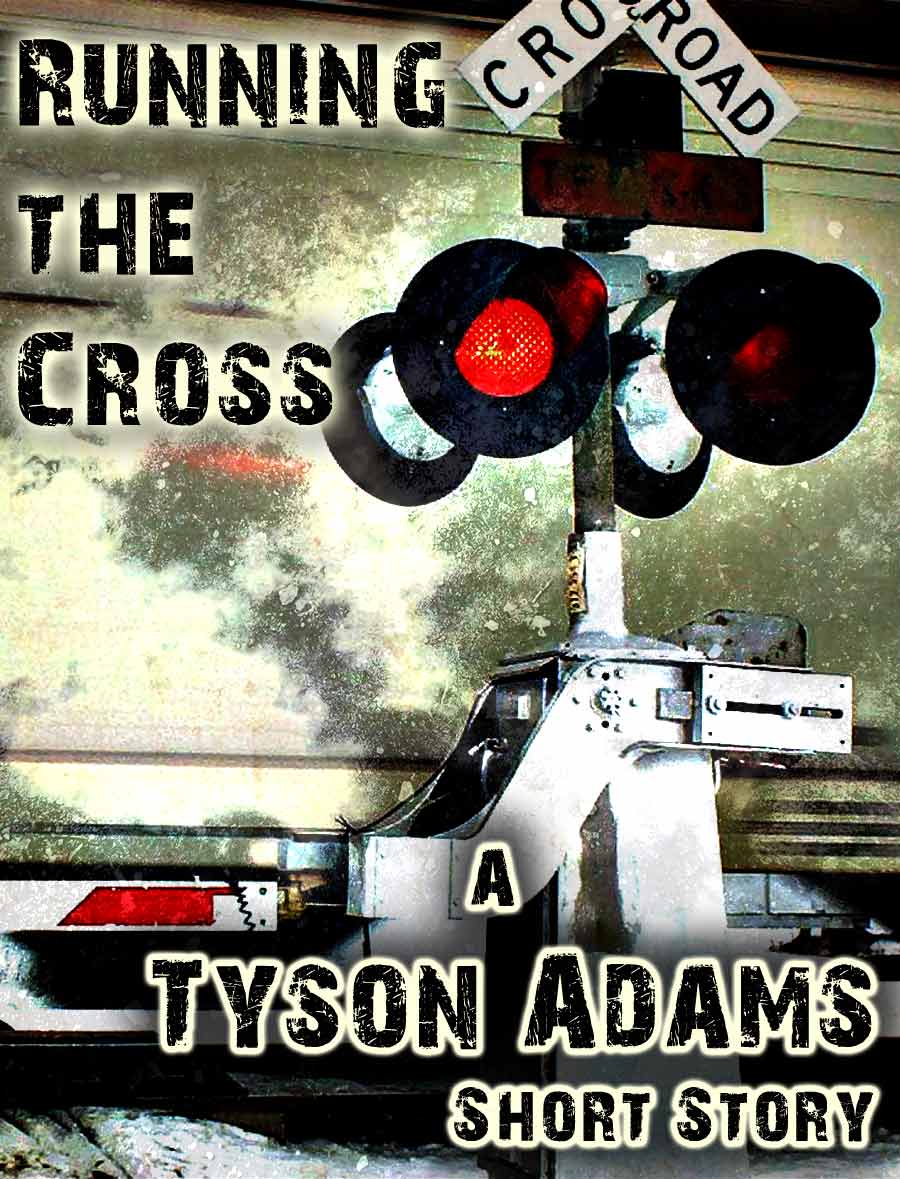
That’s right. I decided that there was no better way to learn how to publish my novellas than to practice with two of my short stories. I’m now prepared for the task of crossing the threshold into “professional author” territory, letting my creations escape the confines of my head and harddrive. I’ve priced both short stories at the Amazon standard $0.99, which is about what I think short stories should go for – novellas $2.99, novels somewhere between $7 and $10.

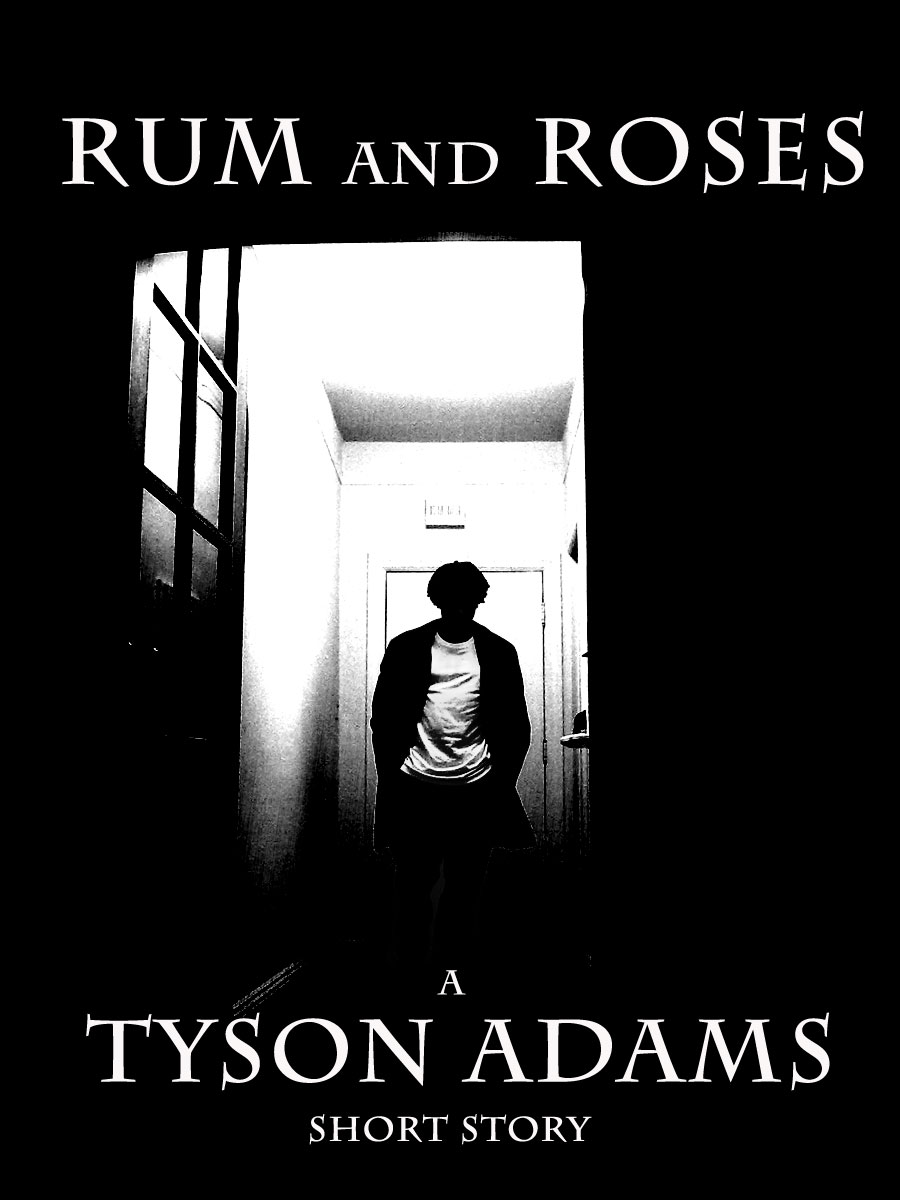
Running-the-Cross Rum-and-Roses

So if you would like to read some short stories, may I suggest you download mine from Amazon. Running the Cross is “A test of mind and body, running the cross is the ultimate test. A dozen rail lines, thousands of tonnes of freight trains travelling at high speed, a race across the tracks to prove yourself. Will you survive?” Rum and Roses “The police don’t like ‘Skinny’ McAfree, but they do like him for the disappearance and possible murder of his next door neighbour.”

I really enjoyed writing both of these, especially Running the Cross, and hope you enjoy reading them.
http://www.amazon.com/dp/B00B3WP0OK – Running the Cross

http://www.amazon.com/dp/B00B3XTKFO – Rum and Roses

Reading stats for 2012

Hot off of the presses we have two new American reading surveys: Reading Habits in Different Communities and E-book Reading Jumps; Print Book Reading Declines

Actually, the phrase “hot off of the presses” is rather antiquated now. News stories that are breaking generally hit electronic mediums, or in some cases, such as celebrity gossip, they hit the TV and radio mediums. Interesting research or data is normally promoted virally via Twitter and the like. Should we have a new phrase like “just blogged” or “trending tweet” instead?

Back to the survey. While not all of us live in the USA, despite what some American congress-people might say, their trends in reading can be seen as indicative of what is happening elsewhere or is likely to happen elsewhere. The Pew Institute have done a pretty decent survey, it would be great if a few others were done for other countries.

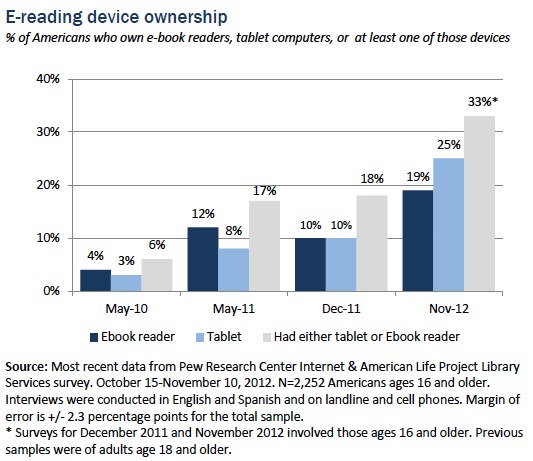
What I found interesting was the growth in e-books and e-readers. There are further breakdowns in the full reports about why the change is happening, but suffice to say, e-books have many advantages over paper, despite paper books still being the most popular reading format.

Ereading-device-ownership

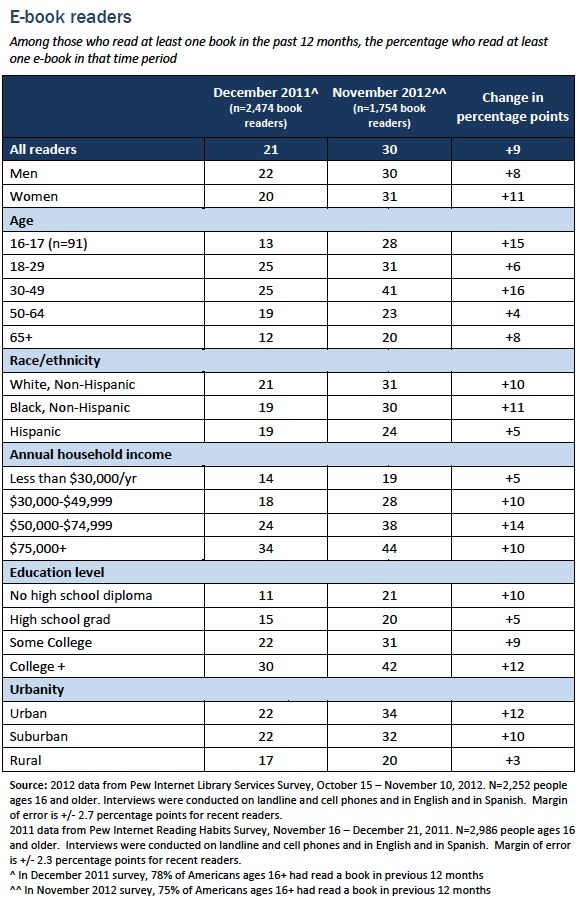
We can see a growth of 9% in people reading e-books during 2012, up from 21% to 30%. In terms of age demographics we can see that most age groups are taking up e-books, although the big growth is still in the middle age (30-49) group.

02-reading-and-ebooks

The next point of interest was who the readers were and how much they read. We can see that there is still a sizeable chunk of the community that don’t read and another chunk that pretend to read. I’d hazard a guess that light readers read non-fiction and the latest talked about bestseller only. Because they never really read good books it takes them ages to read one book and thus don’t read often.

22-reading-frequency

Among those ages 16 and older who had read a book in the past 12 months:

  • 8% read 1 book
  • 17% 2-3 books
  • 16% 4-5 books
  • 19% 6-10 books
  • 18% 11-20 books
  • 22% more than 20 books (this is my category)

Book-readers

And my final comment, women are still the readers. They make up a bigger proportion of book readers and they read more books. I have my own hypotheses as to why this is: boys are expected to like sport and reading is the opposite of sport; and reading doesn’t make you look as sexy as playing sport, so boys think you are less likely to get laid if you read. The big change I’d like to see, and this seems to be the case with e-readers and e-books, is for the average reader to read more books in a year, even if it is only so that people read the book before they make the movie of it.

Ten Indisputable Signs That You’re a Writer

Think you might be a writer but aren’t 150% sure? Here are ten signs that you may very well have a budding writer inside you.

  1. You constantly edit. Whether it’s while you’re driving down the street and pass a misspelled sign, or grammatical errors in Facebook posts, you fix errors constantly in your mind—and sometimes not so silently.
  2. You’re highly observant. And not only do you notice things all the time, but you file them away in your I could write about this later folder.
  3. You often ask, “How could I describe this?” You don’t ignore your life experiences—everything from walking outside during a torrential downpour, to burning yourself while cooking, to taking the first bite of a piping-hot homemade chocolate chip cookie can be used in your writing, and you often pause to think about how you would describe it in words.
  4. You have a hyperactive imagination. There’s never a dull moment in that head of yours—your imagination is always working on overtime to keep you entertained and give you fresh ideas.
  5. You feel inspired to write after reading a good book. Enough said.
  6. You often daydream about your Work In Progress. Your characters never completely leave you— they walk alongside you throughout the day and give you new ideas when you least expect it.
  7. You feel guilty if you haven’t written anything in a while. What a “while” is depends, but after a writing hiatus, a part of you begins to demand that you get back to the keyboard and reprimands you if you don’t.
  8. Grammar jokes are funny. Well, they are
  9. You can’t get enough books. After all, every new book is a couple of hours worth of inspiration.
  10. You keep doing this writing thing. It doesn’t matter if you’re not published, if no one else cares if you continue to write, if you don’t make a penny off of the words that you put on the page—none of that matters, because you’ll continue to write anyway.

Reblogged from: Ten Indisputable Signs That You’re a Writer.

E-book statistics for 2012

I seem to be finding a bunch of cool infographics recently, they are the future of communication (warning, sarcasm may be in affect here). It is always interesting to see what the status of sales, especially e-book sales. Personally, I see the e-book becoming the new paperback within a few years, and I also think that backlists will be all e-books. What will be really interesting is whether authors will be the one controlling their backlists or whether publishing houses will want to grab hold of those. Then it becomes a case of what rates are paid on backlist, because the sunk costs are a frontlist issue, so you would expect a greater author share of sales (although it could be argued that sunk costs are sunk, thus trying to recoup those costs as part of the sale price is bad economics).

ebook-market-2012-us-uk-canada-australia_50291c7f807a7_w594