7 Types of Narrative Conflict by Mark Nichol

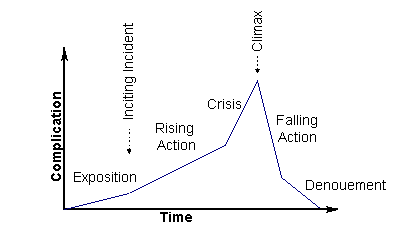
contemp_freytag

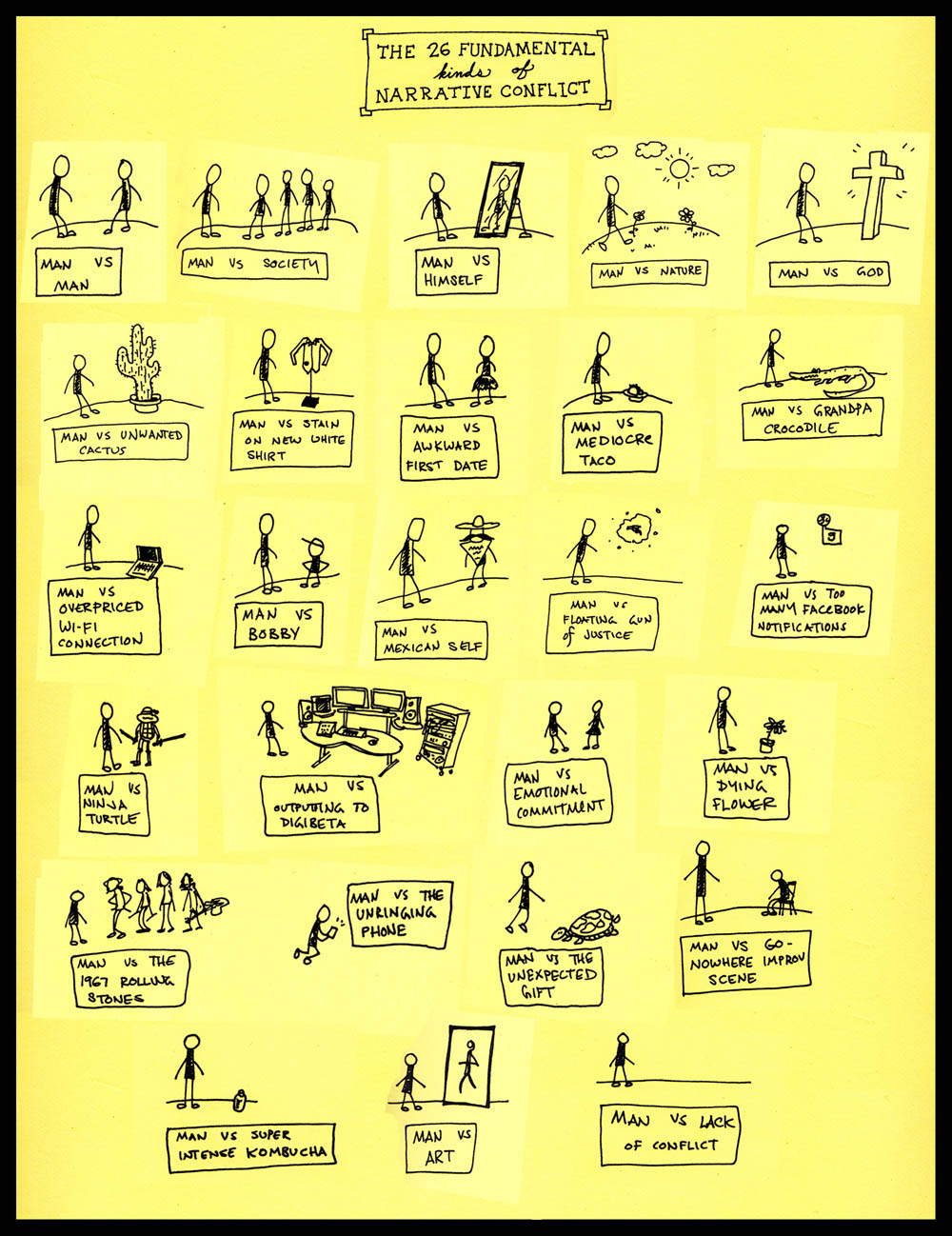
Every work of literature, and much nonfiction narrative, is based on at least one of the following conflicts. When you write a story or a biography, or relate a true event or series of events, you need not focus on such themes, and there’s no reason to state them explicitly (except in passing, perhaps, to provide insight about a biographical subject), but you’re wise to identify the conflicts inherent in your composition and apply them as you write.

1. Person vs. Fate/God
This category could be considered part of conflict with self or with society (many people count only four types of conflict, including those two and conflict with another person or with nature). That’s a valid argument, as one confronts fate as part of an internal struggle and religion is a construct of society, but explicitly naming fate (Oedipus Rex) or God — or the gods (The Odyssey) — as the antagonist is a useful distinction.

2. Person vs. Self
A person’s struggle with his or her own prejudices or doubts or character flaws constitutes this type of conflict (Hamlet).

3. Person vs. Person
Any story featuring a hero and a villain or villains (The Count of Monte Cristo) represents this type of conflict, though the villain(s) is/are often representative of another antagonist in this list, whether a villain is in essence an alter ego of the protagonist (thus representing the conflict of person versus self) or stands in for society.

4. Person vs. Society
When the protagonist’s conflict extends to confronting institutions, traditions, or laws of his or her culture, he or she struggles to overcome them, either triumphing over a corrupt society (I draw a blank here – Tyson says: most thrillers have an element of this), rejecting it (Fahrenheit 451), or succumbing to it (1984).

5. Person vs. Nature
In this conflict, the protagonist is pitted against nature (Robinson Crusoe) or a representation of it, often in the form of an animal (Moby Dick).

6. Person vs. Supernatural
Superficially, conflict with the supernatural may seem equivalent to conflict with fate or God, or representative of a struggle with an evocation of self (Dr. Jekyll and Mr. Hyde) or nature (The Birds). But this category stands on its own feet as well.

7. Person vs. Technology
Humanity’s innate skepticism about the wonders of technology has resulted in many stories in which antagonists use technology to gain power or in which technology takes over or becomes a malign influence on society (Brave New World).

From Daily Writing Tips.

Of course, Mark left out the most important one for writers, especially those working on a series of novels:

Person vs. Expectations.
Someone picked up your book because the publishing house put a picture of a dog on the cover, even though there isn’t a dog in the book (unless you count the love interest), and is expecting a book that will help them get to sleep in the 10 minutes per night that they read just before bed. Anything other than an easy to read, short chapter, low concept novel and the expectations will either result in a sleepless night or dire reprisals on social media. If this is not the first book the person has read by the author, then unfair comparisons will be made if you don’t manage to outshine everything you’ve ever written and will ever write – the latter for those coming late to a series or author.

conflict1000

Top 40 books of all time chosen by Lee Child

Easter is here for another year. I like to celebrate this time of year with bacon (for peace) and chocolate eggs and bunnies. Actually, interesting fact, the reason we celebrate Easter with eggs and bunnies is because they were fertility and sex symbols of the goddess Ishtar (pronounced Easter). In honour of the event, we clearly need the chocolate eggs and bunnies to keep us fuelled up for the fertility long weekend. In some of the spare hours, it might be worth reading a good book.

So, have you read any of Lee’s favourite books and will you be reading any of them this long chocolate fueled sex weekend?

1 To Kill a Mockingbird by Harper Lee
“The greatest legal thriller ever written.”

2 Revolution in the Head by Ian MacDonald
“If you were there, you can’t remember – so read this.”

3 Roots by Alex Haley
“A tragic story we should all know.”

4 Sophie’s Choice by William Styron
“If you read only 10 novels in your life, make this one.”

5 Catch 22 by Joseph Heller
“Started a brief but glorious period of dissent in the United States.”

6 The Day of the Triffids by John Wyndham
“The best what-if sci-fi ever.”

7 Brideshead Revisited by Evelyn Waugh
“An elegant saga and a double love story.”

8 The Grapes of Wrath by John Steinbeck
“A novel that described and defined an era.”

9 Nice Work by David Lodge
“Social realism from a recent but almost forgotten era.”

10 Goldfinger by Ian Fleming
“Iconic, for a reason.”

11 Ragtime by EL Doctorow
“What great novels used to be – and could be again.”

12 The Big Sleep by Raymond Chandler
“The best of the US golden age of crime writing.”

13 Romeo and Juliet by William Shakespeare
“The finest writing EVER.”

14 The Road to Wigan Pier by George Orwell
“How we used to live, think and write.”

15 Churchill by Roy Jenkins
“The best one-volume biography ever.”

16 The Dam Busters by Paul Brickhill
“Guys my age grew up on stuff like this.”

17 Gorky Park by Martin Cruz Smith
“A Californian writing about Russia in a Scandinavian way.”

18 Los Alamos by Joseph Kanon
“My current favourite writer’s debut – excellent.”

19 Postmortem by Patricia Cornwell
“There’s a reason she became so popular – and this is it.”

20 Sleepyhead by Mark Billingham
“An amazing debut with an early ‘reveal’ that will shock you.”

21 The Glittering Prizes by Frederic Raphael
“A time, a place – how we used to live, who we used to be.”

22 Maisie Dobbs by Jacqueline Winspear
“The first in an amazing new series.”

23 The Little Drummer Girl by John le Carré
“The unfairly neglected jewel in le Carré’s crown.”

24 City of Thieves by David Benioff
“Powerful, entrancing, tough, wonderfully imagined.”

25 Have His Carcase by Dorothy L Sayers
“The best of ‘golden age’ mystery fiction.”

26 The Girl Who Loved Tom Gordon by Stephen King
“An example of King’s genius – he can make a story out of the simplest premise.”

27 A Place of Execution by Val McDermid
“Everything plus that vital x-factor that makes you cross when you have to stop.”

28 The Lost by Daniel Mendelsohn
“A heartbreaking work of personal history that reads like a thriller.”

29 Debt of Honour by Tom Clancy
“The best from the man who dominated the genre for a decade.”

30 The Golden Rendezvous by Alistair MacLean
“His first dozen books are all great – why not start here?”

31 The Female Eunoch by Germaine Greer
“That rare thing – a book that changed the world.”

32 Dreams From My Father by Barack Obama
“I read this 7 years ago and wanted him for president right then.”

33 The Power of the Dog by Don Winslow
“A huge multi-generational crime saga – a book of the decade.”

34 The Day of the Jackal by Frederick Forsyth
“ ‘Book Zero’ in terms of recent thriller evolution.”

35 Green River Rising by Tim Willocks
“Maybe the best-ever prison novel – terrific suspense.”

36 The Runaway Jury by John Grisham
“Much more than it seems – a masterclass in narrative drive.”

37 Brilliant Orange by David Winner
“My favourite sport explains one of my favourite cultures.”

38 Night Sky by Clare Francis
“The multitalented Ms Francis unleashes terrific suspense and a great ‘OMG’ moment.”

39 On the Beach by Nevil Shute
“The best of 1950s style – with 1950s concerns.”

40 The Given Day by Dennis Lehane
“A big meaty epic, sprawling and inclusive – like novels use to be.”

Choosing a location for your story

32359_388405211247188_455351472_n

As much as I love America, does every crime and thriller novel written have to be set there? Wouldn’t it be great if more stories chose some other locations?

Before anyone jumps on me, yes, I know, there are plenty of stories set in diverse locations. My comment is more about the way writers are so often told that people only want to read stories set in the US, that it has to appeal to the US market. I think we all know that this is a presumption on behalf of the industry for us readers. Let’s try and push for the more challenging locations in the stories we read.

Perth Writers’ Festival 2013

Another year has come and gone for my local writers’ festival. Once again I joined my fellow reading nerds and aspiring authors to descend upon the grounds of UWA. This year there were 30,000 of us who felt the need to spend three days of lovely weather discussing books.

This year I spent a lot of the three day in writing workshops and less time at discussion/interview sessions. There is always room for improvement in writing, so what better way than sitting down with an expert and two dozen peers to discuss and practice. I’d like to thank the various experts who all had some interesting insights and tips: Susan Midalia (short stories – literary focus), Belinda Castles (finding your voice and turning that story into reality), LA Larkin (thriller writing, great tips and she is also running a longer course with the Sydney Writers Centre) and Parker Bilal (crime writing, developing the characters and structure).

This isn’t to say that I didn’t get the chance to see any talks. The discussion of Antarctica was fascinating and puts it on the list of places I’d like to visit before climate change has its wicked way with it. The discussion with Major General John Cantwell and former WA premier Geoff Gallop about why it is necessary to help remove the stigma around mental illness was fantastic. John managed to pretend he wasn’t suffering PTSD for 20 years, which is just amazing considering some of the the ramifications it was having on him. Another great session was with David Petrarca, Sue Masters and James Bradley discussing how TV storytelling now rivals cinema and literature. It is quite clear that subscription TV and services like Netflix are changing the game for production of TV, which is why we are seeing great writing, great acting and decent budgets to give us programming I actually want to watch. James Bradley made a very poiniant comment: we have to stop ragging on Master Chef and other boring and mindless TV shows, their popularity allows decent TV to be funded. Finally, on Sunday I was introduced to two new (for me) authors in the panel discussion on thrillers with Andrew Croome, LA Larkin and Steve Worland. I’m looking forward to reading Andrew and Steve’s books, and of course Louisa’s new novel Thirst.

But, now the festival is over for another year. This picture sums up the take home message for me from this year’s Perth Writers’ Festival:

538064_470914782957833_324528495_n

Book Review: Arctic Floor by Mark Aitken

Arctic FloorArctic Floor by Mark Aitken
My rating: 3 of 5 stars

There is nothing quite like a marketing executive, especially when they work in publishing. These are the people who come up with the fantastic ideas like: dog on the cover because dogs sell books, no dogs in the book; bright and cheery cover art, book about a serial killer; quotes recommending the book by famous authors, authors that have the same publisher. In this case the marketing department came up with a brilliant idea: Matthew Reilly is an Australian author who sells a lot of books, let’s mention him on the cover, despite the fact that the two authors write in a completely different style.

I grabbed Mark’s book from my local library because I saw he had a new book out, the third in a series, and I hadn’t heard of him previously. A fellow Aussie author, with a comparison to Matthew Reilly on the cover: this should be gold. Needless to say, the marketing people drew me in with false advertising. Mark’s book is a thriller and was a decent read, but he was more Cussler or Archer than Reilly. In fact, I was more reminded of Sahara (swap baking temperatures for freezing cold) than I was of Ice Station.

False advertising aside, this is quite a decent thriller. Worth a read, if you are after a James Rollins or Clive Cussler style novel. I’d expect later books in this series will probably “grab” the reader more, so maybe check out Mark’s new one.

View all my reviews

Book Review: How I Became a Famous Novelist by Steve Hely

How I Became a Famous NovelistHow I Became a Famous Novelist by Steve Hely
My rating: 3 of 5 stars

Satire is always fun. There is something so rewarding about taking the piss out of someone, something or society. The problem with satire is either that the target often doesn’t have much of a sense of humour or that the joke is just dragged out too far. One of the greatest works of satire, Jonathan Swift’s Gulliver’s Travels, is a great example of how writers can sometimes labour a joke/point too much, whilst being absolute geniuses.

Steve’s satire of the literary industry is right on the money. From the biting examples of literary drivel, to the examples of writers and the claims by industry figures that no-ones knows anything about books, Hely has hit the mark. I’m sure if I actually read much literary fiction I’d even recognise the books and writers who were satirised.

So it pains me to give this book only 3 stars, but I really had to. There were bits I had to skim over, especially in the second half of the book. Some of the literary satire pieces were too close to the truth for me, essentially making for boring reading. And, as I have already alluded, the book relies on one joke. This is still very well done, an enjoyable read, but it does suffer the fate of many pieces of satire, hence only 3 stars from me.

View all my reviews

Book Review: Gone Girl by Gillian Flynn

Gone GirlGone Girl by Gillian Flynn
My rating: 5 of 5 stars

I normally hate literary styled books. They normally take all the fun stuff out of the book and replace it with tedious exposition masquerading as deep and meaningful prose. Award winning books are usually weighed down with this superfluous fluff.

This is a harsh statement, I know. Just because a book has won a literary award that doesn’t mean it has to suck. But it all comes back to some training I had in communication sciences at university. No-one cares about the methods, or process, or how long you spent doing this, and especially not how much research you did, they only care about what’s in it for them. Boil that down to a simple: readers are reading your book to be entertained. So all of that exposition is just getting in the way of entertaining the reader.

Gone Girl is as close to a literary styled novel I have read (to completion) in almost a decade. I used to read persevere with them all the time, now I have learnt my lesson. What makes Gillian’s book different is that she hasn’t forgone the plot, nor drawn out the story. So fans of crime novels will be captivated and literary fans might admit they need to read more genre books.

I put this novel off for a long time, buying it because of all the rave reviews and awards, then hearing it was very literary and baulking. I can see why this novel has been the big thing of 2012, it deserves the praise.

View all my reviews

Reading stats for 2012

Hot off of the presses we have two new American reading surveys: Reading Habits in Different Communities and E-book Reading Jumps; Print Book Reading Declines

Actually, the phrase “hot off of the presses” is rather antiquated now. News stories that are breaking generally hit electronic mediums, or in some cases, such as celebrity gossip, they hit the TV and radio mediums. Interesting research or data is normally promoted virally via Twitter and the like. Should we have a new phrase like “just blogged” or “trending tweet” instead?

Back to the survey. While not all of us live in the USA, despite what some American congress-people might say, their trends in reading can be seen as indicative of what is happening elsewhere or is likely to happen elsewhere. The Pew Institute have done a pretty decent survey, it would be great if a few others were done for other countries.

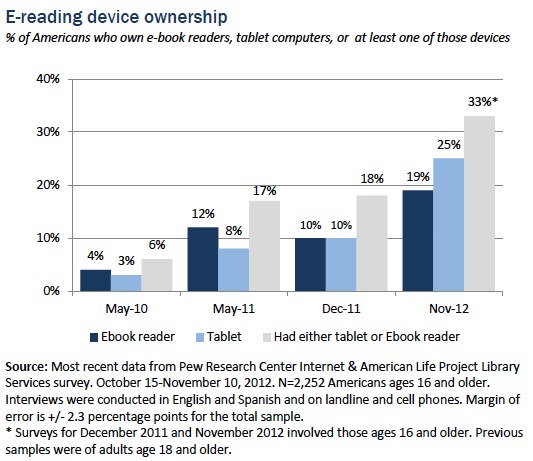
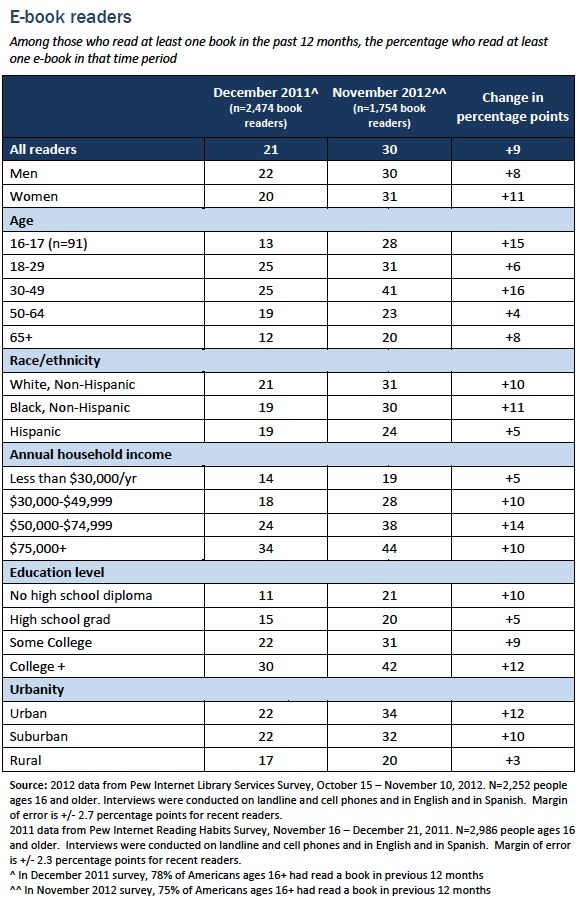
What I found interesting was the growth in e-books and e-readers. There are further breakdowns in the full reports about why the change is happening, but suffice to say, e-books have many advantages over paper, despite paper books still being the most popular reading format.

Ereading-device-ownership

We can see a growth of 9% in people reading e-books during 2012, up from 21% to 30%. In terms of age demographics we can see that most age groups are taking up e-books, although the big growth is still in the middle age (30-49) group.

02-reading-and-ebooks

The next point of interest was who the readers were and how much they read. We can see that there is still a sizeable chunk of the community that don’t read and another chunk that pretend to read. I’d hazard a guess that light readers read non-fiction and the latest talked about bestseller only. Because they never really read good books it takes them ages to read one book and thus don’t read often.

22-reading-frequency

Among those ages 16 and older who had read a book in the past 12 months:

  • 8% read 1 book
  • 17% 2-3 books
  • 16% 4-5 books
  • 19% 6-10 books
  • 18% 11-20 books
  • 22% more than 20 books (this is my category)

Book-readers

And my final comment, women are still the readers. They make up a bigger proportion of book readers and they read more books. I have my own hypotheses as to why this is: boys are expected to like sport and reading is the opposite of sport; and reading doesn’t make you look as sexy as playing sport, so boys think you are less likely to get laid if you read. The big change I’d like to see, and this seems to be the case with e-readers and e-books, is for the average reader to read more books in a year, even if it is only so that people read the book before they make the movie of it.

Ten Indisputable Signs That You’re a Writer

Think you might be a writer but aren’t 150% sure? Here are ten signs that you may very well have a budding writer inside you.

  1. You constantly edit. Whether it’s while you’re driving down the street and pass a misspelled sign, or grammatical errors in Facebook posts, you fix errors constantly in your mind—and sometimes not so silently.
  2. You’re highly observant. And not only do you notice things all the time, but you file them away in your I could write about this later folder.
  3. You often ask, “How could I describe this?” You don’t ignore your life experiences—everything from walking outside during a torrential downpour, to burning yourself while cooking, to taking the first bite of a piping-hot homemade chocolate chip cookie can be used in your writing, and you often pause to think about how you would describe it in words.
  4. You have a hyperactive imagination. There’s never a dull moment in that head of yours—your imagination is always working on overtime to keep you entertained and give you fresh ideas.
  5. You feel inspired to write after reading a good book. Enough said.
  6. You often daydream about your Work In Progress. Your characters never completely leave you— they walk alongside you throughout the day and give you new ideas when you least expect it.
  7. You feel guilty if you haven’t written anything in a while. What a “while” is depends, but after a writing hiatus, a part of you begins to demand that you get back to the keyboard and reprimands you if you don’t.
  8. Grammar jokes are funny. Well, they are
  9. You can’t get enough books. After all, every new book is a couple of hours worth of inspiration.
  10. You keep doing this writing thing. It doesn’t matter if you’re not published, if no one else cares if you continue to write, if you don’t make a penny off of the words that you put on the page—none of that matters, because you’ll continue to write anyway.

Reblogged from: Ten Indisputable Signs That You’re a Writer.

Book Review: Ice Force by Matt Lynn

Ice Force (Death Force, #4)Ice Force by Matt Lynn
My rating: 3 of 5 stars

Don’t you hate it when you can’t look past a minor flaw? It’s like Tom Cruise with Scientology, Jim Carey dating Jenny McCarthy, Liam Neeson appearing in that woeful Star Wars film and babies with their lack of personal hygiene. If it wasn’t for these minor flaws you could really enjoy what is before you, especially if you didn’t get sick of Jim Carey years ago.

There is a lot to like about Matt Lynn’s Ice Force, especially if you like the “real operation” styled thrillers that Chris Ryan and Andy McNab write. Matt differs from the others in this style with his humorous banter between the characters, something I really like to see in novels, something I am trying to do with my own writing. So what is it that I’m hung up on? The misogyny.

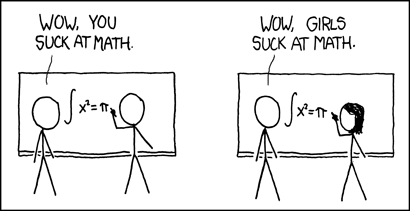
Now, I’m not saying that this book and the writer are misogynistic, rather I’m saying that there is a tone stated by some of the characters that women aren’t good at soldiering, that they distract men from the soldiering and that they are generally just eye candy. This is typical bloke-y fare that you get with the military and men talking at the pub who hate to admit that they are not in charge in their relationship. It may be “real” but I really don’t like reading it.

It reminds me of a cartoon:
how_it_works

So, this was a great thriller, but points off for marginalising women.

View all my reviews

E-book statistics for 2012

I seem to be finding a bunch of cool infographics recently, they are the future of communication (warning, sarcasm may be in affect here). It is always interesting to see what the status of sales, especially e-book sales. Personally, I see the e-book becoming the new paperback within a few years, and I also think that backlists will be all e-books. What will be really interesting is whether authors will be the one controlling their backlists or whether publishing houses will want to grab hold of those. Then it becomes a case of what rates are paid on backlist, because the sunk costs are a frontlist issue, so you would expect a greater author share of sales (although it could be argued that sunk costs are sunk, thus trying to recoup those costs as part of the sale price is bad economics).

ebook-market-2012-us-uk-canada-australia_50291c7f807a7_w594

What is a bookworm?

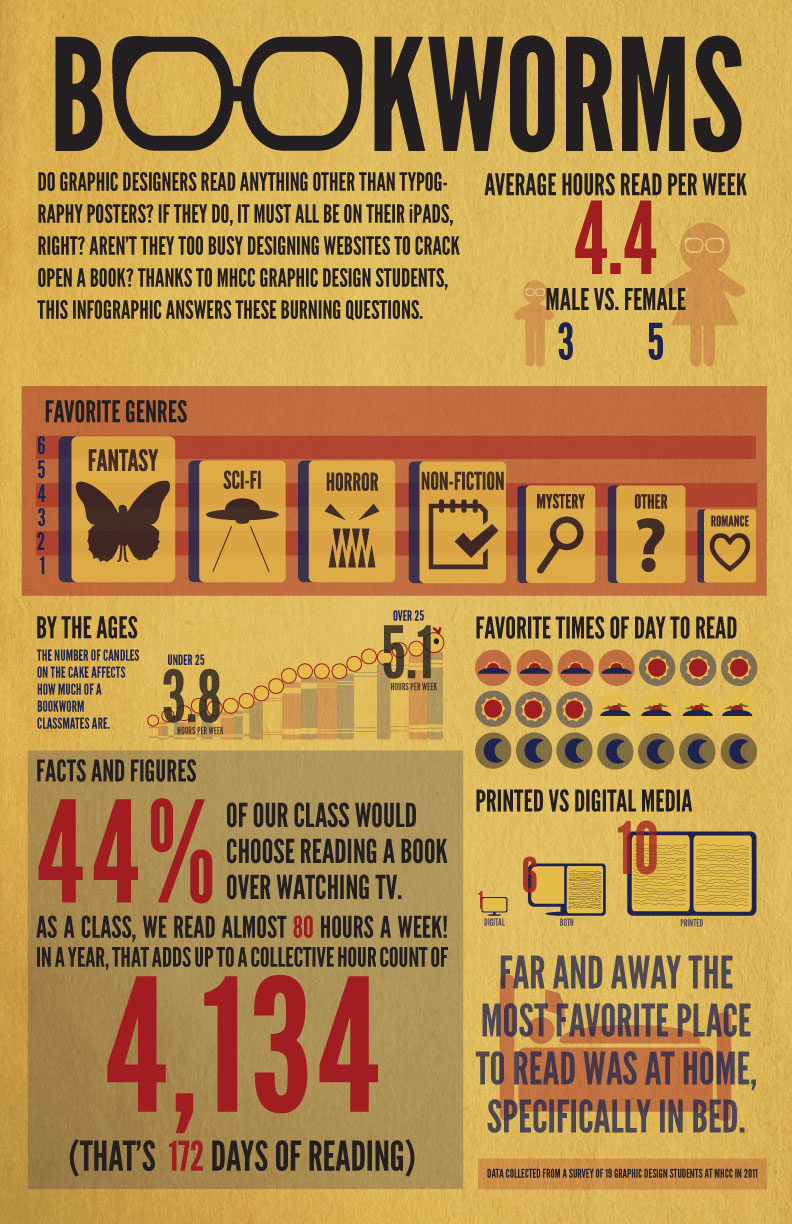
I’ve never really thought of myself as a bookworm, given the lack of exoskeleton, and my functioning vertebrae and CNS. There is no doubting that my wife and I are readers though, since we average at least a book a week, usually closer to two a week. We’re hoping our son will become a reader as well, but at the moment he is more entertained with pooping his diaper.

Anyway, in my internet trolling this week, I came across this infographic from a survey of a graphic design class. We all know that infographics must be accurate and representative, so let’s see what a Bookworm’s characteristics are.

windsore_infographic

Book Review: Death In The Dark by Emily Kimelman

Death In The Dark (A Sydney Rye novella #2)Death In The Dark by Emily Kimelman
My rating: 4 of 5 stars

I look forward to a lot of things: my football team winning another premiership, science discovering something cool, sleeping in on the weekend, sleeping in on a weekday, reading a good book. As a reader, I feel I have a responsibility to look forward to the next novel from my favourite authors. Thankfully, my favourite writers have never failed to deliver.

The first Sydney Rye novel was a great mystery from Emily Kimelman. The novel rated as my Awesome Indy book of 2011. Dog walker is not the first occupation you expect from a mystery novel’s protagonist. But since detective or private investigator characters are as stale as last week’s bread that was first frozen, then thawed, then used to mop up spilt beer, it was refreshing for Emily’s protagonist to be a dog walker. Plus, I like dogs.

If you haven’t read the first Sydney Rye novel, you may be confused why Joy Humbolt is calling herself Sydney and living in an RV in this second adventure. I recommend reading the first novel now…. Okay, so now that we are on the same page, I can say that Sydney is evolving. This isn’t just a name change, this is a quest to become something more. Emily manages to even cheekily title one of the chapters “Obligatory Training Montage”.

All this novella has done is left me wanting to read the next edition. Fortunately, Emily has that coming out in January.

View all my reviews