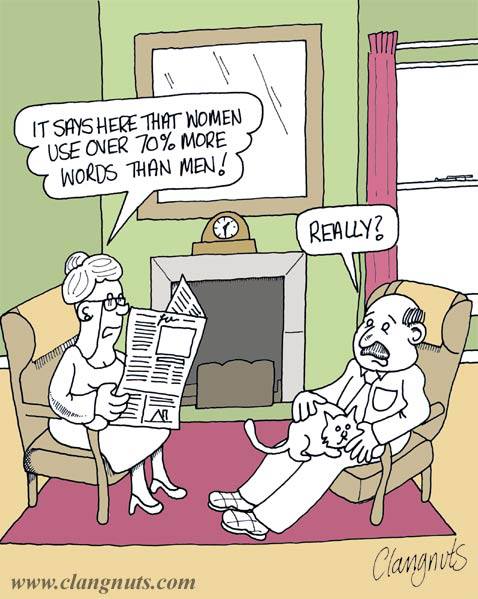
Manly? Hardly.

therapy-misogyny-756020

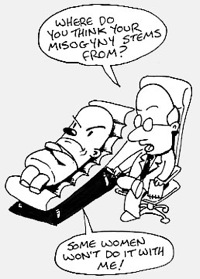
Currently I’m doing a writing course, a real one, one that assigns homework! For my homework I was doing some research when I accidentally came across a webpage and general philosophy that I found interesting. By interesting I mean ‘rabidly sexist garbage that demeans both men and women.’

Now I have heard this stuff before, a lot of it stems from a lack of modern male identity in the post-feminism world. Whenever you have social change there will inevitably be a push-back and level of disenfranchisement of sectors who have no clear ‘voice’. They talk about being “alpha males” and swallowing the red pill, taking control of their lives and their women. This is, of course, just the excuse that bigots and morons need to write garbage like:

  • Paternity fraud is worse than rape
  • 5 Reasons To Date A Girl With An Eating Disorder
  • Apple Should Have Never Hired A Female Handbag Executive
  • 5 Reasons Women Should Come With HoFax Reports

This sort of shit really is pathetic. Take the first article as an example: in what world is child support worse than the second most heinous physical act? (NB: the worst is still murder, although combine the two and you have a new crime novel) Now if we were actually talking about misandry then there would be valid concerns and points to be made and opinions to be listened to. If we were talking about the role of men in society and how it has changed, again, legitimate concerns and points to be made. But how does the lot of men (and women) improve with this:

It should be noted that 30 something American women are not becoming traditionally minded or anything, but rather they are simply in a desperate rush to find the useful idiot who will put a roof over her head. Once an American man goes foreign, American females both in their age 20′s and 30′s are sloppy seconds and cannot compete with non-Western women…… It takes time but your chances of finding a quality girlfriend elsewhere are better, as opposed to in the States where men have to contend with the overweight, screwed up, tattooed, walking STD incubators that are pass for women today. TS: I kid you not, this is an actual quote from one of the articles.

You see, this is not a realistic view of the world. It isn’t even a snapshot of a small segment of society. These are the views of the next generation of sexists and bigots, the kind of people that will dish out emotional and physical abuse because they are ‘real men’. These are the views of the weak and insecure. These are the articles written by frauds of men.

I leave you with Steve Shives’ wonderful take on this topic.

Also see: http://www.cracked.com/blog/5-responses-to-sexism-that-just-make-everything-worse/

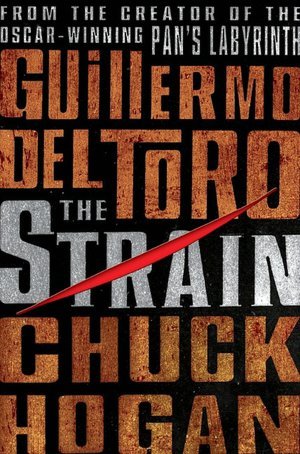
Book Review: The Strain by Guillermo Del Toro and Chuck Hogan

The Strain (The Strain Trilogy, #1)The Strain by Guillermo del Toro
My rating: 4 of 5 stars

I bought this novel after watching the fantastic Pan’s Labyrinth. If you haven’t watched that movie, do so now. In fairness though, this novel has more in common with Del Toro’s contribution to the Blade series of movies than it does to Pan’s Labyrinth.

This is another take on the viral outbreak thriller, thankfully it doesn’t take it down the path of zombies, as most recent novels in this genre have done. Non-sparkly vampires are back!

The only disappointment for me was that this was definitely the first instalment in a trilogy and felt a little more unfinished than I’d have liked. The writing is very reminiscent of Douglas Preston and Lincoln Child’s Prendergast series. Worth a read for horror and thriller fans.

View all my reviews

Book review: Zero at the Bone by David Whish-Wilson

Zero at the BoneZero at the Bone by David Whish-Wilson
My rating: 5 of 5 stars

I know it is only early into November, but I think I’ve read the best book of the year. But don’t just take my word for it, Angela Savage thinks so too. That isn’t to say you can’t take my word for it. I’m trust-worthy. Honest.

David has set himself a huge task: setting a crime novel in the sleepy city of Perth Western Australia and making the hard-boiled-thriller work. Let’s just say that I’m glad I was too young to experience the Perth David has crafted in Zero at the Bone.

If you read Angela’s review, she has summed up the story and highlighted David’s skilled writing. I’ve previously discussed David’s previous novel, Line of Sight, as being a great novel; this one is even better.

View all my reviews

Rules of thriller writing

archer-gun

1) If in doubt kill a character.

2) Plot holes can be filled with dead bodies.

3) Nothing screams thriller more than characters screaming for their lives.

4) Car chases and shootouts are mandatory.

5) The hero can’t die, unless you really, really want them to.

6) The bad-guy must die horribly, unless you want them for the sequel. Even then, the sequel could be a zombie thriller.

7) Beloved minor characters must die the most gruesome and pointless of deaths.

8) Minor bad-guys must follow the inverse ninja law.

9) The only reason a gun should ever run out of bullets is if it puts the hero in even more danger.

10) The rules of physics and biology do not apply to the hero, unless it puts them in even more danger.

11) Deus ex machina can only be used once in the story, so use it wisely.

12) If your story hasn’t given your readers a heart attack, rewrite it so that it does.

See also:
http://davidmorrell.net/on-writing/writing-advice/
http://www.creative-writing-now.com/how-to-write-a-thriller.html
http://www.writerscentre.com.au/sydney/thrillerwriting.htm

Breaking Bad: Only in the USA

enhanced-buzz-wide-5417-1378832798-28

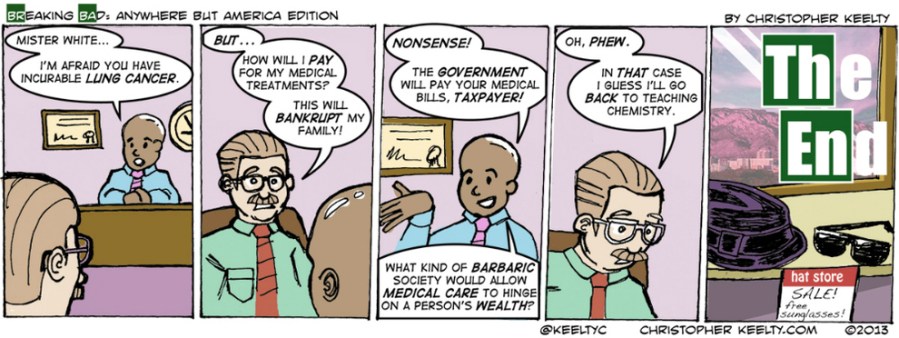
It’s quite interesting to see how the premise for any book, movie or TV show is endemic. The above example of Breaking Bad is a classic, and especially funny given the current furore over affordable health care in the USA. But there are plenty of others.

Sherlock Holmes is a classic example. Imagine a drug addicted, genius, arsehole detective in the modern age where drugs are illegal. Yep: Sherlock and the Hounds of B-Block. Also, before anyone says House, think about how long House would have spent in malpractice suits.

Robinson Crusoe would be pretty difficult to see happening in this day and age. Sure, Tom Hanks tried to convince us that modern people could be lost on an island and survive by their wits and a bunch of FedEx packages. But with modern tracking methods, mapping and the fact that no-one travels by boat now-a-days, Robinson Crusoe would be Bear Grylls or Survivor.

Huckleberry Finn is the tale of a young boy running away with his adult slave. That just wouldn’t happen these days. Now it isn’t that slaves don’t exist anymore (they do), nor the idea of run-aways. A young boy going missing in the USA with a grown man, sounds like an episode of Without a Trace.

The test of a premise really is to see if it would work anywhere else, any-time else. If it doesn’t work anywhere or any-when else, then it is interesting. If it can be transposed, how interesting was the premise to begin with?

Mythtaken: Shark attacks

A while back I wrote a post on how sharks aren’t the deadly monsters attacking people all the time that we think they are. Now I’m not suggesting that we all go and hug sharks, they only like to be touched by cleaning fish, nor that we jump in to swim with them, they play tag far too roughly for delicate humans. What I’m suggesting is that we really need to start worrying about stuff that is actually a concern rather than stuff that is just wild gesticulations in front of a camera for ratings.

So here is a list of things that kill more people than sharks annually:

funny-sharks-things-that-kill-more


Picture from: http://themetapicture.com/things-that-kill-more-people-than-sharks/

Things they don’t tell you about getting married

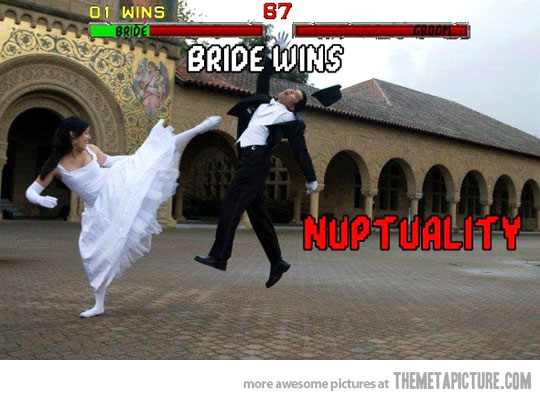
funny-wedding-photo-ideas-game

1) Mentioning the word ‘wedding’ in a store, restaurant or venue immediately adds 30% to the price.
Don’t believe me? Go into a coffee shop and say you’re getting married when you order a drink – doesn’t even have to be for your wedding – and watch the price rise.

2) Getting married is an excuse for your friends and family to change their topic of conversation.
Before you had a partner the topic of conversation was about who you were dating. Once you have a partner the conversation becomes about when you are getting married. Once you’re married the conversation can finally change to when are you having kids. Once you have a kid the conversation is all about when you are having the next one. I’m assuming that some time after this the conversation switches to what heart medication you’re taking now.

3) Everyone wants to make a big deal about you getting married.
Anyone would think that you only do this two or three times in your life or something.

4) The bride is expected to be bride-zilla, destroyer of kittens and venue staff. The groom is expected to show up. Preferably in a suit.
I’m not sure how this works at LGBT weddings (oh wait, we’re still backward hicks), but having the subjugation of half of the partnership by everyone around you is not exactly the best way to encourage a balanced relationship. Although, I hear that the 1950s were cool in other ways.

5) You will be expected to invite everyone you’ve ever met.
This is despite the fact that you can’t remember half of their names, let alone addresses. Nor the fact that you didn’t particularly want to invite your creepy uncle who will no doubt get drunk and try to feel up your new wife.

6) You will pay for a lot of alcohol you don’t get to drink.
Being the centre of attention means that you will barely have a chance to take a sip of your drink all night, whilst everyone else will be queuing up to throw-up as to make room for more free booze. This doesn’t apply to the bride, who has a shiny white dress that says, “Give me a drink.”

7) Your hens and bucks nights have to involve strippers.
Something to do with the stabilisation of the economy. Remember to tip well.

Fast and Furious series

Fast and Furious: Car Porn

The other night I was watching the Fast and Furious 6, which is a great story about how The Rock is proving you don’t need CGI for the next Hulk movie. With the announcement and post-credits scene showing they are making Fast and Furious 7, I thought it was worth re-capping the series so far.

1) The Fast and The Furious
This first instalment is pretty much Point Break with cars.

2) 2 Fast, 2 Furious
Also known as The Curious Case of the Missing Vin Diesel.

3) The Fast and The Furious: Tokyo Drift
Who are these people? Why are they driving sideways? Where are Paul and Vin?

4) Fast and Furious: Career Booster
After realising that people still like seeing cars at the movies but are only so-so about Vin Diesel and Paul Walker’s other films, it was time to film some car porn with the original cast.

5) Fast 5: Bicep Showdown
The Rock and Vin Diesel spend two hours showing off their gym time.

6) Fast and Furious 6: The Rock and some cars
The Rock dwarfs everyone on screen and no-one can see the cars clearly.

7) Fast and Furious 7: Back to Tokyo*
We quickly forget that Paul Walker has been a main cast member of the series as Jason Statham, Tony Jaa, Rhonda Rousey, Vin Diesel and The Rock beat the crap out of each other near some cars.

8) Fast and Furious 8: Reasonably Priced Car
Having realised that with all the protein and creatine the stars have been eating they can no longer afford fancy cars, Vin’s crew now rebuild some small hybrid cars to make them capable of a 20 second quarter mile.

9) Fast and Reasonably Furious 9: Repossession
Despite having downgraded to cheaper vehicles, the sheer weight of the bloated continuation of the series leads to the repo-men arriving and taking all the cars. When Vin and his crew confront the repo-men, the repo’s say “This is what we do.”

10) Fast and Not Really Furious 10: Nursing Home Drift
Now confined to wheelchairs and with rapidly deflating biceps, Vin’s crew trick out some wheelchairs and mobility scooters to pass the time between naps.


Update: According to my news feed, Paul Walker died in a car crash after a charity event at age 40. I’ve written before about Paul Walker seeming like a nice bloke who seems to have made it in films by being a decent guy and not because of acting ability. My comments above about the next Fast and Furious movie suddenly take on a new light, so I just hope the next instalment honours Paul’s involvement in the franchise (it was that initial screen chemistry between Paul and Vin that made the first movie a success). I’d already felt the franchise was drifting away from Paul as the main character, hence the joke about the massive ensemble cast above, so let’s hope they do something cool to honour him.

How Copyright Made Mid-Century Books Vanish

Now this is an interesting study and article. I have actually noticed this phenomenon myself when looking for crime and thriller authors and books from various generations. Everyone knows Robert Howard, Raymond Chandler and Donald E Westlake, they’ve pretty much stayed in print since they were released. But what about the other authors from the 1920s to the mid 1980s? On various writer forums you will find writers re-releasing their novels from the 80s as ebooks. This is the downside of copyright. Read for this article I stole am re-blogging from The Atlantic.

by REBECCA J. ROSEN
A book published during the presidency of Chester A. Arthur has a greater chance of being in print today than one published during the time of Reagan.
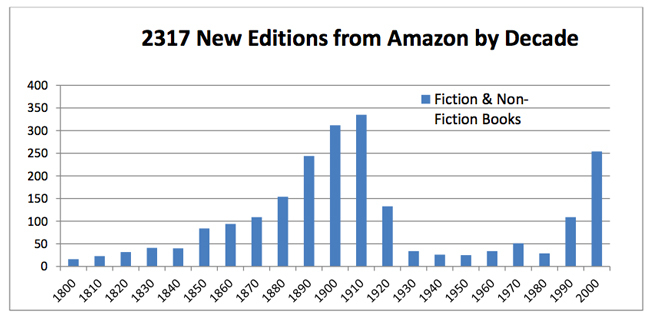
neweditions650-thumb-650x317-128315 Last year I wrote about some very interesting research being done by Paul J. Heald at the University of Illinois, based on software that crawled Amazon for a random selection of books. At the time, his results were only preliminary, but they were nevertheless startling: There were as many books available from the 1910s as there were from the 2000s. The number of books from the 1850s was double the number available from the 1950s. Why? Copyright protections (which cover titles published in 1923 and after) had squashed the market for books from the middle of the 20th century, keeping those titles off shelves and out of the hands of the reading public. Heald has now finalized his research and the picture, though more detailed, is largely the same: “Copyright correlates significantly with the disappearance of works rather than with their availability,” Heald writes. “Shortly after works are created and proprietized, they tend to disappear from public view only to reappear in significantly increased numbers when they fall into the public domain and lose their owners.” The graph above shows the simplest interpretation of the data. It reveals, shockingly, that there are substantially more new editions available of books from the 1910s than from the 2000s. Editions of books that fall under copyright are available in about the same quantities as those from the first half of the 19th century.

Publishers are simply not publishing copyrighted titles unless they are very recent. But this isn’t a totally honest portrait of how many different books are available, because for books that are in the public domain, often many different editions exist, and the random sample is likely to overrepresent them. “After all,” Heald explains, “if one feeds a random ISBN number [into] Amazon, one is more likely to retrieve Milton’s Paradise Lost (with 401 editions and 401 ISBN numbers) than Lorimer’s A Wife out of Egypt (1 edition and 1 ISBN).” He found that on average the public domain titles had a median of four editions per title. (The mean was 16, but highly distorted by the presence of a small number of books with hundreds of editions. For this reason, statisticians whom Heald consulted recommended using the median.) Heald divided the number of public-domain editions by four, providing a graph that compares the number of titles available. titlesavailable650 Heald says the picture is still “quite dramatic.” The most recent decade looks better by comparison, but the depression of the 20th century is still notable, followed by a little boom for the most recent decades when works fall into the public domain. Presumably, as Heald writes, in a market with no copyright distortion, these graphs would show “a fairly smoothly doward sloping curve from the decade 2000-20010 to the decade of 1800-1810 based on the assumption that works generally become less popular as they age (and therefore are less desirable to market).” But that’s not at all what we see. “Instead,” he continues, “the curve declines sharply and quickly, and then rebounds significantly for books currently in the public domain initially published before 1923.” Heald’s conclusion? Copyright “makes books disappear”; its expiration brings them back to life. The books that are the worst affected by this are those from pretty recent decades, such as the 80s and 90s, for which there is presumably the largest gap between what would satisfy some abstract notion of people’s interest and what is actually available. As Heald writes:
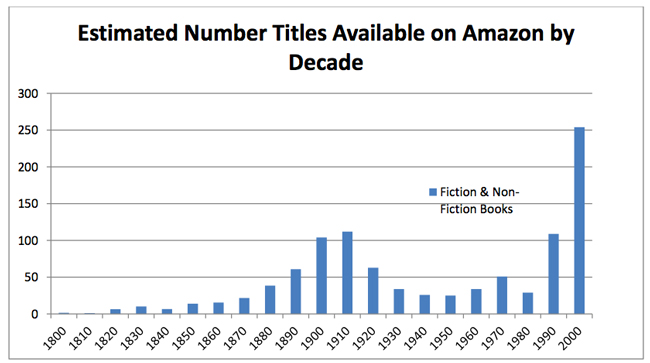
This is not a gently sloping downward curve! Publishers seem unwilling to sell their books on Amazon for more than a few years after their initial publication. The data suggest that publishing business models make books disappear fairly shortly after their publication and long before they are scheduled to fall into the public domain. Copyright law then deters their reappearance as long as they are owned. On the left side of the graph before 1920, the decline presents a more gentle time-sensitive downward sloping curve.

But even this chart may understate the effects of copyright, since the comparison assumes that the same quantity of books has been published every decade. This is of course not the case: Increasing literacy coupled with technological efficiencies mean that far more titles are published per year in the 21st century than in the 19th. The exact number per year for the last 200 years is unknown, but Heald and his assistants were able to arrive at a pretty good approximation by relying on the number of titles available for each year in WorldCat, a library catalog that contains the complete listings of 72,000 libraries around the world. He then normalized his graph to the decade of the 1990s, which saw the greatest number of titles published. adjustedtitles650 By this calculation, the effect of copyright appears extreme. Heald says that the WorldCat research showed, for example, that there were eight times as many books published in the 1980s as in the 1880s, but there are roughly as many titles available on Amazon for the two decades. A book published during the presidency of Chester A. Arthur has a greater chance of being in print today than one published during the time of Reagan. Copyright advocates have long (and successfully) argued that keeping books copyrighted assures that owners can make a profit off their intellectual property, and that that profit incentive will “assure [the books’] availability and adequate distribution.” The evidence, it appears, says otherwise.
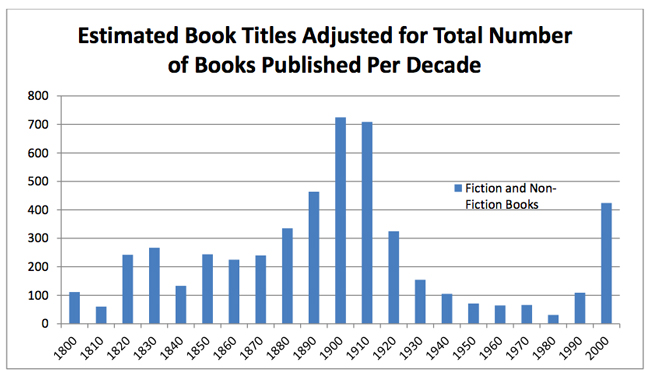
Further reading: http://artlawjournal.com/can-find-creative-work-copyright-free/

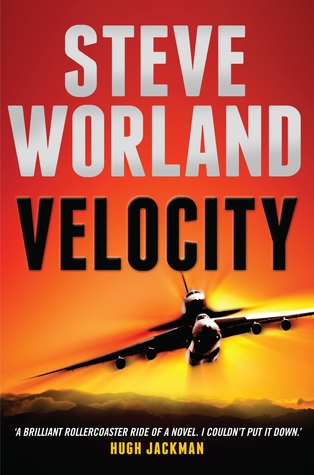
Book Reviews: Velocity by Steve Worland

Velocity (Judd Bell & Corey Purchase, #1)Velocity by Steve Worland
My rating: 4 of 5 stars

Whenever there is a new thriller author on the block, especially if they are Australian, there is always someone drawing a comparison to Matthew Reilly. You can just about guarantee that this comparison will be drawn by someone who hasn’t read Matthew Reilly’s books or hasn’t read the new author’s book/s. Finally, there is an author with whom this comparison is valid.

Well worth the read.

View all my reviews

Song Dedications

Radio and Wedding DJs like to dedicate songs, but rarely do they get past the “This one goes out to all the ladies.” or “This one’s for all the lovers.” It seems odd to me that DJs don’t mix it up a bit and play some songs for more specific groups of people. For example:

This one is for everyone who loves kids.
Michael Jackson – Beat It – because Michael Jackson loved kids too.

This one is for anyone at home playing with rope.
Joy Division – Love Will Tear Us Apart – because rope lovers identify with the Joy Division front man.

This one is for those who are having a good day.
Dimmu Borgir – Burn In Hell (Twisted Sister cover) – because a DJ is never having a good day.

This one is for everyone arguing on the comments of Youtube.
Jackson 5 – ABC – because clearly no one commenting there have learnt them.

This one is for everyone driving slow.
The Beatles – Can’t Buy Me Love – because you aren’t buying love on the street.

This one is for the Westboro Baptist Church.
AC/DC – Highway to Hell – because that is exactly where this church belongs.

This one is for all the politicians.
Guns ‘n’ Roses – Get in the Ring – seriously, one round, no holds barred, no tap outs.