Music that lasts

I was recently having a discussion about Zeitgeist. No, not the concept of a spirit of the age or spirit of the time, I mean the 2007 album from the (not) Smashing Pumpkins. I’ve been a massive fan of the Smashing Pumpkins’ music since about 1994 (wow, 20 years!) but have to say that Zeitgeist was the last of their albums I bought and I don’t listen to it, Ava Adore (1998), nor Machina (2000). Essentially, I’m no longer a fan of the Smashing Pumpkins, I’m a fan of their early work only.

What amazes me is you can listen to Gish (1991), Siamese Dream (1993), Mellon Collie (1995), even their b-sides album Pieces Iscariot (1994), and they still hold up really well. With the exception of the song Untitled (from their retrospective Rotten Apples, 2001) and maybe Tarantula (from Zeitgeist), the Smashing Pumpkins haven’t released a song or album that compares to any of the material on those early albums. With the more recent material the songs sound unfinished. When old b-sides sound better than your new a-sides, you really have to question what you’re doing.

But this isn’t just about the Smashing Pumpkins, name a Rolling Stones song released in the last 30 years (i.e. everything post Dirty Work from 1983). Can’t, can you!? They’ve released 5 studio albums and countless – well you can count them, but who cares to – live and collection albums in that time. Fans everywhere dread this announcement at a Rolling Stones concert, “And here’s a song from our new album.”

There are a few factors at play here: the idea of talent and inspiration meeting, the idea that even great artists can’t continue at that elite level indefinitely, and the idea that some art is transitory whilst some is timeless. I’ll leave the first two points for another day, the latter point gives me an opportunity to insult pop music.

Some art, music, TV, movies, books, etc, rise through the charts, become hugely popular, and dominate the media. Then a few years later everyone is embarrassed to talk about those artists and art, digging a deep pit of denial to throw those pieces of crap where they will never be found again. I’ve discussed this before in my article on Good versus Popular, suggesting that popular music/art/things aren’t necessarily good and that time and perspective sort the wheat out from the chaff. Some of the music we enjoy is just because it is played everywhere we go. Some music just filled a hole in the age bracket or life journey, such as Limp Bizkit for all the angry teens, or Placebo with their dark depressing (teen) angst music. A decade on and you’d battle to find anyone who would admit to having bought a Limp Bizkit album, and when I recently relistened to those albums I wondered how I ever listened to that junk.

So what music (or art) lasts? Is it immediately obvious? What lasts isn’t easy to define, because I would never have picked Yellow Submarine to last in the same way that Get Back has. A kid’s song versus a satire of attitudes to immigration in the UK. Would we even listen to Yellow Submarine now if it hadn’t been a Beatles song or bland and inoffensive enough be played to us as kids in primary school? I digress. I think the answer to what will last is often, but not always, immediately obvious. And what lasts is rarely categorised by the prefix* pop.

Take for example everyone’s current objects of pop music derision: Justin Bieber (or Miley Cyrus, whichever you prefer to hate more). Bieber’s music is popular, he’s famous as a result, and I don’t think anyone would argue that his music will be forgotten in 5 years time and laughed at in 10, much like The Spice Girls. Remember them? Me neither. We** already know his music won’t last. And how about an example of something that will stand the test of time…. Wow, this is the part where I admit I’m a metal fan and haven’t listened to ‘commercial’ music in over a decade. I’d say Daft Punk’s most recent work will last, but they have been around for over a decade now, so hard to call them a new artist.

But I will give you another prediction, Pearl Jam will be my generation’s Rolling Stones. They will be still touring long after anyone has realised they still record new albums. And people will go to see them live because of those first few albums that everyone loved and still loves.

Essentially I think that lasting comes down to quality. I’m not talking about the recording studio, production values, or hair gel and dance routines. I’m talking about the quality that arises from talent and inspiration meeting. Bob Dylan’s songs had terrible production and his voice sounds like someone gargling gravel, whilst strangling a cat as their foot is fed into a wood chipper. Yet he had talent and inspiration, subsequently capturing the zeitgeist and lasting (see what I did there). But that music/art has to find a fanbase, whether immediately, or growing it over time as Led Zeppelin did. Now the only question remains: which is better, to last or to grab the headlines for 15 minutes?***

* Yeah, I know, not actually a prefix, more of a noun or adjective dependant upon the context.
** Having not ever heard any of Justin Bieber’s music and only accidentally heard part of a Miley Cyrus song at the gym, I can’t actually judge how good or bad their music is and how long it will last. I’m basing my judgement upon what has happened with previous pop stars.
*** The answer is easy: to last. If everyone forgets your 15 minutes did you even have those 15 minutes?
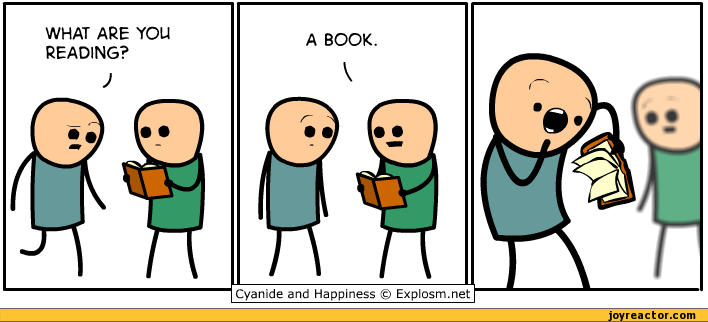
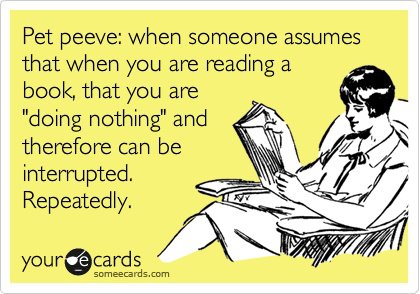
My Top 10 Reading Peeves

comics-Cyanide-and-Happiness-books-626554

1) Canned laughs
Either a joke is funny or it isn’t. Having the author or characters pointing out that someone has just told a joke – he laughed in response to the hilarious joke – is like beating the reader over the head with the complete Get Smart box set. (insert laughs here) Laugh tracks ruin everything.

2) Street directions
I have a map book and Google Maps works pretty well, I don’t need them included in my novel.

3) Prologues
If it doesn’t fit in chapter one it shouldn’t be there. If chapter one isn’t exciting enough then the book has failed to start at the correct spot.

4) Epilogues
I will forgive this if it adds to the story, just as long as it is not just a chapter tying up loose ends. I really don’t care about the hero receiving medals from someone very important. The final chapter should be the end of the story, not a post script of lazy story telling.

5) Purple prose
There are few authors that can get away with flowery language and overly descriptive phrases. I wish authors would stop pretending that they are one of those few authors.

6) That wise old guy character
Why don’t authors just start naming this wise old guy Obi-Wan and be done with it. Sure, there is bound to be a need for a teacher, mentor, or knowledgable character in some stories. But so often the character may as well have been a cardboard cutout, just like Obi-Wan in Star Wars episodes I, II and III.

7) Getting the details wrong
Since when does a Glock have an external safety?* Cordite smell? Racking the slide? Why am I only listing gun mistakes?

8) Including the details
This is similar to the street directions of #2. The excruciating detail that the author has researched is great….. for the author. The reader just wants a story. Accuracy is nice, but overkill is tedious.

9) Using overly common or overly obscure names for characters
Overly common names just blend into the background for me. Overly obscure names might as well be written as @#$%.

10) Having an author name that is very similar to a big name author
I’m looking at you Dale Brown. It really feels like the author has let the marketing department try to rip readers off with the mistaken identity.

See also:
http://kjcharleswriter.wordpress.com/tag/things-i-hate-about-books/
http://101books.net/2013/01/11/9-things-to-do-with-thick-novels-you-hate/

* I actually understand why this one occurs. Often at some stage in editing the types of gun are changed around and ‘Glock’ has become synonymous with ‘gun’. Thus it is quite common for someone to decide that the type of gun originally referenced needs to be changed to a Glock/gun and the details around this aren’t changed to suit.

Reading habits over time…. well, one year

I’ve just come across some interesting research on reading habits by the Pew Research Center. It shows what many readers already knew, that e-books continue to grow in prevalence for readers. But there are also less readers. Although, I will state that comparing 2012 to 2011 and drawing conclusions about people who have read at least one book is always troubling. Might as well be comparing New Year’s weight loss programs prior to February first.

Also: One book? In a year? That isn’t a reader, that’s someone who got an unwanted Xmas present.

Anyway, in 2012 75% of US adults (+16) had read at least one book, down 3% on last year. Print books were generally less popular in 2012 across all age groups not still in school (I guess students get to count class assigned books in a survey), and were read by 67% of US adults, down 5%. E-books were 7% more popular, with 23% of adults having read one in 2012, with all age groups embracing them, especially in the 30-49 age bracket. Audio books were slightly more popular (2%) at 13% in 2012, which would be interesting to relate to the rise of Audible and similar online audio book businesses.

This slideshow requires JavaScript.

I guess now the question is, how do these data compare to avid readers? I’m betting avid readers have a closer split of ebooks to paper books in their reading.

Book Reviews: Velocity by Steve Worland

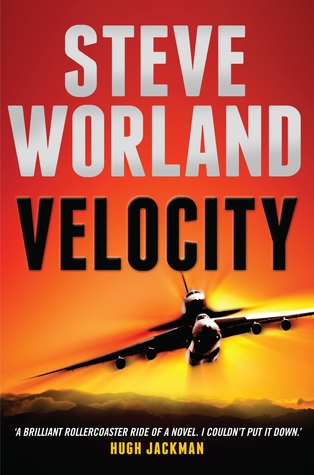
Velocity (Judd Bell & Corey Purchase, #1)Velocity by Steve Worland
My rating: 4 of 5 stars

Whenever there is a new thriller author on the block, especially if they are Australian, there is always someone drawing a comparison to Matthew Reilly. You can just about guarantee that this comparison will be drawn by someone who hasn’t read Matthew Reilly’s books or hasn’t read the new author’s book/s. Finally, there is an author with whom this comparison is valid.

Well worth the read.

View all my reviews

The top 10 books people claim to read but haven’t

tldr

Let’s face it, a large chunk of literature and non-fiction sales are nothing to do with people reading and everything to do with being seen to read. It was no surprise to early e-reader adopters that the romance and erotica genres took off as people on the bus to work could now read the stuff they wanted to without being judged. The Guardian posted this survey of readers (although I can’t find the source) listing off everyone’s favourite reading cred books, you know, the ones you claim to have read but fell asleep at page 2.

A recent survey of 2,000 people suggests that the majority of people pretend to have read classic books in order to appear more intelligent, with more than half of those polled displaying unread books on their shelves and 3% slipping a highbrow cover on books they’d rather not be seen reading in public.

The books most likely to be lied about are, naturally, the books most often filmed, talked about and studied in school (some of the respondents must have been lying since GCSE onwards). Are any of them in your pretend-I’ve-read/never-finished pile, or do you save your literary fibbing for Finnegans Wake and Infinite Jest? Share your guilty secrets below.

1) 1984 by George Orwell (26%) I have actually read this classic. I read it because Animal Farm was one of the only books I had to read in English Lit class that I actually enjoyed (I’m not counting plays, you’re not meant to read plays, you’re meant to see them performed!!!). I enjoyed it, but I can see how people would battle to read this one.

2) War and Peace by Leo Tolstoy (19%) Haven’t read this one and have no intention of trying. People always talk about battling through it in small chunks because it is such an important and blah blah blah book. If it was really important it wouldn’t have been so boring as to necessitate reading it in small chunks.

3) Great Expectations by Charles Dickens (18%) I watched the old black and white film, does that count?

4) The Catcher in the Rye by JD Salinger (15%) I’ve read this many times and hated it every single time. Each time I’ve re-read it I’ve done so because I felt I was too young and/or stupid to get it, so I must re-read it because I’m so much older and smarter now. Although, John Green did manage to convince me of its literary merits via Crash Course Literature, not that I’ll bother revisiting this novel.

5) A Passage to India by EM Forster (12%) I can honestly say I’ve never heard of this book.

6) Lord of the Rings by JRR Tolkien (11%) I’ve read it, but I will admit that I did so only after seeing the first movie. I really enjoyed the book, but it was long and waffly and I can see why others wouldn’t actually finish it. I will also say that I started reading The Hobbit when I was in school and then realised that life was worth living and stopped.

7) To Kill A Mocking Bird by Harper Lee (10%) Okay, I’m guilty of this one. It is on my TBR pile. I have it on Kindle and DTB.

8) Crime and Punishment by Fyodor Dostoevsky (8%) See #2

9) Pride and Prejudice by Jane Austen (8%) I’m going to read the zombie version.

10) Jane Eyre by Charlotte Bronte (5%) If there is a zombie version of this I may read it.

Don’t kill books

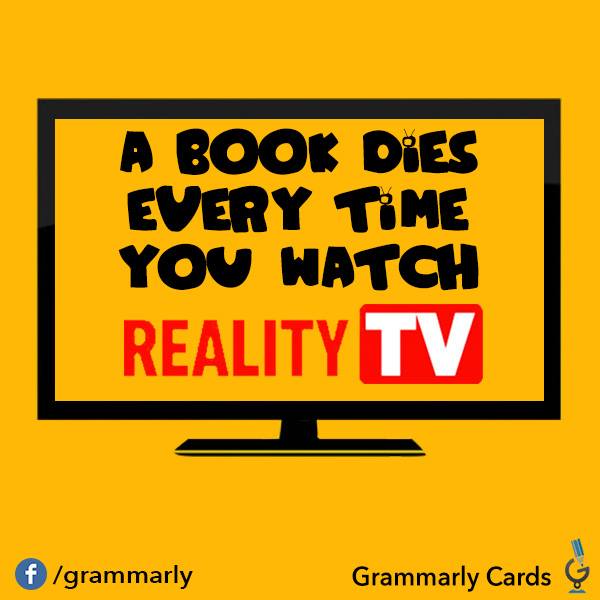
Reality TV


It isn’t just reality TV, it is quite a bit of TV programming that is killing books and, thus, us.

Think about the worst book you’ve ever read. Now remember that, with few exceptions, the movie is always worse than the book. Now think about the best programming on TV being movies and high calibre drama shows. So what I’m insinuating is that the best programs on TV are inferior to just about any book.

For every half-hour wasted watching bad TV, that is 5-10% of a decent novel that you’ll never get to read. Scary, isn’t it!

NB: If people are interested I might write about my favourite TV shows, because not all TV sucks.

Serif and sans-serif fonts

I don’t like to claim a lot of expertise in formatting, layout and graphic design. That isn’t to say I can’t do it, nor that I haven’t produced a couple of my own publications and newsletters. But I found myself in an argument recently defending using both serif and sans-serif fonts, which is like arguing over what colour black you want to wear to a metal concert (that’s a no-brainer: the darker one).

Anyway, there are plenty of anal retentive science nerds like me who have gone and done research into what fonts work best for which applications. There are actually a surprising number of research studies on fonts and readability.

First, let’s define what is meant by serif and sans-serif fonts. (From Scribe Consulting) Consider the following characters. The first is set in Georgia, a lovely serif font. The second is set in Verdana, an easy-to-read sans-serif font.

serif sans-serif
    serif     sans serif

Notice the small decorative flourishes at the ends of the strokes in the left character. These are called serif. The right character does not have these strokes and is said to be a sans-serif font. Sans is the French word for without. So I could be currently sans-pants.

The most common examples of these two font types are Times New Roman (serif) and Arial (sans-serif). Bleeding Cowboys would be an example of an overused serif font that is for try-hards, whilst Comic Sans is an overused sans-serif that shows a lack of taste.

Now there are some simple rules of thumb when it comes to using serif and sans-serif fonts, which are backed up by science. The first rule is that thumbs only hit the space bar once. The second rule is:

Use serif for printed work

Serif fonts are usually easier to read in printed works than sans-serif fonts.

This is because the serif make the individual letters more distinctive and easier for our brains to recognise quickly. Without the serif, the brain has to spend longer identifying the letter because the shape is less distinctive.

The commonly used convention for printed work is to use a serif font for the body of the work. A sans-serif font is often used for headings, table text, captions, and ransom notes.

The third rule is:

Use sans-serif for online work

An important exception must be made for the web. Printed works generally have a resolution of at least 1,000 dots per inch; whereas, computer monitors are typically around 100 dots per inch. Even Apple’s much vaunted retina display is only around 300 dots per inch — much lower than print.

This lower resolution can make small serif characters harder to read than the equivalent sans-serif characters because of their more complex shapes. Yes this does give you an excuse to buy a 4K monitor for your computer. Go nuts.

It follows that small on-screen text is better in a sans-serif font like Verdana or Arial.

Further reading: http://alexpoole.info/blog/which-are-more-legible-serif-or-sans-serif-typefaces/

Cool infographic:

serif-vs-sans-serif

Infographic from here.

Kids these days

wifiWifi

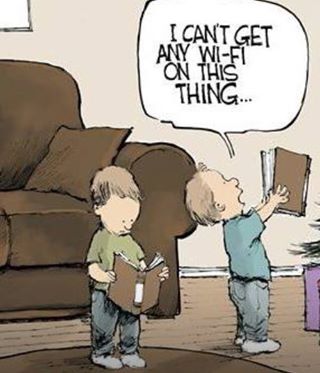
Okay, just to be serious for a moment: Do you see a difference between these two cartoons?

Some of you may have seen the awesomeness displayed on The Oatmeal in response to people stealing his cartoons and taking his authorship off of the picture. Well, here is another example. The second cartoon was the one I was going to post, but I realised that it didn’t have the creator’s signature on it and it would be good to make sure that they were able to be tracked down. Ideally, I’d link to the original, but that isn’t always possible, especially when someone has decided to edit out the part that would help us all identify the author. It is clear that the author isn’t even asking for money, the cartoon is freely published on the web, yet someone has decided to remove the content creator as though they aren’t important.

Free content is great, so many people with great ideas are creating stuff to entertain others just because they enjoy it. I’m going to try and make sure the authors (content creators) are acknowledged when possible, I hope everyone else does too.

Why are books abandoned?

Goodreads survey

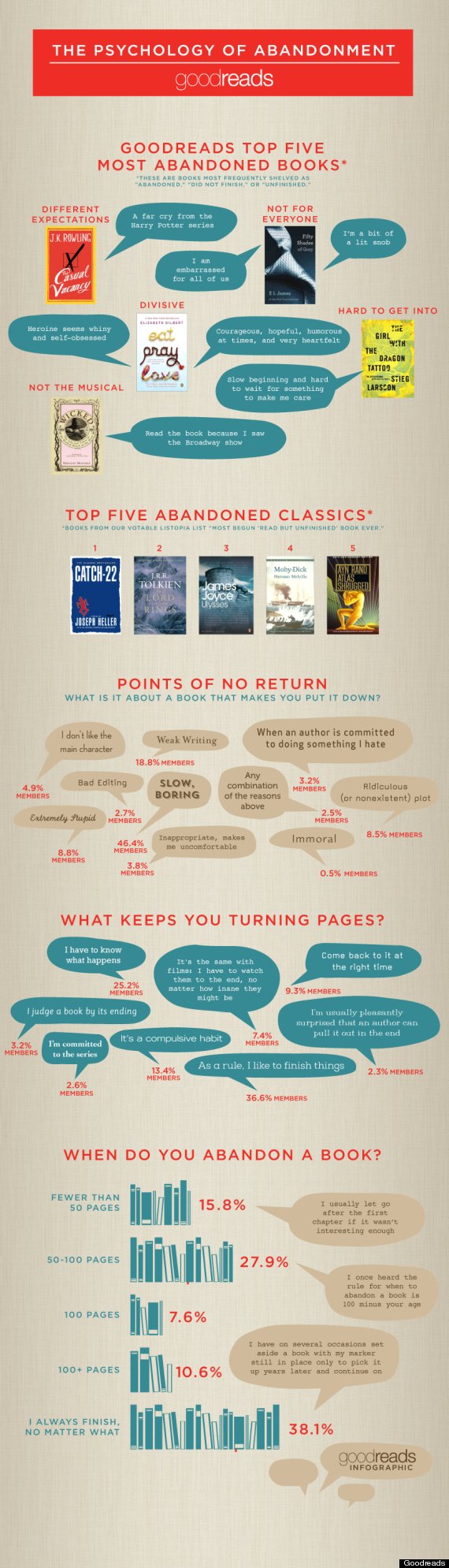
This is a great breakdown of why readers give up on reading and which books are the biggest culprits. I largely agree with most of the sentiments and books listed. It is very interesting to me that “slow and boring” is the #1 reason people abandon a book. Not just #1, it is number two and three as well, as the next reason had less than half the polling. I’ll offer a few comments on each part of the infographic.

Top Five most abandoned:

Casual Vacancy by JK Rowling – This is no surprise really. I’ve heard it is a particularly dark book and the remark that people were expecting it to be more like Harry Potter shows that no-one read the blurb.

Fifty Shades of Grey by EL James – Who’d have thought that Twilight fan-fiction would be poorly written?

Girl With the Dragon Tattoo by Stieg Larsson – When you have a trilogy that could have been edited down to a single book there are bound to be a few readers, like me, who think this ‘thriller’ is slow going.

I haven’t read or heard of anything to do with the other two on the list.

Top Five most abandoned classics:

Catch-22 by Joseph Heller – When people don’t get it then of course they will abandon it. One of the rejection letters for Catch-22 said, “I haven’t the foggiest idea about what the man is trying to say…Apparently the author intends it to be funny – possibly even satire – but it is really not funny on any intellectual level.”

Lord of the Rings by JRR Tolkien – I can see why some people wouldn’t like this book. While I loved it, there are unnecessary characters, events, chapters, scenes, language use… Okay, it’s long and waffly.

Ulysses by James Joyce – At a thousand pages, unless you like an abridged, tiny text, 600 page version, this was never going to be an easy read.

Moby Dick by Herman Melville – I read this when I was in primary school. It made my brain hurt. Very hard to read and spent a long time between the interesting scenes.

Atlas Shrugged by Ayn Rand – Great doorstop, selfish drivel to read.

Reasons for and against abandoning:

It really doesn’t surprise me that the reason most people give up reading a book is that it is boring and slow (46.4%). What does surprise me is that the reason people keep reading a book is not because people are enjoying the book but that they like to finish a book regardless (36.6%). Clearly too many people are reading books that they don’t like. Given the popular books, like the already mentioned Stieg Larsson and EL James, it shouldn’t be surprising. I’ve read instruction manuals with more action than The Girl With the Dragon Tattoo.

I remember working out roughly how many more books I could read in my life. I have averaged reading roughly 100 books per year for the last few years. Now excluding a major accident or the zombie apocalypse, I should be able to continue this average until I die peacefully in my car travelling the wrong way down the freeway at age 90. That means I can only read another 5,500 books in my life! There are more than 8,500 books published every year in Australia, so my chances of reading all the great books I’d like to are slim. We really don’t have time to waste on bad books.

Banned Books: The Huff Post sequel

It seems that the Huffington Post are stealing my article ideas. Only three days after my article lamenting censorship of books, they do an article on the 2013 Banned Books campaign (September 22-28th).

Now I’m not bitter, in fact, I’m currently covered in orange sherbet. So this follow-up article is to add my support to the Banned Books Campaign and talk about the most frequently challenged books of last year. The annual report of the American Library Association had a lot of interesting findings. They are still having problems with publishers allowing them to loan ebooks (sigh – I bet the same arguments were made when libraries first started lending books), the people using libraries still think that they offer a very important service, they have become technology and research hubs for people, but visit rates have dropped a bit. The really interesting thing for me – because I’m not American, let alone a member of an American library, so all of those points are belly lint to me – was the top ten list of challenged books for 2012.

Here is the Office of Intellectual Freedom’s Top Ten List of Frequently Challenged Books in 2012:

■ Captain Underpants (series), by Dav Pilkey (offensive language, unsuited for age group) TA: Exactly what were parents expecting from a book with this title?

■ The Absolutely True Diary of a Part-Time Indian, by Sherman Alexie (offensive language, racism, sexually explicit, unsuited for age group) TA: Oh noes, a young adult book that doesn’t treat the readers like kids!!

■ Thirteen Reasons Why, by Jay Asher (drugs/alcohol/smoking, sexually explicit, suicide, unsuited for age group) TA: Another young adult book that deals with real issues, can’t have that!

■ Fifty Shades of Grey, by E. L. James (offensive language, sexually explicit) TA: An erotica book that is sexually explicit….. Words to describe the stupid, fail me.

■ And Tango Makes Three, by Justin Richardson and Peter Parnell (homosexuality, unsuited for age group) TA: Based on real penguins, must be evil!!

■ The Kite Runner, by Khaled Hosseini (homosexuality, offensive language, religious viewpoint, sexually explicit) TA: Be warned, the characters aren’t white or Christian!!

■ Looking for Alaska, by John Green (offensive language, sexually explicit, unsuited for age group) TA: Written by John Green, so clearly the complainants were too stupid to enjoy the book.

■ Scary Stories(series), by Alvin Schwartz (unsuited for age group, violence) TA: The title clearly didn’t give the game away for some sensitive little souls.

■ The Glass Castle, by Jeannette Walls (offensive language, sexually explicit) TA: Real life is clearly too confronting for some readers.

■ Beloved, by Toni Morrison (sexually explicit, religious viewpoint, violence) TA: Someone clearly thinks that slavery is a lot more fun than the author portrayed it.

The thing I find striking about this top ten list is that the books are all multiple award winners (except that crud by EL James, which makes up for lack of awards with sales to keep a publishing house afloat). As such, I’d hazard a guess that most of the complaints are coming from people who haven’t read the book, nor let their little darlings near a book. We can only hope that next year people are too busy reading good books to complain about them.

Banning books

306052_582022981816696_1299899960_n

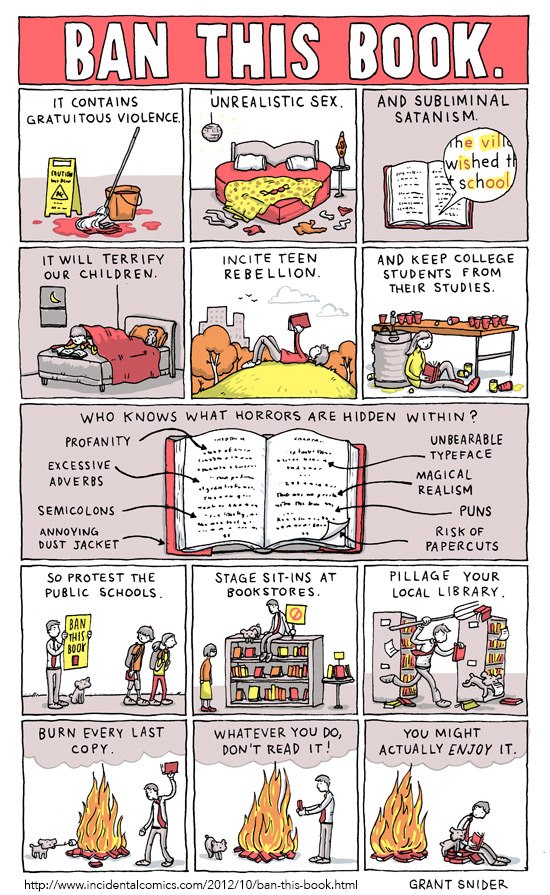
I’m against censorship. Unfortunately many are in favour of censoring books. You may have heard of the outcry over the decision to edit Mark Twain’s classic, Huckleberry Finn, to stop calling the main supporting character, N-word Jim. What you may not have heard is that schools had stopped teaching Huckleberry Finn because they didn’t want to have to explain the historical and racial undertones and themes of the book. We can’t have a literary book actually studied now, can we! Definitely don’t want to look at Twain’s biting commentary on racism in the south of America, because that would mean discussing racism, and we like to pretend it isn’t still an issue.

It isn’t just the school curricula that are being impacted, it is libraries and book stores as well. The list of frequently challenged books is far too long and the reasons cited are far too ridiculous. For example, Brave New World by Aldous Huxley is regularly objected to for being: insensitivity; nudity; racism; religious viewpoint; sexually explicit. Seriously? What about the other complaints?

I’m offended by the word ‘sustainable’ as it is ambiguous term that is used politically as a catch-cry to gloss over reality. Does that mean I can complain about books containing that word? And what is sexually explicit? Is it when two characters embrace for a passionate kiss, or when the ball-gag and whips make an appearance? Are parents really concerned about the level of “smut” in the books their kids read or are they trying to have books banned because readers might enjoy them?

I know I have a complaint about the Twilight books. Now, my reasons aren’t like the other complaints (Reasons: religious viewpoint and violence), I just don’t like them because I’ve been dragged to see four terrible films by my wife. Ban the Twilight books so that husbands and boyfriends everywhere aren’t tortured with Kirsten Stewart’s “acting.”