Book review: Curing Affluenza by Richard Denniss

Curing Affluenza: How to buy less stuff and save the worldCuring Affluenza: How to buy less stuff and save the world by Richard Denniss

My rating: 4 of 5 stars

“Advertising has us chasing cars and clothes, working jobs we hate so we can buy shit we don’t need.”*

Richard Denniss’ Curing Affluenza seeks to define the problems our current consumerist society has and how to address it. He posits that we need to abandon consumerism and opt instead for materialism if we have any chance of changing the shape of our economy, which will, in turn, allow us to address issues like climate change and environmental degradation.

For many years now I’ve been a fan of Richard and The Australia Institute’s work. He and they manage to talk economics without making it feel like you’ve been hit with a brick made of buzzwords.** As such, this book has been on my TBR pile since its release. It has not disappointed.

Richard makes his arguments simply and clearly, in a way that make sense. Even if you disagree with him politically, you would have to agree with his points about economics and politics being about choosing a shape for the economy – the shape being what we choose to spend money on and value. You may argue that we need more spending on tanks and less on healthcare, which has a different shape than an economy where I want fewer tanks and more healthcare. This also applies to our purchases; so if I’m buying tickets to see bands play live rather than upgrading my phone every 6 months, the economy changes shape.

On the Affluenza front, Richard suggests 7 principles for tackling it:
1) First, do no harm.
Think of this as consumer boycotts and active decisions about consumer/lifestyle choices.

2) Some change is better than no change.
Baby steps. It isn’t possible to stick 100% to #1, and larger changes may take longer.

3) It’s not about sacrifice and denial; it’s about saving money and having a better life.
We’re trying to change the shape of the economy, not become monks.

4) Services are good for you.
New status symbol phone or see a live music act? Stuff doesn’t make you happy but experiences do, and they help change the economy’s shape.

5) When you are full, stop consuming.
Because there is such a thing as too many books… Wait, what?

6) Get yourself and your country into better shape.
Our saving and spending, especially when organised with others, can reshape the economy.

7) Flatter is fairer.
Equality of resources and opportunity for all. I.e. redistribution.

Whilst this was a very good book, I did have two problems with it. The first issue was that the middle chapters labour the point, so much so that it felt like needless padding. This was frustrating because as someone who has read various articles and essays from Richard before, I know he can be very concise. It also didn’t help that I was already familiar with what he was trying to argue and the examples used. Though, this may be from that familiarity, so others may appreciate these chapters more.

The second issue was that Richard was largely dismissive of options that didn’t involve capitalism. There was a big assumption that we still need/want capitalism and thus should be reforming/tinkering with it. This assumption was never examined nor justified adequately. It would have been nice to see some discussion addressing those other options, especially in a pros and cons manner.***

A very interesting read and one that ties into several other books I have read recently.
Utopia for Realists
Austerity: History of a bad idea
Winners Take All

* Quote is obviously from Fight Club and not this book. I’m almost certain that Richard is not advocating young men beat each other up and try to destroy capitalism.
** Richard appropriately calls the indecipherable economics talk Econobabble.

*** Richard responded to this point on Twitter. He felt it was outside of the scope of the book and would have muddied the message. I think that is a fair point.

View all my reviews

Book review: Manufacturing Consent by Noam Chomsky and Edward Herman

Manufacturing Consent: The Political Economy of the Mass MediaManufacturing Consent: The Political Economy of the Mass Media by Noam Chomsky

My rating: 4 of 5 stars

Don’t believe everything you see in the news… but which bits?

There is a narrative we hold to be true: that the news media are trying to inform us of the facts; that they search high and low for the truth; that they are honest and hardworking; and that they hold truth to power. Manufacturing Consent presents the argument that they often don’t do that at all but instead operate under the Propaganda Model of media.

Almost a decade ago, I attended a panel session about news journalism that billed itself as to how award-winning journalists hunted down and exposed the truth. I walked out about half-way through from disgust. You see, these award-winning journalists had been patting themselves on the back for having done what I regard as the bare minimum of fact-checking on a story and had managed to discover something. These were the people we relied upon for our information.

While that wasn’t the first time (nor the last) that I’d run up against the failings of the media, it was the moment that has come to summarise my view of the media. I think that is why Chomsky and Herman’s thesis in the book feels familiar.* The way media act to perpetuate the status quo and the interests of power and influence is well articulated if unsurprising.

There were a few issues I had with Manufacturing Consent. The first was that the introductory chapters, including the preface written in the early 2000s, and the final chapter were excellent, but the middle case study chapters erred on the side of exhaustively labouring the point. I mean, the history of various conflicts was fascinating, but not exactly what I signed up for when I started reading.

The second issue I had was that this book feels somewhat out-of-date. The examples were from a previous generation of media. While it appears that much of the propaganda model still holds, you have to question if it isn’t far more nuanced now. Media ownership has become even more consolidated, the diversified online media landscape has made attention seeking and funded agenda pushing the norm, partisanship is leveraged for audience retention, media owners and management are more overtly pushing agendas, and lobbyists and other bad faith actors exist in all aspects of public discourse driving narratives. Power is Feeding the Chooks** now more than ever. It feels like the propaganda model and the 5 filters are still highly relevant but in need of an update to capture the new realities.

Another issue was one that was briefly touched upon in the final chapter. The propaganda model tends to assume a level of competence and diligence to journalism and the media. I often use Hanlon’s Razor: Never attribute to malice that which is adequately explained by stupidity. A lot of the reporting being attributed to a propaganda model may actually fall under the lazy, incompetent, and uninterested model instead. Although, that could be seen as part of the 5 filters of media selection – or to paraphrase Chomsky: if they were actually good at journalism they wouldn’t be working there.

My final issue was around solutions: what are they? There aren’t any solutions posed, both from the point of view of a media consumer trying to be well informed and from the point of view of a society wanting a reliable media. Some ideas are alluded to, such as the reports from independent groups covering an issue (e.g. Amnesty and America Watch were mentioned), which also requires an active audience who seek out information (i.e. lateral reading and fact-checking). But I feel as though this was an important set of recommendations to explicitly state.

A very interesting and insightful book that is well worth a read. Be warned that the case studies are more of a history lesson than you’d probably be expecting.

The 5 Filters of the Mass Media Machine

* Although, it may feel familiar because this text has been in the “mainstream” for decades, so much of it will have found its way to me without having read it directly.

** For the non-Aussies, Feeding the Chooks was a term for Press Conferences from one of Australia’s most corrupt politicians. Sir Joh would wait until journalists were desperate for information and then feed them timed propaganda that they wouldn’t question due to deadlines – hence, feeding the chooks. He was an authoritarian who rigged elections (sorry, gerrymandered…), essentially ran a police state, held the press in disdain, was generally racist and homophobic (although, kinda standard for an Aussie conservative from Queensland), and marginalised workers and unions.

Update: I’ve learned that Matt Taibbi wrote a book called Hate Inc. that was originally intended to be a modernising of Manufacturing Consent with Chomsky’s approval. It changed a bit, but addresses some of the issues I raised above.

Framing a viewpoint
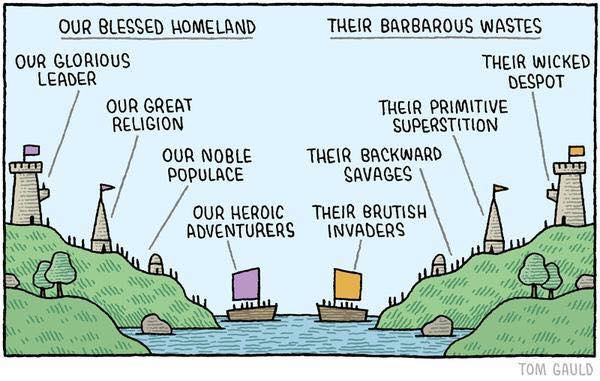
Media descriptions summarised by Tom Gauld.

View all my reviews

Book review: Utopia for Realists by Rutger Bregman

Utopia for Realists: And How We Can Get ThereUtopia for Realists: And How We Can Get There by Rutger Bregman

My rating: 5 of 5 stars

“You can’t pull yourself up by your bootstraps if you have no boots.”

Rutger Bregman’s Utopia for Realists starts with a simple premise: since we are already living in the utopia imagined by previous generations, what’s the utopia we’re aiming for now? We need big ideas to strive toward in order to keep progressing forward.

I have been meaning to read Utopia for Realists for several years now. Prior to the book’s publication, I read the sections Bregman had made available from two of his chapters on Medium. Those were my first introduction to the concept of a Universal Basic Income and how there was some fairly compelling, if limited, evidence for just giving people money to fix just about every problem. Poverty, it seems, isn’t a moral failing or a lack of work ethic, it’s a lack of cash. Since then I have watched several of his interviews and discussions (yes, including the Davos inequality panel) and still managed to gain more insights from his book.

It seems odd to note that we’ve stopped thinking about our future utopia. Outside of Star Trek*, most of our future visions are of dystopias which warn us of our mistakes, but also underline what happens when we stop thinking of a utopia to strive for. We can only see the negative futures, not the potentially great futures.

Bregman spends a lot of Utopia for Realists outlining several of our current societal problems and then introduces some of the evidence for his utopian vision of a Universal Basic Income, lower inequality, and a shorter working week as solutions. These are not new ideas – Mill, Russell, and Keynes have all written on these topics – but they are the utopia that Bregman thinks we need to be aiming for. In outlining the evidence in favour of this vision, he also shows how close we have come on several occasions to implementing some of these reforms and how easy it is for naysayers to win the day.

Utopia for Realists is very well written**, is easy to read, and not particularly long. The only reason I didn’t finish this quickly was that I kept tracking down the extensive references and surrounding literature for further reading. My own fault for being a giant nerd. One of my favourite references was this one on the value created by various professions, which suggests that we are rewarding some who are actively bad for the economy, whilst under-paying those who are good for the economy.

This book is highly recommended reading.

See also: https://tysonadams.com/2019/04/05/book-review-austerity-the-history-of-a-dangerous-idea-by-mark-blyth/
https://tysonadams.com/2019/03/19/book-review-winners-take-all-by-anand-giridharadas/

* Although, how much of a utopia is Star Trek, what with the wars, the planet of hats, and Borg collectives? Discussed further here.
** Not sure whether to credit this to Bregman or his translator – Elizabeth Manton.

View all my reviews

Book review: A Dirty Job by Christopher Moore

A Dirty Job (Grim Reaper, #1)A Dirty Job by Christopher Moore

My rating: 3 of 5 stars

Tedious job, flexible hours, remuneration package includes invisibility powers, some harassment involved, and if quotas not met world will end in darkness.

Charlie Asher’s world is turned upside down the day he becomes a father. His wife dies, he becomes a grim reaper, his daughter can kill by pointing at things, and he may never get laid again. His new job is confusing – the JDF is in the mail – the forces of darkness are calling to him from the sewers and people are starting to suspect he’s a serial killer. At least the pay is good.

Over the last month, I’ve tried to read several humorous novels, and have only managed to complete two of them. The two I have finished – A Dirty Job and Redshirts – have had similar pros and cons. Both have had a strong premise, were mostly well executed and were reasonably entertaining. But neither were as funny as they thought they were.

Moore’s absurdist writing style is a strength to this novel. But I couldn’t help but feel he didn’t capitalise on that with more humour. And some of the humour that he does inject… Let’s just say that cringy white guy jive-talking or ethnic caricatures probably don’t amuse me as much as they used to.*

I think it was because of this only mildly amusing level of humour that I started nitpicking aspects of the story. The continuous references to ‘beta males’ became tiresome as, aside from being scientifically debunked, it made the author sound like he was posting on Reddit subforums. Another was the use of weapons against the forces of darkness.** Whilst the humour of this was done well, it did trivialise the threat at several points.

So, much like I said in my review of Redshirts, I think A Dirty Job wasted its potential as a comedic novel and was only okay.***

* I’m going to pretend it wasn’t deliberately racist.
** Also, since when does an American not have access to an arsenal of firearms? One handgun? One?
*** I feel as though I’m being a bit too harsh/critical of humorous novels of late. Maybe all the Terry Pratchett I’ve been reading has spoiled regular books for me.

View all my reviews

Book review: The Boys by Garth Ennis

The Boys Omnibus, Volume One (The Boys Omnibus, #1)The Boys Omnibus, Volume One by Garth Ennis

My rating: 4 of 5 stars

The words you don’t want to hear from someone with superpowers: Because I can.

The Boys series by Garth Ennis shows us a world where superheroes are a marketing gimmick for a military-industrial company – Vought America – and these all-powerful beings – such as The Homelander – have to be kept from overindulging in hedonism, vice, and collateral damage. But there is more at stake, as Vought scheme and The Homelander plots.

It was interesting to revisit this series 7 years later as the TV series is set to commence. I remember enjoying the series for its interesting take on superheroes. Much like Irredeemable and Incorruptible, The Boys tries to imagine a more realistic scenario for how people with superpowers would behave. This gives Ennis a chance to pour in his trademark nudity, sex, violence, and toilet humour.

But underneath that facade is a much more interesting story. The Boys team are comprised of trauma victims who (mostly) have interesting story arcs. The superheroes are portrayed in a way that feels much truer to life; especially if you take them as a stand-in for actors, models, rich socialites or the like and the shady stuff we know they get up to. The political and business machinations throughout stands as a cautionary tale. And the series is pretty much one big swipe at the military-industrial complex.

I think I appreciated the depth of this series more on the second read. The Boys is worth reading, especially if you’ve seen other Ennis comics and ever wondered what he really thinks of superheroes.

A quick comment on the TV show: I’m hoping the series is good. From the trailer, it appears they’ll be doing some things a bit differently to the comics, notably The Homelander’s personality and the more prominent corporate criticism. Karl Urban, Antony Starr*, and Elizabeth Shue are great actors, so just their presence should make it worthwhile.

* Antony was the lead in the criminally underappreciated Banshee. If you haven’t watched that series, do so.

View all my reviews

Book Review: The Society of the Spectacle by Guy Debord

The Society of the SpectacleThe Society of the Spectacle by Guy Debord

My rating: 3 of 5 stars

“Quotations are useful in periods of ignorance or obscurantist beliefs.”

The Society of the Spectacle is an aphoristic set of polemic essays that examines the “Spectacle,” Debord’s term for the everyday manifestation of capitalist-driven phenomena; advertising, television, film, and celebrity. He argues that we have become alienated from ourselves and reality in order to have us serve the economy/capitalism with the production of commodities and accumulation of wealth.

I first encountered the idea of the Spectacle from Peter Coffin (see below) and his video essays related to what he terms Cultivated Identity. This is a fascinating idea and particularly relevant today in the age of mass media, late-stage capitalism, and the commodified zeitgeist. Look at how much of our society is obsessed with or based upon edifying upward mobility, celebrity, fame, reputation, and positions of power or prestige.

This ultimately means that our media has become the thing that tells us how to think and it is essentially inescapable within our modern society. Thus, the limits of our conversations and thinking have already been defined, which then becomes a feedback loop for the media we consume. Click “Like” if you already agree.

The only drawback of this work was that it is obscurus and jingoistic. Aphorisms might be cool for ancient philosophers, but they don’t make for great enlightenment nor clear communication of ideas. I’ve actually gained more from reading and watching related overviews of The Society of the Spectacle than from Debord’s actual work.

Wikipedia
Illustrated Guide to Debord’s The Society of the Spectacle
Super Summaries

Peter Coffin’s video essays on the Spectacle:

Discussion of the Spectacle by a philosopher:

And her blog post on it: https://dweeb.blog/2018/12/21/the-society-of-the-spectacle/

Another explainer on the Spectacle:

An audiobook in Spectacle form:

A detailed review:

View all my reviews

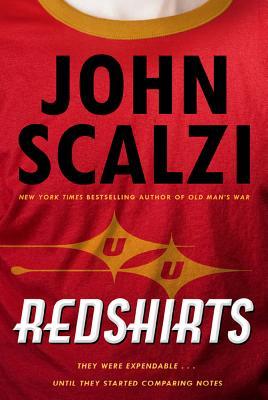
Book Review: Redshirts by John Scalzi

RedshirtsRedshirts by John Scalzi

My rating: 3 of 5 stars

Sometimes you can create characters that are a little bit too realistic.

Ensign Andrew Dahl has just been assigned to the Intrepid as a xenobiologist. But from his first day onboard he notices that something is wrong with the rest of the crew. He and his fellow new recruits quickly realise that people on away missions have a nasty habit of dying. Except for a select handful of important crew members that is. They also notice that reality doesn’t make much sense at times when The Narrative takes over. Can Dahl and his friends figure it out before an away mission kills them too?

After reading the first chapter of Redshirts I had to consult with the interwebz to answer a question about this book: Is it worth reading the whole thing? Aside from one notable review that captured several of my concerns, the vast majority of my fellow readers loved Scalzi and this book. So I decided to persist and found myself at the end of Redshirts with the same reservations as I had at the end of the first chapter.

Firstly, this book was good enough to keep me reading. Redshirts has a very strong premise and the story is mostly well executed. The main story – more on the codas in a minute – steams along and is pretty entertaining. It won a Hugo, so clearly it has a lot to offer.

Now, let’s get to the buts.

For what is clearly a comedic novel, Redshirts is nowhere near as funny as it thinks it is. He said. He said. It has a cast of characters that are meant to be shallow and interchangeable, but they are so interchangeable that you wouldn’t know who was talking if you weren’t constantly reminded. He said. He said. The premise may be very strong, but I felt it wasn’t fully realised, which left me frustrated. And then the three codas arrived and shifted away from the previous 25 chapters’ lighthearted tone. All three, but especially 2 and 3, had a much more serious tone and felt like they belonged in a different novel.

So while I mostly enjoyed reading Redshirts, I feel it wasted its premise and wasn’t as well-executed as I’d have liked.

NB: My wife said I had to tell everyone that I’ve spent all day complaining about the ending to Redshirts. She feels it would be disingenuous of me not to mention that and to also give you an idea of how much she is looking forward to me reading something else.

View all my reviews

Book Review: Socialism A Very Short Introduction by Michael Newman

Socialism: A Very Short IntroductionSocialism: A Very Short Introduction by Michael Newman

My rating: 4 of 5 stars

How will we have anyone to look down upon if we all work together to make a better and fairer society?

The “A Very Short Introduction” series explores the topic of Socialism promising exactly what the title suggests. Michael Newman seeks to give an overview of socialism; the good, the bad, the misunderstood, and the misrepresented.

In my continued effort to dig into a few of the current bogeymen of cultural discourse, I went looking for an introductory text on socialism that wouldn’t shy away from the flaws but would also be more honest than most detractors. I think Newman succeeds in this respect. Many discussions of socialism treat it as a monolith – which they ironically still manage to misrepresent – which Newman is able to dispell by discussing some of the many iterations. Socialism also tends to have many ills landed at its door without adequate context – e.g. Stalin’s totalitarianism and Lysenkoism are all treated as completely socialism’s fault whilst under other policial regimes we divorce or distance those issues (people starving under capitalism isn’t capitalisms fault… apparently). Newman discusses examples like Cuba and Sweden with enough context to show how internal and external forces impacted what we regard as socialism.

This was a handy overview of socialism and certainly one that people should be encouraged to read before espousing views on the subject.

View all my reviews

Book Review: Incorruptible by Mark Waid

Incorruptible Digital OmnibusIncorruptible Digital Omnibus by Mark Waid

My rating: 3 of 5 stars

Lifetime villains just don’t know the recipe for being good.

Max Damage was at ground zero the day the Plutonian went berserk. But Max knew it was coming, he’s known the Plutonian’s secret since the day he was sent down the path of criminality. Now with his own superpowers, he realises that if the world’s greatest hero has switched sides, he has to become a hero. It was never going to be that simple though.

Incorruptible is the companion series to Mark Waid’s fantastic Irredeemable. When I originally read both series in 2011-12, I thought they were both very comparable, but that I enjoyed Max’s story more. Now upon re-reading, I’ve switched sides.

The story for Incorruptible deals with more of the consequences to the world after Superman/Plutonian turns villain. The redemption of such a despicable and immoral character is much more interesting than good guy turns bad. But where Irredeemable looks at the repercussions on multiple characters, Incorruptible mostly focuses on Max. This would be fine if Max was actually the protagonist. Unfortunately, Max is merely along for the ride, with major plot points and decisions taken away from him by the events in Irredeemable.

So if you are going to read Incorruptible, do so at the same time as Irredeemable.

View all my reviews

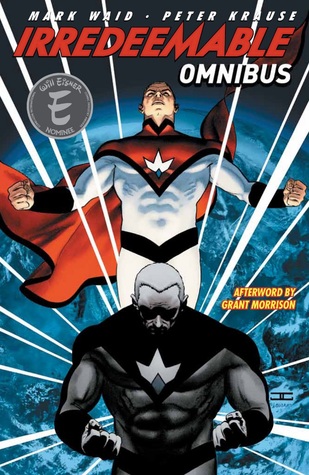
Book review: Irredeemable Volume 1 & 2 by Mark Waid

Irredeemable Digital Omnibus, Volume 1Irredeemable Digital Omnibus, Volume 1 & 2 by Mark Waid

My rating: 4 of 5 stars

“Why does everyone treat me like I’m a bomb about to go off?” He shouts unironically.

Irredeemable asks the question: What if Superman became evil? We watch the fall of the world’s greatest superhero, the Plutonian, how his friends and fellow superheroes attempt to find a way to stop his rampage while dealing with their own problems of betrayal and hopelessness. And being a superhero comic, there are alternate dimensions, aliens, supervillains, myths become real, and the spirit realm for good measure.

I originally read this and the companion series Incorruptible in 2011-12, toward the end of their run. It was also one of the first comic series I bought in e-format. Originally, I found this take on superheroes to be far more interesting and rewarding than the sort of stories we usually see. The old Spiderman quote, “With great power comes great responsibility”* butts heads with “Absolute power corrupts absolutely” in this story to great effect.

Whenever I think of superheroes, I always think of this series.** Re-reading the series in one sitting made me appreciate more of the story. During my first read through, I thought segments of the series in the run-up to the final arc got bogged down in their own intricacy and lack of relevance to the main story. But this time, I appreciate their inclusion more, even if it did slow the pacing a bit.

If you like superhero stories, then this will probably be a refreshing shot in the arm.

* Although, this quote predates Spiderman by a couple of hundred years.

** And Garth Ennis’ The Boys. I guess standard superhero stories just don’t interest me the same way.

View all my reviews

Book review: Austerity – The History of a Dangerous Idea by Mark Blyth

Austerity: The History of a Dangerous IdeaAusterity: The History of a Dangerous Idea by Mark Blyth

My rating: 4 of 5 stars

You have to live within your means unless you are a bank, then you get someone else to pick up the tab.

Austerity: The History of a Dangerous Idea is pretty much as the title implies. Mark Blyth lays out the history of austerity economics, the arguments for its use, and then counters those arguments. Job done: let’s have cake.

In general, the deployment of austerity as economic policy has been as effective in bringing us peace, prosperity, and crucially, a sustained reduction of debt, as the Mongol Golden Horde was in furthering the development of Olympic dressage.

I first became aware of Mark Blyth as one of a handful of experts who were explaining the European sovereign debt crisis and why countries like Greece were mad at the austerity measures. He and others were the only ones who managed to accurately cut through the econobabble and victim-blaming. Before then, various people involved in causing the Global Financial Crisis seemed intent on pointing fingers at out-of-control government spending, or nation-states who were riddled with debt and no major industry. This was, of course, a distraction.

As an Aussie, I clearly remember during the Global Financial Crisis our treasurer dusting off his copy of Keynes and stopping us from being on the list of victims of the banks. As much as I quibble with some of the details of that economic stimulus, it worked. So it has puzzled me why so many financial experts seem to want to beat the economy to death in order to save it.

This book offered the explanation. It was eye-opening and expanded upon tackling the concept of austerity for sovereign nations who were forcibly saddled with the debt of multinational banks. For such a highly supported and enacted policy you would have thought there would be some very solid economics underpinning it… Yeah, not so much. As Mark outlines, pretty much every case of its use is purely ideologically driven and has rarely worked. In fact, quite often it has been a disaster.

Well worth a read. Or you could just watch a 5-minute version of the book:

Or a 1-hour version:

View all my reviews

Book review: How Fascism Works by Jason Stanley

How Fascism Works: The Politics of Us and ThemHow Fascism Works: The Politics of Us and Them by Jason Stanley

My rating: 4 of 5 stars

Fascism: coming to a country near you!

Jason Stanley’s How Fascism Works is an overview of the ten distinct strategies employed by fascists in their thirst for power. Stanley’s family escaped Nazi Germany, so this is clearly a topic he has a personal affinity with.

Each chapter covers one of the strategies:
1. The Mythic Past – the time when things were as they should be for the chosen ones.
2. Propaganda – have to sell the abhorrent.
3. Anti-Intellectualism – can’t have those pesky thinkers pointing out you’re wrong.
4. Unreality – replace reason with fear and anger.
5. Hierarchy – democracy and equality have no place in fascism.
6. Victimhood – that out-group are trying to destroy us!
7. Law and Order – utilise framing to make the out-group look unlawful then actualise that.
8. Sexual Anxiety – this is related to the hierarchy and how women and LGBTQI people undermine this.
9. (Soddom and Gomorrah) Appeals to the Heartland – this is related to the mythic past, hierarchy, and lionising the base of support.
10. (Arbeit Macht Frei) Work Shall Make You Free – dismantling of public welfare and unity as part of attacking the out-group and seizing power.

Have (or create) a major social and/or economic upheaval that allows for inequality to have created a disgruntled and disenfranchised group. Take those in the group who believe in hierarchies, combine with a leader/movement (demagogue) who promises to create the hierarchy that puts that group where they feel they should be, create an out-group to demonise, gaslight and utilise revisionism for a mythic ideal past, and make sure no one challenges your power.*

There were two things that disappointed me about this book. The first was that there was a decidedly American-centric feel despite the inclusion of examples from Europe and Africa. Whilst I understand that Stanley is an American Yale Professor with his eye on the rise of fascism in the USA under Trump, he only makes passing mention of this rise occurring elsewhere. Considering the causes of the current rise are global in nature, I’d have liked to have seen a more global view.

The second point is related to the first. Stanley does a terrific job of identifying and explaining fascism but he doesn’t go into much depth. I suddenly found myself at the end of the book when I was expecting a bit more, like the above mentioned global view.

These are minor points, however, and overall this is a very good introduction to understanding fascism. Sadly, it is a topical book.

Also see my review of Antifa, my review of a book on how we got here in Winners Take All, and and my post on BlacKkKlansman.

* Then watch it all fall to pieces because fascism tends to destroy itself, but only after doing massive amounts of damage.

View all my reviews

Book review: In Praise of Idleness by Bertrand Russell

In Praise of IdlenessIn Praise of Idleness by Bertrand Russell

My rating: 4 of 5 stars

“Work expands so as to fill the time available for its completion.”*

In Praise of Idleness is an essay written in between the two world wars and expands upon one of the points made in his Political Ideals essay. Once again, Russell manages to argue a challenging concept in an erudite and concise manner. Even if you disagree with him on the idea of work being overrated, there is value in engaging with what he is saying.

On inequality:
“Modern methods of production have given us the possibility of ease and security for all; we have chosen, instead, to have overwork for some and starvation for others.”
Variations of this statement are still being made today around inequality. They tend to use far more words.

On wasted efforts:
“Modern technique has made it possible to diminish enormously the amount of labour required to secure the necessities of life for everyone. This was made obvious during the war.** At that time all the men in the armed forces, and all the men and women engaged in the production of munitions, all the men and women engaged in spying, war propaganda, or government offices connected with the war, were withdrawn from productive occupations.”
I mean, could you be any more scathing of warmongering?

While I think he does make his argument well, there are some points that are taken as a given. The example of the wasted effort of war in the quote above is one of those. There is a valid point made about how society managed to function despite being asked to drop everything and fight a war, but the point about war being a waste of time and that standards of living were still okay just has to be taken as a given.

Worth a read, even if you disagree with Russell on some or all points.

* Parkinson’s Law, coined in 1955.
** WW1
View all my reviews

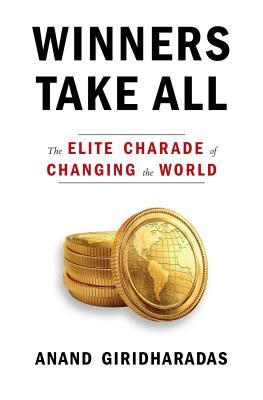
Book review: Winners Take All by Anand Giridharadas

Winners Take All: The Elite Charade of Changing the WorldWinners Take All: The Elite Charade of Changing the World by Anand Giridharadas

My rating: 5 of 5 stars

The first rule of MarketWorld is you do not criticise MarketWorld.

Winners Take All is a critique of the modern market-driven and capitalistic thinking that dominates the social and political landscape. Giridharadas focuses upon philanthropy in particular, as the more moralistic and benign problem of MarketWorld that is often used to whitewash the more obviously bad actions of those solely interested in the accumulation of wealth and power to the detriment of others.

This was a very interesting read and particularly insightful.* Throughout the book, Giridharadas is able to show us how MarketWorld created itself and now perpetuates and grows itself. And it doesn’t back away from being critical of people who think of themselves as doing good (and in a sense are) and of the system that allows this to happen.

Two topics in the book particularly resonated with me. The first was the idea of the immoral or amoral approach that is used to making money, which is then used for philanthropy later. This money is often made by exploiting people and the commons ruthlessly, and then is whitewashed of guilt by “giving back”, rather than, you know, not exploiting people/commons in the first place and thus negating the need for giving. I’ve previously come across this idea from a few philosophers and people like Alain de Botton who have discussed this on moral grounds.

The second topic was that of the Thought Leader. I’ve long been troubled by the happy-clappy approach to ideas and intellectual thinking we see in popular culture. Whether it be TED talks or deceptive pop-science authors like Malcolm Gladwell, there is a tendency in this field to be anti-intellectual or present a facile understanding of an issue/topic. So I especially enjoyed seeing the Thought Leader taken down a peg or two and the winning formula exposed.

Thought Leader 3-Step:
1) Focus on the victim, not the perpetrator.
In this way, you can avoid dealing with larger systemic issues and instead make smaller changes that have more direct and emotional appeal. Think, telling women to not dress too sexily so they won’t get raped** instead of addressing the issue of rape and rapists.

2) Personalise the political.
Or to put it another way, don’t be a critic pointing out systemic and collective issues, but instead make it about personal and individual dramas.

3) Be constructively actionable.
This is about having some nice and easy steps that people can do to make a difference. Remember to keep it at a personal level!***

This book wasn’t without fault. I’m not a particular fan of the narrative/literary journalism style employed. You commonly see this style in the pretentious long-form essays and “important” journalistic pieces. What it tends to do is obscure hard facts in the narrative and steer away from addressing points fully. This might make for a more “human” piece of writing that many would call more engaging and interesting, but it weakens just about any point and argument made.

I highly recommend this book.

Thanking our sponsors:

*The reason for the insightfulness is obvious if you are familiar with Giridharadas or read the Acknowledgements section. This is his playground. He is the son of a director of the McKinsey Institute consulting firm (they come in for a lot of flak in the book), worked there himself, he’s a Harvard alum, has given TED Talks (thought leader), and was a Henry Crown fellow of the Aspen Institute.

**And ironically, this is a great example of why this sort of focus just doesn’t work. It is a myth that clothing has anything to do with rape, but addressing rape and rapists would require a systemic change that makes many uncomfortable.

***This is why we see IPCC and other climate change reports making recommendations like installing solar panels, installing led lighting, and buying an electric car, rather than demanding a move away from fossil fuel usage at a society level.

View all my reviews

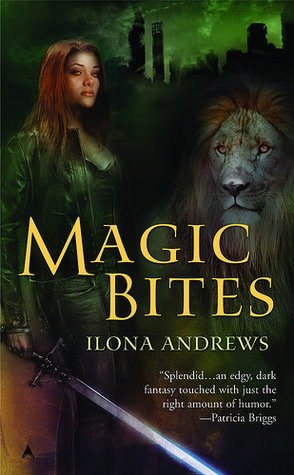
Book review: Magic Bites by Ilona Andrews

Magic Bites (Kate Daniels, #1)Magic Bites by Ilona Andrews

My rating: 4 of 5 stars

So, if magic and science are incompatible, does that mean gravity is magic or physics?

Kate Daniels is scraping by making a living as a mercenary. In her world magic rolls through in waves, knocking out technology and allowing all the beasties to have way too much fun. As a result, people need mercenaries with magical abilities like Kate. Then, as part of a power play, someone kills her guardian sending her after the most powerful magical beast in Atlanta.

The Kate Daniels series was recommended to me by my wife. She has been steadily reading the whole series and kept making appreciative sounds whilst reading them. Written by Ilona and Andrew Gordon, I wouldn’t have immediately picked up a book that hints at fantasy romance. The cover of Magic Bites may be more neutral, but some of the later books in the series I saw in the library had a lot of chiselled male torsos on them.

Fortunately for me, Magic Bites reminded me more of a Harry Dresden book than a steamy romance. Kate is a much more likeable character than Harry,* and the world she lives in makes a bit more sense.** There is also the implication of Kate having continuing adventures that are building toward something, not just another series that will keep churning out instalments.

I’m looking forward to reading more of Kate Daniels’ adventures.

*I originally described this book as Dresden Files except without a jerk as the main character.
**I mean, there are only so many world-ending events that Dresden can take on single-handedly before a) someone non-magic notices, and b) the Wizard Council would also get involved.

View all my reviews

Book Review: Reality is Not What It Seems by Carlo Rovelli

Reality is Not What it Seems: The Journey to Quantum GravityReality is Not What it Seems: The Journey to Quantum Gravity by Carlo Rovelli

My rating: 4 of 5 stars

Reality might not be what it seems, but at least it isn’t a simulation. Possibly.

Carlo Rovelli is a theoretical physicist and has a background in the history and philosophy of science. His field of research is quantum gravity. This makes him an ideal person to write a book about the history of quantum physics and the current state of affairs with scientists trying to reconcile quantum mechanics and general relativity.

Rovelli is one of the founders of loop quantum gravity theory, a candidate alongside string theory for an explanation of quantum gravity. As there are many books, videos, and proponents of string theory, Rovelli thought loop quantum gravity deserved a book too. So while string theory is mentioned, the focus is on the history of quantum physics leading to loop quantum gravity theory.

This was a particularly well-written book. The history, starting with my favourite thinker Democritus, and the explanations were (relatively) easy to follow. At no point did I feel lost in spin foam or uncertain about what is really complicated material.

But I also came away from the book feeling as though I’d missed a section. Maybe I need to re-read the book (doable, as it isn’t particularly long) as I felt like the discussion of loop quantum gravity was actually a brief overview* compared to the sections on the background to its development.

Reality is Not What It Seems is a very good overview of quantum physics, I just wanted a little bit more.

*Loop quantum gravity doesn’t try to string together gravity with quantum mechanics but extends quantum mechanics as a granular geometric equation into the macro realm of what we understand as special relativity.

View all my reviews

Book review: Discourse on the Origin of Inequality by Jean Jacques Rousseau

Discourse on the Origin of InequalityDiscourse on the Origin of Inequality by Jean-Jacques Rousseau

My rating: 3 of 5 stars

Natural man vs Social man: there can be only one winner!

In 1754, the Academy of Dijon held a competition to answer the question, “What is the origin of inequality among people, and is it authorized by natural law?” In response, Rousseau wrote his famous Discourse on the Origin of Inequality. No one remembers the first prize winner.*

As one of the early Enlightenment thinkers, and as someone who inspired the French Revolution, Rousseau was/is an important philosopher. This work on equality is certainly one filled with important thoughts on how inequality isn’t just about natural differences between people** but is about society itself creating inequality. I would interpret this as the powerful/wealthy structuring society to benefit themselves, but an argument could be made for those with the will to power.

Or put another way: inequality is a way for the rich and powerful to build a moat and castle.

The main issue I had with this book was that much of the argument is based upon a flawed evolution of “man”. While I don’t think this undermines his points, it does highlight how far our understanding of humanity, our evolution, and our social bonds has improved.

The version I read of this book had a biography and philosophic overview of the work by Israel Bouseman. This was an excellent addition. It did highlight the flawed knowledge of human evolution, however, it failed to note the now known social aspects of humanity that negate some of the points made.

I’d recommend reading the Bouseman edition of this book whilst trying to contextualise the ideas within our more advanced understanding of human evolution.

Further reading: https://plato.stanford.edu/entries/ro…

*I tell a lie, it was François Xavier Talbert.
**Rousseau refers to men only, specifically European men. Women are lesser beings, and non-Europeans are savages. I found it unclear whether that makes the savages natural men or something beneath that. This is made more unclear by the common false attribution of the Noble Savage trope to Rousseau.

http3a2f2fwww.relatably.com2fq2fimg2fjean-jacques-rousseau-quotes2f39c2c533ceae29e00722831b6433cfc4

View all my reviews

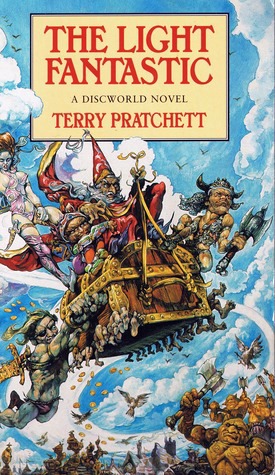
Book review: The Light Fantastic by Terry Pratchett

The Light Fantastic (Discworld, #2)The Light Fantastic by Terry Pratchett

My rating: 5 of 5 stars

Luggage that doesn’t get lost? This must be a fantasy novel.

After shooting off the edge of the Discworld in The Colour of Magic, Rincewind and Twoflower are magically returned to the Disc for reasons unknown. The world turtle, Great A’Tuin, is swimming through space, excited about the red star it is approaching. The Wizards have noticed the red star and the magical change that allowed Rincewind and Twoflower to return, allowing them to uncover an ancient prophecy. Can the prophecy be fulfilled before Great A’Tuin reaches their destination?

When I finished The Colour of Magic I was a little peeved. Whilst a continuing story cliffhanger is a common fantasy trope, a book satirising fantasy tropes should surely rise above such shenanigans. That downgraded my rating to 4 stars.

Happily, The Light Fantastic finished the story started in The Colour of Magic in a highly entertaining fashion. I especially enjoyed the introduction of Cohen the Barbarian, being a fan of the Robert E Howard stories. Death and the other horsemen learning Bridge had me grinning for days. I wouldn’t rate this as one of Pratchett’s best Discworld novels, but it certainly started the ball rolling.

View all my reviews

Book review: Old Scores by David Whish-Wilson

Old Scores (Frank Swann, #3)Old Scores by David Whish-Wilson

My rating: 5 of 5 stars

New tourism campaign: Come to Perth, where you can grift in peace.

Former Detective, Frank Swann, is starting a job with the new Western Australian Premier. The exact nature of his job is unclear. The exact motives of those around him are even less clear. Power players are moving to get their slice of the development and mining booms that are starting. The “facilitators” have their hands out. The usual underworld players – from bikies to bank robbers – see their chance as well. And the target is painted on Frank as he’s caught in the thick of it.

Back in 2016, I was lucky enough to attend the book launch for Old Scores. As a long time fan of David’s, it surprised me to realise that over two years had elapsed since getting my signed copy. If I’m honest, I feel pretty guilty for not having read it immediately. I got there… eventually.*

David is a fantastic writer and Old Scores is another great crime novel from him. He delivers with a gritty and evocative style that us crime fans love. Set in Perth, you not only get the feel of the city, but you have a sense of the underbelly that shaped it. I was too young to really understand WA Inc, but David capitalises on those, and other, events to craft his own tale. In many ways, it is often hard to spot what is a fictionalised historical event and what is actual fiction.

Old Scores is a must for any crime fiction fan and for anyone who wants to get a sense of what Perth and Western Australia were like in the 1980s.

*I promise I’ll read the next one sooner, David.

View all my reviews

Book review: Doughnut by Tom Holt

Doughnut (YouSpace, #1)Doughnut by Tom Holt

My rating: 3 of 5 stars

Life is like a box of doughnuts. Mmmmmmm, doughnuts!

Theo Bernstein is on something of a losing streak. He lost his money, he lost his wife*, he lost his job, and he lost the visibility of one of his arms. Given how high profile the reason for losing his job was – who knew people would miss a mountain? – it’s a wonder he is able to find any work at all, first at an abattoir, then at a hotel. The hotel gig might be easier than hauling offal, but it’s a weird job, made weirder by the strange bottle left to him by his old professor, Pieter van Goyen. How can this bottle be the future of entertainment? And is there a doughnut shop nearby?

In the middle of last year, an author friend – Kaaron Warren** – recommended The Management Style of Supreme Beings to me. It was one of the nominees for an international award she was judging and she spoke glowingly of it. I’d previously enjoyed one of Tom’s books under his KJ Parker pseudonym, so I decided to track it down at the library. Obviously, I was unsuccessful, as instead, I ended up with Doughnut.

This explanation is a roundabout way of saying that I had high expectations for this novel. In some ways, Doughnut managed to rise to those expectations. Holt is a very sharp and inventive author. There are plenty of genuinely funny moments and ideas in this book. But somehow I felt it was all a bit pointless and inane.

In some ways, this is a product of the very British bumbling protagonist used in this novel. It tends to influence the way the story is told, usually in a way that is deliberately frustrating but with the reward of large doses of humour. Unfortunately, I’m not sure this was quite funny enough for the narrative style.

So while this was quite entertaining, I had hoped for more, particularly in the humour department.

*Lost his wife in the sense that she decided to leave him, not the lost in the ‘we were just walking through the Xmas sales and she let go of my hand for a moment and now I can’t find her in this crowd’ kind of way.

** Read her books: https://www.goodreads.com/author/show…

View all my reviews