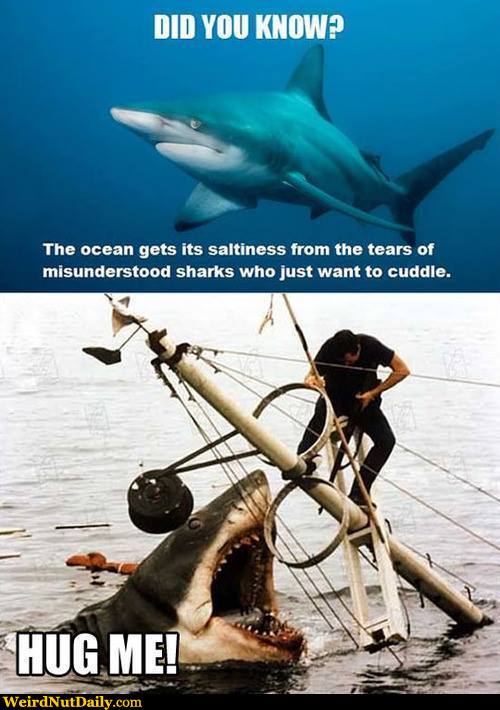
Ever since Spielberg made us scared of seeing any more Indiana Jones films, people have felt better about blaming him for the hysteria around sharks.
Recently in my home state of Western Australia there has been a decision made to cull sharks because some people have been killed by them. Clearly we should blame sharks for just wanting a hug and not humans for dressing up like shark food. This is a stupid decision and I’m about to outline why we can’t even tell if there have been more shark deaths, let alone whether a cull would actually work, let alone whether you’d know if the cull does anything. It all comes down to statistics. Well, that and media beat-ups to sell advertising space.
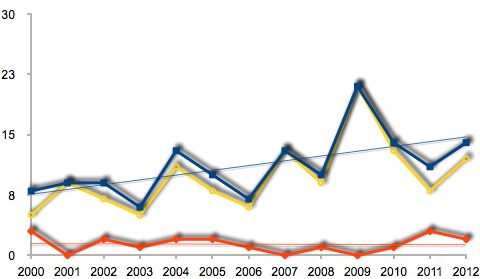
You’d honestly think that there had been a change in the number of people dying in Australia from shark attacks in order to justify a shark cull. Well, the official stats show there hasn’t been an increase in deaths from shark attacks. In fact the deaths are so low the noise around the long term average of 1.38 deaths per annum (2000-2012), that any increase or decrease in deaths are impossible to assign any significance to (see chart below). Three deaths in a year (2000): could be an anomaly. Zero deaths the year after (2001): likely to be regression to the mean. Number of deaths from the most ferocious animal on the planet: bees; 10 per year.
Graph of Aussie shark attacks 2000-2012. Blue is total encounters, yellow is non-fatal, red is fatal. Trend lines for total and fatal.
What you do see in the data is a slight increase in the number of attacks. If you look at the number of attacks and fatalities since 1900, there has been a general increase in the number of shark attacks, but a decrease in the fatalities from shark attacks. It’s almost as though there are more people in the world and more of them bobbing up and down in the ocean in seal costumes, possibly on a tasty cracker.
International Shark Attack File data, Florida Museum of Natural History
Now this is interesting for the world and Australia, as it appears that despite our best efforts as humans, sharks aren’t taking revenge for the 100 million of them we kill each year. But this is about a shark cull in Western Australia: what’s happening there? Well, these tables say it all really:
Western Australia accounts for ~13% of shark attack deaths. When we look at 2012 data we see that WA is having a greater proportion of the Australian attacks and accounts for all the fatalities in Australia. The terms “bigger population”, “longer coastline”, “more cashed up bogans“ come to mind.
So there is no actual proof that there are any more deaths occurring from shark attacks, definitely no trend toward more deaths, but a significant increase in the number of media reports on those deaths (citation needed). Even on a state by state basis there isn’t any death trend.But there is a trend towards more shark incidents. What we are actually seeing is an increase in the number of people dressing up like seals/shark food (scuba divers and surfers).
Circumstances affecting shark / human interactions:
The number of shark-human interactions occurring in a given year correlates with human population increases and the amount of time humans spend in the shark’s environment. As Australia’s population continues to increase and interest in aquatic recreation rises, it would realistically be expected that there will be an increase in the number of shark encounters.
Let’s put that in perspective, Australians have a 1 in 3,362 chance of drowning at the beach and a 1 in 292,525 chance of being killed by a shark in one’s entire lifetime. In Australia there are 1.38 deaths per year from sharks, 121 deaths per year from drowning at the beach, and1,193 deathsper year from driving. We’re more likely to die from all the stupid shit we do, than from sharks. So why have a shark cull?
There is no real reason to have a shark cull. We already kill 100 million of the things annually anyway. What we actually need to do is look at where the sharks are looking for food, has their food moved, if so due to what, and are we seeing less shark food available such that sharks are looking for alternate foods. The shark cull with drum lines and nets is actually likely to kill off dolphins, turtles, rays, and endangered shark species, which is why fisheries researchers don’t support the cull.
Update: I neglected to mention that other states in Australia have been using baiting and nets, in the case of Queensland, since 1962, and since 1937 in New South Wales. Reports are not complimentary of the Queensland nor New South Wales programs. To quote:
…the Fisheries Scientific Committee is of the opinion that the current shark meshing program in New South Wales waters’ adversely affects two or more threatened species, populations or ecological communities and could cause species, populations or ecological communities that are not threatened to become threatened.
And (okay, I’ve cherry picked this a bit, read the whole report on how we are overfishing, killing shitloads of sharks, destroying the fisheries and adding baiting on top of this):
The main pressures on grey nurse sharks appear to be fishing activities and shark control programs……. The biological susceptibility of sharks to over fishing, evidence for increasing fishing pressure and lack of information have given rise to increasing concern about the sharks and rays of the Reef.
Essentially shark baiting, whilst paling in comparison to the 100 million sharks killed for their fins annually, is another pressure that endangered species don’t need. Especially when the baiting is still killing other endangered animals, not just sharks.
these data highlight signs of hepatorenal toxicity, possibly due to the new pesticides specific to each GM corn.
Monsanto, fomous for its Round Up lawsuit, the manufacturer of two of the studied strains of GM corn, responded, dismissing the article, particularly by criticizing the statistical methods used. Is Monsanto’s criticism valid?
Have their been additional studies done that either support or refute the claim that genetically-modified corn has toxic effects?
Answer:
The simple answer is no.
GM corn has the BT gene that allows lower use of pesticides due to increased or the RR gene that allows the use of glyphosate for weed control. Neither of these alterations have any impacts upon the production of sugars or proteins in the plant. http://www.ca.uky.edu/entomology/entfacts/ef130.asp
The problem that can arise is from the pesticides that are now used on the crops and the timing of their application. These pesticides are known to harm mammals and if the dose is high enough can cause problems. http://www.ncbi.nlm.nih.gov/pmc/articles/PMC2793308/
There is an issue with using corn as a feed supplement in animals though. Corn is not a complete food source and is generally low in protein, especially tryptophan. This means that a feed mix is required, not just straight corn meal. http://www.ag.ndsu.edu/pubs/ansci/beef/as1238w.htm
Another issue is that corn can cause Pellagra. This is due to the niacin and B12 being bound in the corn starches and not being released in normal digestion. Tryptophan is also low in corn and can cause Pellagra.
Another point that should be made is that the paper cited is from a notorious “research” group who produce shoddy science in order to further their biased agenda against GM technology. The big problem with the paper is that it uses the wrong sort of analysis and the data has already been analysed by two other papers and found to say the opposite of what this paper says. Essentially, if you do a statistical test with a 95% confidence margin, you are saying that you have one chance in twenty of being wrong because of natural variability. So if you measure 20 variables with separate tests, you are likely to have one be a false positive result. Measure 40 with separate tests, 2 false positives. This is what the research group did, set up the stats to generate lots of false positives, instead of analysing the data correctly with tests that account for this problem. It should be noted that this is a common problem/tactic with anti-GM research papers.
Additional question: The ACSH source claims Studies Indicate GM Crops Are Safer and Healthier, but last time ACSH reported their funding, they were co-funded by what are now GMO companies. Currently they are not open about their funding at all. Therefore, their independence cannot be established. Can you back up the claim by research where all funding sources are open and independent? – gerrit
Reply: Of course there is plenty of independent data. gmopundit.blogspot.com/ has an entire series devoted to the safety studies of GM crops. The highly respected journal Nature had an entire edition devoted to the topic. But that is beside the point, the underlying mechanism of the Bt is not one that works on humans (it is even sprayed on organic farms). We don’t have an alkaline stomach to activate the chemical (ditto some insects it doesn’t impact either) which means it can’t do anything. So the concerns are completely misplaced.
Does global warming make for milder winters? What about specifically North America?
(You often hear people extol global warming for giving us mild winters. Is there evidence of a causal link?)
Two examples claims of global warming causing mild winters in New York, and Tibet are linked in the comments. However, my question is whether this is a global phenomenon.
Answer:
This is a tricky question to answer because weather, what you experience at your house right now, is not really that same thing as climate, the patterns of global air and sea movements that bring weather.
So milder winters can be a possibility in certain locations, as they will be exposed to an overall warming of the entire atmosphere. But colder winters can be experienced.
Since the mid 1970s, global temperatures have been warming at around 0.2 degrees Celsius per decade. However, weather imposes its own dramatic ups and downs over the long term trend. We expect to see record cold temperatures even during global warming. Nevertheless over the last decade, daily record high temperatures occurred twice as often as record lows. This tendency towards hotter days is expected to increase as global warming continues into the 21st Century.
Vladimir Petoukhov, a climate scientist at the Potsdam Institute for Climate Impact Research, has recently completed a study on the effect of climate change on winter. According to Petoukhov,
These anomalies could triple the probability of cold winter extremes in Europe and northern Asia. Recent severe winters like last year’s or the one of 2005-06 do not conflict with the global warming picture, but rather supplement it.
Weather being a local response to climatic conditions means that you have to understand what has changed in the climatic patterns in your region. What are your local weather drivers? How have they changed since the 1970s?
Thus, you could end up with some areas experiencing colder winters; due to greater moisture levels in the air, more precipitation of snow, greater heat loss at night due to clear skies, etc. Or you could have an area that will experience milder temps in winter due to warmer air currents, warmer oceans, localised heat island impacts, etc.
For further information you should investigate the weather and climate agencies publications for your area.
A while back I wrote a post on how sharks aren’t the deadly monsters attacking people all the time that we think they are. Now I’m not suggesting that we all go and hug sharks, they only like to be touched by cleaning fish, nor that we jump in to swim with them, they play tag far too roughly for delicate humans. What I’m suggesting is that we really need to start worrying about stuff that is actually a concern rather than stuff that is just wild gesticulations in front of a camera for ratings.
So here is a list of things that kill more people than sharks annually:
I was having a conversation last night with someone who was questioning why science? Doesn’t it get in the way of creativity? I’ve never seen it that way, I think Heinlein, Assimov and the like would agree with me. Zen Pencils did the comic below which encapsulates why science very nicely.
It has been a while since I’ve blogged one of my book reviews. I guess that is part of the parenting manual that I didn’t read: hobbies are no longer priorities. There have been plenty of good books pass before my eyes since my last review, but I felt content just to let a short sentence, a star rating and an update to my Twitter feed to promote a good read.
This is slightly different. Ben’s book made me annoyed.
I’m a science nerd. I prefer to read the original research papers rather than the media coverage of them, as it is always terrible, usually based on a half-arsed press release and never links to the actual research. I am constantly amazed that in our modern age of computers, internet, vaccines, satellites and zero calorie drinks that people still believe in stuff that wasn’t plausible 200 years ago. And that’s why Ben’s book annoyed me. He made it painfully obvious how deliberate some of the misinformation campaigns have been.
I knew homoeopathy was rubbish (magic water droplets on sugar pills, or as I prefer to call it, a placebo), I knew that complimentary medicine is the term for stuff that hasn’t ever been proven to work, I knew anti-vaccine campaigners clearly didn’t remember that my dad’s generation had polio victims everywhere, I knew that “Big Pharma” are a mixed bag of good and bad science. So if I knew all of this already, why am I annoyed? Because I didn’t realise just how culpable the news media were and how media liaison and PR companies are straight up lying to people.
You see, I always thought, and this is still mostly true, that most media get science wrong because they don’t understand it and it isn’t easy to do the background research to check a press release on a study. I see this as not having the specialist science reporters doing the science journalism (imagine if a science journalist reported on climate change from the beginning, we’d have emissions at zero by now). But with Ben’s section on the MMR “controversy” and the “nutritionists” in the media, he paints a very clear picture of culpability that the media needs to address, or as Ben points out, people will just go to science blogs written by actual scientists in that field.
Excellent book and a must read for anyone who still reads newspapers or watches the TV news.
Yeah, you know that whenever a title/headline asks a question you can almost guarantee the answer is no. In this case the question is also an interesting way of asking about having the blocked up innards of a red faced, bowl gripping, battleship bomber. The most talked about probiotic is Yakult and its patented strain of “good” bacteria. I wonder if “bad” bacteria have a three day growth and shifty eyes?
In terms of the probiotic Yakult, which has “6.5 billion healthy bacteria in every serve,” there was a 2010 review conducted by the European Food Safety Authority. This was a separate study called to support those made on intestinal health claims (which have been covered by Johan already).
The EFSA panel concluded that a cause and effect relationship had not been established between the consumption of the Lactobacillus casei strain Shirota and maintenance of the upper respiratory tract defence against pathogens by maintaining immune defences. This shouldn’t be that surprising considering that 6.5 billion bacteria is 0.0065% of the 100 trillion or so bacteria in the intestines.
The food constituent, Lactobacillus casei strain Shirota, which is the subject of the health claim, is sufficiently characterised. The Panel considers that maintenance of the upper respiratory tract defence against pathogens by maintaining immune defences is a beneficial physiological effect. The applicant identified a total of 12 references as being pertinent to the health claim. These included nine human intervention trials and three animal studies. In weighing the evidence, the Panel took into account that there was no human study from which conclusions could be drawn for an effect of Lactobacillus casei strain Shirota consumption on upper respiratory tract infections, that one human study did not support an effect of Lactobacillus casei strain Shirota consumption on the immune response to influenza vaccination, and that there was a lack of evidence for an effect of Lactobacillus casei strain Shirota consumption on the immune system that could relate to the defence of the upper respiratory tract against pathogens.
Yakult is supposedly backed by a signficant body of science. The number of scientific papers is certainly large, however, most of them are related to in vitro and in vivo experiments, with some human clinical trials done on cohorts (e.g. 1, 2, 3). The trials also tended to use much larger daily consumptions of bacteria, in the order of 40–100 billions of probiotic L. casei Shirota (sorry, links are now behind a paywall in the UK), far above the single bottle concentration of approximately 6.5 billion.
An example of the studies performed shows that the claims are borderline, with both placebo and Yakult treated constipation groups showing improvements (improved constipation 56% vs. 89%, p=0.003) in the second week, or the claims are based on small sample sizes (n=20). This shows why the EFSA concluded as they did.
So, save your money and wait until there is either some conclusive science or you run out of vegetables. In the meantime, this article is of interest on this topic.
Update: The Lancet recently published a paper on antibiotic-associated diarrhoea and Clostridium difficile diarrhoea which showed that multistrain preparations of lactobacilli and bifidobacteria did nothing. This is another example of how the previous smaller studies that have shown benefits are being overturned by more conclusive studies. I could go into the statistical and methodological reasons for this, or you could all thank me for not doing so. Thanks to Ross from Skeptically Challenged for the paper.
There are a lot of guns in the world. The figure is something like 639 million firearms, or to put it another way, one gun for every 9 people on the planet. Yet the average person knows diddly squat about guns. People probably have a better idea of how Nicki Minaj managed to become a star than express knowledge about guns. Most of our knowledge is likely to come from movies:
Or professional Russians:
As an author I really wanted to make sure I didn’t base my gun knowledge upon misinformation, otherwise I’d have to work as a reporter covering the gun debate. So here are a few myths to be busted.
Machine guns are not monsters of death
They may fire great big bullets at hundreds of rounds per minute but machine guns really are given the fashion magazine airbrushing treatment. A great big gun letting off a whole lot of explosions in a short amount of time has a habit of getting hot. Really hot. We’re talking change the barrel over every minute hot! Yes, that’s right, at the maximum rate of fire your machine gun needs a new barrel every minute to keep firing without causing problems – which I imagine as a gigantic explosion like Bugs Bunny sticking his finger in the end of Elmer Fudd’s shotgun. But it isn’t just the barrel changes, most of the time you aren’t actually firing the machine gun at people, you’re firing it at super mean looking inanimate objects, or as the military call it, suppressive fire (250,000 rounds for one kill!!!). Essentially the machine gun is a tool that performs a very different role from the one gun noobs think it does. Well, unless you don’t mind the thing catching on fire (yes, I know that isn’t technically a machine gun):
Guns aren’t really death machines
For death machines, these gun things really don’t kill enough people. In science we talk about effects, rates and how to blow up stuff with the things you find under the kitchen sink, as such it is hard to look at the gun deaths and gun injury rates and not think guns kinda suck at their job. The USA use guns to kill roughly 30,000 people a year, one third of those are homicides, but that is less than half the people they injure with guns, roughly 65,000. But that isn’t really fair, because not every time a gun goes off is it being used to shoot at someone else or a particularly nasty piece of paper. If you just look at homicides and attempted homicides, guns are still only getting the job done 21% of the time.
Guns suck for self defence
Not everyone can have Chuck Norris camped out in their house for self defence, nor carry Steven Segal around where-ever they go. But as mentioned above, guns really do suck at their job. Whether it is only being 23% effective in legal interventions, or the fact that you’re 4.5 to 5.5 times more likely to be shot for carrying a gun, you really start to think running away looks like a better option, even if you are as fat as Steven Segal has gotten lately.
Handguns are about as accurate as the horoscopes
A handgun is a really convenient weapon to carry around with you, but if the side of a barn is more than a few metres away, you’re not particularly likely to hit it. Even cops can’t hit much with these things, even when the bad-guy is less than 15m away. Half the problem is that bad-guys shoot back, which means you don’t stand around collecting holes, you run for cover, which really ruins your accuracy. But I’ve already mentioned that guns suck at their job, well, your handgun might hit the bad-guy 55 times and still not kill them.
Guns sure do help kill people
As much as guns suck at their job, as I’ve just pointed out, guns still do a better job of killing than many of the other methods we’ve devised for killing each other. Sure, people love their tools to kill one another, but guns are a really good tool to use for killing one another. I can’t wait to see the military being sent off to war with hammers and cars instead of a gun.
Being shot doesn’t mean you can fly
The trick to flying is throwing yourself at the ground and missing. So being shot clearly can’t make you fly. Don’t know why people think that shooting someone can disobey this simple fact, let alone Newton’s Laws of Motion. But what good is a trope if it isn’t always on display?
Semi-auto rifles are not assault rifles
Every time someone refers to a semi-auto rifle as an assault rifle, or worse, the made up term assault weapon, a puppy dies. You don’t want all the puppies to die do you? Well then, it is time to learn the difference between the military configured select fire rifle, called the assault rifle, which is capable of fully automatic and (sometimes) burst fire, and the civilian one trigger pull, one shot, semi-automatic rifle. I know, they may look the same to the untrained eye, but some people think cars are all the same thing too.
Mags, clips, high capacity…
While we’re on the topic of rifles, I have a dictionary and an abacus for people talking about magazines, clips and high capacity mag clips. A magazine is something you read, a clip is something you watch and high capacity is a Japanese train at rush hour. Different guns have different sizes of magazines (which may or may not be loaded with a clip), which means 30 rounds may be high capacity for one gun and normal capacity for another. Also, when one of these these rifles go through 700 rounds per minute and even soldiers only carry 210 rounds, from a standard 30 round magazine, then no gun fight is really lasting that long.
It’s a suppressor not a silencer!
Remind me, is +120 decibels loud or quiet? It sure is a lot quieter than a normal gunshot sound (+160db), but calling it “silent” is like calling bagpipes a little annoying. When the best suppressors on the smallest calibre weapons still manage to be as loud as a jack hammer or AC/DC, then suppressors have again gotten the Hollywood make-over. But 30db is a decent drop from ear splitting to “say what” territory, so I’d say these things should be compulsory.
There is no smell of cordite
If someone describes the smell of cordite in the air after a gun fight, you either know that the book is set before 1950 or that there is a sub-plot about a time traveller who comes from the past to assassinate a future self. It seems really odd that so many books use the time traveller sub-plot, because it is usually a one off. It would be far more interesting if this was built upon more, maybe have Gengis Khan show up to knock down a wall, or something, as well.
Less guns are a good idea
Shooting is fun, hunting is very primal, but at some point your neighbours start to get worried when you look more like you are going to war than to the shooting range. Aside from guns sucking for self defence, they also suck at not shooting your loved ones, are handy for suicide, and unless you are in a warzone, more guns in society equals more gun violence. But it is also worth thinking about what gun figures actually mean, like 300 million guns in the US, enough for one for every American despite there being only about 80,000 gun owners. Sounds like a lot, but that means each gun owner has a rifle, a handgun and a shotgun, which is clays, targets and pistols at the local range on the weekend. Perfectly reasonable to go shooting, just not at your local school.
Normally I don’t talk politics. It really hurts my head when I repeatedly bash it against the desk when listening to politicians speak. Being apolitical I see little point in discussing what a bunch of self-serving failed lawyers do on a daily basis. Regardless, I’ve reblogged this post from uknowispeaksense – a fellow science nerd – as he has done a very good breakdown of both the houses of Australian parliament and where they stand on climate change.
Being a scientist, I find the current political inaction on climate change to be unacceptable. I find the denial of climate science to be akin to disputing gravity. Then again, I’m sure we could find politicians that would argue pigs can fly if there were enough votes in it. The science is settled. So I think it is important that people know where their politicians stand on what is quite possibly the most important issue to face humanity.
Also, this link has position statements of various parties.
In September this year, 2013, Australians will head to the polls to exercise their democratic right and vote in the federal election, with each eligible voter hoping the party of their choice wins enough seats to govern for the next 3 years. Recently, Australian politics has seemingly become much like American politics with the right shifting to the extreme right and what were formerly centre left shifting slightly to the centre. In the process, the issue of climate change has become highly politicised. The idea of this page, is to highlight where each party and some selected individuals stand on climate change. In particular, I am interested in whether they accept the science or not.
Recent climate change is real, it is happening now, it is caused by humans and it is serious. This is not up for debate because the science is settled. Every major national scientific body in the developed world and the tens of thousands of scientists researching the climate accept this as fact. In my opinion, and many others, it is hands down the most important global issue and challenge facing humanity, and urgent action is required…now.
In order for global initiatives to be implemented to tackle the threat of climate change we must have governments who are prepared to act, and that means we must first have governments that accept the science. So how does our current crop of politicians stack up? To find out, Hansard, party websites, individual websites, press releases, newspaper, radio and television interview transcripts were searched for definitive statements made by our politicians that demonstrate that they either accept the science or not. Where a definitive statement wasn’t apparent, but the Member had mentioned some aspects of climate change, I emailed the Member requesting clarification of their position. Where no response was provided, the Member was classified as “no data” or “insufficient data”. Two Members made no mention of “climate change” or “global warming” at all in the places searched. They have been placed in the denier category. Retiring politicians (as at February 16, 2013) have been excluded.
An example of a definitive statement accepting the science on climate change is this one from Steve Irons, the Liberal Party Member for Swan, who when rising to speak in parliament on the Carbon Pollution Reduction Scheme Bill 2009 and associated Bills (CPRS2009), said…
“I accept the premise that climate change exists and that greenhouse gas emissions are contributing to the accelerated rate of climate change. There is evidence to support this and I lend my weight to those arguments.”
The link for that speech is here. An example of a definitive statement or statements rejecting the science is this barrage from Warren Truss, the National Party Member for Wide Bay as reported in the Australian newspaper.
”It’s too simplistic to link a finite spell to climate change.”
”These comments tend to be made on hot days rather than cold days.
”I’m told it’s minus one in Mt Wellington at the present time in Tasmania.
”Hobart’s expecting a maximum of 16.
”Australia’s climate, it’s changing, it’s changeable. We have hot times, we have cold times…
”The reality is that it’s utterly simplistic to suggest that we have these fires because of climate change.”
This is the usual grab bag of inane throw away lines, or variations of, one can find on any climate denial website. So, just how many of our politicians accept or reject the science of climate change?
Position on the science of climate change of current Australian members of the House of Representatives. n=150
What is clear from this graph is that the majority of Members accept the scientific consensus on climate change and have made definitive statements to that effect. When we break it down into party affiliations v position, we get an interesting look into the politicisation of the issue.
Position on the science of climate change of Members of the House of Representatives by political party affiliation. n=144 (6 retiring)
The striking thing about this graph that should be immediately apparent, is the fact that nearly every Australian Labor Party Member has made a definitive statement accepting the science of climate change. For the conservatives, the split is nearly 50/50. This can be broken down further…
Position on the science of climate change of Coalition Members of the House of Representatives by political party affiliation n=59
No real surprises here that the Nationals, being the representatives for large areas of “the bush” are climate change deniers. Their constituents tend to be highly conservative. Please note: retiring members and those for which there is no data have been excluded from this graph.
So, who accepts the science and who doesn’t? What is clear is that if you are of the right, there’s a good chance you are in the wrong. Here is a complete breakdown of the results with each member and their position.
Current sitting Members of the House of Representatives and their position on climate change science.
It’s probably fitting that the leader of the opposition, with a bit of help from alphabetisation, tops the list of deniers. This is the man who wants to lead the country and he refuses to accept the science of climate change. Remember, it is Abbott who claimed that “climate change is crap.” Now I’m sure there are supporters of Mr Abbott who will find quotes about his direct action plan to tackle climate change and hold this up as evidence that he is serious about the climate however, this is the man who will say anything for political expediency.
The thing that really bugs me about the list of deniers, is the presence of those National Party Members. While it isn’t surprising, these 8 people are supposed to represent Australian rural communities and have their best interests at heart. Climate change is likely to have very severe impacts on agricultural production in Australia. The CSIRO State of the Climate 2012 report states…
Australian average temperatures are projected to rise by 0.6 to 1.5 °C by 2030 when compared with the climate of 1980 to 1999. The warming is projected to be in the range of 1.0 to 5.0 °C by 2070 if global greenhouse gas emissions are within the range of projected future emission scenarios considered by the Intergovernmental Panel on Climate Change. These changes will be felt through an increase in the number of hot days and warm nights, and a decline in cool days and cold nights.
Climate models suggest long-term drying over southern areas during winter and over southern and eastern areas during spring. This will be superimposed on large natural variability, so wet years are likely to become less frequent and dry years more frequent. Droughts are expected to become more frequent in southern Australia; however, periods of heavy rainfall are still likely to occur.
These changes will require mitigation and adaptation activities to be undertaken not just by the agricultural producers, but also the communities in which they exist, and without government support, many will go to the wall. One wonders if a government full of climate change deniers will be able to make the important decisions that will secure Australia’s food future? For an insight into the potential challenges faced by agricultural producers in the future, as well as what will be required to adapt and mitigate, it is well worth reading the 2012 paper by Beverly Henry et al titled, Livestock production in a changing climate: adaptation and mitigation research in Australia. From the abstract…
Climate change presents a range of challenges for animal agriculture in Australia. Livestock production will be affected by changes in temperature and water availability through impacts on pasture and forage crop quantity and quality, feed-grain production and price, and disease and pest distributions. This paper provides an overview of these impacts and the broader effects on landscape functionality, with a focus on recent research on effects of increasing temperature, changing rainfall patterns, and increased climate variability on animal health, growth, and reproduction, including through heat stress, and potential adaptation strategies.
So, here are a few examples of the kinds of statements made by the deniers in our parliament. Remember, these people are ignoring the advice of tens of thousands of experts from around the world who are all saying the same thing, and they want to make decisions on your behalf, that won’t just affect you, but your children and grandchildren as well.
“The Prime Minister and her ministers have repeatedly declared that the “science is settled” and there is no need for further debate on how to respond to the environmental challenges from climate change. A Nobel Prize-winning scientist told me recently that “science is never settled” and that scientific assumptions and conclusions must always be challenged. This eminent Noble Laureate pointed that had he accepted the so-called “settled science”, he would not have undertaken his important research, which challenged orthodox scientific propositions and led to new discoveries, which resulted in a Nobel Prize.” Julie Bishop
“We are after all only talking about models and forecasts. Just as an aside, when the weather bureau cannot reliably tell me what the weather is going to be like tomorrow and then tells me that in 100 years there are going to be sea level rises of a metre as a result of climate change, I think I am entitled to exercise a level of caution in deciding whether to accept everything that is put to me about weather, climate and long-term trends.” Darren Chester
Darren Chester, failing to understand the difference between short-term weather forecasts and long-term climate trends. Scarily, he then goes on to discuss how wonderful it would be to dig out and burn all the brown coal in the Latrobe Valley. For the uninitiated, burning any coal is bad, but burning brown coal specifically is very bad. It burns much cooler than anthracite due to higher water content and less lithification and so you have to burn more of it to produce the same amount of energy.
“As I rise to speak on the Carbon Pollution Reduction Scheme Bill 2009 and related bills, I do so wondering whether the debate is being driven by alarmists or scientists. Are we debating this subject from a scientific standpoint or are we being caught up in the emotion of the times? We do live in an uncertain world and it is understandable why it can be easier to accept statements at face value rather than questioning what we are being told. I have been reading Professor Ian Plimer’s book on his response to the global warming debate. It makes for very interesting and illuminating reading, and I would recommend it to any member entering the debate on global warming.”Joanna Gash
Joanna Gash basing her uneducated and ill-informed opinion on the writings of a non-expert who has never published a single peer-reviewed paper on the subject of climate change and who is the director of seven mining companies. Can you say “vested interests” Joanna?
“To say that climate change is human induced is to overblow and overstate our role in the scheme of the universe quite completely over a long period of time. I note that the member for Fraser came in here today with a very strong view about how human beings have been the source of all change in the universe at all times. He has joined a long line of Labor backbenchers I have spoken about in this place before—amateur scientists, wannabe weather readers, people who want to read the weather, people who like to come in here and make the most grandiose predictions about all sorts of scientific matters without even a basic understanding of the periodic table, or the elements or where carbon might be placed on the periodic table. So the member for Fraser has joined this esteemed group of people who seem to be great authorities on science.” Alex Hawke
Alex Hawke, also confusing weather with climate but doing so in a spectacularly arrogant way. I love it. He’s not just saying, “I’m an idiot” but rather “I’m really an idiot and you better believe it! So there!” Who wants to ask Mr Hawke where carbon is on the periodic table? I know I do.
“As the only PhD qualified scientist in this parliament, I have watched with dismay as the local and international scientific communities and our elected leaders have taken a seemingly benign scientific theory and turned it into a regulatory monolith designed to solve an environmental misnomer. With a proper understanding of the science, I believe we would not even be entering into this carbon tax debate. To put it simply, the carbon tax, with all its regulatory machinations, is built on quicksand. Take away the dodgy science and the need for a carbon tax becomes void. I do not accept the premise of anthropogenic climate change, I do not accept that we are causing significant global warming and I reject the findings of the IPCC and its local scientific affiliates.” Dennis Jensen
Dennis Jensen, legend in his own lunchtime appealing to his own non-authority and single-handedly dismissing the honest, dispassionate work of tens of thousands of real scientists from around the world. At this point I should point out that Dennis Jensen does indeed have a Phd….in materials engineering on ceramics. Next time it starts raining cups and plates I’ll be sure to look him up. Oh, and he is also tied in with the Lavoisier Group and according to Wikipedia, boycotted parliament the day Kevin Rudd apologised to the Stolen Generation. I know that isn’t relevant to climate change but hey, if he’s a racist arsehole then everyone has the right to know about it. Anyway, I strongly urge my readers to check out the rest of his parliamentary rant. It is a cracker. Every single paragraph is filled with…well….crap. Who voted for this clown?
“Perhaps more concerning is the evidence that suggests climate scientists have engaged in manipulation of data, routine alienation of scientists who dispute the theory of anthropogenic global warming and the overall culture of climate change science that encourages group think and silences dissent.”Don Randall
Don Randall, reflecting on a newspaper article about “Climategate”no less. Obviously 9 independent investigations into “Climategate” all finding no wrong doing isn’t enough for the wilfully ignorant. For a good roundup of the whole saga, skepticalscience is the place to go.
These were just a few of the deniers and their ill-informed statements that I randomly selected. Having read through so many speeches and transcripts and media releases, I can attest that these are representative of the other deniers in the list. For me, the mind boggles when it comes to climate change denial. Presumably, these politicians are meant to be rational people. The appeals to the authority of non-experts really confuse me. It is akin to getting a plumber instead of an electrician to rewire your house. They wouldn’t get a vet to perform the brain surgery some of them clearly need. Why do they think the opinions of non-experts has any weight when it comes to climate science? It is completely irrational.
I guess it may seem to some that I am picking on the conservatives…and that would be correct, but I also have one or two big questions to ask of the ALP. If you all accept the science behind climate change as you claim and see fossil fuel combustion as the primary cause of recent climate change, why do you subsidise the fossil fuel industry to the tune of billions of dollars every year? Why not use that sort of money to develop the renewable energy sector and get us off our dependence on coal quicker?
This year’s election, if recent polling results carry through to September, is going to be won by the conservatives. Their leader, who admits to lying, who is on the record as holding different policy positions based on political expediency, is surrounded by men and women who are irrational in their non-acceptance of the science of climate change, many of them failing to grasp simple concepts such as the difference between weather and climate. Some of them suffer heavily from arrogance and one inparticular the Dunning-Kruger effect. A number of them have links to the mining industry and right-wing think tanks that are funded by mining companies and/or have mining executives on their boards. I wonder where their royalties loyalties lay? Is it with the people who have elected them, or their mining mates? I think I know the answer and it isn’t we the people. But then you’ve got the ALP subsiding the very industries they are claiming are the problem. Decisions decisions. For some, the decision might be about the lesser of two evils. Choose wisely.
Thanks to John Byatt for his valuable assistance with data collection.
If any politicians read this and feel they have been misrepresented, please feel free to contact me at unknowispeaksense@y7mail.com preferably with a definitive statement and I will make the necessary corrections and publish your response.
Tyson Says: A point I should make about the results here, which was also made on The Drum last night: The Labor Party doesn’t allow for crossing the floor or dissenting public comment. Now, it isn’t like there aren’t penalties in the other parties for doing so, but this point needs to be considered when viewing the statistics.
Essentially, where it has all of Labor politicians on board with climate change, that is actually a party stance, not the individuals. I know from first hand discussions that there are Labor politicians who don’t believe in climate change science, but they won’t go on record as such because the party room has voted against them.
This is partly why we see such pathetic policies and hypocritical positions (e.g. mine coal like it is going out of fashion whilst claiming coal is to blame). Remember, politicians don’t care about science or facts, they care about making their supporters happy. Just don’t think that the voting public are their key supporters, because they certainly didn’t donate tens of millions to their party.
(via Climate Central)
From our friends at NASA comes this amazing 13-second animation that depicts how temperatures around the globe have warmed since 1950. You’ll note an acceleration of the temperature trend in the late 1970s as greenhouse gas emissions from energy production increased worldwide and clean air laws reduced emissions of pollutants that had a cooling effect on the climate, and thus were masking some of the global warming signal.
The data come from NASA’s Goddard Institute for Space Studies in New York (GISS), which monitors global surface temperatures. As NASA notes, “All 10 of the warmest years in the GISS analysis have occurred since 1998, continuing a trend of temperatures well above the mid-20th century average.”
The cardio folks usually point out the “afterburner” effect, where the body continues to burn calories even after the workout. And weight lifting people mention that muscles burn more calories than fat, so more muscle is the key.
Are there studies showing if either one is true? Or are both needed? And what about interval training?
Answer:
This is a tough question to answer as there are a lot of ifs and buts.
Weight loss is all about caloric deficit, expend more energy than you consume and you lose weight. Most people do this by dieting, but the body tends to readjust the resting metabolic rate so that you don’t lose too much reserves. Thus exercise plusdiet is needed for weight loss to be effective.
How effective is ‘Diet Only’ versus ‘Diet plus Exercise’ for Weight Loss? Most studies demonstrate that when diet (caloric restriction) and physical activity are combined in a weight management program, encouraging results in weight loss occur. Donnelly and colleagues (2009) explain that a weight loss program design may create an energy deficit (e.g., 500 to 1500) composed of exercise (e.g., 250 kilocalories/day) and caloric restriction (e.g., 250 kilocalories/day) for the daily caloric deficit total (500 kilocalories in this example). In studies where investigators introduce an energy deficit of 700 to 1000 kilocalories per day, ‘diet only’ and ‘diet plus exercise’ result in similar losses. Donnelly explains that this is due to metabolic adaptations that “diminish any additive effect of energy expenditure from physical activity on weight loss”. However, in investigations where the energy deficit is 500-700 kilocalories/day, the ‘diet plus exercise’ group is about 20% greater than the ‘diet only’ intervention.
So weight loss needs to be related to your activity and diet in order to understand your basal metabolism. But weight loss isn’t just about bodyweight as it is about losing bodyfat (as muscle is useful for maintaining basal metabolism and body function). When you calculate this you are able to figure out how many calories need to be removed from the diet in order to lose fat. See here. There are also strategies that can change your metabolism.
Exercise is usually broken down into two categories: cardio and weight training. There are many benefits to both and generally both are recommended for long term health. Weight training is known to burn fat.
This study is the first to directly show that resistance exercise increases adipose tissue lipolysis and thus contributes to improved body composition. This boost in lipolysis is apparently due to the excitatory effect of resistance training on specific hormones (e.g., epinephrine, norepinephrine and growth hormone). As this study design was completed with trained male subjects, it is hoped that the methods and procedures will be completed with other subject populations (e.g., females, untrained persons, youth, seniors, overweight, etc.) in future research.
For cardio training, there is obviously fat burning taking place. The amount of fat burning that occurs is related to the intensity of the cardio.
In summary, that data clearly show that exercise intensity is the main factor in determining the magnitude and duration of EPOC following aerobic exercise. Thus, when developing a cardiorespiratory exercise prescription for weight maintenance and weight loss, the influence of exercise intensity on EPOC and its potential contribution to total caloric expenditure should be taken into consideration.
The same is true of weightlifting (from the same article):
The data on resistance training and EPOC suggest that EPOC is distinctly influenced by the intensity of the resistance training program.
The actual amount of post activity “fat burning” will be related to the intensity and duration of the exercise done. Weightlifting has advantages in terms of encouraging muscle satellite cell accumulation that sustains and grows muscle. Cardio has the benefit that it can be performed for longer durations than weightlifting. So the essential answer will come down to the individual and their strength and fitness.
Essentially any exercise program should incorporate both cardio and weight training for weight loss, especially targeting fat loss.
For more articles on fitness and metabolism see here.
Further question: Hey, do you think I can get the source on your statement that “the body tends to readjust the resting metabolic rate so that you don’t lose too much reserves.”? I’m rather curious about this. – Joel Cornett
Reply: Joel, there is a lot of research related to metabolic rate and how it changes under dieting and exercise regimes. It is quite a complex topic because it depends upon many factors. Someone who has just started dieting will be different from someone who is active already in terms of responses. Here is one paper that looks at the overweight people and weight control. I linked to Kravitz’s other articles that cover some of the athlete side of metabolism in the last link.
Farmers are some of the most innovative Australians – since 1970 they have lost 7.5% of arable land, but they’ve found ways to increase production by 220%. They’re also some of the most conservative, expressed in their reluctance to accept the science of climate change. So what will win as they face a changing climate: innovation or conservatism?
The agriculture industry has been developing for the past 10,000 years, but it could be argued that the biggest advances have come in the last 50 to 60 years. Since 1970, the world population has doubled, yet farming area has stayed the same.
Essentially farmers and the research that has supported them have been fantastic. A recent Conversation article highlighted this. But now agriculture faces, possibly, its biggest challenge: climate change.
Australian agriculture: the greatest story never told.
Research in Western Australia found that over half (52%) were uncertain whether human-induced climate change was occurring. This is in sharp contrast to the 97% of climate scientists who agree that humans are causing global warming. Only 31% thought climate change represented a major threat to the future of their farm businesses. Results also showed that only 33% of all respondents found climate change information easy to understand.
In Western Australia since July 2010, the Farm Business Resilience program has, in part, been seeking to educate farmers about climate change. Before the initial sessions, farmers were surveyed by Chris Evans for their perceptions, knowledge and attitudes to climate change. Only 33% reported that they agreed climate change was occurring and just 19% believed climate change was human induced. Surveys at the end of the course assessed perceptions, knowledge and attitudes again, now showing that 80% of the farmers understood the impact of climate change and variability change on their businesses.
This was a staggering improvement, considering the difficulties that communicators face when they’re trying to correct misinformation. Numerous social studies have found misinformation is notoriously difficult to dislodge and debunking myths can sometimes have the effect of reinforcing them (known as the backfire effect). The backfire effect is particularly potent when presenting climate science to conservative audiences. If myths are not replaced with an alternative, plausible explanation, their influence can persist like returning weeds.
Farmers live and breathe a changing climate. Anthony Georgeff
The key to the program’s success came down to knowing how to contextualise information. An example is that most scientists present science to the public but fail to make their knowledge understandable. The authors know how important it is to explain that information and doing so in a program like this allows clear explainations and discussion. The advantage of speaking with farmers about climate is that they live and breathe it. Million dollar business decisions often hinge on seasonal outlooks, so farmers usually have a good knowledge base to work with.
So why is it important to educate farmers about climate change? Because successful farming is really important. Need proof? Don’t eat for a week.
Even without climate change, farmers have a lot to deal with in the next few decades. There are pressures on productive land from:
There are also social and political pressures for chemical usage, access to technology and production practices. The current debates over access to GM technologies and use of pesticides are just two examples of social pressures on farming. There are also the ever-present economic pressures, as returns decline and costs increase – the cost price squeeze.
Under all of this pressure, agriculture has to supply increasing food demands, all while climate change is forcing down productivity. Given that most of the world’s agriculture is rainfed (73%), agriculture has a lot to lose with changes in rainfall resulting from climate change.
A recent article on The Conversation highlighted how little people outside of agriculture know about where and how their food is produced. It is important for everyone to understand how modern agriculture works, to see the science and technology that is involved. Just as farmers need to know about climate change and how it will impact them, the wider community has to understand what agriculture needs into the future.
Agriculture has a lot to lose from changes in rainfall. Jane Rawson
Without community support, farmers will not have access to the latest technologies, trade agreements will be jeopardised and production will leave our nation without needed food security. And without more knowledge about farming, the wider public won’t understand proposed strategies for agriculture under climate change.
So the agriculture industry needs to be involved in an informed discussion of its future. Having farmers and the wider public meet will also help non-agricultural people understand where their food comes from and how it is produced. The better this link between producer and consumer, the better the industry will be. Through programs like Farm Business Resilience we can improve agriculture. But it can’t stop there: if farming doesn’t come to grips with climate change, it will affect us all.
This article was co-authored by Tim Scanlon. Tim is a scientist who is primarily involved in the agriculture industry as an extension specialist. His current focus is in climate change extension to rural Australia as part of a national program being trialed in Western Australia.
John Cook does not work for, consult to, own shares in or receive funding from any company or organisation that would benefit from this article, and has no relevant affiliations.
It has been claimed that due to their large size, and the velocity of their blades that wind turbines kill large numbers of birds that run into them at night, or in fog, and die.
The simple answer is yes. The more complex answer is that the number of deaths is nothing in comparison to other man made structures and the risks from climate change.
There have been several studies done to find the environmental impact of wind farms on birds. Generally birds lack the ability to dodge humans and their quest for global supremacy. From the American Bird Conservancy there are a list of deaths related to sources as deaths per year in the US:
Feral and domestic cats – Hundreds of millions
Power lines – 130-174 million
Windows – 100 million to 1 billion (NB the high end seems too large to me)
Obviously wind turbines aren’t as popular as cars, cats and windows, but with the expected increase in wind energy generation, the impacts will likely increase. The thing that has to be borne in mind is that the wind turbines are on an order of magnitude smaller impact than other bird killers. It also has to be remembered that the studies are also showing that newer wind power plants are having less impact on birds due to design upgrades, better placement and better ecological planning.
The real issue here is climate change. Coal power plants kill birds, in fact, they are threatening to wipe out entire species. According to a study reported in Scientific American, at least 950 entire species of terrestrial birds will be threatened with extinction as a result of climate change under several scenarios, even at the lower estimate of temperature gains, just counting species of non-sea birds in the higher latitudes; outside the tropics. Birds in the tropics will be impacted by habitat loss, which brings the total species wiped out to ~1800 (Jetz, Wilcove, and Dobson 2007).
The take home point is that we need clean energy sources to save bird species. Those that fly into turbines each year will be minimised with better designs and locations of turbines. In the meantime, worry about the cats and climate change.
Update: recent studies have shown that birds of prey are more prone to injury and death from wind turbines. Essentially, birds of prey spend a lot of time looking down for prey and not enough time looking where they are going. The usual bird collision rate is 0.08 birds per turbine per day on average (range 0.05–0.19), whilst the ‘smarter’ Eagles are colliding at a rate of 0.112 to 0.133. The study also suggests that bird size and speed of flight are important determinants of collision rates, hence why gliding and hovering prey birds are colliding more often. It is worth bearing in mind that both of these collision rates (that often result in death) still indicate an avoidance rate of 99%.
This avoidance rate is important to compare to the relative deaths per gigawatt-hour of the power sources to realise that wind power is still a very good option. This study estimates that wind farms and nuclear power stations are responsible each for between 0.3 and 0.4 fatalities per gigawatt-hour of electricity while fossil-fueled power stations are responsible for about 5.2 fatalities per gigawatt-hour. Thus, wind turbines could do with some investigation into how to make them safer for birds, but they are already a much better option than fossil fuels.
Update #2: an Australian researcher has recently done an interview on Ockham’s Razor (an ABC science show) to dispel some of the bird myths surrounding wind turbines.
Update #3: Teale commented via Facebook that the upscaling of power generation by wind hasn’t really changed the annual bird deaths per MW/hr despite the increase in the number of wind turbines and areas with wind farms. The bird deaths are ~33,000 pa, which is still in the range cited by the American Bird Conservationists from a few years ago, and the power generated has increased to ~4%. Again we come back to the point above about what other power generation and mining does to birds is a much larger impact. Remove them and the wind turbines can get a lot more prevalent and still not have the same impact. (NB: there may be some circular referencing going on between the sources in this article, so if this is the case, please send through any revised data sources, especially on data changes with time).
Another year has come and gone for my local writers’ festival. Once again I joined my fellow reading nerds and aspiring authors to descend upon the grounds of UWA. This year there were 30,000 of us who felt the need to spend three days of lovely weather discussing books.
This year I spent a lot of the three day in writing workshops and less time at discussion/interview sessions. There is always room for improvement in writing, so what better way than sitting down with an expert and two dozen peers to discuss and practice. I’d like to thank the various experts who all had some interesting insights and tips: Susan Midalia (short stories – literary focus), Belinda Castles (finding your voice and turning that story into reality), LA Larkin (thriller writing, great tips and she is also running a longer course with the Sydney Writers Centre) and Parker Bilal (crime writing, developing the characters and structure).
This isn’t to say that I didn’t get the chance to see any talks. The discussion of Antarctica was fascinating and puts it on the list of places I’d like to visit before climate change has its wicked way with it. The discussion with Major General John Cantwell and former WA premier Geoff Gallop about why it is necessary to help remove the stigma around mental illness was fantastic. John managed to pretend he wasn’t suffering PTSD for 20 years, which is just amazing considering some of the the ramifications it was having on him. Another great session was with David Petrarca, Sue Masters and James Bradley discussing how TV storytelling now rivals cinema and literature. It is quite clear that subscription TV and services like Netflix are changing the game for production of TV, which is why we are seeing great writing, great acting and decent budgets to give us programming I actually want to watch. James Bradley made a very poiniant comment: we have to stop ragging on Master Chef and other boring and mindless TV shows, their popularity allows decent TV to be funded. Finally, on Sunday I was introduced to two new (for me) authors in the panel discussion on thrillers with Andrew Croome, LA Larkin and Steve Worland. I’m looking forward to reading Andrew and Steve’s books, and of course Louisa’s new novel Thirst.
But, now the festival is over for another year. This picture sums up the take home message for me from this year’s Perth Writers’ Festival:
I wrote a little satirical book review about a notorious science journal called Energy & Environment, which is the go-to place for people who think the Earth is flat and that climate change isn’t happening. I’ve written a few articles on the topic myself and I’m also rather active in promoting climate science and renewable energy (just read my Twitter and Facebook feeds). As a result the author of the Infographic below – Allison Lee – contacted me. So enjoy a few climate facts from the graphic below and share it to continue to raise awareness.
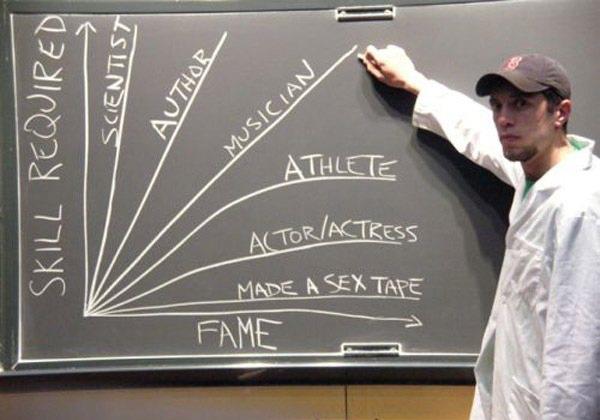
You can always trust a guy in a lab coat, they know stuff. This relationship of skill required versus fame really does show that I have really decided to limit my levels of fame. Scientists aren’t really cool enough to be famous, authors are similarly nerdy, just better with words. Maybe it is time for scientists and authors to start making sex tapes.
Like everyone else with a pulse, I’m a Monty Python fan. Whether it be a killer white rabbit or a very naughty boy, there is nothing quite like the laughs that a Python sketch can illicit. I recently found this lecture that John Cleese gave on creativity. It is quite interesting the ground he covers and the conditions that are needed to be cultivated in order to be creative. Hope everyone gets as much out of this as I did.
I’ve been making my way through most of the Preston and Child novels, enjoying each in turn, so I thought it was time to hunt down some of their individual efforts. My local library happened to have Blasphemy on the shelves, which came home with me for a few days.
This is a very well written book. Not only is it intriguing, it weaves in several themes, allegories, allusions and straight up social commentaries. At the same time it is a fast paced thriller. I really enjoyed it.
Of course the title is likely to make some people a little nervous about reading the book. It should be made clear that The Flying Spaghetti Monster is not mentioned, nor is his noodliness likely to be happy with the religious comments – beer and pirates are not mentioned once. No doubt some will be offended, especially if they swear blind that Sam Harris and Richard Dawkins have horns and pitch forks. Everyone else will enjoy this interesting and fast paced novel.









 This article was originally published at



 Tyson Adams