Angela at Books and Opinions posted one of those lists where you are meant to pick either/or. In true Tyson Adams fashion – which has suddenly grown to referring to myself in the third person – I’m going to ruin the list with my answers.
1) Paper or Digital?
Both. They’re both books. I like books. And repeating words.
2) Romance or Sci-Fi?
I love science, so sci-fi.
3) History or Current Events?
I remember back when history was current events.
4) Hercule Poirot or Sherlock Holmes?
Sherlock Holmes because he likes music, logic, and drugs. Lots of drugs.
5) Twilight or Hunger Games?
Blade or Battle Royale? Have to say Blade.
6) Jane Eyre or Anna Karenina?
I’ve ignored both equally.
7) Harry Potter or Narnia?
Living in a cupboard or travelling through one: tough choice. Have to go to the sorting hat for this one.
8) History or Biography?
To be honest, not a fan of either. Especially if it is the history of a sport or biography of a sportsperson. Or the history of biographies.
9) Stand Alone story or Series?
Series has the advantage of telling a story over many books. Stand alone has the advantage that the story isn’t dragged out over many books. There’s a lot to be said for both.
10) Dante or Tolstoy?
Dante has far more literary nerd cred for those trying to impress people on the bus/train.
11) Sauron or Jadis the White Witch?
Jadis hands down. Sauron isn’t even in the same race. He’s like the annoying sidekick.
12) The Hardy Boys or Nancy Drew?
The Hardy Boys and their jalopy, overt racism, and old-timey values.
Have you ever written something sarcastic only to have someone take you seriously?
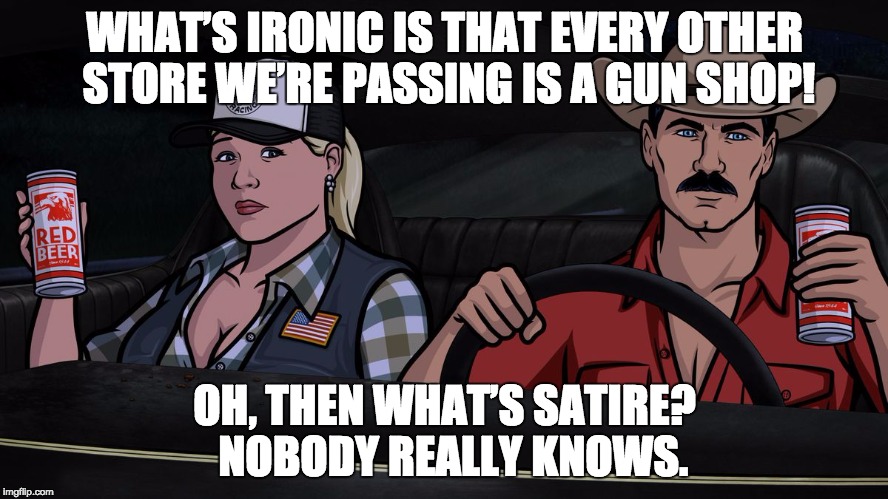
Have you tried to be ironic but people are confused as to whether you are being serious, ironic, or satirical?
Well, how about we try to bring back the Percontation Point.
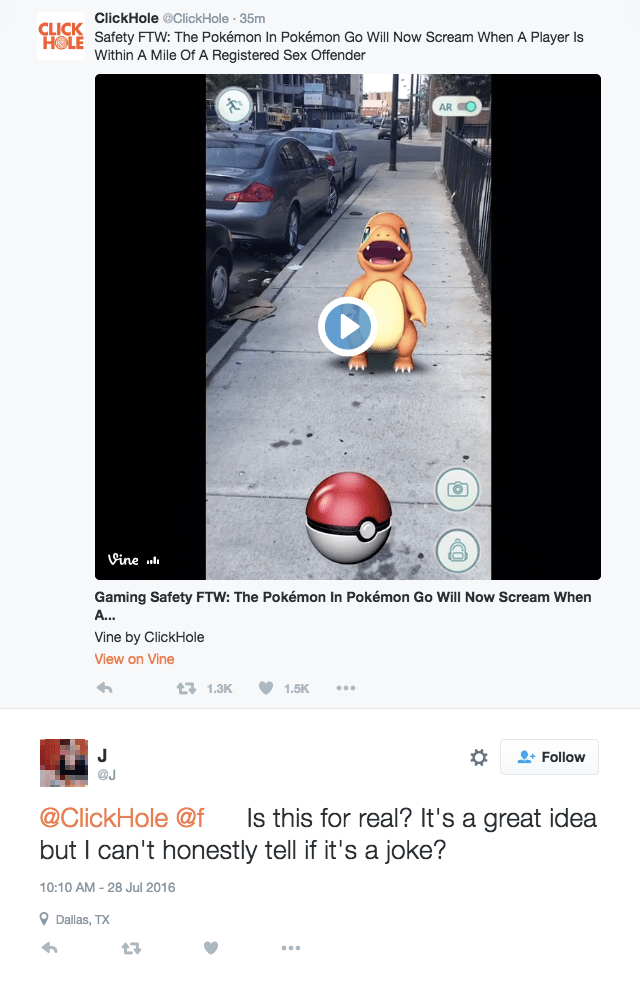
The Percontation Point, or the Irony Mark, used to be a punctuation mark that indicated that the sentence had another layer of meaning to it. With spoken words we get to use tone of voice or facial expressions to make sure people are hearing the other layers. In writing we have to make our layers so obvious that we bash people over the head to make it clear. Even then people will inevitably ask:
So it is clear that writers need to revive the use of the Percontation Point to indicate sarcasm, satire, and irony. It is an essential tool for smart people to use to make stupid people feel even stupider. Which makes it the best punctuation mark of all.
The Fast and Furious series continues to make money at the box office. I have previously summarised the movies but it is time for an update.
The Fast and the Furious
Vin Diesel and Paul Walker prove that by combining the acting chops of Keanu Reeves and the charisma of Patrick Swayze you can recreate Point Break with cars.
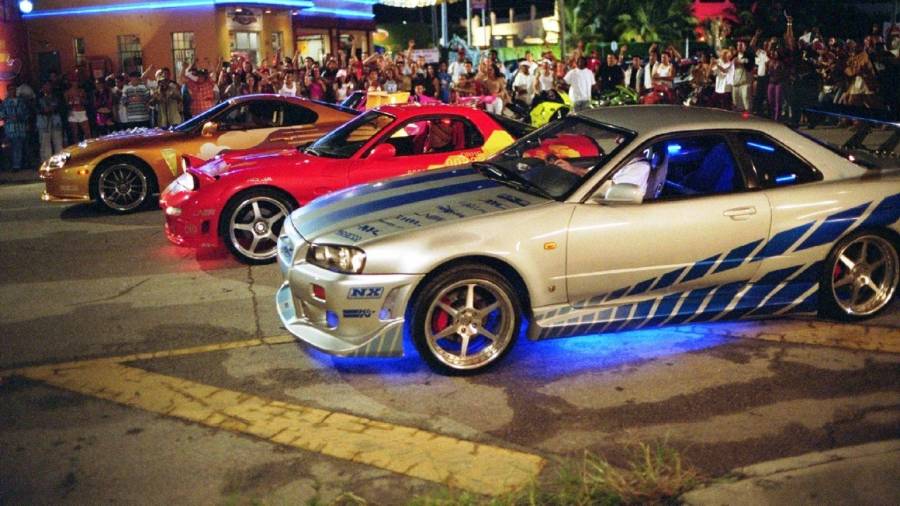
Fun Fact: Boys under 25 were inspired to buy Toyota Supras by this movie. Failing that, they attached hi-flow exhausts to their Hyundai Excel.
2 Fast 2 Furious
Diesel was 2 busy and subsequently introduced Tyrese Gibson to the series. Thus started the series long question “What is he doing here? Is he the comedy relief without the comedy? Why hasn’t he been accidentally shot yet?” Fun Fact: Someone actually thought you could replace Diesel with Gibson.
The Fast and the Furious: Tokyo Drift
Lucas Black and Bow Wow make Diesel and Walker look like Shakespearean actors. Even with the most cars and jailbait in skirts, we still wonder how this is a Fast and Furious movie.
Fun Fact: This movie got made. No-one is quite sure how.
Fast & Furious
Diesel and Walker return to remind us that as unlikely as it would seem, they make this series work. I’m sure there was a plot and stuff probably happened. Cars exploded though.
Fun Fact: This wasn’t released direct to DVD.
Fast Five
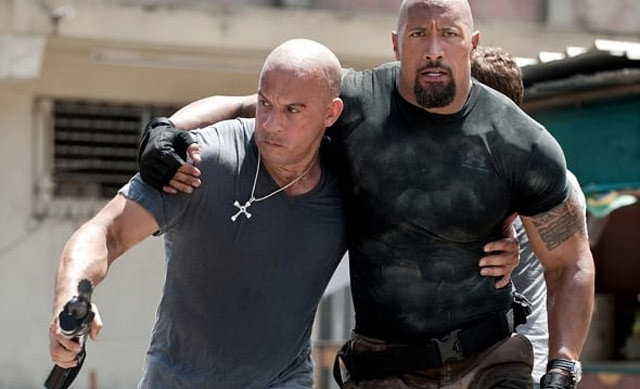
The Rock is introduced and immediately this series becomes awesome. Diesel realises The Rock is in this film and spends the next few films trying to buff up and look half as intimidating as a single eyebrow raise from The Rock.
Fun Fact: The Rock is in this film!!
Fast & Furious 6
The Rock gains an endorsement from Under Armour and Johnson’s Baby Oil to help hold this film together. Characters get resurrected. Others die. We are painfully reminded that street racers are not professional mercenaries.
Fun Fact: Tanks and Planes can be destroyed with sports cars. Engineers and the military are working together to figure out how they got things so wrong.
Furious 7
Hey look, we just made a billion dollars with this movie. Pretty impressive for a movie that is a loosely strung together series of set pieces designed by a kid with a Hot Wheels obsession. The heroes also decide that they want to see how many innocent people they can get caught in the crossfire for the final showdown.
Fun Fact: They actually did a touching send off for Paul Walker.
The Fate of the Furious
The Rock and Jason Statham are now the stars of the series. They have all the coolest scenes and make you gloss over the various characters who have disappeared.
Fun Fact: Did you know that Lamborghinis were bulletproof? Apparently a grappling hook goes straight through the door but not any bullets. Amazing engineering.
Future Fast and Furious movies?
Fast and Furiosa
Charlize Theron returns as the villain. The Rock and Statham join forces to stop the Imperator. Diesel fights for relevance in the series with huge doses of steroids. They probably use cars despite them not making sense for the plot.
Furious and the Walking Dead
CGI advances to the point where Paul Walker is resurrected for the series. This once again gives Vin Diesel relevance to the series. The Rock and Statham pull out the zombie fighting kit and attack the uncanny valley.
Previously in What’s the Difference? the Cinefix team have covered The Fellowship of the Ring and The Two Towers. So it is time to wrap up their coverage of Lord of the Rings with The Return of the King… and enough partings to make you think you are a hairdresser.
A lot of epic stuff happens in the last third of the Lord of the Rings. A lot of tearful goodbyes happen as well. Honestly, when you are reading the paper version you reach the first ending and can’t figure out why there are so many pages left. By the third ending you start wondering if it will ever end.
As I’ve previously discussed for the other instalments, I think the movie is a fantastic adaptation. The minor changes, like Sam not putting on the ring, don’t make much difference – but that one didn’t make much sense either. The major differences are actually quite welcome. Except one.
First I’d like to comment on Sam not wearing the ring. I actually thought that whilst being a minor point, it was also very important to his character and the later act of carrying Frodo. Sam experienced just for a short moment the burden Frodo bore. It helped him redouble his efforts. And also made for a more believable way for Sam to infiltrate the Orc camp.
The major difference that I thought should have been in the film was the reclaiming of The Shire from Saruman. Obviously we’d already had too many endings and needed another one like an extra hole in our heads. But the heroes returned from war to a village ignorant/indifferent to the war and the sacrifice – can anyone say Vietnam vet myths? That isn’t really a happy ending. By having the heroes come home and expel the evil from their village as well, it would have shown their growth as warriors, but also tied their sacrifice to the people they had defended…. Plus, it would have been another action scene in a boring section of the film.
Now that Cinefix have finished with Lord of the Rings it is hard to know what they will cover next. Fingers crossed that is a 6 video coverage of the 3 movie adaptation of the 1 book story The Hobbit.
Edit: Since posting this article I’ve come across a video that explains why the ending of The Return of the King feels so long. The video below argues that it isn’t too long, but rather there is a gap between when the plot finishes and where the story does.
Of course, there is a 30 minute gap between the plot finishing and the story ending. The tension has been resolved so the film feels to drag on, entering Ending Fatigue. 30 minutes out of 558 is 10.7% of your run time devoted to that gap. That’s a lot of time. If they had managed to use less screen time for the story ending/s then we wouldn’t have noticed. Or if people were first watching the films in a marathon, such that 30 minutes out of +9 hours feels shorter, then they’d notice less.
I have written previously (here, here) about how people like to pretend they have read something they haven’t. To summarise my take on this phenomenon: Stop it!
People claim to have read books (1, 2, 3, 4) and watched movies they haven’t in order to appear more intelligent. From the new list that I will discuss below, you have to question who they are trying to impress by claiming to have read Dan Brown and Stieg Larsson.
Impressing people is what this is all about. We all have an inability to admit we like (or dislike) stuff because others may have a subjectively different taste and ridicule us. We even come up with the fake term “guilty pleasure” to describe something we like but are ashamed of for some reason. There shouldn’t be guilty pleasures, only pleasures… unless that pleasure is illegal or immoral or both – such as the movies of Uwe Bole.
This new list of lied about books comes from a poll of 2,000 UK adults. In it 41% of respondents admitted they fibbed about what, and how much, they read. This was part of The Reading Agency‘s look at reading habits. It found that 67% of respondents would like to read more, but 48% claimed they were too busy to read… but caught the game on the TV and did you see those new cat videos? Another interesting point was that 35% said they struggle to find a book they really like, and 26% want recommendations from someone they know. I.e. reviews are important.
As you will see from the list, most of these books have been turned into movies. That was probably why people lied. They wanted to impress people in a discussion but couldn’t just admit that they had only watched the movie. Hint: us readers can tell you haven’t read the book.
1. James Bond novels by Ian Fleming
I can’t claim to have read many of the James Bond novels – one, I’m pretty sure I’ve only read one. But I have watched most of the movies at least once. For my own part, the reason I haven’t read more of the books is partly lack of interest, and partly making time to catch up on older novels. There are a lot of influential authors and novels I’m yet to have a chance to read. Plus I’ve heard that the books have far fewer explosions.
2. The Lord of the Rings by J.R.R. Tolkien
Admittedly I read the novel after the first movie came out – or possibly only finished it after the first movie came out. I’ve covered this book recently as part of my Book vs Movie discussions (1, 2, 3). I don’t think you can blame people for watching the movies instead of reading the book. The book is long, waffly, and at times difficult to parse. The movies are only long and awesome.
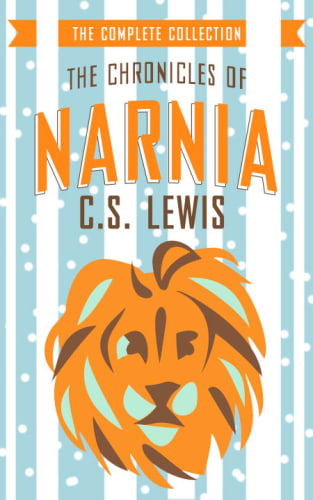
3. The Chronicles of Narnia by C.S. Lewis
I’ve only read six of the seven Narnia novels. I read this series when I was young and pretty much lost interest before reading The Last Battle. The first two novels (chronological, not published) are well worth reading, but I can understand people not bothering to read the rest. I can also understand people having watched the movies and decided not to read the books. The movies are only okay, which is generally not enough to encourage most people to read books.
4. The DaVinci Code by Dan Brown
Apparently The DaVinci Code is one of the most read books of all time…. if you just go by book sales. I have a love-hate relationship with Dan Brown’s Artefact McGuffin Adventures. While I have read two of Brown’s novels, I actually prefer other authors who write superior Artefact McGuffin Adventures. Can’t really blame people for watching Tom Hanks run around historical places instead of reading about Robert Langdon.
5. The Hunger Games by Suzanne Collins
I can honestly say I haven’t read this book, nor been interested in doing so, despite the paperback being on our shelves. The movies didn’t exactly inspire me either. The main reason I haven’t tackled it is that my wife only thought it was okay and similar to Divergent by Veronica Roth.
6. Trainspotting by Irvine Welsh
I didn’t even realise the movie was based on a book until relatively recently. I’m sure most people will have seen the movie and assumed the book is pretty similar.
7. The Wonderful Wizard of Oz by L. Frank Baum
Another book I haven’t read and one I’m not really interested in reading – nor the rest of the series for that matter. I’m not sure why anyone would claim to have read this book when they haven’t, unless they want to say “Oh, the books are so much darker” when the movie is being discussed.
8. Bridget Jones’s Diary by Helen Fielding
Another novel that is on our shelves thanks to my wife. The impression I have of the main character is that I would probably not enjoy this, especially since I try to be out of the room when people are watching the movies.
9. The Girl With the Dragon Tattoo by Stieg Larsson
Ugh. I read part of this book before shredding it and using the remains to create a nest for a family of rats. Even the Wikipedia synopsis of the novel bores me to tears. Any “thriller” that starts with ten pages of descriptions of flowers, followed by a few more pages discussing home renovations had better make them giant mutated flowers with Uzis that are renovating the home with explosives. If only people would stop talking about this book so that people would stop talking about it as though it was good.
10. The Godfather by Mario Puzo
I bought The Godfather from a bargain bin next to a pile of remaindered books. The only reason I decided to buy and read it was that the movie was/is a classic. It is probably fair to say that most people only ever considered reading this because of the movie, so it is no surprise that people inflate that from considering to have read.
11. One Flew Over the Cuckoo’s Nest by Ken Kesey
I have neither read this book nor watched the film. My entire understanding of this book comes from Thug Notes. That’s enough for me.
12. Gone Girl by Gillian Flynn
This book certainly isn’t for everyone. When I reviewed it I called it literary crime fiction, which puts it between genre fiction that people like reading, and award-winning stuff people only pretend to like reading.* That means it could attract people from both audiences, or annoy both audiences – yes, I am assuming that those two audiences are disparate entities that share nothing in common. So I could see why some people would claim to have read this novel, what with the awards, and praise, and movie forcing them to either admit something about their reading habits or to make some facile excuse for not having read it yet.
13. The Kite Runner by Khaled Hosseini
This book has the dubious honour of being a novel I was only aware existed as a result of it appearing on these lists of books people claim to have read but haven’t. Maybe this book doesn’t actually exist but is inserted into these reading lists as an internal check for the survey of readers. Let’s see who notices that this book is fictional fiction.
As you can see, it is easy to admit which books you have and haven’t read. Some books you may not want to read. Some you may not have had a chance to read yet. Some you might only be aware of due to the movie adaptation. The main thing is to acknowledge the truth so that entertaining books are promoted (review books, but do it the right way), rather than dreck that people haven’t read but assume is entertaining. And if you want to continue to lie about books you’ve read, here is a summary of some classic novels:
This slideshow requires JavaScript.
*Yes, that is me being snobby. Yes, I am meant to be against that judgmental stuff. Yes, I am a hypocrite at times.
Last month Cinefix covered The Fellowship of the Ring. This month they cover The Two Towers with What’s the Difference?
For me the middle third of the Lord of the Rings was both the most enjoyable and most annoying. As mentioned in the video, there are three tales running separately and rather than moving between these tales as they unfold in the narrative, we jump back to start again for each perspective. The book has some of the most memorable moments in this section – I may or may not have named one of my computers Entwash – but the order of events feels confused. Sorry, not confused, more drawn out, which for a novel that includes a hell of a lot of walking is something unneeded.
As with The Fellowship of the Ring, I think the movie is a fantastic adaptation. Seeing the battles brought to life was certainly a highlight. Nothing quite like watching Ents smash up Isengard rather than just reading about it.
Next month we’ll see the last instalment from Cinefix. Well, until the 6 video coverage of the 3 movie adaptation of the 1 book story The Hobbit.
Time for some ultra-violence with this month’s instalment of CineFix’s What’s the Difference?
Video: A Clockwork Orange – What’s the Difference?
I can’t remember if I read the book or watched the movie first. A Clockwork Orange was a novel in my parents’ collection of novels, which is why I turned out so well. I do remember the novel wasn’t as easy to consume as the movie, mainly because you can interpret spoken language more easily than understanding the lexicon employed in Burgess’ written words.
This may be a somewhat shocking statement, but I’m not much of a fan of Stanley Kubrick’s films. I always found them somewhat bland, as though there were a lot of empty space on the screen. As such, there are parts of the film I find to be bordering on dull, and others that strike me as weird and hammy (such as the scene with Alex’s parol officer). Meanwhile, the book managed to be entertaining and yet critical of youth culture whilst discussing free will.
It is ironic that I would enjoy a book that is critical of “kids these days”. But the fact that it was written in 1962 only further proves my point that complaining about the younger generation has been a popular pastime for old people since the invention of young people. Oh, and free will probably doesn’t exist.
Since everyone else is blogging about their most popular posts of the year, I thought I’d jump on that bandwagon. I love bandwagons. Especially if they have drinks.
I’ve been blogging for 6 years now and the views, readers, and regulars has been gradually increasing. So a big thank you to everyone for joining me here.
Who’d have thought a listicle would be the most popular thing I’ve written? Originally written for one of those comedy list sites, I’m glad so many have enjoyed this one.
Before people were aware of what a dangerous kook David ‘Avocado’ Wolfe was, I wrote this piece dissecting his memes. I did try to get this published in a science magazine, but apparently Wolfe doesn’t like people reproducing his content… a lot of which is stolen from other creators. I like that I was ahead of the curve on calling this guy out for his dangerous nonsense.
This article needs to be rewritten and published somewhere with a huge platform. It could then be used as a regular rebuttal to every whiny piece complaining about the younger generation.
One of a few posts I wrote in response to anti-technology pieces that were being circulated through writing groups. It annoys me when bad studies or preliminary studies are cited as the final answer on a subject. It annoys me more when those same studies are misrepresented because someone is pushing an agenda. I’m glad people actually read this response.
This article is a response to a question from a reader. It is another article addressing an anti-technology piece that was being circulated, this time on GMOs. A version of it appeared in Skeptic Magazine without the yeti cocaine addict joke.
When I pitched this article the response was deafening silence. It was also my most down-voted item on Reddit. Apparently we don’t talk about sports negatively. Especially not if you back it up with facts. I’m glad people here have enjoyed it.
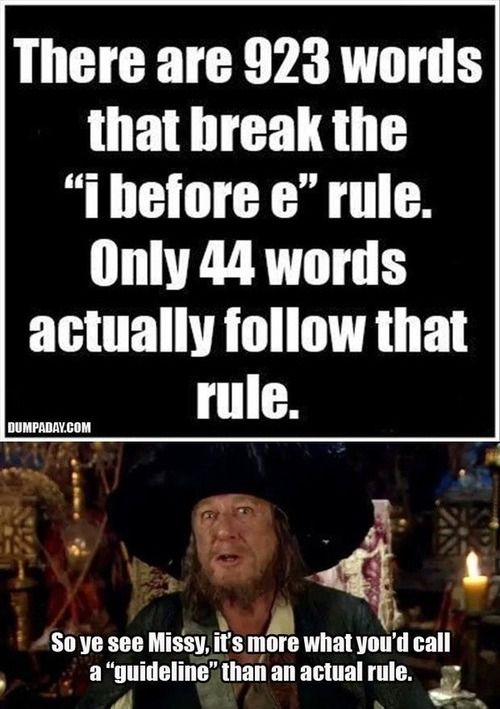
That’s right. Never trust anything the grammarians say, with their “rules” and mnemonics.
Apparently the 923 words figure comes from a QI fan who crunched the numbers from Scrabble. Most of the words are more obscure, so the rule is probably okay for the average person, and invaluable to football commentators.
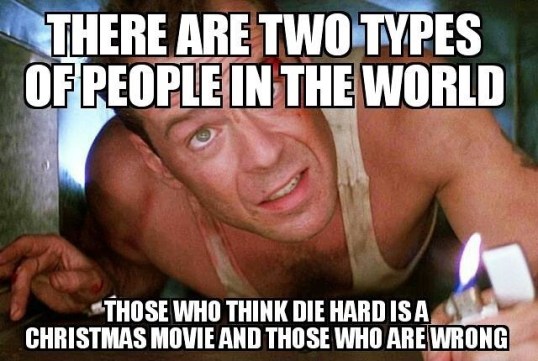
Picture: There are two types of people in the world, those who think Die Hard is a Christmas movie and those who are wrong.
What better time of year for CineFix to do a What’s the Difference? episode on the best Xmas movie of all time!
Video: Die Hard – What’s the Difference?
Video: Die Hard – Lost in Adaptation.
While I have gotten my grubby hands on the Roderick Thorp novel (Nothing Lasts Forever), I must confess to not having read it as yet. It is probably a good thing I don’t mind spoilers. Hope you don’t mind either, because, you know, spoiler alert.
The differences between the two endings are interesting. Having the watch moment with McClane’s wife/daughter play out differently, and Dwayne Robinson’s sacrifice, would not have made this a classic Xmas movie. So it makes sense that the movie’s creative team changed those things to make this a more upbeat ending.
Enjoy the season rewatching all the Die Hard movies… except A Good Day to Die Hard: that is an abomination and an offence against not only cinema but the good name of Die Hard.
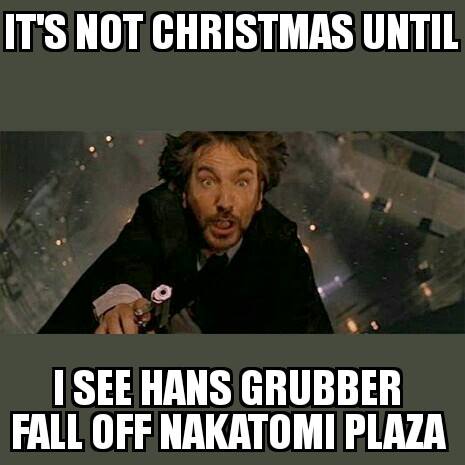
Picture: It’s not Christmas until I see Hans Gruber fall off Nakatomi Plaza.
Recently a video of a man punching a kangaroo that was trying to…. Actually, have you seen the video? Do you reckon it was? I mean, you know. Nudge nudge, wink wink. Anyway, the kangaroo is all over the man’s dog and the man valiantly defends the dog’s honour with a nice right cross.
As a result of this internet sensation, my article on dangerous Aussie animals has become quite popular. In that article I discuss the National Coroner’s data report from 2000 to 2010 and give flippant explanations for the death tolls. Some people liked my article so much that I’m being quoted:
KANGAROO ARE SERIOUSLY DANGEROUS
Kangaroos can seriously injure or even kill a man with their powerful hind legs. As per Tyson Adams*, Kangaroos are one of the ten most deadly animals in Australia. The site ranked buck on fifth place claiming that the species has 18 deaths to its name. It further mentioned that though Kangaroos look loveable and cuddly, underneath that skin lays a nasty, vicious bully.
There are a few things to unpack here:
They don’t mention how ruggedly handsome I am.
Kangaroos do rank in the top ten deadly animals…. but;
Worth noting my explanations of how kangaroos managed to kill people, which was from traffic accidents;
Worth noting that 18 deaths in a decade is officially classed as SFA by the Coroner;
Worth noting that I also referred to kangaroos as modern-day, sleepy, vegetarian, T-Rexes.
While I’m flattered that people are reading and referencing my article it would be nice if they had understood the point I was making. Yes, that would have required the TechPlz people to read the entire piece rather than just the bit about kangaroos, and it would also have meant comprehending how cows could make Rambo look like a cub scout. I feel that they should have been referencing that the 18 deaths were over a decade. Or referencing that they ranked 5th based upon a coroner’s report (with a little artistic license in the rankings from me). Or that citing a coroner’s report doesn’t make the deaths something I’m claiming so much as the official statistics on the matter. Or that Aussie animals aren’t anywhere near as dangerous as we Aussies like to make out. Or that linking to my article would have been nice….. Yeah, it’s mainly the last point: I want the traffic.
I suppose the main thing is they spelled my name correctly.
Most states also have writers’ centres that run events and courses. Writers’ Centres
Several universities run creative writing courses. My friend and author, David Whish-Wilson (read his books, they are great), teaches creative writing at Curtin University in Western Australia. There are plenty of courses available via Open Universities online.
Another option are centres like the Australia Writers’ Centre who run various courses year round. I’ve done a course with them myself. My friend and author, LA Larkin, also teaches a course at the AWC.
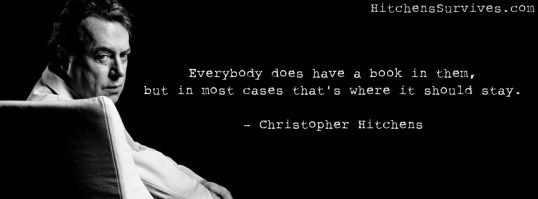
But when all said and done, the primary way to learn to write is by doing it. But before you do remember the above sage piece of advice from the late, great, Christopher Hitchens.
Is The Crow one of your favourite cult movies? Well, it should be. CineFix discuss the movie and the comic it was based upon in this month’s What’s the Difference?
The Crow remains one of my favourite films, which probably says a lot about my teenage years. The comic it is based upon, however, was not a book I enjoyed reading.
As the video mentions, author James O’Barr wrote the comic as a way of coping with the death of his girlfriend at the hands of a drunk driver. The book is bleak, and when not being directly about revenge, it is darkly introspective and depressing. The main character is clearly a form of Super Id – drawn as lean, muscular, 6’5″, invulnerable, unstoppable – and acts as a form of cathartic revenge against a cruel world. That might be fine for a Steven Seagal movie, but there’s a reason why you had to look up who Seagal was just now.
The movie is an example of a great adaptation, especially considering the film couldn’t be completed as intended after the unfortunate death of Brandon Lee. They managed to capture so much of the tone and character of the book whilst not making a movie that would have you slitting your wrists halfway through. The video refers to this as Hollywoodising, but I think they are being too harsh. The story was a revenge tale, but the movie manages to create an actual character arc and have more compelling bad guys. Case in point: Michael Wincott’s Top Dollar. The movie also trims off the bleak stuff in favour of a more cohesive narrative. This is why I had a poster from the movie on my wall and gave the comic away.
I love creative writing and I’m good at university dissertations, but when I try to write a story, I struggle and the writing is often awkward. Yet I love doing it. What pratical guides or reading list would you recommend for people who wish to masted the art of writing and creative writing?
Creative writing is as much about practice as it is about any advice you can read in a book. Part of that practice is writing, part of it is editing your own work, and part of it is reading to see how others construct their prose.
Essentially, if you already know the mechanics of how to write, then the part that is missing is the hours and hours of practice and analysis of that practice.
That said, there are plenty of manuals on style and grammar that would be helpful. E.g. Strunk and White’s Elements of Style is regarded as a classic of writing.
I personally think Stephen King’s On Writing is a must read for any author.
People around the world may be familiar with Pub Rock thanks to a little known band called AC/DC. They and many other rock bands were touring at a time when the live music scene revolved around the Aussie Pub. As a result, the music, and particularly the lyrics, reflected this.
Bush Ballads are the lesser known and more antiquated Aussie music style. Think of it as folk music written by people who loved sheep a bit too much. As a mix between love of rural Australia, folk music, country music, and oldy time-y nostalgia, the genre is less popular now than when gramophones were a thing. That isn’t to say that Bush Ballads had no influence, as Waltzing Matilda is regarded as the unofficial national anthem, and some songs have gained international audiences from cover versions (see Dr Hook example below).
Indiginous music as it stands today would generally be better referred to as fusion. This is because it combines traditional Indiginous musical styles and instruments and fuses them with other genres (rock, hip-hop, rap, country, etc). What makes it such an Australian genre is the cultural themes and lyrical content, which is very unique.
I’ve been a fan of martial arts for as long as I can remember. While I’m not a fighter (I’m a pussy) I have great respect for the athletes that beat the crap out of each other for our entertainment. I also love a bit of choreographed hijinx in films as well.
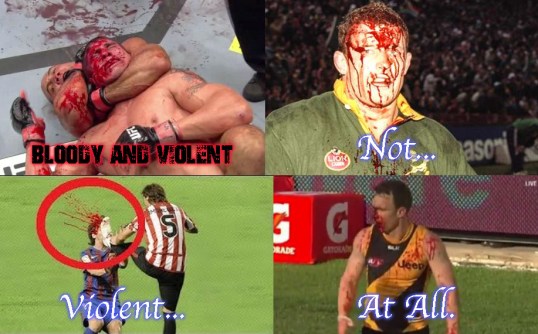
But for some reason there are people who don’t share my love and respect for people punching each other in the face until someone carts them off on stretchers. They decry boxing and MMA as bloody and violent sports that should be banned – won’t somebody please think of the children! At the same time they blithely ignore the injury and deaths from good old harmless football et al.
So I thought that I would run through a few of the statistics and studies on those violent sports to see if the claims stack up. Yeah, you know what’s going to happen: don’t you!
Let’s start by looking at boxers and MMA fighters: just how likely are injuries and knockouts? Well, a study of 1181 MMA competitors and 550 boxers found that boxers were less likely to suffer the cuts and bruises of MMA fighters, but they were more likely to be knocked out.
Boxers were significantly more likely not to experience injury (49.8% vs 59.4%, P < 0.001), whereas MMA fighters were significantly more likely to experience 1 injury (typically contusion/bruising, P < 0.001). Boxers were more likely to experience loss of consciousness (7.1% vs 4.2%, P = 0.01) and serious eye injury (1.1% vs 0.3%, P = 0.02).
This makes sense given that there are more ways to win an MMA bout than by points, KO, or bookmaker arranged dive. Also the overall injury rate in MMA fights of 8.5% is surprisingly low for two people beating the crap out of one another.
The overall injury rate was 8.5% of fight participations (121 injuries/1422 fight participations) or 5.6% of rounds (121/2178 rounds). Injury rates were similar between men and women, but a greater percentage of the injuries caused an altered mental state in men. Fighters also were more likely to be referred to the ER if they participated in longer bouts ending in a KO/TKO.
Other studies have found higher rates of injury, 28.6%, but have similar conclusions regarding the types of injuries – facial cuts and bruises – being higher than boxing, but knockouts being lower.
Part of this is down to the small, fingerless gloves used in MMA. Less padding, that is mainly there to protect the hands from breaking with every punch, leads to a different force being applied to the opponent’s face.
All padding conditions reduced linear impact dosage. Other parameters significantly decreased, significantly increased, or were unaffected depending on padding condition. Of real-world conditions (MMA glove–bare head, boxing glove–bare head, and boxing glove–headgear), the boxing glove–headgear condition showed the most meaningful reduction in most of the parameters. In equivalent impacts, the MMA glove–bare head condition induced higher rotational dosage than the boxing glove–bare head condition. Finite element analysis indicated a risk of brain strain injury in spite of significant reduction of linear impact dosage.
Okay, so how do these nasty violent sport stats compare to less violent sports? What is the chance of dying in MMA or boxing compared to, I don’t know, horse riding? Well, a 2012 study from Victoria found motor sports, fishing, equestrian activities, and swimming all led to more deaths in a year than boxing. That’s right, riding a horse or going fishing is deadlier than standing in a ring getting punched in the face. That brutal and nasty boxing didn’t even make it into the top ten.Hell, even real life is more dangerous, as another study found motor vehicle accidents and falls were far more likely to kill people than boxing or any other sport. It’s almost as though the controlled forum of a boxing ring or MMA octagon are somehow stopping things getting out of hand.
The Victorian study is only looking at one state in Australia, so hardly representative of the entire world, and only looked at 2001-2007, which isn’t a huge time span, but the results are still very interesting:
There were 1019 non-fatal major trauma cases and 218 deaths. The rate of major trauma or death from sport and active recreation injuries was 6.3 per 100,000 participants per year. There was an average annual increase of 10% per year in the major trauma rate (including deaths) across the study period, for the group as a whole (IRR 1.10, 95% CI, 1.06-1.14). There was no increase in the death rate (IRR=0.94, 95% CI, 0.87-1.02; p=0.12). Significant increases were also found for cycling (IRR 1.16, 95% CI, 1.09-1.24) off-road motor sports (IRR 1.10, 95% CI, 1.03-1.19), Australian football (IRR 1.21, 95% CI, 1.03-1.42) and swimming (IRR 1.16, 95% CI, 1.004-1.33).
Did you take that in? I’ll let the authors summarise:
The rate of major trauma inclusive of deaths, due to participation in sport and active recreation has increased over recent years, in Victoria, Australia. Much of this increase can be attributed to cycling, off-road motor sports, Australian football and to a lesser extent swimming, highlighting the need for coordinated injury prevention in these areas.
But is this representative? UFC boss Dana White likes to compare his sport to NFL, as MMA fighters are kept sidelined after concussions for longer than their football (should be hand-egg, but let’s not quibble) counterparts. According to a report made by One Sure Insurance, the fact remains that under all that protective gear used to play rugby, NFL players are hitting each other with the (padded) equivalent force of a car crash. Studies of brains show that all contact sports are bad for the brain. Even Soccer (or is that Football?) players are at risk of brain injury. MMA like to keep their fighters healthy, whilst most sports want their players back next week to go again.
I keep seeing these claims about MMA or boxing being dangerous to health. Meanwhile, football, rugby, gridiron, that skating sport that Canadians jizz over, all seem to have just as much chance of injury or death. Essentially, we can easily list a dozen sports more dangerous than fight sports (seriously, cheerleading: WTF!). But that doesn’t really matter. The main thing is to know the actual risks so that athletes (and spectators) are making a well informed decision. Because as much as horse riding is bad for your health, it is also boring to watch (NB: personal opinion and quite a snobby one at that) so people won’t really care about another death in that sport. Whereas a death in an exciting sport like MMA is much more visceral and likely to have spectators on hand. Hard to compare horse riding to MMA, unless we had Kentucky Thunder step into the octagon.
The main problem I see with the “MMA is violent and dangerous” or “Boxing is a brutal sport” and “They should be banned” (please, think of the children!) is that it assumes fighters are unaware that being punched in the head is bad for their health. Do people really think that fighters love being knocked out or injured, instead of just spar that vast variety of dummies (e.g. these mmalife.com/the-6-best-grappling-mma-dummies/)? Even UFC and Boxing acknowledge that they need to understand the risks of a career of head-butting people’s fists.
It could be argued that young athletes are unaware of the risks of being an athlete, what with the naivety of believing they are bulletproof and will be young forever – don’t worry kids: you’ll be cool your entire life. People do have a fascinating ability to ignore long term risks in favour of short term gains. UFC champion George St Pierre reportedly retired from MMA due to persistent headaches (maybe). So it is important that athletes are made aware of the risks of injury and long term debilitation, with further research in this area being essential – yes, there is an echo in here. But it also has to be acknowledged that athletes aren’t exactly unaware of the issue. George Foreman was aware of the risks of eponymous naming of kitchen appliances, but the money was good. He was also aware of the risks of being a boxer, and named his kids George so he wouldn’t forget them – “You have to plan for memory loss in boxing.”
Then there are those that see fighting as entertainment for lowlifes and thugs. That somehow only the uneducated or the uncivilised enjoy seeing two people belt each other around the head. This is, of course, just more of the “I don’t like it, therefore it is bad and only poo-poo heads like it” argument that snobs like to make. Nothing like playing the moral and intellectual superiority card to denigrate something. Ignorance is always funnier when someone thinks they are superior.
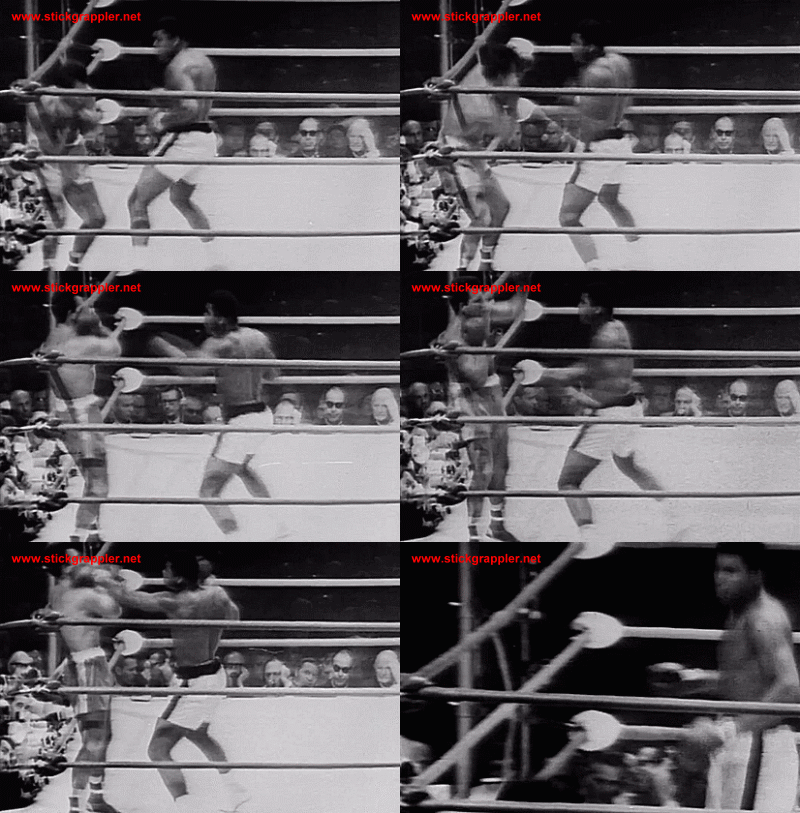
Some argue, as the AMA does, that the intent of boxing and MMA is to belt each other senseless. If all you see in fighting is two people trying to kill one another, then you aren’t watching. You’re distracted by the superficial aspects of the events. Insights that shallow just show an ignorance of what is happening in the ring. In MMA and boxing there are many ways to win a fight, as already alluded to above. Take for example this famous clip (more here from my friend Stick):
Now the superficial view of the video has us watching Ali wailing on a guy against the ropes. Obvious, but not the reason this is classic boxing footage. Boxing fans would point out Ali’s footwork, the athleticism and skill involved, the amazing speed, and the fact that his opponent is seriously outclassed. Boxing isn’t just about punching your opponent. Watch what happens when someone tries to reverse the tables with a flurry of punches thrown at Ali:
This is athleticism defined. This is why Ali is still regarded as such a great fighter, as it takes far more than turning your opponent’s brain to mush to win a fight. And that is what non-fight fans don’t understand. They can’t get past the superficial to see the sport. They are so caught up in being snobbish and outraged that they missed the amazing athletes doing amazing things.
I adore reading. I read very often, my bare minimum being 4 books a week. But ever since I read ‘The Da Vinci Code’ by Dan Brown, I do not feel satisfied with any book I read. I am hungry for more yet no book seems to satisfy me. What books could satisfy me?
Can I recommend more authors like Dan Brown? Hopefully not. In the Pantheon of thrillers authors, Dan Brown sits proudly atop a pile of money that is only rivalled by James Paterson. They are both great at getting people to read their books, for a reason that is unclear to me.
I have a love-hate relationship with Dan Brown. Dan writes very entertaining novels that are well paced with interesting plots. But he also manages to bash readers over the head with plot points and squeeze in a lot of useless exposition. At times you honestly think he is just bashing at the keyboard like a drunk monkey taking dictation. Personally, I think that Steve Berry and James Rollins, who write a similar genre of thriller, are far better authors. If you haven’t read them already, I’d recommend anything they have written to sate your Brown problem.
There are other authors who dabble in that same genre of thriller who are worth mentioning. I’m a huge fan of Matthew Reilly, who writes insanely fast-paced novels that are great fun. His Jack West Jr series have similar “find the artefact to save the world” McGuffin adventures and has a new instalment in the series coming out in September (2016). Andy McDermott also writes fast-paced Artefact McGuffin Adventures* which are also humorous in parts.
A tool that might help is the Literature Map. While it doesn’t have every author, it does link them together and give you some good ideas. Or they might lead you astray.
This post originally appeared on Quora.
*I think that should be the official classification for this sub-genre of thriller.
Language expert take on Dan Brown novels: “A renowned male expert at something dies a hideous death and straight away a renowned expert at something quite different gets a surprise call and has to take an unexpected plane flight and then face some 36 hours of astoundingly dangerous and exhausting adventures involving a good-looking (and of course expert) member of the opposite sex and when the two of them finally get access to a double bed she disrobes and tells him mischievously (almost minatorily) to prepare himself for strenuous sex. Where are we?” And another.
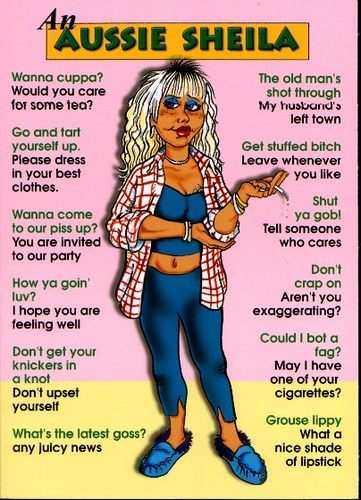
The term sheila means you have strayed far from the path of modern Australian society and have found yourself in the backwaters of the outback. In these dark hollows near stringy-bark trees and billabongs you will find yourself at risk of flamin’ Alf Stewart.
It is generally recommended that you quickly reverse the ute back up that dusty track winding back, turn at Gundagai, and head straight for the nearest inner city cafe, preferably one in Melbourne. The main thing is to pay lots of money for coffee and sit near people wearing corduroy pants or cyclists clad in lycra bodysuits. If the cafe does regular poetry readings, more the better.
Remember, once you have escaped the outback of Australia do not use any of the language you heard on your travels. Referring to a woman as a sheila, or an old person as codger, is likely to see you arrested for stoning the crows.
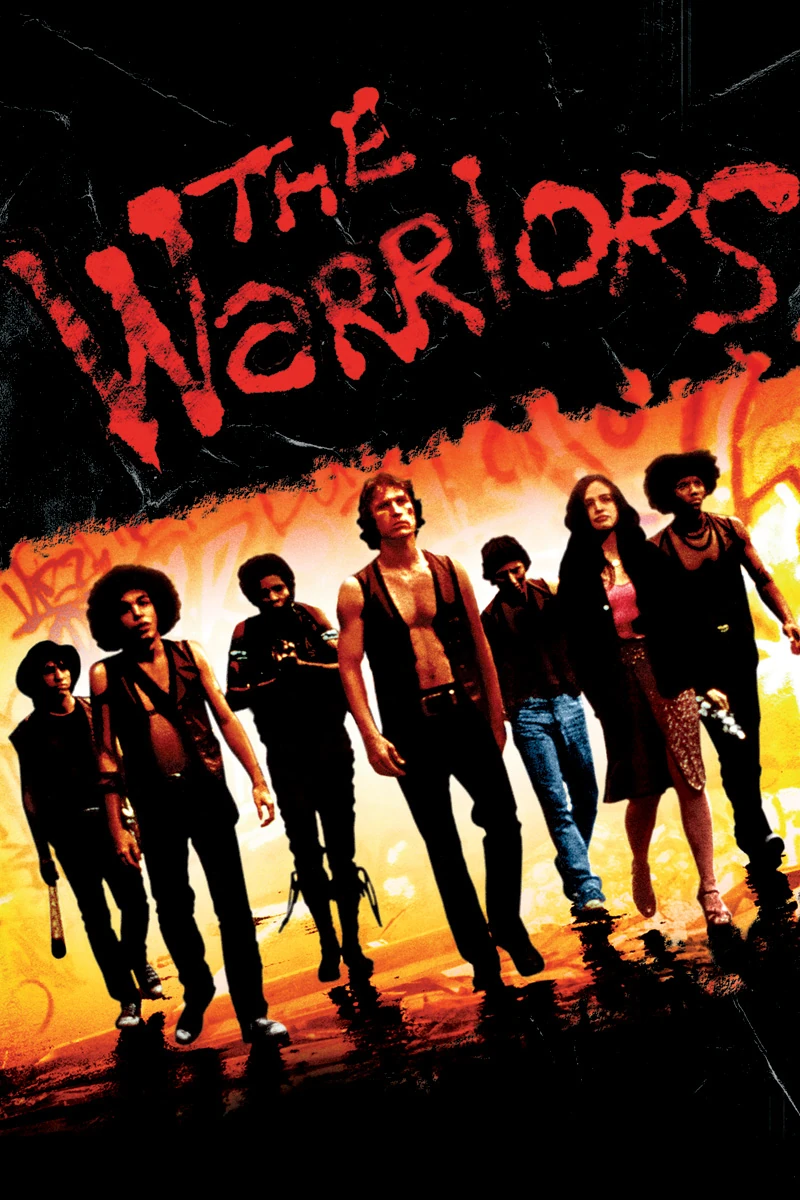
Did you know that the cult classic, The Warriors, was based on a novel? How about that the novel was based on the ancient Greek tale Anabasis? Cinefix explain in this month’s What’s the Difference.
I can’t really comment much on this instalment as I’ve not seen the entire movie, nor read either the novel by Sol Yurick nor Xenophon’s tale. But it is interesting that even a cult action film about street gangs has pedigree origins. This reinforces a point I’ve often made here; that we shouldn’t be snobby about the things other people like. We might like to think that our subjective taste is better but often we don’t even appreciate how biased we are in that taste. A book/movie about a gang on the run could be one person’s retelling of a Greek tale, or it could be another person’s mindless genre piece. Or it could be both.
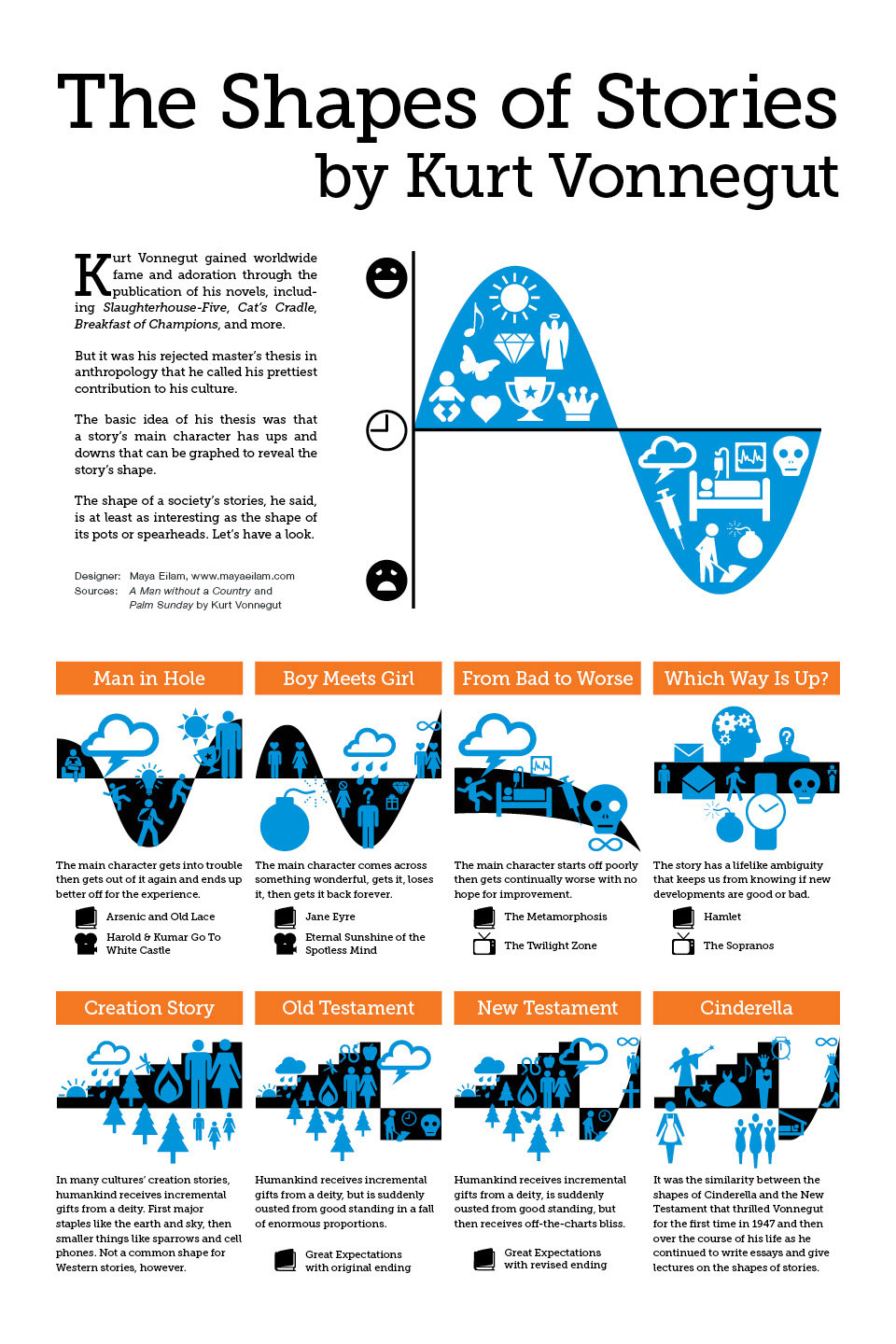
I’ve written before about plots and how there aren’t as many of them as you’d think – somewhere between 1 and 36 depending upon how you want to break them down. Recently there was some research published that analysed 1,737 fiction novels to figure out how the story arcs are constructed. Let’s pretend there is a big difference between a plot anda story arc…
The study used Project Gutenberg – i.e. public domain works – and the results suggest that there are only really six story arcs:
Fall-rise-fall: ‘Oedipus Rex’, ‘The Wonder Book of Bible Stories’, ‘A Hero of Our Time’ and ‘The Serpent River’.
Rise-fall: ‘Stories from Hans Andersen’, ‘The Rome Express’, ‘How to Read Human Nature’ and ‘The Yoga Sutras of Patanjali’.
Fall-rise: ‘The Magic of Oz’, ‘Teddy Bears’, ‘The Autobiography of St. Ignatius’ and ‘Typhoon’.
Steady fall: ‘Romeo and Juliet’, ‘The House of the Vampire’, ‘Savrola’ and ‘The Dance’.
Steady rise: ‘Alice’s Adventures Underground’, ‘Dream’, ‘The Ballad of Reading Gaol’ and ‘The Human Comedy’.
Rise-fall-rise: ‘Cinderella’, ‘A Christmas Carol’, ‘Sophist’ and ‘The Consolation of Philosophy’.
The most popular stories have been found to follow the ‘fall-rise-fall’ and ‘rise-fall’ arcs.
Or for those that prefer to read graphs because it makes them feel intellectual:
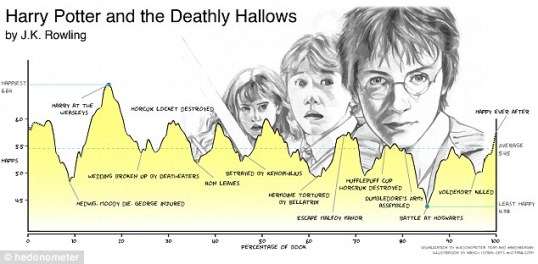
For those that just saw a bunch of squiggles in those graphs, what you are looking at is the story arc plotted over time for each story analysed. They’ve broken these into similar groups then added an average (the orange line). You can see how some of the story arcs follow the average more, whilst some types vary more. To see an individual story arc, they picked out Harry Potter as an example in the paper, but have the rest archived here (Project Gutenberg books) and here (a selection of classic and popular novels). As they note:
The entire seven book series can be classified as a “Rags to riches” and “Kill the monster” story, while the many sub plots and connections between them complicate the emotional arc of each individual book. The emotional arc shown here, captures the major highs and lows of the story, and should be familiar to any reader well acquainted with Harry Potter. Our method does not pick up emotional moments discussed briefly, perhaps in one paragraph or sentence (e.g., the first kiss of Harry and Ginny).
This is all nice and good, but why is this interesting? Well, aside from using my favourite statistical technique – principal components analysis – this study shows that authors create, and the audience expect, structures that are familiar. The fact that two of the story arcs (rise-fall and fall-rise-fall) are the most common emphasises this point. Our ability to communicate relies in part upon a shared emotional experience, with stories often following distinct emotional trajectories, forming patterns that are meaningful and familiar to us. There is scope to play within the formula, but ultimately we desire stories that fit conventions.
So yes, there is no original art being made.
Update: Vonnegut’s take on plots is a good addition here.










 Tyson Adams