The Beastie Boys said you gotta fight for your right to… exist?
The Geek Feminist Revolution is a collection of Kameron Hurley’s essays that tie to the themes of feminism, representation in media, and not putting up with bullshit. Some of the essays also discuss being an author and all the fun that entails.
After finishing this collection I feel remiss for not having read any of Hurley’s work previously. I picked up a copy from the library after my sister recommended it to me – it’s literally the only title they have of Kameron’s. Hurley is passionate, often angry, and always eyeing off ways to make the world suck a little less.
It is difficult to go into specifics given the range of topics covered. Some highlights were around the 20-30% figure and women’s erasure from “the narrative” of history. That statistic is the fairly consistent proportion of women involved in conflicts throughout history. They have always fought, but that is not the way history is told to us. The concept of a dominant narrative that suits and reinforces ruling social structures is not new to me, but one I don’t feel I’ve heard enough about, making it always welcome in my reading. The insights on being a speculative fiction author were also excellent.
The only aspect that I didn’t enjoy in this collection was that it was a tad repetitive. That is to be expected with a collection of previously published essays. There’s bound to be a bit of overlap.
A very interesting collection of essays, particularly for those interested in speculative fiction and pop-culture.
Your voice is powerful. Your voice has meaning. If it didn’t, people wouldn’t work so hard to silence you.
Remember that.
Much like any other commuter in Australia, Kangaroos have to obey certain laws and regulations. One of those laws is that all young must be restrained so that in event of an accident, say a mother Kangaroo misjudging the distance between her and a tree and slamming into it, the Joey isn’t flung about in the pouch.
The most common restraint for younger Joeys is a capsule, then a three-point restraint seat. See the table below.
Of course, just as not every adult human wears a seatbelt, not every parent Kangaroo is as concerned with safety as others. Those terrible parent Kangaroos tend to rely on the Joey being small and the strength of the pouch muscles to hold the Joey still. They are also likely to lay off too much bouncing once the Joey gets bigger.
Usually, the final straw is when the Joey defecates too much in the pouch. Then it is time for the Joey to do its own bouncing and let mum have a rest.
In Kill All Normies, Angela Nagle attempts to document and explain the rise of the Alt-Right out of the online space and into the Oval Office. She discusses many of the toxic forums and their leading mouthpieces and their war against the left/liberals in their forums/safe-spaces.
This book hit my TBR list as it was highly recommended and one of the few to document the online culture that lead to the rise of a change in political and social discourse worldwide. Having existed online and been familiar with many of the “players”, I was hoping for some deeper insights and analysis of how these forums become toxic and how that spreads out.
Let’s just say that this is not the book I was hoping for.
For much of Kill All Normies, I found myself thinking that I don’t just disagree with many of the points made, but that Nagle gets many things factually incorrect or offers up a very poor understanding of points raised.* If I was unfamiliar with much of the material, this book would have been very misleading. Just one example of this, in a later chapter Nagle refers to Germaine Greer being de-platformed over transphobic comments, to which she claims Greer hadn’t written about trans-issues in 15 years. That’s blatantly false. In fact, worse, it is a lie from transphobic sources that this book is meant to be, in part, critiquing.
This article offers a few more examples, including the Greer example. Another accuses her of plagiarism. Apparently, Nagle and Zero Books (her publisher) had both offered rebuttals to these pieces, but they are now dead links.
Another problem I had with Kill All Normies was that a lot of Nagle’s expressed opinions seemed to utilise the terms of reference used by those she was supposedly exposing. But only in one direction. For example, when Nagle criticised the online misogynists she would treat their claims as having merit, but when she was criticising the multiple genders of Tumblr** they were treated as though they didn’t have merit.
There was also a level of misrepresentation or laziness in the accurate portrayal of several events mentioned. One of the above-linked articles discusses a Jordan Peterson example. I noted an egregious one about Milo Yiannopoulos. The Berkley campus protests that shut down Milo’s talk supposedly shows an unwillingness to engage him in debate and challenge his ideas, instead resorting to shutting down free speech… Except that’s revisionist nonsense that ignores several hard facts. Milo wasn’t actually available for a debate, he was there to lecture and browbeat unprepared audience members during Q&A. Given that these examples were key to Nagle’s argument about how these bad ideas should be addressed and challenged with the liberal idea of debate and free speech and the market place of ideas and… Well, that might be a tad hard to do when you don’t get to have any free speech other than protests outside the venue.
There were also several things I felt were lacking in the coverage of the online culture wars. Very little was said about the atheist and skeptic YouTube movements that are noted for their early adoption of anti-SJW and anti-feminist stances. This is especially important given many are seen as gateways to the Alt-Right, often platform Alt-Right figures, and would fit the definition of Alt-Lite. I mean, Carl “Sargon” Benjamin even went into politics with the far-right UKIP party and was referred to as a great entry point to the Alt-Right by white nationalist*** Richard Spencer. How can you leave that out?
Nagle also didn’t cover a very important part of the Alt-Lite and Alt-Right, particularly the online media it has created. The money. While much of the book makes it sound like the internet is filled with communities living off of one another, crowdfunding being racist or bronies – depending upon your kink. This ignores the documented money coming from rich conservatives interested in promoting their agenda on one side of this culture war. And prior to this, there was also the organised astroturfing that occurred, again funded by rich conservatives, that fed into a lot of the online communities (some of this was documented in training sessions organised during the Tea Party movement). Suddenly that crowdfunded “both sides” feel to the online communities takes on a more one-sided and darker reality than portrayed in the book.
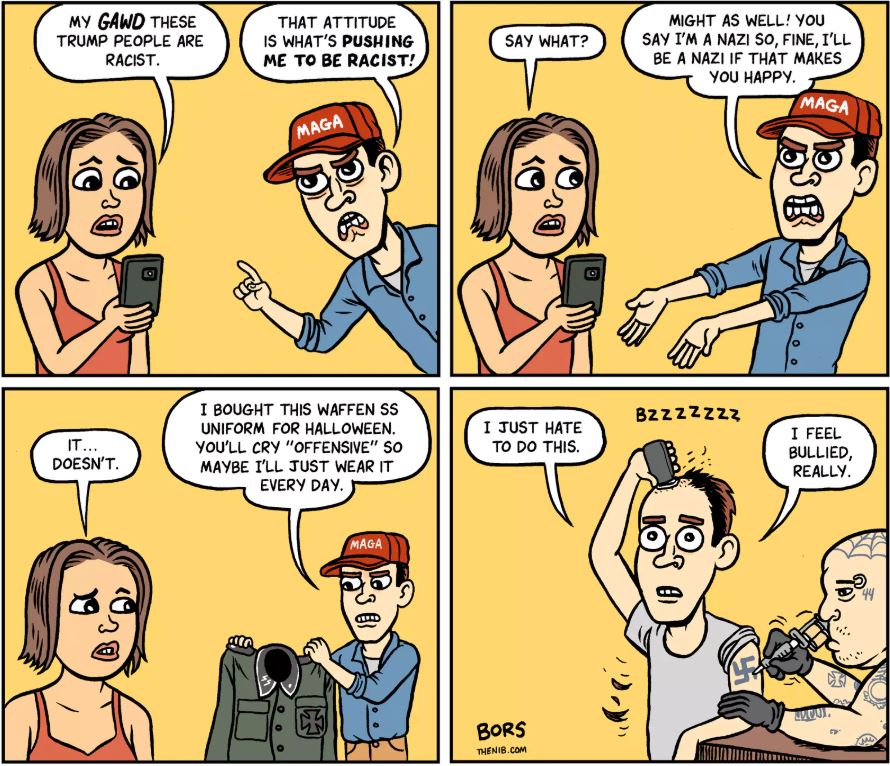
Finally, I come to my main critique which is also the underlying thesis of the book. Nagle is essentially arguing throughout that all of these really nasty, racist, sexist, bigoted forums and subsequent culture is the left’s**** fault because they have been successful in getting gay married, not having women tied to the kitchen sink, and having public discussions of other progressive ideas. The Shock! The Horror! This is the classic “the left caused people to drop liberal principles and become alt-right extremists” argument that Matt Bors skewered. It is no less stupid and unsupported here than elsewhere.
I’d be near the front of the line to agree that “the left” is filled with smug intolerant people, a la the Vampire Castle. But much like the criticism of Exiting the Vampire Castle, it’s a tad unwise to treat the issues being raised by those “lefties” as somehow wrong or a valid reason for someone to pushback and become a Nazi. There has always been pushback against successful progressive social changes, and while many of the reactionary behaviours we see in the culture wars exist across the political spectrum, a proper critic of these culture wars would address these arguments more carefully, with more insight, and would stop pretending that Alt-Right propaganda claims are valid points to base a thesis around.
I was highly disappointed and annoyed with this book.
* There is also a very important point to be made about Nagle’s lack of quantitative insight. One piece of data I keep thinking back to is the demographics of various online platforms. It is interesting to note that male-dominated forums (4chan, sub-Reddits, Youtube comments sections) tend to be more toxic than those with a neutral or female dominant audience (Tumblr). Almost as if there is an important point to be made here. With stats. With some analysis. Something. Side note, women are larger users of social media than men.
** The Tumblr list used in the book wasn’t actually from Tumblr and most likely a satirical version.
*** Richard Spencer loves to dance around being called a white nationalist or neo-Nazi, but that’s just because he knows those terms are toxic. It’s why he coined the rebranding term Alt-Right.
**** A lot of the points being made about left/liberal people (two very different groups that appear to be used somewhat interchangeably in the book, odd given that Nagle identifies as a feminist lefty) amount to lefties can be reactionaries too (call-out culture, etc). Oddly, not much discussion of the reactionary nature of all the groups being discussed and how that feeds the culture wars.
I apologise for posting a negative review. As I said in my negative review of Neil Postman’s Amusing Ourselves to Death, I will try to keep my blog reviews 3 stars and above. I will endeavour to keep the exceptions to a minimum.
In this month’s What’s the Difference? the CineFix team delve into the crazy world of The Mask.
The Mask turns 25 this month AND the comics are coming back! So it’s time to look back at Jim Carrey’s half cartoon turn as the big green head. Based on a shockingly violent graphic novel, how did The Mask go from a splatterfest to slapstick? It’s time to ask What’s the Difference!?
When I was a young lad, The Mask was one of the most quotable movies that weren’t R-Rated Pulp Fiction. It was Jim Carey at his zaniest, a digitally enhanced Ace Ventura. It was funny… for teens and some adults.
I’m not sure if the movie has dated poorly, or if it became too popular and thus annoying – the ever problematic oversaturation phenomenon – or if we’ve had enough of the zany Jim Carey, or if I’m just an old man shouting at clouds now. But there was a time when this movie was cool and funny. It was Looney Tunes for teenagers who grew up watching reruns of Bugs and Daffy.
The comic… I remember trying really hard to read it. But after having watched the movie first, the differences were too much. The dark and violent humour of the comic was asking too much of a younger me who was expecting zany Bugs Bunny style slapstick.
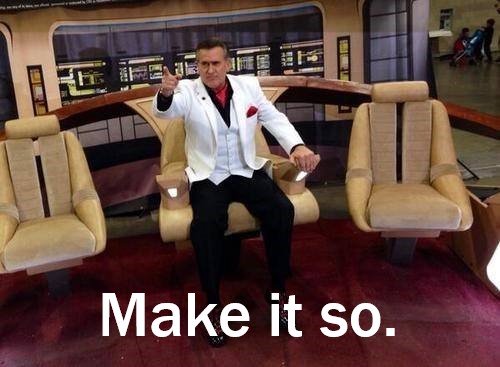
This video did leave me with the question: what if they’d asked Sam Raimi to direct The Mask with Bruce Campbell in the lead? You could have the horror styled darkness and all the humour, just like Army of Darkness. Not too late!
In answer to “Are Aussies ashamed that they lost a war against Emus” there needs to be some context to how us brave Aussies were able to valiantly defend ourselves to the last against the evil horde of emus.
First of all, as I’ve outlined in a blog post, yes, this Emu War actually happened. Roughly 20,000 emus invaded the Eastern Wheatbelt area, discovering newly cleared farmland filled with crops and watering points for sheep. They liked this supply of food and water and were ambivalent toward the soldier settler (and other) farmers’ tough run of grain prices and droughts.
They turned up their tails at the mere thought that farmers might be doing it tough. They stuck their beaks into food that wasn’t theirs – and don’t give me any of that “they were there first” and “it was their land” and “do you want to see them starve” nonsense. Take your bleeding heart elsewhere, hippy!
Pure Evil
Since these were ex-soldiers facing ruin (from drought, grain prices, broken subsidy promises, and emus – blame the killer emus!), they liked the idea of using machine-guns (2 Lewis Guns) against the birds in the same way they’d used them against opposing infantry in WW1. They wanted to reminisce about mass slaughter, even if it wasn’t against the most deadly of game.
This didn’t go anywhere near as well as expected. Emus are faster, harder to kill outright, and generally not running straight at a machine-gun embankment like some sort of pea-brained… Anyway, their casualties were low.
Two attempts were made at an emu cull, but ultimately the government decided to offer a bounty on emus instead. Later they went with the tried and trusted move of building a fence to keep the emus out of agricultural areas (along with dingoes, wild dogs, rabbits, kangaroos – although the latter laugh at attempts to build a fence they can’t jump over).
In the infirmary, Takeshi Kovacs is approached by a soldier who is sitting on the artefact discovery of several lifetimes. Kovacs, currently operating as an elite commando, takes his leeway to recruit the soldier, an archaeologist (archaeologue), a merry band of mercenaries, and a corporate bankroll. Together they are trying to uncover ancient alien technology in the middle of a warzone before any other interested parties, including the warring armies, come for them.
After reading Altered Carbon I threw caution to the wind and dived straight into Broken Angels. It is rare that I read instalments of a series back-to-back as I usually feel like I’ve had an adequate sufficiency of that character/world/theme for the time being. Wanting more is a sure sign that the author gave me some good stuff. Oh, yeah, that’s the stuff.
Broken Angels is quite different in thematic style from Altered Carbon. Where the latter was a hard-boiled cyberpunk mystery, the former is a noir Artefact-MacGuffin-Adventure* with a more languid pace than those sorts of novels tend to be. The change of pace and style didn’t extend to the themes. While there is less critique of elitist wealth hoarding, there is some delving into corporatism, warmongering, and capitalist drivers behind war that ties to Morgan’s social commentary. His comments on capitalism and war reminded me of Smedley Butler’s War is a Racket – Butler was a Major General of the Marine Corps who did not hold back in discussing what war was really about (hint: money).
Another enjoyable Kovacs adventure. The only thing that stopped me reading the third instalment straight away is that despite owning a copy I didn’t have it on my ereader.
I shook my head. “I don’t have the energy to hate the corporates, Hand. Where would I start? And like Quell says, Rip open the diseased heart of a corporation and what spills out?”
“People.”
“That’s right. People. It’s all people. People and their stupid fucking groups.”
* A term I use to describe the style of thriller churned out by authors like James Rollins, Steve Berry, Matthew Reilly, Andy McDermott, etc.
Invent technology to make interstellar travel possible. Use it to make rich people immortal.
Takeshi Kovacs is a former elite soldier – Envoy – who becomes a criminal on Harlan’s World and has his body killed. Thanks to the technology of stored consciousness – via cortical stacks – he is revived on Earth to solve the body death of one of the richest men on the planet. The police think Bancroft committed suicide, the evidence suggests suicide, but Bancroft is convinced he wouldn’t kill himself after centuries of living. Kovacs starts treading through the underbelly of Earth and tries to discover if it was suicide or murder.
Altered Carbon has been on my TBR pile for almost a decade. My uncle recommended it again a few years ago, which got it bumped up the list. But, as with all TBR piles, it took a TV adaptation to get the novel read. I enjoyed the TV series, particularly on a second viewing. I’d say I enjoyed the book a similar amount but in a different way.
I commented in a blog post about the show that I enjoyed the themes even if the aesthetic was borrowed from Blade Runner. Kovacs in the show is a grumpier and more adept character than the novel. The show also has a more personal feel to many of the characters and makes the female characters feel less like a description of sexy body parts. Pretty amazing given the amount of nudity in the show.
What I think I liked most about the novel was one of the themes. Morgan expressed it like this:
“Society is, always has been and always will be a structure for the exploitation and oppression of the majority through systems of political force dictated by an élite, enforced by thugs, uniformed or not, and upheld by a wilful ignorance and stupidity on the part of the majority whom the system oppresses.” Source.
This resonated with me given the sorts of non-fiction I’ve been reading lately. Not to mention some of the things happening in the world these days… It made this hard-boiled cyberpunk novel very entertaining.
Well worth reading before or after watching the TV show.*
A couple of quotes related to that theme:
“Kristin, nothing ever does change.” I jerked a thumb back at the crowd outside. “You’ll always have morons like that, swallowing belief patterns whole so they don’t have to think for themselves. You’ll always have people like Kawahara and the Bancrofts to push their buttons and cash in on the program. People like you to make sure the game runs smoothly and the rules don’t get broken too often. And when the Meths want to break the rules themselves, they’ll send people like Trepp and me to do it. That’s the truth, Kristin. It’s been the truth since I was born a hundred and fifty years ago and from what I read in the history books, it’s never been any different. Better get used to it.”
“You live that long, things start happening to you. You get too impressed with yourself. Ends up, you think you’re God. Suddenly the little people, thirty, maybe forty years old, well, they don’t really matter anymore. You’ve seen whole societies rise and fall, and you start to feel you’re standing outside it all, and none of it really matters to you. And maybe you’ll start snuffing those little people, just like picking daisies, if they get under your feet.”
* Is it accurate to call them TV shows now? We watch them on TV, but would it be more accurate to call them streaming shows since they aren’t made for TV networks?
I’ve lifted weights for a couple of decades now. How the time flies. Back in my day gyms weren’t like they are now with their… actually, they haven’t changed that much. The challenge of lifting heavy stuff is cool and the added side effects of being (subjectively) stronger, fitter, healthier and sexier are awesome.
Fitness is sexy. Steroids are sexier.
After being around gyms and fellow fitness junkies this long you start to realise that articles on how to get in shape are as numerous as new programs claiming to be the best program ever. Every person and their pet has their five cents on the subject (cough, cough). There is nothing wrong with different programs with different ideals. Not everyone loves running, not everyone loves bench pressing on Mondays, not everyone needs to look super lean for their next Instagram shoot. Variety can be good. And some variety can be quite funny:
But something happened to me between when I wrote about an F45 promotional ad news article and now. I’ve stopped reading exercise articles, blogs, and scientific papers.* Essentially, there are only so many times you can read “Exercise in a progressive way and eat healthily in amounts that match your energy needs/expenditure.” Doesn’t stop people writing them though.
Okay, big deal, you’re tired of reading the same 3 articles (Eat less/more, Do exercises that address a weakness, Train to progress), what’s your point?
Good question, imaginary audience surrogate.
Not a problem. Are you going to answer the question?
Not unless you can find a way to incorporate the answer into a segue to my list of things to look out for in any fitness article.
1) Fake experts.
So many articles are written by some unqualified hack who just happens to be in good shape in spite of any fitness program and diet they followed. These hacks quite often have some impressive modelling photos, or celebrity cache, or online course credentials, or all of the above. Sometimes the fake expert will be the opposite of this, with lots of legitimate qualifications and knowledge but zero idea of how to apply it.** Often it is very hard to tell the difference between an actual expert and someone who woke up with abs one morning and decided to advise others on how to do the same.
What to look for:
Fake experts will try to reveal some magic secret or brand new piece of knowledge but will likely have little evidence or be running counter to the majority of evidence. They’ll be citing one study, or what worked for them, or some other similarly small amount of evidence.
2) Quack medicine
The fitness industry is filled with alternative/complementary medicine nonsense. Health-conscious people will go looking for medical help. And there are lots of quacks looking to lighten their wallets.*** If any of this stuff worked it wouldn’t be called alternative medicine, it would just be medicine. Many of these fitness articles lend credence to quack medicine or use quack medicine to support their claims. The advantage of using quack claims is that it doesn’t require real evidence, which makes it easy to sell people on the new fitness fad.
What to look for:
If it comes under the banner of (S)CAMS or alternative medicine, there’s a good chance the article is rubbish.
3) BRAND NEW!!!
I remember when F45 was called circuit class. I remember when HIIT was called interval training. When Crossfit was just a cult… nothing new there. A few tweaks here, a brand name there, and you have the new fitness craze. This is more marketing than anything because no one wants last season’s wheel, have to reinvent it.
What to look for:
Advertorial disguised as news or an article.
4) Buzzwords, appeals, and contradictions
Have you tried holistic functional fitness? Get a six-pack for summer!How to focus on this extensive list of things.
This sort of meaningless nonsense is rife in an industry represented by people who failed high school. You know: athletes. You either focus on one thing, or you aren’t focussing at all. What exactly makes swinging a kettlebell functional versus doing a weightlifting snatch? How exactly does balancing on a ball while I wave dumbells around get me a six-pack and not a date with my shoulder surgeon? All these questions and more will be glossed over as someone tries to sell you on their new program or fill space between adverts for supplements you don’t need.
What to look for:
Marketing and spin.
5) Random numbers
Articles will often have a set of numbers that will be regarded as heavy or a long distance or a fast time by the author. Most often, these numbers are made up or arbitrary. This is most obvious when the numbers aren’t given any context. E.g. One-hundred kilograms is ridiculously heavy for a bicep curl, but light for a deadlift by an experienced lifter who weighs at least 80% of that.
Sometimes these numbers are just naïve. That sounds big enough to me. Sometimes they are humble brags. Yeah, those are my bench numbers. Impressed? Sometimes they are the inflated internet numbers. What do you mean only three people in history have run a faster time than that?
What to look for:
The context for the numbers or a reference to accepted standards.
Hope this helps you become disillusioned too.
* What? Didn’t I mention I’m a nerd and like going to the source for information?
** This is surprisingly common across a range of science fields. We may have the answer down to an amazing level of detail but it has little application to the average situation. E.g. a highly knowledgable nutritionist might be able to give you a full biochemical breakdown of how what you’re eating is killing you, but that does very little to address the underlying habits and reasons for those habits that would lead to actual diet changes.
*** To be fair, many of the alternative medicine people are genuine in wanting to help. The problem is that they have been sold on nonsense and become unwitting purveyors of it themselves. In many instances, reputable institutions who should know better hand out degrees in this stuff. Odd that the chiropractors aren’t in the physio or medicine faculties.
Capitalist Realism is a long essay or short book that argues we – as in Americans, but pretty much everyone on the planet – are so emersed in capitalism that we have no frame of reference for anything else. Mark Fisher argues that this both impedes our ability to reform or fight back against the worst aspects of capitalism, and/or to develop other socio-political societies. This is, of course, he argues, bad.
This was an interesting book. There were some truly eye-opening and enlightening moments where Fisher managed to capture an idea or concept in a concise and accessible way. He makes high-level critical analysis easy to read and understand, and not like an obtuse – or is that acute? – philosophy textbook.
It was somewhat less interesting when it drew upon pop-culture references. These references were often very good and served as a great way to make points or analogies. But some undermined any points being made by the very subjective interpretations and associations used. E.g. Kurt Cobain being the last self-aware musician was a little too reductionist. Trying to argue that Cobain could see himself being commodified and thus sought escape ignores so much of what made Cobain the person he was.
Then there were the Zizek references… and so on and sniff so on. I’ve only a passing knowledge of Zizek, but many of the philosophers I follow on social media have the same thoughts on him as I have. That is, Zizek is a sloppy thinker who gets distracted from any point he is trying to make and ends up chasing his tail around. To quote Chomsky: “There’s no theory in any of this stuff, not in the sense of theory that anyone is familiar with in the sciences or any other serious field. Try to find in all of the work you mentioned some principles from which you can deduce conclusions, empirically testable propositions where it all goes beyond the level of something you can explain in five minutes to a twelve-year-old. See if you can find that when the fancy words are decoded. I can’t.” Which, again, tends to undermine the points a bit, as it can be seen as selective and potentially misrepresentative.
Overall, this was fascinating. I think Fisher’s main points are worth serious thought and action. And at 80 pages, this probably needs to be read a few times.
You will never find a more wretched hive of scum and villainy than a group of rich people travelling together.
Hercule Poirot decides that he has earned himself a holiday and thinks it would be nice to travel up The Nile in Eygpt. As he ventures out he meets a newlywed couple, their stalker, their maid, their trustee, a romance novelist and her daughter, a socialite and her cousin and nurse, a mother and son, a communist, an archaeologist, a solicitor, a doctor, and Poirot’s friend Colonel Race. He is soon taken into the confidence of newlywed Linnet and her stalker Jacqueline and thinks that it will not be long before something tragic happens. But more than one person is targeting Linnet and it isn’t long before Poirot has another mystery to solve.
I read my first Agatha Christie Poirot novel a couple of years ago and felt that it was time for another. In that previous outing, I had enjoyed discovering many of the mystery tropes in their original form. This time, knowing what to expect, I was more interested in the story itself. Which was okay.
This mystery was interesting and I enjoyed the use of multiple crimes to muddy the waters. Christie certainly earned her reputation. But it did all feel just a little bit quaint. Whether it be the characters reminding you of the class system the Brits loved (and still do), or that the setting could have been the steamer or a country manor – as long as it had a sitting room. You can’t help but agree with the commie character that a few more could do with shooting.
I’m probably being a little harsh. This was a quick and entertaining read that was enjoyable. And they are making it into a movie soon, so best to read it before watching the movie.
Bullshit Jobs builds upon David Graeber’s 2013 essay titled On the Phenomenon of Bullshit Jobs. He posits that many of us are working in jobs that we know don’t need to be done, that we could stop doing them and no one would notice. And he suggests that these jobs are bad for us as individuals and society. If you’re nodding at this point, my condolences.
When David’s essay was released in 2013 it was something of a viral hit. It resonated with people.* For evidence supporting his proposed phenomenon, you need look no further than that response. Since then, some studies and a lot of discussions have taken place, which led David to more fully explain his ideas and evidence them with this book. He tries to distinguish between bullshit jobs, shit jobs, and bad jobs, and why they come about.
It is this discussion of the larger system that brings about bullshit jobs that is the most interesting aspect of the book. While the idea of bullshit jobs is still hazy – the definition is subjective when all said and done – the changes to our society, economy, and personhood are well documented and discussed. The combination of this discussion with the theory lends weight to another idea presented within: that the role of jobs in society needs to change.
Currently, we place a large amount of prestige and identity on what we do for work.** Our exchange of labour for money is how we afford to live and often how we understand our contribution to society. But is that all we have to offer? Will we be remembered by our job titles? Does that mean that unpaid work doesn’t have value, either in the identity or contribution sense? The answer to these questions is clearly no, making this discussion a highlight of the book.
This was a very interesting book and tied in well with Rutger Bregman’s Utopia for Realists.
* Nope, I’m not going to comment one way or the other about it resonating with me. That would give away how I feel about my day job slowly killing me.
** One of the first questions you will be asked is, ‘What do you do for a living?’
Update: this review at Current Affairs is also worth a read.
Update Sept 2020: David Graeber has passed. It is sad to hear that someone who got dirt under their nails as well as brought intellectual depth to their work is gone. Rest in Power!
“Advertising has us chasing cars and clothes, working jobs we hate so we can buy shit we don’t need.”*
Richard Denniss’ Curing Affluenza seeks to define the problems our current consumerist society has and how to address it. He posits that we need to abandon consumerism and opt instead for materialism if we have any chance of changing the shape of our economy, which will, in turn, allow us to address issues like climate change and environmental degradation.
For many years now I’ve been a fan of Richard and The Australia Institute’s work. He and they manage to talk economics without making it feel like you’ve been hit with a brick made of buzzwords.** As such, this book has been on my TBR pile since its release. It has not disappointed.
Richard makes his arguments simply and clearly, in a way that make sense. Even if you disagree with him politically, you would have to agree with his points about economics and politics being about choosing a shape for the economy – the shape being what we choose to spend money on and value. You may argue that we need more spending on tanks and less on healthcare, which has a different shape than an economy where I want fewer tanks and more healthcare. This also applies to our purchases; so if I’m buying tickets to see bands play live rather than upgrading my phone every 6 months, the economy changes shape.
On the Affluenza front, Richard suggests 7 principles for tackling it:
1) First, do no harm.
Think of this as consumer boycotts and active decisions about consumer/lifestyle choices.
2) Some change is better than no change.
Baby steps. It isn’t possible to stick 100% to #1, and larger changes may take longer.
3) It’s not about sacrifice and denial; it’s about saving money and having a better life.
We’re trying to change the shape of the economy, not become monks.
4) Services are good for you.
New status symbol phone or see a live music act? Stuff doesn’t make you happy but experiences do, and they help change the economy’s shape.
5) When you are full, stop consuming.
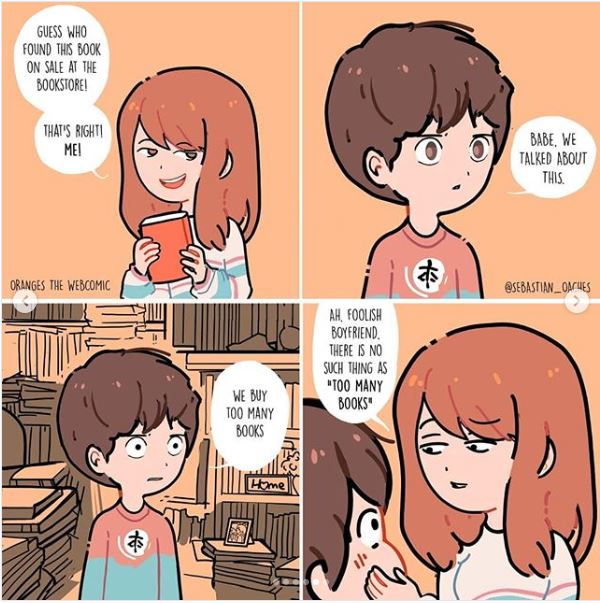
Because there is such a thing as too many books… Wait, what?
6) Get yourself and your country into better shape.
Our saving and spending, especially when organised with others, can reshape the economy.
7) Flatter is fairer.
Equality of resources and opportunity for all. I.e. redistribution.
Whilst this was a very good book, I did have two problems with it. The first issue was that the middle chapters labour the point, so much so that it felt like needless padding. This was frustrating because as someone who has read various articles and essays from Richard before, I know he can be very concise. It also didn’t help that I was already familiar with what he was trying to argue and the examples used. Though, this may be from that familiarity, so others may appreciate these chapters more.
The second issue was that Richard was largely dismissive of options that didn’t involve capitalism. There was a big assumption that we still need/want capitalism and thus should be reforming/tinkering with it. This assumption was never examined nor justified adequately. It would have been nice to see some discussion addressing those other options, especially in a pros and cons manner.***
* Quote is obviously from Fight Club and not this book. I’m almost certain that Richard is not advocating young men beat each other up and try to destroy capitalism.
** Richard appropriately calls the indecipherable economics talk Econobabble.
*** Richard responded to this point on Twitter. He felt it was outside of the scope of the book and would have muddied the message. I think that is a fair point.
Back a few years ago, the Nobel committee created a minor furore for awarding Bob Dylan – known for his performances in Hearts of Fire* and Pat Garrett and Billy the Kid – a Nobel Prize in Literature. At the time, PBS Ideas Channel had an interesting take on this contentious topic. And as is always the case, it isn’t really that simple.
I’m near the front of the queue to criticise literature for being a dry and dreary form of art that sucks the life out of its audience. But of course, as Mike discusses in the video, literature isn’t as easily defined as my dismissive rhetoric would imply. What defines literature isn’t arbitrary, but it is often about who is defining or classifying a work as such.
My criticisms of literature stem from who performs this classifying, as they will often be people like Jonathan Jones – who said Terry Pratchett sucked – who will criticise the literary merits of works they haven’t read. These arbiters of artistic merit (i.e. snobs) like certain things, thus those certain things are worthy. They create lists of these worthy things and tell us we need to read them at school, study them at university, and expound on how much better these works are… until they actually read one of the unworthy ones and have to eat humble pie.
As I pointed outrecently, the origins of what we call literature versus genre have their origins in the class divide during the Industrial Revolution. Workers got to read one type of magazine, whilst richer managers (but not the capitalists) got a fancier magazine. The stories that were published in the fancier magazines became literary, whilst the rest was genre. So when I say that literature is based on snobbery, it is quite literally the snobbery of class divides in “Western culture”.
So the literary and artistic merit we often operate under in society is more about what a certain group of people like. But as Mike points out, that isn’t a good definition and literature, and “good” art in general, are harder to define. Essentially anything can be literature. And even then the status of a work being literary may be revoked or instated, as tastes change.
Thus, having the Nobel committee awarding Dylan’s lyrics a literary prize might actually be about them trying to bridge the divide. They could possibly be about making us all think of lyrics as an art-form, something that has social defamiliarization. Lyrics are, after all, a form of poetry that are no less artful. Maybe this award will help us acknowledge that art/literature is all around us.
I look forward to future Nobel Prizes for Literature being handed to Dan Brown and James Patterson. Because they are certainly pushing literature in an interesting direction.
* This is a great reference. Seriously. Check for yourself.
There is a joke that started a month or two ago about how HBO subscriptions were going to cease once Game of Thrones concluded. The implication is that despite a long history of high-quality TV shows – Oz, The Sopranos, Deadwood, The Wire, True Blood, Boardwalk Empire, Flight of the Concords, Banshee*, and Strikeback** – the station will suddenly have nothing to offer audiences.
This argument reminded me of a PBS Ideas Channel video I shared on how technology is changing TV shows.
It raises an interesting point about how there appear to be more complex narratives in TV shows now. And in light of the conclusion of Game of Thrones, audiences are expecting more from networks that they doubt can be provided.
Of course, there are several problems with this idea. The first is perception. For every Breaking Bad and Justified we have CSI Whatever and the banality of reality TV. So without some hard data on the number of shows and relative audiences, it is really hard to say how real that perception is.
The second problem is that TV shows run a continuum from pure episodic shows, where everything is wrapped up in an episode and the next episode has little to no changes evident to the characters or larger show, through to serials, which have more complex plot lines that often take at least a season to develop and resolve with character arcs building over the course of the entire series. The key word is continuum, as most shows have some aspects of the serial and episodic about them. Again, without breaking down each show on this continuum, and then comparing shows now versus the past, we don’t have any idea of what has changed, if anything has changed.
The third problem is the good old sample or selection bias, especially as it relates to our favourite shows and the shows we remember. E.g. Survivor has been running since 2000 (or 1997 if you are in the UK), yet without looking that up I’d have had no idea when the show started, let alone whether it is still running. I don’t remember it because I’m not a fan. But I will still complain bitterly about the cancellation of Firefly. My frame of reference is biased, so I’m going to remember some shows more than others and think more favourably of some of the ones I remember than others.
The final problem I see is assigning time shift technologies and marathon watching as the driver of a change in our demands for more complex narratives. The idea itself is sound, as I can’t think of thing less interesting than watching the same episode with minor changes in a marathon. That would be like watching 9 hours of hobbits walking. The recording, DVD buying, streaming and subsequent marathon TV show watching would indeed favour shows that have more to them, that more complex narrative that will keep you pressing play on the next episode.
I don’t know that the time shifting, or recording, or DVD buying, or other methods of marathon watching, is driving demand for more complex narratives. As I said above, I think the more complex shows lend themselves more to the marathon than other shows. But if we assume there are more of these shows worth grabbing a blanket and a couch dent, then I still think there are other things at play. I think we’ve seen more avenues for creativity come to the fore, such as Youtube channels, computer games, and the like that didn’t exist a decade ago as they do now. As a result, entertainment such as TV shows has a need to engage the audience on a deeper level. So while episodic shows like CSI Whatever are still huge, they don’t attract the same devotion and fan adoration as a good serialised show. Plus, the advantage of the more complex narratives is that it allows for more interesting characters, plot lines, etc, which in turn allows for better acting, direction, writing, etc, which creates a feedback loop that may one day cause fandom to implode due to awesome achieving gravitational singularity. I’m assuming this will happen when Netflix reboots Firefly.
NB: I hate the term binge-watching and as such haven’t used it in this article. Binge implies that there is something wrong with what you are doing. There is nothing wrong with watching a TV show or movie series you enjoy, so we should stop implying there is something wrong.
* Banshee is criminally underappreciated.
** I stand by including this on the list. Show me another TV show that managed to do more in one episode than most entire action movies with 10x the budget.

 The Geek Feminist Revolution by Kameron Hurley












 Tyson Adams