Book review: Thirteen by Richard K Morgan

ThirteenThirteen by Richard K. Morgan

My rating: 3 of 5 stars

When society stops being violent someone will try to genetically re-engineer violence.

Carl Marsalis is a specialist bounty hunter. Genetically engineered and indoctrinated from birth to be a dangerous weapon, he now hunts others like him. After landing in prison in the wrong part of the former USA – Jesusland – he is seconded to track down someone who is killing his way across the former USA after eating his way through the crew of a Mars-to-Earth flight. But the cannibal seems to be a step ahead of the game and not picking targets at random. It’s as though he has help and is possibly working for someone as their hitman.

After recently finishing the Altered Carbon series, I decided to see what other Morgan novels I could get my hands on. Thirteen promised to be similar to Altered Carbon. The setting was similarly cyber-punk, the mystery/detective narrative is front and centre, and Marsalis likes to get violent and have sex with any and all female characters.

But where Altered Carbon used those elements in a compelling way, Thirteen was too indulgent with them. The novel feels padded out and runs far too long. This leads to pacing problems, with some sections really bogging down. The charisma of Kovacs is not present in Marsalis, despite their similarities, so you don’t feel the same thrill from him dispatching a bad guy or having the love interest* throw herself at him.

I think I could have forgiven those aspects a bit more if it weren’t for the “conversations” between characters about genetics. These were long discussions that bashed the reader with the point. I’d have had less of a problem with them if they weren’t quite so wrong on the science. The “conversations” amounted to telling us that we are essentially only our genetics. That’s not only nonsense (GxExM is how we discuss genetics in science) but is pretty much spouting modern-day scientific racism.**

That point is particularly ironic given the obvious analogies for racism and backward thinking being drawn. “Look at how backward these religious bigots are. Look at how badly they treat black people. Hey, check out my thinly veiled racism disguised as science!” I don’t know if I missed something, but this really did read to me as admonishing racism whilst justifying it as not something we can get over. If that was Morgan’s point, then it would have been great if he could have done it in about 150 pages less.

With all that said, this was still enjoyable and I am looking forward to reading more from Morgan.

* I’m being overly flippant and critical here. Sevgi Ertekin is a fairly well-developed character but her role does appear to be just the love interest and character motivation.

** Yes, scientific racism is back. Modern-day phrenology comes in many forms. Often it is IQ studies and hereditarianism, sometimes it is labelled Human Biodiversity (HBD), other times it will be straight up eugenicists and white nationalists. Reading about its insidious creep into academia and mainstream discourse is sickening.

View all my reviews

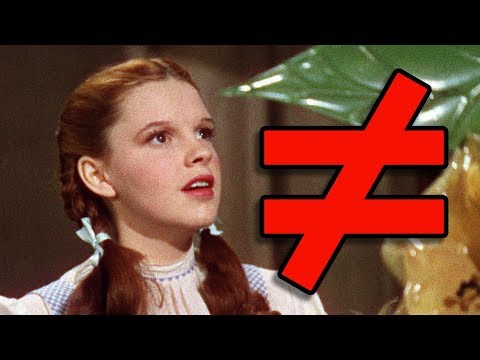
Book vs Movie: The Wizard of Oz – What’s the Difference?

hqdefault

A cinematic classic versus its literary classic in this month’s What’s the Difference from CineFix.

The Wizard of Oz movie is definitely a film that I think is deserving of being called okay. With the list of highly memorable song and the amazing use of colour, you can see why this film is so perfectly adequate entertainment for a rainy Sunday.

Return to Oz came out when I was young. Unlike its predecessor, it was more faithful to the books and kept their much darker and nastier tone. This, of course, meant that reviewers and other opinion havers* thought it was terrible and not suitable for children… Despite being more faithful to the kids’ books it was based upon.

I never really got into the Oz books as a kid. They were no Magic Faraway Tree, so they lost my interest almost immediately. I feel as though I should revisit them now as a sleep-deprived parent to give them a more fair assessment. Or maybe I’ll just see what land has arrived at the top of the tree this month.

We’re not in Kansas anymore, and neither was the film adaptation of The Wizard of Oz. The 1939 classic turns 80 this year, so it’s time to look back at Dorothy and Toto’s journey from the pages of L. Frank Baum’s book, to the glorious technicolor screens of the movie. So gather your courage, you Cowardly Lions, open up those Tin Man hearts and pick your Scarecrow brains because it’s time to ask, What’s the Difference?!

* Ha-ha, I did an irony.

Book review: Game of Mates by Cameron Murray and Paul Frijters

Game of Mates: How Favours Bleed the NationGame of Mates: How Favours Bleed the Nation by Cameron Murray

My rating: 3 of 5 stars

I don’t want to see the final season of Game of Mates, I’ve heard the entire thing falls flat.

Cameron Murray and Professor Paul Frijters set out to expose the inner workings of the Australian economy in Game of Mates. Through a series of case studies, they outline how a few (the Jameses) take from the many (the Bruces) by blurring the line between business and the regulators. Then, knowing that their readers will be suitably gobsmacked and annoyed, call for the masses (Bruces) to make a change.

As with any book about real-life grifting in the halls of power, this book made me annoyed and disillusioned. There is nothing more galling than to have someone show you how the grift is endemic and then realise you kinda knew. We kinda all know. There is no surprise here. And that means there is no “justice”. Cue scene of me staring out the window as rain drips down it.

Murray and Frijters conclude with some ways to stop the grift:

1) Reclaim the value of grey gifts for the public.
Essentially, when the grifters rig the system they gift themselves advantage/money/power. We have to tear that down. One example was Public-Private Partnerships on infrastructure developments, which essentially end up being a gift of public assets to private businesses with a guaranteed profit underwritten by the public.

2) Disrupt (James’) the grifters’ coordination.
This is fairly obvious, stop the revolving door between public and private interests, put in oversight, make sure the oversight isn’t part of the problem, etc.

3) Bust the myths (James) the grifters use.
This isn’t just about addressing the claims cherry-picked “experts” will make, such as promoting projects that aren’t needed (examples are given, there are plenty). This is also about reclaiming the narrative from these grifters. In Australia, this is particularly difficult as many of the media outlets are either owned or have close links to the same people grifting.

4) Fight back.
Disillusion can lead to apathy. That’s what keeps us on the losing end.

Speaking of the losing end, the costs of this game are:

  • New Housing – 70% of the gains from rezoning;
  • Transportation infrastructure – 68% of the investment;
  • Superannuation – 27% gobbled up;
  • Mining – 48% of the profits;
  • Banking – 60% more expensive for the masses;
  • Taxes – 23% extra taxation borne by the masses (I’ve seen a figure suggesting this is a global issue and sees the average person taxed proportionally more);
  • Pharmacies, medicines, and health – 10% more expensive;
  • Higher education – 100% more expensive…

Okay, so clearly this book hit the mark and is enlightening. Why only three stars, I hear someone say? Well, while I appreciate your question, I’m wondering what you’re doing in my house.

I think the problem I had with this book was the polemic style to it. We are told. I listed the figures above, and whilst those numbers are backed up, they are big claims that require fairly solid evidence. I felt the evidence was a bit flimsy. Not wrong, but maybe selective, or misrepresentative.

Another example was around how to stop the revolving door which amounted to banning people from getting a different job in the same industry. That’s probably not as well thought out as it needs to be.

Game of Mates is worth reading but it felt underdone.

View all my reviews

Cli-Fi: Can These Books Save The Planet?

Climate Fiction or cli-fi – get it, it’s like sci-fi except with climate… – may trace its origins to early science fiction works, but it has become a (sub) genre of its own in recent years. Who’d have thought that active disinformation and denial campaigns leading to delayed action on such an important issue would lead to a cultural response expressing concern at the lack of action?

This video from the PBS Digital Studios channel Hot Mess offers a great explainer on cli-fi. It also features Lindsay Ellis.

I think many of us would have read or watched cli-fi without really acknowledging it. Sometimes climate change is just a theme or motif because it is a reality writers/creators have absorbed. Other times it is more deliberate with the intention of discussing the issue.

While this can help create a wider acknowledgement and acceptance of climate change, I’m not sure it can help save the planet. I think there was an analogy about a horse and water and beatings or something that works here.

One thing I am hopeful of is that cli-fi will be like the nuclear holocaust fiction, emblematic of the fears of our time, but those fears will prove misplaced due to actions to prevent disaster. Or at least a great resource in the future for the evolved sentient cockroaches looking to understand what happened to our race and the planet.

See also: https://www.theatlantic.com/entertainment/archive/2015/08/climate-fiction-margaret-atwood-literature/400112/

Climate Fiction comes in all sorts of forms, there’s your Mad Maxes, your Games of Thrones, your Parables of the Sowers, and your WALL-Es. But are all these Cli-Fi books, movies, and TV shows just capitalizing on a hot topic, or do they actually change people’s perceptions of climate change? Lindsay Ellis, of It’s Lit, and Amy Brady, the editor-in-chief of The Chicago Review of Books, help us find out.

Read more: https://docs.google.com/document/d/1vp6lDmU3vT-NvMTRzCkLW97JfX7FQ4ZLhX0qvTGg-_I/edit

The limits of imagination

Many would think of authors as having limitless imaginations. We can imagine amazing futures, fantastical worlds, utopias, dystopias, magics, stuff that we call science that is actually just more magic, but we can’t imagine a rich person as wealthy as actual rich people.

That’s right when it came to thinking of massive piles of money that a fictional character would go swimming through, it didn’t amount to as much money as our actual wealthiest people.

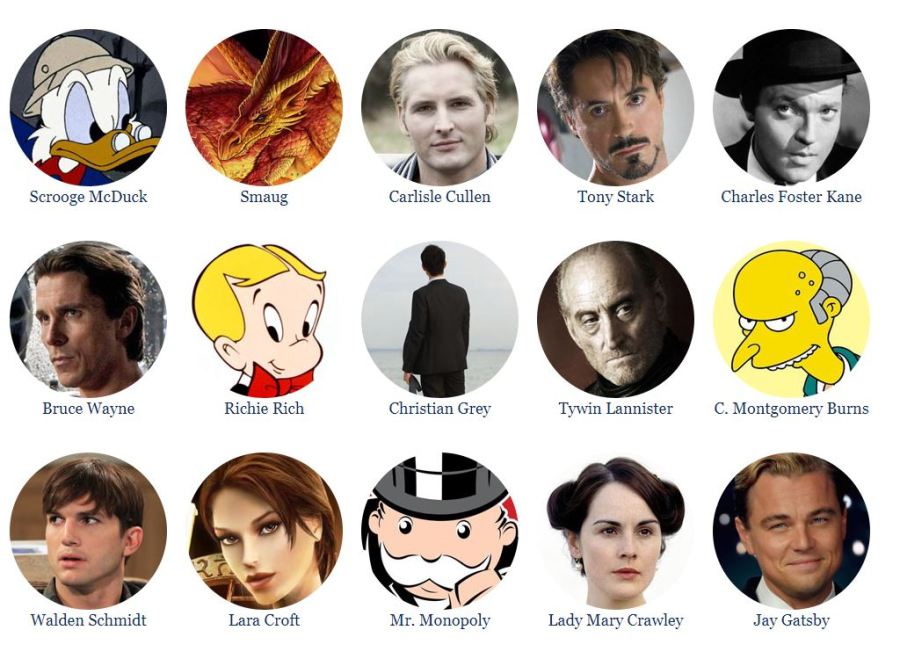
Fictional 15 richest

  1. Scrooge McDuck – $65.4 billion
  2. Smaug – $54.1 billion
  3. Carlisle Cullen – $46.0 billion
  4. Tony Stark – $12.4 billion
  5. Charles Foster Kane – $11.2 billion
  6. Bruce Wayne – $9.2 billion
  7. Richie Rich – $5.8 billion
  8. Christian Grey – $2.2 billion
  9. Tywin Lannister – $1.8 billion
  10. C. Montgomery Burns – $1.5 billion
  11. Walden Schmidt – $1.3 billion
  12. Lara Croft – $1.3 billion
  13. Mr Monopoly – $1.2 billion
  14. Lady Mary Crawley – $1.1 billion
  15. Jay Gatsby – $1.0 billion (Source: Fictional 15, 2013) Total = $215.5 billion

Let’s compare that to the real-life Richie McRiches.

Real 15 richest

  1. Jeff Bezos – $131 billion
  2. Bill Gates – $96.5 billion
  3. Warren Buffett – $82.5 billion
  4. Bernard Arnault (and family) – $76 billion
  5. Carlos Slim Helu (and family) – $64 billion
  6. Amancio Ortega – $62.7 billion
  7. Larry Ellison – $62.5 billion
  8. Mark Zuckerberg – $62.3 billion
  9. Michael Bloomberg – $55.5 billion
  10. Larry Page – $50.8 billion
  11. Charles ‘f@#k the environment’ Koch – $50.5 billion
  12. David ‘f@#k poor people’ Koch – $50.5 billion
  13. Mukesh Ambani – $50 billion
  14. Sergey Brin – $49.8 billion
  15. Francoise Bettencourt Meyers (and family) – $49.3 billion (Source) Total = $993.9 billion

On the fictional list, we have a literal 350-year-old blood-sucking parasite who had several lifetimes to accumulate his wealth. Another is the image we conjure up when we think of rich people. One character even has rich in his name twice. Yet for all of their billions, they aren’t matching it with the real-life billionaires.

It says something that the richest fictional character has half as much money as the richest man in the real world. And the total worth of the Top 15s couldn’t be more different. All of the world’s authors couldn’t come up with a list of the wealthiest characters with as much money as their real-life counterparts ($215 vs $994 billion!!).

But the worst part is the real-life billionaires. Do we see Jeff Bezos swimming in a giant vault of money? Does he even own a giant vault? What type of pathetic billionaire is he? Too busy stopping his workers unionising to enjoy a swim in his money is what he is. Bill Gates has not once tried to scare dwarves away from his mountain of gold, on the plus side, he isn’t a gold hoarding dragon. And will we ever see the Warren Buffet spanking a college newspaper reporter sex tape, and will that be hotter than the 50 Shades of Grey movies?

What about superheroes? Zuckerberg isn’t donning a cowl and fighting crime, he’s too busy selling elections. Tony Stark was fighting to save the planet, the Koch brothers only seem to have time to see the planet burn. Would it kill them both – or at least one more – to try to build an arc reactor?

Authors may not be able to imagine ridiculous levels of wealth for their characters, but billionaires seem equally unable to imagine doing something worthwhile with their billions.

Book review: The Three Secret Cities by Matthew Reilly

The Three Secret Cities (Jack West Jr #5)The Three Secret Cities by Matthew Reilly

My rating: 4 of 5 stars

The world is only days away from destruction. Again. Again.

With only a few hours rest after winning The Great Games, Jack West Jr is thrown back into the fray. The secret ruling elite’s world has been thrown into disarray with only a few days to save the world. They don’t think they need Jack’s help, so they send a secretive order of assassins after him. But without Jack and his team, the chances of saving the world are close to zero.

I finally got around to reading my Xmas present. I have a standing order for Matthew Reilly books that my parents dilligently fulfil. Ever since picking up my first Scarecrow adventure, I’ve been hooked on Reilly’s fast-paced thrill-rides. The Three Secret Cities was once again a fast-paced thrill-ride.

But…

After thoroughly enjoying The Four Legendary Kingdoms I was excited to see what else would happen in this three-part Jack West Jr adventure. One of my earlier criticisms of the Jack West Jr series was that it often felt like stuff just happened, that you were reading a series of explosions without the peril and tension. The Four Legendary Kingdoms didn’t have that feeling. But after finishing The Three Secret Cities that sense of stuff just happening was back.

This left me with a troubling thought: have Reilly’s books always been heavy on the explosions and light on the peril of those explosions, has Reilly lost a step, or am I just not as entertained by Reilly as I once was? I noted in my revisit review of Ice Station that several things suddenly annoyed me and were suddenly distracting. So it is possible that I’m not enjoying Reilly’s novels like I once did.

While this does sound like strong criticism, The Three Secret Cities was still solidly entertaining. I just hope the next instalment has plenty of peril. Suddenly.

View all my reviews

Book review: Whispering Death by Garry Disher

Whispering Death (Inspector Challis, #6)Whispering Death by Garry Disher

My rating: 4 of 5 stars

Cat burglary seems like a career that should involve more standing near open doors deciding whether to go out.

Inspector Hal Challis is reaching the end of a chapter in his life. A new relationship, a career he’s frustrated with, a dying car, and a finished hobby. But the town of Waterloo has become the scene of a series of sexual assaults by a man disguised as a copper, a bank robber is making the rounds, and a cat burglar is making her presence felt. A great time to tell the local press exactly what you think about budget cuts.

If I’m remembering correctly, this is my third Garry Disher novel and second Challis story. Disher is to Australian crime writing what Ian Rankin is to the UK and Michael Connelly is to the US. He is respected, consistent, and knows how to tell a tale. Whispering Death is one of those solid and consistent crime novels.

I’m writing this review a few days after having finished reading Whispering Death. And I think my characterisation of this novel as “solid and consistent” is also partially a criticism as well as praise. It’s an entertaining read and I think many will want to read more about Grace the cat burglar in a future instalment (or spinoff). But I’m also noticing that even though it has only been a few days, I can’t really think of anything that memorable about the book to mention here.*

That said, Disher continues to entertain and I look forward to reading more of his Challis (and Wyatt) series.

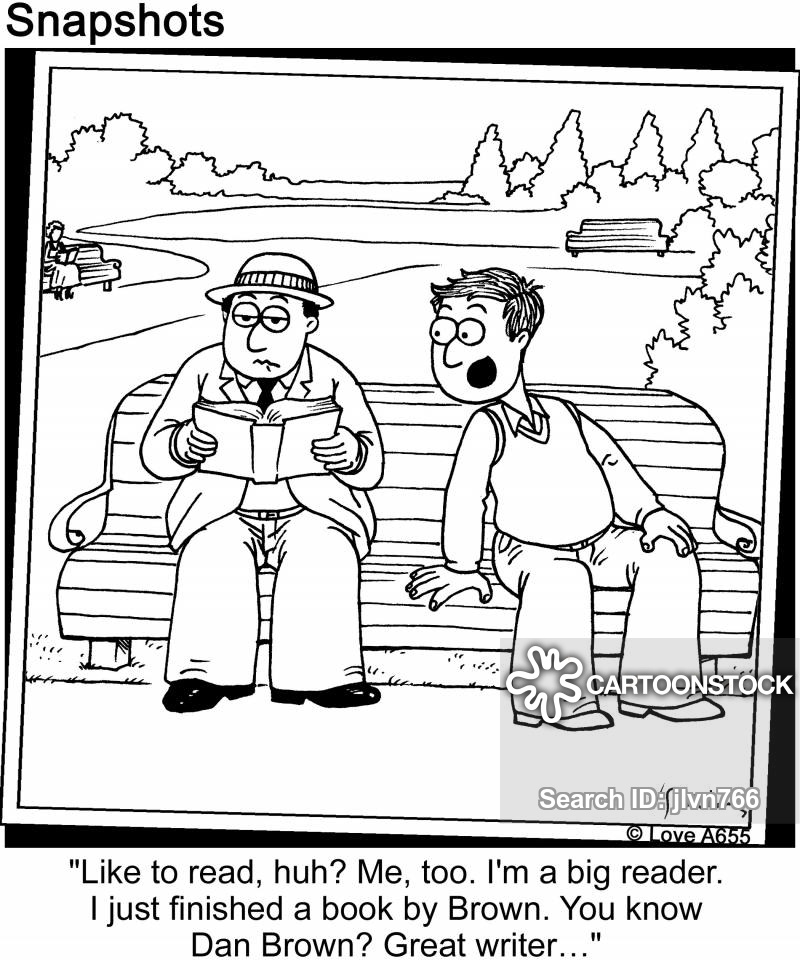
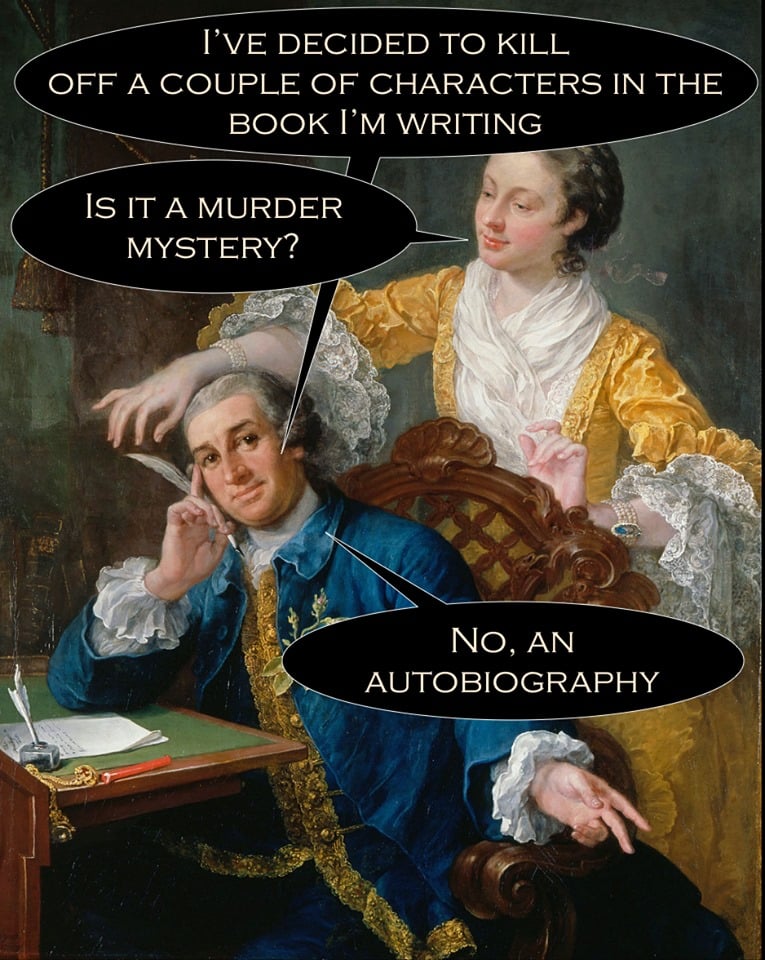
* As my wife pointed out to me, this could be a factor of my age. I’m no longer a twenty or thirty-something. A solid book has plenty of other solid books to blend in with in my increasingly fuzzy memory (having kids ruins your brain) compared with a decade or more ago. So as I age and read more, the harder it will be to entertain me. The fewer thrills I will receive from even great authors with great books. Until finally, no longer able to find joy in the simple pleasure of reading, I commit suicide by Dan Brown.

View all my reviews

Book review: The Communist Manifesto by Karl Marx and Friedrich Engels

The Communist ManifestoThe Communist Manifesto by Karl Marx

My rating: 4 of 5 stars

The only thing you have to lose is your car keys. And chains.

“The ruling ideas of each age have ever been the ideas of its ruling class.”

The Communist Manifesto was part of my reading project to have some actual knowledge about the current bogeymen of cultural discourse. How could it not be? Various (sarcasm alert) intellectual giants, including Canadian self-help gurus and fake universities, have blamed Marx personally – poor Engels, always the bridesmaid, never the bride – and communism generally for every malady of the last 150 years. Obviously, they would know this after having studiously analysed the Manifesto… oh, and all of the hundreds of other texts on the subject.

What struck me about this text is how it captures a few essences of society, both then and now, with an insight that resonates. But it also manages to feel immature and underdeveloped compared to the later writings from Marx and Engels. From my further reading, this appears to be a common criticism.

There were interesting insights into women’s and workplace rights. These ideas from Marx and Engels’ have had to be implemented in our society. They realised that a capitalistic society couldn’t function the way it did. So those changes have been implemented. And it took social and union movements to make our society function, but not the communist revolution Marx and Engels expected.

Another interesting aspect was the definition of bourgeoise socialists. The idea of people advocating for small manageable changes to gradually improve society sounded an awful lot like centrist liberals or socially conscious millionaires/billionaires. They will admit the system is rigged and that it is unfair, but do you honestly expect them to sleep on less than 800 thread count sheets? Who is the real victim here?*

That isn’t to say there aren’t valid criticisms of the Manifesto. As an example, people like Sloterdijk have criticised Communism for channelling rage from their life in the direction of an “other” – in this case, the rich/capitalists. This rage is channelled by the ruling class of the communist movement and used to empower themselves. I.e. it becomes just another control mechanism, exchanging one oppressive power for another.

But it is clear from the Manifesto that this is/was not the intention. Something many critics miss.** Marx refused to speculate in detail about the nature of communism, arguing that it would arise through historical processes, and was not the realisation of a pre-determined moral ideal. Maybe this was a fatal flaw in his thinking, such that if he had been more prescriptive his writings wouldn’t have been used by authoritarian/totalitarian people to seize power.

There has been a lot of academic and scholastic work on Marxism since The Communist Manifesto. But this short work still remains a worthwhile read.

* See my review of Winners Take All.

** And let’s be honest, it is deliberately missed. Communism is the “other” of the 20th century. They were the evil we could rally together to defeat. So actual understanding of communism has been deliberately negatively framed. “Look at all those starving people under communism! Ignore all the starving people under capitalism!”

See my review of Socialism a Short Introduction.

Further reading: https://plato.stanford.edu/entries/marx/

View all my reviews

Book review: The Calculating Stars by Mary Robinette Kowal

The Calculating Stars (Lady Astronaut, #1)The Calculating Stars by Mary Robinette Kowal

My rating: 5 of 5 stars

Sometimes it does take PhDs in math and physics to explain where babies come from.

In 1952 Elma York and her husband are on a weekend retreat when a meteorite wipes out the east coast of the USA. Elma flies them to safety only to realise that this strike was an extinction-level event. The fledgeling space program is thrown into overdrive, with Elma and her husband deeply involved. But in the race to colonize space, a few people are being overlooked for humanity’s future, and Elma wants to see women go into space too.

Quite simply, I loved this book.

There were so many moments where you feel the frustrations, joys, and unfairness of the 1950s. This is a very human tale mixed with the fascinating behind-the-scenes look at the early space program – reimagined, of course. And while this comes across as hard sci-fi, it doesn’t make the plot nor pacing drag.

Normally I’m not a fan of the alternate history tales. Often they feel gratuitous and unnecessary, like dragging in various famous historical figures for cameos – hey look, Mark Twain is on the Enterprise!! But here the alternate history felt like it served the plot and themes well, and not just some stoned writer saying, hey, what if…

Well worth reading.

View all my reviews

Book review: Woken Furies by Richard K Morgan

Woken Furies (Takeshi Kovacs, #3)Woken Furies by Richard K. Morgan

My rating: 4 of 5 stars

Those feels when you have to take time off from murdering religious zealots to overthrow the establishment.

Kovacs is a one-man army stalking a series of religious zealots on his home planet of Harlan’s World. In the aftermath of one assassination, he runs afoul of the Yakuza and befriends a mercenary. The merc, Sylvie, invites him to join her team decommissioning sentient military hardware in the un-settlement zone. During this operation, Sylvie collapses and appears to take on a new personality, the long-dead revolutionary Quellcrist Falconer. Together they are being hunted by the ruling elite, a revived younger Kovacs, and the Yakuza. Their only hope is to restart the Quellist rebellion.

I’ve read all three Takeshi Kovacs novels over the last two months and have enjoyed them all. There is the entertaining surface level to the stories: a hard-boiled noir detective story, military adventure, and in this instalment a more standard thriller. Then underneath that, there is an interesting socio-political discussion that has culminated in the plot of this final novel in the series. In some respects, Woken Furies is the most in-depth look at the socio-political world Morgan has created, as well as having the most social criticism. For some, this could be a bit offputting, but I’ve really enjoyed this aspect of the series.

The only problem I had with Woken Furies was that it felt as though it was padded out a bit too much. It is significantly longer than the previous novels (probably 40% longer at a guess) and I’d have preferred it at roughly the same length as those other two. It’s a little churlish to complain about a book you’re enjoying giving you hours more entertainment, but in many ways, I’m a petty man.

A good conclusion to an enjoyable series.

View all my reviews

Killer Car Fallacy

If you read the news daily you may have noticed that humans really like hurting each other. While this popular pastime is generally on the decline, it is still at concerning levels. Whether it be the latest school shooting in the only country that happens in, or the suppression of the people by regimes in all countries, violence happens. And violence is big business.

Many people would obviously like to reduce the amount of violence occurring on our planet. They will often point out the war profiteers, the gun manufacturers, and the lack of regulation on the sale of weapons to oppressors. And without fail, there will be someone who will bravely stand up and defend these practices that facilitate (and perpetuate*) violence. These brave defenders will always use the individualist argument that places the onus on the user and not the tool. One common example used is “Do you blame the driver or the car?”

On the surface, this seems like a sound argument. A bad worker blames their tools, and all that. You see, it isn’t a killer car, it is a drunk driver or a driver who is trying to kill someone.

Of course, this is a false equivalence, a fallacy, a load of nonsense. It’s The Killer Car Fallacy.

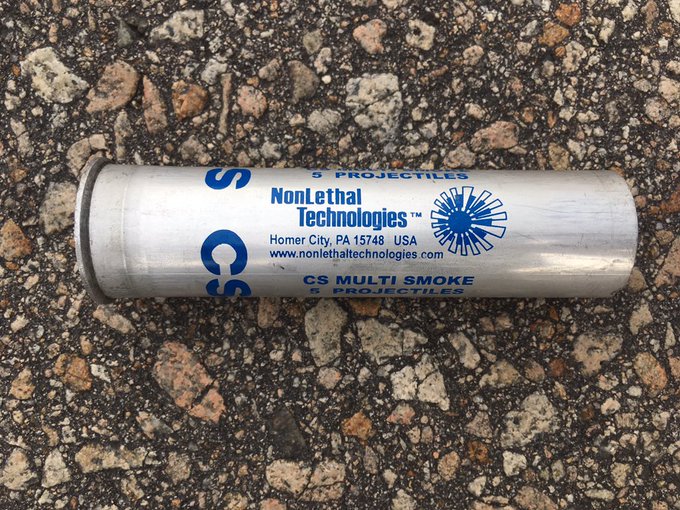
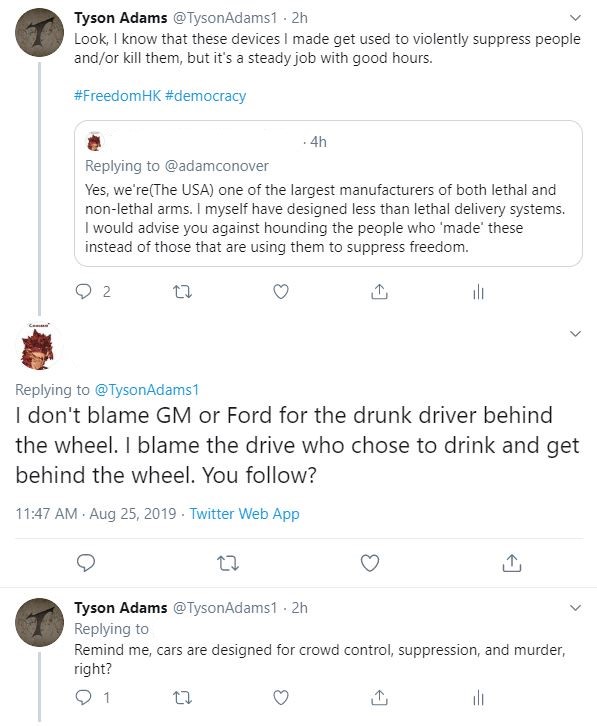
Below is a common example of this fallacy in action during an exchange I had on Twitter. The original point being discussed was about US companies being complicit in the suppression of the democracy protests in Hong Kong via their manufacturing of the weapons of suppression. You may remember the USA from their tireless promotion of democracy in the Middle East, Vietnam, and South America.

ECuTKLBW4AE5IIU
Source.
killer cars
Source.

As you can see in my last tweet**, the comparison people try to make between a car and a weapon are nonsense.

A car is designed to transport people and their stuff in comfort, style, and with as much complaining about other drivers as possible. If a drunk driver kills someone with their car, they have misused their car and are at fault. The car can and does kill people, but that is not exactly the advertised selling point. I’m currently unaware of any car manufacturer advertising a toddler per kilometre death rate as a feature.

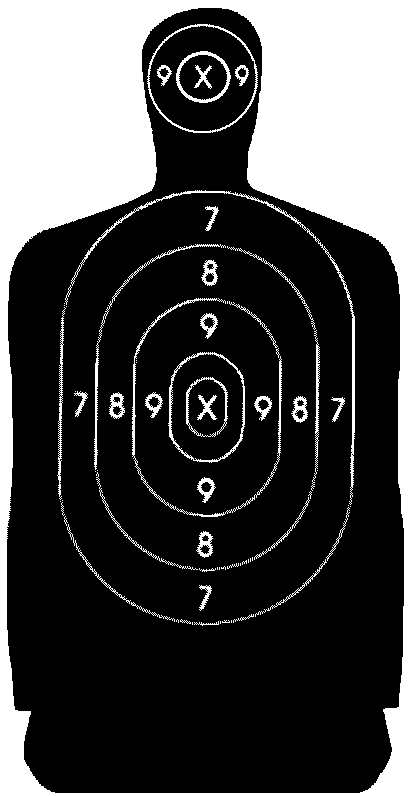
Compare that to a gun***, which was designed for violence. It is never being misused if it kills someone. Even if the gun was designed for hunting or target shooting, using it to hunt a human or use a human as a target isn’t a misuse in any equivalent way to the car. Unless driver training involves trying to aim the car at pedestrians since I sat my driver’s test.

target-human_silhouette
Target Shooting…

This is without getting into the larger discussion about how cars require licensing, insurance, and safety assessments. Drivers have to prove they are passingly competent – when paying attention during a test, the rest of the time, let’s just hope for the best – and be licensed. There are rules about car operation. One of the rules is about not being too drunk to safely operate the car because we recognise that’s probably not a good idea.

Car manufacturers also have some rules they have to follow. They can’t just sell a car to people without a license. They have to provide certain features to improve safety for drivers (e.g. seatbelts) and non-drivers (e.g. lead-free fuel****). These are all acknowledgements by the car manufacturers, governments, and society at large that there is a larger moral responsibility in the making and selling of cars. It’s pretty clear that there is no equivalence here.

But the Killer Car Fallacy persists. Because apparently selling weapons designed to harm people has no moral responsibilities attached.

The logical fallacy of false equivalency. (self.GunsAreCool)
by GabourKilled by a gun nut

Why am I here? You are a person who used an NRA talking point in the form of a false equivalency.

So? What is a false equivalency? It is a logical fallacy.

You are a libtard/pinko/homo, why should I listen to you? Logic rules remain the same wherever you fall on the political spectrum. Even after showing gun owners the Wikipedia entry, they will continue to use it immediately afterwards and cling to it desperately. That is why this was created.

What is the definition of false equivalency? “False equivalence is a logical fallacy which describes a situation where there is a logical and apparent equivalence, but when in fact there is none.” Wikipedia

I still don’t believe you. What is the structure of the argument? If A is the set of c and d, and B is the set of d and e, then since they both contain d, A and B are equal. Id.

That doesn’t make sense to me. Why does my argument look nonsensical to people who aren’t supporters of my position? I will put it in terms that would offend a gun owner so that you have a better understanding of why you look bad. Nuclear weapons explode (c) but are still just tools (d). Guns are merely tools (d) that shoot people (e). Since they are both tools they are both equivalent. Because they are merely tools, nuclear weapons should be treated the same as guns under the Second Amendment, and citizens should be allowed to conceal carry them into schools, courthouses, or government buildings.

Well that’s a stupid argument, what are other kinds of false equivalencies that gun owners use?
The variations are endless, but here are some common ones:
-Guns and alcohol are equivalent, because they both ______
-Guns and cars are equivalent, because they both ______
-Guns and knives are equivalent, because they both ______
-Guns and bleach are equivalent, because they both ______
-Guns and fists are equivalent, because they both ______
-Gun and stamp collecting are equivalent, because they are both _____
-Guns and _______ are equivalent, because they both _____

And those are all false equivalencies? Yes.
Are you sure? Yes.
Really? Because I would really like that to be not true. Everyone in /r/guns uses them constantly, and they get tons and tons of upvotes for it! Doesn’t that mean they are even a little right? No. Justin Bieber is pretty popular within his bubble, doesn’t mean it makes sense to people viewing it from the outside.

Can you do it for me? Imagine cars are just as legal as they are now, resulting in 33,000 traffic fatalities each year. Now, imagine guns are completely banned and there are zero deaths from their use each year. No government body would pass a law that instantly implemented the current United States gun proliferation laws while simultaneously handing out 270,000,000 guns to the civilian population. Especially considering the fact that 30,000 people would then be killed each year and 100,000 wounded. And they would certainly not do so under the pretense that guns and cars should be treated equivalently. This example applies to each of the false equivalencies given above.

Why has this been downvoted a million times? Because there are few good arguments for guns in our society so taking away a popular one, however incorrect it may be, further weakens the talking points. We also only send pro-gun types here to view this and they are not particularly happy to learn that their father was wrong when they taught them this false equivalency or that they have been using a really stupid argument around their loved ones unchecked for most of their lives.

What do you think about gun control? The ability to use logic and to correctly reason should be a basic skill for everyone, but is essential for those who carry lethal weapons. Gun owners should have to complete the following sentence before purchasing a gun to show that they can perform basic reasoning: Comparing guns to ________ is a false equivalence because __________.

* Because what industry making weapons of violence wants to see the amount of violence decline?

** This conversation did continue, but I bowed out after they tried to use my own arguments as though it applied to their points.

*** I’m using guns here despite the original example being the use of non-lethal devices like teargas. Direct deaths from a tool are easier to show the fallacy than the use of non-lethal force to suppress others. But it is still the same bad thinking. Some will try to use knives as an example because it is a greyer tool. Knives can be used to kill and are often designed to do so. But for knives, the context of their use switches from tool to weapon based on use and still fits this paradigm, albeit in a more complicated way.

**** Regulations they fought long and hard against despite the harm they knew it was doing.

Scamming writers

scam-artist-_kar_-_fotolia

Welcome to the internet. Sucker.

Scams are nothing new and at this stage neither is the internet. Whether it be someone offering to enlarge your penis – in the porn sense, the dating sense, the dysfunction sense, or the extra inch sense – or someone encouraging you to hate an out-group, the internet appears to be filled with scammers.

It was only this morning I received a very convincing looking invoice for a large order of books from a publisher I have been known to buy books from. Fortunately, I know some people in high places, like my friend the Nigerian prince, and they were able to warn me that I hadn’t actually ordered any books this week and should probably not click on the link to pay for them. Targeting readers and writers with scams are where I have to draw the metaphorical line in the metaphorical sand.

Most writers are hobbyists, writing because they love it. The handful that do get paid enough to be full-time writers are few and far between. So targeting writers with scams means that somewhere a monkey at a keyboard is not being fed today.

Let’s dissect a writing scam to see if we can spot the tricks used to part you from your potentially hard-earned money. This article was for a New, Amazing, Adjective, program that promises to give you the tools to write a 400-word article in 7 minutes. My comments are in blue.

Dear Fellow Article Writer

TA: This is a strong start. It creates kinship from a cold open. It wouldn’t read as well if they just called you a mark or sucker. Unless your name happens to be Mark. Or Sucker. But why would anyone call their child that? I mean, no offense to any Marks, but it’s a terrible name.

Did you watch the video above? It’s hard to believe so many people would send me such raving, unsolicited testimonials about my product, “How to Write an Article in 7 Minutes or Less“.

TA: I haven’t included the video but it is amazing how many unsolicited video testimonials appear to be shot with professional lighting and cameras.

If you did watch the video, you saw with your own eyes how I was able to take people who spent more than an hour writing an article down to as fast as 5 minutes per article!

TA: 5 minutes? I thought you said 7 minutes. Does this mean I get a 2 minute abs program as a bonus?

Would you like to experience the same results, without risking a penny? If so, then let me extend to you this unusual guarantee:

If you don’t cut your current article writing time down by at least 65% in less than a week after trying my methods, then not only will I refund every single cent of your purchase…

I’ll Give You DOUBLE Your Money Back!

TA: Cool, cool, cool, cool. But what if my average article writing time is 30 minutes and you only manage to bring it down by 65% to 10 minutes? Do I get 65% of my money back?

All you have to do is show me three articles you’ve written using my simple “7 minute formula” and tell me honestly that it didn’t at least increase your article writing speed by 65% while still maintaining the same quality and…

I will give you double your money back.

TA: This, folks, is called a caveat. 

Also, if for any reason at all you are unsatisfied, you can always ask me for a refund — no matter what — and I’ll promptly and quietly return every penny you paid in full.

TA: Is anyone else’s cynicsense tingling?

Either way you can’t lose.
How I Stumbled Upon the
Secret for Writing Articles Quickly!

Not too long ago I earned my keep ghostwriting for internet marketers.

If you read articles, forum posts or follow the “gurus” in anyway, chances are you’ve read something ghostwritten by me.

I have written thousands of articles for my clients, and along the way discovered a simple process for generating content quickly for almost any topic.

TA: Notice that this pitch pretty much precludes any allusions to quality writing.

Here’s how it works.

  1. Open my 3 special research sites. TA: Wikipedia? 
  2. Use my “skim and grab” research technique to find your
    3 main points (Takes about a minute).  TA: Yes, because reading comprehension is for suckers. 
  3. Outline each main point with two “sub points.” (another minute here). TA: What if there is only one point?
  4. Use the “opening paragraph” template to quickly create the first paragraph (About 30 seconds). TA: Insert generic filler paragraph, got it.
  5. Use the “main point” template to write paragraphs for each of your three main points. (2-4 minutes total time) TA: So, standard writing….
  6. Use the “conclusion paragraph” template to quickly create the conclusion. (another 30 seconds). TA: Insert generic filler paragraph at the end.
  7. Proof read your article, and then submit it to the appropriate directory. (1-2 minutes) TA: Click spellcheck and hope it doesn’t miss anything.

The cool thing about using these templates is you never have to pause to think…but… you also enough leeway so each article remains 100% unique, and of the highest quality.

TA: Yes, why would you want to actually put any thought into your writing. Highly overrated for quality content. This approach screams quality writing.

Don’t worry: My method has nothing to do with plagiarism!

TA: Of course not, copy and pasting clearly takes too long.

Anyway, you can learn all about my 7 minute article technique by reading my special report, “How to Write an Article In 7 Minutes”, and by watching the videos I made showing step by step how I do it.

But that’s not all… TA: Steak knives? Please be steak knives.

My first thought upon seeing the claim that you could learn to write an article in 7 minutes was that it was bullshit. The fact that people would find this plausible left me a little stunned, a little thirsty, and thinking about having a nap. Clearly, some people are going to be taken in by these kinds of scams. So I want to just illustrate my critical thinking process and how I avoided being scammed for $37 (I know, huge amounts of money).

Drawing from personal experience, I know that I’d spend more than 7 minutes just copying in the links to the research I’d be citing, let alone reading the 3 magic research sites. So the first check is to understand just how long certain tasks actually take you. This scam works on the idea that you don’t really measure the time it takes for common activities. You may know how long you spend on a full article or day’s writing, but not on the little parts, like one paragraph or one sentence. So when someone presents you with some figures, you are bound to think, “Well, I do spend a lot of time staring at the screen and checking my Twitter feed.” Suddenly you are partly receptive to the con.

Let’s have a look how long writing actually takes the average person. Being a science nerd, I like to have a few figures around on writing, reading, average number of Facebook posts per hour; you know, important stats. The average person has a typing speed of 60-100 words per minute, which gives you 400-700 words written in 7 minutes. The page claims a 400-word article with 5 minutes of actual writing time. So the claim is physically possible. Just. But that is typing speed, not writing speed. Typing is just mashing a bunch of keys in the correct order, writing requires a little more thought as to what those mashed keys actually communicate.

What about editing? Nothing is perfect on a first draft, nothing! So even if this is a 400-word article written in 5 minutes, you still need to edit. Reading speed is not the same as proofreading speed, with average speeds of 180-200 words per minute. That’s another 2-3 minutes.

Aaannnddd, we’re out of time. Sorry, folks.

Just the physical act of writing and reading your new article chews up the time allocation. Unless this program comes with a Deloren or Time Turner it is unlikely to have you churning out 8 articles an hour.

But what if the program can reduce my writing time by 65%, I hear a brave new bridge owner chewing on brain pills ask.

Well then, send me $40 and I’ll send you some templates that I guarantee will improve your writing by 69%, add inches to your IQ, and make Nigerian royalty give you money. Trust me, no-one lies on the internet.

Book review: Old Man’s War by John Scalzi

Old Man's War (Old Man's War, #1)Old Man’s War by John Scalzi

My rating: 3 of 5 stars

That feeling when you call someone a young whippersnapper and realise it’s your reflection in the mirror.

Widower John Perry has reached his seventy-fifth birthday and enlisted. The Colonial Defense Force are waging war across the universe and need old feeble bodies to join their fighting forces. After some upgrades and basic training, Perry and his new comrades are sent off to meet strange new people and cultures and kill the sons of bitches as quickly as possible.

When I finished reading I knew exactly what I was going to say about Old Man’s War. My entire review could be summarised as: It was fine. Just fine.

I decided to read Old Man’s War after my mixed feelings from reading Redshirts. To assuage those mixed feelings, I picked up Scalzi’s highest-rated book. And in many respects, it delivered. The “fresh” take on classic sci-fi novels from the likes of Heinlein was entertaining. But unlike those classics, I found myself nitpicking at various ideas and premises rather than being filled with wonder.

One of the premises I found hard to swallow was that in the infinite reaches of space, habitable planets are hotly contested property. Sorry, I just can’t wrap my head around that one. Even Scalzi’s handwaving explanation in the book feels like someone fully cognizant of just how much hand flapping he’s doing.* Given that this is the central conceit for the novel, it felt like there either needed to be better groundwork or less attention drawn to how close that premise circles the plot hole.

In my review of Redshirts, I noted two things that apply to Old Man’s War as well. He said. He said. The first is that this novel is nowhere near as funny as it thinks it is. It’s only upon reflection that I realised that many of the scenes were meant to be funny. Not the ideal time to notice the jokes. The second was the dialogue tags that often felt redundant and only there to remind you that the dialogue that could have been said by anyone had been said by a specific anyone.

This was an okay novel. Old Man’s War was entertaining enough to read but after two novels I’m not sure Scalzi entertains me enough for a third.

* And related to that particular scene was a scene that justified war and implied diplomacy didn’t have a place in this world. I’m not sure if that scene was meant to be ridiculously heavy-handed or if it was meant to be funny. Bit of a fail whichever way it was meant to fall.

View all my reviews

Book vs Movie: The Iron Giant – What’s the Difference?

irongiant2

This month’s What’s the Difference? from Cinefix is all about giant killer robots learning to love.

Twenty years on and who’d have thought that two of Vin Diesel’s most memorable and acclaimed roles would have been voicing laconic characters.

This was an interesting instalment of What’s the Difference as I wasn’t aware that The Iron Giant was based upon a book. Apparently, The Iron Man was a story Ted Hughes developed to help his children deal with the death of their mother, Sylvia Plath. And obviously, grieving kids back in the 60s needed to also deal with impending nuclear war. I wonder if there will be any people left to look back in wonder at our generation’s stories and themes?

Obviously, the movie is pretty flawless*. It oozes charm and classic animated movie appeal. The existential concept of you are who you choose to be is a fantastic narrative element. Or as the director, Brad Bird, put it in his pitch, “What if a gun had a soul, and didn’t want to be a gun?”

I think another part of the appeal of this film was that it only became successful after failing at the box office and being mismanaged in all of its marketing. There were no toy and fast-food tie-ins. No big ad campaigns. This is a movie that found success because it was a good movie. As such, it managed to retain its charm because it didn’t need to support a toy-line and limited edition drink containers at Burger-Donalds.

So when Warner Bros inevitably remakes The Iron Giant, I look forward to the mountains of crass action figures that will be available, with flashing lasers and launchable rockets.*

* He says having not watched it in the best part of two decades.

** All parts made of plastic and sold separately.

Story Arcs

tumblr_lctxer4JSc1qcfl10

I’ve written before about plots and how there aren’t as many of them as you’d think – somewhere between 1 and 36 depending upon how you want to break them down. Often writers utilise some of the well-known plot structures, such as The Hero’s Journey or Save the Cat or The Plot Hole.

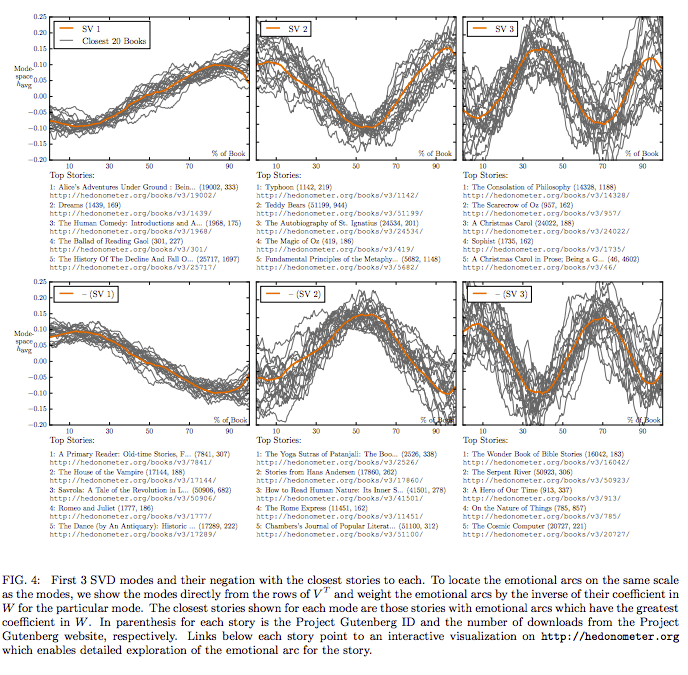
Some 70 years after Kurt Vonnegut proposed the idea of mapping story shapes for a rejected Masters thesis, some researchers decided it was time to crunch some data. They analysed 1,737 fiction novels to figure out how the story arcs are constructed. Let’s pretend there is a big difference between a plot and a story arc

The study used Project Gutenberg – i.e. public domain works – and the results suggest that there are only really six story arcs:

Fall-rise-fall: ‘Oedipus Rex’, ‘The Wonder Book of Bible Stories’, ‘A Hero of Our Time’ and ‘The Serpent River’.

Rise-fall: ‘Stories from Hans Andersen’, ‘The Rome Express’, ‘How to Read Human Nature’ and ‘The Yoga Sutras of Patanjali’.

Fall-rise: ‘The Magic of Oz’, ‘Teddy Bears’, ‘The Autobiography of St. Ignatius’ and ‘Typhoon’.

Steady fall: ‘Romeo and Juliet’, ‘The House of the Vampire’, ‘Savrola’ and ‘The Dance’.

Steady rise: ‘Alice’s Adventures Underground’, ‘Dream’, ‘The Ballad of Reading Gaol’ and ‘The Human Comedy’.

Rise-fall-rise: ‘Cinderella’, ‘A Christmas Carol’, ‘Sophist’ and ‘The Consolation of Philosophy’.

The most popular stories have been found to follow the ‘fall-rise-fall’ and ‘rise-fall’ arcs.

Or for those that prefer to read graphs because it makes them feel intellectual:

Screen Shot 2016-07-09 at 8.22.03 PM.png

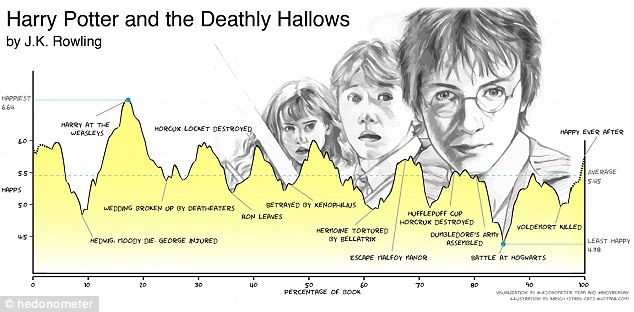
For those that just saw a bunch of squiggles in those graphs, what you are looking at is the story arc plotted over time for each story analysed. They’ve broken these into similar groups then added an average (the orange line). You can see how some of the story arcs follow the average more, whilst some types vary more. To see an individual story arc, they picked out Harry Potter as an example in the paper, but have the rest archived here (Project Gutenberg books) and here (a selection of classic and popular novels). As they note:

The entire seven book series can be classified as a “Rags to riches” and “Kill the monster” story, while the many sub plots and connections between them complicate the emotional arc of each individual book. The emotional arc shown here, captures the major highs and lows of the story, and should be familiar to any reader well acquainted with Harry Potter. Our method does not pick up emotional moments discussed briefly, perhaps in one paragraph or sentence (e.g., the first kiss of Harry and Ginny).

Harry Potter plot

It is interesting to see how close Vonnegut’s proposed shapes aligns with the research.

story arcs vonnegut

Source.

The above is from graphic designer Maya Eilam and can be viewed at her website.

Here is Vonnegut explaining the story shapes:

This is all nice and good, but why is this interesting? Well, aside from the study using my favourite statistical technique – principal components analysis – it shows that authors create, and the audience expects, structures that are familiar. The fact that two of the story arcs (rise-fall and fall-rise-fall) are the most common emphasises this point. Our ability to communicate relies in part upon a shared emotional experience, with stories often following distinct emotional trajectories, forming patterns that are meaningful and familiar to us. There is scope to play within the formula, but ultimately we desire stories that fit conventions.

So yes, there is no original art being made.

Book review: Down and Out in the Magic Kingdom by Cory Doctorow

Down and Out in the Magic KingdomDown and Out in the Magic Kingdom by Cory Doctorow

My rating: 4 of 5 stars

It’s so unrealistic to have Disney gradually taking over the world.

Jules has moved in with his girlfriend Lil – someone 15% his age at ~20 – at Disney World. As members of the ad hoc who had taken over Disney with the rise of the post-scarcity, post-death, Bitchun Society, they were there to have fun and accumulate Whuffie. His old friend Dan reappears in his life and someone murders Jules. Then another ad hoc tries to take over Jules and Lil’s part of Disney. Where reputation is everything, they have to put theirs on the line to fight back.

I’d heard of Cory Doctorow long before I realised he was an author. Sure, he was at writers festivals and associated events, but he never seemed to be there promoting a book so much as talking about copyright or Amazon or what sort of barrel publishing houses used with authors. So it has taken me quite a while to pick up one of his books.

I’m not sure how to rate this book. It was a fun read. The world-building was done effortlessly and didn’t pad things out – refreshing after the last sci-fi novel I read and DNF’d. Cory has also added in some very interesting ideas and explorations, particularly around what would happen post-scarcity and post-death. He even manages to stick the satirical boot in.

But now that I’ve finished the book, I’m not sure there was anything particularly remarkable about it. Possibly my feelings on the matter are related to the somewhat bland ending. Possibly it is related to how the moral questions raised were answered with a shoulder shrug. Maybe it’s just that this was a good but not great novel that promised more.

An entertaining read that explores some interesting territory.

View all my reviews