Every now and then I masochistically log onto Twitter to see what passes for civil discourse amongst the people trying to sell you stuff and those not quite racist enough to be booted to Gab. When I recently logged on, a couple of the authors I follow were updating their fans with their novel progress, or what was currently distracting them from writing.
What interested me about these updates was that several authors were talking about having to trim their draft by 50-65%. That’s right, authors who needed to hand in a 100,000 word manuscript to their publisher were having to trim 100-200,000 words from their novel.
Word limits are a funny thing. I’ve never had a problem being succinct, to the point that my editing usually involves added 15-20%. Yet these successful authors* are having to sit down with their editors to cull half their manuscript. And if we’re being honest, some successful authors** should have culled a lot more and saved their readers all that page skipping.
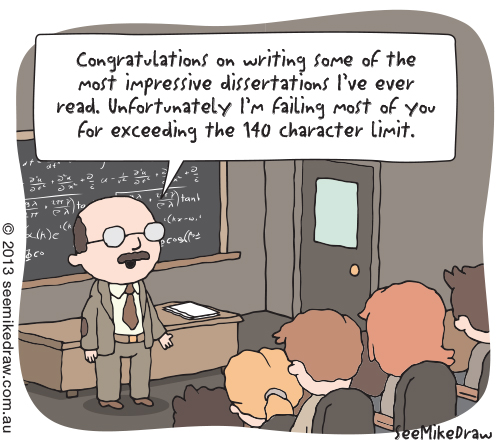
One of the good things that Twitter trains you to do, aside from teaching you that trolling people is perfectly okay, is how to express yourself succinctly in 140 280 characters. It forces you to practice creating a thought or sentence in a manner that may be foreign. For example, the complex phrase:
I disagree with your supposition as it is currently unsupported by any evidence, either presented by yourself or in the scientific literature, thus there is no reason for me to support your statements. I would also question how rational your supposition is, because despite the lack of evidence, there is no reason to suspect that there is any industry conspiracy trying to deny Dwanye “The Rock” Johnson an Oscar for Best Actor.
Can be replaced with:
Lol, moron!
This says everything that is needed and doesn’t dance around the topic. Conversely, the reply to this can be shortened from:
Whilst you are allowed to disagree with me, my opinion still stands. I cannot provide a summary of the relevant scientific literature at this time, but this is information that is readily understood and referenced in the literature. Thus I will endevour to provide a few examples when I am able to, but in the meantime I’d invite you to read further on the topic, as I suspect that you will agree with me once you have. I will admit, however, that the literature on this topic is currently inaccessible due to paywall restrictions, thus this unsourced blog post will have to suffice until such time as the academic publishing model is reformed.
Can be replaced with:
Well screw you and the horse you road up on.
The trick is to start with what your key points are and not overuse exposition to explain those points. The 140 280 character limit can help with this a lot.
In the meantime, if you aren’t a fan of See Mike Draw, I suggest you become one now.
* Maybe that is why they are successful authors and I’m still in thatemerging authorcategory. Perhaps it is time to write double the amount I need.
“Work expands so as to fill the time available for its completion.”*
In Praise of Idleness is an essay written in between the two world wars and expands upon one of the points made in his Political Ideals essay. Once again, Russell manages to argue a challenging concept in an erudite and concise manner. Even if you disagree with him on the idea of work being overrated, there is value in engaging with what he is saying.
On inequality:
“Modern methods of production have given us the possibility of ease and security for all; we have chosen, instead, to have overwork for some and starvation for others.”
Variations of this statement are still being made today around inequality. They tend to use far more words.
On wasted efforts:
“Modern technique has made it possible to diminish enormously the amount of labour required to secure the necessities of life for everyone. This was made obvious during the war.** At that time all the men in the armed forces, and all the men and women engaged in the production of munitions, all the men and women engaged in spying, war propaganda, or government offices connected with the war, were withdrawn from productive occupations.”
I mean, could you be any more scathing of warmongering?
While I think he does make his argument well, there are some points that are taken as a given. The example of the wasted effort of war in the quote above is one of those. There is a valid point made about how society managed to function despite being asked to drop everything and fight a war, but the point about war being a waste of time and that standards of living were still okay just has to be taken as a given.
Worth a read, even if you disagree with Russell on some or all points.
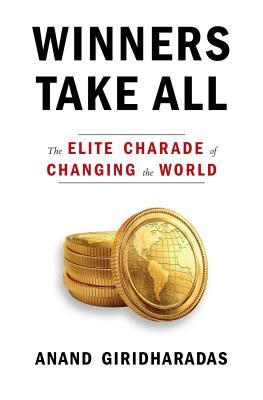
The first rule of MarketWorld is you do not criticise MarketWorld.
Winners Take All is a critique of the modern market-driven and capitalistic thinking that dominates the social and political landscape. Giridharadas focuses upon philanthropy in particular, as the more moralistic and benign problem of MarketWorld that is often used to whitewash the more obviously bad actions of those solely interested in the accumulation of wealth and power to the detriment of others.
This was a very interesting read and particularly insightful.* Throughout the book, Giridharadas is able to show us how MarketWorld created itself and now perpetuates and grows itself. And it doesn’t back away from being critical of people who think of themselves as doing good (and in a sense are) and of the system that allows this to happen.
Two topics in the book particularly resonated with me. The first was the idea of the immoral or amoral approach that is used to making money, which is then used for philanthropy later. This money is often made by exploiting people and the commons ruthlessly, and then is whitewashed of guilt by “giving back”, rather than, you know, not exploiting people/commons in the first place and thus negating the need for giving. I’ve previously come across this idea from a few philosophers and people like Alain de Botton who have discussed this on moral grounds.
The second topic was that of the Thought Leader. I’ve long been troubled by the happy-clappy approach to ideas and intellectual thinking we see in popular culture. Whether it be TED talks or deceptive pop-science authors like Malcolm Gladwell, there is a tendency in this field to be anti-intellectual or present a facile understanding of an issue/topic. So I especially enjoyed seeing the Thought Leader taken down a peg or two and the winning formula exposed.
Thought Leader 3-Step:
1) Focus on the victim, not the perpetrator.
In this way, you can avoid dealing with larger systemic issues and instead make smaller changes that have more direct and emotional appeal. Think, telling women to not dress too sexily so they won’t get raped** instead of addressing the issue of rape and rapists.
2) Personalise the political.
Or to put it another way, don’t be a critic pointing out systemic and collective issues, but instead make it about personal and individual dramas.
3) Be constructively actionable.
This is about having some nice and easy steps that people can do to make a difference. Remember to keep it at a personal level!***
This book wasn’t without fault. I’m not a particular fan of the narrative/literary journalism style employed. You commonly see this style in the pretentious long-form essays and “important” journalistic pieces. What it tends to do is obscure hard facts in the narrative and steer away from addressing points fully. This might make for a more “human” piece of writing that many would call more engaging and interesting, but it weakens just about any point and argument made.
I highly recommend this book.
Thanking our sponsors:
*The reason for the insightfulness is obvious if you are familiar with Giridharadas or read the Acknowledgements section. This is his playground. He is the son of a director of the McKinsey Institute consulting firm (they come in for a lot of flak in the book), worked there himself, he’s a Harvard alum, has given TED Talks (thought leader), and was a Henry Crown fellow of the Aspen Institute.
**And ironically, this is a great example of why this sort of focus just doesn’t work. It is a myth that clothing has anything to do with rape, but addressing rape and rapists would require a systemic change that makes many uncomfortable.
***This is why we see IPCC and other climate change reports making recommendations like installing solar panels, installing led lighting, and buying an electric car, rather than demanding a move away from fossil fuel usage at a society level.
So, if magic and science are incompatible, does that mean gravity is magic or physics?
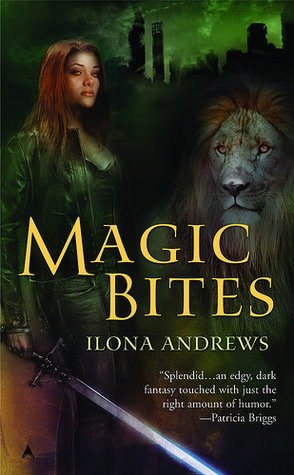
Kate Daniels is scraping by making a living as a mercenary. In her world magic rolls through in waves, knocking out technology and allowing all the beasties to have way too much fun. As a result, people need mercenaries with magical abilities like Kate. Then, as part of a power play, someone kills her guardian sending her after the most powerful magical beast in Atlanta.
The Kate Daniels series was recommended to me by my wife. She has been steadily reading the whole series and kept making appreciative sounds whilst reading them. Written by Ilona and Andrew Gordon, I wouldn’t have immediately picked up a book that hints at fantasy romance. The cover of Magic Bites may be more neutral, but some of the later books in the series I saw in the library had a lot of chiselled male torsos on them.
Fortunately for me, Magic Bites reminded me more of a Harry Dresden book than a steamy romance. Kate is a much more likeable character than Harry,* and the world she lives in makes a bit more sense.** There is also the implication of Kate having continuing adventures that are building toward something, not just another series that will keep churning out instalments.
I’m looking forward to reading more of Kate Daniels’ adventures.
*I originally described this book as Dresden Files except without a jerk as the main character.
**I mean, there are only so many world-ending events that Dresden can take on single-handedly before a) someone non-magic notices, and b) the Wizard Council would also get involved.
Reality might not be what it seems, but at least it isn’t a simulation. Possibly.
Carlo Rovelli is a theoretical physicist and has a background in the history and philosophy of science. His field of research is quantum gravity. This makes him an ideal person to write a book about the history of quantum physics and the current state of affairs with scientists trying to reconcile quantum mechanics and general relativity.
Rovelli is one of the founders of loop quantum gravity theory, a candidate alongside string theory for an explanation of quantum gravity. As there are many books, videos, and proponents of string theory, Rovelli thought loop quantum gravity deserved a book too. So while string theory is mentioned, the focus is on the history of quantum physics leading to loop quantum gravity theory.
This was a particularly well-written book. The history, starting with my favourite thinker Democritus, and the explanations were (relatively) easy to follow. At no point did I feel lost in spin foam or uncertain about what is really complicated material.
But I also came away from the book feeling as though I’d missed a section. Maybe I need to re-read the book (doable, as it isn’t particularly long) as I felt like the discussion of loop quantum gravity was actually a brief overview* compared to the sections on the background to its development.
Reality is Not What It Seems is a very good overview of quantum physics, I just wanted a little bit more.
*Loop quantum gravity doesn’t try to string together gravity with quantum mechanics but extends quantum mechanics as a granular geometric equation into the macro realm of what we understand as special relativity.
Natural man vs Social man: there can be only one winner!
In 1754, the Academy of Dijon held a competition to answer the question, “What is the origin of inequality among people, and is it authorized by natural law?” In response, Rousseau wrote his famous Discourse on the Origin of Inequality. No one remembers the first prize winner.*
As one of the early Enlightenment thinkers, and as someone who inspired the French Revolution, Rousseau was/is an important philosopher. This work on equality is certainly one filled with important thoughts on how inequality isn’t just about natural differences between people** but is about society itself creating inequality. I would interpret this as the powerful/wealthy structuring society to benefit themselves, but an argument could be made for those with the will to power.
Or put another way: inequality is a way for the rich and powerful to build a moat and castle.
The main issue I had with this book was that much of the argument is based upon a flawed evolution of “man”. While I don’t think this undermines his points, it does highlight how far our understanding of humanity, our evolution, and our social bonds has improved.
The version I read of this book had a biography and philosophic overview of the work by Israel Bouseman. This was an excellent addition. It did highlight the flawed knowledge of human evolution, however, it failed to note the now known social aspects of humanity that negate some of the points made.
I’d recommend reading the Bouseman edition of this book whilst trying to contextualise the ideas within our more advanced understanding of human evolution.
*I tell a lie, it was François Xavier Talbert.
**Rousseau refers to men only, specifically European men. Women are lesser beings, and non-Europeans are savages. I found it unclear whether that makes the savages natural men or something beneath that. This is made more unclear by the common false attribution of the Noble Savage trope to Rousseau.
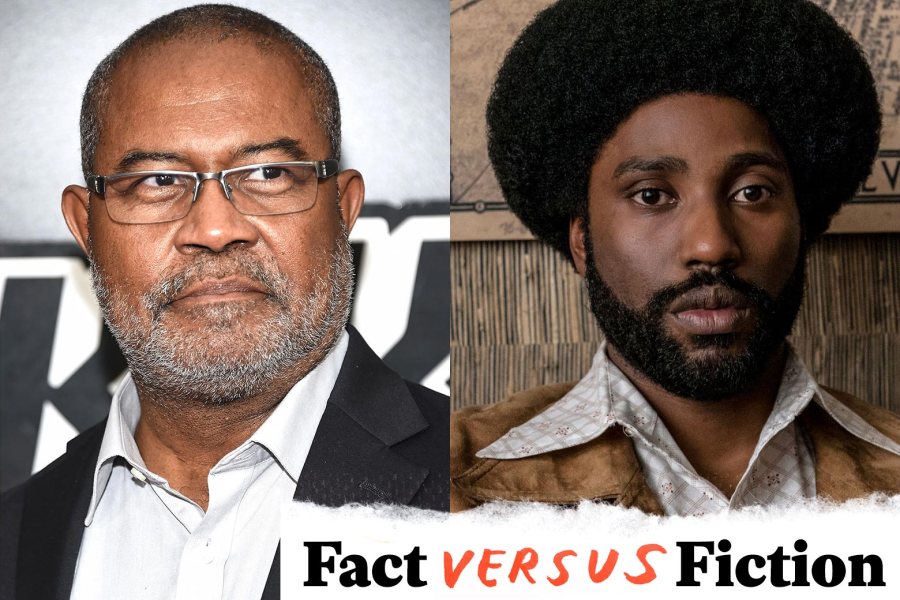
This month’s What’s the Difference? from Cinefix covers the amazing Spike Lee film based on the autobiography of the same name: BlacKkKlansman.
I have been reading quite a bit about fascism and racism lately. As someone who got lucky to be living in privileged skin, these are issues I feel we all need to be more aware of and actively standing against.
Instead of my normal comment on the film or book, I suggest watching the Vice coverage of the Charlottesville rally, Philosophy Tube’s videos on racism, Antifa and fascism, and reading the book on how to oppose fascism.
Luggage that doesn’t get lost? This must be a fantasy novel.
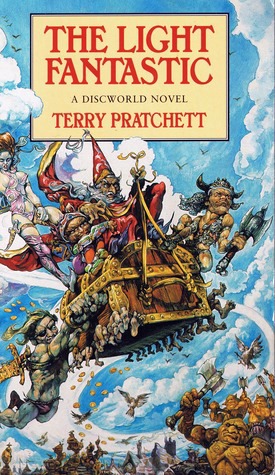
After shooting off the edge of the Discworld in The Colour of Magic, Rincewind and Twoflower are magically returned to the Disc for reasons unknown. The world turtle, Great A’Tuin, is swimming through space, excited about the red star it is approaching. The Wizards have noticed the red star and the magical change that allowed Rincewind and Twoflower to return, allowing them to uncover an ancient prophecy. Can the prophecy be fulfilled before Great A’Tuin reaches their destination?
When I finished The Colour of Magic I was a little peeved. Whilst a continuing story cliffhanger is a common fantasy trope, a book satirising fantasy tropes should surely rise above such shenanigans. That downgraded my rating to 4 stars.
Happily, The Light Fantastic finished the story started in The Colour of Magic in a highly entertaining fashion. I especially enjoyed the introduction of Cohen the Barbarian, being a fan of the Robert E Howard stories. Death and the other horsemen learning Bridge had me grinning for days. I wouldn’t rate this as one of Pratchett’s best Discworld novels, but it certainly started the ball rolling.
New tourism campaign: Come to Perth, where you can grift in peace.
Former Detective, Frank Swann, is starting a job with the new Western Australian Premier. The exact nature of his job is unclear. The exact motives of those around him are even less clear. Power players are moving to get their slice of the development and mining booms that are starting. The “facilitators” have their hands out. The usual underworld players – from bikies to bank robbers – see their chance as well. And the target is painted on Frank as he’s caught in the thick of it.
Back in 2016, I was lucky enough to attend the book launch for Old Scores. As a long time fan of David’s, it surprised me to realise that over two years had elapsed since getting my signed copy. If I’m honest, I feel pretty guilty for not having read it immediately. I got there… eventually.*
David is a fantastic writer and Old Scores is another great crime novel from him. He delivers with a gritty and evocative style that us crime fans love. Set in Perth, you not only get the feel of the city, but you have a sense of the underbelly that shaped it. I was too young to really understand WA Inc, but David capitalises on those, and other, events to craft his own tale. In many ways, it is often hard to spot what is a fictionalised historical event and what is actual fiction.
Old Scores is a must for any crime fiction fan and for anyone who wants to get a sense of what Perth and Western Australia were like in the 1980s.
Life is like a box of doughnuts. Mmmmmmm, doughnuts!
Theo Bernstein is on something of a losing streak. He lost his money, he lost his wife*, he lost his job, and he lost the visibility of one of his arms. Given how high profile the reason for losing his job was – who knew people would miss a mountain? – it’s a wonder he is able to find any work at all, first at an abattoir, then at a hotel. The hotel gig might be easier than hauling offal, but it’s a weird job, made weirder by the strange bottle left to him by his old professor, Pieter van Goyen. How can this bottle be the future of entertainment? And is there a doughnut shop nearby?
In the middle of last year, an author friend – Kaaron Warren** – recommended The Management Style of Supreme Beings to me. It was one of the nominees for an international award she was judging and she spoke glowingly of it. I’d previously enjoyed one of Tom’s books under his KJ Parker pseudonym, so I decided to track it down at the library. Obviously, I was unsuccessful, as instead, I ended up with Doughnut.
This explanation is a roundabout way of saying that I had high expectations for this novel. In some ways, Doughnut managed to rise to those expectations. Holt is a very sharp and inventive author. There are plenty of genuinely funny moments and ideas in this book. But somehow I felt it was all a bit pointless and inane.
In some ways, this is a product of the very British bumbling protagonist used in this novel. It tends to influence the way the story is told, usually in a way that is deliberately frustrating but with the reward of large doses of humour. Unfortunately, I’m not sure this was quite funny enough for the narrative style.
So while this was quite entertaining, I had hoped for more, particularly in the humour department.
*Lost his wife in the sense that she decided to leave him, not the lost in the ‘we were just walking through the Xmas sales and she let go of my hand for a moment and now I can’t find her in this crowd’ kind of way.
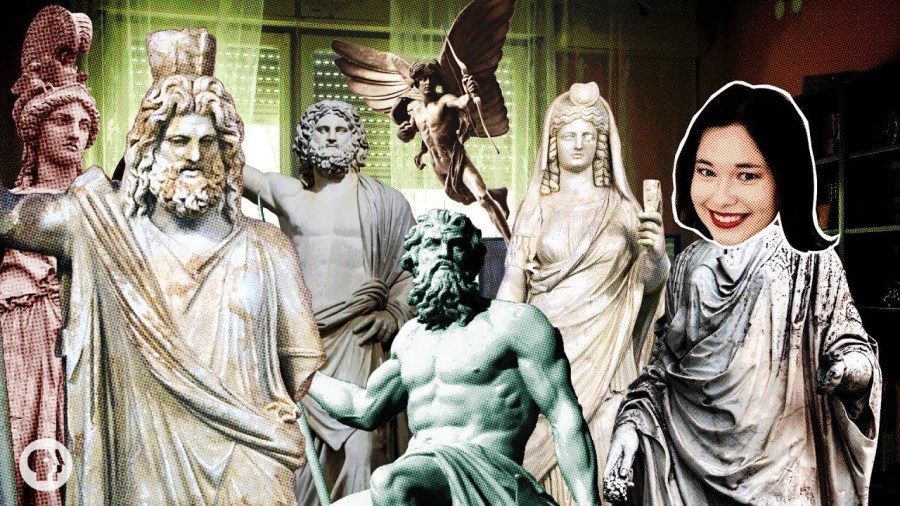
Did you know that James Joyce’s Ulysses is a (relatively) modern tale inspired by Ancient Greek Mythology? Well, even if you did know that, this video has something for you.
Given this video series has focussed on literature and books made into movies more than popular fiction, I knew that one of my favourite genres wouldn’t get a mention. The vigilante hero/anti-hero traces its origins back to the Ancient Greek Myths as well. The most obvious versions are The Wanderer or Knight Errant which draw upon themes and ideas from heroes like Perseus. This early creation underpins later takes on the hero. And thus, Jack Reacher could be slaying gorgons and saving royals.
Interestingly, the Knight Errant is also prevalent in literature not influenced by Ancient Greek Mythology. So it is possible that convergent ideas are at work.
Ancient Greek Mythology has worked its way into modern pop culture so deeply that it would be an almost Sisyphean task to compile every way it’s manifested!
It’s Lit! is part of THE GREAT AMERICAN READ, a eight-part* series that explores and celebrates the power of reading. Hosted by Lindsay Ellis
Finally, an episode of It’s Lit about everyone’s favourite Terry Pratchett character. Oh, and a few other versions of it from lesser authors.
Lindsay Ellis fans will have noticed similarities between this video and an earlier Loose Cannon video she did on the same topic. Worth watching both and noting what having a production budget allows for.
Death as a character reveals how we process one of life’s greatest mysteries, and there’s a lot more breadth to how the grim reaper is depicted than you might think.
It’s Lit! is part of THE GREAT AMERICAN READ, an eight-part series that explores and celebrates the power of reading. Hosted by Lindsay Ellis.
Who makes the money in publishing? Nobody. This often repeated dark joke highlights a serious issue. The most recent figures show that Australian authors earn just $12,900 a year from writing work (the median, at $2,800, was even worse). Indeed, authors can gross less than $5,000 for Miles Franklin-nominated titles that took two or more years to write.
Fixing this isn’t as simple as reaching more deeply into publisher pockets, because most of those are empty too. While the major international houses are thriving (Simon & Schuster and Penguin Random House recently reported 16% profits), publishing Australian stories can be financially perilous.
In independent publishing, 10% of the book sale goes to the author, perhaps another 10% to the printer, and up to a whopping 70% for distribution. What’s left has to pay the publisher, editor, marketers, admin staff and keep the lights on.
But we can improve our approach to author rights. Here are five lessons we can learn from elsewhere to help Australian writers earn more money.
Traditionally, contractual “out of print” clauses have let authors reclaim their rights when a print run has sold out and the publisher doesn’t want to invest in another. But in our recent analysis of almost 150 contracts in the Australian Society of Authors archive, we found 85% of contracts with these clauses allowed authors to reclaim their rights only when the book was “not available in any edition”.
These days, books can be kept available (at least digitally or via print-on-demand) forever – but that doesn’t mean their publishers are still actively promoting them.
A better approach is to allow authors to reclaim their rights towards the end of a work’s commercial life, determined with reference to objective criteria like the number of copies sold or royalties earned in the previous year. The Australian Society of Authors recommends authors only sign contracts that have this meaningful kind of out-of-print clause – but many publishers still try to get authors to sign up to unacceptable terms.
A growing number of countries (including France, Romania, Slovenia, Spain, Macedonia and Brazil mandate author rights based on objective criteria. The French law is an interesting model. There, authors can get their rights back if a book has been published for at least four years, and they haven’t been credited royalties for at least two. This opens up new possibilities for the author to license it to another publisher, or even sell it directly to libraries or consumers.
Rebecca Giblin on the problems with publishing contracts and the case for new author rights.
#2: ‘Use it or lose it’: return author rights when they’re not being used
Publishers take very broad rights to most books: in our recent archival analysis we found 83% took worldwide rights, and 43% took rights in all languages. It’s easy to take rights – but if publishers do so, they should be obliged to either use them or give them back.
To that end we can learn from the “use it or lose it” laws that bind publishers in some parts of Europe. In Spain and Lithuania, for example, authors can get their rights back for languages that are still unexploited after five years.
#3: Introduce a ‘bestseller’ clause to contracts
Of course, it’s not always the case that there’s no money in publishing: sometimes a title that was expected to sell 5,000 copies sells 5,000,000. That changes the economics enormously: but in many cases, the contract only provides the same old 10% revenue for the author. For works that achieve unexpected success, we can learn from Germany and the Netherlands (and the proposed new EU copyright law). They have “bestseller” clauses that give authors the right to share fairly in unexpected windfalls arising from their work.
#4: Legally enshrine the right to fair payment
Even where there’s not much money to be made, the author should still receive a fair share. Again, Germany and the Netherlands lead the way on this. There, authors are entitled to “fair” or “equitable” payment for their work – and can enforce those rights if their pay is too low.
These laws don’t set a dollar amount, since what is “fair” depends on all the circumstances. However, such laws at least provide a minimum floor. If the contracted amount is unfair or inequitable, authors have a legal right to redress.
#5: Put time limits on transfers
In Australia, copyright lasts for the life of the author, and then another 70 years after that. Publishers almost always take rights for that full term – only 3% of the contracts between publishers and authors we looked at took less. But publishers don’t need that long to recoup their investments. In the US, authors can reclaim their rights from intermediaries 35 years after they licensed or transferred them.
In Canada, copyrights transfer automatically to heirs 25 years after an author dies. We used to have the same law in Australia, but it was abolished for spurious reasons about 50 years ago. If we reintroduced a similar time limit on transfers, it would open up new opportunities for authors and their heirs (for example, to license or sell to a different publisher, libraries or direct to the public).
It’s true that there’s often not much money in publishing. But by changing our approach to author rights, we can help writers earn more and make Australian books more freely available.








 Tyson Adams