This month’s It’s Lit! covers everyone’s favourite topic: food.
If it isn’t your favourite topic, just give yourself 48 hours without it and see if that changes your mind.
I’ve always found food scenes in books to fall into two categories: needless exposition, or important showing (Oliver Twist is a great example of this). While the video discusses the latter, it is all too common that the former is what we read most.
While I was watching the video I was reminded of something I read last year. The discussion of bread in Victor Hugo’s Les Misérables, particularly around the hard bread that needed to be soaked, was something that Karl Marx wrote about in Das Kapital. The hard bread was actually due to deliberate contamination to make cheap bread that workers could afford, knowing full well that it was bad for them to eat, and the employers knowing full well that the workers couldn’t afford to eat properly (keeping them hungry so they would work).
A great way to remind us future people of how society used to run.*
Food varies wildly from place to place and from culture to culture; since humans are such sensory creatures, using words to evoke the experience of eating is an excellent way to bring a text to life.
It’s Lit! is part of THE GREAT AMERICAN READ, an eight-part series that explores and celebrates the power of reading. Hosted by Lindsay Ellis.
*Let’s be honest, society would quite happily go back to those conditions, and in some areas of the world, it still is operating in that way.
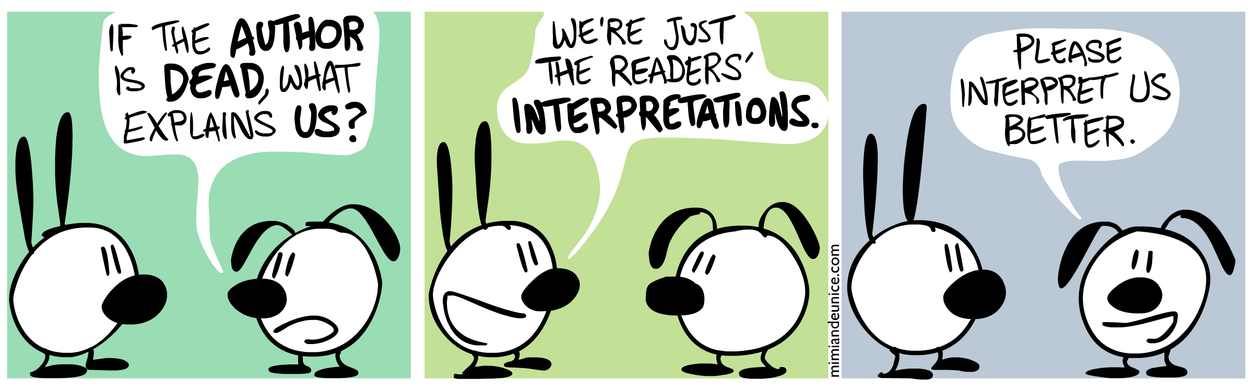
The birth of the reader must be at the cost of the death of the author… or so says Roland Bathes in his essay Death of the Author. Are we talking about literally killing authors? No, this is figurative (like most uses of literally). Can Death of the Author include killing the author? Sure, but get a good lawyer first.
Let’s let Lindsay Ellis (and John Green) explain:
My take on Death of the Author is somewhat complicated. I think there is relevant information that the author has that doesn’t make it into the story (think Elvish languages from Tolkien*), but I also think that quite often if it isn’t in the story it doesn’t really exist. I think that stories are really up to the readers to interpret, as viewpoints and interpretations will change over time**, but that doesn’t mean readers always interpret correctly.
This is a hedged way of saying that Death of the Author is probably too simple a way of thinking about how stories should be interpreted. At least, that’s my interpretation of it.
*Let’s not get into how “relevant” I think those languages are, or a lot of that world-building from authors in general is.
**You may remember book reviews here where I’ve discussed how older books haven’t aged well due to changing societal standards. Sexism and racism are obvious changes that have happened in the last 50 years which make formerly acceptable, even progressive, moments in a story seem backward and unacceptable now.
Another thing that can occur is changes to society changes interpretations. E.g. The Baby It’s Cold Outside controversy can be summed up as an old song made references to things that we are no longer familiar with, so our interpretation changes. This makes Death of the Author a truly bad thing for any artwork that is “consumed” outside of the social and temporal setting it was made within.
Update: Good article in Uncanny that captures some of my thoughts on Death of the Author.
If your novels keep coming true, do you try and make them more fantastical or more boring?
Ian Ludlow’s latest novel isn’t like his previous one. He needed a thriller that had international espionage, a conspiracy that would justify his Clint Straker character getting into life-threatening situations, and preferably a plot that wouldn’t come true this time. But his far-fetched plot about a Chinese operation has him and his assistant, Margo French, mistaken for spies and the only ones able to stop an assassination.
I always seem to enjoy Lee Goldberg’s thrillers. Whether it be his collaboration with Janet Evanovich (which gets a reference in this book) or his standalone novels, he always manages to make them fun and humorous. Some stories of this sort can fall flat through a lack of tension or poor pacing but neither problem is present in Killer Thriller.
There are quite a few in-jokes in this novel, such as the Evanovich reference, that you may miss if you aren’t familiar with Lee and his writing. I don’t think this detracts from the novel, but it may have enhanced my enjoyment more than the casual reader.
This is a great novel for anyone looking for a highly entertaining, funny, and fast-paced adventure.
I received an Advanced Review Copy from NetGalley in exchange for a fair review.
Believe in something. Anything. No, not that. No, best not that either.
It’s Hogswatch, the time of year for carol singing, presents, warm alcoholic drinks, and giant department stores to sell lots of stuff. But some “people” have hired Mr Teatime (Teh-ah-tim-eh) to stop the Hogfather bringing presents and drinking sherry. Can DEATH and his granddaughter Susan help?
To get in the festive mood this year, I decided I needed to read an appropriate book. Rereading the Hogfather was an obvious choice. HO-HO… oh yes, HO.
There are many of my favourite characters in this novel, DEATH and Susan being prime examples, as well as some very memorable others, Mr Teatime if only for the proper pronunciation of his name. It is also such a wonderful satire. I think that I enjoyed this novel more upon rereading than the first time around, which means I’ll have to make sure my copy stays on my bookshelf.
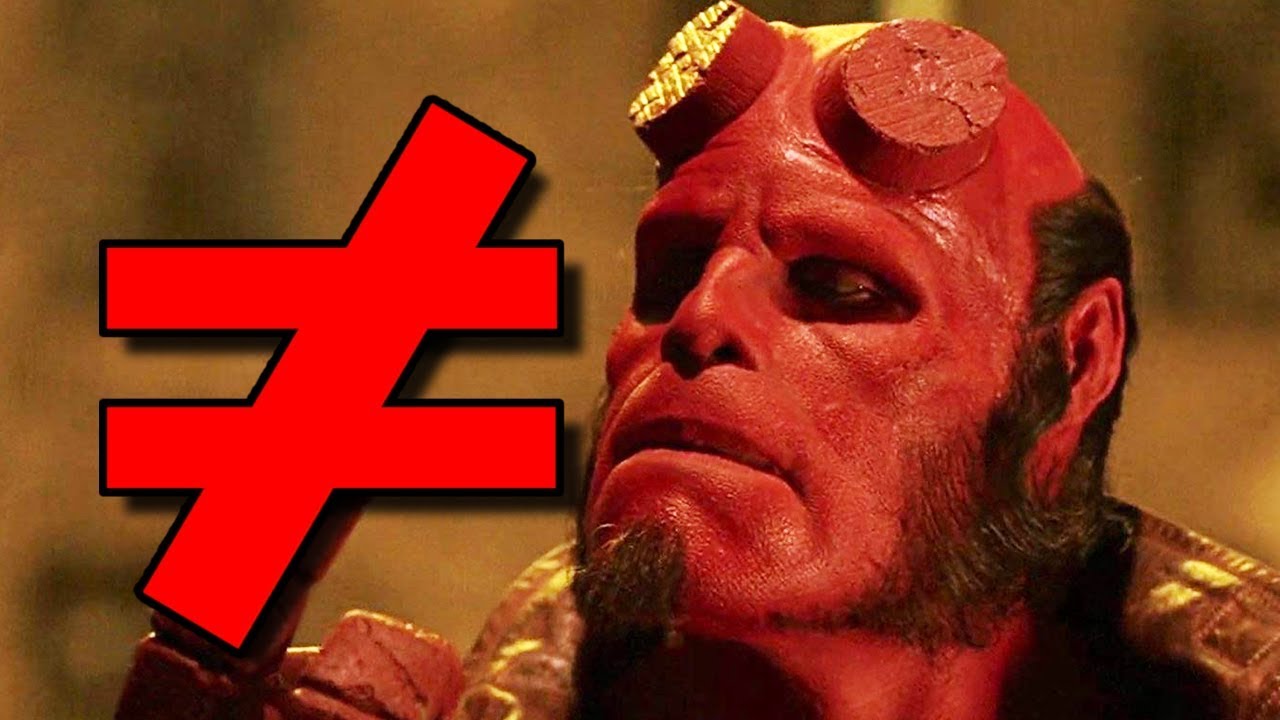
This month’s instalment of What’s the difference? from CineFix looks at Mike Mignola’s graphic novel and Guillermo Del Toro’s Hellboy?
In the interest of full disclosure, I’m not a fan of Hellboy: movie or comic. Yes, I know, how dare you not love Del Toro’s amazing artistic vision! I’ve watched both Hellboy movies multiple times and have not loved them (and despite liking the Blade trilogy, Blade 2 isn’t my favourite – but Pan’s Labyrinth was fantastic). The comics I probably didn’t give them a fair chance, as I tried reading one omnibus after not enjoying the first film.
Anyway, the point I wanted to highlight from the video was something I think too many adaptations fail to do. When you are talking about a series of comics or books, there is often some prevailing themes, motifs, and imagery to them that may be less noticeable in any one edition, but taken as a whole it is important.
Because movies are often only drawing on one book at a time, or drawing on one run (or story arc) of a comic, important aspects may be lost. An example would be the Tim Burton or the Adam West takes on Batman versus the Christopher Nolan version. The latter drew upon more of the Batman comics than the earlier adaptations (not that either of those adaptations was bad*).
So while this doesn’t necessarily result in a direct adaptation, it does result in an adaptation that is faithful to the source material in the elements that matter.
*I’m pretending that the Joel Schumacher adaptations don’t exist. Akiva Goldsman is probably more to blame, given he has a long track record of making everything he is attached to that bit worse.
Being prophetic is really easy when you make a “kids these days” argument.
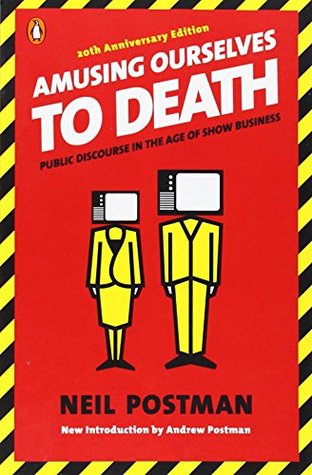
Amusing Ourselves to Death is Neil Postman’s ode to the “good old days” before television when entertainment wasn’t ruining everything. TV bad, reading good!
I decided to read this book after it once again started to be referenced as prophetic in the modern age. The first time someone mentioned this book to me I couldn’t help but feel the argument was likely to lack substance – you can amuse and inform at the same time.* What I found in this book was a supposition that isn’t without merit – slogans and sound bites can be influential whilst lacking any substance – but is argued in a cherry-picked and biased manner.
One example is how Postman claims that political campaigns used to be written long-form to influence voters, whereas now (meaning then in 1985, but many say it is highly relevant today) we get political messages in sound bites and 30-second adverts. This argument underpins his work and is at best convenient revisionism, at worst it is naive drivel. To suggest that there is no modern day long form political articles (and interviews, etc) is rubbish, just like the idea that the historical long-form articles he alludes to were well read by the masses is rubbish.
Another example is Postman claiming that media organisations aren’t trying to (in general) maliciously misinform their audience. We know that this isn’t the case. Even at the time this was written there were several satires addressing how “news” is deliberately framed for ratings (e.g. Network, Brave New World, the latter he references in the book). Either he has a different interpretation of malicious misinformation or he just thinks the media are incompetent.***
Now, his idea that we should be trying to educate kids to be able to navigate this new media landscape – instilling critical thinking, understanding of logic, rational thought, basic knowledge so that we are less likely to be fooled – is laudable. I completely agree. I’d also agree that there is a desperate need for this in people of all ages when we have an attention economy in place that is less interested in informing you than making sure your eyeballs stay glued for the next advert. I think this is why Postman’s book has resonated with people, the arguments aren’t without merit. But they are also deeply flawed and problematic.
I can’t really recommend this flawed book, but it isn’t without merit.
* This modern review from an education professional sums up this point:
“Instead of striking a balance between the use and over-use of media in education, Postman has completely shut down the debate in the belief that there is no good way to use visual media like the television and film in education. If you take his thesis to its logical conclusion, the number of technological tools in the classroom would be reduced to the overhead projector, the ScanTron grading machine, the copier and the laser pointer, and the field of educational technology would be greatly reduced in the process.”**
** Read this review particularly carefully. The author cites a number of problematic sources for claims made, such as Ben Shapiro, David Barton, Glenn Beck, Jonathan Strong (of The Daily Caller). All are known to deliberately misrepresent their sources (e.g. see my review of Ben Shapiro’s book covering this issue).
***Hmmm, could be something to that argument. As I regularly say, don’t attribute to malicious intent that which could be incompetence.
NB: I don’t normally post reviews of books I haven’t enjoyed (3 stars or more out of 5). It is my intention that this particular review will be one of few exceptions.
It’s that time of year once more. I’d like to take this opportunity to thank all of you readers, followers, and friends for spending time with me and my random collections of (mostly book related) posts in 2018.
Before the New Year, I’ll post one of those Top 10 post lists to discuss the highlights of my 2018 blogging… and the stats, you know I love talking stats.
As a gift for this festive season, I wanted to share some free books with you all. You see, for the first time in over 20 years, on the first of January, books from 1923 will enter the US public domain.
Yes, it has been 75 years already… Wait, quick maths tells me that 1923+75=1998, so shouldn’t these books have already been available in 1999? Why, yes, yes they should have. But apparently, the US Congress decided that for totally justifiable reasons [insert eyeroll] that books from 1923 to 1977 needed an expanded copyright term of 95 years.*
I’ve blogged previously about how copyright has excluded a lot of titles from the public domain. This essentially made any out-of-print titles disappear. And academics like Rebecca Giblin have been researching how copyright needs to change.
But now (some of) the drought is over. Google Books will offer the full text of books from 1923, instead of showing only snippet views or authorized previews. The Internet Archive will add books to its online library, and stores will be able to make these titles available for cheap (studies have shown that public domain books are less expensive, available in more editions and formats, and more likely to be in print—see here, here, and here.)
A few examples of books that will now be available in the public domain:
Edgar Rice Burroughs, Tarzan and the Golden Lion
Agatha Christie, The Murder on the Links
Winston S. Churchill, The World Crisis
e.e. cummings, Tulips and Chimneys
Robert Frost, New Hampshire
Kahlil Gibran, The Prophet
Aldous Huxley, Antic Hay
D.H. Lawrence, Kangaroo
Bertrand and Dora Russell, The Prospects of Industrial Civilization
Carl Sandberg, Rootabaga Pigeons
Edith Wharton, A Son at the Front
P.G. Wodehouse, works including The Inimitable Jeeves and Leave it to Psmith (Source)
So have a happy holiday and enjoy whatever festivities you celebrate at this time of year with a free book!
*See more on copyright from Rebecca Giblin’s Author’s Interest project.
The first rule of this month’s It’s Lit! is that you don’t talk about the narrator.
Unreliable narrators are an interesting topic. To some extent, I regard all narrators as flawed in some way. Unless you have omniscient narration you always have a limited viewpoint, and it could be argued that even with omniscient you still aren’t pulling away from the main narrative so it is limited as well. So I would argue that unreliable narrators are more a case of how unreliable are all narrators.
Who is the most powerful character in fiction? Villains may doom the world, heroes may save it, but no one has more control over the plot than the narrator – expositing the who, what, where, when and how directly into the reader’s mind. But how can you tell that the person telling you the story is telling you the whole story?
It’s Lit! is part of THE GREAT AMERICAN READ, a eight-part series that explores and celebrates the power of reading.
When you sit, sit. When you browse Twitter, browse Twitter… Maybe there’s a reason social media causes stress.
The Way of Zen by Alan Watts is an introduction to Zen Buddism and its roots in Taoism and Mahayana Buddhism. It was one of the first books of its kind and tries to explain “Eastern” concepts to a “Western” audience.
After my forays into various “Western” philosophers and philosophies, I thought it was time to investigate some others that weren’t just footnotes to Plato. Having already read the Dao De Jing and a more modern guide to Zen, I thought reading a bit more on Zen would be interesting. Watts certainly covers some quite different ground to Zen in the Age of Anxiety and puts the Dao in more context.
This was certainly less of a philosophy text and more of an overview or introduction to Zen. One of Watts’ central aims was to make sure the reader understood how the “Western” philosophical tradition has a strict adherence to certain logical structures which the “Eastern” philosophies like Zen do not. This was certainly an important distinction and something that must have helped popularise Zen Buddhism outside of the “East”.
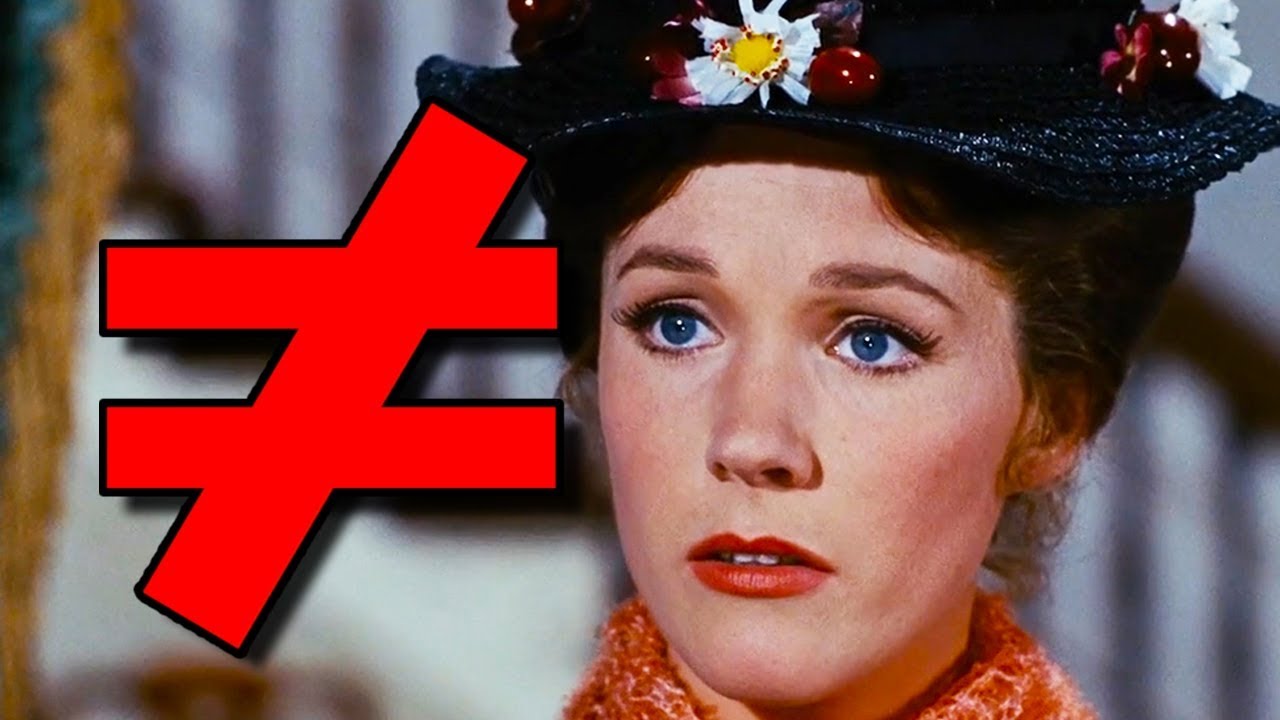
This month’s What’s the Difference? from Cinefix looks at one of the movies that you probably only realised was based on a book when they made a film pointing that fact out: Mary Poppins.
Having not read the books, I don’t have much to say about this month’s What’s the Difference? I would like to segue into a topic that the recent Saving Mr Banks raised. I think there are some interesting points to be made about the differences between mediums when it comes to how and what is remembered.
Truly great books will generally be read by fewer people than the number who will watch a middling film adaptation. Make a great film from a great book and you will still reach more people with the film. I’ve previously mentioned how as many people saw the final Harry Potter movie as there were sales of all of the Harry Potter series of novels. So even if we just go on audience size alone, it is fair to say that a movie adaptation will shape people’s memory of an artwork.*
Of course, it is worth noting that the movie Saving Mr Banks is somewhat revisionist. Tad important to know this as large media companies dominate the landscape of society. I mean, next thing you know Americans will use movies to try and tell us they turned the war by capturing an Enigma machine…
This video essay by Lindsay Ellis talks about the Revisionist World of Disney:
*Further to this point is should this influence the author’s decision to allow a movie/TV adaptation knowing that their writing will take second place to the more popular medium?
I would posit that there are two things that are important to an author when writing with regards to the genre:
That the author enjoys the genre they are writing in;
That the genre suits the story they are writing.
I’d also argue that the first point is far more important than the second. I say this mainly because I want to provide a very superficial argument on the second point.
In a panel discussion entitled Bestsellers and Blockbusters on ABC TV’s Book Club, thriller author Matthew Reilly made mention of some literary authors who had been tempted to try writing thrillers – because money. Always about those big juicy bucks. Those authors didn’t really like the thriller genre and as a result, they didn’t understand how to write them and thus failed to write entertaining thrillers.
I have previously discussed one example of what Matthew raised in the above video. In 2014, the literary award-winning author Isabel Allende decided to dabble in crime fiction with Ripper. No, seriously, that was the title. Allende didn’t enjoy the experience. She was quoted as saying she hates crime fiction because:
It’s too gruesome, too violent, too dark; there’s no redemption there. And the characters are just awful. Bad people.
Allende went further to say that Ripper was a joke and ironic. The response to this was for crime genre fans to condemn her, bookstore Murder by the Book sent their orders back, and Goodreads ratings suggest it is one of her worst received books. Maybe next time she will not make those comments whilst on the promotional tour. Or, you know, not write something she doesn’t enjoy. One of the two.
Authors obviously have to invest a lot of time and energy in creating a novel. If they aren’t enjoying the experience, then that is likely to spill over into the quality of the end creation. So they are likely to invest time and energy in doing something they enjoy so that readers will enjoy it. Or try to grin and bear it as they go after some big juicy bucks.
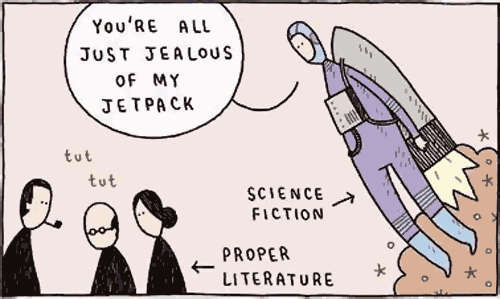
The second point that authors consider is what genre suits the story they are trying to tell.* Genre can help define and shape the story. So the genre often acts as the stage or setting for the story. Think of science fiction and themes of social protest, or fantasy exploring social constructs, or horror exploring ways to dismember work colleagues. Obviously, some genres will be more suitable for telling certain stories.** As a result, the genre will be an important consideration in the writing process.
In summary, an author is likely to write in a genre they enjoy and utilise the genre that helps tell their story. To my mind, this is how an author thinks about the genre.
Update: Matthew Reilly contributed to an article by Drew Turney discussing genre’s marginalisation at Good Reading Magazine.
*Sometimes the opposite approach is used to give us a space western or sparkly vampires.
**Of course, shifting the usual themes and tropes from one genre to another can be a way to create stories as well. Where would we be without Firefly?
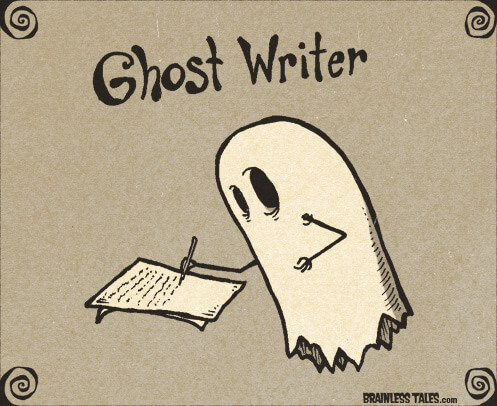
Is ghostwriting cheating? Well, this edition of It’s Lit discusses just that.
I think the most interesting point raised in the video is around the idea of the solitary author. This is the creative genius whose work you love or the dolt whose work you loathe. All praise and ridicule can be easily directed at one person. But outside of some indie authors, a book (or series of books) isn’t the work of one person. A lot goes into bringing a story to life and placing it in front of us readers for our entertainment. From the cover art to the editing, from the writer’s group feedback to the publisher’s request for a sequel, lots of people are involved in influencing, shaping, and ultimately creating a book.
Now, I have been known to take a dig at authors like James Patterson for their co-authoring ways. And I find it a little unseemly that Tom Clancy is still releasing new books despite having been dead for five years – seriously, half as many as his releases while alive. But that is probably as much about the mass-produced book under a name-brand that we used to associate as the domain of pulp titles. To have that become part of the big-name author stable cheapens the experience somewhat.
That cheapened feeling is probably related back to the idea of the solitary author. Or possibly that I’m not a huge fan of Patterson or Clancy. You know, one of those.
You might being asking yourself– Why do ghostwriters even exist? Isn’t that cheating? Isn’t literature supposed to be the result of one person’s agonizing need to create? Aren’t books supposed to be the blood, sweat, and tears of the tortured auteur? Well, the answer is more complicated than you think!
It’s Lit! is part of THE GREAT AMERICAN READ, an eight-part series that explores and celebrates the power of reading. Hosted by Lindsay Ellis.
If you have a lot of naked adventures, wouldn’t you move to a more agreeable climate?
Henry “library boy” DeTamble is unstuck in time. He visits moments from the past and future unbidden and with a lack of clothes. Claire is his wife. She has loved him since she met Henry as a little six-year-old girl and he was thirty-six. This is the story of their complicated life together.
I’ve been meaning to read The Time Traveler’s Wife since I saw the movie on our honeymoon. Achievement unlocked before the tenth anniversary! This isn’t the sort of book I’d normally read as it is a relationship focussed story with a heart-rendingly sad conclusion. Yet I really enjoyed it.
There were two things that let the novel down for me. The first is that this book runs long. There isn’t any needless rambling or overuse of exposition, but it felt like the story had a lot of filler. None of that filler was bad, per se, but I couldn’t help but feel this novel was about a third longer than it needed to be.
The second thing was the slightly uncomfortable relationship between Henry and Claire. While I was reading there were only a few moments that felt “wrong” and that those moments were handwaved a bit too much (e.g. teen Claire and adult Henry having the hots for one another). But those moments tie to the larger issues with the relationship being fated to mess with Claire’s whole life, and to a lesser extent Henry’s. If this had been discussed more directly and given more weight I’d have been happier.
Overall, I enjoyed The Time Traveler’s Wife and would recommend it.
The new episodes of It’s Lit are finally making it to YouTube. In this episode, Lindsay Ellis discusses book covers.
It is interesting that everyone in the reading industry* talks about not judging a book by its cover. Yet the entire industry is built around judging books by their covers.
We have the publishers and their creative team designing covers to attract readers. We have the readers browsing the stores and picking something that catches their eye. There are plenty of statistics around showing the improved sales based upon book placement in stores, whether they are face out or not, and whether they are in big piles – which makes all sorts of subconscious suggestions to shopping readers.** All of these factors are about presenting us readers with the cover of the book in the hopes that we’ll be interested enough to buy it.
But don’t judge it by its cover!!
*I honestly think we should stop using the term publishing industry and refer to the end user instead. I think we lose sight of who matters at times.
**Online stores have similar sales statistics related to cover design. Indie authors will often talk about the success of changing covers and improving sales.
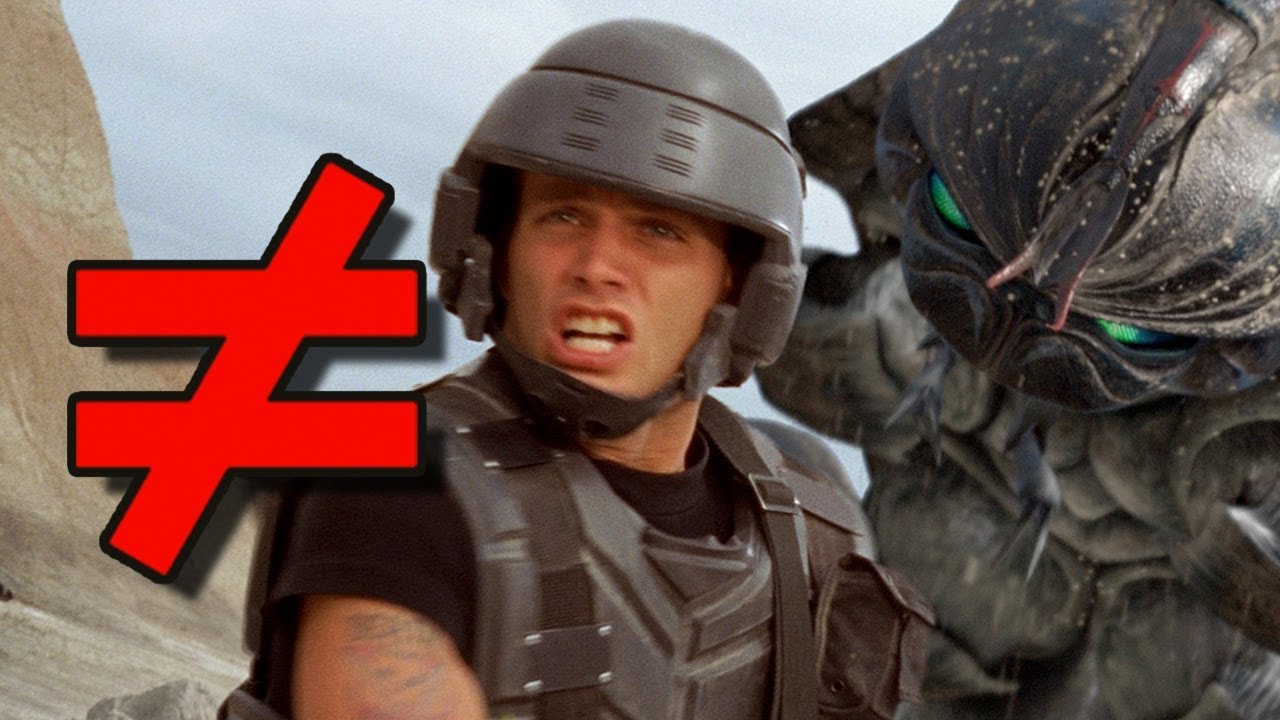
This month’s What’s the Difference? from Cinefix looks at one of the more blatantly different book adaptations: Verhoeven vs Heinlein’s Starship Troopers.
The first time I watched Starship Troopers all I saw was a cheesy B-grade action movie. This was also what many movie reviewers thought at the time. Many years later I finally read the book and it clicked.
Verhoeven’s film only made sense to me after I’d read the book as it is as much a critique of the material as it is an adaptation.
“I stopped after two chapters because it was so boring,” says Verhoeven of his attempts to read Heinlein’s opus. “It is really quite a bad book. I asked Ed Neumeier to tell me the story because I just couldn’t read the thing. It’s a very right-wing book. And with the movie we tried, and I think at least partially succeeded, in commenting on that at the same time. It would be eat your cake and have it. All the way through we were fighting with the fascism, the ultra-militarism. All the way through I wanted the audience to be asking, ‘Are these people crazy?’ Source
The cheesy propaganda segments riff on the heavy-handed philosophical lecturing Heinlein does. The proud militarism is given consequence by utilising Heinlein’s own references to disabled veterans and by showing horrible training injuries and battlefield scenes. The fascist elements are played up for farce in the uniforms and sequences mirroring actual Nazi propaganda films.
Michael Ironside asked, “Why are you doing a right-wing fascist movie?”
Verhoeven replied, “If I tell the world that a right-wing, fascist way of doing things doesn’t work, no one will listen to me. So I’m going to make a perfect fascist world: everyone is beautiful, everything is shiny, everything has big guns and fancy ships, but it’s only good for killing fucking Bugs!” Source
Now, I did actually enjoy the book. It is very interesting and many of the ideas were challengingly different. The portrayal of future warfare was, at the time, as imaginative as I’d come across. So Verhoeven’s reaction to satirise the book – one that Heinlein dashed out as an angry response to the US stopping nuclear tests – was probably overwrought by his childhood in the Nazi-occupied Netherlands. But if the movie adaptation had been faithful we’d probably have seen the worst elements of Heinlein’s ideas paraded around like something produced by the Ministry of Enlightenment.
Well, either that or a schlocky B-grade action movie about the military killing alien bugs.
Update: Here’s another take on the movie that, whilst missing Verhoeven’s critique, shows how much imagery and rhetoric is utilised. Although, it makes a good point that Verhoeven may have missed the mark a little in his critique.
I have been a devoted Kindle user for my e-book reading addiction. Unfortunately, my Kindle has become lethargic and prone to wasting valuable reading time. I could buy a new Kindle or one of the competing e-reading devices, or I could turn to the devices I already have.
No, I’m not talking about the stack of unread paper books on my shelf, I’m talking about my phone and tablet. Although, I probably should reduce the size of that stack before they feel unloved and attempt to move house without me.
So, having decided to utilise my iPad, I plugged it into my Windows* machine, booted up iTunes, and discovered a decided lack of Books to transfer.
A tad hard to transfer books to my iPad when the Book category has been removed. Now, if I was still using a Mac the problem would be easily remedied, as iBooks has taken over the role of synching books to the iPad. But on a Windows machine, I can only really transfer my books from the store to my computer.
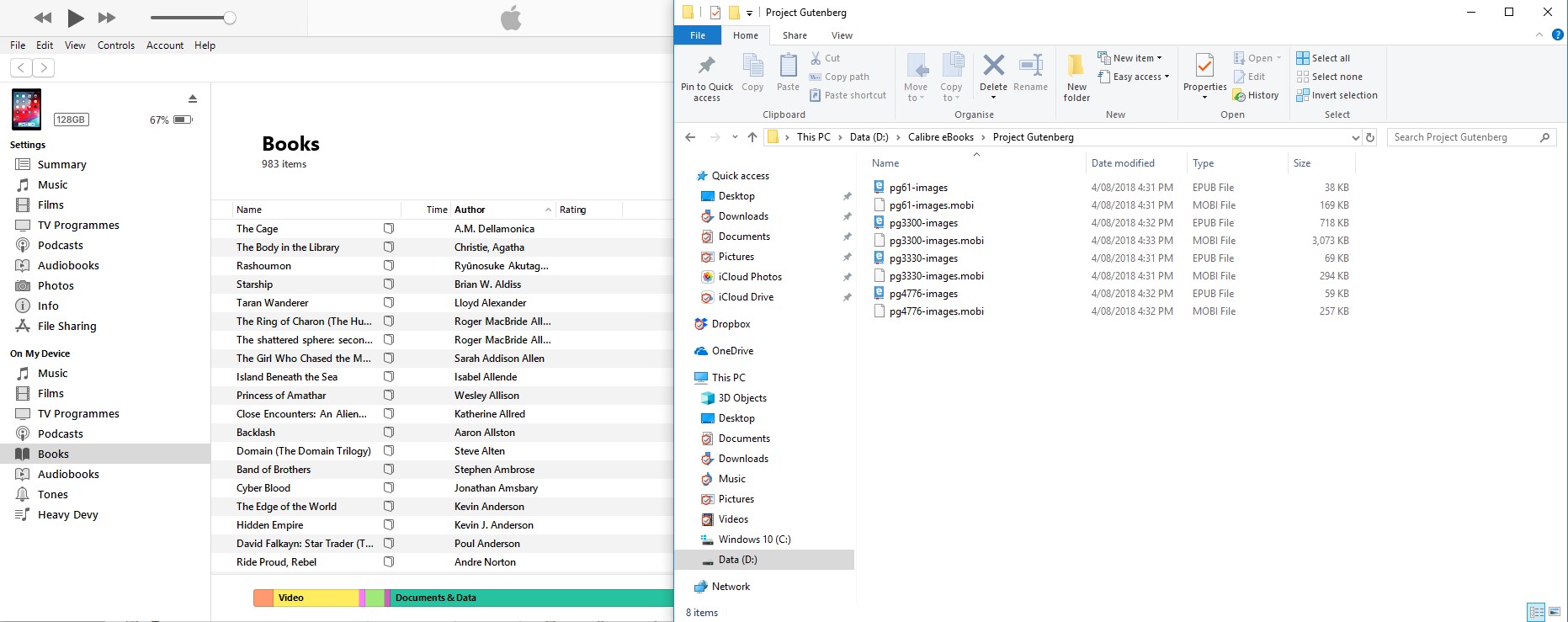
Try as I might, I couldn’t find an article explaining how to transfer books. So I did what every computer user does when something doesn’t work: I kept clicking until something happened. After replacing the CPU, I tried the sideloading technique some Apps utilise. You open iTunes to the place you want the file (Books) and then open a File Explorer window to the directory that contains the books you want.
As you can see in the screenshot, I’m transferring some Project Gutenberg books to my iPad. Just click and drag the files into the Books frame of iTunes and they will be copied. The transfer will begin once you hit sync.
Hopefully, this helps some other readers who want to transfer their e-books to their iPhone or iPad using a Windows machine. The same process works for adding books to other reading Apps, or other files to other Apps – I’ve added beta-manuscripts to the Kindle app this way.
*Yes, yes, deride Windows all you want. It works better than my broken Mac and Linux machines.
If you received a dollar for everytime someone said “X business is a license to print money” you’d have the first instance of that statement being true.
On the day before the Dragonfly Festival in Bleak Harbor, Danny Peters goes missing. Pete Peters, his stepdad, is having a quick beer after work at his medicinal marijuana shop before he and Danny go fishing when he receives a strange text message. Carey Peters is halfway through her long commute, thinking of her work problems, when she receives the message. At first, they aren’t sure if Danny has run off again or if something more sinister has happened until they receive the photo. But which of their secrets has gotten Danny in trouble?
From the very start, we see that this mystery will be built upon the layers of secrets Danny’s parents have been keeping. The twists and turns this gives us are tightly woven together. Pete and Carey feel like painfully human characters stumbling through life and now stumbling through the disappearance of their son. Danny is a refreshing and interesting portrayal of someone with autism, steering clear of the usual cliches and errors.
But I really did find it hard to engage with this novel. I liked Danny, but Pete and Carey weren’t particularly interesting or charismatic. It is hard to follow along with their trials and tribulations when you just want to slap them and tell them to talk to one another. As a result, it was hard to give this more than three stars despite how well the mystery was structured and the book was written.
I received an advance review copy of this book in exchange for a fair review.
Given the title, you’d think at least one person would be strangled in this story.
Former Wimbledon contender and now tennis club pro, Chuck Chandler, has moved to Key West after sleeping with the wrong person’s wife. Learning from his recent lesson, he starts sleeping with someone else’s wife. This does not end well and he’s soon in the frame for murder. A retired NYC homicide detective, Tommy Sculley, is seeing out his days as the Key West detective training a local rookie. He thinks there is more to this murder than Chuck’s philandering would suggest. A lot more.
In my efforts to explore my local library’s offerings, I came across NYT Bestselling Author Stuart Woods. I didn’t really have any expectations and was rewarded with as much. The twist was something I figured out before the first murder. Admittedly, I didn’t pick the entirety of the finale, but those extra details were window dressing. Figuring out the twist that early would have been fine if the rest of the novel was more compelling, but it just wasn’t. An example of this is that the two main characters – Chuck and Tommy – aren’t particularly interesting. How can you make a philandering tennis pro boring?
To summarise, Choke was only okay. It was just interesting enough to keep you reading but once you’ve finished you can’t think of anything noteworthy about it. Well, except that the local tennis pro is probably trying to have sex with your wife.










 Tyson Adams