Aussies have discovered the fountain of youth in the heart of the outback. From a very rare location in the heart of the Gibson Desert flows a natural spring that wells up from deep within the Earth’s mantle. This spring has regenerative properties that helps with many common diseases and ailments.
This spring water is used to brew beverages that are part of the Aussie staple diet. As a result, the increases in food abundance and greater sedentary lifestyles of the populous have not resulted in the normal health impacts due to obesity. So if you see any of these three beverages in your country, it is worth buying them in bulk in order to ward off disease.
Of course, it could just be that life expectancy has been growing in first world nations due to improved health care (child mortality, vaccinations, disease treatment, etc) and that steady increase hasn’t been impacted by the relatively recent surge in obesity rates. I.e. too soon to have obesity impacting life expectancy.
If a professional thief pretends to be a terrorist does that mean they blow all of their money in a public place?
Well, Elvis Cole would have found that funny. Bite me.
Elvis Cole and Joe Pike are back and this time they have been hired to investigate a missing person. Somehow that missing person leads to black market arms deals, murder investigations, Homeland Security mole hunts, thieves and terrorists. We also get to see some more of Scott James and his dog Maggie. Narration from the POV of the dog: go on, buy the book right now.
It has been a while since I’ve picked up a Robert Crais novel. I loved his early Elvis Cole novels but when he moved away from the humorous tone later in the series I lost interest. Fortunately I decided to check back in to see what was happening with Cole and Pike. This was a terrific read, with plenty of twists and turns, and is crammed full of interesting characters. The only negative I have is that the humour of the early novels is still taking a back seat. There are some Cole moments, but that aspect has been dialled right back, something I continue to miss with Crais’ writing.
Hell is being surrounded by famous people, apparently.
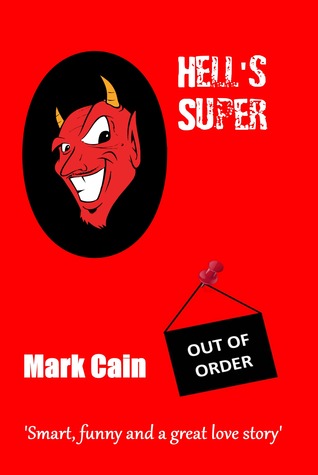
Hell’s Super follows Steve Minion, the only non-famous person in hell as far as I can tell, as he tries to fix all the problems that come up in hell. Whether it be replacing a broken light bulb on the sign leading into hell (Abandon all hope ye who enter here), or stopping a civil uprising, Steve is tasked with fixing the problem because he sucks at fixing things: it’s hell, it’s his punishment. His sidekick is Orson Welles and he is dating Florence Nightingale: enough said.
I picked up Mark Cain’s Hell’s Super as it promised to be a novel in the vein of Terry Pratchett or Good Omens: some satire, some straight laughs, some silly fun. It had those elements but for me it rarely rose above mildly entertaining. Having recently re-read Good Omens, a book Hell’s Super is compared to in the back cover blurb, I can safely say that the Pratchett and Gaiman novel is not being knocked off the Best Novel of All Time podium any time soon. Too much of the humour and plot relies on utilising famous people and irony (especially in the punishments) to be classed as Pratchett-esque satire and humour. It also didn’t help that the plot twists were obvious given the setting.
That said, this is an entertaining novel with enough humour to amuse. I think the comparisons drawn to Good Omens, Terry Pratchett, and Douglas Adams in the blurb set up too-high an expectation for me. Knowing that, you may enjoy it more as a result.
Regular readers here will have noticed I’ve not been blogging as much lately as I’ve taken to answering the occasional question on Quora. I feel it is important to help others understand topics. We all start by asking questions, and someone needs to answer them.
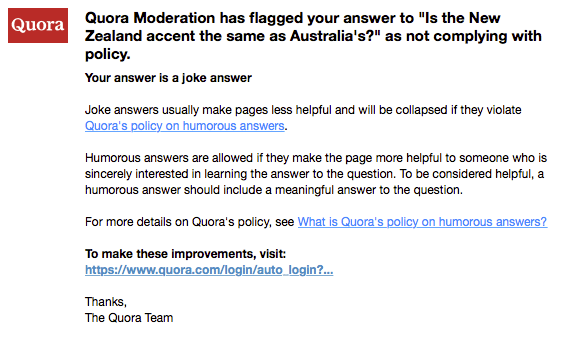
Today I received a disheartening email.
I’m shocked, SHOCKED I say. It is hard to believe that my answer would be found to be unhelpful. Read for yourself and see if you don’t find my answer helpful.
Is the New Zealand accent the same as Australia’s?
The New Zealand accent is almost exactly the same as an Aussie accent. This is mainly because, like Tasmania, New Zealand is actually a state within Australia. So any differences are essentially regional dialects of the same accent, much like the difference between a Texan drawl and whatever the hell that New Jersey thing is called.
This little fact isn’t really understood outside of the ANZAC nation; the ANZACs being our military arm. So here is a little list of evidence:
Russell Crowe – renowned Aussie actor from New Zealand.
Sam Neil – renowned Aussie actor from New Zealand.
Tim and Neil Finn – renowned Aussie musicians (Crowded House) from New Zealand.
Pavlova – renowned Aussie dessert from New Zealand.
Sheep shagging – renowned Aussie practice from New Zealand.
The easiest way to explain the slight regional dialects between the mainland Aussie accent and the island versions is to imagine a less evil version of the Aussie accent. That’s what the state of New Zealand inhabitants sound like. And before you ask, yes, Maoris and Aborigines are exactly the same peoples.
Clearly I was being helpful and giving the question the answer it deserved. When my answer was removed it had the second most views and had been upvoted several times. So it boggles my mind that anyone would flag the answer as unhelpful.
It is with outrage at the ignominy that I share this with you all here. My answer addressed all the points that were required. The explanation could not be any more clear as to the similarities of Aussie and New Zealander accents. Unless of course the person asking the question (and Quora) expected not to be mocked and to be treated super cereal.
For some reason the world of writers is filled with technophobic troglodytes intent on proving that their old-fashioned way of doing things is better. I’ve written previously about how older people’s favourite hobby since the dawn of time has been complaining about kids these days. This is also true of changes in technology, with people intent on justifying not learning to use a computer or e-reader. Because cutting down trees is the future of communication!
Once again I’ve stumbled across another article that misrepresents scientific studies to try and convince people that we need to clear forests, pulp them, flatten them into paper, cover them in ink, and act as snooty as possible. This time they – the nebulous they: my nemesis!! – are trying to pretend that taking notes with a pen is better than using a keyboard.
Ugh.
When will people learn that paper isn’t the medium we should be promoting? We need to be going back to scratching on rocks and cave walls. When was the last time a paper book lasted more than a hundred years out in the rain, snow, and blazing sun? That doesn’t even begin to compete with the longevity of the 50,000 year old cave paintings. Data retention for rock far surpasses the much inferior paper.
This isn’t the first article I’ve seen on The Literacy Site misrepresenting science. Hopefully they will acquire come scientific literacy soon and overcome their biases. If I turn blue and pass-out, try to act concerned. Let’s dive in.
New Research Explains How The Pen Is Mightier Than The Keyboard
It’s great when articles improve on the titles of science papers. I mean, who wants to read the science paper The Pen Is Mightier Than the Keyboard: Advantages of Longhand Over Laptop Note Taking? Pity that both titles misrepresent the actual findings. Also, is 2014 still regarded as new?
In her graduate assistant days, psychological scientist Pam Mueller of Princeton University used to take notes just like everyone else in the modern age: with a computer. One day, Mueller forgot her laptop and had to take notes the old-fashioned way. Rather than being held back by pen and paper, Mueller left class feeling as if she’d retained far more information than usual on that day. She decided to create a case study that could prove her hunch that writing longhand was actually better for comprehension than typing.
This is actually a good little story and illustrates how a lot of hypotheses are formed in science. This is the anecdote or observation that scientists want to turn into a hypothesis to create actual knowledge. But remember, this is an anecdote, which has as much value as used Easter egg wrappers that have been stuffed between the couch cushions. Putting anecdotal stories at the start of an article can set the audience up to not think too hard about the rest of the article, as you have given them the conclusion in a nice little story.
The study she created, published in Psychological Science, indicated that taking notes by hand is a more effective method than typing them on a laptop when it comes to processing information conceptually.
And here we jump straight off the rails, over the side of the bridge, and careen into the waiting river below. Sure, The Literacy Site is just quoting the press release, but that is lazy. The study itself has this line in the abstract that show how this claim is a misrepresentation of the findings:
We show that whereas taking more notes can be beneficial, laptop note takers’ tendency to transcribe lectures verbatim rather than processing information and reframing it in their own words is detrimental to learning.
In other words, the findings were that people spend all their time typing and no time actually listening and comprehending the lectures. Because the pen is an archaic device that is unwieldy and slow compared to the keyboard, students using a pen only write down notes after they have listened, picked out the key points, and conceptualised that information into a note. But don’t take my word for it, the press release on the University of Michigan website has a few recommendations including:
To interrupt verbatim note-taking on laptops, break up your lectures with short activities that encourage deeper processing of information.
Have students use laptops or other technologies to process–not just record–information.
Now it is time to discuss the study details a little bit, because someone might be interested in the methods section. I’m sure those people exist. Somewhere. Interested is probably the wrong word.
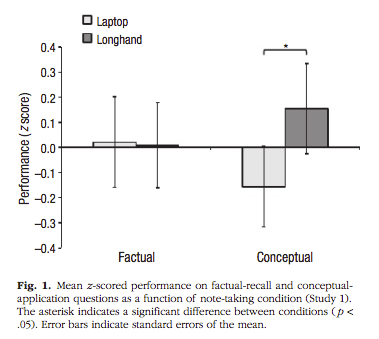
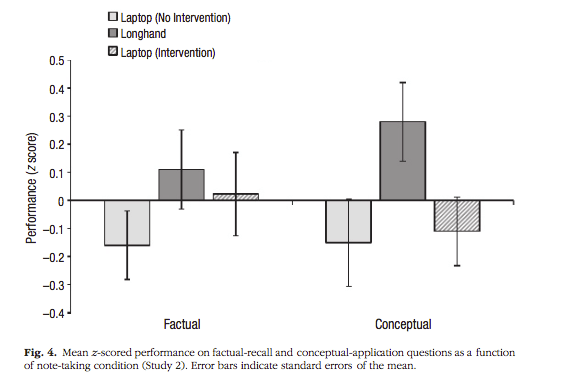
In the first of a series of studies led by Mueller, 65 college students watched various TED Talks in small groups, and were provided with either pens and paper or laptops for taking notes. When the students were tested afterward, the results were overwhelming. While the groups performed equally on questions that involved recalling facts, those who had taken longhand notes did significantly better when it came to answering conceptual questions.
Sorry, I need to catch my breath. I’m so shocked at the massive sample size. This is definitely enough people to represent the rest of society. Conclude away I say!
Anyway, these overwhelming results are just a tad whelming.
Whelming error bars.
As you can see the performance on retaining facts was the same, with error bars that suggest 65 people is probably not enough to draw conclusions from. Not that anyone would be trying to claim this study is proof of anything, right? The next thing you see is the benefits of using a pen…. as long as you ignore those error bars and just accept the p-value tells us something of value. Given that those error bars overlap for the two groups, I wouldn’t be drawing conclusions from a p-value. Also, I’m not exactly sure why an ANOVA was used when there were only two groups to compare. KISS principle applies to statistics as well.
Now the study realised that 65 people wasn’t enough, so they repeated the study with a few variations twice more. In the second and third tests they had 151 and 109 people take notes. Each test had the typists writing between 250 and 550 words, whilst the pen wielders wrote roughly 150 to 400 words. Interestingly the note takers were writing verbatim 12-14% with their laptop but the pen users only managed 4-9% verbatim. This shows why the conclusions I’ve quoted above were drawn.
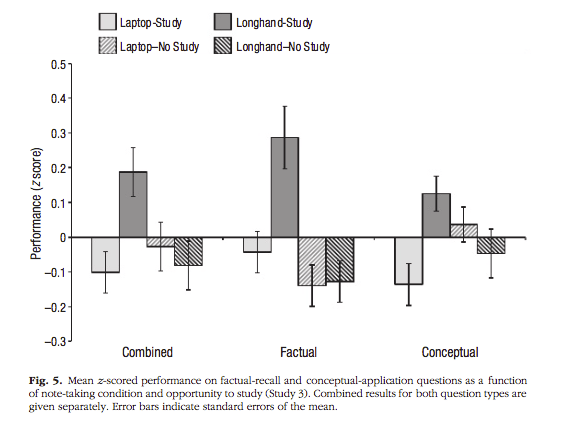
Out of interest, here are the results from the other two tests that were more convincing for that conceptual finding.
Okay, this is more like it.
The second test with 151 people were tested with pen, laptop, and laptop with a lecture from the tester about how they really should pay attention. With 50 people per group you’d hardly jump up and down about the significance of this test, but clearly telling people to pay attention doesn’t… hey look a squirrel.
Methinks that possibly the greater number of treatments has lessened this test’s significance.
The third test with 109 people again tested for pen vs keyboard, but this time they allowed revision of notes before being questioned. This makes the groups even smaller, and again I’d question the significance of such a small sample. But the researchers summed up the results with this erudite paragraph:
However, a more nuanced story can be told; the indirect effects differ for conceptual and factual questions. For conceptual questions, there were significant indirect effects on performance via both word count and verbatim overlap. The indirect effect of word count for factual questions was similar, but there was no significant indirect effect of verbatim overlap. Indeed, for factual questions, there was no significant direct effect of overlap on performance. As in Studies 1 and 2, the detriments caused by verbatim overlap occurred primarily for conceptual rather than for factual information, which aligns with previous literature showing that verbatim note taking is more problematic for conceptual items.
In other words, doing lots of writing, particularly just copying what was said verbatim, makes you suck at understanding what the hell is going on. Oh, and study before the test. Apparently it helps too. Made that mistake at university.
So back at The Literacy Site they are skipping the other tests and just heading to the conclusions:
Mueller found that this was the result of laptop users trying too hard to transcribe the lecture rather than listening for the most important information and writing it down by hand. It may be an era where computers have made handwriting seem useless, but Mueller isn’t the only believer in the importance of longhand.
Notice the nuanced difference that seeing all three tests provides? We could be led to believe that there was overwhelming evidence for the pen, but what we see is that note takers need to readdress their methods of taking notes. Or they could just wing it.
An article in TIME discusses Karin James, an Indiana University psychologist, who published a 2012 study indicating writing is particularly important in the cognitive development of pre-literate children five and under. While using a computer for note-taking in some situations makes sense, it’s important not to overlook the longhand method.
It’s great that the article tries to incorporate some extra research. Citing one study with a small sample size is hardly compelling, certainly not worth writing an article about. But again the research is being misrepresented:
…the benefits of writing: increased creativity, better critical thinking, boosted self confidence, and a correlated improvement in reading capability with writing prowess.
But are these benefits real? The short answer: Mostly not. “There’s lot of caveats in handwriting research,” says Karin James, a psychologist at Indiana University
Curse those damn caveats! Why can’t we have a control group of kids we don’t teach to read and write?!
Which brings me to a final point about these old technologies vs new technologies articles: stop jumping the gun! We’re in a transition phase. This isn’t 1970s velvet suits with platforms versus 2010s hipster atrocities. This is typewriter hipster texting on his phone. Technology is changing and we’re still learning how to use it properly. The studies that are cited in many of these articles have very limited scope, test very few people, and are comparing new and established things. Has anyone taught laptop users to take notes effectively for the new medium? Do you actually need to take written notes at all in this modern age? We need to see more science done on the changes taking place, and we need the articles discussing the science to do more than discuss (one study from) one paper, and highlight the limitations. Well, unless you have already made up your mind about a topic and just want some links to throw at people in an argument. Screw being right!
This blog post is being shared online, in print, and carved into a cave wall. Comment below which format you preferred receiving it in.
Sometimes in a novel when you go down the well you have to put the lotion on your skin, other times you’re travelling back to Earth. The latter; this one is the latter.
James Holden and his crew of the Rocinante are back again serving as an ad hoc belter law enforcement when they are sent to investigate an incident on Ganymede. Things quickly circle the drain from there as the war between Earth, Mars, and The Belt threatens to start again at any moment. Oh, and Venus is now under alien control. Fun times.
This is the second novel in The Expanse series by James SA Corey (aka Daniel Abraham and Ty Franck) and as a sequel to Leviathan Wakes it delivers. I thoroughly enjoyed the further adventures of the Rocinante crew, but the new characters of Bobbie, Prax and Avasarala only added to fuel to the fire. Avasarala in particular is a great character to follow, making the political side to the story palatable (Avasarala is portrayed by Shohreh Aghdashloo in the TV series, and I’m sure the writers had her in mind when the character was created).
I guess that means it is time to start reading the third novel in this series. Tough job but someone has to do it.
If a fictional bestselling author writes a bestselling book that refers to a fictionalised version of his fictional character, at what point does reality start gurgling down the drain?
Derek Storm and Xiangbang have uncovered a plot by a hedge-fund manager to ruin the world economy for financial gain. The hedge-fund manager has hired Storm’s presumed dead nemesis, Gregor Volkov, to aid his plans, i.e. Volkov is hired to kill the right people. Can Storm and Xiangbang stop the carnage and global economic meltdown?
Derek Storm is the super id and hero of the Richard Castle novels. Richard is the fictional author and lead character in the Castle TV show. Rather than have a novel tie-in for the show, Tom Straw has written a series of novels as though he was Richard Castle writing them. This entire series – of which I’ve only read a couple of instalments of – is written with tongue firmly planted in cheek.
Case in point: there is one scene in this novel that has a crossover between the Nikki Heat and Derek Storm characters that then references the fictionalised versions of the Castle TV show. The exchange of “ruggedly handsome” compliments that flows between the various representations of Richard Castle is something Nathan Fillion’s character would definitely do.
It is hard to recommend this novel or any of the Richard Castle books without the caveat that they are meant to be cheesy to fit with the meta-humour and references to the TV show. If you aren’t a fan of Castle, or aren’t prepared for the style, this book and series would come off as hackneyed; I’ve seen other reviews suggest as much. So make sure you have your life-sized poster of Captain Mal (or is that Captain Hammer?) next to your reading chair to remind you that this is meant to be stupid-fun.
The music industry has always run on Sex and Drugs and Rock ‘n’ Roll!! But not for Lindsey Stirling.
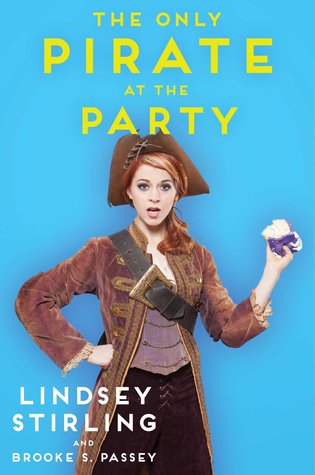
The Only Pirate at the Party is Lindsey Stirling’s autobiography…. Okay, is it still an autobiography when you co-write it with your sister? That’s not like having a ghost writer, right? Anyway, this is Lindsey’s story about carving out a career in music her own way.
I’m not exactly someone who follows TV “talent” shows and their stream of supposedly talented winners, let alone the people who lose those “talent” shows. I guess you could say I prefer a different kind of music, one that isn’t aimed at generating money off of teenagers voting and selling them insipid cover versions of songs. So it is odd that I would stumble across a crazily good dubstep/electronica dancing violinist who was one of the failed contestants on America’s Got Talent (now there’s an oxymoron title). It was the incongruous appeal of Lindsey’s music that had me interested in her background and thus, this book.
Lindsey’s story of success is not only interesting, but deeply personal. She discusses all sorts of personal issues, such as her love of Jesus – as defined by a 19th century con man – and her battle with anorexia. The starkest moments come in the audiobook version when Lindsey talks about her longtime bandmate/friend Jason Gaviati. Between the time when the book was written and when the audiobook was recorded, Jason died of cancer. Like I said: deeply personal.
Even if you aren’t a fan of her music, there is a lot to be taken away from this story. Lindsey’s tale of success comes from hard work and making her own opportunities. And how can you not enjoy the music?
This instalment of CineFix’s What’s The Difference? covers one of my favourite books: The Martian by Andy Weir.
As you can see from the breakdown, the film was a very faithful adaptation of the book. I thought the casting was spot on – can you believe some people didn’t think Matt Damon could get Watney’s tone right? – and they didn’t dumb anything down. Probably why I enjoyed both the book and the movie so much.
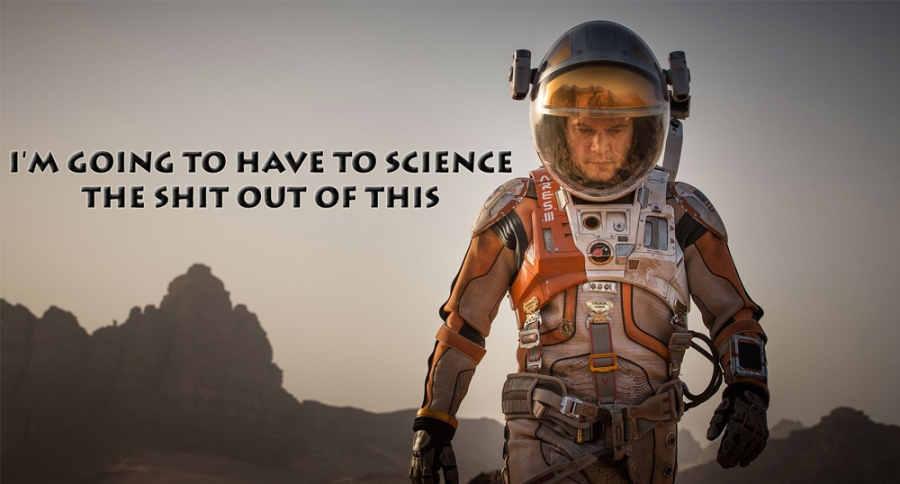
For me the main difference I noticed was the curtailing of some struggles in order to serve the larger plot and not have a 3 hour run-time. The continuous stream of problems that Watney had to McGyver his way out of really brought the “science the shit out of this” aspect to the fore. Most notable was the rover crash after the sandstorm. But for the movie you can see why they would cut that scene: it would have taken a fair bit of screen time, it would have detracted/distracted from the build-up to the big finish, and they’d probably have been tempted to go all Michael Bay with the crash. Car crashes have to explode: movie rule.
So if you haven’t read the book or watched the movie, do both ASAP.
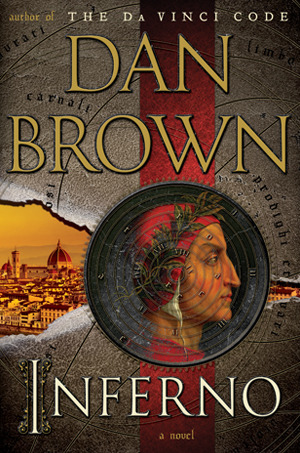
There’s nothing quite like an author desperately trying to establish their literary cred by referencing classic works of fiction. Guess what is mentioned in Inferno.
Professor Robert Langdon is back for another inexplicable adventure to save the world. This time a madman with a love for Dante’s Divine Comedy and the Black Death is threatening to release a new disease that could wipe out humanity. Only Langdon and his latest arm candy can save the day.
If it isn’t obvious, I have a like-hate relationship with Dan Brown novels. Dan writes very entertaining novels that are well paced with interesting plots. But he also manages to bash readers over the head with plot points – or character traits, or other random things he deems important – and squeeze in a lot of useless exposition. The useless exposition often feels like an attempt to impress readers with the amount of research that has gone into the novel. But when he starts mentioning things like Dim Mak – the mythical pressure point and no touch martial arts technique – with credulity, I cringe.
There are other points I find amusing about Inferno in particular. The continuous referral to six-foot tall Langdon as “tall” says a lot about the author (or editor’s) height. The desperate need to reference great literary works in a mass-market thriller novel. The idolatry of Langdon by various characters – “she was admiring him more and more”, “his deep voice” – is heavy-handed at best. But for these points, I wonder if this is a result of Dan’s success and wide appeal. Could it be that because Dan sells billions of copies of his books that he and his editors have to make sure the book has wider appeal and comprehension? Or is it the reverse; is his appeal that every plot point is hammered home, and that the reader is repeatedly bludgeoned with how awesome the protagonist is?
For all the book’s faults, Inferno was an entertaining read. Upon picking this novel up I was refreshingly entertained. Worth a read for fans of Brown, Steve Berry, James Rollins, etc.
[Spoiler]
I wanted to rip the final scene out and rewrite it. Langdon is returning the stolen Dante death mask to the museum but the curator can’t meet him. So Langdon sneaks in and replaces it, reopening the exhibit himself.
Boring!
How about Langdon being caught in the act of replacing the death mask. Security recognises him as the guy who stole the mask a few days earlier but hasn’t gotten the memo about Langdon being off the hook. So they are arresting him at gunpoint, to wit Langdon responds, “Please, I can explain.” The handcuffs go on and the book finishes there.
Language expert take on Dan Brown novels: “A renowned male expert at something dies a hideous death and straight away a renowned expert at something quite different gets a surprise call and has to take an unexpected plane flight and then face some 36 hours of astoundingly dangerous and exhausting adventures involving a good-looking (and of course expert) member of the opposite sex and when the two of them finally get access to a double bed she disrobes and tells him mischievously (almost minatorily) to prepare himself for strenuous sex. Where are we?” And another.
Did you know Who Framed Roger Rabbit was based on a book? Me neither. But apparently in this instalment of What’s the Difference from Cinefix, the differences between book and movie are so vast that it is more a case of what is actually the same.
Recently I reposted a cool infographic about science fiction weapons, which was a continuation of my posts of infographics with cool comparisons (such as the fastest space ships). Bryan at EVELO liked those posts and sent me a link to his post on the Fastest Bikes in Fiction. Check it out.
Cool infographic comparing the destructive power of sci-fi weapons from Foundation Digital and Fat Wallet. And yes, the Smart Disk is probably more accurately called a Smart Chakram (if I learnt anything from watching Xena Warrior Princess).
For the first time I’m actually interested in what is in The Juice. I’m betting The Juice doesn’t contain oranges.
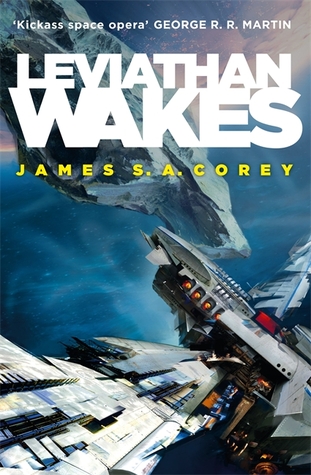
Leviathan Wakes is the first novel in The Expanse series and follows two protagonists, Jim Holden and Joseph Miller. Holden hauls ice – not that kind – for the colonies spread throughout the solar system. He and his small crew inadvertently start a war when their ship is blown up. Meanwhile Miller is a detective trying to find a missing rich girl. Holden and Miller’s paths cross and they have to stop a war, and something even more dangerous, from destroying humanity.
It has been awhile since I’ve sunk my teeth into a space opera. The impetus to do so came from the SyFy series The Expanse, the first season of which is based upon Leviathan Wakes. For the first few weeks of the show I was matching pace with the TV and novel, but have finally pulled in front with my reading. I can highly recommend both the show and the novel.
There is a lot going on in the novel: it touches on elements of many genres (noir, mystery, hard sci-fi, etc); it maintains a brisk pace/tension; has elements of social and political commentary (anyone else notice the WikiLeaks ethos reference?); and combines some interesting characters with an interesting plot. As such, this is one of the better sci-fi novels I have read. I’m starting Caliban’s War, the sequel, today.
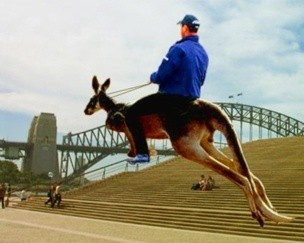
Like most advanced countries, Australia has moved past antiquated methods of travel. Just as you don’t see horses and carts in major cities anymore, Aussies have moved away from riding kangaroos in much the same way. Let’s face it, kangaroos are smelly, need to eat lots of food, and are dangerous with a nasty kick – kinda like horses when you think about it. Cars really are much nicer to commute to work in.
But just like horses, there are diehard kangaroo riding enthusiasts who haven’t figured out that cars are so much better. As such there are riding schools, such as Alex Hayek’s Kangaroo Riding School, and clubs for people to learn to ride. Some children do prefer to ride kangaroos instead of bikes to school, but that is becoming less common with the advent of helicopter parents.
The sad thing about kangaroo riding is that it isn’t as popular as horse riding in Australia, despite kangaroos resulting in less deaths each year than horses. So it will be interesting to see if this proud tradition is continued in future generations.
If you go to war with the Mafia do you have to use Tommy Guns?
Mac Bolan is a one man army and he has the Mafia in his sights because reasons. And he gets the girl. I think that sums up the plot. Change Mafia for some other antagonist and you have the plot for the entire series of the long running young-men’s action novels.
When I was young Indiana Jones was the prototype for action-adventure movies. They were amazing. It took a long time for them to be released on DVD, but when they finally did I grabbed them for a movie marathon. I was a little disappointed. They were cheesy. It was hard to tell if they were always cheesy or if they had aged badly because Indiana Jones was the prototype for a genre that had evolved and now looked lame in comparison. NB: don’t take that as a diss on Indiana Jones…. except Kingdom of the Crystal Skull, which was terrible.
The Executioner is similar to Indiana Jones in that it was the prototype – well, one of many – for a genre that has evolved. It’s hard to call this cookie cutter stuff since this was the prototype cutter. It is easy to see the appeal and how this influenced so many people, including my friend Matt Hilton (shameless plug). But so much time has passed since these were new. In that time a generation of authors, TV shows (watch Banshee), and movies have been influenced and created works. The genre has grown, matured, and taken on other elements, such that this feels kinda cheesy. Was it always cheesy? Maybe that was what made this series fun in the first place.
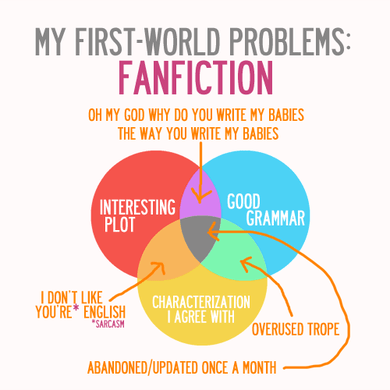
I’ve never understood authors, directors, or other creatives who have a problem with fan fiction (and other derivatives). What is wrong with fans showing their love for something you’ve created by creating something of their own? Sure, it won’t be canon, and they might not get the feel of your work right, but does it really matter?
With that, I give you a fan fiction short from Rocket Jump.*
*Yes, this post is just an excuse to share the above video, even if it is only for the Firefly reference.
A much loved book and a classic movie: this month CineFix tackle the differences between the tree and silver halide versions of The Princess Bride by William Goldman.
Many years ago my sister was kind enough to force me to read The Princess Bride. Of course I was a fan of the movie; despite never doing the fancy dress thing for parties I have worn an Inigo Montoya name badge, so yes, I was a fan. But for some reason at the time I had this strange idea that if I had seen the movie then there wasn’t much point in reading the book. I mean, how different could they be?*
Long story short, The Princess Bride is one of my favourite novels, ranking up there with Good Omens and Hitchhikers Guide to the Galaxy. The What’s the Difference? video only makes passing mention to the style of the novel, which is as much about making an abridged version of the original S. Morgenstern novel, as it is about the adventures of Westley and Princess Buttercup. Having to edit out the endless chapters describing trees, the difficult negotiations required to secure the rights to do the abridgement over Florin native Stephen King (who ends up securing the rights to the sequel, Buttercup’s Baby), and generally only including the good parts, are key to the novel. Just about all of this was dropped from the movie, because meta-humour would be too confusing to audiences (trust me, people still don’t understand Inception for some reason). So the novel is quite different from the movie. Read it.
On the subject of the above video, it is interesting in this instance that William Goldman wrote the book and the screenplay. So we are able to see how Goldman has zeroed in on the important parts of the narrative to simplify the movie. Because movie audiences aren’t like us sophisticated book readers. In the anniversary edition of the book, Goldman notes how pleased he was with the movie, particularly the casting that brought the book to life. No mention was made of the budget blow-outs due to Andre The Giant’s alcohol consumption.
*Hence the reason I share this fantastic video series each month: it is my penance for such poor thinking.
One day I’m going to start a think tank and name it after a bodywash – possibly a shampoo – just like Lincoln Child did with his fictional institution, Lux.
There’s a problem in the west wing of the think tank Lux. No, it isn’t that their research is funded by special interest groups. No, it isn’t that they are neo-cons intent on bending governments to their policy wills. Lux has a slight problem with residents going crazy. So they contact Dr Jeremy Logan, a former resident and investigator who specialises in the extraordinary, to figure out what is causing the problems. That’s when they find The Forgotten Room and its contents.
Without realising it, I’ve actually read one of the other Jeremy Logan mysteries. The reason I didn’t realise I had read the first in the series (this being #4) was that Jeremy wasn’t the main character in Deep Storm. But much like Deep Storm, The Forgotten Room is a compelling mystery that hits all the right beats. Where Deep Storm was more techno/sci-fi based, The Forgotten Room has allusions to the supernatural whilst being more conventional. Where Deep Storm had a mysterious illness, The Forgotten Room has a mysterious illness. Where Deep Storm tried to kill off as many characters as possible, The Forgotten Room keeps the fatalities to a minimum. I don’t know why I’m comparing the two books in the series this much, probably because they seem to have the same general plot and feel to them. Although I do prefer the character of Logan to Crane.
As with all Lincoln Child and Douglas Preston books, you can be assured of an entertaining read. Whilst Logan is no Pendergast, he does make for an interesting character to follow as he unravels the mystery. But as with my review of Deep Storm, I did feel this book to be a little too “by the numbers”.
In the latest instalment of the What’s the Difference? series, the CineFix team have broken down the Ian Flemming novel and Daniel Craig movie, Casino Royale.
Unfortunately Casino Royale is not one of Bond novels I’ve read. The change between generations is very marked when reading a Bond novel, the little changes like letters and radio to texts and mobile phones (cells to US people) are expected. But the social change that has occurred is the biggest noticeable difference, mostly with the role of women and minorities in society. Felix Leiter being African-American in the movie? Vesper Lynd being the intellectual equal of Bond? These are not things that Flemming would have imagined for his world.
I like Daniel Craig’s Bond and think that Casino Royale was a shot in the arm for the long running series. The gritty take on things was needed after the cheese that was Die Another Day (etc). And you can’t help but love any film that has Eva Green in it. With rumours flying that Craig’s Bond will be no more, it will be interesting to see what the next take on Bond will bring us. Will the producers push back to a suave Connery take on Bond, or a tongue-in-cheek Moore version, or an in-between like Brosnan, or something really lame and poorly written like Dalton and Lazenby’s outings?
Whatever happens with the Bond series it is clear that the social update to the novels will continue.















 Tyson Adams