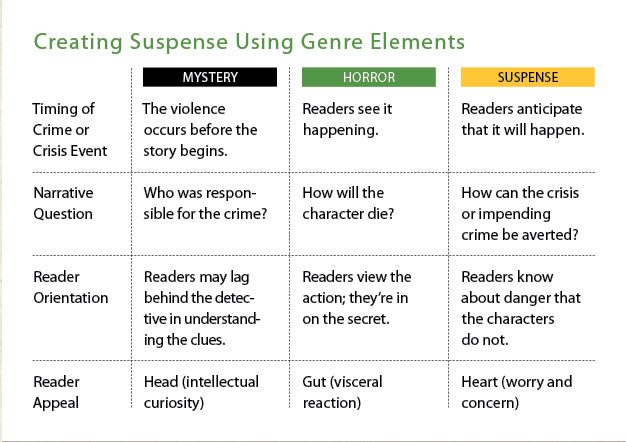
We don’t often think of fantasy novels as being mysteries. And yet, in JK Rowling’s Harry Potter novels, the mystery elements are cornerstones of the plot.
Mystery isn’t easy to do well, either, as we will see in the two videos below from Just Write. In the Harry Potter novels we see the elements Rowling used to great effect, and in the new Fantastic Beasts movies, we see how Rowling bungles those elements.
I suppose the big takeaway is that even a master writer* can mangle the craft.
*Feel free to disagree with this assertion and point out to me Rowling’s various flaws as an author in painful detail that assumes I’ve never read the Potter books. That’s why they invented the comments section.
It feels like only yesterday, but it’s actually just over a week since I finished my Fellowship at the KSP Writers’ Centre. What’s a Fellowship? I hear you ask. Actually, I didn’t hear you, but I do hear voices in my head – no, I have an adequate sufficiency of matches, so be quiet. Anyway, I applied for a writing retreat to focus on (finishing….) my novel Evil Corp. Twelve-and-a-half days to do nothing but writing in a purpose built hut.
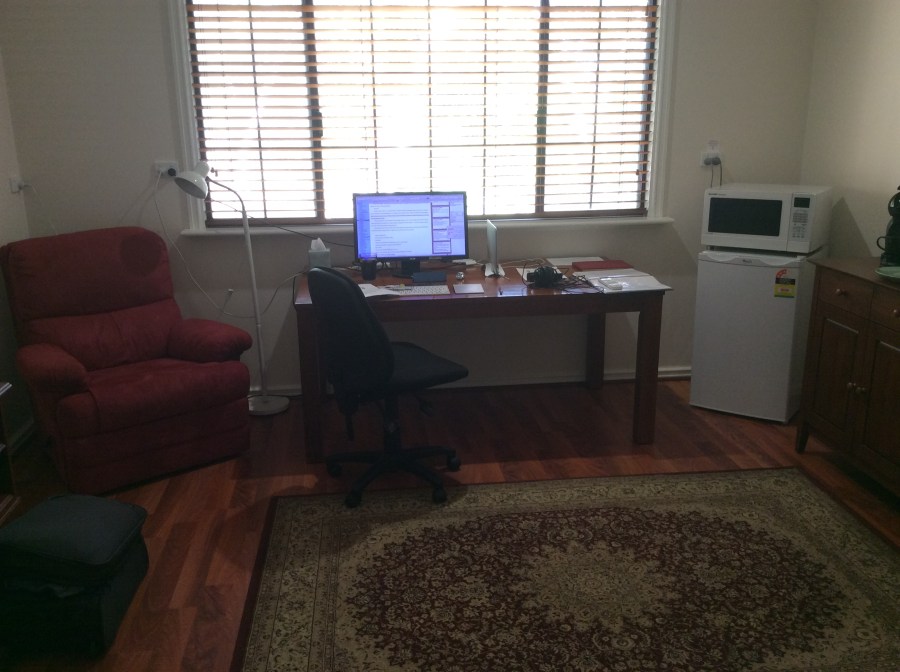
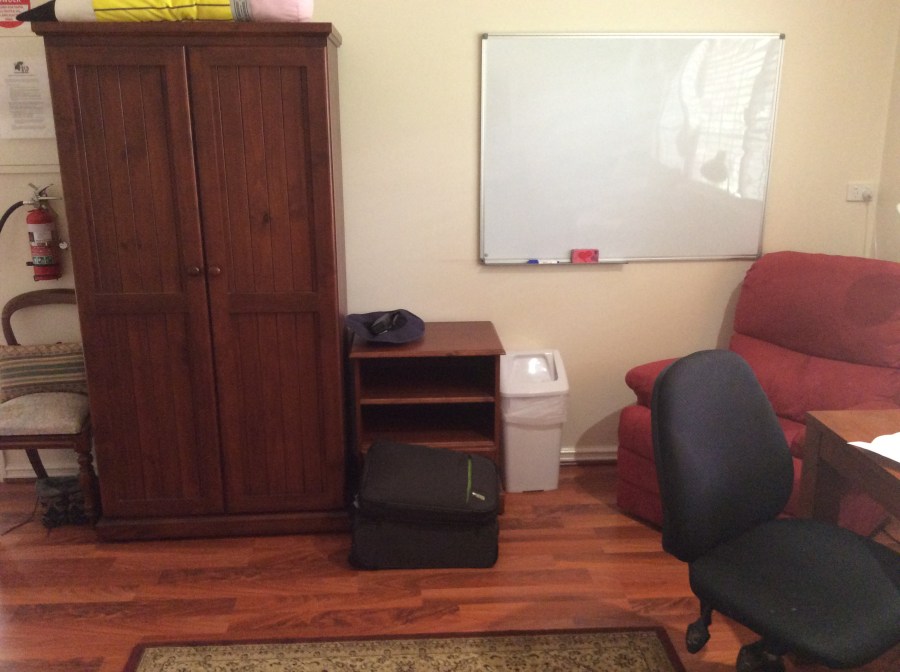
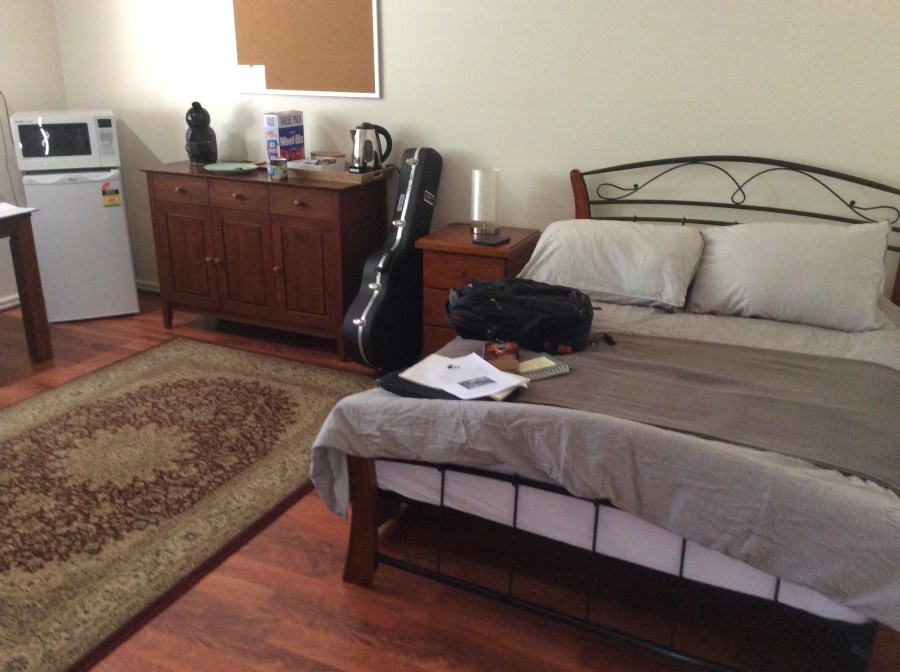
The writing huts are modeled after Katharine Susannah Pritchard’s own writing retreat and are very much focussed on having a room to write in. Your desk faces out onto the garden – I had a view of a gum tree with a beehive in its trunk – you have amenities for snacks and drinks, a chair for quiet contemplation, and a bed for… well, you know what beds can be used for.
I had a whiteboard… which I didn’t end up using. And a giant pencil… which I also didn’t use.
The hut was quiet and felt ideally suited to writing. Or painting. Or reading. Or slowly going mad and deciding to live like a hermit. All good options.
Yes, I brought a guitar.
The best feature was definitely the lack of adjoining accommodation for young children, who slowly steal your hopes and dreams as they consume more of your life than you’d ever imagine, such that you wake up at 40 wondering why you haven’t published a novel yet.
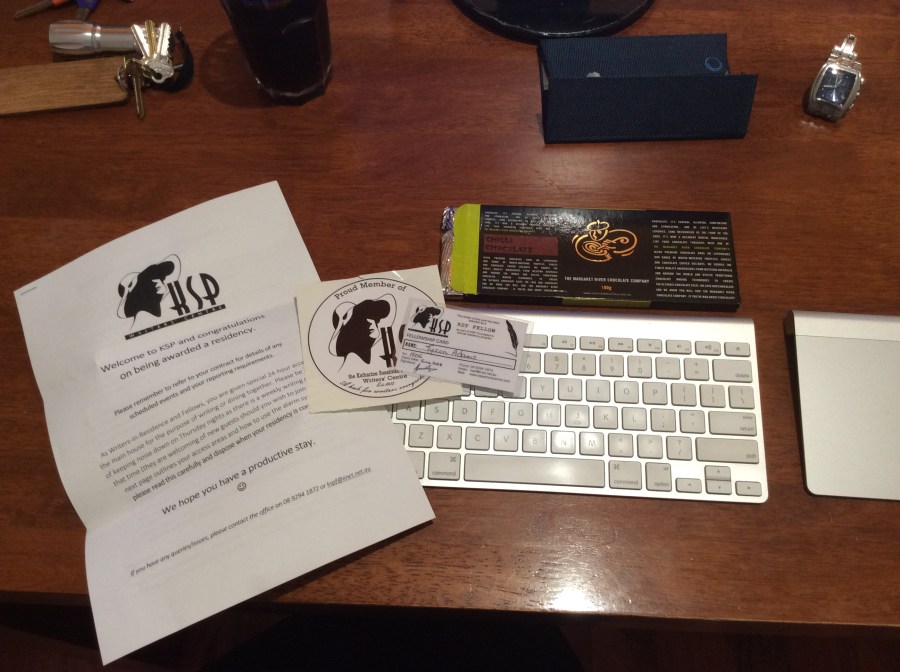
With the welcome letter in hand, my computer set up, I was ready to right write!
Getting my author on
Not sure if I made this picture blurry by drinking too much caffeine, or if it was the wrong lighting for the camera to focus.
For my stay at KSP I had set a few hard and soft goals. Hard goals were things like: relax and enjoy being able to pursue my hobby uninterrupted for a fortnight; not wake up at 5am because my kids weren’t going to be there; refrain from buying a beret and neck-scarf; write more than 1,000 words per day. Soft goals were things like: wake up before noon; eat properly; get some exercise; try not to feel guilty about leaving my wife alone with our kids; write 20,000 words during my stay. Try to guess which goals I achieved.
I didn’t want to place too much pressure on myself to, say, “finish my novel” or “write 5,000 words a day”, because that would have sucked the fun out of the Fellowship. Having previously won NaNoWriMo, I knew I could write 2,000 words a day for a sustained period, but I was surprised at how having more time to write didn’t necessarily increase output. I’m going to claim that it was higher quality than NaNoWriMo writing though. A low bar I’m willing to jump over. But I did manage to write 20,000 words, do some plotting, create a few characters, outline several chapters for the future, review a couple of books, and come up with two plots for other projects, so it felt productive.
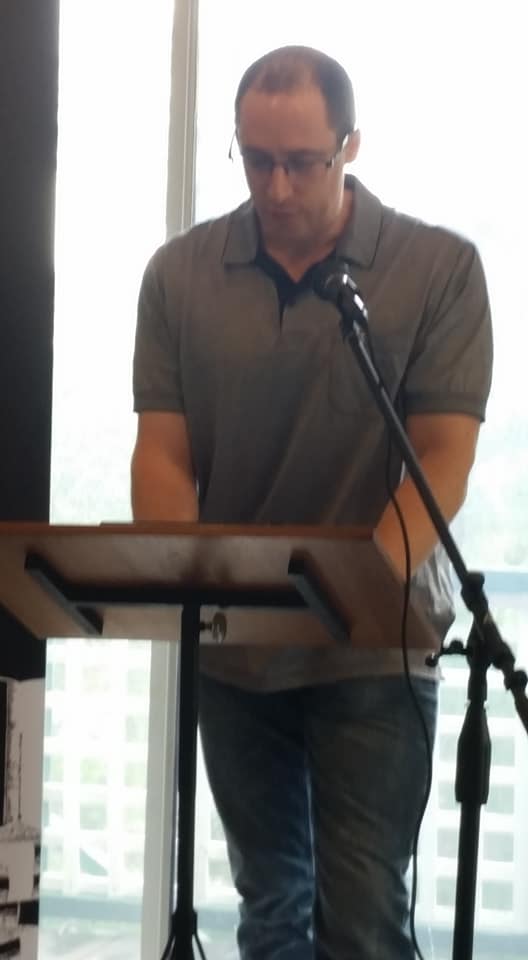
On the first weekend of my Fellowship the KSP Writers’ Centre held their open day. It was a fun event and well attended despite the threats of rain. As the above photo shows, I was asked to do a reading for the event on behalf of one of my writing groups. I read Werespoon by my fellow Fantasy Sci-Fi Horror group author Anne Forbes. Gillian Clarke read on behalf of my other author group, the Thursday Night group.
Another thing that made me feel authorly was mingling with other authors.
Surrounded by other authors
Rachael Mead, Kaaron Warren, me being told to smile more.
Writing is generally regarded as a lonely occupation. Well, unless you take your laptop to a coffee shop so you can tell anyone who has the misfortune of coming too close that you’re an author and that sitting in a coffee shop telling people about your WIP counts as writing. The KSP cabins were decidedly setup for writing. On your own. Uninterrupted. I brought a guitar. But I still managed to hang out with other authors.
Kaaron Warren and Rachael Mead were also at KSP doing a Residency and Fellowship respectively. Kaaron has been publishing stories since before I’d figured out Coco-Pops didn’t need extra sugar. She was shortlisted for an Australian Shadow Award while she was in residence, and just last week released Tide Of Stone. One evening we were discussing awards (she is a judge for the World Fantasy Awards this year) and she casually mentioned being beaten by luminaries Stephen King and KJ Parker… I’m not sure that counts as losing.
Rachael has a PhD in creative writing and, like Kaaron, an impressive list of awards to her name. She has published multiple poetry collections, including one that came out earlier this year, and regularly contributes arts reviews to magazines. She also writes short stories and was working on what appears to have become a collection themed around paramedics during her time at KSP.
Which made me the bumbling rookie trying not to sound like an amateur around the two pros.
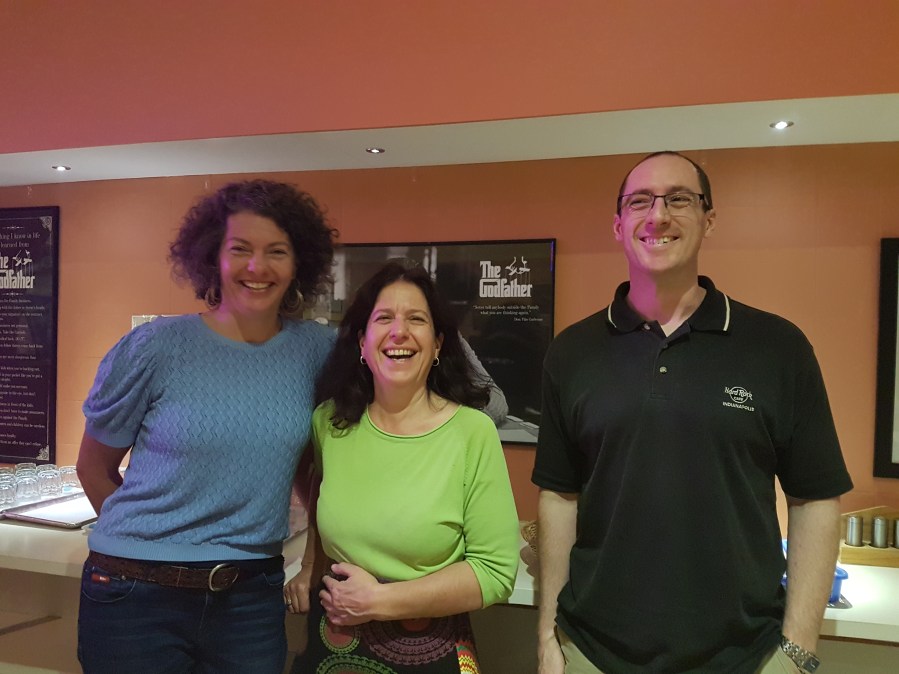
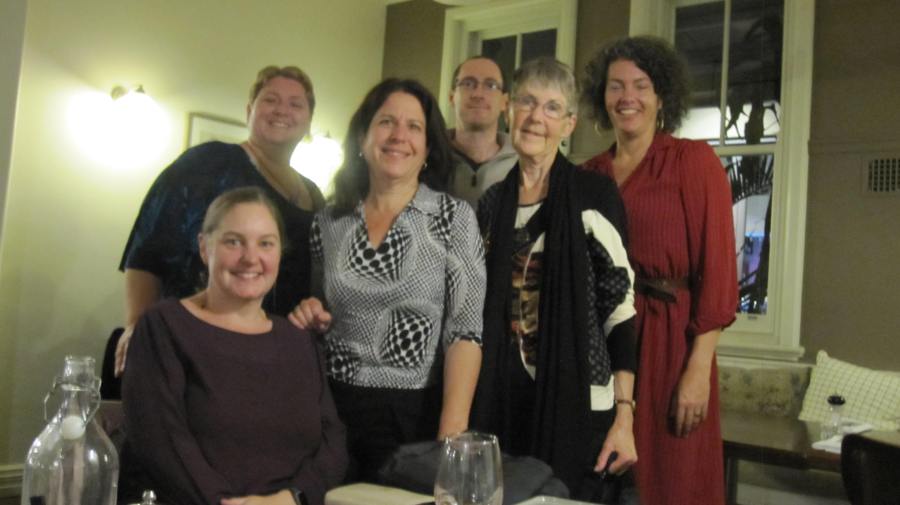
It was invaluable to chat with them over dinner, or at drink-o-clock, or at procrastination time. For example, Rachael helped me with a chapter I was headed in the wrong direction with. But it was also good just to be able to have a chat and socialise, including catching up with an old friend who is a mutual friend of Kaaron’s. If that wasn’t enough wordsmiths to hang out with, we also had a lovely dinner out with some other KSP Fellows. See the blurry photo below that proves kids aren’t necessarily good with technology.
Dinner with some other KSP Fellows.
Summary
It was great to have the opportunity to feel like a writer and make some progress on (one of) my works in progress. I met some lovely people, got some writing done, and didn’t get woken up by a toddler wanting to find the teddy that is lying right next to them in bed even once. I very much appreciate the board and staff at the KSP Writers’ Centre for awarding me the Fellowship.
Last week I reblogged an article about some new research into what makes us creative. This week I’m sharing a video from one of my favourite YouTube channels, which essentially covers the same work. But this one is a video!
Since this is going to be a three part series, I’ll update this post as the other videos are released.
This is an interesting short video featuring Suzy Jackson, voice artist, recording an audiobook at Audible Studios.
Joanna Penn has also interviewed a number of people on her podcast about audiobooks, which are worth listening to.
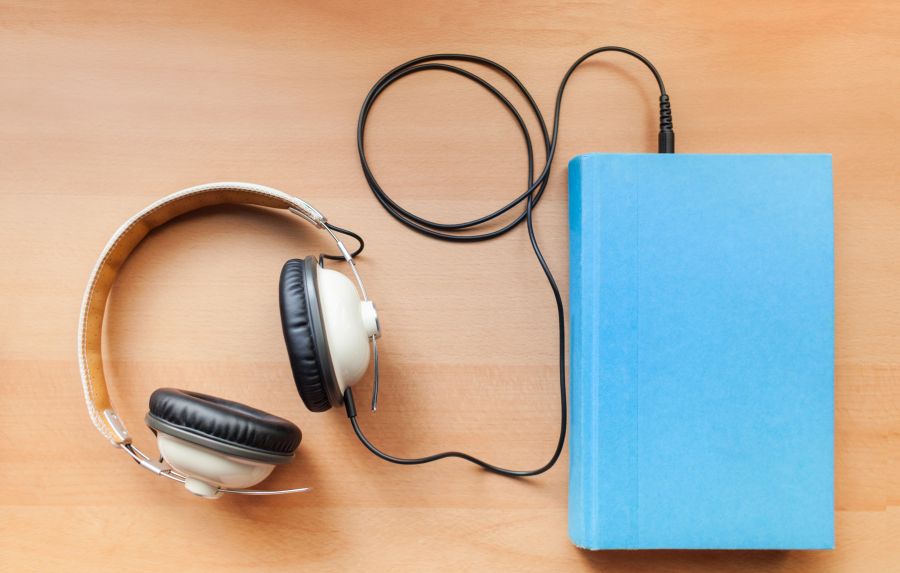
I’m quite the fan of audiobooks. Being able to read a book while I’m exercising or commuting has been a life changer for me. There is something about having headphones in that stops people interrupting you to ask what you’re reading. Sorry, not stops, but certainly lowers the number of interruptions.
Creativity is often defined as the ability to come up with new and useful ideas. Like intelligence, it can be considered a trait that everyone – not just creative “geniuses” like Picasso and Steve Jobs – possesses in some capacity.
It’s not just your ability to draw a picture or design a product. We all need to think creatively in our daily lives, whether it’s figuring out how to make dinner using leftovers or fashioning a Halloween costume out of clothes in your closet. Creative tasks range from what researchers call “little-c” creativity – making a website, crafting a birthday present or coming up with a funny joke – to “Big-C” creativity: writing a speech, composing a poem or designing a scientific experiment.
Psychology and neuroscience researchers have started to identify thinking processes and brain regions involved with creativity. Recent evidence suggests that creativity involves a complex interplay between spontaneous and controlled thinking – the ability to both spontaneously brainstorm ideas and deliberately evaluate them to determine whether they’ll actually work.
Despite this progress, the answer to one question has remained particularly elusive: What makes some people more creative than others?
In a new study, my colleagues and I examined whether a person’s creative thinking ability can be explained, in part, by a connection between three brain networks.
Mapping the brain during creative thinking
In the study, we had 163 participants complete a classic test of “divergent thinking” called the alternate uses task, which asks people to think of new and unusual uses for objects. As they completed the test, they underwent fMRI scans, which measures blood flow to parts of the brain.
The task assesses people’s ability to diverge from the common uses of an object. For example, in the study, we showed participants different objects on a screen, such as a gum wrapper or a sock, and asked to come up with creative ways to use them. Some ideas were more creative than others. For the sock, one participant suggested using it to warm your feet – the common use for a sock – while another participant suggested using it as a water filtration system.
Importantly, we found that people who did better on this task also tended to report having more creative hobbies and achievements, which is consistent with previous studies showing that the task measures general creative thinking ability.
After participants completed these creative thinking tasks in the fMRI, we measured functional connectivity between all brain regions – how much activity in one region correlated with activity in another region.
We also ranked their ideas for originality: Common uses received lower scores (using a sock to warm your feet), while uncommon uses received higher scores (using a sock as a water filtration system).
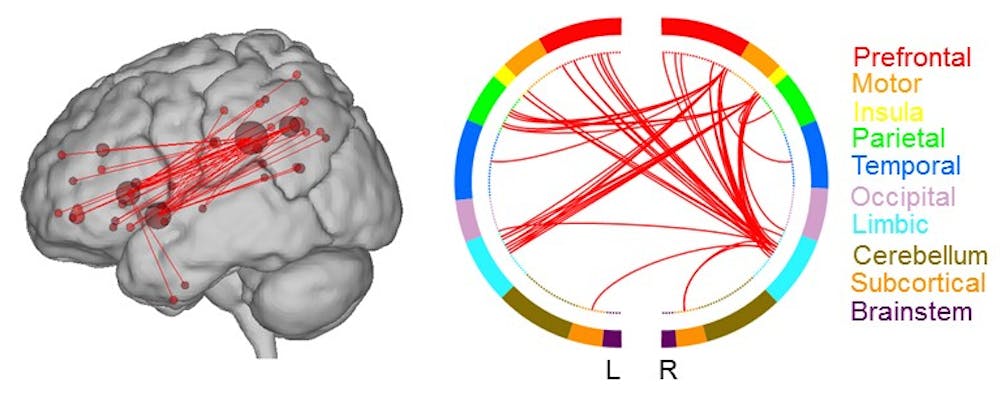
Then we correlated each person’s creativity score with all possible brain connections (approximately 35,000), and removed connections that, according to our analysis, didn’t correlate with creativity scores. The remaining connections constituted a “high-creative” network, a set of connections highly relevant to generating original ideas.
Two renderings show the lobes of the brain that are connected in the high creative network. Author provided
Having defined the network, we wanted to see if someone with stronger connections in this high-creative network would score well on the tasks. So we measured the strength of a person’s connections in this network, and then used predictive modelling to test whether we could estimate a person’s creativity score.
The models revealed a significant correlation between the predicted and observed creativity scores. In other words, we could estimate how creative a person’s ideas would be based on the strength of their connections in this network.
We further tested whether we could predict creative thinking ability in three new samples of participants whose brain data were not used in building the network model. Across all samples, we found that we could predict – albeit modestly – a person’s creative ability based on the strength of their connections in this same network.
Overall, people with stronger connections came up with better ideas.
What’s happening in a ‘high-creative’ network
We found that the brain regions within the “high-creative” network belonged to three specific brain systems: the default, salience and executive networks.
The default network is a set of brain regions that activate when people are engaged in spontaneous thinking, such as mind-wandering, daydreaming and imagining. This network may play a key role in idea generation or brainstorming – thinking of several possible solutions to a problem.
The executive control network is a set of regions that activate when people need to focus or control their thought processes. This network may play a key role in idea evaluation or determining whether brainstormed ideas will actually work and modifying them to fit the creative goal.
The salience network is a set of regions that act as a switching mechanism between the default and executive networks. This network may play a key role in alternating between idea generation and idea evaluation.
An interesting feature of these three networks is that they typically don’t get activated at the same time. For example, when the executive network is activated, the default network is usually deactivated. Our results suggest that creative people are better able to co-activate brain networks that usually work separately.
Future research is needed to determine whether these networks are malleable or relatively fixed. For example, does taking drawing classes lead to greater connectivity within these brain networks? Is it possible to boost general creative thinking ability by modifying network connections?
For now, these questions remain unanswered. As researchers, we just need to engage our own creative networks to figure out how to answer them.
The Katherine Susannah Pritchard Writers’ Centre have announced their Writers-in-Residence and Fellows for 2018. I’ve been awarded a Fellowship to work on a satirical novel titled Evil Corp.
This will be a wonderful opportunity to have time and space to write. Here’s the blurb for the story:
Here at Evil Corp we have been successfully carving a path toward world domination for 15 years. With our dedicated staff we want to have you serve our every whim.
Your family deserves the security and friendly authoritarian rule that you could expect from an organisation like Evil Corp, but with the personal touches that only a caring and understanding community minded team can offer.
Have you bowed down to Evil Corp?
Update: The list of residencies and dates with author profiles are now available. I’m afraid it appears I’m the only one who didn’t take their profile seriously.
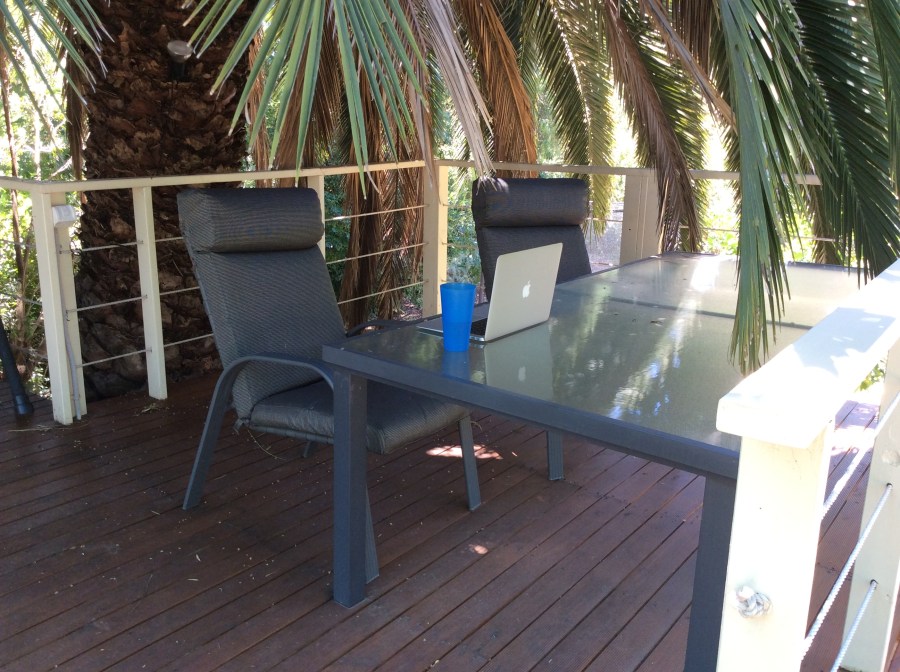
Where I pretend I write. Nice, isn’t it. (Not pictured: mosquitoes, noisy kids, actual desk the computer usually resides on.)
Of late I have noticed a disturbing trend occurring on writing blogs and groups: Write Shaming.
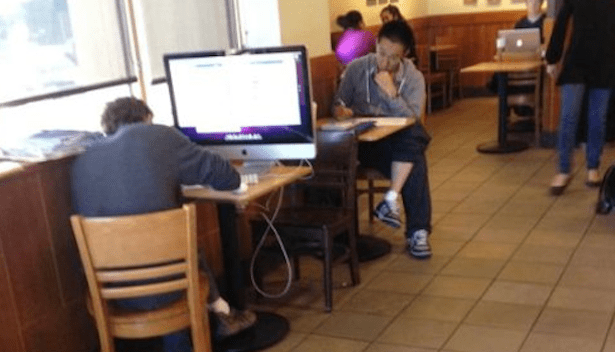
Write Shaming is when writers post images of their favourite place to write. Usually they attach some little story – because they’re writers, they can’t resist – about how inspiring the location is. The story about how awesome the local cafe is compared to their purpose-built study. Or how the desk was secretly trying to kill the author. The goal is that people become envious and to have them start thinking “I could write well/heaps/both if only I had a setup like that.”
This all got me thinking about an article from Patricia Briggs’ site and a recent discussion we had at my local writers’ group: What are all the cool kids writing with? Whether it be the latest liquid-cooled PC with a display that makes the term UltraHD seem quaint, or your chisel set and pile of clay tablets, every writer has their own setup for crafting masterpieces. Well, everything from Twilight fan-fic through to masterpieces.
So what better way to procrastinate during prime writing time than to discuss all the writing toys you could be buying.
Portable writing tools
This list includes:
Pen and notebook
Laptop
Phone
Tablet
In Australia Pilot Press created a Diary for Writers. It has writing prompts, weekly ideas pages, writing tips, contact details for writers’ centres, and dates for competitions, events and festivals. Of course, there are plenty of other notebooks made specifically for writers… they just kinda seem feeble in comparison now, don’t they.
The big advantage of a notebook and pen is that it gives you a consistent place to record ideas. Many famous novelists are known to have a notebook on their bedside table for that inevitable just-before-sleep brilliant idea that you’ll totally remember in the morning… More’s the pity that some of those ideas weren’t lost.
Phones and tablets are taking over the role of notebooks in this modern age. With synching programs like Evernote, Dropbox, Google Docs, etc, able to run on all your devices, your ideas are safe to embarrass you when you rediscover them ten months from now. Phones and tablets are more than powerful enough to be your primary writing tool as well. Phones have defied the pre-smart phone trend of getting smaller, and are now sporting screens big enough to be seen by some stranger two rows back on your commute. Let’s hope the police believe you’re a writer when that stranger reports you for that twisted thing you wrote. You know the one.
Tablets and small laptops are starting to become interchangeable now. No longer are these highly portable devices in possession of processors that run at the speed of two tortoises passing notes to each other across a football field. Writing isn’t exactly a hardware draining or intensive software activity, so the choice really comes down to how much you like typing on a tablet versus a laptop. And which one has the coolest games and other procrastination tools. Even Scrivener has launched an iOS friendly app for iPhone and iPad.
One caveat to tablets and laptops is the keyboard. Some keyboards are not full-sized and can be challenging or plain infuriating to use, especially if you touch type. Although they also act as a great excuse for your pathetic typing skills. Another issue is that some keyboards aren’t real keyboards, and much like typing on a tablet or phone screen, they don’t have any tactile feedback and can lead to some hilarious typos. Turn predictive text on for sentences that make even less sense than your drunken uncle discussing politics and the economy.
The writing desk and computer
Yes, yes, I know, there are some people who prefer to write things out longhand. They spend countless hours with pen/pencil in hand writing on thinly sliced dead trees only to have to spend even more hours transcribing it into an electronic format that is of any use. So excuse me if I acknowledge that this is 2017 and talk about computers for writing.
While portability can be awesome, having a dedicated space with a full-sized – possibly “ergonomic” – keyboard, a screen that doesn’t induce eyestrain from having to read documents in 4 point text size, and an internet connection that doesn’t drop out every time a car drives past and blocks the Wi-Fi signal has advantages. As above, computers are more than capable of handling the pressures of word processing, which makes the choice more about budget and what graphics package you need to run Netflix* in UltraHD. Laptops can fill the role of desktop computer here with a base station connecting a decent sized monitor, etc.
Writing software is still oddly dominated by the “my computer came with it” word processors. Needless to say, MS Word is highly popular because people don’t know any better. Word is a highly versatile program that can do just about anything, integrates with all the plugins and add-ons you can imagine, and does a perfunctory job of being useful. In its favour it is the most supported program, which means updates actually happen, integration with programs like referencing software is a thing (hey, us science nerds care about that stuff!), and editing with tracking and commenting is excellent. MS Word is the jack-of-all-trades, and thus master of none, and has so many features there are entire lists to point out the stuff you didn’t know it had.
Of course Mac OS have their own less popular versions of the MS Office programs. But Apple admitted people liked Microsoft and let MS Office come play on their OS.
Linux users and anyone liking freeware have long utilised the MS Office knockoffs of OpenOffice and LibreOffice. Since the demise of OpenOffice and the limping of ApacheOpenOffice toward the same fate, LibreOffice is as close to MS Office you’ll get without feeling too dirty.
There are plenty of online options that all have limitations and benefits. Google Keep, Evernote, Onenote, etc, fill differing roles. These aren’t just writing and note tools, but can also save documents and webpages. Since they are cloud based, anything you have saved there is accessible anywhere, anytime. Well, unless you have third world internet like us Aussies.
The online options also extend to apps that are made for writing and not just note taking. Google Docs is the most obvious, especially with its sharing capability. Novlr is an online/offline subscription based app made by writers for writers. ApolloPad is an online writing app with features like cork-boarding and timelines – pity it is still in beta. Novel Factory is another online subscription based writing app made by writers for writers. Apparently writers don’t get paid unless they can also code software.
Dedicated writing apps aren’t always best served in the cloud or online. Feature rich programs tend to play better when they can hog your RAM directly rather than through your browser. Novel Factory has a Windows version that isn’t subscription based. Bibisco is an open source (yay, free!) dedicated writing app with some cool but standard features. WriteItNow has a lot of features, including an events chart to help with planning. And what blog on writing tools would be complete without flagellation over how awesome Scrivener is? Personally I’ve used Scrivener for years and love it. I didn’t even get paid to say that – hint to any of the app developers out there, I will cash for comment.
Like any good procrastination effort, there is a lot to compare, contrast, analyse, and digest here. I’ve barely scratched the surface. There is an entire list of add-ons and plug-ins that are great tools for writers (e.g. Hemmingway) that I may cover in another blog if people are interested. I may cover it even if people aren’t interested. That’s just how I roll.
*Netflix being the PG friendly term for any of those streaming sites you’ll be accessing.
** Thanks to Gary from my Spec-Fic writing group for his list of writing apps.
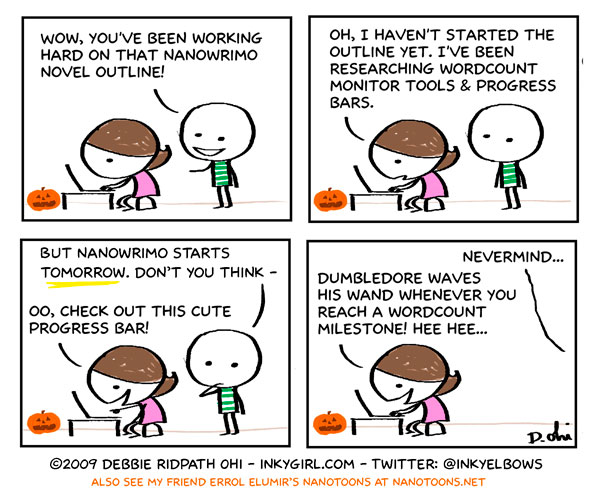
I haven’t done NaNoWriMo since 2011. It can be a great experience and can teach you how to set and achieve writing goals. But mainly it is worth doing so you can fully appreciate Debbie Ridpath Ohi’s cartoons.
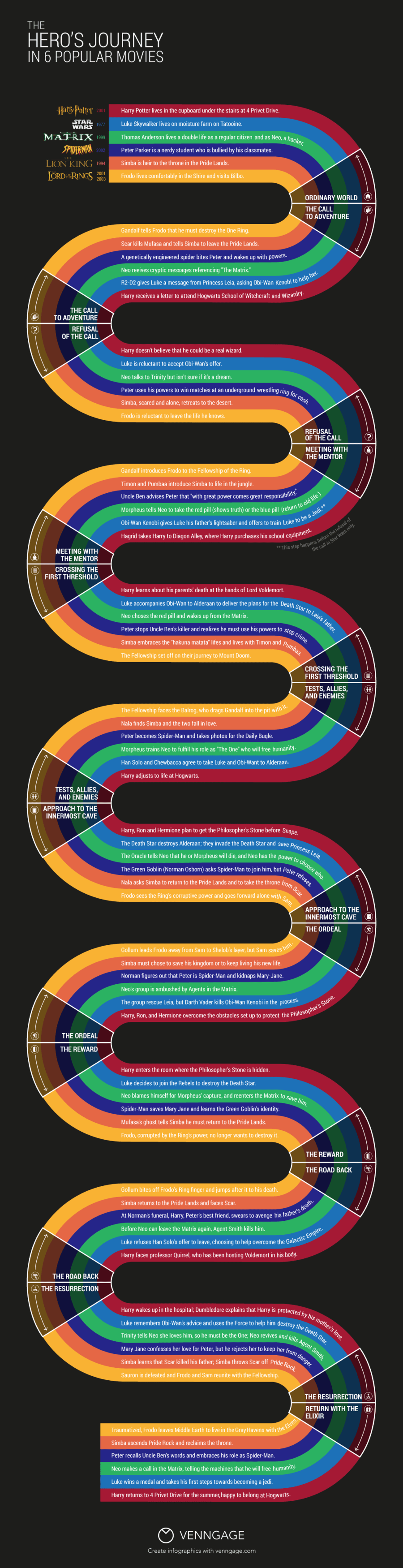
Ever thought that Harry Potter’s adventures shared a lot in common with Luke Skywalker’s? Ever thought that Simba and Neo were soul mates? Can you believe I just used the term soul mates?
The reason so many of the stories we know and love feel familiar is because of one of the most popular narrative structures writers like to use. The Hero’s Journey is explained below using Harry Potter, Star Wars, The Matrix, Spiderman, The Lion King, and The Lord of the Rings. Worth also seeing how this structure fits into the 6 Story Arcs.
I don’t often post news here. Nothing worse than being seen as someone blowing their own trumpet – and is that now officially called a Steve Bannon?
This morning I received an email congratulating me on being shortlisted for a short story award.
Dear Tyson
The KSP Foundation is delighted to advise that your story ‘Flicker’ has been short listed in the Open category of this year’s Ghost Story competition.
The winners will be announced on Saturday 26th August 2017 at the KSP Writers’ Centre. We would also like to invite you to read your story on the night, to share with our audience.
With our best wishes and warmest congratulations,
Kind regards,
NB: I’ve edited the email. Unless you wanted the details and directions to the event.
A little background, at the writers’ group I’ve joined we have a monthly challenge. We take a random excerpt from an award-winning novel in the KSP (Katharine Susannah Pritchard Writers’ Centre) library and use it as inspiration for a short story. Knowing that the Ghost Story Competition was coming up, several of us used the monthly challenge as the basis for entries.
I haven’t heard from my writers’ group friends as to whether they were shortlisted as well. But I do know that the judges had huge piles of entries to read, so it will be interesting to see how many there were in total. I’m betting the judges appreciated the word limit.
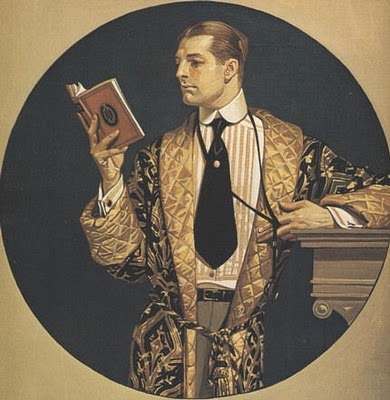
When I think of literature I think of an older guy sporting a greying moustache, sipping a sherry, wearing a smoking jacket, seated in a library of leather-bound books in front of a simmering log fire. The guy speaks with an aristocratic English accent and expounds on the greatness of some book that other older men dressed like him, sitting in similar log-fire warmed libraries, also like to read when not shagging the maid.
Aspiring literary snob reader
Now clearly not everyone who reads literature fits this image. Some probably can’t even afford a maid to shag. But it does appear to be an image that people aspire toward, an image that informs what they deem literature, and thus what they deem worthy of reading. Rather than judging any written work based upon its lasting artistic merit – although that definition is so subjective as to be useless and ideal for starting pointless arguments…. (cough) – people seem intent on creating boundaries before a work is allowed to be judged. They must defend Fort Literature from the invading Lesser Works.
Normally I’d launch into a whinge about how speculative fiction is unfairly maligned, or how I’ve read crime fiction that has more artistic merit than most literary works. But instead, I’m going to talk about graphic novels. In an article on The Conversation, Catherine Beavis explained how the graphic novel Maus came to be part of the literature curriculum.
Despite this explanation, there was always going to be someone in the comments telling us how a graphic novel can’t be literature. I assume they wrote their comments whilst wearing a smoking jacket and taking a break from shagging the maid.
Well well……..so it’s art as literature.
Why not a more well-known comic (sorry graphic novel).
Not saying this isn’t a worthy addition to any curriculum, but more as social comment rather than literature.
Surely the novels of great Australian writers should be preferable – Winton, Malouf, Carey etc.
Let’s break these points apart one by one. As will be seen from further comments, the argument primarily revolves around the feelpinion that because graphic novels contain pictures they are art and thus not literature. A similar argument could be made for movies being TV shows and thus we could abolish the Oscars… actually, that isn’t a bad idea. Anyway, I guess we’d better break the news to the literature professors that Shakespeare’s plays need to be taken off of the curriculum.
The argument then moves to the “I haven’t heard of it, so it can’t be good” assertion. Maybe because they realise this isn’t a great argument, they immediately distance themselves from it. But we start to see the “worthy“ argument being formed. I’ve argued many times that “worthy“ is a great subjective argument put forward by people who think they are worthy.
Of course, it wouldn’t be a literary argument if someone didn’t cite some authors they deem worthy. For those unfamiliar with Winton, Malouf, and Carey, they are award-winning Aussie authors who write “interior histories” and about “people rebuilding their lives after catastrophe” and “people who experience death and will never be the same again”. None of those statements could be applied to a graphic novel about someone who survived the Holocaust… No sir.
Their list of worthy authors is as subjective as their comments about graphic novels and Maus. I could similarly ask why the Hitchhikers Guide to the Galaxy isn’t on the curriculum. It has a lot to say about society and has entered the lexicon, which is more than can be said for any of the other authors mentioned nor the graphic novels being shunned. I could say the same again about Superman or Spiderman, which have implanted ideals and phrases of morality into society, regardless of whether people have read those graphic novels or not.
*Steps on soapbox*
I personally welcome any work into the class that will encourage kids to read, think and learn. And to anyone who derides graphic novels, they are clearly saying they don’t or haven’t read any.
*Steps down from soapbox*
The commenter responded to criticism of their subjective opinion:
That may be so, but my bigger point was that literature = words.
This is art with captions.
Not disputing that it may be hugely popular or good (even great)…
but literature it ain’t.
I think the appropriate response to this is a head shake. The problem is the black and white definition of what literature is, whilst ignoring the fact that the graphic novels fit the definition of literature. Pointing out the flaws in these opinions is as easy as saying that graphic novels, with very few exceptions, are composed of words. They also use graphics, but that is often a collaboration between the writer and the artists they work with. Thus, by the definition of “literature = words”, graphic novels are eligible to be classified as literature.
But anything to keep only the “worthy” books in contention as literature. Can’t have that kids stuff being called literary!
So I named three contemporary Australian writers – call me subjective.
I am not knocking the (art) form…just that it (to ME) is not literature.
Your opinion is obviously as valid as mine……don’t get huffy.
The last point here is one that irks me more than irksome irkers on an international irking junket. Opinions are not equally valid. That sort of subjectivism nonsense eats away at reality and suggests we “just don’t know, man”.
The commenter made a subjective list, so I put together some examples that were superior in quantifiable ways (impact on society, entering the lexicon, referenced by society) to show that the subjective claims were more worthless than a $9 note because clearly not much knowledge or thought was put into the claims.
There is also the idea of literary critique and argument, rather than stating feelpinions. I’ve stated an opinion and argued it, offering reasoning. The examples I countered with aren’t necessarily the best choices, but I have justified and quantified my argument, something you learn in high school literature class. Art Spiegelman won a Pulitzer, so clearly, someone in the literati agrees. And surely a Pulitzer prize winner is worthy of being on the curriculum. But of course all opinions are equally valid and “I’m entitled to my opinion”, dammit!
Surely the whole point of literature is that the reader has to imagine the scene described, the way words are spoken, the implications of what is said and much more. It’s all in the mind, which develops through reading.
A graphic novel presents the words and pictures with almost no imagining required. The number of words is hugely reduced to give way to often wasted space. In the example above there are 21 words, which if in normal lowercase type could be written in 10% of the space.
Sorry I’m not convinced graphic novels have any merit for senior students.
Shakespeare’s plays give stage directions and poetry is often deliberately obscure. So how do those examples fit this exclusionary definition of literature? I’m sure some artists would object to the idea that they aren’t conjuring a scene that develops in people’s minds. And is the idea to only allow readers to imagine a scene? Isn’t it about conveying ideas and emotions too? Isn’t this some great mental gymnastics to try to maintain Fort Literature from invasion by the Lesser Works?
The second paragraph is also exemplary of someone who hasn’t read many, if any, graphic novels. So, of course, this commenter wouldn’t be convinced that graphic novels are of any merit. First, they’d have to know something. But that doesn’t hold them back from commenting.
While I’m in the mood for alienating folks, let me also say that this is a good example of dumbing down literature.
Give the kids a picture with limited words and maybe they’ll get the idea.
Don’t kids these days have the attention span to read a novel?
The last graphic novel I read was 480 pages long and took many hours to read. It covered sexual identity, morality, the greater good argument, do evil deeds make us evil, etc, as issues. The last “literature” novel I read was about a woman who manipulated people to get what she wanted. It was ~300 pages long and took many hours to read.*
This argument is typical of people who have a snobbish attitude to something based upon pure ignorance of the topic. Similar statements have been made throughout time, decrying the dumbing down or declining standards of today’s youth. Oddly enough it has been proven false again and again only to be spouted once more.
There is a similar article on The Spectator – a home for uninformed opinion – which argues that if we let graphic novels into literature we have to let in everything. They must defend Fort Literature from the invading Lesser Works. Maybe I’ll address that one at some stage when I’m feeling masochistic, but I’m going to leave it there. The maid has arrived.
*This comparison was true at the time of my original comments on The Conversation. I’ve read many graphic novels since, but no further literature novels.
Update: Nerdwriter made a particularly good video discussing Maus and how it is constructed as a story and piece of art. Every frame, every image, the whole page, has meaning. Kid’s stuff indeed.
Update: A great video essay about how you can’t judge art objectively.




 For now, these questions remain unanswered. As researchers, we just need to engage our own creative networks to figure out how to answer them.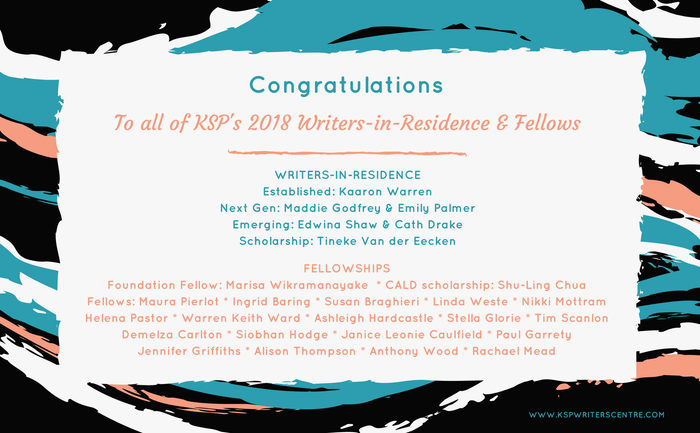




 Tyson Adams