New tourism campaign: Come to Perth, where you can grift in peace.
Former Detective, Frank Swann, is starting a job with the new Western Australian Premier. The exact nature of his job is unclear. The exact motives of those around him are even less clear. Power players are moving to get their slice of the development and mining booms that are starting. The “facilitators” have their hands out. The usual underworld players – from bikies to bank robbers – see their chance as well. And the target is painted on Frank as he’s caught in the thick of it.
Back in 2016, I was lucky enough to attend the book launch for Old Scores. As a long time fan of David’s, it surprised me to realise that over two years had elapsed since getting my signed copy. If I’m honest, I feel pretty guilty for not having read it immediately. I got there… eventually.*
David is a fantastic writer and Old Scores is another great crime novel from him. He delivers with a gritty and evocative style that us crime fans love. Set in Perth, you not only get the feel of the city, but you have a sense of the underbelly that shaped it. I was too young to really understand WA Inc, but David capitalises on those, and other, events to craft his own tale. In many ways, it is often hard to spot what is a fictionalised historical event and what is actual fiction.
Old Scores is a must for any crime fiction fan and for anyone who wants to get a sense of what Perth and Western Australia were like in the 1980s.
Life is like a box of doughnuts. Mmmmmmm, doughnuts!
Theo Bernstein is on something of a losing streak. He lost his money, he lost his wife*, he lost his job, and he lost the visibility of one of his arms. Given how high profile the reason for losing his job was – who knew people would miss a mountain? – it’s a wonder he is able to find any work at all, first at an abattoir, then at a hotel. The hotel gig might be easier than hauling offal, but it’s a weird job, made weirder by the strange bottle left to him by his old professor, Pieter van Goyen. How can this bottle be the future of entertainment? And is there a doughnut shop nearby?
In the middle of last year, an author friend – Kaaron Warren** – recommended The Management Style of Supreme Beings to me. It was one of the nominees for an international award she was judging and she spoke glowingly of it. I’d previously enjoyed one of Tom’s books under his KJ Parker pseudonym, so I decided to track it down at the library. Obviously, I was unsuccessful, as instead, I ended up with Doughnut.
This explanation is a roundabout way of saying that I had high expectations for this novel. In some ways, Doughnut managed to rise to those expectations. Holt is a very sharp and inventive author. There are plenty of genuinely funny moments and ideas in this book. But somehow I felt it was all a bit pointless and inane.
In some ways, this is a product of the very British bumbling protagonist used in this novel. It tends to influence the way the story is told, usually in a way that is deliberately frustrating but with the reward of large doses of humour. Unfortunately, I’m not sure this was quite funny enough for the narrative style.
So while this was quite entertaining, I had hoped for more, particularly in the humour department.
*Lost his wife in the sense that she decided to leave him, not the lost in the ‘we were just walking through the Xmas sales and she let go of my hand for a moment and now I can’t find her in this crowd’ kind of way.
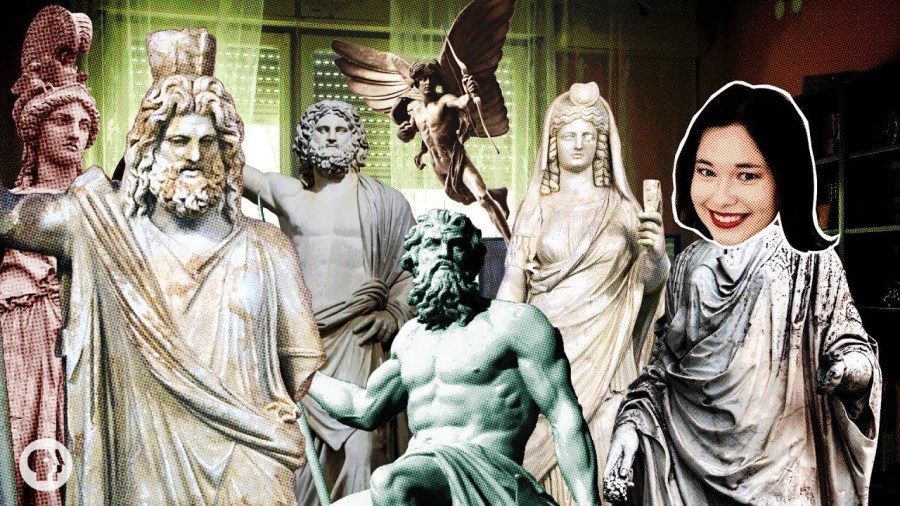
Did you know that James Joyce’s Ulysses is a (relatively) modern tale inspired by Ancient Greek Mythology? Well, even if you did know that, this video has something for you.
Given this video series has focussed on literature and books made into movies more than popular fiction, I knew that one of my favourite genres wouldn’t get a mention. The vigilante hero/anti-hero traces its origins back to the Ancient Greek Myths as well. The most obvious versions are The Wanderer or Knight Errant which draw upon themes and ideas from heroes like Perseus. This early creation underpins later takes on the hero. And thus, Jack Reacher could be slaying gorgons and saving royals.
Interestingly, the Knight Errant is also prevalent in literature not influenced by Ancient Greek Mythology. So it is possible that convergent ideas are at work.
Ancient Greek Mythology has worked its way into modern pop culture so deeply that it would be an almost Sisyphean task to compile every way it’s manifested!
It’s Lit! is part of THE GREAT AMERICAN READ, a eight-part* series that explores and celebrates the power of reading. Hosted by Lindsay Ellis
Finally, an episode of It’s Lit about everyone’s favourite Terry Pratchett character. Oh, and a few other versions of it from lesser authors.
Lindsay Ellis fans will have noticed similarities between this video and an earlier Loose Cannon video she did on the same topic. Worth watching both and noting what having a production budget allows for.
Death as a character reveals how we process one of life’s greatest mysteries, and there’s a lot more breadth to how the grim reaper is depicted than you might think.
It’s Lit! is part of THE GREAT AMERICAN READ, an eight-part series that explores and celebrates the power of reading. Hosted by Lindsay Ellis.
Who makes the money in publishing? Nobody. This often repeated dark joke highlights a serious issue. The most recent figures show that Australian authors earn just $12,900 a year from writing work (the median, at $2,800, was even worse). Indeed, authors can gross less than $5,000 for Miles Franklin-nominated titles that took two or more years to write.
Fixing this isn’t as simple as reaching more deeply into publisher pockets, because most of those are empty too. While the major international houses are thriving (Simon & Schuster and Penguin Random House recently reported 16% profits), publishing Australian stories can be financially perilous.
In independent publishing, 10% of the book sale goes to the author, perhaps another 10% to the printer, and up to a whopping 70% for distribution. What’s left has to pay the publisher, editor, marketers, admin staff and keep the lights on.
But we can improve our approach to author rights. Here are five lessons we can learn from elsewhere to help Australian writers earn more money.
Traditionally, contractual “out of print” clauses have let authors reclaim their rights when a print run has sold out and the publisher doesn’t want to invest in another. But in our recent analysis of almost 150 contracts in the Australian Society of Authors archive, we found 85% of contracts with these clauses allowed authors to reclaim their rights only when the book was “not available in any edition”.
These days, books can be kept available (at least digitally or via print-on-demand) forever – but that doesn’t mean their publishers are still actively promoting them.
A better approach is to allow authors to reclaim their rights towards the end of a work’s commercial life, determined with reference to objective criteria like the number of copies sold or royalties earned in the previous year. The Australian Society of Authors recommends authors only sign contracts that have this meaningful kind of out-of-print clause – but many publishers still try to get authors to sign up to unacceptable terms.
A growing number of countries (including France, Romania, Slovenia, Spain, Macedonia and Brazil mandate author rights based on objective criteria. The French law is an interesting model. There, authors can get their rights back if a book has been published for at least four years, and they haven’t been credited royalties for at least two. This opens up new possibilities for the author to license it to another publisher, or even sell it directly to libraries or consumers.
Rebecca Giblin on the problems with publishing contracts and the case for new author rights.
#2: ‘Use it or lose it’: return author rights when they’re not being used
Publishers take very broad rights to most books: in our recent archival analysis we found 83% took worldwide rights, and 43% took rights in all languages. It’s easy to take rights – but if publishers do so, they should be obliged to either use them or give them back.
To that end we can learn from the “use it or lose it” laws that bind publishers in some parts of Europe. In Spain and Lithuania, for example, authors can get their rights back for languages that are still unexploited after five years.
#3: Introduce a ‘bestseller’ clause to contracts
Of course, it’s not always the case that there’s no money in publishing: sometimes a title that was expected to sell 5,000 copies sells 5,000,000. That changes the economics enormously: but in many cases, the contract only provides the same old 10% revenue for the author. For works that achieve unexpected success, we can learn from Germany and the Netherlands (and the proposed new EU copyright law). They have “bestseller” clauses that give authors the right to share fairly in unexpected windfalls arising from their work.
#4: Legally enshrine the right to fair payment
Even where there’s not much money to be made, the author should still receive a fair share. Again, Germany and the Netherlands lead the way on this. There, authors are entitled to “fair” or “equitable” payment for their work – and can enforce those rights if their pay is too low.
These laws don’t set a dollar amount, since what is “fair” depends on all the circumstances. However, such laws at least provide a minimum floor. If the contracted amount is unfair or inequitable, authors have a legal right to redress.
#5: Put time limits on transfers
In Australia, copyright lasts for the life of the author, and then another 70 years after that. Publishers almost always take rights for that full term – only 3% of the contracts between publishers and authors we looked at took less. But publishers don’t need that long to recoup their investments. In the US, authors can reclaim their rights from intermediaries 35 years after they licensed or transferred them.
In Canada, copyrights transfer automatically to heirs 25 years after an author dies. We used to have the same law in Australia, but it was abolished for spurious reasons about 50 years ago. If we reintroduced a similar time limit on transfers, it would open up new opportunities for authors and their heirs (for example, to license or sell to a different publisher, libraries or direct to the public).
It’s true that there’s often not much money in publishing. But by changing our approach to author rights, we can help writers earn more and make Australian books more freely available.
A couple of years ago, I made the very popular argument that sports are not actually that popular and that we should be funding more recreational physical activities. I was particularly critical of the way funding goes to team sports as populist pork-barrelling.
Recently I stumbled across an American survey of children’s sports participation that suggested kids are playing less sports, less regularly, and that Armageddon must surely be upon us if this isn’t immediately addressed*. Obviously, I was terribly concerned and immediately emailed my local senator, before realising I’m Australian and think they are concerned about the wrong thing.
While sports, particularly team sports, make up a significant proportion of the organised physical activity of kids, this rapidly declines with age. The two biggest reasons for this change are people having a lack of time to be involved in organised activities, and injury and health issues (from people’s mid-thirties onward Source). Almost as if contact sports might result in injuries. Amazing.
I think the obvious solution is to stop placing such an emphasis on sports and instead focus on the activities we are much more likely to be able to do throughout our lives. But since kids are too young for sex, best to encourage them to go to the gym, go walking, riding, or running.
Now, being Aussie, I’m more interested in Aussie stats: call me a patriot. Our stats are slightly different from the US, showing that there has actually been an increase in kids playing sports, lead by increased participation in soccer and dance. Eight times as many girls doing dance, but boys are starting to get the hint about how to meet girls.
Here is a similar Australian sports survey to the US one was done by AusPlay which looked at what people were doing for physical activity, and it matches with other data from the ABS and RoyMorgan.
This table hasn’t changed much, particularly when it comes to the top 3. Sometimes these tables are presented with jogging, athletics, running, and track and field separated, such that swimming comes out higher. But that’s just to confuse people or make swimmers feel like that aren’t painfully alone, staring at an endless black strip at the bottom of a pool, chlorine itching their skin, as they struggle toward their next breath. Regardless, it shows that the vast majority of interest is in fitness activities, not sports.
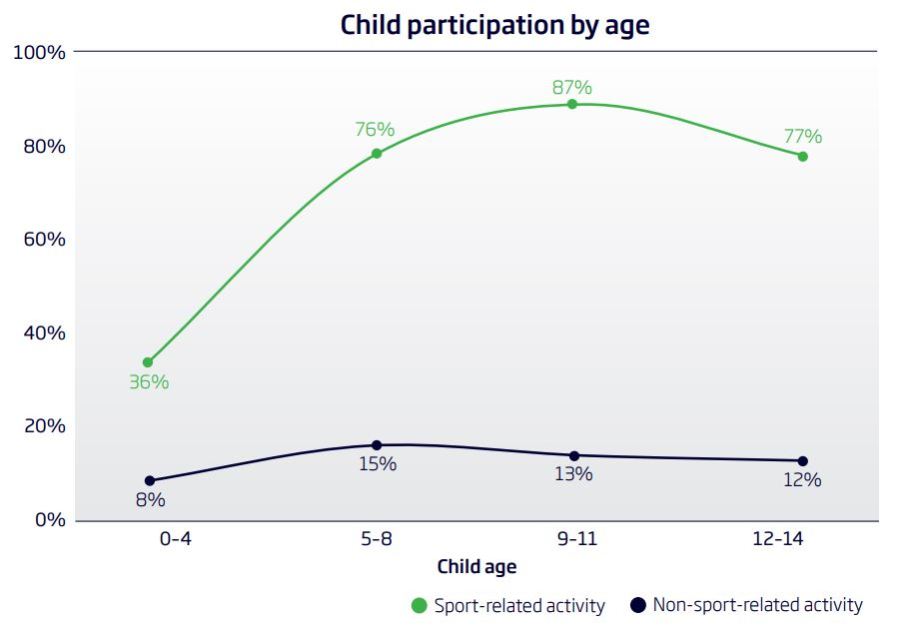
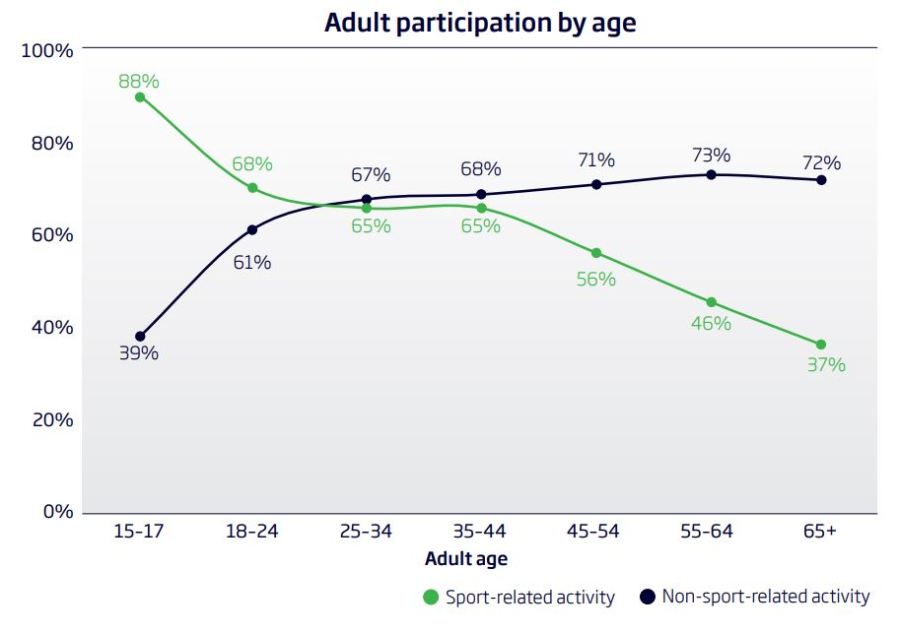
But those figures are for all Aussies. Kids have a different emphasis. Caring parents are desperate to turn out well-rounded offspring with plenty of torn ligaments, broken bones, and early stages of CTE by having them play sports. As a result, kids tend to ignore going for walks in favour of bouncing a ball off of their foreheads. But this quickly declines as kids enter their teen years, continues to drop into their twenties, then levels off until another rapid decline after 40.
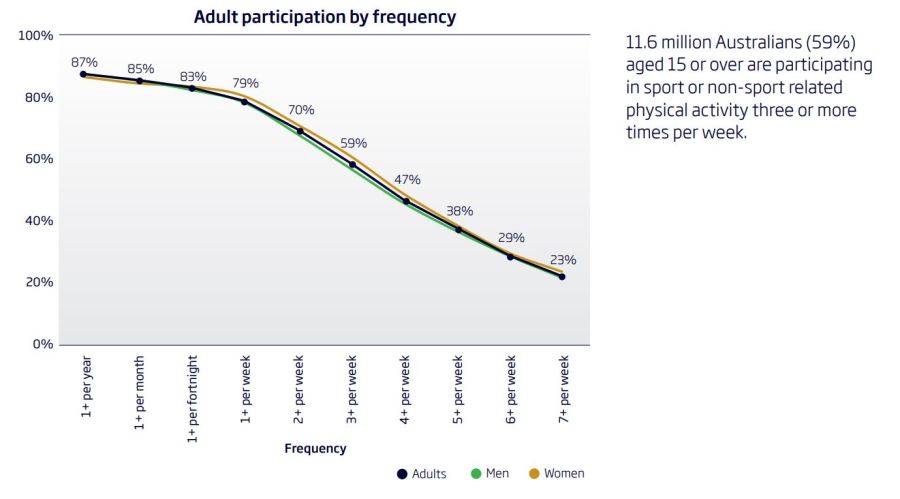
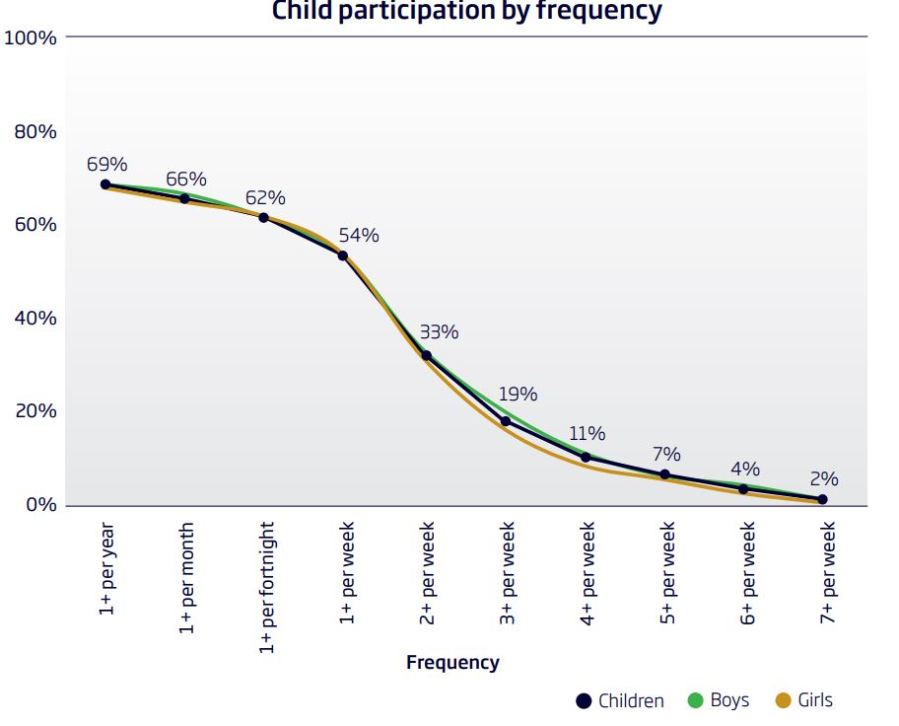
This isn’t the whole story, of course. As I noted in my previous article, participation is usually measured annually. Regular participation tells a slightly different story. Most kids are physically active at least weekly**, while adults are trying for three times a week. Or put another way, kids get dragged to sport on a Saturday morning (and maybe once after school depending on how mum is feeling after cocktail hour) and adults manage to go for a walk three times a week when the dog starts bouncing off the walls with energy.
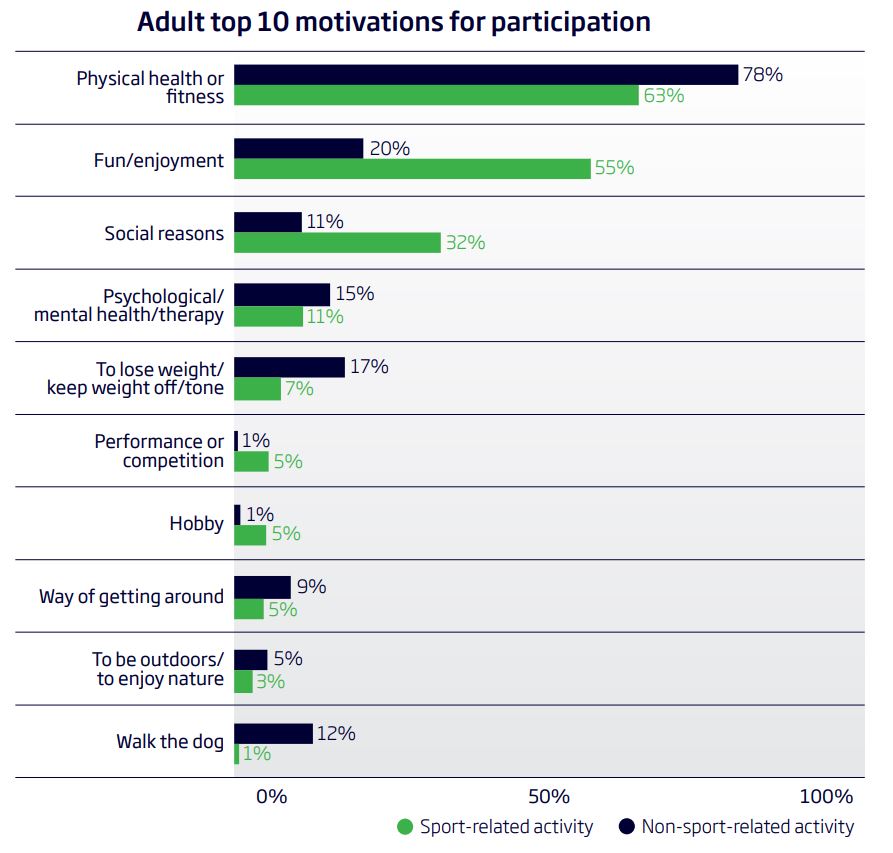
Likewise, the motivations for physical activity are also tied to what people actually do – namely health and fitness. The differences come in with enjoyment and socialising being higher for sports versus activity. Obviously, everyone loves having their ribs mashed into their lungs as they are tackled to the ground during a friendly game of football***, so it is completely understandable that people would rank these highly for sports. But I would argue that non-sports activity is potentially fun/enjoyable and can be very sociable. If you don’t believe me, go to any university gym and see how much fun the gang of dudes pretending to look swole in stringer singlets are having hogging the bench press.
“If you go back in the old days, competition was probably the key driver of the sports,” Mr Fairweather said. “Now it is all about health and fitness, whether you are playing sport or physical activity.” Source
So with that change in attitude and lifetime participation, I think it is time to change our focus away from sports. Whenever these surveys are reported it is always couched in terms of how we need to encourage people back into sports – with pictures/videos of football players and fat kids lying on a couch gaming. But that is missing the point entirely. People are shifting away from sports for a reason. People actually prefer physical activity. We’re pushing kids to be involved in sports instead of setting up good physical activity behaviours for life.
Trying to increase sports participation isn’t the solution, it is the problem. Setting up kids to be physically active for life is the solution, and that requires a rethink and a reallocation of resources. We could start by not calling these sports surveys “sport” surveys. Unless we want to keep pretending walking is a sport.
*As opposed to the very concerning rise in the pastime of shooting US kids.
**Kids are generally more active than adults, though. This is something lost in these surveys due to the way activity is defined. An adult might go to the gym and have an intense 30 minutes of telling other gym goers about their new diet, but kids will spend several hours chasing each other around the playground in an attempt to ruin yet another pair of sneakers. The former will be counted as physical activity, the latter won’t.
***The type of tackle and how many ribs that end up broken will greatly depend on the most popular code in your area. Not every football code is wimpy enough to wear padding and not every code allows proper tackling instead of tripping.
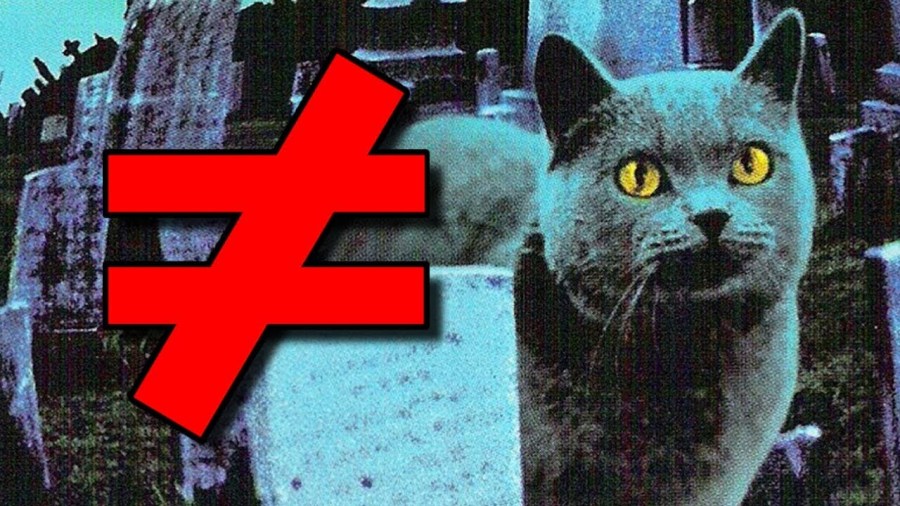
It was inevitable that someone in Hollywood would try to reanimate the corpse of yet another classic film. So with the upcoming release of the remake of Pet Cemetary, what better time for CineFix to discuss the original book and movie in What’s the Difference?
Pet Cemetary is one of the many books lingering on my shelf in the TBR pile. While I have decided that this year will involve a concerted effort to make a dent in said pile*, it is unlikely I’ll get to read this novel anytime soon. If I’m completely honest, I want to read The Stand first.
What about the movie, I hear you ask. Back when I was a young lad – walking the obligatory 10 miles (whatever a mile is in real measurements) to school through 10 feet of snow (why would there be feet in snow?) after working 10 hours at the coal mine – Stephen King novels and movies were all the rage. Whether it was Needful Things, Carrie, Misery, Lawnmower Man, IT, or Children of the Corn, there always seemed to be someone bringing a Stephen King VHS** to watch. And after my hard lesson learnt with IT, I tried to avoid the obviously scary films – hence I have seen Lawnmower Man and most of Needful Things, but not Children of the Corn.
At this point, I probably sound like a wimp. It is odd that I generally don’t find horror novels that bad, and even movies with horror elements are fine. But movies whose goal is to creep you out or gross you out (think Saw franchise or Hostel) just aren’t for me, particularly the latter. It’s a little hard to be entertained by that sort of thing.
Yes, yes, more excuses as to why I haven’t read or watched something. Don’t worry, plenty of horror in my TBR pile. Stay tuned.
*I’ve managed to read one from the pile and added two more to it this month. That counts as progress, right?
Is it okay to punch Nazis? What if I told you that is only one of the tactics for dealing with Nazis?
The Anti-Fascist Handbook aims to summarise the history of fascism and its opponents, the rise of more recent fascist groups, the lessons from history for dealing with fascism, the issue of “free speech” and fascism, and how to combat fascism today. Historian Mark Bray has detailed the tactics of the Antifa movement and the philosophy behind it through interviews and the compilation of history and research into fascism.
I’ve noticed that there are several topics that seem to be widely discussed but never with any actual knowledge. Antifa, Black Lives Matter, and other social movements are prime examples. So when I saw Abigail from Philosophy Tube’s video discussing this book (and other related work) I knew that Bray’s book on Antifa would be another of my must reads.
I think one of the most important takeaways from this book is that the rise of fascism to power hasn’t historically required huge support, just a lot of apathy from the masses. Too often debates will rage around “free speech” or “is it okay to punch a Nazis” while completely missing the point that fascists are loving being legitimised with any of these debates.
The five important lessons (my summary of the headings):
Fascist revolutions have never succeeded, they gained power legally.
Many interwar leaders and theorists did not take fascism seriously enough until it was too late. (Sound familiar?)
Political leaders/groups are often slower to react to fascism than those on the ground.
Fascism steals from left ideology, strategy, imagery, and culture (e.g. the liberal idea of “free speech”).
It doesn’t take many fascists to make fascism (Overton windows shift easily).
Whilst this was a very interesting and important book, it wasn’t perfect. The coverage of fascism outside of Europe was limited; something Bray acknowledged he wasn’t going to cover in detail and would have been a nice addition – something for the next instalment perhaps. Also, the defining traits of fascism were clearly made, but the differences between groups that fall under that banner, or are adjacent (and thus facilitate normalisation), weren’t discussed. I would have found it interesting to have the discussion of how alt-right and alt-lite differ and how you combat the latter. Minor points that might be in future editions.
So before you next hear a professional opinion-haver brand Antifa as terrorists, it would be worth reading this book.
The latest craze in our house is Super Wings with the various character catchphrases having entered my own lexicon. Super Wings is a children’s toy advertisement TV show following the adventures of the red delivery jet imaginatively named Jett. The various sentient planes on the show have the ability to transform into robots and I’m left with some very important questions.
Jett is the series protagonist. Every episode he is dispatched to another location far across the planet to deliver a package. Yes, just one package. Anywhere on the planet. By jet plane.
How does this package delivery company manage to stay financially afloat!?!
I’ve crunched the numbers on a single 3,500km adventure and just the cost of fuel would be ~$3,000. That’s an expensive package. But Jett is modelled off of an F-16 Falcon which has a range of ~4,000km, yet routinely does deliveries of twice that distance. Not only would Jett have to stop over for fuel or do an aerial refill, neither of which have been shown to occur in the show, but those package delivery costs would also further sky-rocket.
This company’s package delivery economic model can’t work. Either the packages, which are often small items like badminton racquets, are freighted with super expensive delivery fees to only extremely wealthy clients, or the company runs at a massive loss. Now, we already know from the list of clients that many of the package recipients are not wealthy. One adventure sees Jett deliver a sled to a Moroccan villager, and whilst Moroccan’s aren’t living in the poorest African nation their average take-home pay is half that of an average Aussie. This leaves us with a company that has to be running at a loss.
But does it? They have to pay for that fuel somehow. Jett’s employment must be worth something. As a sentient transforming plane surely Jett must have economic needs to be met. Jett might be internationally famous, but I doubt that keeps a roof over his head and whatever equivalent of clothes on his back there is for an anthropomorphic plane – paint maybe?
That leads me to conclude that the package delivery company must be operating with an ulterior motive. It can’t be drug smuggling, even their profit margins couldn’t cover the ridiculous costs involved. Or maybe not. Maybe Jett and his deliveries are a cover for the smuggling operations that other delivery planes are involved with. Jett might be the publicity-friendly face covering for a much darker trade. Maybe sentient planes delight in trafficking human slaves around the world. If so, they already have the police in their pocket.
There is another possible explanation for the company’s motives and it relates to Jett’s adventures.
Without fail, every delivery that Jett performs he manages to instigate a series of unfortunate events. You have to wonder if Jett is a magnet for Murphy’s Law*, is some sort of Clouseau-esque character, or an agent of mayhem. Regardless, these events require Jett to call on his friends, the eponymous Super Wings, to help clean up his mess.
Several of these Super Wings friends appear to work at or are based out of the same facility as Jett. It is unclear why a package delivery service would have such broad-ranging staff – police, rescue, passenger, a WW1 biplane. It is also unclear why they are always so readily on-call to help. Are they just waiting for Jett’s latest mishap? But the biggest question is how they manage to fund the involvement of all of these extra staff for every delivery adventure. I’ve already covered how expensive just the fuel would be, but a minimum of two staff per delivery, one staff member unable to perform their primary role whilst helping out Jett, and the extensive travel time to far-reaching parts of the planet, and we start to see a mounting cost that has to be footed by someone.**
But what if these unfortunate events and resultant adventures for Jett and the Super Wings are a deliberate act? What if Jett and his package delivery employers are secretly working toward nefarious ends? They could, in fact, be trying to drive socio-political instability in far-flung places around the world. The only question that would then remain is if Jett is a knowing participant in this nefarious plot or if he is merely a pawn in a dastardly game of epic proportions.
Hopefully, all of these questions will be answered as the Super Wings series unfolds.
*For anyone lucky enough to be unfamiliar with it, Murphy’s Law states: Anything that can go wrong, will go wrong.
**Perhaps the aftermath of every episode is the delivery of an invoice for extra associated costs. Maybe that is how the package delivery service makes its money. Lure people in with a super cheap luxury personalised service and then charge for all of the added expenses incurred when Jett’s mayhem inevitably occurs.
This month’s It’s Lit! covers everyone’s favourite topic: food.
If it isn’t your favourite topic, just give yourself 48 hours without it and see if that changes your mind.
I’ve always found food scenes in books to fall into two categories: needless exposition, or important showing (Oliver Twist is a great example of this). While the video discusses the latter, it is all too common that the former is what we read most.
While I was watching the video I was reminded of something I read last year. The discussion of bread in Victor Hugo’s Les Misérables, particularly around the hard bread that needed to be soaked, was something that Karl Marx wrote about in Das Kapital. The hard bread was actually due to deliberate contamination to make cheap bread that workers could afford, knowing full well that it was bad for them to eat, and the employers knowing full well that the workers couldn’t afford to eat properly (keeping them hungry so they would work).
A great way to remind us future people of how society used to run.*
Food varies wildly from place to place and from culture to culture; since humans are such sensory creatures, using words to evoke the experience of eating is an excellent way to bring a text to life.
It’s Lit! is part of THE GREAT AMERICAN READ, an eight-part series that explores and celebrates the power of reading. Hosted by Lindsay Ellis.
*Let’s be honest, society would quite happily go back to those conditions, and in some areas of the world, it still is operating in that way.
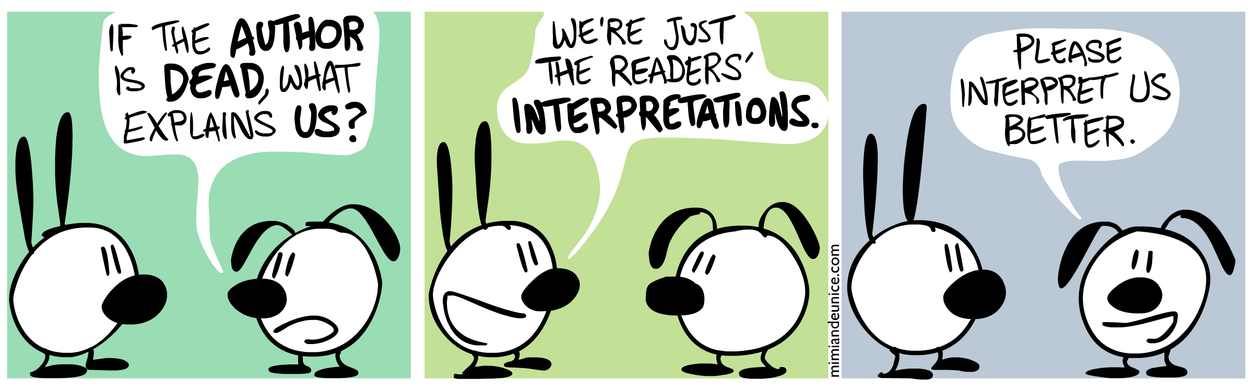
The birth of the reader must be at the cost of the death of the author… or so says Roland Bathes in his essay Death of the Author. Are we talking about literally killing authors? No, this is figurative (like most uses of literally). Can Death of the Author include killing the author? Sure, but get a good lawyer first.
Let’s let Lindsay Ellis (and John Green) explain:
My take on Death of the Author is somewhat complicated. I think there is relevant information that the author has that doesn’t make it into the story (think Elvish languages from Tolkien*), but I also think that quite often if it isn’t in the story it doesn’t really exist. I think that stories are really up to the readers to interpret, as viewpoints and interpretations will change over time**, but that doesn’t mean readers always interpret correctly.
This is a hedged way of saying that Death of the Author is probably too simple a way of thinking about how stories should be interpreted. At least, that’s my interpretation of it.
*Let’s not get into how “relevant” I think those languages are, or a lot of that world-building from authors in general is.
**You may remember book reviews here where I’ve discussed how older books haven’t aged well due to changing societal standards. Sexism and racism are obvious changes that have happened in the last 50 years which make formerly acceptable, even progressive, moments in a story seem backward and unacceptable now.
Another thing that can occur is changes to society changes interpretations. E.g. The Baby It’s Cold Outside controversy can be summed up as an old song made references to things that we are no longer familiar with, so our interpretation changes. This makes Death of the Author a truly bad thing for any artwork that is “consumed” outside of the social and temporal setting it was made within.
Update: Good article in Uncanny that captures some of my thoughts on Death of the Author.
If your novels keep coming true, do you try and make them more fantastical or more boring?
Ian Ludlow’s latest novel isn’t like his previous one. He needed a thriller that had international espionage, a conspiracy that would justify his Clint Straker character getting into life-threatening situations, and preferably a plot that wouldn’t come true this time. But his far-fetched plot about a Chinese operation has him and his assistant, Margo French, mistaken for spies and the only ones able to stop an assassination.
I always seem to enjoy Lee Goldberg’s thrillers. Whether it be his collaboration with Janet Evanovich (which gets a reference in this book) or his standalone novels, he always manages to make them fun and humorous. Some stories of this sort can fall flat through a lack of tension or poor pacing but neither problem is present in Killer Thriller.
There are quite a few in-jokes in this novel, such as the Evanovich reference, that you may miss if you aren’t familiar with Lee and his writing. I don’t think this detracts from the novel, but it may have enhanced my enjoyment more than the casual reader.
This is a great novel for anyone looking for a highly entertaining, funny, and fast-paced adventure.
I received an Advanced Review Copy from NetGalley in exchange for a fair review.
Believe in something. Anything. No, not that. No, best not that either.
It’s Hogswatch, the time of year for carol singing, presents, warm alcoholic drinks, and giant department stores to sell lots of stuff. But some “people” have hired Mr Teatime (Teh-ah-tim-eh) to stop the Hogfather bringing presents and drinking sherry. Can DEATH and his granddaughter Susan help?
To get in the festive mood this year, I decided I needed to read an appropriate book. Rereading the Hogfather was an obvious choice. HO-HO… oh yes, HO.
There are many of my favourite characters in this novel, DEATH and Susan being prime examples, as well as some very memorable others, Mr Teatime if only for the proper pronunciation of his name. It is also such a wonderful satire. I think that I enjoyed this novel more upon rereading than the first time around, which means I’ll have to make sure my copy stays on my bookshelf.
This month’s instalment of What’s the difference? from CineFix looks at Mike Mignola’s graphic novel and Guillermo Del Toro’s Hellboy?
In the interest of full disclosure, I’m not a fan of Hellboy: movie or comic. Yes, I know, how dare you not love Del Toro’s amazing artistic vision! I’ve watched both Hellboy movies multiple times and have not loved them (and despite liking the Blade trilogy, Blade 2 isn’t my favourite – but Pan’s Labyrinth was fantastic). The comics I probably didn’t give them a fair chance, as I tried reading one omnibus after not enjoying the first film.
Anyway, the point I wanted to highlight from the video was something I think too many adaptations fail to do. When you are talking about a series of comics or books, there is often some prevailing themes, motifs, and imagery to them that may be less noticeable in any one edition, but taken as a whole it is important.
Because movies are often only drawing on one book at a time, or drawing on one run (or story arc) of a comic, important aspects may be lost. An example would be the Tim Burton or the Adam West takes on Batman versus the Christopher Nolan version. The latter drew upon more of the Batman comics than the earlier adaptations (not that either of those adaptations was bad*).
So while this doesn’t necessarily result in a direct adaptation, it does result in an adaptation that is faithful to the source material in the elements that matter.
*I’m pretending that the Joel Schumacher adaptations don’t exist. Akiva Goldsman is probably more to blame, given he has a long track record of making everything he is attached to that bit worse.
Being prophetic is really easy when you make a “kids these days” argument.
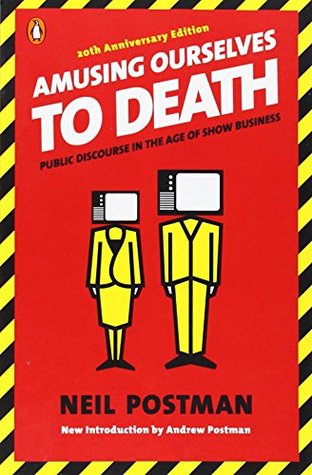
Amusing Ourselves to Death is Neil Postman’s ode to the “good old days” before television when entertainment wasn’t ruining everything. TV bad, reading good!
I decided to read this book after it once again started to be referenced as prophetic in the modern age. The first time someone mentioned this book to me I couldn’t help but feel the argument was likely to lack substance – you can amuse and inform at the same time.* What I found in this book was a supposition that isn’t without merit – slogans and sound bites can be influential whilst lacking any substance – but is argued in a cherry-picked and biased manner.
One example is how Postman claims that political campaigns used to be written long-form to influence voters, whereas now (meaning then in 1985, but many say it is highly relevant today) we get political messages in sound bites and 30-second adverts. This argument underpins his work and is at best convenient revisionism, at worst it is naive drivel. To suggest that there is no modern day long form political articles (and interviews, etc) is rubbish, just like the idea that the historical long-form articles he alludes to were well read by the masses is rubbish.
Another example is Postman claiming that media organisations aren’t trying to (in general) maliciously misinform their audience. We know that this isn’t the case. Even at the time this was written there were several satires addressing how “news” is deliberately framed for ratings (e.g. Network, Brave New World, the latter he references in the book). Either he has a different interpretation of malicious misinformation or he just thinks the media are incompetent.***
Now, his idea that we should be trying to educate kids to be able to navigate this new media landscape – instilling critical thinking, understanding of logic, rational thought, basic knowledge so that we are less likely to be fooled – is laudable. I completely agree. I’d also agree that there is a desperate need for this in people of all ages when we have an attention economy in place that is less interested in informing you than making sure your eyeballs stay glued for the next advert. I think this is why Postman’s book has resonated with people, the arguments aren’t without merit. But they are also deeply flawed and problematic.
I can’t really recommend this flawed book, but it isn’t without merit.
* This modern review from an education professional sums up this point:
“Instead of striking a balance between the use and over-use of media in education, Postman has completely shut down the debate in the belief that there is no good way to use visual media like the television and film in education. If you take his thesis to its logical conclusion, the number of technological tools in the classroom would be reduced to the overhead projector, the ScanTron grading machine, the copier and the laser pointer, and the field of educational technology would be greatly reduced in the process.”**
** Read this review particularly carefully. The author cites a number of problematic sources for claims made, such as Ben Shapiro, David Barton, Glenn Beck, Jonathan Strong (of The Daily Caller). All are known to deliberately misrepresent their sources (e.g. see my review of Ben Shapiro’s book covering this issue).
***Hmmm, could be something to that argument. As I regularly say, don’t attribute to malicious intent that which could be incompetence.
NB: I don’t normally post reviews of books I haven’t enjoyed (3 stars or more out of 5). It is my intention that this particular review will be one of few exceptions.

 Old Scores by David Whish-Wilson












 Tyson Adams