Fan Fiction is Awesome

http3a2f2f3.bp_.blogspot.com2f-zefg4d8h5u02fuegjqkjrpni2faaaaaaaachs2fhfl9azqkijm2fs16002ffanfic
Source

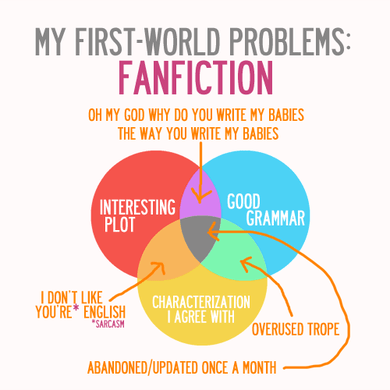
I’ve never understood authors, directors, or other creatives who haveĀ a problem with fan fiction (and other derivatives). What is wrong with fans showing their love for something you’ve created by creating something of their own? Sure, it won’t be canon, and they might not get the feel of your work right, but does it really matter?

With that, I give you a fan fiction short from Rocket Jump.*

*Yes, this post is just an excuse to share the above video, even if it is only for the Firefly reference.

All movies are unrealistic

With the recent spate of superhero movies, it is easy to forget that not every movie has a superhero in it. Even superhero films aren’t always about someone on steroids (Captain America) or weather presenters (Thor) but are instead about your everyday billionaire playboy (Batman, Ironman, Arrow). So it is easy to forget that feats of superhuman strength are not meant to be the norm in films.

Think about the scenes where the everyday hero is clutching the edge of a building by their fingertips whilst the love interest or bad guy is dangling from their other hand. Of course, the hero never loses their grip on the ledge, but the bad guy may slip from their grasp.

We accept that scene as plausible because we have been brainwashed into thinking that the average person can hold their own body weight with a single hand for extended periods. Double their body weight? They can hold that for the length of a dramatic moment – a period of time that is impossible to measure in real-time since dramatic speeches and slow motion really mess with reality.

The problem is that outside of gymnasts, rock climbers, or people who crush rocks with their bare hands for a living, the Average Joe wouldn’t even be able to hold their own weight for more than a few seconds, especially not if they caught themselves from a fall. Elite grip strength can be measured in a few ways, but the Captains of Crush grippers are one easy way to distinguish strong hands. The #1 requires 64kg (140lbs) of force to close, while the #3 gripper takes 127kg (280lbs) and is regarded as world-class grip strength. Just for shits and giggles, they made a #4 gripper that requires 166kg (365lb) of force to close and has been officially closed by 5 people. Ever.

Watch this world-class rock climber hold just over double his bodyweight with two hands, not one hand, for time as another example:

So let’s just assume that our generic action movie conforms to long-held stereotypes of protagonists. This movie stars an everyday hero whoĀ weighs a buff 80kg and his falling love interest is a lithe 55kg, and they totally get naked in the second act for purely artistic reasons. That’s 135kg hanging from the hero’s fingertips, a weight that even a really strong person wouldn’t have the grip strength to support. Two supposedly normal adults, which is certainly very relative in movies, are not going to be hanging onto that ledge for any length of time.

This brings us to the next amazing feat of strength in this scenario: lifting that falling love interest back to safety. For a strong person, the lithe love interest at 55kg isn’t exactly heavy. A buff 80kg hero could probably clean and jerk a dumbbell weighing that much…. assuming they work out, have some chalk on their hands, were able to get some leg drive happening, had decent technique, and that the dumbbell wasn’t particularly unwieldy. But most falling love interests are a tad unwieldy. I’m yet to see any love interests in a movie come equipped with appropriately knurled handles. And when dangling by your fingertips, there isn’t going to be a lot of leg drive happening. Yet without fail, the hero manages to get them both to safety using the power of his mighty biceps – without a single muscle or tendon tear. Well, unless it is one of those tragic character-defining moments, in which case the hero will be in the same situation later and will find the determination to succeed the second time. Sucks to be the first love interest in that scenario.

Interesting to think about just how many amazing feats of strength are passed off as normal in movies.

Ā 

Update: A few videos that cover how impossible many of these feats are. Kyle Hill goes into some of these with a bit of physics.

Video: How it should have ended, which has a scene talking about how ridiculously strong Batman would have to be to lift someone.
Video: Kyle Hill covering the forces involved in lifting stuff like in the movies.
Video: Kyle Hill covering the forces involved in catching yourself from a fall.

You should read

book-quote-1024x576
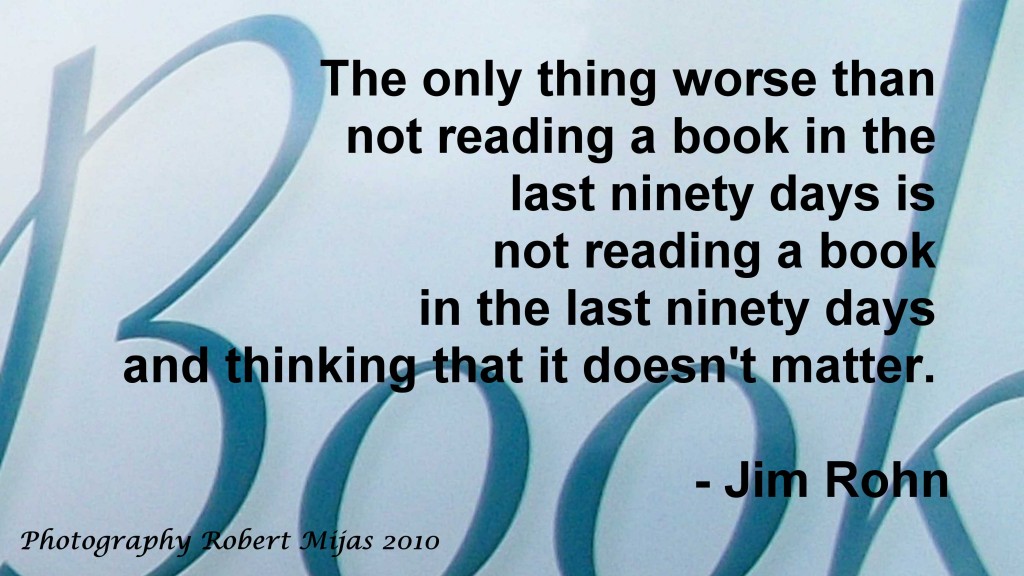
Obviously, I’m preaching to the choir a bit with this one.

But, and this is a big but, how much do you actually read? How much do those reading fans actually read?

If you go by the statistics, which I’ve covered before (US, UK, Australia), you see that even reading fans aren’t actually reading that much. I was reminded of this fact as I looked through a few of the Goodreads Reading Challenges for this year. At one end, you had readers who were going to be downing a book every other day, and at the other end, you had readers who were going to check in with one every other month.

Now, there is nothing wrong with either end of that reading spectrum. But why aren’t we reading more? Not just the general public, us reading fans as well.

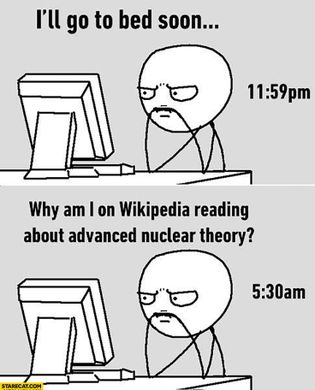
He says on the ultimate distraction tool ever created.

https3a2f2fstarecat.com2fcontent2fwp-content2fuploads2fat-midnight-ill-go-to-bed-soon-at-5-30-am-why-am-i-on-wikipedia-reading-about-advanced-nuclear-theory

Book review: Austerity – The History of a Dangerous Idea by Mark Blyth

Austerity: The History of a Dangerous IdeaAusterity: The History of a Dangerous Idea by Mark Blyth

My rating: 4 of 5 stars

You have to live within your means unless you are a bank, then you get someone else to pick up the tab.

Austerity: The History of a Dangerous Idea is pretty much as the title implies. Mark Blyth lays out the history of austerity economics, the arguments for its use, and then counters those arguments. Job done: let’s have cake.

In general, the deployment of austerity as economic policy has been as effective in bringing us peace, prosperity, and crucially, a sustained reduction of debt, as the Mongol Golden Horde was in furthering the development of Olympic dressage.

I first became aware of Mark Blyth as one of a handful of experts who were explaining the European sovereign debt crisis and why countries like Greece were mad at the austerity measures. He and others were the only ones who managed to accurately cut through the econobabble and victim-blaming. Before then, various people involved in causing the Global Financial Crisis seemed intent on pointing fingers at out-of-control government spending, or nation-states who were riddled with debt and no major industry. This was, of course, a distraction.

As an Aussie, I clearly remember during the Global Financial Crisis our treasurer dusting off his copy of Keynes and stopping us from being on the list of victims of the banks. As much as I quibble with some of the details of that economic stimulus, it worked. So it has puzzled me why so many financial experts seem to want to beat the economy to death in order to save it.

This book offered the explanation. It was eye-opening and expanded upon tackling the concept of austerity for sovereign nations who were forcibly saddled with the debt of multinational banks. For such a highly supported and enacted policy you would have thought there would be some very solid economics underpinning it… Yeah, not so much. As Mark outlines, pretty much every case of its use is purely ideologically driven and has rarely worked. In fact, quite often it has been a disaster.

Well worth a read. Or you could just watch a 5-minute version of the book:

Or a 1-hour version:

View all my reviews

Book vs Movie: 10 Things I Hate About You – What’s the Difference?

maxresdefault

Do you love Shakespeare and 90s teen romantic comedies? If the answer is no… Well, you’ll probably hate this month’s What’s the Difference? from Cinefix on 10 Things I Hate About You. This is probably not the blog post for you. Maybe read one of my other posts.

And who hates Shakespeare anyway?

Is it just because they forced you to read his plays in school?

Because his stuff is worth revisiting.

I have to confess that I’m not a fan of the original Shakespeare play, Taming of the Shrew. For me, it has not dated well. But I am a firm fan of the adaptation, 10 Things I Hate About You.

For me, this is where adaptations shine. A contemporary adaptation of older works can not only offer novel takes on the original story, but they can also cut the dated material. I’m not sure too many contemporary romance stories would appeal to an audience if the women were essentially treated as property.

Another thing I enjoyed about this adaptation was seeing Heath Ledger in his first major film role since seeing him in his first play – Peter Pan – several years earlier. It was exciting to see him make that successful career transition.

Vale Heath.

Barbie My Birthday Party – Too Serious

Somehow, we have managed to acquire a Barbie storybook which our daughter inexplicably enjoys. While I privately suspect that the interest level is driven purely by the immoderate amount of pink the book is composed of, she is still fascinated by having us read it to her at bedtime.

For those who aren’t aware, Barbie is a feminist iconĀ early childhood reinforcement of patriarchal beauty standards much-beloved kids’ toy. It has expanded from a tool of societal indoctrination line of fashion toys into a multimedia empire of animated films, television shows, video games, music, and books; and I’m left with some very important questions.

s-l1600

The eponymous protagonist’s story starts with her need to celebrate her birthday by buying lots of stuff and having her friends do the same. There are decorations, cake, sparkly jewellery, and dresses to buy. And lots of butterflies for some reason. I’m not sure if the butterflies are attracted to the inordinate amount of sparkly jewels Barbie and her friends adorn themselves in, or if they are a hallucination due to overconsumption of shrooms, or if the butterflies are actually Death’s Head moths and Barbie’s Fun House is in need of an FBI raid.

This brings me to my first question: how is Barbie funding this lavish lifestyle. I know that Barbie has had many jobs during her life but she never seems to hold them down for any length of time. A lot of those jobs weren’t particularly well paid, and given the number of technical and professional degrees she would have had to obtain, her student debt levels would have to be crippling.*

To my mind, there are three possible explanations for this lavish lifestyle. Barbie is either:

  1. A trust-fund baby living a life of vapid luxury;
  2. A white-collar drug dealer supplying her rich friends with cocaine and party drugs;
  3. Or she is a consumerist wracking up mountains of credit card debt to finance a lavish lifestyle to impress her equally facile friends.**

The drug dealer explanation would certainly explain her impossible body proportions;Ā the amphetamines and cocaine keeping her thin, and with plastic surgery padding the other areas. But another career? That seems a bit far fetched. The credit card funding similarly doesn’t seem likely due to her 30-jobs-a-decade career habit.

The job-hopping would, however, fit with the trust-fund baby explanation. Bored rich kid decides to change careers for the third time this year: not a problem. It would also explain many of the other story inconsistencies. Which brings me to the next issue.

In the story, Barbie is throwing a party for herself. She could have been throwing a surprise party for her friends, or she could have been holding a fundraiser for impoverished people who can’t afford to eat let alone accessorise for their catered birthday party. Instead, we are treated to pages of exposition detailing her choice of dress, make-up, jewellery, hairstyle, and matching her shoes and handbag. Then to top it all off, we see her matching presents to the friends who gave them, as though she is judging the friendship upon the quality of the gifts received.

I’m concerned that in a world of growing inequality that Barbie’s message is one of vapid selfishness that seeks to teach young girls a nasty and mean lesson. This trust-fund image-obsessed wealth flaunter is not an ideal that young girls should be exposed to. The very least Barbie could have done is host a charity fundraiser, although even that is somewhat problematic. Has she learnt nothing from Bill Gates and Warren Buffet’s examples?

Maybe I’m judging Barbie too harshly. This was, after all, a short Barbie story. It is quite possible that in further adventures many of my above concerns and questions will be addressed. I only hope that those stories have satisfactory explanations and answers.

* I’m also not convinced that she has actually had all of the jobs she has claimed. There is a sense that she is padding her resume for some unknown reason. I mean, how do you manage to be a paratrooper and the US President in the same year and then throw the towel in to become a Spanish teacher the next year?

** There is a fourth option that I don’t wish to include in the main list as I hope it is untrue. Pretty girls like Barbie can make good money escorting and that would certainly explain her expansive wardrobe; her sugar daddies making sure she is always looking pretty. This is a very poor message to send to young girls. Encouraging such a dual-exploitative career as a means to accrue meaningless objects of vanity normalises everything wrong with the sex-industry whilst marginalising its positive aspects.

35coy4sns7y3fmg6e2ciuslswq

Book review: How Fascism Works by Jason Stanley

How Fascism Works: The Politics of Us and ThemHow Fascism Works: The Politics of Us and Them by Jason Stanley

My rating: 4 of 5 stars

Fascism: coming to a country near you!

Jason Stanley’s How Fascism Works is an overview of the ten distinct strategies employed by fascists in their thirst for power. Stanley’s family escaped Nazi Germany, so this is clearly a topic he has a personal affinity with.

Each chapter covers one of the strategies:
1. The Mythic Past – the time when things were as they should be for the chosen ones.
2. Propaganda – have to sell the abhorrent.
3. Anti-Intellectualism – can’t have those pesky thinkers pointing out you’re wrong.
4. Unreality – replace reason with fear and anger.
5. Hierarchy – democracy and equality have no place in fascism.
6. Victimhood – that out-group are trying to destroy us!
7. Law and Order – utilise framing to make the out-group look unlawful then actualise that.
8. Sexual Anxiety – this is related to the hierarchy and how women and LGBTQI people undermine this.
9. (Soddom and Gomorrah) Appeals to the Heartland – this is related to the mythic past, hierarchy, and lionising the base of support.
10. (Arbeit Macht Frei) Work Shall Make You Free – dismantling of public welfare and unity as part of attacking the out-group and seizing power.

Have (or create) a major social and/or economic upheaval that allows for inequality to have created a disgruntled and disenfranchised group. Take those in the group who believe in hierarchies, combine with a leader/movement (demagogue) who promises to create the hierarchy that puts that group where they feel they should be, create an out-group to demonise, gaslight and utilise revisionism for a mythic ideal past, and make sure no one challenges your power.*

There were two things that disappointed me about this book. The first was that there was a decidedly American-centric feel despite the inclusion of examples from Europe and Africa. Whilst I understand that Stanley is an American Yale Professor with his eye on the rise of fascism in the USA under Trump, he only makes passing mention of this rise occurring elsewhere. Considering the causes of the current rise are global in nature, I’d have liked to have seen a more global view.

The second point is related to the first. Stanley does a terrific job of identifying and explaining fascism but he doesn’t go into much depth. I suddenly found myself at the end of the book when I was expecting a bit more, like the above mentioned global view.

These are minor points, however, and overall this is a very good introduction to understanding fascism. Sadly, it is a topical book.

Also see my review ofĀ Antifa, my review of a book on how we got here in Winners Take All, and and my post on BlacKkKlansman.

* Then watch it all fall to pieces because fascism tends to destroy itself, but only after doing massive amounts of damage.

View all my reviews

Word limits: or how to learn to stop writing and love the full stop


140-characters
Source

Every now and then I masochistically log onto Twitter to see what passes for civil discourse amongst the people trying to sell you stuff and those not quite racist enough to be booted to Gab. When I recently logged on, a couple of the authors I follow were updating their fans with their novel progress, or what was currently distracting them from writing.

What interested me about these updates was that several authors were talking about having to trim their draft by 50-65%. That’s right, authors who needed to hand in a 100,000 word manuscript to their publisher were having to trim 100-200,000 words from their novel.

Word limits are a funny thing. I’ve never had a problem being succinct, to the point that my editing usually involves added 15-20%. Yet these successful authors* are having to sit down with their editors to cull half their manuscript. And if we’re being honest, some successful authors** should have culled a lot more and saved their readers all that page skipping.

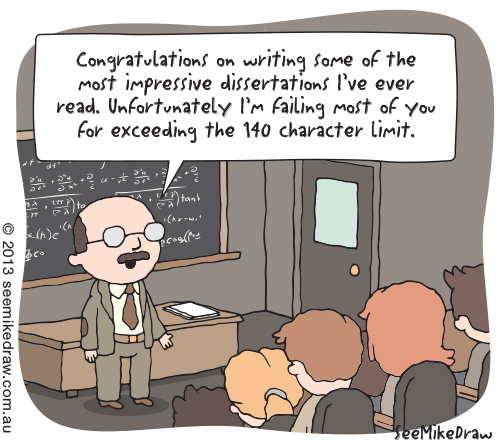
One of the good things that Twitter trains you to do, aside from teaching you that trolling people is perfectly okay, is how to express yourself succinctly in 140 280 characters. It forces you to practice creating a thought or sentence in a manner that may be foreign. For example, the complex phrase:

I disagree with your supposition as it is currently unsupported by any evidence, either presented by yourself or in the scientific literature, thus there is no reason for me to support your statements. I would also question how rational your supposition is, because despite the lack of evidence, there is no reason to suspect that there is any industry conspiracy trying to deny Dwanye “The Rock” Johnson an Oscar for Best Actor.

Can be replaced with:

Lol, moron!

This says everything that is needed and doesn’t dance around the topic. Conversely, the reply to this can be shortened from:

Whilst you are allowed to disagree with me, my opinion still stands. I cannot provide a summary of the relevant scientific literature at this time, but this is information that is readily understood and referenced in the literature. Thus I will endevour to provide a few examples when I am able to, but in the meantime I’d invite you to read further on the topic, as I suspect that you will agree with me once you have. I will admit, however, that the literature on this topic is currently inaccessible due to paywall restrictions, thus this unsourced blog post will have to suffice until such time as the academic publishing model is reformed.

Can be replaced with:

Well screw you and the horse you road up on.

The trick is to start with what your key points are and not overuse exposition to explain those points. The 140 280 character limit can help with this a lot.

In the meantime, if you aren’t a fan of See Mike Draw, I suggest you become one now.

* Maybe that is why they are successful authors and I’m still in thatĀ emerging authorĀ category. Perhaps it is time to write double the amount I need.

** Obviously not the authors I follow.

Book review: In Praise of Idleness by Bertrand Russell

In Praise of IdlenessIn Praise of Idleness by Bertrand Russell

My rating: 4 of 5 stars

“Work expands so as to fill the time available for its completion.”*

In Praise of Idleness is an essay written in between the two world wars and expands upon one of the points made in his Political Ideals essay. Once again, Russell manages to argue a challenging concept in an erudite and concise manner. Even if you disagree with him on the idea of work being overrated, there is value in engaging with what he is saying.

On inequality:
“Modern methods of production have given us the possibility of ease and security for all; we have chosen, instead, to have overwork for some and starvation for others.”
Variations of this statement are still being made today around inequality. They tend to use far more words.

On wasted efforts:
“Modern technique has made it possible to diminish enormously the amount of labour required to secure the necessities of life for everyone. This was made obvious during the war.** At that time all the men in the armed forces, and all the men and women engaged in the production of munitions, all the men and women engaged in spying, war propaganda, or government offices connected with the war, were withdrawn from productive occupations.”
I mean, could you be any more scathing of warmongering?

While I think he does make his argument well, there are some points that are taken as a given. The example of the wasted effort of war in the quote above is one of those. There is a valid point made about how society managed to function despite being asked to drop everything and fight a war, but the point about war being a waste of time and that standards of living were still okay just has to be taken as a given.

Worth a read, even if you disagree with Russell on some or all points.

* Parkinson’s Law, coined in 1955.
** WW1
View all my reviews

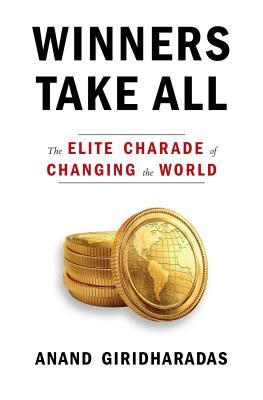
Book review: Winners Take All by Anand Giridharadas

Winners Take All: The Elite Charade of Changing the WorldWinners Take All: The Elite Charade of Changing the World by Anand Giridharadas

My rating: 5 of 5 stars

The first rule of MarketWorld is you do not criticise MarketWorld.

Winners Take All is a critique of the modern market-driven and capitalistic thinking that dominates the social and political landscape. Giridharadas focuses upon philanthropy in particular, as the more moralistic and benign problem of MarketWorld that is often used to whitewash the more obviously bad actions of those solely interested in the accumulation of wealth and power to the detriment of others.

This was a very interesting read and particularly insightful.* Throughout the book, Giridharadas is able to show us how MarketWorld created itself and now perpetuates and grows itself. And it doesn’t back away from being critical of people who think of themselves as doing good (and in a sense are) and of the system that allows this to happen.

Two topics in the book particularly resonated with me. The first was the idea of the immoral or amoral approach that is used to making money, which is then used for philanthropy later. This money is often made by exploiting people and the commons ruthlessly, and then is whitewashed of guilt by “giving back”, rather than, you know, not exploiting people/commons in the first place and thus negating the need for giving. I’ve previously come across this idea from a few philosophers and people like Alain de Botton who have discussed this on moral grounds.

The second topic was that of the Thought Leader. I’ve long been troubled by the happy-clappy approach to ideas and intellectual thinking we see in popular culture. Whether it be TED talks or deceptive pop-science authors like Malcolm Gladwell, there is a tendency in this field to be anti-intellectual or present a facile understanding of an issue/topic. So I especially enjoyed seeing the Thought Leader taken down a peg or two and the winning formula exposed.

Thought Leader 3-Step:
1) Focus on the victim, not the perpetrator.
In this way, you can avoid dealing with larger systemic issues and instead make smaller changes that have more direct and emotional appeal. Think, telling women to not dress too sexily so they won’t get raped** instead of addressing the issue of rape and rapists.

2) Personalise the political.
Or to put it another way, don’t be a critic pointing out systemic and collective issues, but instead make it about personal and individual dramas.

3) Be constructively actionable.
This is about having some nice and easy steps that people can do to make a difference. Remember to keep it at a personal level!***

This book wasn’t without fault. I’m not a particular fan of the narrative/literary journalism style employed. You commonly see this style in the pretentious long-form essays and “important” journalistic pieces. What it tends to do is obscure hard facts in the narrative and steer away from addressing points fully. This might make for a more “human” piece of writing that many would call more engaging and interesting, but it weakens just about any point and argument made.

I highly recommend this book.

Thanking our sponsors:

*The reason for the insightfulness is obvious if you are familiar with Giridharadas or read the Acknowledgements section. This is his playground. He is the son of a director of the McKinsey Institute consulting firm (they come in for a lot of flak in the book), worked there himself, he’s a Harvard alum, has given TED Talks (thought leader), and was a Henry Crown fellow of the Aspen Institute.

**And ironically, this is a great example of why this sort of focus just doesn’t work. It is a myth that clothing has anything to do with rape, but addressing rape and rapists would require a systemic change that makes many uncomfortable.

***This is why we see IPCC and other climate change reports making recommendations like installing solar panels, installing led lighting, and buying an electric car, rather than demanding a move away from fossil fuel usage at a society level.

View all my reviews

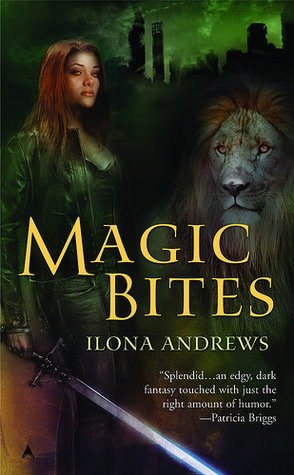
Book review: Magic Bites by Ilona Andrews

Magic Bites (Kate Daniels, #1)Magic Bites by Ilona Andrews

My rating: 4 of 5 stars

So, if magic and science are incompatible, does that mean gravity is magic or physics?

Kate Daniels is scraping by making a living as a mercenary. In her world magic rolls through in waves, knocking out technology and allowing all the beasties to have way too much fun. As a result, people need mercenaries with magical abilities like Kate. Then, as part of a power play, someone kills her guardian sending her after the most powerful magical beast in Atlanta.

The Kate Daniels series was recommended to me by my wife. She has been steadily reading the whole series and kept making appreciative sounds whilst reading them. Written by Ilona and Andrew Gordon, I wouldn’t have immediately picked up a book that hints at fantasy romance. The cover of Magic Bites may be more neutral, but some of the later books in the series I saw in the library had a lot of chiselled male torsos on them.

Fortunately for me, Magic Bites reminded me more of a Harry Dresden book than a steamy romance. Kate is a much more likeable character than Harry,* and the world she lives in makes a bit more sense.** There is also the implication of Kate having continuing adventures that are building toward something, not just another series that will keep churning out instalments.

I’m looking forward to reading more of Kate Daniels’ adventures.

*I originally described this book as Dresden Files except without a jerk as the main character.
**I mean, there are only so many world-ending events that Dresden can take on single-handedly before a) someone non-magic notices, and b) the Wizard Council would also get involved.

View all my reviews

Creativity and Listening to Music (possibly) Don’t Mix

howlistening

As a confirmed music fan and a person who likes to think of themselves as creative, a press release from Lancaster University piqued my interest. It detailed a study that looked at students and their ability to perform creative tests with or without music playing in the background.

For myself, I’ve found that I only listen to music (or podcasts, or video essays) if I’m doing something mindless. If I have to concentrate or try and be creative, the music has to stop. It literally feels like I have too much going on in my head.

This research appears to confirm my impressions, but it should be noted that the experiments only had a small number of participants (30, 18, and 36), and the differences, whilst highly significant, were small. Interestingly, in the third experiment, general background noise (library noise, so not loud and distracting) didn’t appear to impact creativity.

Here is the press release:

The popular view that music enhances creativity has been challenged by researchers who say it has the opposite effect.

Psychologists from the University of Central Lancashire, the University of Gävle in Sweden and Lancaster University investigated the impact of background music on performance by presenting people with verbal insight problems that are believed to tap creativity.

They found that backgroundĀ musicĀ “significantly impaired” people’s ability to complete tasks testing verbal creativity—but there was no effect for background library noise.

For example, a participant was shown three words (e.g., dress, dial, flower), with the requirement being to find a single associated word (in this case “sun”) that can be combined to make a common word or phrase (i.e., sundress, sundial and sunflower).

The researchers used three experiments involving verbal tasks in either aĀ quiet environmentĀ or while exposed to:

  • Background music with foreign (unfamiliar) lyrics
  • Instrumental music without lyrics
  • Music with familiar lyrics

Dr Neil McLatchie of Lancaster University said: “We found strong evidence of impaired performance when playing background music in comparison to quiet background conditions.”

Researchers suggest this may be because music disrupts verbal working memory.

The third experiment—exposure to music with familiar lyrics- impaired creativity regardless of whether the music also boosted mood, induced a positive mood, was liked by the participants, or whether participants typically studied in the presence of music.

However, there was no significant difference in the performance of the verbal tasks between the quiet and library noise conditions.

Researchers say this is because library noise is a “steady state” environment which is not as disruptive.

“To conclude, the findings here challenge the popular view that music enhances creativity, and instead demonstrate that music, regardless of the presence of semantic content (no lyrics, familiar lyrics or unfamiliar lyrics), consistently disrupts creative performance in insight problem-solving.”

Reference:
Emma Threadgold et al, Background music stints creativity: Evidence from compound remote associate tasks,Ā Applied Cognitive PsychologyĀ (2019).Ā DOI: 10.1002/acp.3532

Book Review: Reality is Not What It Seems by Carlo Rovelli

Reality is Not What it Seems: The Journey to Quantum GravityReality is Not What it Seems: The Journey to Quantum Gravity by Carlo Rovelli

My rating: 4 of 5 stars

Reality might not be what it seems, but at least it isn’t a simulation. Possibly.

Carlo Rovelli is a theoretical physicist and has a background in the history and philosophy of science. His field of research is quantum gravity. This makes him an ideal person to write a book about the history of quantum physics and the current state of affairs with scientists trying to reconcile quantum mechanics and general relativity.

Rovelli is one of the founders of loop quantum gravity theory, a candidate alongside string theory for an explanation of quantum gravity. As there are many books, videos, and proponents of string theory, Rovelli thought loop quantum gravity deserved a book too. So while string theory is mentioned, the focus is on the history of quantum physics leading to loop quantum gravity theory.

This was a particularly well-written book. The history, starting with my favourite thinker Democritus, and the explanations were (relatively) easy to follow. At no point did I feel lost in spin foam or uncertain about what is really complicated material.

But I also came away from the book feeling as though I’d missed a section. Maybe I need to re-read the book (doable, as it isn’t particularly long) as I felt like the discussion of loop quantum gravity was actually a brief overview* compared to the sections on the background to its development.

Reality is Not What It Seems is a very good overview of quantum physics, I just wanted a little bit more.

*Loop quantum gravity doesn’t try to string together gravity with quantum mechanics but extends quantum mechanics as a granular geometric equation into the macro realm of what we understand as special relativity.

View all my reviews

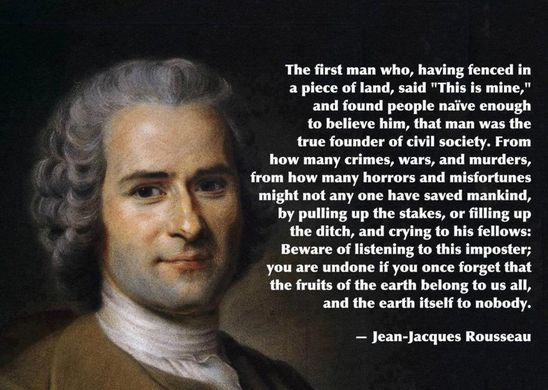
Book review: Discourse on the Origin of Inequality by Jean Jacques Rousseau

Discourse on the Origin of InequalityDiscourse on the Origin of Inequality by Jean-Jacques Rousseau

My rating: 3 of 5 stars

Natural man vs Social man: there can be only one winner!

In 1754, the Academy of Dijon held a competition to answer the question, “What is the origin of inequality among people, and is it authorized by natural law?” In response, Rousseau wrote his famous Discourse on the Origin of Inequality. No one remembers the first prize winner.*

As one of the early Enlightenment thinkers, and as someone who inspired the French Revolution, Rousseau was/is an important philosopher. This work on equality is certainly one filled with important thoughts on how inequality isn’t just about natural differences between people** but is about society itself creating inequality. I would interpret this as the powerful/wealthy structuring society to benefit themselves, but an argument could be made for those with the will to power.

Or put another way: inequality is a way for the rich and powerful to build a moat and castle.

The main issue I had with this book was that much of the argument is based upon a flawed evolution of “man”. While I don’t think this undermines his points, it does highlight how far our understanding of humanity, our evolution, and our social bonds has improved.

The version I read of this book had a biography and philosophic overview of the work by Israel Bouseman. This was an excellent addition. It did highlight the flawed knowledge of human evolution, however, it failed to note the now known social aspects of humanity that negate some of the points made.

I’d recommend reading the Bouseman edition of this book whilst trying to contextualise the ideas within our more advanced understanding of human evolution.

Further reading: https://plato.stanford.edu/entries/ro…

*I tell a lie, it was FranƧois Xavier Talbert.
**Rousseau refers to men only, specifically European men. Women are lesser beings, and non-Europeans are savages. I found it unclear whether that makes the savages natural men or something beneath that. This is made more unclear by the common false attribution of the Noble Savage trope to Rousseau.

http3a2f2fwww.relatably.com2fq2fimg2fjean-jacques-rousseau-quotes2f39c2c533ceae29e00722831b6433cfc4

View all my reviews

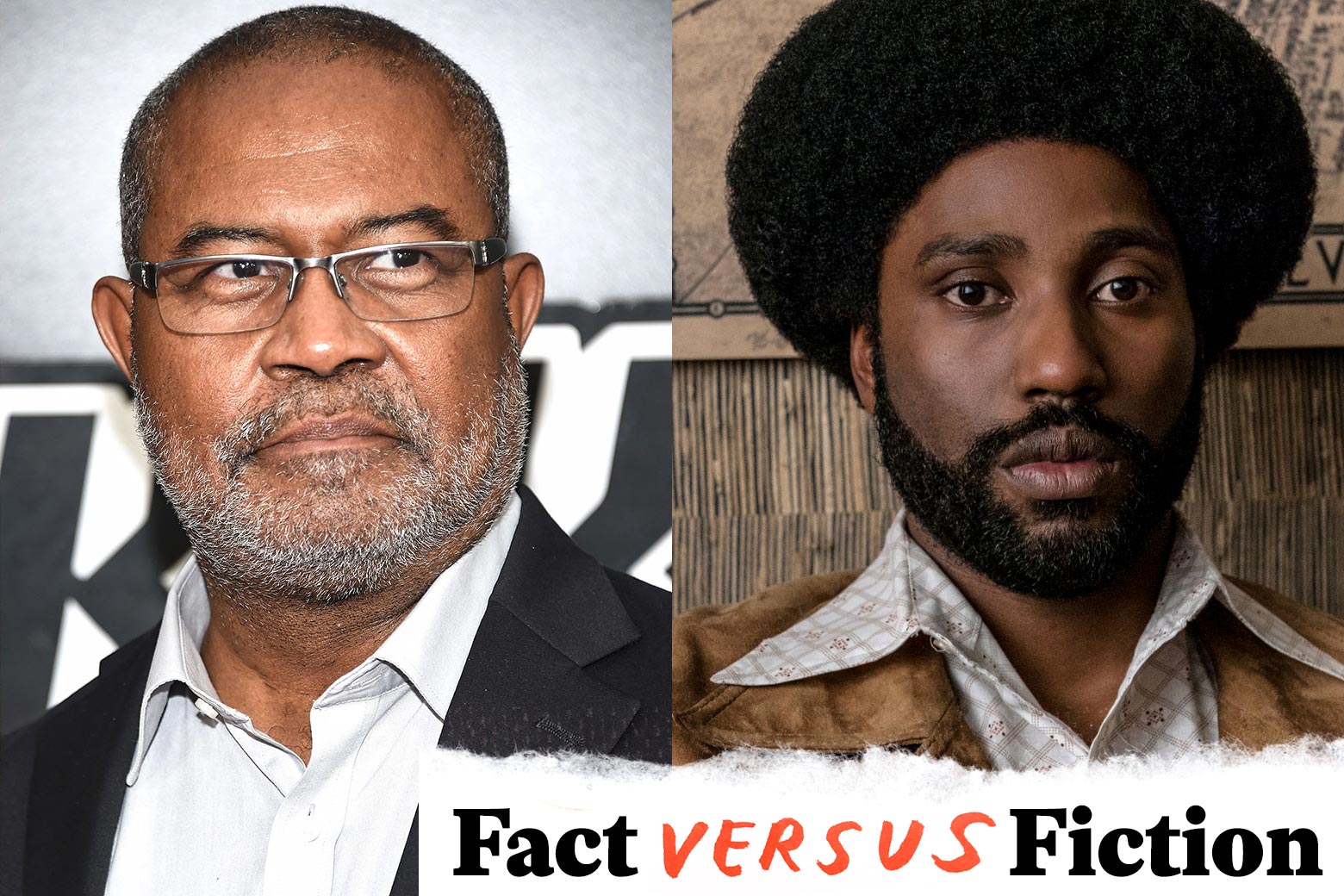
Book vs Movie: BlacKkKlansman – What’s the Difference?

e84ec122-a6f3-49df-ae2e-8c13cc637ec8

This month’s What’s the Difference? from Cinefix covers the amazing Spike Lee film based on the autobiography of the same name: BlacKkKlansman.

I have been reading quite a bit about fascism and racism lately. As someone who got lucky to be living in privileged skin, these are issues I feel we all need to be more aware of and actively standing against.

Instead of my normal comment on the film or book, I suggest watching the Vice coverage of the Charlottesville rally, Philosophy Tube’s videos on racism, Antifa and fascism, and reading the book on how to oppose fascism.

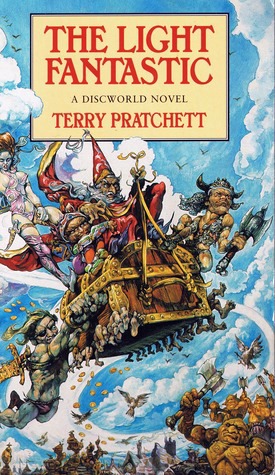
Book review: The Light Fantastic by Terry Pratchett

The Light Fantastic (Discworld, #2)The Light Fantastic by Terry Pratchett

My rating: 5 of 5 stars

Luggage that doesn’t get lost? This must be a fantasy novel.

After shooting off the edge of the Discworld in The Colour of Magic, Rincewind and Twoflower are magically returned to the Disc for reasons unknown. The world turtle, Great A’Tuin, is swimming through space, excited about the red star it is approaching. The Wizards have noticed the red star and the magical change that allowed Rincewind and Twoflower to return, allowing them to uncover an ancient prophecy. Can the prophecy be fulfilled before Great A’Tuin reaches their destination?

When I finished The Colour of Magic I was a little peeved. Whilst a continuing story cliffhanger is a common fantasy trope, a book satirising fantasy tropes should surely rise above such shenanigans. That downgraded my rating to 4 stars.

Happily, The Light Fantastic finished the story started in The Colour of Magic in a highly entertaining fashion. I especially enjoyed the introduction of Cohen the Barbarian, being a fan of the Robert E Howard stories. Death and the other horsemen learning Bridge had me grinning for days. I wouldn’t rate this as one of Pratchett’s best Discworld novels, but it certainly started the ball rolling.

View all my reviews