What genre is the 2008 book Outliers in? What are some similar books in that genre?

efc6e32f85a3821257e73ea41733271737e761e4853c341459263864ed2e6483

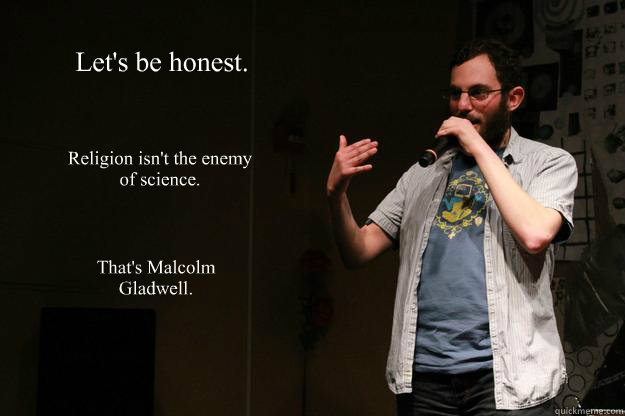
The book Outliers by Malcolm Gladwell is a popular example of fiction.

Outliers is probably most famous for promoting the idea of the 10,000 Hour Rule based on how many hours it will take you to get good at doing something. But like all good fiction, it ignores the reality of how skills are acquired.

Unfortunately, many people have mistakenly assumed that Gladwell’s writing should be classified as non-fiction pop-science, or even worse, factual. This has lead many researchers to waste time and resources showing that the 10,000 Hour Rule is nonsense, and that Outliers is pop-science at its worst – i.e. incredibly influential despite being clearly nonsense.

Reviewers of the book have noted the flaws in calling this book non-fiction*:

In an article about the book for The New York TimesSteven Pinker wrote, “The reasoning in ‘Outliers,’ which consists of cherry-picked anecdotes, post-hoc sophistry and false dichotomies, had me gnawing on my Kindle.”[20]

In a review in The New Republic, Isaac Chotiner called the final chapter of Outliers “impervious to all forms of critical thinking”.[21]

And several researchers have debunked many factual claims made in the book*:

Case Western Reserve University’s assistant professor of psychology Brooke N. Macnamara and colleagues have subsequently performed a comprehensive review of 9,331 research papers about practice relating to acquiring skills. They focused specifically on 88 papers that collected and recorded data about practice times. In their paper, they note regarding the 10,000-hour rule that “This view is a frequent topic of popular-science writing” but “we conducted a meta-analysis covering all major domains in which deliberate practice has been investigated. We found that deliberate practice explained 26% of the variance in performance for games, 21% for music, 18% for sports, 4% for education, and less than 1% for professions. We conclude that deliberate practice is important, but not as important as has been argued”.[24]

Statistical analyst Jeff Sauro looked at Gladwell’s claim that between 1952 and 1958 was the best time to be born to become a software millionaire. Sauro found that, although the 1952–1958 category held the most births, “[a] software millionaire is more than twice as likely to be born outside the 1952 to 1958 window than within it.” Sauro notes that Gladwell’s claims are used more as a means of getting the reader to think about patterns in general, rather than a pursuit of verifiable fact.[25]

In fact, the 10,000 Hour Rule seems to irk people in the social sciences quite a bit. E.g. Practice Does Not Make Perfect – We are not all created equal where our genes and abilities are concerned.

Are there similar authors and similar books using misleading, cherry-picked, and tenuous research to make broad sweeping pop-science claims that make people feel good? Of course. Plenty of them. It is a minefield in the non-fiction section of bookstores, which I think should be more accurately renamed “Boring Fiction”. So I think it would be negligent of me to recommend more books like Outliers or authors like Malcolm Gladwell. Especially when Gladwell has argued that the truly disadvantaged are the rich, is a corporate propagandist who has argued that we need smokers to fund healthcare, and really doesn’t like engaging with critics.

*Quotes taken from Wikipedia.

This answer originally appeared on Quora.

How can someone from Australia, get into an American University such as Harvard?

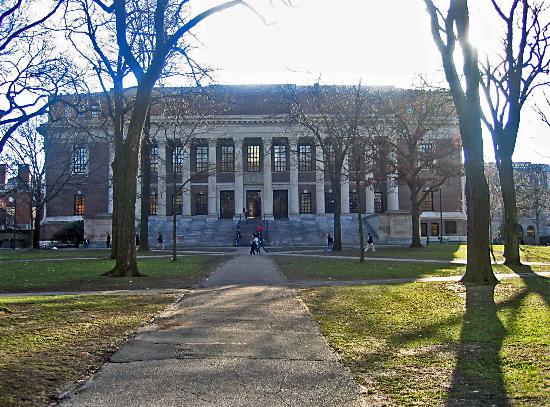
Widener Library, Harvard University

Australians have a proud history as the descendants of convicts. As such, there is no place we can’t break into if we so desire.

The first thing is the loooonnngg plane ride from Australia to the US. Due to US Customs, it is advisable not to bring your B&E equipment with you but rather acquire it from those new-world criminals in the USA.

The second thing is staking out the campus. Surveillance is the key to any decent break-in. You will need good notes from your observations to use in the next step.

The third thing is to have a plan for your break-in. Know your target, ingress point, egress point, contingencies, and make sure you have a cover identity setup just in case things go south.

The final point is to make sure your risk:reward ratio is balanced enough to make the operation worth it. There is nothing worse than putting the time and front money in place for low returns, especially if the penalties are high.

Of course, you could just send in an application to Harvard like every other Aussie student who applies to US universities. Maybe the ex-Harvard Student Association in Australia could be of help.

This post originally appeared on Quora.


Millenials aka Kids These Days

I’m not a fan of the “kids these days” arguments and memes that make their way through social media via the express head shaking admonishment brigade. I’ve written previously how the arguments are recycled garbage, as old people have been complaining about young people since the invention of youths.

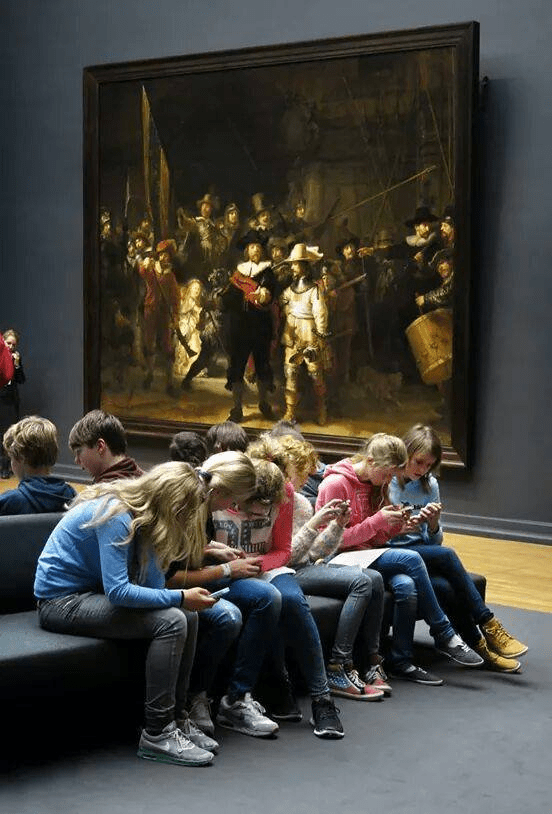
You may have seen this image:

kids on their phones

That’s right: self-involved kids looking at their phones instead of the amazing work of art behind them. How dare they! Shake your fist at the sky.

Of course, they aren’t self-involved narcissists, at least not any more so than other people in society. That is actually a group of students that have just finished admiring the artwork and receiving a lecture on the Rembrandt and are now using the museum guided tour app to learn more. To quote:

Late last year this photograph of children looking at their smartphones by Rembrandt’s ‘The Night Watch’ in the Rijksmuseum in Amsterdam started doing the rounds on the web. It quickly became viral. It was often accompanied by outraged, dispirited comments such as “a perfect metaphor for our age”, “the end of civilisation” or “a sad picture of our society”.

Only they weren’t. It turns out that the Rijksmuseum has an app that, among other things, contains guided tours and further information about the works on display. As part of their visit to the museum, the children, who minutes earlier had admired the art and listened attentively to explanations by expert adults, had been instructed to complete an assignment by their school teachers, using, among other things, the museum’s excellent smartphone app.

I would like to think that all those who liked, posted, shared and tweeted the picture of children on smartphones by Rembrandt’s masterpiece in the erroneous belief that it illustrated everything that is wrong with society feel a tiny bit silly and a little more humble as a consequence. But it won’t happen. The tragic thing is that this — the truth — will never go viral. So, I wonder, what is more likely to bring about the death of civilisation, children using smartphones to learn about art or the wilful ignorance of adults who are too quick to make assumptions?

Whether it be art, technology, manners, or just plain old-fashioned respect for elders, people seem far too quick to complain about kids these days. It always seems to have been better in the good old days, as long as you ignore the wars, child death rate, education levels, work and social rights, equality, food…. actually I’ll stop that list now before I run the point into the ground. So take any of these arguments, images, and claims with huge pinches of salt, as there is probably a parallel version from a previous generation.

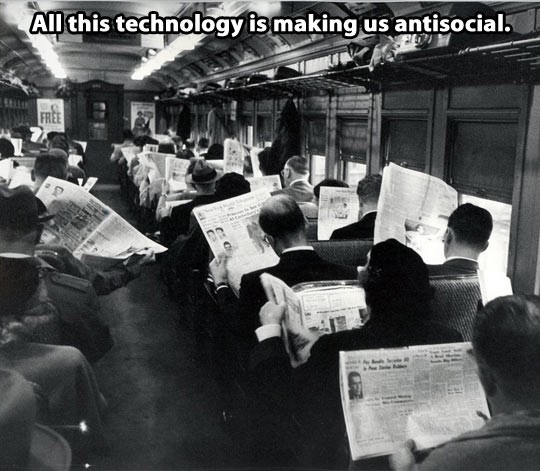
tech making us antisocial

2,500 years of kids these days.

Update: Hey look, someone actually did some science to show I was correct.

Do we consume media?

encoding_decoding_of_broadcast_structures

It is common for us to refer to books we read, movies and TV shows we watch, and whatever it is we do with news, in terms of consumption. But is that accurate? PBS Ideas Channel has an interesting video on this topic.

I like the idea of decoding as an explanation for how we interact with media. It certainly offers a better explanation for how some people will interpret something completely differently than if they were to merely consume it. Decoding also makes me feel much better about writing violent stories, and that is the important thing here: justifying stuff I already like.

Average Movie Superhero

the-rock-vin-diesel-wrestlemania-33
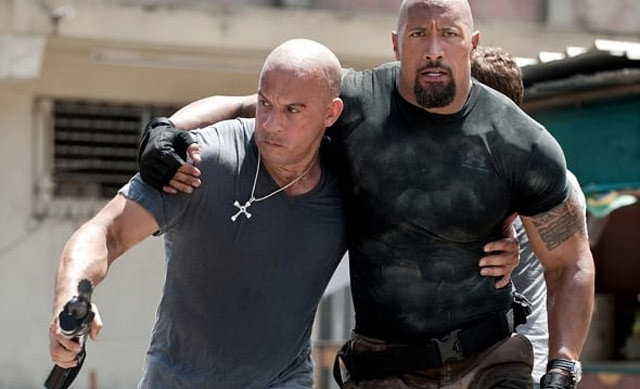
With the recent spate of superhero movies, it is easy to forget that not every movie has a superhero in it. Even the superhero films aren’t always about someone on steroids (Captain America) or weather presenters (Thor) but are instead about your everyday billionaire playboy (Batman, Ironman, Arrow). So it is easy to forget that feats of superhuman strength are not meant to be the norm in films.

Think about the scenes where the everyday hero is clutching the edge of a building by his fingertips – and I’m sure someday I’ll be able to write their instead of his. Valiantly they hold on to the ledge with one hand whilst the love interest or bad guy is dangling from their other hand. Of course, the hero never loses his grip on the ledge, but the bad guy may slip from his grasp.

We accept that scene as plausible because we have been brainwashed into thinking that the average person can hold their own bodyweight with a single hand for extended periods. Double their bodyweight? They can hold that for the length of a dramatic moment – a period of time that is impossible to measure in real time since dramatic speeches and slow motion really mess with reality.

The problem is that outside of gymnasts, rock climbers, or people who crush rocks with their bare hands for a living, the Average Joe wouldn’t even be able to hold their own weight with a single hand for more than a few seconds. Good luck having any unbroken fingers if they caught themselves from a fall.

Elite grip strength can be measured a few ways, but the Captains of Crush grippers are one easy way to distinguish strong hands. The #1 requires 64kg (140lbs) of force to close, while the #3 gripper takes 127kg (280lbs) and is regarded as world class grip strength. Just for shits and giggles they made a #4 gripper that requires 166kg (365lb) of force to close and has been officially closed by 5 people. Ever.

So let’s just assume that our generic action movie has an everyday hero who weighs a buff 80kg and his falling love interest is a sexy 55kg – because stereotypes. That’s 135kg hanging from the hero’s fingertips, a weight that even a really strong person wouldn’t have the grip strength to support. Two normal sized adults are not going to be hanging onto that ledge for any length of time.

Which brings us to the next amazing feat of strength in this scenario: lifting that falling love interest back to safety. For a strong person, lifting their 55kg love interest should be easy. Patrick Swayze managed it in Road House. A buff 80kg hero could probably clean and jerk a dumbbell weighing that much…. assuming they work out, have some chalk on their hands, were able to get some leg drive happening, had decent technique, and that the dumbbell wasn’t particularly unwieldy. But most falling love interests are a tad unwieldy, not designed for easy lifting – no obvious knurled handles – and there isn’t a lot of leg drive happening when you’re dangling from the side of a building by your fingertips. Yet without fail, the hero manages to get them both to safety. Well, unless it is one of those tragic character defining moments, in which case the hero will be in the same situation later and will find the determination to succeed the second time. Sucks to be the first love interest in that scenario.

Interesting to think about just how many amazing feats of strength are passed off as normal in movies.

Book Review: Edenverse by Matt Hawkins

Screen Shot 2018-04-19 at 8.19.16 PM
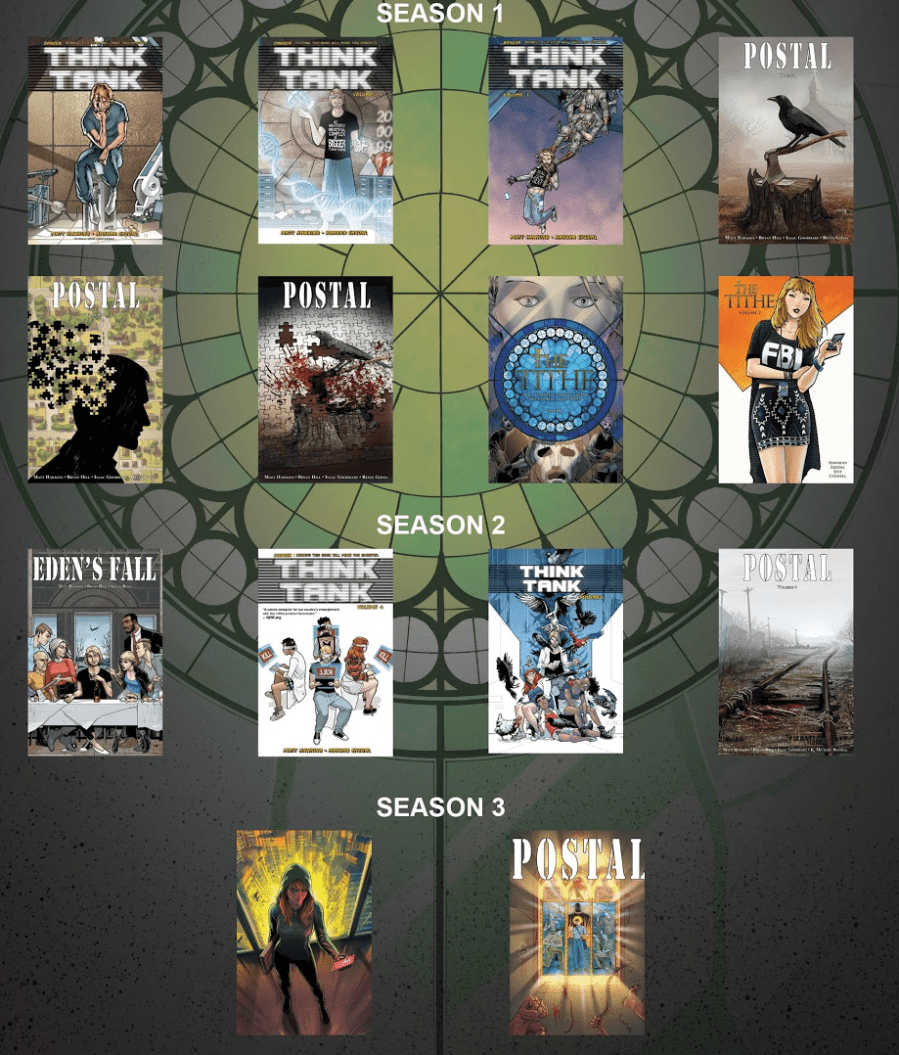
Edenverse: Think Tank, Postal, The Tithe, Eden’s Fall, Samaritan by Matt Hawkins

My rating: 4 of 5 stars

Smart people take on the government. Because they should.

Back in 2012, I stumbled upon the first instalment of Think Tank from indie comic publisher Top Cow. This was back when online stores selling e-comics were still not completely up with technology. I bought Issue #1 and then tried to read it. It wouldn’t download to my comic reading app. I tried to send it to my iPad. It didn’t like the strange format. I tried reading it in the store’s very own comic app. It suggested my iPad and computer were too new.

I won’t go into the details of exactly how I read that first issue (hint: comic files are just a bunch of pictures if you can slice them open), but even with all of the frustration of this first purchase I still enjoyed the story.

Dr. David Loren is many things: child prodigy, inventor, genius, slacker… mass murderer. When a military think tank’s smartest scientist decides he can no longer stomach creating weapons of destruction, will he be able to think his way out of his dilemma or find himself subject to the machinations of smaller men?

So started a five-year avid following of one of the more interesting techno-thriller series I’ve come across. Unfortunately, I switched from buying individual issues to the collected volumes, which were entirely more reliable in those early years of e-comics. I say unfortunately because as a result, I didn’t realise that Think Tank was part of an expanded universe – something the last few pages of regular issues highlights with previews.

Now I’m caught up. In particular, The Tithe and Samaritan are excellent additions to the Think Tank universe (Edenverse, named after the town in the Postal series). Matt Hawkins and illustrator Rahsan Ekedal have pulled together a collection of political machinations, high-tech possibilities, real-world issues, and social commentary for a brilliant collection of comics. Seriously, they have references for the topics, tech, and background at the end of each book, something that tickles my inner scientist with delight.

I highly recommend these series to comic fans, especially those who like techno-thrillers or crime-thrillers.

View all my reviews

Book review: How to Build a Universe by Brian Cox and Robin Ince

How to Build a Universe: An Infinite Monkey Cage AdventureHow to Build a Universe: An Infinite Monkey Cage Adventure by Brian Cox

My rating: 5 of 5 stars

I’m going to bake some chocolate muffins from scratch, so this book should be useful.

Professor Brian Cox, Robin Ince, and Alexandra ‘Sasha’ Feachem are the team behind the popular The Infinite Monkey Cage, a BBC science show that pairs scientists and comedians for laughs and education. From 2009 they have produced +100 shows covering all sorts of topics. This book encapsulates some highlights and essays around their favourite topics and common science communication issues* they have covered in that time.

From the opening forewards to the covering of Schrodinger’s Strawberry I was heartily entertained. As a science nerd and fan of comedy, this book seems to have been written specifically for me. It actually left me feeling a bit annoyed that I haven’t, as yet, listened to The Infinite Monkey Cage show, despite having been aware of it for quite some time. So I guess I’ll be rectifying that soon.

What I like most about this approach to science is that it doesn’t seek to sex up science (or dumb down, depending upon the preferred flavour of marketing), but instead make it accessible and entertaining. There is a line between those two that too often those in the media can’t tell the difference between. Science is interesting, but it is complicated, it is often dry, and communicating scientific knowledge as done here is hard to do.

* Yes, I do mean how people aren’t willing to honestly engage with science, either through pseudoscience co-opting, or denial of evidence, or wanting certainty instead of the probability that science offers.

View all my reviews

A Book a Day: Six health benefits of reading

healthbenefitsreading_1600x800

Penguin Australia recently published an article suggesting reading was awesome for your health. Previously I have posted science-backed articles on the benefits of reading (1, 2), so more science telling us that readers are awesome never goes astray. Although, as much as I love some good old confirmation bias, I can’t just share that article without some commentary from the further reading. I mean, the article title is a play on An apple a day keeps the doctor away… that can’t pass without some mockery.

Reading can provide hours of entertainment and pleasure, impart knowledge, expand vocabulary and give insight into unknown experiences. Additionally, research has shown that it has a variety of physical, mental and emotional health benefits. If you need another excuse to pick up a book, here are six ways reading can benefit your health.

And if those six reasons don’t encourage you to pick up a book, then think of them as six ways you’ll be superior to other people.

Improve brain function

Neuroscientists at Emory University in America conducted a study and discovered that reading a novel can improve brain function on a variety of levels. The study showed that when we read and imagine the settings, sounds, smells and tastes described on the page, the areas within the brain that process these experiences in real life are activated, creating new neural pathways.So next time you’re indulging in an armchair adventure with a great book, you could technically claim you’re working out – your brain, that is.

This study was rather small, consisting of 21 university aged participants who had 19 days of baseline brain scans before 9 days of scans as they read Robert Harris’ Pompeii novel. Warning: they had no null group in this study, only the baseline comparison, so any conclusions drawn should be done next to a salt shaker. It does, however, draw similar conclusions to previous research I’ve discussed.

Obviously, stimulating the brain by engaging with a story is going to light up parts of the brain, but there is the implication that using our brains in this way will strengthen pathways. Calling it a workout for the brain is probably a stretch because it isn’t like our brain sits around doing nothing the rest of the day. But for me, the more interesting thing is the shared response among participants. It proves Steven King’s adage true about writing being a form of telepathy.

The big unanswered questions here are how does this compare to any other shared activity, and how does it compare to other similar activities. I’d bet crypto money – always best to keep bets symbolic – that any other activities would see similar responses.

Increase longevity and brain health in old age

Researchers at Yale University School of Public Health found that, ‘reading books tends to involve two cognitive processes that could create a survival advantage.’ According to their results ‘a 20% reduction in mortality was observed for those who read books, compared to those who did not read books.’And the longer you live, the more time you have to get through your to-be-read pile.

This study nags at my skeptic-sense. Nothing immediately jumps out and screams “This study is nonsense, don’t believe it!” but I can’t help but feel like it is. They sampled 3,635 people in the USA and compared readers to non-readers for longevity. Don’t worry, they factored in stuff like age, sex, race, education, comorbidities, self-rated health, wealth, marital status, and depression. But I’m still left with the nagging sound of my statistics lecturer telling the class that correlation doesn’t equal causation. See this example about storks and babies!

My suspicion is that there is something unmeasured that is confounded with reading that is the actual causal factor. This factor is probably also available from other activities, thus other activities will also increase your lifespan. Just my suspicion. Happy to be proven wrong.

Reduce tension levels

A 2009 study by the University of Sussex found that reading for just six minutes can reduce tension levels by up to 68 per cent.3 Researchers studied a group of volunteers – raising their tension levels and heart rate through a range of tests and exercises – before they were then tested with a variety of traditional methods of relaxation. Reading was the most effective method according to cognitive neuropsychologist Dr David Lewis. The volunteers only needed to read silently for six minutes to ease tension in the muscles and slow down their heart rate. If ongoing stress is an issue take a look at these simple stress management tips.

This claim is hard to pin down. It’s not like other studies haven’t shown reading (and yoga, humour, cognitive, behavioural, and mindfulness) have impacts upon stress levels. But unlike the linked studies, Lewis’ study hasn’t been published. The source in the Canadian National Reading Campaign links to The Reading Agency in the UK which cites an article in The Telegraph. Now, I suspect that this was probably one of those studies done for a report that no one has read because the only publicly available material on it is the press release. But it could also be rubbish research that didn’t get published because of claims like 300% and 700% better than other activities sound like made-up numbers.*

Increase emotional intelligence & empathy

Numerous studies have shown that reading books can promote social perception and emotional intelligence.2 Studies have also found that when a person is reading fiction, they showed greater ability to empathize. Similar to the visualization of muscle memory in sports, reading fiction helps the reader use their imagination to put themselves in someone else’s shoes.For books that’ll test your empathy, push your moral boundaries and ask ‘what would you do?’, take a look at this collection.

I don’t know why they referenced the same two studies again as they didn’t look directly at the issue of emotional intelligence and empathy. I’ve seen better studies, such as the one I mentioned in my piece on Literary Fiction In Crisis, and this one that literary people like to wave around because they can’t afford a Ferrari. So while this appears to be true enough, it is worth understanding why (read this one and see how lots of books have differing levels of literary merit).

Improve sleep

While some scientists believe reading before bed can inhibit sleep due to heightened brain activity, researchers at Mayo Clinic recommend reading as part of a relaxing bedtime ritual that can help promote sound sleep.4 This, coupled with the tension-relieving benefits of reading, can vastly improve both the quality and quantity of your sleep. You may want to stay away from page-turning crime and thriller novels though – you could be up all night…

Clearly these people don’t read thrillers. Am I right people? Huh?

Anyway, it is worth reading what the Mayo Clinic actually said:

Prevention
Good sleep habits can help prevent insomnia and promote sound sleep:
Create a relaxing bedtime ritual, such as taking a warm bath, reading or listening to soft music.

That’s right, it wasn’t that reading helped you sleep, it was that it could be part of a relaxing bedtime ritual. Could. They didn’t recommend it so much as used it as an example of a relaxing activity that wasn’t playing on the computer or watching TV (i.e. screen based). So this is overstating things a bit.

Improve overall wellbeing

Researchers at Italy’s University of Turin published an analysis of ten studies of bibliotherapy: the use of books as therapy in the treatment of mental or psychological disorders. Their findings showed that participants in six of the studies saw significant improvements in their overall wellbeing for up to three years after partaking in a course of reading therapy.5 With that in mind, here are some books to help you achieve mindfulness and find happiness in the everyday.

Worth reading the actual link on this one. In summarising they have made this sound like wellbeing benefits were being measured in most of the studies out to three years when only one of the ten studies did. This could just be me nitpicking, but it does overstate the results in my opinion.

As with many of my posts breaking down a sciency article, you can see that at best the claims are overstated, or as I’ve summed up previously I think you’ll find it is more complicated than that. And as much as I like reading – and I’m sure many of you reading this do as well – too often this sort of science isn’t actually helpful.

Sure, reading is awesome, but if you’re going to stick someone in an MRI to prove it, how about comparing it to other activities and including a nill treatment. That’s called good science! Readers don’t actually need some scientist to tell them their hobby is awesome (or maybe they do), and they especially don’t need overstated claims about that science in articles, it goes astray.

* Seriously, check out this “abstract” quote:

Abstract: Tested against other forms of relaxation, reading was proved 68% better at reducing stress levels than listening to music; 100% more effective than drinking a cup of tea, 300% better than going for a walk and 700% more than playing video games. Reading for as little as 6 minutes is sufficient to reduce stress levels by 60%, slowing heart beat, easing muscle tension and altering the state of mind. ‘Galaxy Commissioned Stress Research’, Mindlab International, Sussex University (2009)

1 https://www.ncbi.nlm.nih.gov/pmc/articles/PMC3868356/#s007title
https://www.sciencedirect.com/science/article/pii/S0277953616303689
3 Dr. David Lewis “Galaxy Stress Research,” Mindlab International, Sussex University (2009)
4 https://www.mayoclinic.org/diseases-conditions/insomnia/symptoms-causes/syc-20355167
5 https://academic.oup.com/eurpub/article/27/suppl_3/ckx186.244/4555858


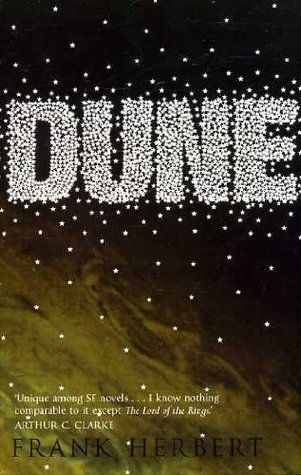
Book review: Dune by Frank Herbert

Dune (Dune Chronicles, #1)Dune by Frank Herbert

My rating: 4 of 5 stars

Tangential foreshadowing from the Collected Sayings of Maud’Dib by the Princess Irulan.

After his dad is asked to take over keeping the oil supply flowing out of the Middle East, Paul, a promising MMA fighter, witnesses the death of his family and friends, narrowly escaping into the desert with his pregnant mother. Befriending a small band of freedom fighters, Paul becomes their holy leader and prophesied deliverer. Meanwhile, the military-industrial-complex of the infidel are trying to apply their bootheel to the impoverished desert people. Can Paul use guerrilla tactics to overthrow the infidel, become Emporer and bring jihad to the west?*

Okay, so Dune does predate the general cluster-truck that is the Middle East conflict, but you do have to wonder if Herbert was munching on a bit of spice for inspiration when writing.

Unlike some other sci-fi classics, Dune does hold up as a novel in the modern day. There are some aspects that mark this as a book of the 60s (e.g. anything related to women) but it isn’t as jarring thanks to the complex worldbuilding. A lot has been poured into this novel that had me marveling at the efforts involved for one book. And yes, I know about the sequels and expanded universe novels, but this was clearly written as an open-ended standalone.

I have previously tried the expanded universe books that were co-written by Kevin J Anderson and Herbert’s son Brian. They did not grab me. The amazing worldbuilding that defined many of the concepts of space opera sci-fi** didn’t appear to have enough legs for those novels. I’m glad I picked up the original Dune to understand what the fuss was all about.

https://www.goodreads.com/review/show…

** https://www.goodreads.com/review/show…

https://www.newyorker.com/books/page-turner/dune-endures

https://www.theguardian.com/books/2015/jan/30/frank-herbert-dune-at-50-sci-fi-masterpiece

View all my reviews

Book Review: I Kill Giants by Joe Kelly

I Kill Giants

I Kill Giants by Joe Kelly

My rating: 5 of 5 stars

Welcome to Superheroes Annonymous. Barbara, would you like to tell us why you’re here?
854547-_sy540_

I really enjoyed this comic. Barabara isn’t a nice character, she is a loner, outsider, and she is battling personal problems, so she takes this out on everyone around her. Layered over this is the ambiguous threat of Giants who are coming to destroy everything she holds dear.

[Spoiler] I liked the ambiguity of whether the Giants are just a fantasy world and an analogue for the troubles Barbara is battling. We see her face those troubles and grow, and (hopefully) become a better person, if one still dealing with loss. [/spoiler]

This isn’t a story for everyone, but it will pull at the heartstrings if you give it a chance.

View all my reviews

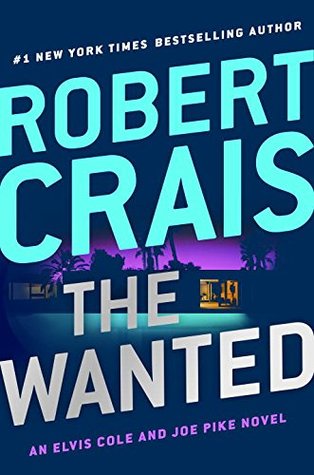
Book review: The Wanted by Robert Crais

The Wanted (Elvis Cole, #17; Joe Pike, #6)The Wanted by Robert Crais

My rating: 4 of 5 stars

There’s a question at the end of this book: “Is your name really Elvis?” The response should have been, “♪ Uh-hu-hu-huh. ♪”

Elvis Cole is called in to figure out how a worried mother’s son came by a luxury watch. Elvis and Joe Pike proceed to investigate a series of high-end burglaries, a spate of murders, and why two professional cleaners are looking for the teen boy. They even get to shoot people for a change.

I do enjoy picking up the occasional Robert Crais novel. They are entertaining and well paced, and offer up a slightly different take on the crime-thriller novel. Admittedly, I actually prefer Crais’ earlier books in the series as they had more humour, but his later novels are worth a read too.

What stops me recommending this novel more than the 4 stars I’ve given it is that, like any long-running series, there is a paint-by-numbers feel to the story. It is actually impressive that Crais hasn’t resorted to a more obvious formula yet, but that could be a reflection of my not reading every Cole and Pike novel.

The Wanted is another solid Cole and Pike novel, and highly enjoyable.

I received an Advanced Review Copy in exchange for an honest review.

View all my reviews