Mythtaken: Shark Attack Deaths

Ever since Spielberg made us scared of seeing any more Indiana Jones films, people have felt better about blaming him for the hysteria around sharks.

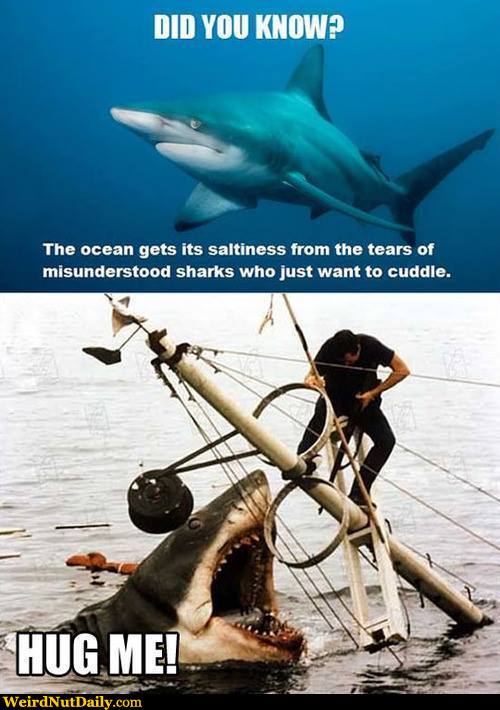
shark tears

Recently in my home state of Western Australia there has been a decision made to cull sharks because some people have been killed by them. Clearly we should blame sharks for just wanting a hug and not humans for dressing up like shark food. This is a stupid decision and I’m about to outline why we can’t even tell if there have been more shark deaths, let alone whether a cull would actually work, let alone whether you’d know if the cull does anything. It all comes down to statistics. Well, that and media beat-ups to sell advertising space.

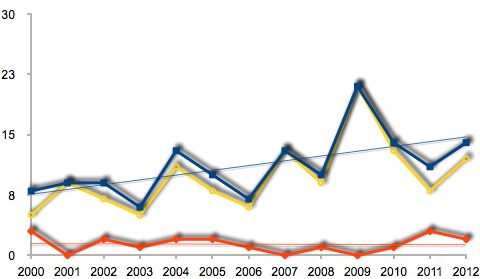
You’d honestly think that there had been a change in the number of people dying in Australia from shark attacks in order to justify a shark cull. Well, the official stats show there hasn’t been an increase in deaths from shark attacks. In fact the deaths are so low the noise around the long term average of 1.38 deaths per annum (2000-2012), that any increase or decrease in deaths are impossible to assign any significance to (see chart below). Three deaths in a year (2000): could be an anomaly. Zero deaths the year after (2001): likely to be regression to the mean. Number of deaths from the most ferocious animal on the planet: bees; 10 per year.

Graph of Aussie shark attacks 2000-2012. Blue is total encounters, yellow is non-fatal, red is fatal. Trend lines for total and fatal.

What you do see in the data is a slight increase in the number of attacks. If you look at the number of attacks and fatalities since 1900, there has been a general increase in the number of shark attacks, but a decrease in the fatalities from shark attacks. It’s almost as though there are more people in the world and more of them bobbing up and down in the ocean in seal costumes, possibly on a tasty cracker.

graph 2 shark attacks since 1900 by decade
International Shark Attack File data, Florida Museum of Natural History

Now this is interesting for the world and Australia, as it appears that despite our best efforts as humans, sharks aren’t taking revenge for the 100 million of them we kill each year. But this is about a shark cull in Western Australia: what’s happening there? Well, these tables say it all really:

Unprovoked Cases Since 1791:

State # Cases Fatal Injured Uninjured Last Fatality
NSW 243 68 (27.9%) 120 55 2013 Coffs Harbour
QLD 251 82 (32.7%) 151 18 2011 Fantome Island
WA 92 20 (21.7%) 57 15 2013 Gracetown
SA 48 18 (37.5%) 23 7 2011 Coffin Bay
VIC 45 9 (20%) 27 9 1987 Mornington Peninsula
TAS 15 3 (20%) 8 4 1993 Tenth Is, Georgetown
NT 10 2 (Duh) 6 2 1938 Bathurst Island
Total 704 202 (28.7%) 392 110 (Revised  28/1/2014)

Provoked Cases Since 1832:

# Cases Fatal Injured Uninjured
Total 190 15 129 46

Western Australia accounts for ~13% of shark attack deaths. When we look at 2012 data we see that WA is having a greater proportion of the Australian attacks and accounts for all the fatalities in Australia. The terms “bigger population”, “longer coastline”, “more cashed up bogans come to mind.

Australian Shark Encounter Statistics for 2012:

State Cases Recorded Fatal Injured Uninjured
NSW 5 0 3 2
QLD 1 0 1 0
SA 1 0 1 0
WA 5 2 2 1
VIC 1 0 1 0
TAS 1 0 1 0
NT 0 0 0 0
TOTAL – Unprovoked 14 2 9 3
TOTAL – Provoked 8 0 5 3
All Cases 22 2 14 6

So there is no actual proof that there are any more deaths occurring from shark attacks, definitely no trend toward more deaths, but a significant increase in the number of media reports on those deaths (citation needed). Even on a state by state basis there isn’t any death trend. But there is a trend towards more shark incidents. What we are actually seeing is an increase in the number of people dressing up like seals/shark food (scuba divers and surfers).

Circumstances affecting shark / human interactions:
The number of shark-human interactions occurring in a given year correlates with human population increases and the amount of time humans spend in the shark’s environment. As Australia’s population continues to increase and interest in aquatic recreation rises, it would realistically be expected that there will be an increase in the number of shark encounters.

Let’s put that in perspective, Australians have a 1 in 3,362 chance of drowning at the beach and a 1 in 292,525 chance of being killed by a shark in one’s entire lifetime. In Australia there are 1.38 deaths per year from sharks, 121 deaths per year from drowning at the beach, and 1,193 deaths per year from driving. We’re more likely to die from all the stupid shit we do, than from sharks. So why have a shark cull?

There is no real reason to have a shark cull. We already kill 100 million of the things annually anyway. What we actually need to do is look at where the sharks are looking for food, has their food moved, if so due to what, and are we seeing less shark food available such that sharks are looking for alternate foods. The shark cull with drum lines and nets is actually likely to kill off dolphins, turtles, rays, and endangered shark species, which is why fisheries researchers don’t support the cull.

Update: I neglected to mention that other states in Australia have been using baiting and nets, in the case of Queensland, since 1962, and since 1937 in New South Wales. Reports are not complimentary of the Queensland nor New South Wales programs. To quote:

…the Fisheries Scientific Committee is of the opinion that the current shark meshing program in New South Wales waters’ adversely affects two or more threatened species, populations or ecological communities and could cause species, populations or ecological communities that are not threatened to become threatened.

And (okay, I’ve cherry picked this a bit, read the whole report on how we are overfishing, killing shitloads of sharks, destroying the fisheries and adding baiting on top of this):

The main pressures on grey nurse sharks appear to be fishing activities and shark control programs……. The biological susceptibility of sharks to over fishing, evidence for increasing fishing pressure and lack of information have given rise to increasing concern about the sharks and rays of the Reef.

Essentially shark baiting, whilst paling in comparison to the 100 million sharks killed for their fins annually, is another pressure that endangered species don’t need. Especially when the baiting is still killing other endangered animals, not just sharks.

For more, read these articles:
https://medium.com/@gidmk/the-trouble-with-risk-7ea70e9afbe8#.hxtx6wimu
https://theconversation.com/wa-shark-frenzy-how-to-stop-a-runaway-train-22669
http://www.nature.com/news/australian-shark-cull-plan-draws-scientists-ire-1.14373
http://www.taasfa.com/No-Shark-Nets.html
https://theconversation.com/western-australias-shark-culls-lack-bite-and-science-21371
https://theconversation.com/cull-or-be-killed-is-this-really-the-solution-to-stop-shark-attacks-3961
https://tysonadams.com/2013/10/16/mythtaken-shark-attacks/
https://tysonadams.com/2011/10/24/shark-attack/

4 Reasons to Make Your Email Public

I read a blog post recently that suggested it is a good idea to make your email address publicly available on your webpage (and elsewhere). This is a great idea. The blog author listed 4 reasons, so I’ll list another 4.

Because everyone needs an extra couple of inches on their penis.
Even if you are a woman. Maybe especially if you are a woman.

How will SEO marketers contact you without your email?
Except via the comments and domain registry information.

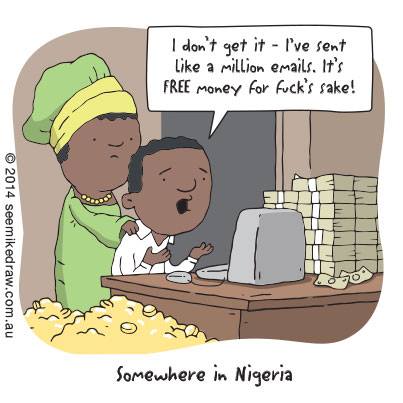
Nigerian Royalty could be trying to contact you.
I hear they need to give away money to people they don’t know.

From See Mike Draw. Become a fan NOW!

Because there is no such thing as social media and direct messaging.
I mean, who even has a Twitter, Facebook, LinkedIn, Tumblr, Google+, etc, account these days? And there are definitely no features that allow you to privately contact the person via those mediums.

Can’t we all just get along: DTB vs E-book

Print vs ebook infographic
The big take home from this infographic is that readers are more interested in reading, not on the format it comes in. I also found it interesting that people read slower on an e-reader (which I’d guess is because the screen is smaller and requires more ‘page turns’ which breaks reading flow) yet those using e-readers read an average of 9 more books per year (24 vs 15).

In summary: reading is good, go and enjoy a good book.

Will individuals respond differently to homeopathic remedies prepared with unboiled vs. boiled water?

I recently watched a debate between Ben Goldacre and Peter Fischer on homeopathy. During the course of the debate, an audience member asked, “If water has a memory, how come you’re not sick every time you drink water out of the tap?.

A homeopathic practitioner answered (paraphrased) that boiling the water resets the memory and that homeopathic remedies are only effective when using boiled water. He makes another comment implying that if a remedy were prepared with tap water, it wouldn’t be effective.

I realize the above related question (“Does water have a memory…?”) is nearly identical. I’m trying to ask it another way as it’s possible to persist with the water memory concept despite the other question’s answer. One could simply say (my hypothetical response),

“Well, we don’t know how it works and perhaps it isn’t by the known mechanism of how water behaves… but trials indicate that it works, nonetheless and that’s all I need.”

Since the audience member in the video indicated tangible predictions, I’m interested if they’ve ever been put to the test. Thus, my question is:

Has a trial ever been conducted in which homeopathic remedies prepared from both unboiled and boiled water were compared against one another in terms of patient response?

If there is another way to answer this question please go for it.

Answer:

It really doesn’t make any difference if the water is boiled or not, homeopathy doesn’t work.

The Minimum Dose and Avagadro’s Number The second and most controversial tenet in homeopathy is that remedies retain biological activity if they are diluted in a series (usually in a 1:10 or 1:100 diluent–volume ratio) and agitated or shaken between each dilution. Hahnemann began this process to reduce toxicity, but later he claimed that this “potenization” process extracted the “vital” or “spirit-like” nature of these substances (2). The limit of molecular dilution (Avagadro’s number) was not discovered until the later part of Hahnemann’s life; by then homeopaths all over the world were reporting that even very high potencies (dilutions lower than Avagadro’s number) produced clinical effects. The implausibility of such claims has led many to dismiss any evidence of homeopathy’s effectiveness as artifact or delusion (3). http://www.annals.org/content/138/5/393.full

But lets pretend for a moment that water does have memory. The aspect of boiling has not been researched. A search of Google Scholar nets no results for boiling and homeopathy. When referring to “how-to” guides of preparations it becomes obvious that homeopaths are merely after clean or unpolluted water to make their preparations in.

Ingredients … 1/2 or 1 litre of boiled water (distilled water may be bought at pharmacies in some countries, if you want that, and bottled, rinsed water is commonly sold in groceries too)

Another example:

Preparing your own bottle: Boil the glass bottle and dropper in filtered water for 15 min. and let it cool completely. Fill it just to the neck with filtered or distilled water.

So clearly the idea that boiling is the only way to reset the water is not backed up by the practices employed by homeopaths themselves. This combined with the fraudulent claim that water retains memory shows that this is another misdirection to allow justification.

Is GM corn toxic?

According to Vendomois et al, 2009:

these data highlight signs of hepatorenal toxicity, possibly due to the new pesticides specific to each GM corn.

Monsanto, fomous for its Round Up lawsuit, the manufacturer of two of the studied strains of GM corn, responded, dismissing the article, particularly by criticizing the statistical methods used. Is Monsanto’s criticism valid?

Have their been additional studies done that either support or refute the claim that genetically-modified corn has toxic effects?

Answer:

The simple answer is no.

GM corn has the BT gene that allows lower use of pesticides due to increased or the RR gene that allows the use of glyphosate for weed control. Neither of these alterations have any impacts upon the production of sugars or proteins in the plant. http://www.ca.uky.edu/entomology/entfacts/ef130.asp

The problem that can arise is from the pesticides that are now used on the crops and the timing of their application. These pesticides are known to harm mammals and if the dose is high enough can cause problems. http://www.ncbi.nlm.nih.gov/pmc/articles/PMC2793308/

Generally though, because you are removing pests and weeds the plants tend to be healthier so they are less impacted by pathogens, thus better for consumption. http://www.acsh.org/factsfears/newsID.962/news_detail.asp

There is an issue with using corn as a feed supplement in animals though. Corn is not a complete food source and is generally low in protein, especially tryptophan. This means that a feed mix is required, not just straight corn meal. http://www.ag.ndsu.edu/pubs/ansci/beef/as1238w.htm

Another issue is that corn can cause Pellagra. This is due to the niacin and B12 being bound in the corn starches and not being released in normal digestion. Tryptophan is also low in corn and can cause Pellagra.

So the problems often cited with GM corn are actually just problems with corn itself. Neither are harmful, if used correctly in a balanced diet, but pesticide residues are of concern. For more see this: http://onlinelibrary.wiley.com/doi/10.1046/j.0960-7412.2002.001607.x/full

Another point that should be made is that the paper cited is from a notorious “research” group who produce shoddy science in order to further their biased agenda against GM technology. The big problem with the paper is that it uses the wrong sort of analysis and the data has already been analysed by two other papers and found to say the opposite of what this paper says. Essentially, if you do a statistical test with a 95% confidence margin, you are saying that you have one chance in twenty of being wrong because of natural variability. So if you measure 20 variables with separate tests, you are likely to have one be a false positive result. Measure 40 with separate tests, 2 false positives. This is what the research group did, set up the stats to generate lots of false positives, instead of analysing the data correctly with tests that account for this problem. It should be noted that this is a common problem/tactic with anti-GM research papers.

Additional question: The ACSH source claims Studies Indicate GM Crops Are Safer and Healthier, but last time ACSH reported their funding, they were co-funded by what are now GMO companies. Currently they are not open about their funding at all. Therefore, their independence cannot be established. Can you back up the claim by research where all funding sources are open and independent? – gerrit

Reply: Of course there is plenty of independent data. gmopundit.blogspot.com/ has an entire series devoted to the safety studies of GM crops. The highly respected journal Nature had an entire edition devoted to the topic. But that is beside the point, the underlying mechanism of the Bt is not one that works on humans (it is even sprayed on organic farms). We don’t have an alkaline stomach to activate the chemical (ditto some insects it doesn’t impact either) which means it can’t do anything. So the concerns are completely misplaced.

Is EPA-approved insecticide (clothianidin) responsible for killing off bees?

recent article in NaturalNews claims that last year there were leaked documents exposing that the U.S. Environmental Protection Agency’s (EPA) illegitimately approved toxic pesticide clothianidin for use, while being aware it might kill bees.

Now, the article says, there’s a new study by Purdue University that confirms that clothianidin is actually killing off bees, and that it’s spread has become systematic in the entire food chain.

The entire report is available online via PubMed: Multiple Routes of Pesticide Exposure for Honey Bees Living Near Agricultural Fields

The article goes on to warn about the consequenses of all this:

Without bees, which are now dying off at an alarming rate due to exposure to clothianidin and various other insecticides and fungicides, one third or more of the food supply will be destroyed, including at least 100 varieties of fruits and vegetables that rely on bees for pollination.

The claim is that if people in US don’t do something to stop the bees from dying, at least one third of the food supply (in the US) will be destroyed. Because bees are dying. Which is the caused mainly by clothianidin. Which is in use because of EPA’s failure or corruption.

Is this information accurate? Or does the article misrepresent the situation somehow? Is the study legitimate?

Related: Are Bees Disappearing and Why

Answer:

Clothianidin is similar to imidacloprid, being of the same chemical group of insecticides and both being linked to bee population decline (Colony Collapse Disorder – CCD).

There is controversy over the role of neonicotinoids in relation to pesticide toxicity to bees and imidacloprid effects on bee population. Neonicotinoid use has been strictly limited in France since the 1990s, when neonicotinoids were implicated in a mass die-off of the bee population. It is believed by some to account for worker bees’ neglecting to provide food for eggs and larvae, and for a breakdown of the bees’ navigational abilities, possibly leading to what has become generally known as Colony Collapse Disorder.

Low concentrations of imidicloprid and clothianidin have impacts upon bees’ ability to forage and return to the hive.

The results show that almost all the control honey bees returned to the hive, and started again visiting the feeder between 2 to 5 hours after the release. Honey bees fed with the concentration of 100 ppb also returned to the hive, but they returned to visit the feeder only 24 hours after the release. Honey bees fed with 500 ppb and 1000 ppb completely disappeared after the release, and they were not seen during the following 24 hours, neither at the hive nor at the feeding site.

But neonicotinoid insecticides are only one of of many things impacting upon bees, and most research indicates that it is a combination of factors that is behind CCD.

The most recent report (USDA – 2010) states that “based on an initial analysis of collected bee samples (CCD- and non-CCD affected), reports have noted the high number of viruses and other pathogens, pesticides, and parasites present in CCD colonies, and lower levels in non-CCD colonies. This work suggests that a combination of environmental stressors may set off a cascade of events and contribute to a colony where weakened worker bees are more susceptible to pests and pathogens.”[20] Applying proteomics-based pathogen screening tools in 2010, researchers announced they had identified a co-infection of invertebrate iridescent virus type 6 (IIV-6) and the fungus Nosema ceranae in all CCD colonies sampled. (Quoted from Wiki, original USDA report linked above)

So this issue is much larger than any one chemical group and is about environmental management and pesticide usage in general. Most insecticides will kill bees, especially with direct contact. Bees are only one of several pollination vectors in the world, so while they are important, this scare campaign is misguided. What is actually needed is further understanding of CCD, bee breeding programs and management strategies that will actually deal with this issue.

Also, as a general rule of thumb, just about anything that appears on Natural News is likely to be wrong.

Update: A paper published in the middle of last year has some interesting results that could indicate a/the driver of CCD in horticulture. Essentially the article shows that bees don’t just forage on one farm, instead collecting pollen from the surrounding area as they see fit. As such, they come back with all sorts of pollens and all sorts of pesticides and fungicides. It is this combination of pesticides and fungicides in the bees’ found that appears to make the bees a bit sick, so they are more likely to get lost whilst foraging or get infected with mites and fungi. Note the lack of worry about clothianidin and other neonicotinoids, but rather the fungicides being the big problem. To quote:

Our results show that beekeepers need to consider not only pesticide regimens of the fields in which they are placing their bees, but also spray programs near those fields that may contribute to pesticide drift onto weeds. The bees in our study collected pollen from diverse sources, often failing to collect any pollen from the target crop (Fig. 1). All of the non-target pollen that we were able to identify to genus or species was from wildflowers (Table S1), suggesting the honey bees were collecting significant amounts of pollen from weeds surrounding our focal fields.

This indicates that beekeepers and horticultural farmers don’t appear to be respecting withholding periods for agricultural sprays the way they should. Partly because the bees are foraging where they don’t expect them to and partly because they haven’t correctly planned sprays and pollination. It will be interesting to see if these results are backed up by more causative work, although I’m not sure it will apply to broadacre farming (does that mean CCD is mainly a horticulture and small hectare farming issue?).

Update: reasonably balanced TED talk on CCD:

Update: a simple summary of where CCD research is at:

Global warming and mild winters

Does global warming make for milder winters? What about specifically North America?

(You often hear people extol global warming for giving us mild winters. Is there evidence of a causal link?)

Two examples claims of global warming causing mild winters in New York, and Tibet are linked in the comments. However, my question is whether this is a global phenomenon.

Answer:

This is a tricky question to answer because weather, what you experience at your house right now, is not really that same thing as climate, the patterns of global air and sea movements that bring weather.

So milder winters can be a possibility in certain locations, as they will be exposed to an overall warming of the entire atmosphere. But colder winters can be experienced.

Since the mid 1970s, global temperatures have been warming at around 0.2 degrees Celsius per decade. However, weather imposes its own dramatic ups and downs over the long term trend. We expect to see record cold temperatures even during global warming. Nevertheless over the last decade, daily record high temperatures occurred twice as often as record lows. This tendency towards hotter days is expected to increase as global warming continues into the 21st Century.

Vladimir Petoukhov, a climate scientist at the Potsdam Institute for Climate Impact Research, has recently completed a study on the effect of climate change on winter. According to Petoukhov,

These anomalies could triple the probability of cold winter extremes in Europe and northern Asia. Recent severe winters like last year’s or the one of 2005-06 do not conflict with the global warming picture, but rather supplement it.

Weather being a local response to climatic conditions means that you have to understand what has changed in the climatic patterns in your region. What are your local weather drivers? How have they changed since the 1970s?

Thus, you could end up with some areas experiencing colder winters; due to greater moisture levels in the air, more precipitation of snow, greater heat loss at night due to clear skies, etc. Or you could have an area that will experience milder temps in winter due to warmer air currents, warmer oceans, localised heat island impacts, etc.

For further information you should investigate the weather and climate agencies publications for your area.

Love it or Hate it

To read genre or not to read genre: that really isn’t the question.

With surprising regularity there are articles written explaining why people should be reading certain types of books. It isn’t just books, of course, but I’m trying not to be distracted…. puppy! The thing that these articles have in common is snobbery.

From a young age we are given lessons in snobbery, certain things are cool to read, certain things have value or social importance. These are the things we should be reading. By definition this means everything else isn’t of value and often becomes termed our guilty pleasures. I agree with the sentiments of this article that mentions guilty pleasures as being one of the phrases that makes people hate you.

The idea that something is a guilty pleasure implies that we should feel bad because we enjoy something. Well that’s just stupid. Either we enjoyed reading the book or we didn’t. Do we really have to impress others with our cool choices in reading material? I’d argue that you can enjoy whatever you like and we need to stop with the snobbery and pretence that some books are more highbrow or worthy of reading. I’d also argue that we aren’t in high school anymore and you don’t have to be cool. And reading is cool…. no, you can’t have my lunch money.

Now I don’t want to get into the argument about reasons why people read. Some people read for pleasure, some for entertainment (I’m defining those two categories slightly differently), some to explore social issues, some to learn about a topic, some to experience emotional stories, and on the list goes. For example, I don’t read scientific papers to be entertained, I read them to learn things, but the novels I read are meant to entertain me. So some people will be snobby about what they read because of why they read. I’m more interested in addressing the other type of snobbery about reading things of worth, value and not the guilty pleasures.

A lot of this snobbery comes from English Literature academics, authors, devotees and columnists. They are regularly telling us that we shouldn’t be wasting our time reading genre fiction, we should be reading the important books. You know, the ones so important that the author didn’t bother to make them entertaining. They would have us believe that reading is too important to be just entertaining, that we can’t read a science fiction, fantasy, thriller, romance or similar genre book because that would mean we haven’t read the worthy books.

Is Terry Pratchett worthy? How about Heinlein? They put more social commentary and sophisticated language into their novels than most of the literature I’ve ever read (yes, I was a literary snob at one point). And here is the problem with the snobbery argument: they are closed minded to the idea of genre books having value and thus miss out on entertaining books that also happen to do a better job of being literature.

This is also why we see 38% of people responding to reading surveys saying that they finish a book, not because they are enjoying it, but because they feel they should finish books they start. This is that snobbery having an extended impact upon our reading habits. We’ve been trained/taught to finish books that aren’t entertaining or enjoyable because of the message or value of the book, which we will only truly appreciate by wading through the boring stuff between the book covers. It will make you think, we are promised. Sure. I always think, What a waste of time, I could have read several other books instead of drudging through this crud.

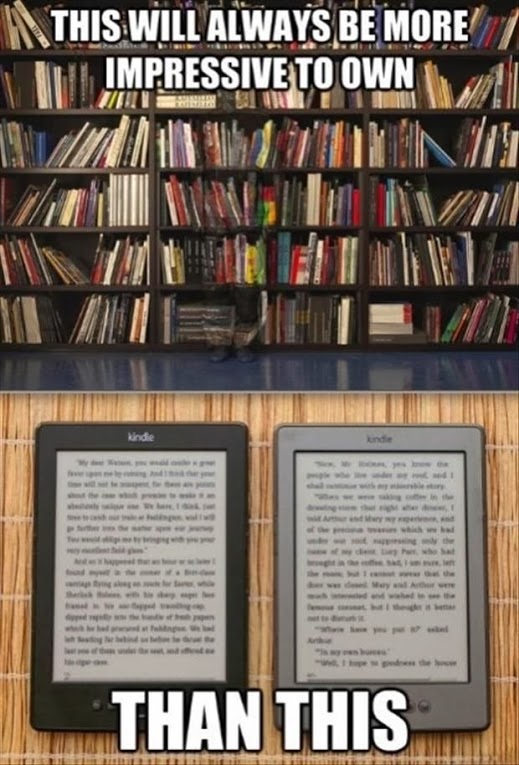
I know that snobbery is very important, because those literary people would be out of a job otherwise, but can people just keep it to themselves, please? It would be nice to see more than 40% of the population being avid readers (a book a month or more). It would be nice if we bought and read books based upon what interests us and not what would look most impressive to be seen reading or have on our bookshelves. Changing this mindset would stop memes like this one:

Stupid meme is stupid.
Stupid meme is stupid – can we just agree that a book is a book, DTB, ebook, clay tablet, whatever?

It’s great that people want to impress others with what they are reading. Currently my toddler has a really impressive array of books scattered all over the house. They make for fantastic things to trip over, stub your toe on, or make us look particularly well read on the adventures of small, overly cute animals. I’m sure all the other toddlers are impressed. I still can’t wait for him to stop impressing everyone and just have them all on an e-reader. We should be reading to enjoy reading, not to decorate our house, impress others, be worthy: no guilty pleasures, just pleasures.

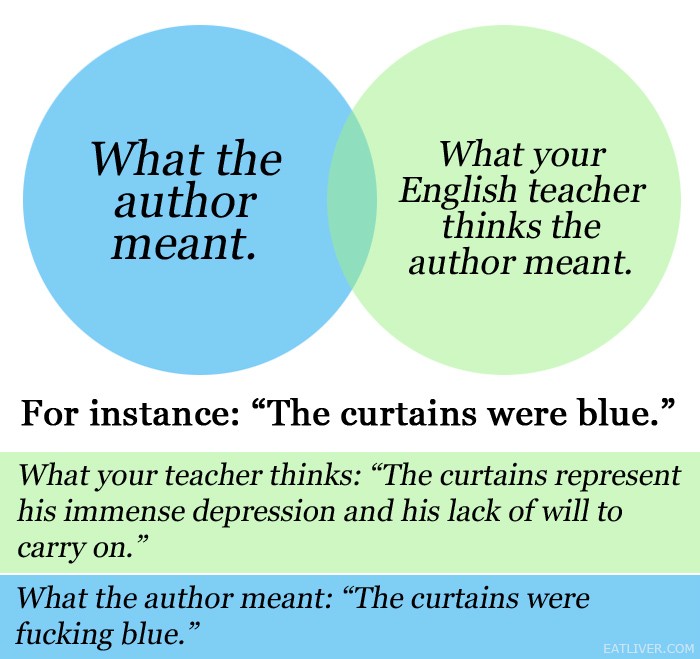
What the author meant

1382160486956

I’ll admit it: I did English Literature in high school. I wasn’t particularly good at it. I’ll exclude all my other excuses as to why I didn’t do well in Lit – like my general lack of motivation in school and desperate need to complete the final level of DOOM – and blame my poor grades on the above graphic.

Obviously not the graphic itself, that would be silly. I mean the message that the graphic is trying to relay, and not just that the curtains may be blue. In school and even now, I find that literature is often over-interpreted. I remember clearly one example of this when we were forced to study Shakespeare’s Macbeth. Studying a play by reading it already had me wanting to throw stuff at the teacher, as plays are meant to be watched, not read. But I remember the teacher being adamant that there was a very important juxtaposition and allegory in the comedic scene of the drunken porter.

If you can’t remember this scene in Macbeth, suffice to say it is one big joke about how being drunk makes you pee and ruins erections. Dick jokes never go out of fashion.

Apparently, there is a lot of deep and meaningful stuff going on….. Dick jokes can be deep and meaningful. I always thought that Macbeth chucked in that joke scene because the rest of the play was so dark, and it gave his actors a chance to change costumes before the next act. Essentially, I thought that it was just a necessity and the master playwright had made it fun for the audience. My teacher disagreed.

But that is the thing, unless Shakespeare wrote down his intentions, or there are some amazing insights recorded from his time, then it is just conjecture, or playing with themselves. Occam’s Razor would have us take the simplest answer that fits and not try to over-complicate things.

That isn’t to say that there isn’t deeper meaning in any artistic work, far from it. But a lot of the deeper meaning is about the reader’s projection as much as what is/was written. Take as an example the list that the wonderful Mental Floss put together:
http://mentalfloss.com/article/30937/famous-novelists-symbolism-their-work-and-whether-it-was-intentional
Many famous authors, many misinterpretations.

Now some authors and genres love to go overboard with the hidden meanings, or at least like to make it seem deep and meaningful (see Steve Hely’s satire on this). Some authors just do it accidentally as part of including various themes and ideas in their work. But literary analysis really does take that interpretation to another level.

Essentially, why can’t people just enjoy a book?

Tyson Adams’ 2013 Book Awards: The Awesomes

This is the third year of The Awesomes™, the award I give to books that had me staying up late to finish them, the books that had me rapt until the end, and sometimes past the end. I’ve read a few books this year (+70) so here are my favourites of 2013 and this year’s Awesome™.

As you will have noticed, my reviews of books are more about my impressions of the book and talking about how much I liked the book, rather than a recap of the plot, etc. My reasoning behind this is simple, I want to say “read this book” to people rather than fall into my bad habit of spoiling the ending, or being a bitch about books I didn’t enjoy. My list is based upon what I have read this year, so obviously some great books have missed out due to lack of reading hours in the year (blame the rugrat). Also my read list does include some books that were published prior to 2013. There were also some categories that were sadly under-represented, whilst others had some very intense competition. Also, the fact that I finished a book shows that it was worth reading. I have my reading rules that stop me wasting valuable reading time on books I’m not enjoying. This means that any books on my read list are entertaining (well, unless I was particularly disgusted with the crappiness of the book in question).

Awesome™ of 2013
Luther: The Calling – Neil Cross
Killer Instinct – Zoe Sharp
Gone Girl – Gillian Flynn
Never Go Back – Lee Child
Without Fail – Lee Child
Altar of Eden – James Rollins
The Secret of Excalibur – Andy McDermott

Zero at the Bone – David Whish-Wilson

Awesome Literary Fiction
There were no nominees in this category this year. Better luck next year.

Awesome Mystery & Thriller
Killer Instinct – Zoe Sharp
Without Fail – Lee Child
Altar of Eden – James Rollins
The Secret of Excalibur – Andy McDermott

Never Go Back – Lee Child

Awesome Crime
Luther: The Calling – Neil Cross
Gone Girl – Gillian Flynn

Zero at the Bone – David Whish-Wilson

Awesome Fantasy
There were no nominees in this category this year. Better luck next year.

Awesome Paranormal Fantasy
There were no nominees in this category this year. Better luck next year.

Awesome Science Fiction
There were no nominees in this category this year. Better luck next year.

Awesome Horror

The Strain trilogy – Guillmero Del Toro and Chuck Hogan

NB: cheating here as it was only 4 stars, but deserves the nod as the TV series is now in development and looks like they might have a winner.

Awesome Romance
There were no nominees in this category this year. Better luck next year.

Awesome Humor
There were no nominees in this category this year. Better luck next year.

Awesome Nonfiction

Bad Science – Ben Goldacre

Awesome Graphic Novels & Comics
Midnighter – Garth Ennis
Batman: The Black Mirror – Scott Snyder

Luthur Strode – Justin Jordan

Awesome Indie
No 5 star indies this year, although several 4 star and a few non-mentionables.

Awesome Poetry
There were no nominees in this category this year. Better luck next year.

Awesome Shorts/E-zines
I’m putting this category in just so that I can pimp:

Thrills, Kills and Chaos

Still Awesomes
I re-read – well in some cases I listened to the audiobook – several books this year. They deserve a mention for still being awesome. Sometimes books are better on their second outing, sometimes they are worse, sometimes you wonder why you didn’t throw the book out the first time (I’m looking at you Holden Caulfield).

Dirk Gentley’s Holistic Detective Agency – Douglas Adams (better than I remember)
Long Dark Tea-time of the Soul – Douglas Adams (similar to how I remember)
Life, the Universe, and Everything – Douglas Adams (similar)
Fight Club – Chuck Palahniuk (slightly better)
Game Keeper – Guy Ritchie and Andy Diggle (better)

Congratulations to all the nominees and winners. I hope that I have a chance to read more fantastic books from these authors again in 2014 and that everyone else does too.

Merry Whatever and Happy Celestial Orbit 2014

In honor of the Xmas season

There are so many religious, non-religious, familial and festive events on this month, leading into the switch over to the new calendar year of 2014. So I hope that whatever end of year, harvest festival, solstice or denominational event you are celebrating, that it is a joyous one.

I’ve had a great year, published a few short stories, I have a novel in submission, my son has gone from sleep, eat and cry to eat, play, sleep and cry, and you have all shared that with me here. I hope you have had a good year as well, or at least one that will make you look forward to 2014 as much as I am.

So, join me again next year, slightly older, slightly wiser, slightly hungover and ready for some fun.

Cheers, Tyson.

Mini-me Jack Reacher sequel announced

According to a reliable source – well, a book blog for a bookstore I like – there is a sequel in the works for Jack Reacher.

That’s right, Tom Cruise will be reprising his role as Jack Reacher. It is unclear whether he’ll wear stilts in this adaptation of Never Go Back, the most recent Reacher adventure. For a reminder of the first Reacher film:


It seems odd to me for Cruise et al. to leap so far forward in the series, the previous movie being based upon the Lee Child novel One Shot. I’d have said there are some fantastic novels in between that would make fantastic movies, even with a half-sized Reacher.

The first movie was kinda average. The story was faithfully adapted, with the changes making sense, Cruise brought his star power, but I don’t have any kind words for his co-stars, who were generally flat and lifeless. So the “sequel” really needs to be better cast….. Maybe fill the cast with good child actors to get the star’s proportions right.

Either way, I’ll watch it.

The book business: 2012 vs 2008

There are some interesting claims being levelled in the publishing industry about the death of books (rubbish), that publishers are going broke (only if they messed up) and that the industry is in turmoil (only when scaremongers keep saying it is). Well, the infographic below highlights some statistics on the US book industry – I think I’m going to stop calling it the publishing industry, maybe reading industry is more appropriate. The final figure is the one that everyone should quote the next time a smaller or non-existent advance is offered to authors, or royalty rates are lowered, or high book prices are justified.

This slideshow requires JavaScript.

Source: http://www.newrepublic.com/article/114998/book-business-doing-fine

A Ten-Month-Old’s Letter To Santa

This is comedy gold that every parent will be able to relate to.

Dear Santa,

 I am a ten-month-old baby and I write because my mother has been sending out my “Christmas List” to people, and her list does not in any way represent the things I really want.  I could give two s#*ts about receiving stacking cups.

And I know you’re ready to make the joke about ten month-old babies and how all we want is the wrapping paper and the boxes.  Touché,Santa.  Touché.   We do, of course, want those things.  But I have a number of additional things I want very badly.

My list is enclosed below.  Have a lovely holiday.

-Ten Month-Old Baby

See the list here: A Ten-Month-Old’s Letter To Santa.

More anti-Amazon nonsense

This morning I was browsing my various news feeds when I noticed someone had written an article about the arrival of the Amazon Kindle store in Australia. Clearly this article was going to feed my confirmation bias on how awesome it was to have an Aussie version of Amazon available, just like Canada, the UK, India, Germany, Spain, etc. No longer being locked out of some editions of books because of our region, an Aussie store is one step closer to Aussie writers not having all the publishing issues that currently exist, a .au suffix making us feel special: all good! Right?

Well, not according to the article Amazon’s Australian Kindle store: an unhappy ending for the book industry? by Ben Eltham. Rather than stream bile right here, I’ll dissect Ben’s opinion piece about the demise of the protected Aussie book market, and hopefully inject some much needed reality.

Amazon has been prising open the wallets of Australian consumers for years – but what will its local push on Kindle mean for readers, writers and publishers?

It is always good to start an article by using emotive language and by poisoning the well. The use of a logical fallacy so early in the article does not bode well for Ben’s opinion piece.

The local book industry is threatened by Kindle’s entry into the Australian market. When Amazon opened its Australian Kindle store last month, it was to feisty reaction from independent bookshops. Charismatic Sydney bookseller Jon Page of Pages & Pages Booksellers even relaunched his “Kindle amnesty” – a scheme that allows conscientious local readers to swap their Kindle for the Australian book sector’s preferred e-reader, the Kobo, and receive a $50 book voucher for their trouble.

This opening reference to a stand by one independent bookshop being representative of all bookshops is another example of polarizing the argument before raising any actual evidence, essentially further poisoning the well. You see we are set up to believe that the Kobo e-reader is somehow better for Australian bookshops, despite Kobo also being in direct competition with stores in the same way the Kindle is, as well as to love the “feisty” response to the big bully Amazon arriving.

“We’re calling it Kindle Amnesty 2.0,” jokes Page, who is spruiking for the Kobo Aura HD, which he argues is “equal to or better than the Kindle Paperwhite”. Those who read via tablets such as the iPad or Galaxy have access to Kobo reader apps. “We want to take the fight to Amazon because they are so dominant in this market, particularly with the Kindle device,” argues Page. Pointing to the Commonwealth’s 2011 Book Industry Strategy Group report, he claims that Kindle represents about 70% of dedicated e-reading devices. (This figure does not include tablets, phones or laptops). “That’s a problem, because the Kindle locks competition out and locks customers in.”

My idea of a joke is a thing that someone says to cause amusement or laughter, especially a story with a funny punchline. “We’re calling it Kindle Amnesty 2.0” doesn’t really make the grade as a joke, but this is all about, again, poisoning the well and polarizing the reader to the author’s opinion without needing to state facts or evidence.

The next point about the Kobo being as good or better than the Kindle is neither here nor there, it just doesn’t matter. I agree that the Kobo is a great e-reader, but most e-readers are pretty good, you are really choosing an e-reader based upon the stores and catalogue they offer access to. I’ve written before about hearing Kobo Australia’s chief seeming to have a very good idea of what is needed in the market place for readers and authors. But ultimately the raising of Kobo vs. Kindle in a discussion about Aussie bookstores is like raising a conversation about which is the tastier bacon at a vegetarian food store.

Finally we do get some actual data, showing that the Kindle is the biggest e-reading device. Well, d’uh. Amazon have the biggest store and have expanded into the most markets, have invested in technology early, have created new markets themselves, and have….. Okay, let’s not get ahead of ourselves here. The point is that the argument raised is that Amazon and the Kindle have a monopoly. Which is true. What is false about this assertion is the idea that the monopoly isn’t one that can be supplanted by the next generation of technology, or better business models arriving, or the competition preying on Amazon’s weaknesses.

You see, the key weakness for Kindle is also it’s strength. If you lock readers into one store you allow the competition to usurp the market by doing the deals with many stores and libraries (hang on, that’s what Kobo is doing in Australia and Canada!). You also have to remember that the Kindle or any other e-reader is only really for avid readers. Tablets and phones are for the more casual readers, thus they aren’t locked into one device or one store. So we are only another generation of technology away from e-readers losing their advantage over tablets and phones, and the entire Kindle argument becomes moot.

Industry sentiment is divided over the impact of the entry of the tech giant into Australian online retailing. Some have been forecasting impending doom. Others are merely apprehensive about Jeff Bezos’ juggernaut. Amazon’s thin margins terrify competitors. Despite vast revenues, the parent company makes no profit. Amazon raked in US$17bn in net sales last quarter, for an operating loss of US$25m. Analysts and brokers are starting to wonder whether, eventually, Amazon’s gravity-defying stock price will tumble to earth.

This part is a doozy. Ben has framed a false dichotomy in how the industry perceives Amazon. Where is the mention of the people who love their Kindle and the Amazon store? Where is the mention of the people who like their Kindle and Amazon but want to be able to use other formats and borrow e-books from their local library? This is a common false dilemma fallacy used in arguments.

Next the argument goes to Amazon’s business model, providing some facts but leaving out others. Why? Why not mention what the “thin margins” are that terrify competitors? I’d sure like to know. The next point is about how Amazon makes heaps of money, yet doesn’t profit….. Remember above how I mentioned that Amazon had stayed ahead of the competition by expanding and investing? Well that’s where all that revenue is going, straight back into making their business better.

What I’ve always wondered was why an online bookstore was the first one to grab hold of the e-reader concept. E-books are not new, nor are e-readers. They have been waiting in the wings for a decade or more, waiting for a company to invest and make things happen. Why wasn’t this investor a publishing house? Why not a major bookstore chain? Surely they are meant to be knowledgable about their industry and future trends, so why weren’t they the ones creating the new digital marketplace instead of Amazon? The answer is obvious. Amazon had the balls to do it and had an eye on the future, instead of a protectionist view of old and antiquated business and media models. To the victor go the spoils.

But other industry observers have argued that an Australian Amazon presence will be good for consumers and readers. As Kobo’s Malcolm Neil told Melbourne’s Independent Publishing Conference recently: “Amazon is good because the customer likes them … We’re not going to win the argument by telling people they’re wrong.”

Didn’t I say above about Kobo’s boss being a bright guy that knew what the industry wanted? If you’ve heard Malcolm talk about the publishing industry before you know that he has a lot of good points that have been left out, can’t think why. Malcolm’s points are the first example in this article of a different viewpoint being offered. But we’ve already been setup to either disagree with it or ignore it.

Martin Shaw, books division manager at independent retailer Readings, argues that Amazon’s Australia venture may not be such big a deal. “It is only ebooks,” he says. “That market has got so many players in it now, who knows what sort of impact it will have? We will just have to see how the dust settles.” Shaw foresees a coming war of devices in which competitors try to lock customers into competing ecosystems. “I think there will be a lot of devices flooding the market trying to get people to enter the walled garden,” he says. “That will force other e-tailers like Kobo to become more aggressive.”

This speaks to my points above about Amazon and Kindle only being one technology change away from losing market share. I used the example of tablets and phones, but there are other examples in the online stores themselves. Both Kobo and Amazon have exclusive author deals happening. We’ll probably see more of this, which starts to sound like publishing houses and their favoured deals with stores.

Of course the irony is that, in our globalised world, Amazon is not really “starting up” in Australia at all. The retail behemoth has long been prising open the wallets of Australian consumers, who have been buying books and all manner of other things from Amazon in the US for years – estimates of how much that market is worth vary enormously. The move by Amazon to begin an “.au” store that trades in Australian dollars and sells Australian ebooks through Kindle merely makes that custom one step easier. “All that’s changed now is that it’s an Australian-facing site,” Page argues.

I think the irony with this paragraph is the use of the term irony when there appears to be none. But it does give the article a chance to move away from the viewpoints the author disagrees with and move back to more Amazon hate.

There are upsides for consumers. The Gordian knot of digital copyrights, based around various national boundaries, has meant that some US and Australian titles were not available as ebooks in Australia. The new Amazon.com.au store can now stock a much wider range of titles that have Australian-only digital licences.

Lower prices for consumers: Yay!

And prices will be forced lower. Shaw says that we may see “a race to the bottom”. Amazon’s deep pockets, he says, means “they can go there [to low prices] and stay there for as long as they want”. Australian book prices are still much higher than comparable titles internationally. In Amazon’s view, that margin can be returned to consumers in the form of lower prices.

Okay, Yay and Bullshit. Currently Australian e-book prices are ridiculously high. You cannot justify the high cost of an e-book when there are no distribution or printing costs. I have been meaning to post some figures taken from a few publishing houses and their presentation to the shareholder meetings, figures that show just how profitable e-books are for them thanks to the lower costs associated. There is actual irony here, because those same publishing houses are using e-books lower price to justify lower advances and smaller royalty percentages to authors. So Amazon making prices more competitive is a good thing, for readers and authors.

A quick look around the various sites for Australian ebooks revealed some savings. An ebook of Ross Garnaut’s Dog Days worth $9.99 on Kobo, was $9.49 on Amazon. Eleanor Catton’s Booker-winner The Luminaries was $10.68 on Kobo; on Amazon it was $9.35. (As a comparison, a paperback of Dog Days costs $15.29 from Bookworld, while The Luminaries costs $22.49). For other titles, owing to so-called “agency pricing”, Kobo and Amazon’s prices have converged: Christos Tsiolkas’ Barracuda was the same price on both.

Notice that this is the only time “agency pricing” is mentioned. It will not be discussed again. Despite the importance it plays in this entire argument about e-books, pricing, readers, authors, the industry and who is screwing whom.

The other potential winners of Amazon’s entry are successful authors and self-publishers. Amazon’s benefits to authors are controversial, but for the top tier they are real. The Australian publishing industry has been rather wary of embracing the digital world and while it’s hard to pinpoint precise figures, there’s a perception that many local authors have lagged well behind their US counterparts in ebook market penetration. Australian self-publishers will now get a 70% royalty for books sold to Amazon.com.au accounts. International experience has shown that a lucky few will reach big new audiences with bestselling self-published titles. Although on the other hand, mid-rank and lower authors may find themselves little better off.

Well, d’uh. Any new bookstore or way to buy books will favour already successful authors (NB: self-publishers are authors too), because, wait for it, people buy books by successful authors. What is not mentioned is that Amazon algorithms are more likely to expose readers/buyers to authors they haven’t heard of because of purchases they have made or books they have liked. I don’t know if Kobo have a similar system, but I do know that most bookstores do not have anything remotely similar to the promotional power of Amazon for new, emerging or midlist authors.

The statement about Australian self-publishers will “now” get 70% royalties is deliberately misleading. They already get a 70% royalty, that has been the policy from day one at Amazon, it is what all the other self-publishing platforms have come to adopt as well (correct me if I’m wrong on this, I haven’t checked them all).

Meanwhile, agents, publishers and booksellers still face real challenges from digital, Amazon or not. Digital is reshaping the industry and still threatens to cut middlemen out of the chain. Online-only retailers like Bookworld may be the most vulnerable, lacking the size and scale to adequately compete. When Amazon bought Book Depository, the UK retailer popular with Australian consumers, there was consternation in the book industry, despite the Australian Competition and Consumer Commission deciding not to oppose the move.

Yeah, who’d have thought an antiquated business model would be under threat by changes in the industry? And didn’t the article make the point that Amazon has already been in Australia to a large extent for years? So doesn’t this kinda negate any points made here?

As books blogger Patrick O’Duffy wrote recently in a long analysis of Amazon’s entry into the Australian market: “By starting this process of moving into Australia, Amazon is going to permanently affect the local writing, reading, publishing and bookselling world.” That much at least seems certain.

Um, no. This final statement and paragraph are about 10 years out of date. E-books and the ability of authors to manage their own careers without ‘gatekeepers’ is what has changed the industry. This has happened for quite a while now. To say that Amazon opening an Aussie store suddenly changes things completely negates the history and many of the points raised in this article.

Now that I’ve addressed the article by Ben Eltham, paragraph by paragraph, I think it is clear that this article is nonsense. It is just another in the long line of e-book, e-publishing, self-publishing, fear-mongering articles that have come to represent “informed” comment on the publishing industry over the last 5 to 10 years. I for one am sick of these articles, in fact I hate them. It isn’t just the continued “fear of change” mantra they all adhere to. The main reason I hate these sorts of articles is that they are trying to pretend that the publishing industry is hurt by changes that benefit readers and writers. Nothing could be further from the truth. Readers and writers are the publishing industry, everyone else is there at their behest. If those middlemen want to stay in the game then they have to offer something to the readers and writers that is beneficial to both. And the success of Amazon (Kobo, etc) and the various publishing houses (agents, editors, designers, etc) that have adopted/adapted to the new paradigms, only illustrates how out of touch these articles are with the industry. Instead of discussing the real issues, like the squeeze on authors, we get another stream of uninformed bile.

My Top 10 Reading Peeves

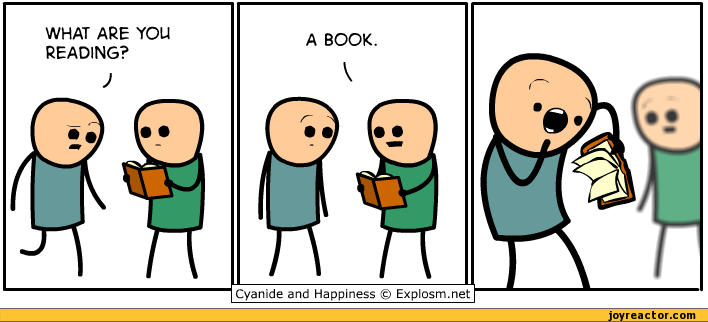
comics-Cyanide-and-Happiness-books-626554

1) Canned laughs
Either a joke is funny or it isn’t. Having the author or characters pointing out that someone has just told a joke – he laughed in response to the hilarious joke – is like beating the reader over the head with the complete Get Smart box set. (insert laughs here) Laugh tracks ruin everything.

2) Street directions
I have a map book and Google Maps works pretty well, I don’t need them included in my novel.

3) Prologues
If it doesn’t fit in chapter one it shouldn’t be there. If chapter one isn’t exciting enough then the book has failed to start at the correct spot.

4) Epilogues
I will forgive this if it adds to the story, just as long as it is not just a chapter tying up loose ends. I really don’t care about the hero receiving medals from someone very important. The final chapter should be the end of the story, not a post script of lazy story telling.

5) Purple prose
There are few authors that can get away with flowery language and overly descriptive phrases. I wish authors would stop pretending that they are one of those few authors.

6) That wise old guy character
Why don’t authors just start naming this wise old guy Obi-Wan and be done with it. Sure, there is bound to be a need for a teacher, mentor, or knowledgable character in some stories. But so often the character may as well have been a cardboard cutout, just like Obi-Wan in Star Wars episodes I, II and III.

7) Getting the details wrong
Since when does a Glock have an external safety?* Cordite smell? Racking the slide? Why am I only listing gun mistakes?

8) Including the details
This is similar to the street directions of #2. The excruciating detail that the author has researched is great….. for the author. The reader just wants a story. Accuracy is nice, but overkill is tedious.

9) Using overly common or overly obscure names for characters
Overly common names just blend into the background for me. Overly obscure names might as well be written as @#$%.

10) Having an author name that is very similar to a big name author
I’m looking at you Dale Brown. It really feels like the author has let the marketing department try to rip readers off with the mistaken identity.

See also:
http://kjcharleswriter.wordpress.com/tag/things-i-hate-about-books/
http://101books.net/2013/01/11/9-things-to-do-with-thick-novels-you-hate/

* I actually understand why this one occurs. Often at some stage in editing the types of gun are changed around and ‘Glock’ has become synonymous with ‘gun’. Thus it is quite common for someone to decide that the type of gun originally referenced needs to be changed to a Glock/gun and the details around this aren’t changed to suit.