Pen vs Keyboard: FIGHT!!

header-1

For some reason the world of writers is filled with technophobic troglodytes intent on proving that their old-fashioned way of doing things is better. I’ve written previously about how older people’s favourite hobby since the dawn of time has been complaining about kids these days. This is also true of changes in technology, with people intent on justifying not learning to use a computer or e-reader. Because cutting down trees is the future of communication!

Once again I’ve stumbled across another article that misrepresents scientific studies to try and convince people that we need to clear forests, pulp them, flatten them into paper, cover them in ink, and act as snooty as possible. This time they – the nebulous they: my nemesis!! – are trying to pretend that taking notes with a pen is better than using a keyboard.

Ugh.

When will people learn that paper isn’t the medium we should be promoting? We need to be going back to scratching on rocks and cave walls. When was the last time a paper book lasted more than a hundred years out in the rain, snow, and blazing sun? That doesn’t even begin to compete with the longevity of the 50,000 year old cave paintings. Data retention for rock far surpasses the much inferior paper.

This isn’t the first article I’ve seen on The Literacy Site misrepresenting science. Hopefully they will acquire come scientific literacy soon and overcome their biases. If I turn blue and pass-out, try to act concerned. Let’s dive in.

New Research Explains How The Pen Is Mightier Than The Keyboard

It’s great when articles improve on the titles of science papers. I mean, who wants to read the science paper The Pen Is Mightier Than the Keyboard: Advantages of Longhand Over Laptop Note Taking? Pity that both titles misrepresent the actual findings. Also, is 2014 still regarded as new?

In her graduate assistant days, psychological scientist Pam Mueller of Princeton University used to take notes just like everyone else in the modern age: with a computer. One day, Mueller forgot her laptop and had to take notes the old-fashioned way. Rather than being held back by pen and paper, Mueller left class feeling as if she’d retained far more information than usual on that day. She decided to create a case study that could prove her hunch that writing longhand was actually better for comprehension than typing.

This is actually a good little story and illustrates how a lot of hypotheses are formed in science. This is the anecdote or observation that scientists want to turn into a hypothesis to create actual knowledge. But remember, this is an anecdote, which has as much value as used Easter egg wrappers that have been stuffed between the couch cushions. Putting anecdotal stories at the start of an article can set the audience up to not think too hard about the rest of the article, as you have given them the conclusion in a nice little story.

The study she created, published in Psychological Science, indicated that taking notes by hand is a more effective method than typing them on a laptop when it comes to processing information conceptually.

And here we jump straight off the rails, over the side of the bridge, and careen into the waiting river below. Sure, The Literacy Site is just quoting the press release, but that is lazy. The study itself has this line in the abstract that show how this claim is a misrepresentation of the findings:

We show that whereas taking more notes can be beneficial, laptop note takers’ tendency to transcribe lectures verbatim rather than processing information and reframing it in their own words is detrimental to learning.

In other words, the findings were that people spend all their time typing and no time actually listening and comprehending the lectures. Because the pen is an archaic device that is unwieldy and slow compared to the keyboard, students using a pen only write down notes after they have listened, picked out the key points, and conceptualised that information into a note. But don’t take my word for it, the press release on the University of Michigan website has a few recommendations including:

  • To interrupt verbatim note-taking on laptops, break up your lectures with short activities that encourage deeper processing of information.
  • Have students use laptops or other technologies to process–not just record–information.

Now it is time to discuss the study details a little bit, because someone might be interested in the methods section. I’m sure those people exist. Somewhere. Interested is probably the wrong word.

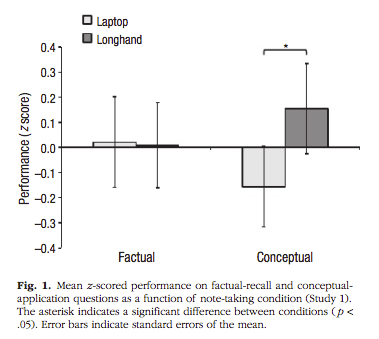
In the first of a series of studies led by Mueller, 65 college students watched various TED Talks in small groups, and were provided with either pens and paper or laptops for taking notes. When the students were tested afterward, the results were overwhelming. While the groups performed equally on questions that involved recalling facts, those who had taken longhand notes did significantly better when it came to answering conceptual questions.

Sorry, I need to catch my breath. I’m so shocked at the massive sample size. This is definitely enough people to represent the rest of society. Conclude away I say!

Anyway, these overwhelming results are just a tad whelming.
Whelming error bars.

As you can see the performance on retaining facts was the same, with error bars that suggest 65 people is probably not enough to draw conclusions from. Not that anyone would be trying to claim this study is proof of anything, right? The next thing you see is the benefits of using a pen…. as long as you ignore those error bars and just accept the p-value tells us something of value. Given that those error bars overlap for the two groups, I wouldn’t be drawing conclusions from a p-value. Also, I’m not exactly sure why an ANOVA was used when there were only two groups to compare. KISS principle applies to statistics as well.

Now the study realised that 65 people wasn’t enough, so they repeated the study with a few variations twice more. In the second and third tests they had 151 and 109 people take notes. Each test had the typists writing between 250 and 550 words, whilst the pen wielders wrote roughly 150 to 400 words. Interestingly the note takers were writing verbatim 12-14% with their laptop but the pen users only managed 4-9% verbatim. This shows why the conclusions I’ve quoted above were drawn.

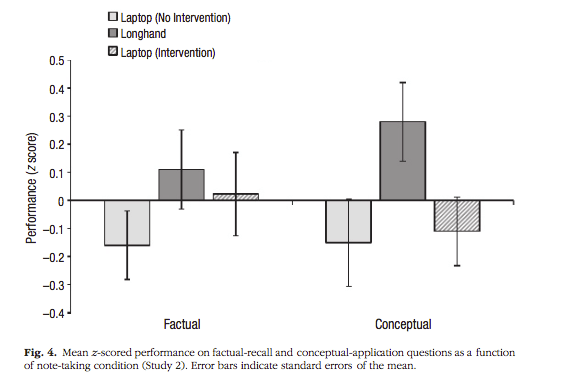
Out of interest, here are the results from the other two tests that were more convincing for that conceptual finding.
Okay, this is more like it.

The second test with 151 people were tested with pen, laptop, and laptop with a lecture from the tester about how they really should pay attention. With 50 people per group you’d hardly jump up and down about the significance of this test, but clearly telling people to pay attention doesn’t… hey look a squirrel.

squirrel

Methinks possibly the greater number of treatments has lessened this test's results.
Methinks that possibly the greater number of treatments has lessened this test’s significance.

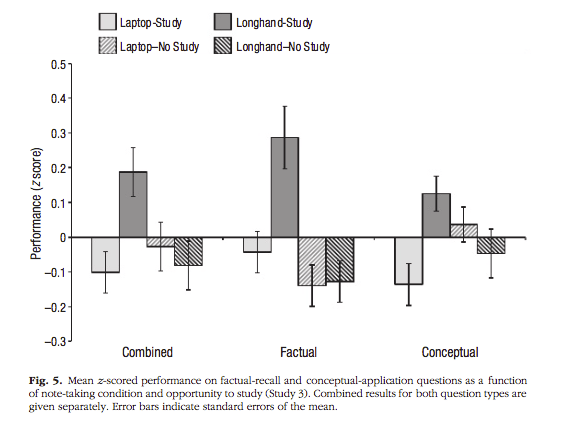
The third test with 109 people again tested for pen vs keyboard, but this time they allowed revision of notes before being questioned. This makes the groups even smaller, and again I’d question the significance of such a small sample. But the researchers summed up the results with this erudite paragraph:

However, a more nuanced story can be told; the indirect effects differ for conceptual and factual questions. For conceptual questions, there were significant indirect effects on performance via both word count and verbatim overlap. The indirect effect of word count for factual questions was similar, but there was no significant indirect effect of verbatim overlap. Indeed, for factual questions, there was no significant direct effect of overlap on performance. As in Studies 1 and 2, the detriments caused by verbatim overlap occurred primarily for conceptual rather than for factual information, which aligns with previous literature showing that verbatim note taking is more problematic for conceptual items.

In other words, doing lots of writing, particularly just copying what was said verbatim, makes you suck at understanding what the hell is going on. Oh, and study before the test. Apparently it helps too. Made that mistake at university.

So back at The Literacy Site they are skipping the other tests and just heading to the conclusions:

Mueller found that this was the result of laptop users trying too hard to transcribe the lecture rather than listening for the most important information and writing it down by hand. It may be an era where computers have made handwriting seem useless, but Mueller isn’t the only believer in the importance of longhand.

Notice the nuanced difference that seeing all three tests provides? We could be led to believe that there was overwhelming evidence for the pen, but what we see is that note takers need to readdress their methods of taking notes. Or they could just wing it.

An article in TIME discusses Karin James, an Indiana University psychologist, who published a 2012 study indicating writing is particularly important in the cognitive development of pre-literate children five and under. While using a computer for note-taking in some situations makes sense, it’s important not to overlook the longhand method.

It’s great that the article tries to incorporate some extra research. Citing one study with a small sample size is hardly compelling, certainly not worth writing an article about. But again the research is being misrepresented:

…the benefits of writing: increased creativity, better critical thinking, boosted self confidence, and a correlated improvement in reading capability with writing prowess.

But are these benefits real? The short answer: Mostly not. “There’s lot of caveats in handwriting research,” says Karin James, a psychologist at Indiana University

Curse those damn caveats! Why can’t we have a control group of kids we don’t teach to read and write?!

Which brings me to a final point about these old technologies vs new technologies articles: stop jumping the gun! We’re in a transition phase. This isn’t 1970s velvet suits with platforms versus 2010s hipster atrocities. This is typewriter hipster texting on his phone. Technology is changing and we’re still learning how to use it properly. The studies that are cited in many of these articles have very limited scope, test very few people, and are comparing new and established things. Has anyone taught laptop users to take notes effectively for the new medium? Do you actually need to take written notes at all in this modern age? We need to see more science done on the changes taking place, and we need the articles discussing the science to do more than discuss (one study from) one paper, and highlight the limitations. Well, unless you have already made up your mind about a topic and just want some links to throw at people in an argument. Screw being right!

This blog post is being shared online, in print, and carved into a cave wall. Comment below which format you preferred receiving it in.
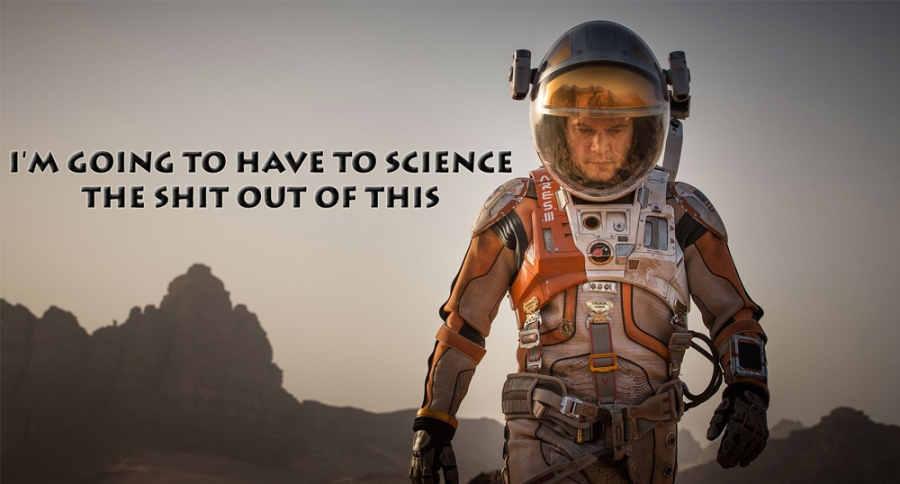
 

Book to Movie: The Martian – What’s The Difference?

This instalment of CineFix’s What’s The Difference? covers one of my favourite books: The Martian by Andy Weir.

As you can see from the breakdown, the film was a very faithful adaptation of the book. I thought the casting was spot on – can you believe some people didn’t think Matt Damon could get Watney’s tone right? – and they didn’t dumb anything down. Probably why I enjoyed both the book and the movie so much.

For me the main difference I noticed was the curtailing of some struggles in order to serve the larger plot and not have a 3 hour run-time. The continuous stream of problems that Watney had to McGyver his way out of really brought the “science the shit out of this” aspect to the fore. Most notable was the rover crash after the sandstorm. But for the movie you can see why they would cut that scene: it would have taken a fair bit of screen time, it would have detracted/distracted from the build-up to the big finish, and they’d probably have been tempted to go all Michael Bay with the crash. Car crashes have to explode: movie rule.

So if you haven’t read the book or watched the movie, do both ASAP.

Science-the-shit-out-of-this

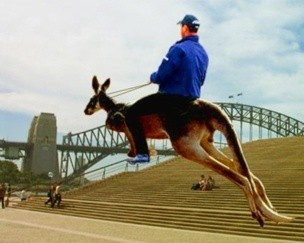
Do people in Australia ride kangaroos?


riding-kangaroo

Yes and no.

Like most advanced countries, Australia has moved past antiquated methods of travel. Just as you don’t see horses and carts in major cities anymore, Aussies have moved away from riding kangaroos in much the same way. Let’s face it, kangaroos are smelly, need to eat lots of food, and are dangerous with a nasty kick – kinda like horses when you think about it. Cars really are much nicer to commute to work in.

But just like horses, there are diehard kangaroo riding enthusiasts who haven’t figured out that cars are so much better. As such there are riding schools, such as Alex Hayek’s Kangaroo Riding School, and clubs for people to learn to ride. Some children do prefer to ride kangaroos instead of bikes to school, but that is becoming less common with the advent of helicopter parents.

riding-school

The sad thing about kangaroo riding is that it isn’t as popular as horse riding in Australia, despite kangaroos resulting in less deaths each year than horses. So it will be interesting to see if this proud tradition is continued in future generations.

Originally published on Quora and Medium.

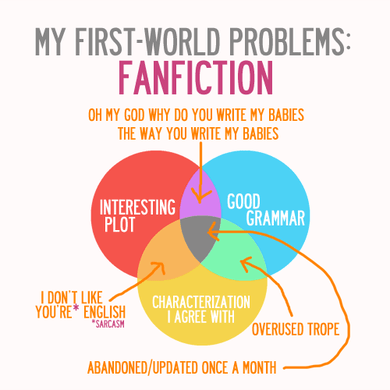
Fan fiction is awesome

http3a2f2f3.bp_.blogspot.com2f-zefg4d8h5u02fuegjqkjrpni2faaaaaaaachs2fhfl9azqkijm2fs16002ffanfic
Source

I’ve never understood authors, directors, or other creatives who have a problem with fan fiction (and other derivatives). What is wrong with fans showing their love for something you’ve created by creating something of their own? Sure, it won’t be canon, and they might not get the feel of your work right, but does it really matter?

With that, I give you a fan fiction short from Rocket Jump.*

*Yes, this post is just an excuse to share the above video, even if it is only for the Firefly reference.

Book vs Movie: The Princess Bride – What’s the difference?

A much loved book and a classic movie: this month CineFix tackle the differences between the tree and silver halide versions of The Princess Bride by William Goldman.

Many years ago my sister was kind enough to force me to read The Princess Bride. Of course I was a fan of the movie; despite never doing the fancy dress thing for parties I have worn an Inigo Montoya name badge, so yes, I was a fan. But for some reason at the time I had this strange idea that if I had seen the movie then there wasn’t much point in reading the book. I mean, how different could they be?*

Long story short, The Princess Bride is one of my favourite novels, ranking up there with Good Omens and Hitchhikers Guide to the Galaxy. The What’s the Difference? video only makes passing mention to the style of the novel, which is as much about making an abridged version of the original S. Morgenstern novel, as it is about the adventures of Westley and Princess Buttercup. Having to edit out the endless chapters describing trees, the difficult negotiations required to secure the rights to do the abridgement over Florin native Stephen King (who ends up securing the rights to the sequel, Buttercup’s Baby), and generally only including the good parts, are key to the novel. Just about all of this was dropped from the movie, because meta-humour would be too confusing to audiences (trust me, people still don’t understand Inception for some reason). So the novel is quite different from the movie. Read it.

On the subject of the above video, it is interesting in this instance that William Goldman wrote the book and the screenplay. So we are able to see how Goldman has zeroed in on the important parts of the narrative to simplify the movie. Because movie audiences aren’t like us sophisticated book readers. In the anniversary edition of the book, Goldman notes how pleased he was with the movie, particularly the casting that brought the book to life. No mention was made of the budget blow-outs due to Andre The Giant’s alcohol consumption.

*Hence the reason I share this fantastic video series each month: it is my penance for such poor thinking.

Book vs Movie: Casino Royale – What’s the Difference?

In the latest instalment of the What’s the Difference? series, the CineFix team have broken down the Ian Flemming novel and Daniel Craig movie, Casino Royale.

Unfortunately Casino Royale is not one of Bond novels I’ve read. The change between generations is very marked when reading a Bond novel, the little changes like letters and radio to texts and mobile phones (cells to US people) are expected. But the social change that has occurred is the biggest noticeable difference, mostly with the role of women and minorities in society. Felix Leiter being African-American in the movie? Vesper Lynd being the intellectual equal of Bond? These are not things that Flemming would have imagined for his world.

I like Daniel Craig’s Bond and think that Casino Royale was a shot in the arm for the long running series. The gritty take on things was needed after the cheese that was Die Another Day (etc). And you can’t help but love any film that has Eva Green in it. With rumours flying that Craig’s Bond will be no more, it will be interesting to see what the next take on Bond will bring us. Will the producers push back to a suave Connery take on Bond, or a tongue-in-cheek Moore version, or an in-between like Brosnan, or something really lame and poorly written like Dalton and Lazenby’s outings?

Whatever happens with the Bond series it is clear that the social update to the novels will continue.

The continued war on e-books

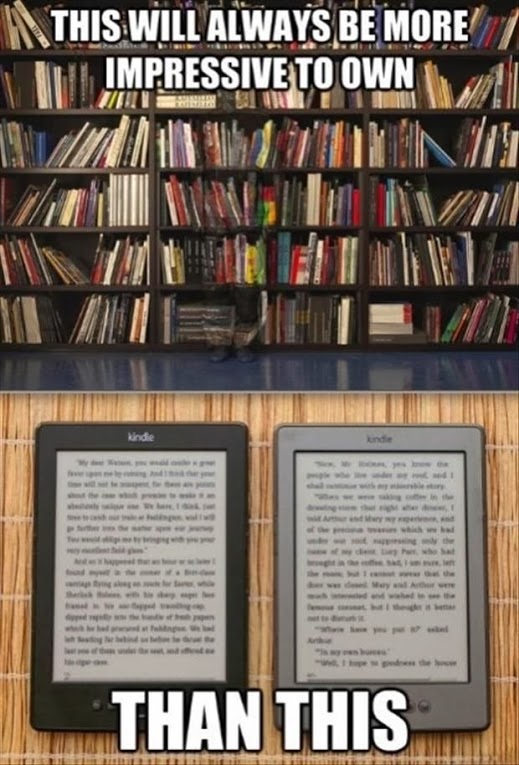
Stupid meme is stupid.

Do you love the smell of books?
Do you prefer the feel of paper?
Do you feel slightly superior to others because you paid for the hardcover?
Do you grasp at any excuse to deride e-books and the people who read them?
Well, I have found the article for you!

Recently on Mental Floss an article entitled “5 Reasons Physical Books Might Be Better Than E-Books” sought to comfort snooty readers who wanted ammunition to fling at e-book readers. In the proud tradition of deriding any new technology as bad (see e-books, e-cars, driverless cars, etc), this article introduces us to some research that is wonderfully out of context for the intent of the article’s argument. Let’s dig in.

Though e-book readers have become a more common sight around town, traditional books still have their evangelists. According to The New York Times, e-book sales have been falling in 2015. Print definitely isn’t dead. In fact, according to some research, it may actually be a better choice for some readers. While scientists are still trying to tease out exactly how digital reading affects us differently, here are five ways e-books might be inferior to their dead-tree cousins.

When deriding things it is always best to reference another article that derides the same thing. In this case the article references the wonderfully misleading NYT piece on e-book sales slipping. Pity that the sales didn’t slip… That’s right, the NYT misrepresented a slowing in e-book sales growth as a drop in sales. And did they mention why readers were stating a preference for paper? Yes. Hidden in the article is a little quote about how publishers had been protecting their paper sales by inflating e-book prices. Now, my economics is a tad rusty, but I’m pretty sure making something more expensive when there are direct substitutes on offer results in a decrease in sales of that item and an increase in the sales of the substitution item. At least, that’s what I’ve heard…

1. E-BOOKS CAN REDUCE READING COMPREHENSION.
In a study of middle schoolers, West Chester University researchers found that students who read on iPads had lower reading comprehension than when they read traditional printed books. They discovered that the kids sometimes skipped text in favor of interactive features in the e-books, suggesting that certain multimedia in children’s e-books can be detrimental to the practice of reading itself. However, the researchers noted that some interactive features in e-books are designed to enhance comprehension, and that those might be more helpful than game-type interactive graphics.

This is a fantastic study in how multitasking is terrible for concentration and thus impacts reading comprehension. iPads have all sorts of cool stuff on them, including little notifications telling you that your friend just liked your latest picture of your meal. And building those distractions into the book being read: sounds like a great idea! What this study doesn’t do is support the idea that e-books reduce reading comprehension.

2. YOUNG KIDS CAN GET DISTRACTED BY E-BOOKS.
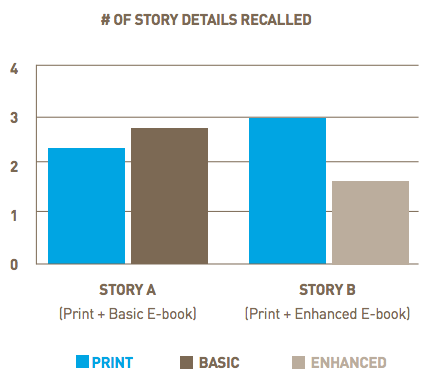
Similar results were found by a small study by the Joan Ganz Cooney Center that consisted of 32 kids reading e-books and print books with their parents. It found that “enhanced” e-books might be distracting. Kids who read enhanced e-books—ones with interactive, multimedia experiences—were more engaged with them physically, but in the end they remembered fewer narrative details than those who read print books or basic e-books [PDF].

Don’t read the link. Don’t read the link. You read the link: didn’t you. Leaving aside the tiny study size for a moment (a point the study authors acknowledge), the study itself supports the points I made above about being distracted whilst reading. And if you look through the study you see a great little chart that showed the comparison of reading comprehension – expressed as story details recalled – was actually superior in basic e-books than in print books or enhanced e-books.

Screen Shot 2015-10-04 at 10.13.19 am

The findings of the study were literally stated as:

The enhanced e-book was less effective than the print and basic e-book in supporting the benefits of co-reading because it prompted more non-content related interactions.

Odd that the “e-books are bad” article failed to highlight this finding…

3. YOU REMEMBER LESS ABOUT A BOOK’S TIMELINE.
Another study of adults also found that e-books can be hard to absorb. The researchers asked 25 people read a 28-page story on a Kindle and 25 to read the story in paperback, then asked the readers to put 14 events from the story in chronological order. Those who read the story on a Kindle performed worse on the chronology test than the book readers, though they performed about the same as print readers in other tests. Earlier research by the same scholars, from Stavanger University in Norway, found that Norwegian 10th graders also remembered more about texts if they read them in print rather than on a computer screen [PDF].

Finally we come to a study on actual e-books on an actual e-reader versus their dead tree counterparts. Of course I’m again blown away by the sample size of the study, a massive 50 people. That should easily extrapolate to the rest of humankind. The linked article doesn’t give us much information, but I found a better one, and it has this summary:

In most respects, there was no significant difference between the Kindle readers and the paper readers: the emotional measures were roughly the same, and both groups of readers responded almost equally to questions dealing with the setting of the story, the characters and other plot details. But, the Kindle readers scored significantly lower on questions about when events in the story occurred. They also performed almost twice as poorly when asked to arrange 14 plot points in the correct sequence.

I’d link to the original paper, but it is behind a paywall. Suffice to say that the error margins were pretty big (even the paper readers got 34% of the plot points in the wrong order). And this was a short story, something that shouldn’t be that difficult for any reader. So this probably says as much about the story as anything. They’d need far more stories and participants to get a good idea of what is going on. But I will concede that reading on paper vs e-reader vs screen is definitely a different experience and has an influence. What that influence is, positive, negative, or just different, needs more research.

Interestingly the study of reading PDF texts on a screen vs paper texts in high school students showed why scrolling is a terrible way to read anything. Scroll down to read more about PDFs sucking.

4. THEY’RE NOT GREAT AS TEXTBOOKS.
While e-book textbooks are often cheaper (and easier to carry) than traditional door-stop textbooks, college students often don’t prefer them. In some surveys of college kids, the majority of students have reported preferring print books. However, a 2012 study from the UK’s National Literacy Trust of kids ages 8 to 16 found that more than 50 percent of children reported preferring screen reading [PDF].

It is odd to start a point and then go on to disprove it. E-book textbooks being cheaper, easier to carry, and in some surveys preferred by the majority of respondents, seems to me to be the opposite of “not great”. The preference for paper textbooks claim comes from a survey of 527 students, yet is immediately refuted by the UK survey of 34,910 students. I wonder which one is more representative of how students feel about textbooks?

In the comments of the Mental Floss article, someone made a good point in regard to the format of textbooks. Oftentimes the textbooks are PDFs, which brings us back to the point about scrolling, and adds the problem with taking notes. Clearly the format of the e-book plays a big part in how people feel about them.

5. THEY’RE TIRING.
Staring at a lit screen can be tiring for the eyes and the brain. A 2005 study from Sweden found that reading digitally required a higher cognitive workload than reading on paper. Furthermore, staring at LED screens at night can disrupt sleep patterns. A 2014 Harvard study found that people who used e-readers with LED screens at night slept worse and were more tired the next day. So, if you’re going to go for an e-book, go for one without the backlight.

Now let us talk about how bad e-books are for your brain…. Sorry, did I say e-books when I meant LED screens like your iPad and computer? Silly me. Having bright light, especially from white background screens, shining in your eyes at night isn’t a good thing. But that is about as related to e-books as X-Factor is to talented singers. So the message about changing your screen setup for night viewing only really applies to readers if they utilise a backlit screen for reading.

And now that we are at the end of the article, let’s throw in some information for the pretence of balance in the hopes you will ignore the headline and main article points:

BUT DON’T THROW AWAY YOUR E-READER JUST YET.
However, all this may not mean that reading on a Kindle is really going to melt your brain. For instance, reading an e-book on a computer is a much different experience than reading on a Kindle, which is specifically designed for consuming books. So, too, is playing with an interactive e-book on an iPad, compared to using a simpler e-book device that only presents the text, with no opportunities to click away into digital distractions.

This really does appear to be information that would have been better presented in the context of the “e-books are evil” points above; doesn’t it. Throwing in this sort of context at the end rather than in the discussion of the study findings is a cheap tactic, a ploy that sees important information left until after you have already formed your opinion on a subject, or just plain stopped reading the article. This information has far less chance of being retained than the others points made earlier in the article, thus the article has created the bias they were after (deliberately or otherwise).

And some studies have found that part of the difference between the way people absorb information from e-books versus paper might be due to approaching e-books differently—in one test, participants didn’t regulate their study time with digital books like they did with paper texts, leading to worse performances. It’s possible that our expectations of e-book reading—as well as the different designs of the digital reading experience on a computer or iPad or Kindle—might affect how we approach the text and how much effort we put into studying them. As generations of e-book readers evolve, and people become more accustomed to the idea of sitting down with a digital textbook, these factors could change—for better or for worse.

These are all good points, again made at the end of the article rather than at least being hinted at throughout. And unlike the main points in the article, these are unreferenced. Are these points from the studies already referenced (some are) or some other studies that aren’t worth mentioning? In the former, you would expect these points to have been raised earlier in the article in the proper context, in the latter, this feels like an attempt to downplay the statements as less important than the referenced points above. Either way we are left with the sentiment “change is scary” rather than “change is change”.

Hopefully this breakdown of the Mental Floss article shows just how disingenuous many of these anti-technology articles are, especially the “e-books are evil” articles. I’m not trying to say that e-books are what everyone should be reading, or that our forests are now saved from Dan Brown. There is clear evidence that our changing technology is changing the way we read and absorb information, and this transition period is still a learning phase as to how and if we will change our reading preferences. But negative preconceived ideas about e-books (or technology) don’t help in communicating about the change that is happening.

Update: This study compared reading on paper and screens and found stark differences. The sample size was again small, but the study appears to have been better conducted than the others I’ve discussed above. The conclusions from the paper suggest, as I have, that we need to look at teaching/learning how to read e-books and utilise e-readers.

To sum up, the consistent screen inferiority in performance and overconfidence can be overcome by simple methods, such as experience with task and guidance for in-depth processing, to the extent of being as good as learning on paper.

Further reading – https://theconversation.com/do-students-lose-depth-in-digital-reading-61897

Book vs Movie: V For Vendetta – What’s the difference?

In this outing for the CineFix team they have covered the classic graphic novel and movie adaptation of Alan Moore’s V For Vendetta.

So, truth be told, I’m not a huge fan of the Alan Moore graphic novel V For Vendetta – yeah, yeah, I know: sacrilege. I actually gave up on it about a third of the way through, as such, it is hard for me to compare the book to the movie. Actually, that’s not true, I can compare how entertained I was, since I enjoyed the movie and couldn’t be bothered finishing the book. That should say a lot.

Moore distancing himself from all adaptations of his work is odd, but completely understandable given it is based upon having watched* The League of Extraordinary Gentlemen movie. That was the film that caused Sean Connery to quit acting, which gives you some idea of just how bad that movie was. But you are still left with his admonishments of adaptations, like V For Vendetta or The Watchmen, that were good films (IMHO) and captured the essence of the source material. Like most of the book to movie adaptations discussed in the What’s the Difference? series, when you see the breakdowns of differences you can completely understand why the changes were made. The example in this video was of Evie’s character arc to help the audience empathise with both her and V in a shorter format. The book and movie occupy different spaces, have different constraints, and are often made at different times for society.

Which is why I find Moore’s stance – or is that complaints – on adaptations of his work to be a bit precious. I mean, he was, and I quote, “getting money for old rope” as well as a much wider exposure as an artist. He has managed to influence popular culture (The Killing Joke was the primary reference material for Heath Ledger’s portrayal of The Joker). Not much to complain about. Unless the movie studios paid him in beard trimmers.

*Being a little flippant here as he was also sued over accusations that someone else’s script was plagiarised.

Update: I rewatched V for Vendetta recently and started reading the comic again. I haven’t finished the comic, but after watching the video below, I think the sentiments expressed by Moore and Wisecrack are valid. I’m not sure if I’m just 5 years older and wiser, or if I’m just impressionable and a sound argument will sway my views.

Book vs Movie: Alice in Wonderland – What’s the difference?

Another great instalment from the CineFix team. And don’t worry, they didn’t do the Depp/Burton movie comparison. Dodged a bullet there.


I can’t claim to have read all of Alice in Wonderland. I can’t even claim to be much of a fan of the movie; Disney animation or otherwise. My main reason for not liking either is that this is a classic example, and possibly the progenitor, of the “and then she woke up” ending. My wife dislikes the book because it lacks a point and is boring and waffly. Since it is a “classic children’s book” it could explain why kids used to hate reading: thank FSM for Harry Potter!

One of the annoying things about movies

With the recent spate of superhero movies, it is easy to forget that not every movie has a superhero in it. Even the superhero films aren’t always about someone on steroids (Captain America) or weather presenters (Thor) but are instead about your everyday billionaire playboy (Batman, Ironman, Arrow). So it is easy to forget that feats of superhuman strength are not meant to be the norm in films.

Think about the scenes where the everyday hero is clutching the edge of a building by his fingertips whilst the love interest or bad guy is dangling from their other hand. Of course, the hero never loses his grip on the ledge, but the bad guy may slip from his grasp.

We accept that scene as plausible because we have been brainwashed into thinking that the average person can hold their own bodyweight with a single hand for extended periods. Double their bodyweight? They can hold that for the length of a dramatic moment – a period of time that is impossible to measure in real time since dramatic speeches and slow motion really mess with reality.

The problem is that outside of gymnasts, rock climbers, or people who crush rocks with their bare hands for a living, the Average Joe wouldn’t even be able to hold their own weight for more than a few seconds, especially not if they caught themselves from a fall. Elite grip strength can be measured a few ways, but the Captains of Crush grippers are one easy way to distinguish strong hands. The #1 requires 64kg (140lbs) of force to close, while the #3 gripper takes 127kg (280lbs) and is regarded as world class grip strength. Just for shits and giggles, they made a #4 gripper that requires 166kg (365lb) of force to close and has been officially closed by 5 people. Ever.

Watch this world-class rock climber hold just over double his bodyweight with two hands, not one hand, for time as another example:

So let’s just assume that our generic action movie conforms to long-held stereotypes of protagonists. This movie stars an everyday hero who weighs a buff 80kg and his falling love interest is a lithe 55kg, and they totally get naked in the second act for purely artistic reasons. That’s 135kg hanging from the hero’s fingertips, a weight that even a really strong person wouldn’t have the grip strength to support. Two normal sized adults are not going to be hanging onto that ledge for any length of time.

Which brings us to the next amazing feat of strength in this scenario: lifting that falling love interest back to safety. For a strong person, the 55kg gravity lover isn’t exactly heavy. A buff 80kg hero could probably clean and jerk a dumbbell weighing that much…. assuming they work out, have some chalk on their hands, were able to get some leg drive happening, had decent technique, and that the dumbbell wasn’t particularly unwieldy. But most falling love interests are a tad unwieldy, not designed for easy lifting – no obvious knurled handles – and there isn’t a lot of leg drive happening when you’re dangling from the side of a building by your fingertips. Yet without fail, the hero manages to get them both to safety. Well, unless it is one of those tragic character defining moments, in which case the hero will be in the same situation later and will find the determination to succeed the second time. Sucks to be the first love interest in that scenario.

Interesting to think about just how many amazing feats of strength are passed off as normal in movies.

Book vs Movie: X-Men Days of Future Past – What’s the difference

The latest instalment of Cinefix’s What’s the Difference is out. This time they tackle the ridiculously named X-Men: Days of Future Past.

So this is one book in the book vs movie series that I haven’t read. Although, in my defence, the Marvel Comic Universe is such an overlapping, rebooted, reshaped, alternate-time-lined, mish-mash of ridiculous proportions that it probably wouldn’t matter if I had. Watching the breakdown it becomes obvious that the screenwriters did a good job of streamlining the plot and picking characters who would work for the movie adaptation. Less clear is why the movie got so lazy with the “and then he woke up” ending.

Book vs Movie: 2001 A Space Odyssey – What’s the difference

The Cinefix team are back once again with their series on movies based on books. This instalment is in two parts and is slightly different. 2001: A Space Odyssey wasn’t so much a movie based upon a book as much as it was a collaboration between Kubrick and Clarke.

I think the summary in the second video (from about 9:40 onward) encapsulates the main differences between the book and the movie nicely. Essentially Kubrick dispensed with the pedantic explanations and descriptions in favour of stunning visuals and esoteric story telling. Whereas Clarke made that esoteric story telling understandable with all the motivations and insights. I.e. to understand the film read the book, to experience the book watch the film.

Book vs Movie: Watchmen – What’s the difference

Another great breakdown of the differences between the book and the movie from Cinefix. This time it is Alan Moore’s Watchmen.

If I’m honest I’d have to say I prefer the movie over the book in this instance. I liked both, but I thought the changes they made for the movie made for better spectacle and entertainment. Obviously that wasn’t Moore’s original intention, so it is unsurprising that fans were annoyed with these changes. I felt that Snyder’s adaptation remained relatively faithful to the source material whilst also creating a film that cinema goers would enjoy. This is the hard path to tread in any adaptation: making sure the film works but remains true to the source.

Of course Snyder managed to make a film that people didn’t watch in the cinema and that fans of the book complained about. Guess there is just no pleasing some people.

One (of the many) problems of arguing with science deniers

In a recent post I discussed some points about how to spot anti-science nonsense. Pick a subject, any subject, and there will be someone – probably Alex Jones – making an outrageous claim about it. But don’t worry, they’ll solve the problem with items available from their reasonably priced store: $1440 per litre is a bargain price for something you don’t need and doesn’t do as claimed.

Credit: Jason Hymes
Credit: Jared Hyames

Obviously scammers are gonna scam, and anti-scientists are going to not-science. The thing is once you understand that something is wrong you have some responsibility to make sure the misinformation doesn’t spread like a leaky diaper. With great power knowledge comes great responsibility. Which means you have to start discussing science with science deniers. Don’t forget to place a cushion on your desk and wear padded gloves.

Despite having the advantage of science/facts in the argument against science deniers, you have the decided disadvantage that you can’t just make stuff up (despite how tempting and financially rewarding it is). In fact you have to be better informed about not only your side of the argument but also about the science denier’s arguments.

Sounds odd, doesn’t it? You have to learn nonsense to talk about science. That makes as much sense as being pro-life and pro-death penalty. Bear with me here. Take this example of climate change denier Bret Stephens arguing against Bill Maher on Real Time:

Bret sounds convincing, doesn’t he? Bret sure thinks so. He makes some vague references to headlines from the 1930s and 1970s as dismissals of current concerns about oceans. Then he references an economic study on environmental policy priorities, all whilst looking very smug and sure of himself. These statements leave Bill at a stumbling point because he has to admit he doesn’t know what the hell Bret is talking about. The video edited out the pant-less victory lap Bret did of the studio, complete with crotch gyrations in Bill’s face, as he screamed “Take that liberal media!”

Now it isn’t a bad thing to admit you don’t know stuff. Nobody knows everything, it is arrogant to act like you do. Arrogance is of course the result of being surrounded by Knowitalls, an invisible mythical creature that looks like a cross between a unicorn and Bill O’Reilly. Anyway, I’m glad Bill Maher admitted he didn’t know about the study; if only he would do the same with his position on vaccination and GM/GMOs. But the admission did make him appear less convincing as he couldn’t directly rebut the points made.

And here is why you need to know what the anti-science people “know”. Take the first points Bret makes about the oceans dying. His two dates mentioned are actually making reference to points unrelated to the issue of climate change causing ocean acidification. The first date was reference to the Overfishing Conference in 1936 about whaling and fishery management (as far as I can ascertain), issues that were addressed by introducing catch sizes, fishing licenses, and the phasing out of whaling. So Bret is trying to justify inaction on climate change to save ocean damage by referencing an environmental concern that was acted upon. What a great argument!

His second date was the 1975 Newsweek and New York Times (and others) article about global cooling. This is a well worn climate change denier talking point/myth that has been thoroughly debunked yet has evolved beyond a PRATT point and become a zombie point. Some myths just won’t die and are constantly in search of brains to infect/affect.

We then hear Bret reference a Bjorn Lomborg study on best use of resources and where climate change ranked. Very convincing, aside from the fact that it was complete and utter nonsense. See, Bjorn doesn’t accept the actual risks and actual current changes that have occurred due to climate change. So his entire analysis and argument started off from a completely flawed position and was thus doomed to fail to draw any worthwhile conclusions. Actual experts have torn apart his work, particularly his “conference”, here, here and here. But Bill didn’t know this, thus the points made stand unchallenged and as a sort of “valid” evidence.

And this is why it is important to know your enemy. If you know the arguments they are likely to raise, then you can have rebuttals ready. In the case of citing Lomborg’s work you can point out the failings before people have a chance to take it seriously. In the case of old magazine articles, you can point out you only read them for the pictures. But it means you don’t just have to know the science, you have to know the anti-science.

It is also worth noting that Bret reeled off a string of statements that were essentially nonsense dressed up as facts. That is a tried and trusted debating tactic known as the Gish Gallop, and it is very hard to argue against. It takes a lot more energy to redress the nonsense than they take stating it, not to mention time wasted not making your own points. Also helps that science has to have facts on its side, anti-science can make it all up on the spot.

Of course the obvious thing to say here is that the anti-science movement often don’t see themselves as anti-science and will use similar tactics. They will familiarise themselves with the science in order to dismiss it. This is possibly the most annoying part of science communication, those imbedded in anti-science positions aren’t ignorant of the facts, they are wilfully ignorant of their fact-ness.

Surviving animal attacks

Being an Aussie people kindly send me advice on how to not be killed by animals. Yes, we do have some decidedly deadly animals in Australia, some of the deadliest are not what you would think. But as much as I appreciate the advice, I think it is time that an Aussie set the record straight on how to deal with deadly animals. Let’s start with the most recent piece of advice I received.
How to survive various animal attacks
Clearly this meme was written by someone from North America, what with the unexotic list of animals (although the meme comes from a UK site). I mean, I know that bears and wolves are scary to some people who have never been to Australia, but we have to remember that the bar is raised when talking to Aussies.

Bears:
You can’t roll toward a bear in Australia as they live in trees and attack from above. The best rule is to use the one borrowed from chemistry, and that is to have a sacrificial (anode) friend with you. This friend should preferably smell delicious; possibly have them carry bacon in their pockets. If someone suggests you carry some bacon then you know exactly how much to spend on presents at Xmas time.

Sharks:
The true nemesis of sharks is dry land, of which we have plenty in Australia. But obviously being so dry we like to crowd down to the coast and chance our hands at being shark food. There are many strategies you can employ on sharks, swimming between the flags being the most popular, as everyone knows flags terrify sharks. Another strategy is having American friends, because sharks love the deep fried marinade of their flesh. In a pinch, there are also plenty of Aussies who could be mistaken for Americans, so just swim with one of them.

Wolves:
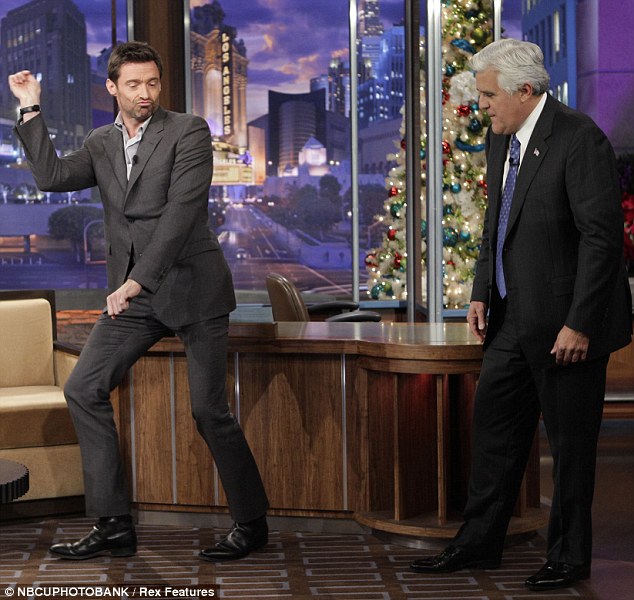
These aren’t particularly common in Australia. Instead we have the Dingo. These are actually pretty safe to be around as long as you are over the age of two. Unless we’re talking about Hugh Jackman, in which case just play a samba beat.

Jackman dancing

Geese:
When you are attacked by a goose you just have to accept that you’re going to get bitten. Repeatedly. Geese aren’t apex predators without good reason, but they prefer to eat their prey live and running. As long as you can stay mobile and find a fortified position, such as a bank vault or a KFC, you should survive. Remember to clean and dress your gaping wounds, sepsis is a common cause of death. If there is more than one goose you’re done for, just try to throw your final letter clear of the carnage.*

Wasps:
The only reason people have geese is because they are the only thing terrifying enough to take on wasps. So if you have a bank vault or run a KFC you should be able to avoid wasps. If you don’t then buy a shotgun and practice.

Snakes:
Unlike many other countries who measure snakebites in terms of whether you need to visit a hospital, Australia measures snakebites in terms of minutes until death. The main piece of advice for people thinking of visiting Australia is to not get bitten. Actually, that’s good advice for every Australian animal, since they are all poisonous, or big enough not to need poison. Actually, it’s also good advice for plants, since those are poisonous too. Most Australians prefer to run over snakes with their car, then drop a boulder on them.

Spiders:
The humble spider is a much misunderstood animal. Yes, they are deadly, but in a country like Australia that is par for the course. The fact is that spiders are actually quite cuddly, once you get past the poisonous pincers. They are also easy to train, much easier to train than combat troops. As a result Australia doesn’t have a tank division of the army, but instead has a spider division. Think twice before invading.

Crocodiles:
Yes you should be afraid of crocodiles. Deep down I’m afraid of any apex predator that lived through the K-T extinction. Physically unchanged for a hundred million years, because it’s the perfect killing machine. A half ton of cold-blooded fury, the bite force of 20,000 Newtons, and stomach acid so strong it can dissolve bones and hoofs. But the trick is to keep the animal around that does this to crocodiles:

crocodile head


Which animal is that, I hear you ask. Which is odd given this is a written article. The answer is the Australian Budgerigar. Don’t let its small size and cuteness fool you, they form large deadly flocks of ravenous skyborne killers.

Cats:
Let’s be clear: cat’s are m@#$er-f@#$ing dangerous. They are sneaky, silent, killing machines with the world renowned ability for invulnerability and regeneration. How can you possibly take on this harbinger of death that will survive dying repeatedly? Attack it ten times.

This is just a taste of Aussie animal survival techniques. There are obviously many more deadly animals (read: all of them) with advice varying from the examples above to emigrating to a safe country, preferably one that allows the importation of Vegemite.

*A final letter is an Australian government required document that all Australians must carry upon their person at all times. In the event of likely untimely death it acts as the final thoughts and wishes for the deceased, usually just short goodbyes to loved ones and reminders to take the bins out.

Beware the meme!

Memes fly around the internet like quantum accelerated particles. Some are fun, some are informative, others are utterly ridiculously wrong. Unfortunately people get caught up in pretty pictures with inspiring – or is that insipid – quotes printed on them, so they start following someone on social media, someone who spreads as much nonsense as inspirational quotes.

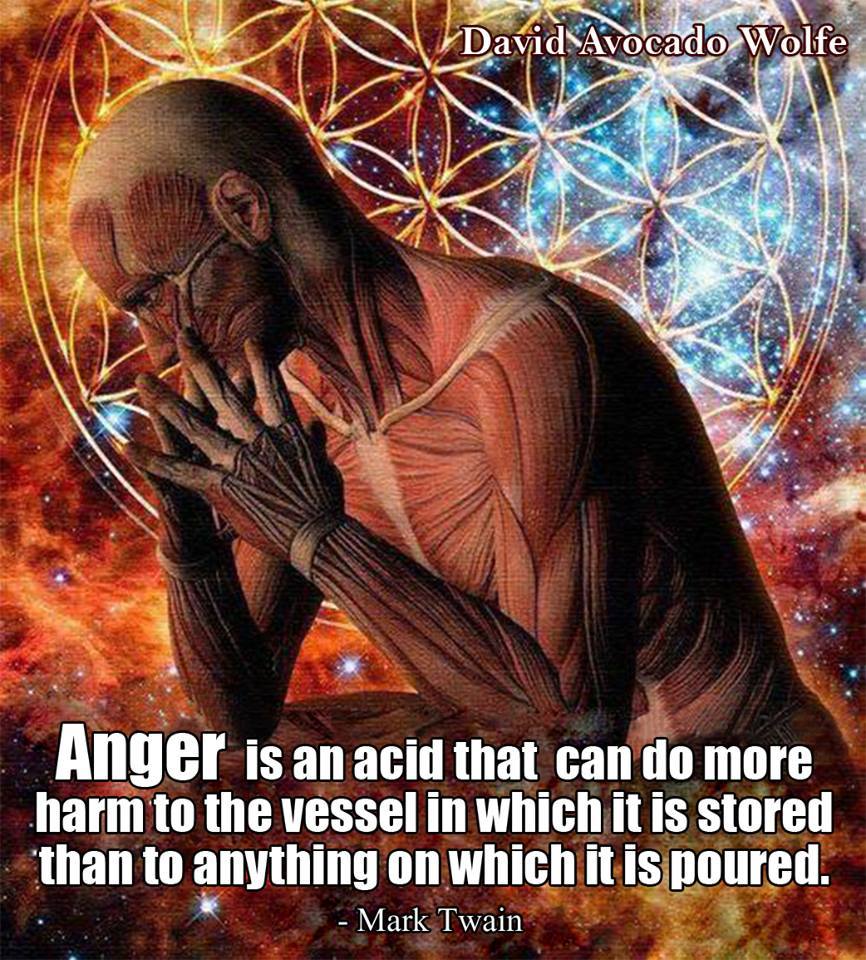
Take for example this quote from Mark Twain:
Mark Twain on nonsense background
At face value there is a great message from Twain about not storing up emotional baggage. Let’s just ignore the scientific inaccuracy of how acids work and how the materials of the respective containers and the Ka (acid dissociation constant) of the acid are going to be the deciding factors in how much damage the acid does. But once you move past the quote and pretty picture you start to notice certain things about the picture, namely that there is some weird design stuff going on it. There’s some spacey looking stuff in the background, there’s a person with no skin, and some sort of lattice work design: what the hell is this stuff? That’s called the Flower of Life, something that has been incorporated into Sacred Geometry, a load of nonsense that would have Mark Twain penning scathing insults toward; Twain loved science.

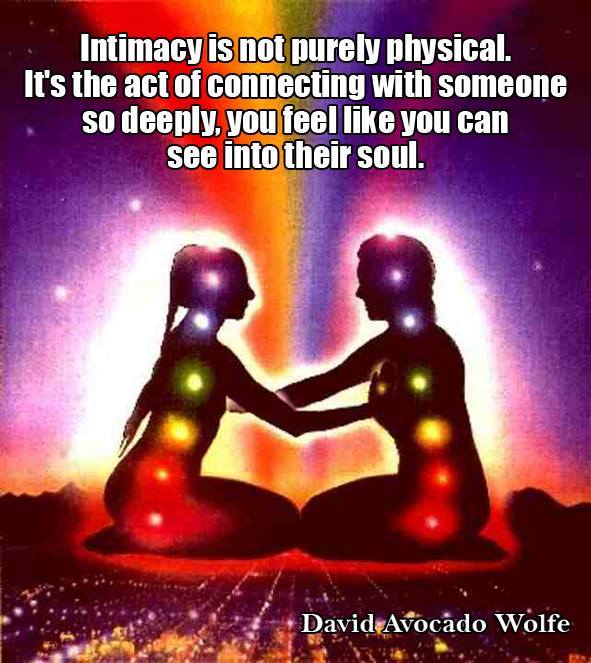
Let’s take a look at another meme:

Chakra nonsenseAgain we have a bit of text that implies that good relationships are much deeper than the shallow, fleeting, physical attraction. This one is, however, more obvious in its ridiculousness. In amongst the rainbows and pretty city the two outlines of people are hovering above, there are glowing lights in the bodies of the people. Take a guess at what they are meant to be. Chakras. That’s right, we’ve gone all new-agey nonsense right out in the open. So once you spot the new-age nonsense you realise the word “soul” isn’t being used in the allegorical sense but in the “I believe all sorts of rubbish” sense.
And now we descend into health nuttery:
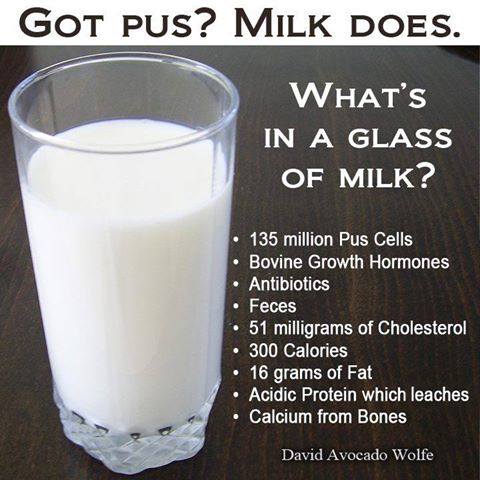
Milk nonsense

This is a typical health meme that these sorts of social media pages post: half truths, misconceptions, lies and nonsense.

Let’s start at the top: there are no pus cells in milk. The meme seems to be referring to the somatic cell count of milk, which is not the same thing, and just part of the biology fail on display here. The 135 million figure is from the detection levels for mastitis in cows, which says that uninfected cows will have less than 150,000 cells/mL (they’ve clearly scaled up to a litre of milk in that glass, which doesn’t look like a litre glass to me).

Growth hormones: misleading at best. Food has hormones in it, produced by the food, be that plants or animals. Remember how soy is meant to be good for menopausal women? Yep: plant hormones. So milk will have naturally occurring hormones in it. Some countries have limited/banned the use of growth hormones in animal production, others have allowed it. And this brings us to one of the many reasons pasteurisation is used in milk production, as it breaks down most of the hormones.

Antibiotics: nope, they test every truck of milk as it leaves the farm gate to make sure there is no antibiotic contamination.

Feces: again this is misleading, and also one of the main reasons for pasteurisation. You aren’t so much going to end up with feces in the milk as the bacteria associated. So it is important to kill the nasties and why raw milk is considered dangerous.

Cholesterol: I’m not sure where they got the figures from but they seem to be assuming 200 mL of full fat milk. Odd considering they were assuming 1,000 mL for the pus/somatic cells. Yes, milk has 24 mg of cholesterol per 100 mL. And that isn’t necessarily a bad thing.

Calories: I’m not sure why food having calories in it is bad…… Figures are roughly correct for 200 mL of full fat cows milk though.

Fat: Again, I’m not sure why food having fat in it is bad.

Acidic protein: This one is quite funny because there are a lot of acidic proteins. And obviously these acidic proteins leaching calcium from bones is one of those things that “mainstream medicine is ignoring” – aka the rallying cry made by purveyors of nonsense. Pity that dietary protein (which can include dairy) has actually been shown to be good for bones. The issue here is actually a couple of health myths. The first is the acid/alkaline diet that is utter nonsense. The second is the overstating of health benefits of milk, specifically as they relate to bone health and osteoporosis development.

Now I’m not saying that milk is bad for you, but it also isn’t the most awesome drink ever made – that would be whiskey. Milk should be like whiskey: consumed in moderation.

The point about memes is that they are only as good as their creator. The intention of the above memes is clearly to help people, inspire them to lead better lives, even if it is by showing them some pretty pictures with brain droppings written on them. But sadly it is obvious that these memes were created by someone who is not in touch with reality, which makes their health advice something to be avoided. Beware the meme: it could be nonsense!

Book vs Movie: Fight Club – What’s the Difference?

Another great installment from the Cinefix team.


A point I’d make about the final chapter of the novel is that I thought the implication was that the narrator was so drugged up in the mental hospital that he wasn’t sure what was going on. And I also thought that the people with the tell-tale bruising were the Project Mayhem members implying they were waiting for him to escape so they could try again.

Also one plot point I really liked in the book was the bit about the type of explosive used, the Narrator preferring one, Tyler the other. This explained why the explosives failed and also implied that the Narrator had been able to sabotage the plan.

Update: Wisecrack discussed the differences as well. Worth a watch.