Book vs Movie: When the Book Is Better

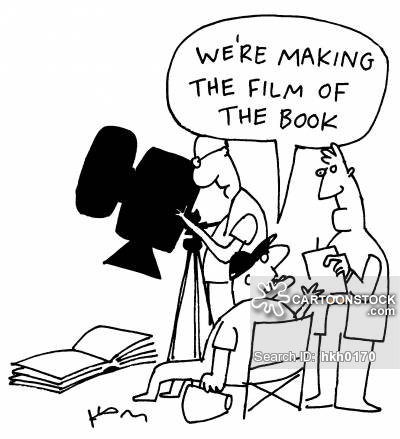
'We are making a film of the book.'

PBS Digital Studios have a new video series It’s Lit! which is part of The Great American Read, an eight-part series that explores and celebrates the power of reading. Featuring one of the premiere video essayists in Lindsay Ellis, this series should be brilliant.

The first video briefly discusses a topic I’ve frequently discussed here, what makes a good adaptation and why the book is so often regarded as better.

Lindsay has very concisely summarised why movies so often don’t make for good or faithful adaptations of the source material. But she also touches on why they can sometimes improve the book, or make an adaptation that uses the source material in an interesting way to tell a different story.

If you aren’t already subscribed to Lindsay or PBS Digital Studios, you may want to do so now.

Reading is awesome even when you don’t do it…

Scrolling through my feed I came across this little gem:
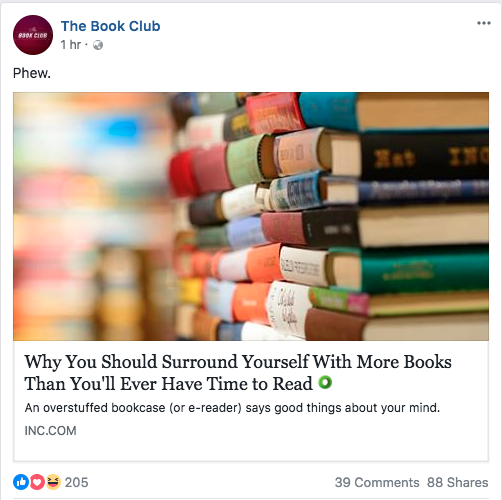
Screen Shot 2018-05-07 at 8.29.58 am

How could I not click on this article? I have several years supplies of paper books on my shelf to read, and even more on my e-reader. Justifying this state of affairs is clearly something I need.

Pity the article is rubbish.

The first hint that this story is nonsense is how they start by commending readers as smart – softening everyone up a bit. They list a few famous people who read and say you too can be just like them if you read. Somehow reading = lifelong learning, so you’ll be happier, earn more, stay healthier, and become president – I’m tempted to dive into those claims for a fact check, but one piece at a time. I’m willing to accept the claim that reading = lifelong learning… for now.

Lifelong learning will help you be happier, earn more, and even stay healthier, experts say. Plus, plenty of the smartest names in business, from Bill Gates to Elon Musk, insist that the best way to get smarter is to read. So what do you do? You go out and buy books, lots of them.

Then it suddenly announces you don’t have to read.

But if it’s simply that your book reading in no way keeps pace with your book buying, I have good news for you (and for me; I definitely fall into this category): Your overstuffed library isn’t a sign of failure or ignorance, it’s a badge of honor.

Oookaaaayyy. Please explain to me how not reading is just like reading.

That’s the argument author and statistician Nassim Nicholas Taleb makes in his bestseller The Black Swan. Perpetually fascinating blog Brain Pickings dug up and highlighted the section in a particularly lovely post. Taleb kicks off his musings with an anecdote about the legendary library of Italian writer Umberto Eco, which contained a jaw-dropping 30,000 volumes.

Did Eco actually read all those books? Of course not, but that wasn’t the point of surrounding himself with so much potential but as-yet-unrealized knowledge. By providing a constant reminder of all the things he didn’t know, Eco’s library kept him intellectually hungry and perpetually curious. An ever-growing collection of books you haven’t yet read can do the same for you, Taleb writes.

An antilibrary is a powerful reminder of your limitations — the vast quantity of things you don’t know, half-know, or will one day realize you’re wrong about. By living with that reminder daily you can nudge yourself toward the kind of intellectual humility that improves decision-making and drives learning.

This is what is commonly referred to as a non-sequitur, or a bullshit argument. Nassim Taleb is notorious for these sorts of nonsense arguments. That and blocking people on Twitter* for not agreeing with him and praising the ground he deadlifts upon.

It is hard to decide where to start with this. The irony of suggesting you need to surround yourself with knowledge in an article on the internet is amazing. Even if we take it, as Taleb implies, as requiring a physical reminder, we already have libraries, bookshops, universities, experts, friends, enemies, who all exist with knowledge we don’t have. It isn’t about the reminder, it is about awareness.

I’m not sure you can take people seriously when they talk about knowledge in terms of what you don’t know. One list is considerably larger than the other. If I was to provide a resume of what I didn’t know it would run to libraries worth in length. Who would suggest we think in those terms?

“People don’t walk around with anti-résumés telling you what they have not studied or experienced (it’s the job of their competitors to do that), but it would be nice if they did,” Taleb claims.

Of course he would suggest that. I guess I’ll mail Taleb a résumé of the Dewey codes** for the stuff I don’t know to become his deadlift partner.

How do they rationalise this anti-library?

Why? Perhaps because it is a well-known psychological fact that it’s the most incompetent who are the most confident of their abilities and the most intelligent who are full of doubt. (Really. It’s called the Dunning-Kruger effect.) It’s equally well established that the more readily you admit you don’t know things, the faster you learn.

So stop beating yourself up for buying too many books or for having a to-read list that you could never get through in three lifetimes. All those books you haven’t read are indeed a sign of your ignorance. But if you know how ignorant you are, you’re way ahead of the vast majority of other people.

Actually, the Dunning-Kruger Effect is about how people with low cognitive ability are exactly those who lack the ability to realise they are of low cognitive ability so they will rank themselves more highly. High cognitive ability people incorrectly assume others are at their level, so will rank themselves lower (see also Imposter Syndrome). You can see from this explanation of the effect why surrounding yourself with knowledge doesn’t really achieve anything.

It’s about awareness.

You would have to be aware that your knowledge is lacking, not just have a reminder of it. If you are ignorant or arrogant then you won’t benefit from the stacks of books around you. We are already surrounded by knowledge in our society – I mean, we’re on the internet here, you can look up literally anything and potentially get the correct answer… potentially. But this article – and Taleb himself – are proposing a form of arrogance. Surround yourself with books and you’ll be better than the vast majority of people.

I’m not saying you shouldn’t buy heaps of books, I myself already own more than I’ll probably be able to read in a lifetime. But don’t be fooled by these sorts of feel-good pieces that give you a pseudo-justification for doing so. It doesn’t say good things about your mind, nor make you better, it just says you like books and would like the authors to be able to afford to eat this week.

* Seriously, check out his profile or this search to see how often he justifies blocking people. As someone whom he has blocked, I can say that he really hates engaging in discourse. Oh, and the reason I was blocked was that he Tweeted about disease resistance in plants and how it works, except he got it massively wrong. When I pointed this out I was immediately blocked.
**Get it? The joke is that there are more library classification systems than just Dewey Decimal. I’m hilarious!

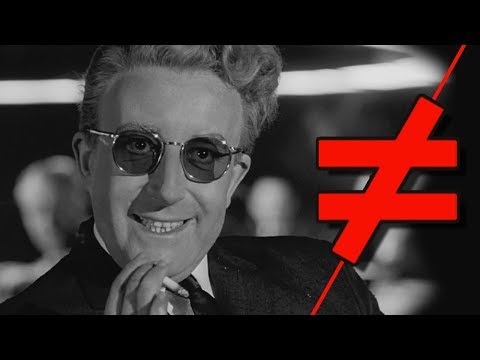
Book vs Movie: Dr Strangelove – What’s the Difference?

dr-strangelove-whats-the-difference-image-5239079

This month’s What’s the Difference? from CineFix delves into one of the few Stanley Kubrick films I’ve enjoyed.

Everyone remembers Dr Strangelove but very few remember Red Alert, the novel that was the basis for Kubrick’s adaptation. Peter George’s book was an early nuclear war thriller and having got there first tended to be copied (or is that emulated?) by many other authors. This was an important point since Kubrick and George decided to sue the production of another movie based upon a nuclear war thriller that was deceptively similar to Red Alert. I’m not exactly sure why this was important as George teamed up with Terry Southern to change the super-cereal novel into a timeless satire.

Did you know that Dr Strangelove was originally going to end with a pie fight? Apparently, the farcical element involved in that was deemed too silly for a poignant satire, despite how metaphorical it was to the destruction of the human race. I guess many would have missed that point. Comedy needs to take itself more seriously if people are to get the point.

I think Dr Strangelove is a great example of a movie being better than the book. The way it does this is by not taking the source material seriously. What would have been another by-the-numbers thriller was elevated by satirising war. Landing not long after the Cuban Missile Crisis, the film managed to capture sentiments of the absurdity of mutually assured destruction and the ineptness of the cabals of military and political elites deciding fates.

Plus, Peter Sellers.

Can you name a book?

creative-bookshelf-18__700

Sounds like a simple challenge, right? Name a book, any book at all.

In the long tradition of asking Americans general knowledge questions on the street and filming their glorious ignorance, I present this video from Jimmy Kimmel.

Before we all laugh and point at the Americans and insult their intelligence, let’s remember that you could do this just about anywhere. Although, Americans do make this stuff easy at times. I’ve previously discussed the reading figures for the US, UK, and Australia. I’m sure those numbers are at least in the same ballpark as other countries, if not outright representative.

Wait, why guess when I can actually use the wonders of the greatest information resource in human history to look that up? Why have an unfounded opinion that I then rant about in indignant outrage, arrogantly assuming I’m right and belittling anyone who does bother to look up the data? To the research!

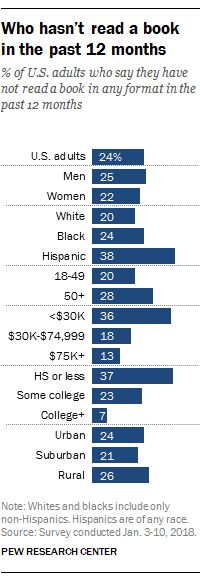
Let’s start with the data that the above video was citing from Pew Research.

ft_18-03-22_nonbookreaders_whohasnt
Source

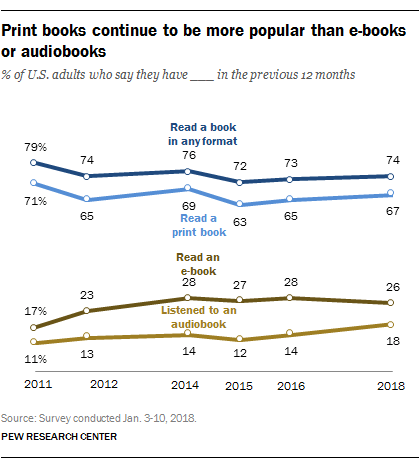
As we can see, the 24% figure is showing that older, poorer, less educated, men (just), and Hispanics read less in the USA. This isn’t a new conclusion, as data from Pew in 2016 shows. The conclusion around the number who don’t read is also similar to the 2016 results of 26% not having read a book in the last 12 months. I’m not sure you can interpret much change over time in the number of people reading, but numbers might be slowly decreasing (although, look at the uptick in audiobooks as that format has come down in price).

ft_18-03-07_bookreading_printbooks
Source

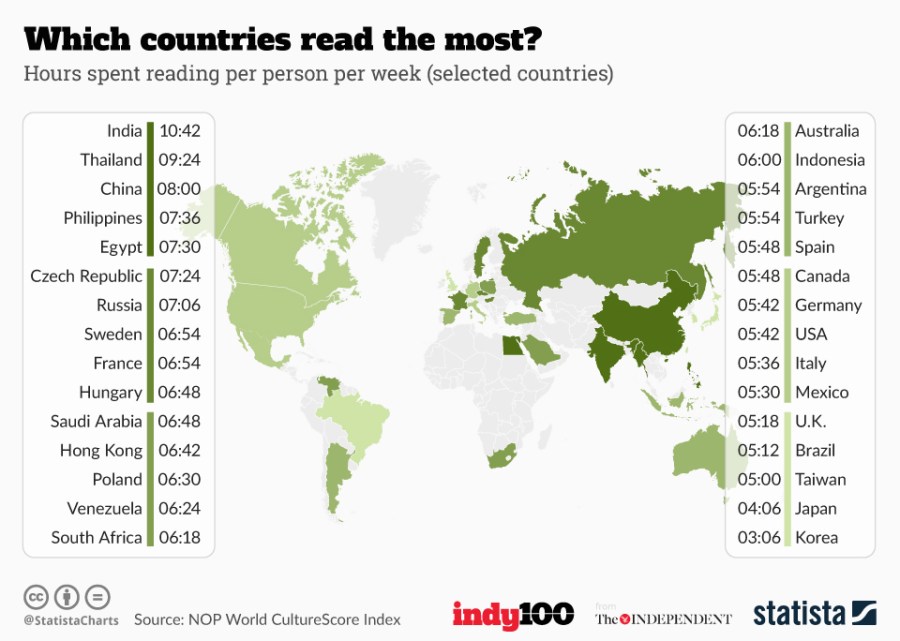
Now we can look at how the USA sits in terms of reading. I’ve previously discussed how Aussies spend roughly 23 minutes per day reading (ABS figures), or an hour a day if you believe the Australian Arts Council report (I suggested there was possible survey bias in that figure). Below you can see that the NOP World Culture Score puts Australia at 6 hours 18 minutes – which I think makes this an “ALL-YOU bench-press” set of numbers.

chartoftheday_6125_which_countries_read_the_most_n
Source: Statista

This chart suggests that the USA is probably typical for English speaking countries, but that many other countries read far more on a weekly basis in terms of hours. Unless reading is code for something else in non-English speaking countries. Maybe they thought they were being asked about how many hours they spent having sex per week.

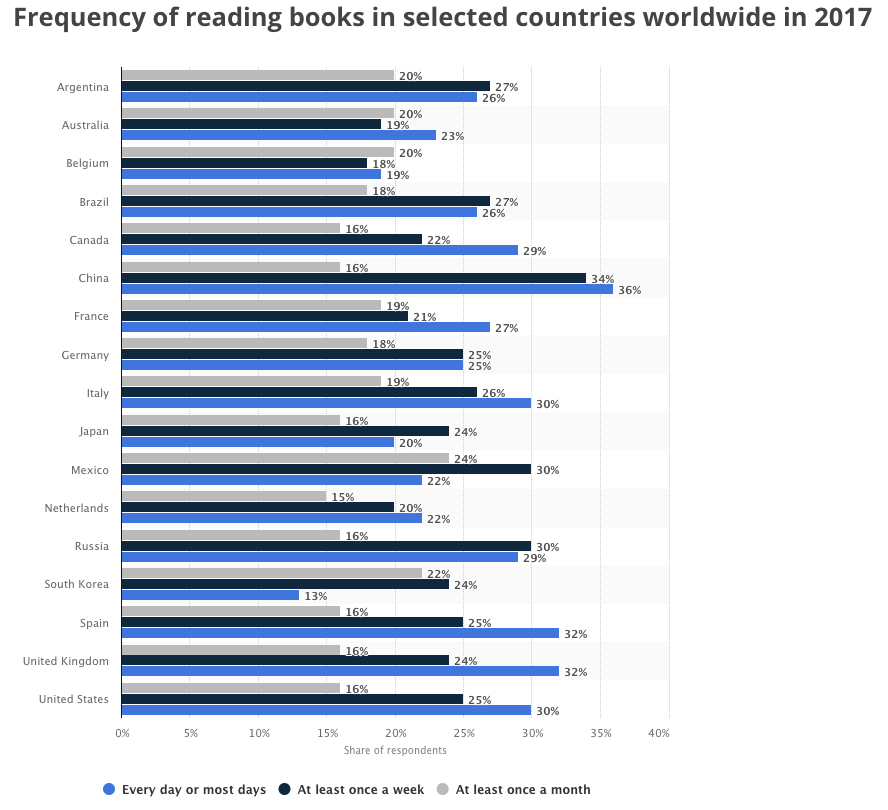
If we then look at the countries and how frequently they read books you can see in the chart below that they were afraid to include the bars for “didn’t read a book”. The high end has only 14% of Chinese people not reading a book, whilst the low end has the Dutch at 43% not reading (USA comes in at 29%, UK 28%, Australia 38% – I demand a recount!!).*

Screen Shot 2018-05-25 at 7.50.23 pm
Source: Statista

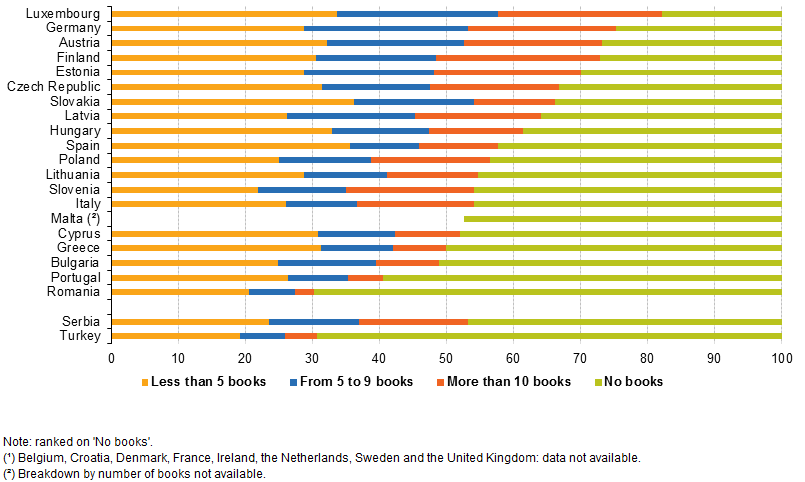
How about the number of books people read, or at least what they claim once they round up?

number_of_books_read_in_the_last_12_months2c_2011
Source: Eurostat
table-2
Source
Screen Shot 2017-10-08 at 6.24.23 PM
Source

What this all shows is that there are plenty of countries where you could ask ten people on the street to name a book and have one or two of them fail. You could ask those ten people what book were they reading today and only three of them could. Isn’t that sad? I reckon people would really enjoy reading if they made time for it. I’ve commented before on why I think people don’t read, suggesting that they don’t because they get told to read literature when they actually enjoy thrillers, sci-fi, and romance.

Maybe it is time to change that before someone sticks a camera and microphone in our faces.

*Be careful with my assumption here. Depending on how the question was asked and any other unreported categories, I may be very wrong in assuming the unreported numbers are non-readers.

Book Review: Electric Dreams by Philip K Dick

Philip K. Dick's Electric DreamsPhilip K. Dick’s Electric Dreams by Philip K. Dick

My rating: 3 of 5 stars

Sometimes you learn that aliens are better than people, so don’t be a jerk and you could stop an invasion.

Electric Dreams is a small sampling of an array of Philip K Dick short stories that were used as the basis for 10 episodes of a TV series of the same name. Dick wrote a huge number of short stories in his career – publishing 121 in a 30-year career, alongside 44 novels. So this selection (collection?) is probably best described as a taste-tester of PKD.

I find it hard to classify PKD as an author. What I have read of his works so far have left me thinking things like: “I was expecting more from this classic”*; “More interesting than engaging”; “Oh look, Deckard realised he lacks empathy so suspects he might be an android.”*** While I think PKD deserves to be acknowledged as a highly influential author I feel this is mainly for his ideas rather than their execution.

This collection was enjoyable on the ideas front and makes for a good sampler of PKD’s work.

*We Can Remember It For You Wholesale
**The Minority Report
***Really? You don’t know what book that is referring to? Would it help if I quoted some lines from the movie?

View all my reviews

My Fellowship at KSP


IMG_0836
A room for writing.

It feels like only yesterday, but it’s actually just over a week since I finished my Fellowship at the KSP Writers’ Centre. What’s a Fellowship? I hear you ask. Actually, I didn’t hear you, but I do hear voices in my head – no, I have an adequate sufficiency of matches, so be quiet. Anyway, I applied for a writing retreat to focus on (finishing….) my novel Evil Corp. Twelve-and-a-half days to do nothing but writing in a purpose built hut.

The writing huts are modeled after Katharine Susannah Pritchard’s own writing retreat and are very much focussed on having a room to write in. Your desk faces out onto the garden – I had a view of a gum tree with a beehive in its trunk – you have amenities for snacks and drinks, a chair for quiet contemplation, and a bed for… well, you know what beds can be used for.

IMG_0838
I had a whiteboard… which I didn’t end up using. And a giant pencil… which I also didn’t use.

The hut was quiet and felt ideally suited to writing. Or painting. Or reading. Or slowly going mad and deciding to live like a hermit. All good options.

IMG_0837
Yes, I brought a guitar.

The best feature was definitely the lack of adjoining accommodation for young children, who slowly steal your hopes and dreams as they consume more of your life than you’d ever imagine, such that you wake up at 40 wondering why you haven’t published a novel yet.

IMG_0835
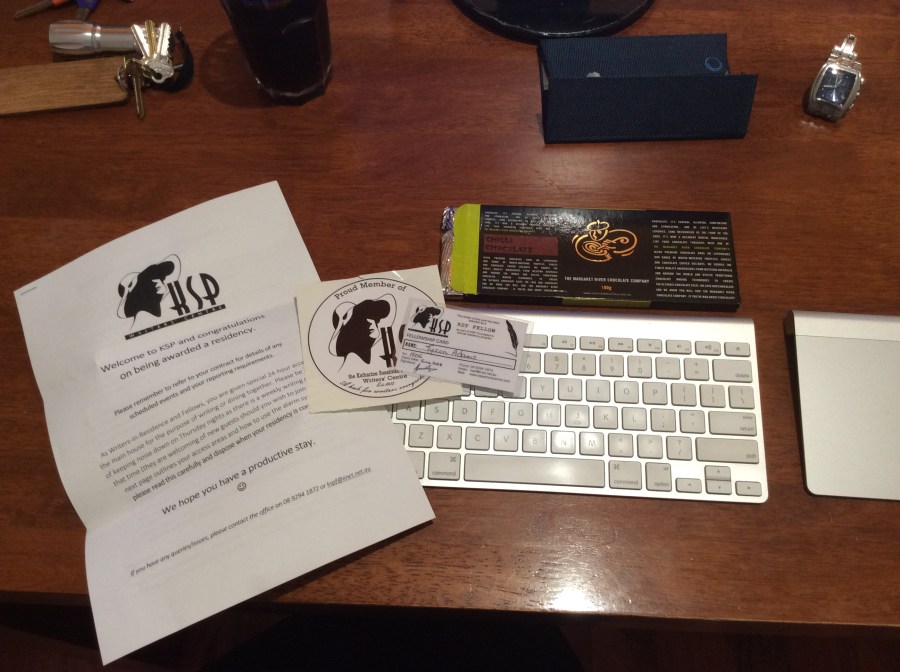
Welcome Pack: Welcome letter, KSP sticker, KSP Fellow card, CHOCOLATE!

With the welcome letter in hand, my computer set up, I was ready to right write!

Getting my author on

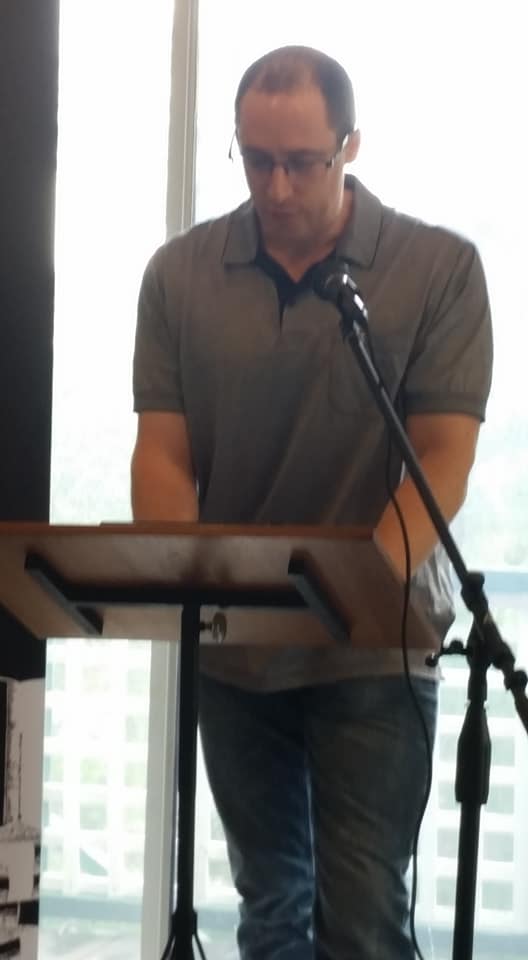
Reading Anne's story at KSP Open day 2018
Not sure if I made this picture blurry by drinking too much caffeine, or if it was the wrong lighting for the camera to focus.

For my stay at KSP I had set a few hard and soft goals. Hard goals were things like: relax and enjoy being able to pursue my hobby uninterrupted for a fortnight; not wake up at 5am because my kids weren’t going to be there; refrain from buying a beret and neck-scarf; write more than 1,000 words per day. Soft goals were things like: wake up before noon; eat properly; get some exercise; try not to feel guilty about leaving my wife alone with our kids; write 20,000 words during my stay. Try to guess which goals I achieved.

I didn’t want to place too much pressure on myself to, say, “finish my novel” or “write 5,000 words a day”, because that would have sucked the fun out of the Fellowship. Having previously won NaNoWriMo, I knew I could write 2,000 words a day for a sustained period, but I was surprised at how having more time to write didn’t necessarily increase output. I’m going to claim that it was higher quality than NaNoWriMo writing though. A low bar I’m willing to jump over. But I did manage to write 20,000 words, do some plotting, create a few characters, outline several chapters for the future, review a couple of books, and come up with two plots for other projects, so it felt productive.

On the first weekend of my Fellowship the KSP Writers’ Centre held their open day. It was a fun event and well attended despite the threats of rain. As the above photo shows, I was asked to do a reading for the event on behalf of one of my writing groups. I read Werespoon by my fellow Fantasy Sci-Fi Horror group author Anne Forbes. Gillian Clarke read on behalf of my other author group, the Thursday Night group.

Another thing that made me feel authorly was mingling with other authors.

Surrounded by other authors

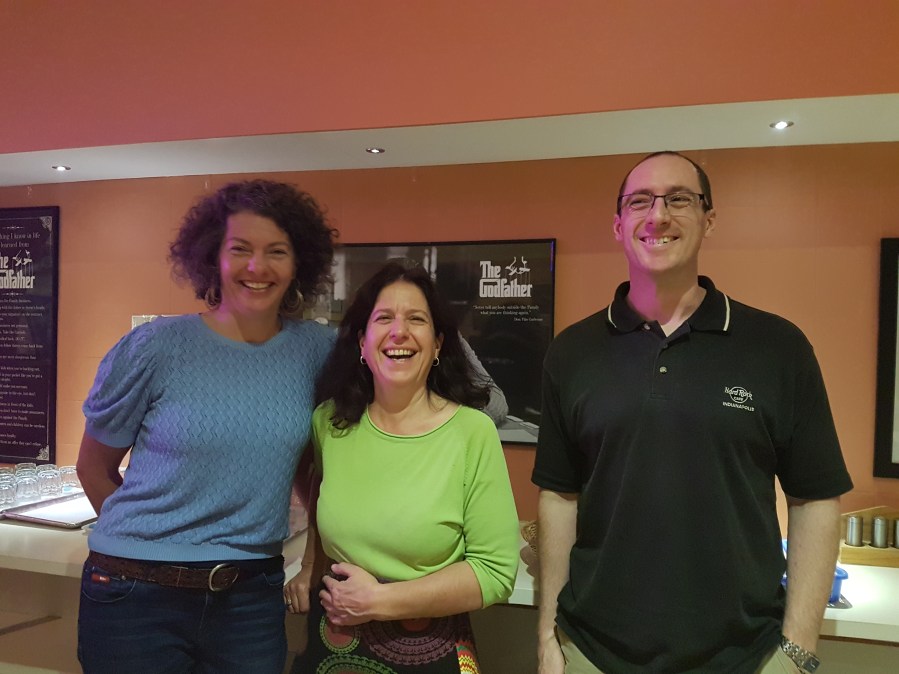
Me Kaaron Warren and Rachel Mead
Rachael Mead, Kaaron Warren, me being told to smile more.

Writing is generally regarded as a lonely occupation. Well, unless you take your laptop to a coffee shop so you can tell anyone who has the misfortune of coming too close that you’re an author and that sitting in a coffee shop telling people about your WIP counts as writing. The KSP cabins were decidedly setup for writing. On your own. Uninterrupted. I brought a guitar. But I still managed to hang out with other authors.

Kaaron Warren and Rachael Mead were also at KSP doing a Residency and Fellowship respectively. Kaaron has been publishing stories since before I’d figured out Coco-Pops didn’t need extra sugar. She was shortlisted for an Australian Shadow Award while she was in residence, and just last week released Tide Of Stone. One evening we were discussing awards (she is a judge for the World Fantasy Awards this year) and she casually mentioned being beaten by luminaries Stephen King and KJ Parker… I’m not sure that counts as losing.

Rachael has a PhD in creative writing and, like Kaaron, an impressive list of awards to her name. She has published multiple poetry collections, including one that came out earlier this year, and regularly contributes arts reviews to magazines. She also writes short stories and was working on what appears to have become a collection themed around paramedics during her time at KSP.

Which made me the bumbling rookie trying not to sound like an amateur around the two pros.

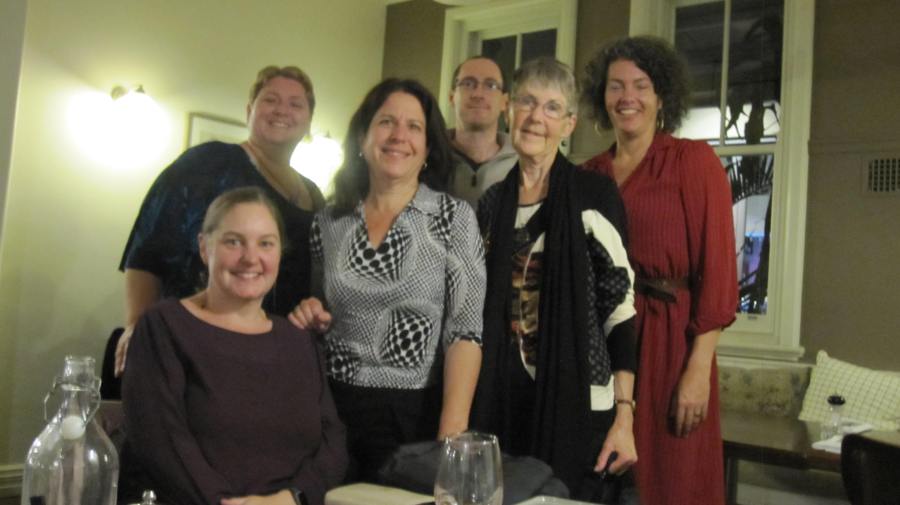
It was invaluable to chat with them over dinner, or at drink-o-clock, or at procrastination time. For example, Rachael helped me with a chapter I was headed in the wrong direction with. But it was also good just to be able to have a chat and socialise, including catching up with an old friend who is a mutual friend of Kaaron’s. If that wasn’t enough wordsmiths to hang out with, we also had a lovely dinner out with some other KSP Fellows. See the blurry photo below that proves kids aren’t necessarily good with technology.

2018-05-10 20.10.41
Dinner with some other KSP Fellows.

Summary

It was great to have the opportunity to feel like a writer and make some progress on (one of) my works in progress. I met some lovely people, got some writing done, and didn’t get woken up by a toddler wanting to find the teddy that is lying right next to them in bed even once. I very much appreciate the board and staff at the KSP Writers’ Centre for awarding me the Fellowship.

Book Review: The Hoodoo Man by Steve Harris

The Hoodoo ManThe Hoodoo Man by Steve Harris

My rating: 5 of 5 stars

Budgie as a weapon? Sure, why not.

Danny Stafford was an ordinary kid until his brother shot him in the face. It was an accident that changed Danny, but it isn’t until his 30s that the change fully takes hold. Now in a stable relationship, renovating a house, and working a dead-end job, Danny’s life is turned upside down. And that’s before the Hoodoo Man starts coming for him.

Back in my formative years, the local librarian introduced me to the adult section of the library after I’d read everything on offer for young adults and kids. This novel, The Hoodoo Man, was the first she pulled off of the shelf for me to try. A brand new horror novel by a UK author. Bit of a leap. But I was hooked. I clearly remember devouring this book, to the point that I missed at least one meal.

Twenty-six years later I wanted to test if my memory of this novel held up. Was The Hoodoo Man as good all these years later, or was I just an impressionable kid who had just discovered his first horror novel? Oh, it stands up alright. It has aged very well and I wasn’t disappointed at all. My immediate response upon finishing was to exclaim “Well, I’m going to have to find more of Steve Harris’ books.”

This is where this story becomes interesting. The Hoodoo Man was Steve’s third novel and it was his most successful, it put him on the map, and became his website’s name. But his career was all but over by the time his seventh novel was released and he retired at the end of the 90s. His career came to an end after his publisher was bought out and he was dumped. He had one completed novel he was shopping around, another in the works, and a third that had originally been intended as his sixth novel but was deemed too terrifying*. Harris’ novels went out of print and after no success in finding a new publisher, he retired from writing and ran to the hills**.

In this day and age, a writer in this situation would probably take their back-catalog and self-publish, then release their new material. Of course, a publisher would be unlikely to let an author go out of print. But it does make me wonder how many authors are in a sense lost to us because of the machinations of the publishing world. I guess they won’t be getting any money from me*** hunting down Harris’ back-catalog in the secondhand stores.

*The Switch was an attempt by Steve to bring the reader as close to feeling actual pain as possible. Back when his website was active I read an excerpt and can confirm that he succeeded. I have never looked at liver the same since.
**This bad reference to Iron Maiden’s bass player of the same name brought to you by the number 666.
***Obviously, Steve won’t be either.
http://www.shadow-writer.co.uk/kinter…

View all my reviews

Book Review: Riot Act by Zoe Sharp

Riot Act (Charlie Fox, #2)Riot Act by Zoë Sharp

My rating: 4 of 5 stars

Those in council housing shouldn’t throw stones. Molotov cocktails are much better.

Charlie Fox is dog and house sitting in a rough neighbourhood for her friend. After some kids manage to seriously injure her neighbour during a robbery, a vigilante mob and a security group move into the area. Ulterior motives abound and Charlie is stuck in the middle of it all as the violence is let loose.

It has been awhile since I’ve picked up a Zoe Sharp thriller. After reading a couple several years ago I went on a spending spree, but haven’t gotten to them until now. I do enjoy reading a female lead thriller written by a female author. Zoe brings something very different to the story that you don’t get from her contemporaries in the genre – her writing has been compared to Lee Child, similar to how all comedy shows are compared to The Office.

Riot Act keeps the intrigue and action coming in steady measures. This was an enjoyable thriller.

View all my reviews

What genre is the 2008 book Outliers in? What are some similar books in that genre?

efc6e32f85a3821257e73ea41733271737e761e4853c341459263864ed2e6483

The book Outliers by Malcolm Gladwell is a popular example of fiction.

Outliers is probably most famous for promoting the idea of the 10,000 Hour Rule based on how many hours it will take you to get good at doing something. But like all good fiction, it ignores the reality of how skills are acquired.

Unfortunately, many people have mistakenly assumed that Gladwell’s writing should be classified as non-fiction pop-science, or even worse, factual. This has lead many researchers to waste time and resources showing that the 10,000 Hour Rule is nonsense, and that Outliers is pop-science at its worst – i.e. incredibly influential despite being clearly nonsense.

Reviewers of the book have noted the flaws in calling this book non-fiction*:

In an article about the book for The New York TimesSteven Pinker wrote, “The reasoning in ‘Outliers,’ which consists of cherry-picked anecdotes, post-hoc sophistry and false dichotomies, had me gnawing on my Kindle.”[20]

In a review in The New Republic, Isaac Chotiner called the final chapter of Outliers “impervious to all forms of critical thinking”.[21]

And several researchers have debunked many factual claims made in the book*:

Case Western Reserve University’s assistant professor of psychology Brooke N. Macnamara and colleagues have subsequently performed a comprehensive review of 9,331 research papers about practice relating to acquiring skills. They focused specifically on 88 papers that collected and recorded data about practice times. In their paper, they note regarding the 10,000-hour rule that “This view is a frequent topic of popular-science writing” but “we conducted a meta-analysis covering all major domains in which deliberate practice has been investigated. We found that deliberate practice explained 26% of the variance in performance for games, 21% for music, 18% for sports, 4% for education, and less than 1% for professions. We conclude that deliberate practice is important, but not as important as has been argued”.[24]

Statistical analyst Jeff Sauro looked at Gladwell’s claim that between 1952 and 1958 was the best time to be born to become a software millionaire. Sauro found that, although the 1952–1958 category held the most births, “[a] software millionaire is more than twice as likely to be born outside the 1952 to 1958 window than within it.” Sauro notes that Gladwell’s claims are used more as a means of getting the reader to think about patterns in general, rather than a pursuit of verifiable fact.[25]

In fact, the 10,000 Hour Rule seems to irk people in the social sciences quite a bit. E.g. Practice Does Not Make Perfect – We are not all created equal where our genes and abilities are concerned.

Are there similar authors and similar books using misleading, cherry-picked, and tenuous research to make broad sweeping pop-science claims that make people feel good? Of course. Plenty of them. It is a minefield in the non-fiction section of bookstores, which I think should be more accurately renamed “Boring Fiction”. So I think it would be negligent of me to recommend more books like Outliers or authors like Malcolm Gladwell. Especially when Gladwell has argued that the truly disadvantaged are the rich, is a corporate propagandist who has argued that we need smokers to fund healthcare, and really doesn’t like engaging with critics.

*Quotes taken from Wikipedia.

This answer originally appeared on Quora.

How can someone from Australia, get into an American University such as Harvard?

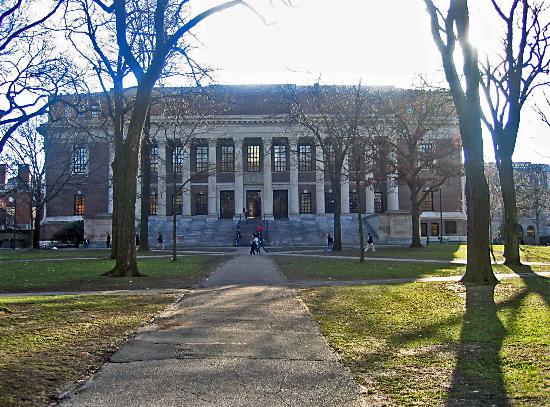
Widener Library, Harvard University

Australians have a proud history as the descendants of convicts. As such, there is no place we can’t break into if we so desire.

The first thing is the loooonnngg plane ride from Australia to the US. Due to US Customs, it is advisable not to bring your B&E equipment with you but rather acquire it from those new-world criminals in the USA.

The second thing is staking out the campus. Surveillance is the key to any decent break-in. You will need good notes from your observations to use in the next step.

The third thing is to have a plan for your break-in. Know your target, ingress point, egress point, contingencies, and make sure you have a cover identity setup just in case things go south.

The final point is to make sure your risk:reward ratio is balanced enough to make the operation worth it. There is nothing worse than putting the time and front money in place for low returns, especially if the penalties are high.

Of course, you could just send in an application to Harvard like every other Aussie student who applies to US universities. Maybe the ex-Harvard Student Association in Australia could be of help.

This post originally appeared on Quora.


Millenials aka Kids These Days

I’m not a fan of the “kids these days” arguments and memes that make their way through social media via the express head shaking admonishment brigade. I’ve written previously how the arguments are recycled garbage, as old people have been complaining about young people since the invention of youths.

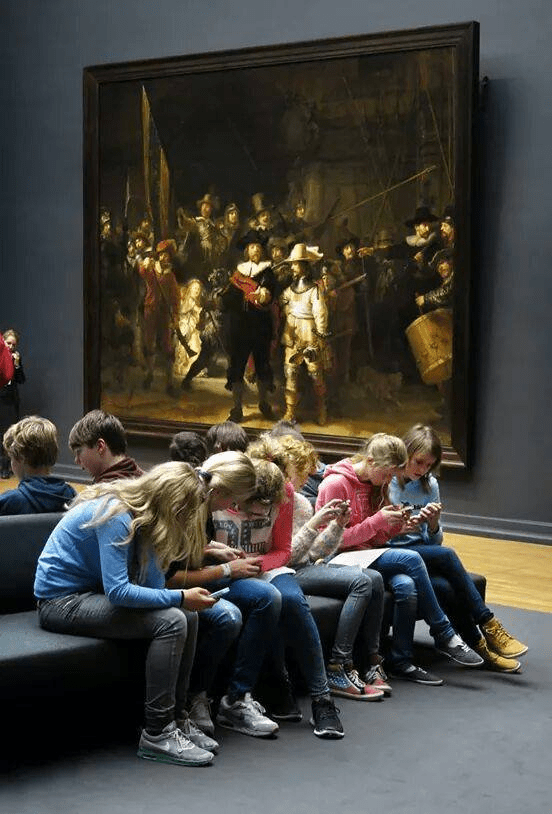
You may have seen this image:

kids on their phones

That’s right: self-involved kids looking at their phones instead of the amazing work of art behind them. How dare they! Shake your fist at the sky.

Of course, they aren’t self-involved narcissists, at least not any more so than other people in society. That is actually a group of students that have just finished admiring the artwork and receiving a lecture on the Rembrandt and are now using the museum guided tour app to learn more. To quote:

Late last year this photograph of children looking at their smartphones by Rembrandt’s ‘The Night Watch’ in the Rijksmuseum in Amsterdam started doing the rounds on the web. It quickly became viral. It was often accompanied by outraged, dispirited comments such as “a perfect metaphor for our age”, “the end of civilisation” or “a sad picture of our society”.

Only they weren’t. It turns out that the Rijksmuseum has an app that, among other things, contains guided tours and further information about the works on display. As part of their visit to the museum, the children, who minutes earlier had admired the art and listened attentively to explanations by expert adults, had been instructed to complete an assignment by their school teachers, using, among other things, the museum’s excellent smartphone app.

I would like to think that all those who liked, posted, shared and tweeted the picture of children on smartphones by Rembrandt’s masterpiece in the erroneous belief that it illustrated everything that is wrong with society feel a tiny bit silly and a little more humble as a consequence. But it won’t happen. The tragic thing is that this — the truth — will never go viral. So, I wonder, what is more likely to bring about the death of civilisation, children using smartphones to learn about art or the wilful ignorance of adults who are too quick to make assumptions?

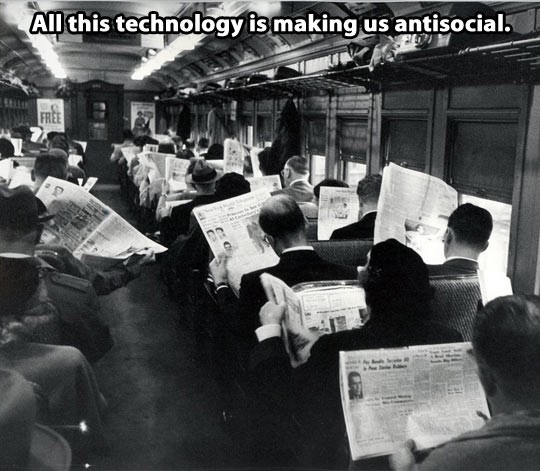
Whether it be art, technology, manners, or just plain old-fashioned respect for elders, people seem far too quick to complain about kids these days. It always seems to have been better in the good old days, as long as you ignore the wars, child death rate, education levels, work and social rights, equality, food…. actually I’ll stop that list now before I run the point into the ground. So take any of these arguments, images, and claims with huge pinches of salt, as there is probably a parallel version from a previous generation.

tech making us antisocial

2,500 years of kids these days.

Update: Hey look, someone actually did some science to show I was correct.

Do we consume media?

encoding_decoding_of_broadcast_structures

It is common for us to refer to books we read, movies and TV shows we watch, and whatever it is we do with news, in terms of consumption. But is that accurate? PBS Ideas Channel has an interesting video on this topic.

I like the idea of decoding as an explanation for how we interact with media. It certainly offers a better explanation for how some people will interpret something completely differently than if they were to merely consume it. Decoding also makes me feel much better about writing violent stories, and that is the important thing here: justifying stuff I already like.

Average Movie Superhero

the-rock-vin-diesel-wrestlemania-33
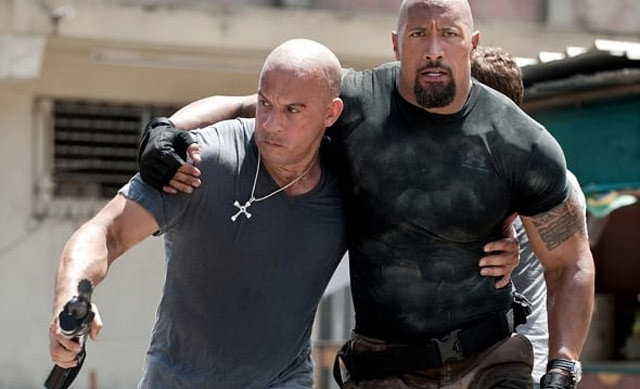
With the recent spate of superhero movies, it is easy to forget that not every movie has a superhero in it. Even the superhero films aren’t always about someone on steroids (Captain America) or weather presenters (Thor) but are instead about your everyday billionaire playboy (Batman, Ironman, Arrow). So it is easy to forget that feats of superhuman strength are not meant to be the norm in films.

Think about the scenes where the everyday hero is clutching the edge of a building by his fingertips – and I’m sure someday I’ll be able to write their instead of his. Valiantly they hold on to the ledge with one hand whilst the love interest or bad guy is dangling from their other hand. Of course, the hero never loses his grip on the ledge, but the bad guy may slip from his grasp.

We accept that scene as plausible because we have been brainwashed into thinking that the average person can hold their own bodyweight with a single hand for extended periods. Double their bodyweight? They can hold that for the length of a dramatic moment – a period of time that is impossible to measure in real time since dramatic speeches and slow motion really mess with reality.

The problem is that outside of gymnasts, rock climbers, or people who crush rocks with their bare hands for a living, the Average Joe wouldn’t even be able to hold their own weight with a single hand for more than a few seconds. Good luck having any unbroken fingers if they caught themselves from a fall.

Elite grip strength can be measured a few ways, but the Captains of Crush grippers are one easy way to distinguish strong hands. The #1 requires 64kg (140lbs) of force to close, while the #3 gripper takes 127kg (280lbs) and is regarded as world class grip strength. Just for shits and giggles they made a #4 gripper that requires 166kg (365lb) of force to close and has been officially closed by 5 people. Ever.

So let’s just assume that our generic action movie has an everyday hero who weighs a buff 80kg and his falling love interest is a sexy 55kg – because stereotypes. That’s 135kg hanging from the hero’s fingertips, a weight that even a really strong person wouldn’t have the grip strength to support. Two normal sized adults are not going to be hanging onto that ledge for any length of time.

Which brings us to the next amazing feat of strength in this scenario: lifting that falling love interest back to safety. For a strong person, lifting their 55kg love interest should be easy. Patrick Swayze managed it in Road House. A buff 80kg hero could probably clean and jerk a dumbbell weighing that much…. assuming they work out, have some chalk on their hands, were able to get some leg drive happening, had decent technique, and that the dumbbell wasn’t particularly unwieldy. But most falling love interests are a tad unwieldy, not designed for easy lifting – no obvious knurled handles – and there isn’t a lot of leg drive happening when you’re dangling from the side of a building by your fingertips. Yet without fail, the hero manages to get them both to safety. Well, unless it is one of those tragic character defining moments, in which case the hero will be in the same situation later and will find the determination to succeed the second time. Sucks to be the first love interest in that scenario.

Interesting to think about just how many amazing feats of strength are passed off as normal in movies.

Book Review: Edenverse by Matt Hawkins

Screen Shot 2018-04-19 at 8.19.16 PM
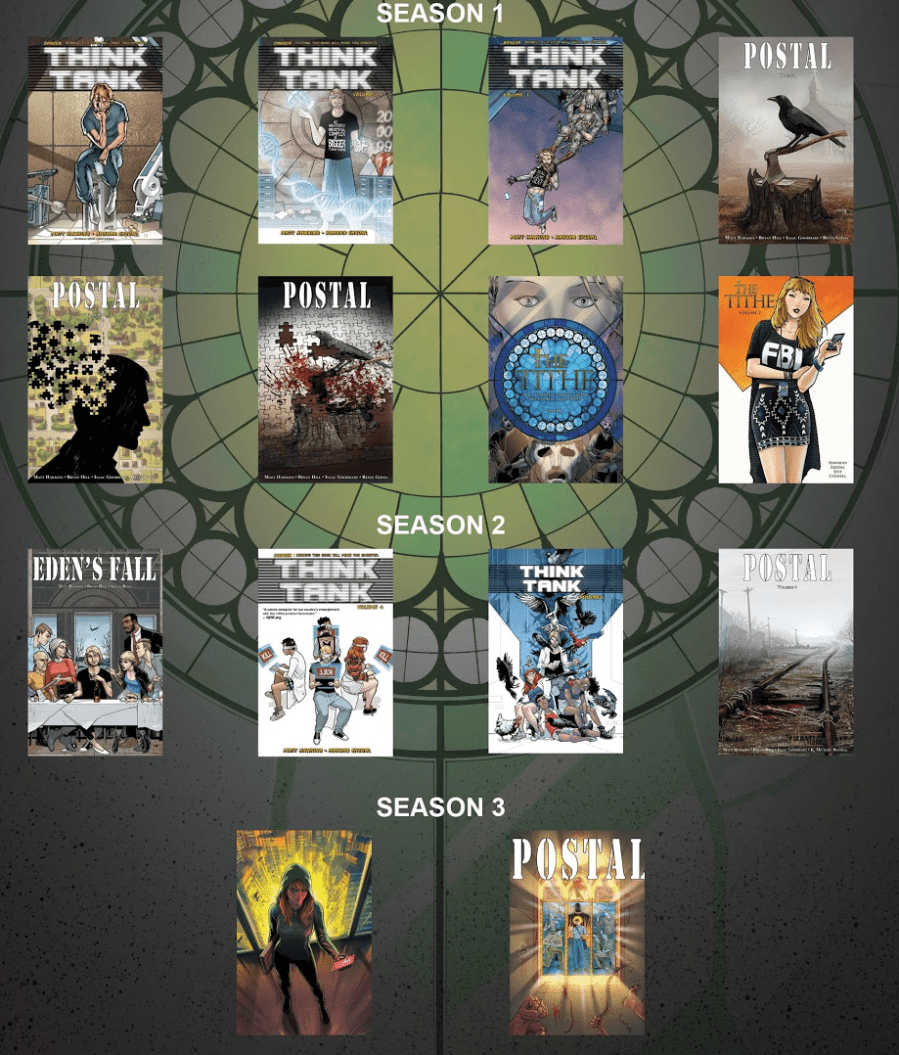
Edenverse: Think Tank, Postal, The Tithe, Eden’s Fall, Samaritan by Matt Hawkins

My rating: 4 of 5 stars

Smart people take on the government. Because they should.

Back in 2012, I stumbled upon the first instalment of Think Tank from indie comic publisher Top Cow. This was back when online stores selling e-comics were still not completely up with technology. I bought Issue #1 and then tried to read it. It wouldn’t download to my comic reading app. I tried to send it to my iPad. It didn’t like the strange format. I tried reading it in the store’s very own comic app. It suggested my iPad and computer were too new.

I won’t go into the details of exactly how I read that first issue (hint: comic files are just a bunch of pictures if you can slice them open), but even with all of the frustration of this first purchase I still enjoyed the story.

Dr. David Loren is many things: child prodigy, inventor, genius, slacker… mass murderer. When a military think tank’s smartest scientist decides he can no longer stomach creating weapons of destruction, will he be able to think his way out of his dilemma or find himself subject to the machinations of smaller men?

So started a five-year avid following of one of the more interesting techno-thriller series I’ve come across. Unfortunately, I switched from buying individual issues to the collected volumes, which were entirely more reliable in those early years of e-comics. I say unfortunately because as a result, I didn’t realise that Think Tank was part of an expanded universe – something the last few pages of regular issues highlights with previews.

Now I’m caught up. In particular, The Tithe and Samaritan are excellent additions to the Think Tank universe (Edenverse, named after the town in the Postal series). Matt Hawkins and illustrator Rahsan Ekedal have pulled together a collection of political machinations, high-tech possibilities, real-world issues, and social commentary for a brilliant collection of comics. Seriously, they have references for the topics, tech, and background at the end of each book, something that tickles my inner scientist with delight.

I highly recommend these series to comic fans, especially those who like techno-thrillers or crime-thrillers.

View all my reviews