One pointlessly heated discussion that seems to occur with painful regularity in reading circles is which book format is superior. Do you prefer audio, or digital, or paper, or papyrus, or clay tablets? Personally I can’t see anyone topping the long-term data retention of carving stuff into stone cave walls. Bit time-consuming for authors though.
When this discussion starts everyone rolls out their usual banal reasoning for their preferred format. Without fail someone will talk about the smell of dead tree books (DTB), or the feel of eviscerated tree flesh in their fingers, or refer to some dodgy research that denigrates e-books. For some reason the reading world is filled with technophobic troglodytes intent on proving that their old-fashioned way of doing things is better.
Currently I read books in three different formats: DTB, e-book, audiobook. I like reading all three formats and they have various advantages and disadvantages. I have many fond memories of dead trees. The time I used one to level a table with an uneven leg. The time I threw one at the TV on election night. The time I used a bag full of them to prop open a door with a hydraulic hinge. Good times. I’m sure I have some fond memories of e-books and audiobooks…
Let’s run through a few pros and cons of the three formats.
DTB Pros:
They are a book.
You can read them.
They make you look smart/nerdy when you have lots of them on shelves.
Can turn to the end of the book to see if that character actually died.
DTB Cons:
Being a physical entity they have to be physically moved to your house.
Generally more expensive than an e-book.
Are heavy and awkward to hold.
Hate having tea spilt on them.
Can’t stop a .45 slug, despite claims to the contrary.
E-book Pros:
They are a book.
You can read them.
When you want another you just download it instantly.
Everyone thinks you are reading the latest political biography when you are really engrossed in the love triangle between a teenage girl, a 100-year-old pedophile, and a smelly dog (yes I got dragged to the Twilight films by my wife).
Text can be resized.
E-book Cons:
E-books can’t be used to start a fire in a life threatening situation.
E-book files won’t be forever, but the database will be, which means updating your collection.
E-readers cost money too.
Dedicated e-readers are the domain of avid readers, everyone else can just read on their phone or tablet.
Hate having tea spilt on them.
E-readers are even less likely to stop a .45 slug.
Audiobook Pros:
They are a book.
You can read them.*
Can be read when you’re doing something else.
Exercising and reading is a personal favourite.
Certainly a better way to read when driving.
Audiobook Cons:
Can be expensive.
Are becoming cheaper in digital versions.
Some voice actors don’t have great voices, nor acting.
Takes longer to read… unless you read by sounding out the vowels still.
Are probably the least likely to stop a .45 slug.
What is my key point out of all of this? If you like reading you will like reading regardless of the format. The medium isn’t the message.
The reality is that we have to stop with the snobbery of the format wars. Every format has benefits to enjoy. Every person I have met who has bravely tried e-books and audiobooks has commented that they were unsure until they made the leap. Then they fell in love with all the formats.
I love books in all their forms, you should too.
*Yeah, go ahead and try and argue that point. I dare you.
Most companies and organisations have an FAQ page these days. What should be a chance to address Frequently Asked Questions often turns into a telling display of the values the company or organisation holds. A lot can be gleaned from the FAQ, and not just opening times and how many health code violations they have accumulated.
Recently I was looking for local martial arts facilities and came across an FAQ page that painted the organisation in a bad light. This isn’t the only poorly written FAQ I’ve come across, but I’ll use some quotes from it as an example.
What you don’t include says as much as what you do include.
FAQs are meant to be about sharing information. Hey, we’re a friendly organisation, just letting you know a bit more about us. So when you avoid sharing information you come across as deceptive as a used car salesman, or as useless as a Scottish underwear store.
How much does training cost?
We do not have contracts or direct debit arrangements; you simply pay the fees to your Branch Instructor at the beginning of each calendar month. You do not pay any fees for months in which you do not train. Our monthly training fees are probably the lowest on average for any mainstream martial art school in Australia.
So, those fees would be how much again?
By not actually including the pricing people can only assume that the fees are ridiculously high, or that they want you to sign over your soul as payment. At least they don’t straight up ask for your firstborn.
Obviously the answer was intended to convey that the fees were competitive to similar services, and that they have easy payment options. They probably didn’t include the pricing because it probably varies by dojo and class sizes. But by not putting these competitive prices in the FAQ it gives the impression that a guy with a curled up moustache will con you into signing up to a ski resort timeshare, while also pressuring you to join up and pay exorbitant fees.
Lesson: be transparent.
What you do say says a lot about you.
If you are a relaxed organisation or business you might include some joke Q&As. If you are friendly you might include some oversharing information to appear personable – or possibly unhinged if you go too far. If you are a jerk then you won’t be able to help yourself.
Can I compete in tournaments?
No. [Our martial art] is a traditional martial art, not a martial sport. We train to perfect technique for real self-defence applications, not for point-scoring or competitions. We believe that, as opposed to the sports approach, the traditional art approach builds physically stronger and more mentally confident practitioners.
So, other martial arts suck?
Nothing makes you sound like a prat more than belittling others…
I’m doing this to help. Not to be a prat. Honest.
Obviously you want to promote your organisation or business, and obviously you think your organisation or business is better than others. But there are ways to do that without walking over to the competitor’s place and taking a dump in the middle of the floor.
This answer could have been phrased in many ways. They could have suggested that their martial art is a good base for moving onto sports applications, perhaps name drop some members who have done that. They could have just left the answer at stating the two are quite different styles of the same martial art, and they focus on the self-defence style. Instead they couldn’t help but stick the boot in and suggest the other styles are crap.
Lesson: don’t be a dick.
How you say something says a lot about you.
There are several ways to say the same thing. There are several ways to skin a cat. If you decide to skin that cat by starting from the tail down, it says one thing, whilst starting once the cat is dead says something else. What the hell did that cat ever do to you anyway?
Can I cross-train in other martial arts?
No. [Our martial art] is a traditional martial art, so all members are expected to show the traditional loyalty to a single master instructor… Bear in mind that our general philosophy is that it is better to learn one art, and learn it extremely well, than to learn several arts to a lower level.
So, I should phone you before I make any decisions? Do I pledge my fealty in writing or by polishing your shoes with my tongue?
What was obviously meant to be a diplomatic answer about the rise of mixed martial arts (MMA) and people learning multiple skills, comes off as a decree about slavishly devoting your soul to this martial art and the master. How dare you be unfaithful!
The mindset of telling someone what they can and can’t do in the hours they don’t spend at this dojo is that of a manipulative bully. You will obey. You will conform. And we’re doing it for your benefit, so you will take our abuse and love us for it. You kinda expect them to have a lesson listed on how to be abusive to your spouse or partner somewhere else on the website.
They could have stated that most students don’t cross train. They could have paraphrased some Liam Neeson, ‘You will learn a particular set of skills. Skills you will acquire over years of dedicated training. Skills that will make you awesome at breaking boards.’ Instead they showed themselves to be exactly the sort of people you don’t want to learn martial arts from.
It’s 20 years on June 26 since the publication of Harry Potter and the Philosopher’s Stone, the first in the seven-book series. The Philosopher’s Stone has sold more than 450 million copies and been translated into 79 languages; the series has inspired a movie franchise, a dedicated fan website, and spinoff stories.
Goodreads
I recall the long periods of frustration and excited anticipation as my son and I waited for each new instalment of the series. This experience of waiting is one we share with other fans who read it progressively across the ten years between the publication of the first and last Potter novel. It is not an experience contemporary readers can recreate.
The Harry Potter series has been celebrated for encouraging children to read, condemned as a commercial rather than a literary success and had its status as literature challenged. Rowling’s writing was described as “basic”, “awkward”, “clumsy” and “flat”. A Guardian article in 2007, just prior to the release of the final book in the series, was particularly scathing, calling her style “toxic”.
My own focus is on the pleasure of reading. I’m more interested in the enjoyment children experience reading Harry Potter, including the appeal of the stories. What was it about the story that engaged so many?
Before the books were a commercial success and highly marketed, children learnt about them from their peers. A community of Harry Potter readers and fans developed and grew as it became a commercial success. Like other fans, children gained cultural capital from the depth of their knowledge of the series.
My own son, on the autism spectrum, adored Harry Potter. He had me read each book in the series in order again (and again) while we waited for the next book to be released. And once we finished the new book, we would start the series again from the beginning. I knew those early books really well.
‘Toxic’ writing?
Assessing the series’ literary merit is not straightforward. In the context of concern about falling literacy rates, the Harry Potter series was initially widely celebrated for encouraging children – especially boys – to read. The books, particularly the early ones, won numerous awards and honours, including the Nestlé Smarties Book Prize three years in a row, and were shortlisted for the prestigious Carnegie Medal in 1998.
The seven books of the Harry Potter series, released from 1997 to 2007. Alan Edwardes/Flickr, CC BY-NC-ND
Criticism of the literary merit of the books, both scholarly and popular, appeared to coincide with the growing commercial and popular success of the series. Rowling was criticised for overuse of capital letters and exclamation marks, her use of speech or dialogue tags (which identify who is speaking) and her use of adverbs to provide specific information (for example, “said the boy miserably”).
The criticism was particularly prolific around the UK’s first conference on Harry Potter held at the prestigious University of St Andrews, Scotland in 2012. The focus of commentary seemed to be on the conference’s positioning of Harry Potter as a work of “literature” worthy of scholarly attention. As one article said of J.K. Rowling, she “may be a great storyteller, but she’s no Shakespeare”.
Even the most scathing of reviews of Rowling’s writing generally compliment her storytelling ability. This is often used to account for the popularity of the series, particularly with children. However, this has then been presented as further proof of Rowling’s failings as an author. It is as though the capacity to tell a compelling story can be completely divorced from the way a story is told.
Daniel Radcliffe in his first outing as Harry Potter in the Philosopher’s Stone, 2001. Warner Brothers
Writing for kids
The assessment of the literary merits of a text is highly subjective. Children’s literature in particular may fare badly when assessed using adult measures of quality and according to adult tastes. Many children’s books, including picture books, pop-up books, flap books and multimedia texts are not amenable to conventional forms of literary analysis.
Books for younger children may seem simple and conventional when judged against adult standards. The use of speech tags in younger children’s books, for example, is frequently used to clarify who is talking for less experienced readers. The literary value of a children’s book is often closely tied to adults’ perception of a book’s educational value rather than the pleasure children may gain from reading or engaging with the book. For example, Rowling’s writing was criticised for not “stretching children” or teaching children “anything new about words”.
Many of the criticisms of Rowling’s writing are similar to those levelled at another popular children’s author, Enid Blyton. Like Rowling, Blyton’s writing has described by one commentator as “poison” for its “limited vocabulary”, “colourless” and “undemanding language”. Although children are overwhelmingly encouraged to read, it would appear that many adults view with suspicion books that are too popular with children.
There have been many defences of the literary merits of Harry Potter which extend beyond mere analysis of Rowling’s prose. The sheer volume of scholarly work that has been produced on the series and continues to be produced, even ten years after publication of the final book, attests to the richness and depth of the series.
A focus on children’s reading pleasure rather than on literary merit shifts the focus of research to a different set of questions. I will not pretend to know why Harry Potter appealed so strongly to my son but I suspect its familiarity, predictability and repetition were factors. These qualities are unlikely to score high by adult standards of literary merit but are a feature of children’s series fiction.
This month Cinefix’s What’s the Difference? tackles the underappreciated Edge of Tomorrow, and it’s source material, All You Need Is Kill. I’d so watch a film called All You Need Is Kill, even if it did have Tom Cruise in it.
Unfortunately I haven’t read the Manga, which appears to have some differences between it and the novel. I read the light novel of All You Need Is Kill before watching the movie. Whilst there are major similarities between the two, they are quite different. Edge of Tomorrow flirts with comedy, while anything with the title All You Need Is Kill is clearly going to have a darker tone. A film starring Tom Cruise is always going to have a Hollywood glamour to it that a novel can dispense with.
The biggest difference between the two is the ending. I said in my review of the film that they should have stuck with the book’s ending. The way the movie ended was the equivalent of “it was all a dream”, whilst the book ending had consequence and substance. Admittedly, watching Tom Cruise kill Emily Blunt would have had audiences outraged (#TeamBlunt) but I’m sure they could have deus ex machina-d something better than what was served up.
Interestingly, Hiroshi is writing a Manga sequel and they’ve announced a movie sequel. I wonder how similar those two will be?
An important point was left out of this book: The history of philosophy is also a history of drunks.
Bertrand Russell has attempted to give a brief overview of the History of Western Philosophy. In this 900 page tome he touches on the major figures, major fields of thought, and the socio-political backgrounds that influenced (and were influenced by) them. Russell also offers up some critique on these aspects, because it wouldn’t be a philosophy book if it wasn’t doing so.
This description sounds like anathema to entertaining reading, and it would be if it wasn’t being tackled by someone like Russell. Bertrand has a very clear, concise, and accessible writing style, and is easily able to explain in plain language even the most complex of philosophical ideas. Normally reading philosophy reminds me of reading genetics textbooks, as it is overstuffed with pedantry and jargon, Russell makes it feel like he is uses no jargon or technical terms.
It should also be noted that Russell is snarky to the point that you find yourself having to laugh and share his comment with someone. His comments are withering and witty, but they also serve as a great way of highlighting the flaws with certain arguments or “great” thinkers. If there are a few takeaway points from this book it is that the great minds were way ahead of their time, but that those same minds were confined by the structures of their time. It makes you wonder how many of today’s ideas are going to look silly and biased to future peoples.
This isn’t really a book to read about certain philosophers, nor fields of thought. A History of Western Philosophy is more a cliff notes version of several thousand years of thinking. Definitely an emphasis on the history and context. And it is all viewed through Russell’s eyes, his snarky, snarky, eyes.
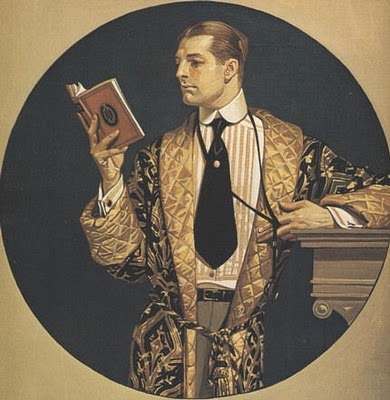
When I think of literature I think of an older guy sporting a greying moustache, sipping a sherry, wearing a smoking jacket, seated in a library of leather-bound books in front of a simmering log fire. The guy speaks with an aristocratic English accent and expounds on the greatness of some book that other older men dressed like him, sitting in similar log-fire warmed libraries, also like to read when not shagging the maid.
Aspiring literary snob reader
Now clearly not everyone who reads literature fits this image. Some probably can’t even afford a maid to shag. But it does appear to be an image that people aspire toward, an image that informs what they deem literature, and thus what they deem worthy of reading. Rather than judging any written work based upon its lasting artistic merit – although that definition is so subjective as to be useless and ideal for starting pointless arguments…. (cough) – people seem intent on creating boundaries before a work is allowed to be judged. They must defend Fort Literature from the invading Lesser Works.
Normally I’d launch into a whinge about how speculative fiction is unfairly maligned, or how I’ve read crime fiction that has more artistic merit than most literary works. But instead, I’m going to talk about graphic novels. In an article on The Conversation, Catherine Beavis explained how the graphic novel Maus came to be part of the literature curriculum.
Despite this explanation, there was always going to be someone in the comments telling us how a graphic novel can’t be literature. I assume they wrote their comments whilst wearing a smoking jacket and taking a break from shagging the maid.
Well well……..so it’s art as literature.
Why not a more well-known comic (sorry graphic novel).
Not saying this isn’t a worthy addition to any curriculum, but more as social comment rather than literature.
Surely the novels of great Australian writers should be preferable – Winton, Malouf, Carey etc.
Let’s break these points apart one by one. As will be seen from further comments, the argument primarily revolves around the feelpinion that because graphic novels contain pictures they are art and thus not literature. A similar argument could be made for movies being TV shows and thus we could abolish the Oscars… actually, that isn’t a bad idea. Anyway, I guess we’d better break the news to the literature professors that Shakespeare’s plays need to be taken off of the curriculum.
The argument then moves to the “I haven’t heard of it, so it can’t be good” assertion. Maybe because they realise this isn’t a great argument, they immediately distance themselves from it. But we start to see the “worthy“ argument being formed. I’ve argued many times that “worthy“ is a great subjective argument put forward by people who think they are worthy.
Of course, it wouldn’t be a literary argument if someone didn’t cite some authors they deem worthy. For those unfamiliar with Winton, Malouf, and Carey, they are award-winning Aussie authors who write “interior histories” and about “people rebuilding their lives after catastrophe” and “people who experience death and will never be the same again”. None of those statements could be applied to a graphic novel about someone who survived the Holocaust… No sir.
Their list of worthy authors is as subjective as their comments about graphic novels and Maus. I could similarly ask why the Hitchhikers Guide to the Galaxy isn’t on the curriculum. It has a lot to say about society and has entered the lexicon, which is more than can be said for any of the other authors mentioned nor the graphic novels being shunned. I could say the same again about Superman or Spiderman, which have implanted ideals and phrases of morality into society, regardless of whether people have read those graphic novels or not.
*Steps on soapbox*
I personally welcome any work into the class that will encourage kids to read, think and learn. And to anyone who derides graphic novels, they are clearly saying they don’t or haven’t read any.
*Steps down from soapbox*
The commenter responded to criticism of their subjective opinion:
That may be so, but my bigger point was that literature = words.
This is art with captions.
Not disputing that it may be hugely popular or good (even great)…
but literature it ain’t.
I think the appropriate response to this is a head shake. The problem is the black and white definition of what literature is, whilst ignoring the fact that the graphic novels fit the definition of literature. Pointing out the flaws in these opinions is as easy as saying that graphic novels, with very few exceptions, are composed of words. They also use graphics, but that is often a collaboration between the writer and the artists they work with. Thus, by the definition of “literature = words”, graphic novels are eligible to be classified as literature.
But anything to keep only the “worthy” books in contention as literature. Can’t have that kids stuff being called literary!
So I named three contemporary Australian writers – call me subjective.
I am not knocking the (art) form…just that it (to ME) is not literature.
Your opinion is obviously as valid as mine……don’t get huffy.
The last point here is one that irks me more than irksome irkers on an international irking junket. Opinions are not equally valid. That sort of subjectivism nonsense eats away at reality and suggests we “just don’t know, man”.
The commenter made a subjective list, so I put together some examples that were superior in quantifiable ways (impact on society, entering the lexicon, referenced by society) to show that the subjective claims were more worthless than a $9 note because clearly not much knowledge or thought was put into the claims.
There is also the idea of literary critique and argument, rather than stating feelpinions. I’ve stated an opinion and argued it, offering reasoning. The examples I countered with aren’t necessarily the best choices, but I have justified and quantified my argument, something you learn in high school literature class. Art Spiegelman won a Pulitzer, so clearly, someone in the literati agrees. And surely a Pulitzer prize winner is worthy of being on the curriculum. But of course all opinions are equally valid and “I’m entitled to my opinion”, dammit!
Surely the whole point of literature is that the reader has to imagine the scene described, the way words are spoken, the implications of what is said and much more. It’s all in the mind, which develops through reading.
A graphic novel presents the words and pictures with almost no imagining required. The number of words is hugely reduced to give way to often wasted space. In the example above there are 21 words, which if in normal lowercase type could be written in 10% of the space.
Sorry I’m not convinced graphic novels have any merit for senior students.
Shakespeare’s plays give stage directions and poetry is often deliberately obscure. So how do those examples fit this exclusionary definition of literature? I’m sure some artists would object to the idea that they aren’t conjuring a scene that develops in people’s minds. And is the idea to only allow readers to imagine a scene? Isn’t it about conveying ideas and emotions too? Isn’t this some great mental gymnastics to try to maintain Fort Literature from invasion by the Lesser Works?
The second paragraph is also exemplary of someone who hasn’t read many, if any, graphic novels. So, of course, this commenter wouldn’t be convinced that graphic novels are of any merit. First, they’d have to know something. But that doesn’t hold them back from commenting.
While I’m in the mood for alienating folks, let me also say that this is a good example of dumbing down literature.
Give the kids a picture with limited words and maybe they’ll get the idea.
Don’t kids these days have the attention span to read a novel?
The last graphic novel I read was 480 pages long and took many hours to read. It covered sexual identity, morality, the greater good argument, do evil deeds make us evil, etc, as issues. The last “literature” novel I read was about a woman who manipulated people to get what she wanted. It was ~300 pages long and took many hours to read.*
This argument is typical of people who have a snobbish attitude to something based upon pure ignorance of the topic. Similar statements have been made throughout time, decrying the dumbing down or declining standards of today’s youth. Oddly enough it has been proven false again and again only to be spouted once more.
There is a similar article on The Spectator – a home for uninformed opinion – which argues that if we let graphic novels into literature we have to let in everything. They must defend Fort Literature from the invading Lesser Works. Maybe I’ll address that one at some stage when I’m feeling masochistic, but I’m going to leave it there. The maid has arrived.
*This comparison was true at the time of my original comments on The Conversation. I’ve read many graphic novels since, but no further literature novels.
Update: Nerdwriter made a particularly good video discussing Maus and how it is constructed as a story and piece of art. Every frame, every image, the whole page, has meaning. Kid’s stuff indeed.
Update: A great video essay about how you can’t judge art objectively.
Angela at Books and Opinions posted one of those lists where you are meant to pick either/or. In true Tyson Adams fashion – which has suddenly grown to referring to myself in the third person – I’m going to ruin the list with my answers.
1) Paper or Digital?
Both. They’re both books. I like books. And repeating words.
2) Romance or Sci-Fi?
I love science, so sci-fi.
3) History or Current Events?
I remember back when history was current events.
4) Hercule Poirot or Sherlock Holmes?
Sherlock Holmes because he likes music, logic, and drugs. Lots of drugs.
5) Twilight or Hunger Games?
Blade or Battle Royale? Have to say Blade.
6) Jane Eyre or Anna Karenina?
I’ve ignored both equally.
7) Harry Potter or Narnia?
Living in a cupboard or travelling through one: tough choice. Have to go to the sorting hat for this one.
8) History or Biography?
To be honest, not a fan of either. Especially if it is the history of a sport or biography of a sportsperson. Or the history of biographies.
9) Stand Alone story or Series?
Series has the advantage of telling a story over many books. Stand alone has the advantage that the story isn’t dragged out over many books. There’s a lot to be said for both.
10) Dante or Tolstoy?
Dante has far more literary nerd cred for those trying to impress people on the bus/train.
11) Sauron or Jadis the White Witch?
Jadis hands down. Sauron isn’t even in the same race. He’s like the annoying sidekick.
12) The Hardy Boys or Nancy Drew?
The Hardy Boys and their jalopy, overt racism, and old-timey values.
Have you ever written something sarcastic only to have someone take you seriously?
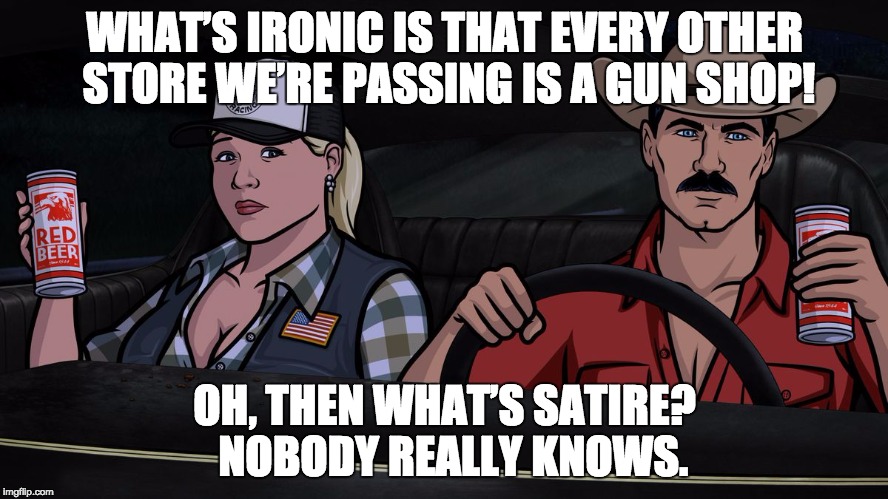
Have you tried to be ironic but people are confused as to whether you are being serious, ironic, or satirical?
Well, how about we try to bring back the Percontation Point.
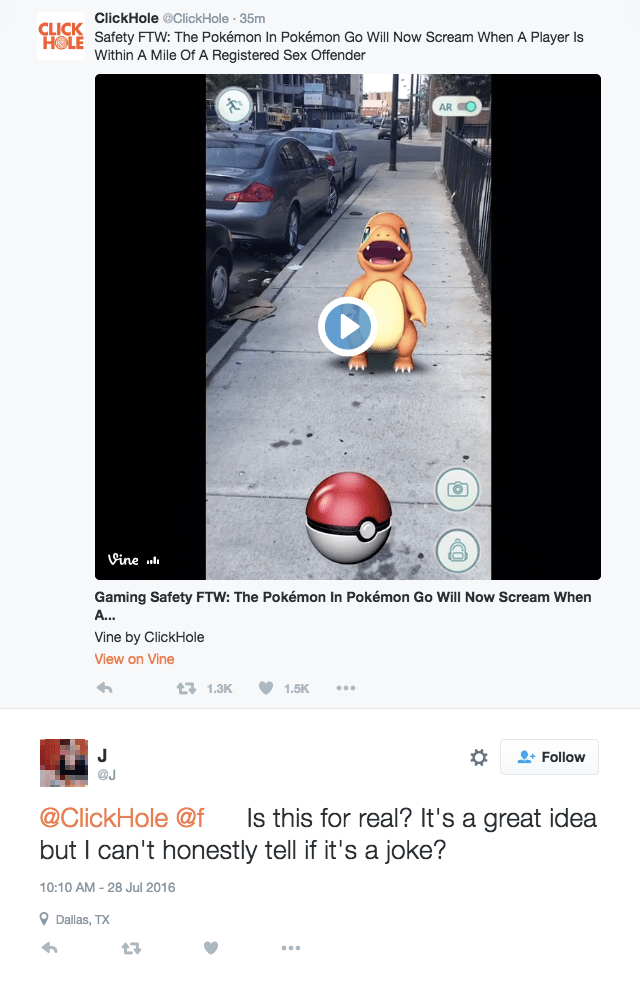
The Percontation Point, or the Irony Mark, used to be a punctuation mark that indicated that the sentence had another layer of meaning to it. With spoken words we get to use tone of voice or facial expressions to make sure people are hearing the other layers. In writing we have to make our layers so obvious that we bash people over the head to make it clear. Even then people will inevitably ask:
So it is clear that writers need to revive the use of the Percontation Point to indicate sarcasm, satire, and irony. It is an essential tool for smart people to use to make stupid people feel even stupider. Which makes it the best punctuation mark of all.
The Fast and Furious series continues to make money at the box office. I have previously summarised the movies but it is time for an update.
The Fast and the Furious
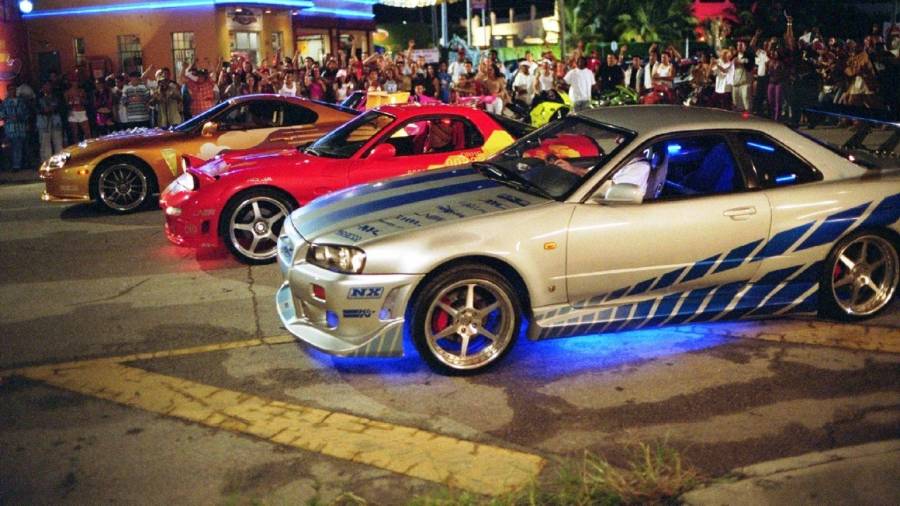
Vin Diesel and Paul Walker prove that by combining the acting chops of Keanu Reeves and the charisma of Patrick Swayze you can recreate Point Break with cars.
Fun Fact: Boys under 25 were inspired to buy Toyota Supras by this movie. Failing that, they attached hi-flow exhausts to their Hyundai Excel.
2 Fast 2 Furious
Diesel was 2 busy and subsequently introduced Tyrese Gibson to the series. Thus started the series long question “What is he doing here? Is he the comedy relief without the comedy? Why hasn’t he been accidentally shot yet?” Fun Fact: Someone actually thought you could replace Diesel with Gibson.
The Fast and the Furious: Tokyo Drift
Lucas Black and Bow Wow make Diesel and Walker look like Shakespearean actors. Even with the most cars and jailbait in skirts, we still wonder how this is a Fast and Furious movie.
Fun Fact: This movie got made. No-one is quite sure how.
Fast & Furious
Diesel and Walker return to remind us that as unlikely as it would seem, they make this series work. I’m sure there was a plot and stuff probably happened. Cars exploded though.
Fun Fact: This wasn’t released direct to DVD.
Fast Five
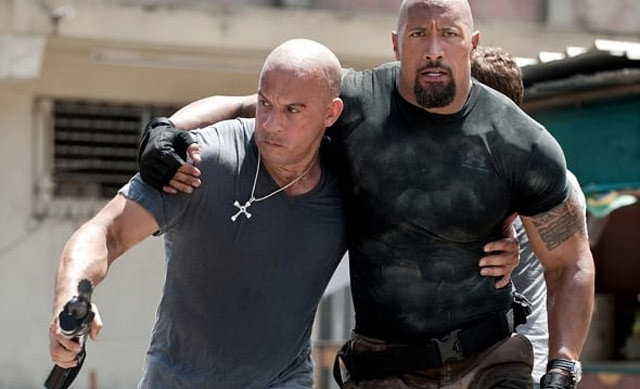
The Rock is introduced and immediately this series becomes awesome. Diesel realises The Rock is in this film and spends the next few films trying to buff up and look half as intimidating as a single eyebrow raise from The Rock.
Fun Fact: The Rock is in this film!!
Fast & Furious 6
The Rock gains an endorsement from Under Armour and Johnson’s Baby Oil to help hold this film together. Characters get resurrected. Others die. We are painfully reminded that street racers are not professional mercenaries.
Fun Fact: Tanks and Planes can be destroyed with sports cars. Engineers and the military are working together to figure out how they got things so wrong.
Furious 7
Hey look, we just made a billion dollars with this movie. Pretty impressive for a movie that is a loosely strung together series of set pieces designed by a kid with a Hot Wheels obsession. The heroes also decide that they want to see how many innocent people they can get caught in the crossfire for the final showdown.
Fun Fact: They actually did a touching send off for Paul Walker.
The Fate of the Furious
The Rock and Jason Statham are now the stars of the series. They have all the coolest scenes and make you gloss over the various characters who have disappeared.
Fun Fact: Did you know that Lamborghinis were bulletproof? Apparently a grappling hook goes straight through the door but not any bullets. Amazing engineering.
Future Fast and Furious movies?
Fast and Furiosa
Charlize Theron returns as the villain. The Rock and Statham join forces to stop the Imperator. Diesel fights for relevance in the series with huge doses of steroids. They probably use cars despite them not making sense for the plot.
Furious and the Walking Dead
CGI advances to the point where Paul Walker is resurrected for the series. This once again gives Vin Diesel relevance to the series. The Rock and Statham pull out the zombie fighting kit and attack the uncanny valley.
Previously in What’s the Difference? the Cinefix team have covered The Fellowship of the Ring and The Two Towers. So it is time to wrap up their coverage of Lord of the Rings with The Return of the King… and enough partings to make you think you are a hairdresser.
A lot of epic stuff happens in the last third of the Lord of the Rings. A lot of tearful goodbyes happen as well. Honestly, when you are reading the paper version you reach the first ending and can’t figure out why there are so many pages left. By the third ending you start wondering if it will ever end.
As I’ve previously discussed for the other instalments, I think the movie is a fantastic adaptation. The minor changes, like Sam not putting on the ring, don’t make much difference – but that one didn’t make much sense either. The major differences are actually quite welcome. Except one.
First I’d like to comment on Sam not wearing the ring. I actually thought that whilst being a minor point, it was also very important to his character and the later act of carrying Frodo. Sam experienced just for a short moment the burden Frodo bore. It helped him redouble his efforts. And also made for a more believable way for Sam to infiltrate the Orc camp.
The major difference that I thought should have been in the film was the reclaiming of The Shire from Saruman. Obviously we’d already had too many endings and needed another one like an extra hole in our heads. But the heroes returned from war to a village ignorant/indifferent to the war and the sacrifice – can anyone say Vietnam vet myths? That isn’t really a happy ending. By having the heroes come home and expel the evil from their village as well, it would have shown their growth as warriors, but also tied their sacrifice to the people they had defended…. Plus, it would have been another action scene in a boring section of the film.
Now that Cinefix have finished with Lord of the Rings it is hard to know what they will cover next. Fingers crossed that is a 6 video coverage of the 3 movie adaptation of the 1 book story The Hobbit.
Edit: Since posting this article I’ve come across a video that explains why the ending of The Return of the King feels so long. The video below argues that it isn’t too long, but rather there is a gap between when the plot finishes and where the story does.
Of course, there is a 30 minute gap between the plot finishing and the story ending. The tension has been resolved so the film feels to drag on, entering Ending Fatigue. 30 minutes out of 558 is 10.7% of your run time devoted to that gap. That’s a lot of time. If they had managed to use less screen time for the story ending/s then we wouldn’t have noticed. Or if people were first watching the films in a marathon, such that 30 minutes out of +9 hours feels shorter, then they’d notice less.
This Youtube channel has lots of great material for budding writers. World building is often done without much thought. J.P. Beaubien runs through how to create the antagonist Evil Empire.





 A focus on children’s reading pleasure rather than on literary merit shifts the focus of research to a different set of questions. I will not pretend to know why Harry Potter appealed so strongly to my son but I suspect its familiarity, predictability and repetition were factors. These qualities are unlikely to score high by adult standards of literary merit but are a feature of children’s series fiction.





 Tyson Adams