Book review: The Wanted by Robert Crais

The Wanted (Elvis Cole, #17; Joe Pike, #6)The Wanted by Robert Crais

My rating: 4 of 5 stars

There’s a question at the end of this book: “Is your name really Elvis?” The response should have been, “♪ Uh-hu-hu-huh. ♪”

Elvis Cole is called in to figure out how a worried mother’s son came by a luxury watch. Elvis and Joe Pike proceed to investigate a series of high-end burglaries, a spate of murders, and why two professional cleaners are looking for the teen boy. They even get to shoot people for a change.

I do enjoy picking up the occasional Robert Crais novel. They are entertaining and well paced, and offer up a slightly different take on the crime-thriller novel. Admittedly, I actually prefer Crais’ earlier books in the series as they had more humour, but his later novels are worth a read too.

What stops me recommending this novel more than the 4 stars I’ve given it is that, like any long-running series, there is a paint-by-numbers feel to the story. It is actually impressive that Crais hasn’t resorted to a more obvious formula yet, but that could be a reflection of my not reading every Cole and Pike novel.

The Wanted is another solid Cole and Pike novel, and highly enjoyable.

I received an Advanced Review Copy in exchange for an honest review.

View all my reviews

Book review: How to be a Stoic by Massimo Pigliucci

How to Be a Stoic: Using Ancient Philosophy to Live a Modern LifeHow to Be a Stoic: Using Ancient Philosophy to Live a Modern Life by Massimo Pigliucci

My rating: 5 of 5 stars

I’m still unclear if reading for pleasure is virtuous. I’m going to pretend that it is.

The former biologist and current philosopher, Massimo Pigliucci, guides us through stoicism and lots of conversations with his imaginary friend, Epictetus. I probably shouldn’t write book blurbs, because this was way more interesting than my previous sentence implies.

Before reading this book, my only understandings of stoicism came from Bertrand Russell. That is to say, I had a snarky and somewhat dismissive understanding of stoicism because Russell wasn’t a fan. Massimo dispelled my misunderstandings and also showed how stoicism could be applied to modern life. Book title goal achieved!

There are two highlights from this book. The first is that Massimo has managed to communicate his philosophy clearly and in a way that I think most people would be able to understand and engage with. The second is that he also manages to upsell readers on the idea of becoming a stoic. I’m not saying I’m rushing out to join Cult Stoic, but there are a lot of good ideas here for people to learn.

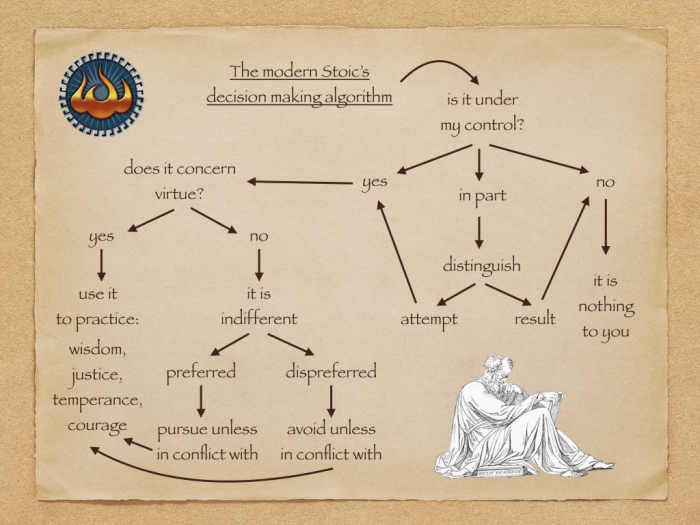
stoic-decision-making

View all my reviews

Further reading:
https://howtobeastoic.wordpress.com/
https://howtobeastoic.wordpress.com/2017/05/11/bertrand-russell-got-stoicism-seriously-wrong/
https://www.reddit.com/r/Stoicism/comments/zblu2/criticisms_of_stoicism_from_bertrand_russells/
https://philosophy.stackexchange.com/questions/9271/how-might-one-counter-bertrand-russells-criticism-of-stoicism-as-not-true-and

What Makes A Good Story?

if-you-didnt-read-the-title-first_fb_526920

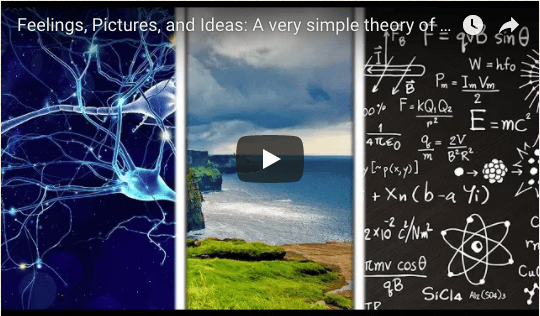
Recently a YouTuber discussed what makes for a good story, based upon three important pillars: pictures, feelings, and ideas. Or as he put it:

Hello and welcome to another instalment of “X lectures you on matters he himself knows nothing about”.

Screen Shot 2018-03-01 at 10.17.55 PM
Video removed, see why further down.

Like with everything that has a simple explanation (and even some complicated ones), I think the response to these sorts of posited arguments is “I think you’ll find it is a little bit more complicated than that.” But this one was funny, so points for effort.

A lot has been written on how to tell good stories. Seriously, every second creative person in history has a list of rules or advice. So here is a list of seven things that make for good stories, because seven is more than three, and it was on the first page of my Google search:

  • A central premise.
  • Strong three-dimensional characters who change over time.
  • A confined space — often referred to as a crucible.
  • A protagonist who is on some sort of quest.
  • An antagonist of some sort bent on stopping the hero.
  • An arch in everything — everything is getting better or worse.
  • And perhaps most important — Conflict. (Source: from Inducing Reality: The Holy Grail of Storytelling by Ken “frobber” Ramsley)

I think Ramsley’s explanation is more of a traditional checklist of things you need in your storytelling. X’s, in contrast, is a more generalist feel of where a story sits on one of those trinity diagrams. Neither, in my opinion, is right. And as a creative person, I’m now going to make a list of rules and advice….

Joking. Joking. Because I don’t think it works like that. I think that what makes a story good is the execution of the various story elements, done at the right time, finding the right audience, and being interesting enough to be remembered.

As an example, Star Wars is regarded as good, despite containing clunky dialogue, wooden acting, and passable directing. Why is it good? Because it hits all the story elements of the hero’s journey, it was one of the first space operas that hit the baby boomer generation and their kids, and had cool ideas like light sabres, space battles, The Force, and merchandising before that was really a big thing, to be remembered.

I’ve previously discussed how the luck factor of being a good story works. One example I cited was of Moby Dick and how it became good literature by accident/chance. Essentially one person dug it up, liked it, wrote favourably on it, and the rest is history. Shakespeare is in a similar boat, as his works were collected posthumously by 5 fans (750 copies, 250 surviving). These are examples of how finding the right audience is important, and how timing may not coincide with when something is made. How many other potentially good works were lost because they didn’t have an advocate who chanced upon them?

Of course, that’s just my thoughts. It’s probably more complicated than that.

Edit: When I originally posted this discussion on what makes a story good, I linked to a video by a YouTuber. Via Twitter I have learnt that this YouTuber sexually abused his former partner. Please take a moment to read her story in the links.

This isn’t behaviour any of us should condone, nor support. In this instance, I was sharing his video and promoting his profile – hence why his user name and video have been removed from this post. I was wrong to tacitly support abuse in this way. By not standing against abuse you might as well be condoning it.

Book Review: Grave Peril by Jim Butcher

Grave Peril (The Dresden Files, #3)Grave Peril by Jim Butcher

My rating: 5 of 5 stars

If you’re only three adventures into your life and already have innumerable enemies seeking vengeance, is it time to stop setting stuff on fire?

Harry Dresden has been trying to figure out why ghosts have been tearing up Chicago. The veil between the real world and the Never Never is in turmoil. His godmother wants him to come and play fetch with her. And the Red Court of vampires want him to come over for a meal. Things are going so well that a war might break out.

I’m admittedly late to the Harry Dresden fan club. Now having completed my second book in the series, I can see that Jim Butcher loves to stack the odds against Harry. No depths are deep enough, no insurmountable challenges big enough for Harry. Or as Murphy’s Law states: anything that can go wrong, does go wrong. Can’t wait to read more of this series.

View all my reviews

What is the name of a kangaroo’s child?

No_Problem_Mate

Kangaroo names really depends upon the mother kangaroo. Mother kangaroos (does or jills) are known to choose names for their joeys based upon:

  • traditional family names
  • popular movie character names
  • favourite fictional characters – typically from movies, but also books

Some of the less common ways jills will choose joey names are:

  • Pick up on joey’s cues (leads to a lot of joeys being called Kick and Jump)
  • Go to the bookshop and pick a random name from a random book (although kangaroos aren’t generally allowed in bookstores due to their habit of browsing and not buying anything)
  • Ask the joey (given kangaroos can’t talk I’m not sure this helps)
  • Name associations (for kangaroos who like word games)
  • Get your other joeys to decide (hard if this is the jills’ first joey)
  • Pull the name out of a hat (although kangaroos don’t wear hats)
  • Meaningful moments (which leads to names like Hop Away From Hunter, and Juicy Leaves).

Some rules jills generally abide by in naming:

  • no names of former girlfriends or boyfriends
  • no names used for pets (not that kangaroos have a lot of pets)
  • no names already used by friends or colleagues (they are often in mobs, so best not to double up on names).

Hope this helps.

This post originally appeared on Quora. Yep. Someone used Quora instead of Google for this. They are probably registered to vote too. Just think about that.

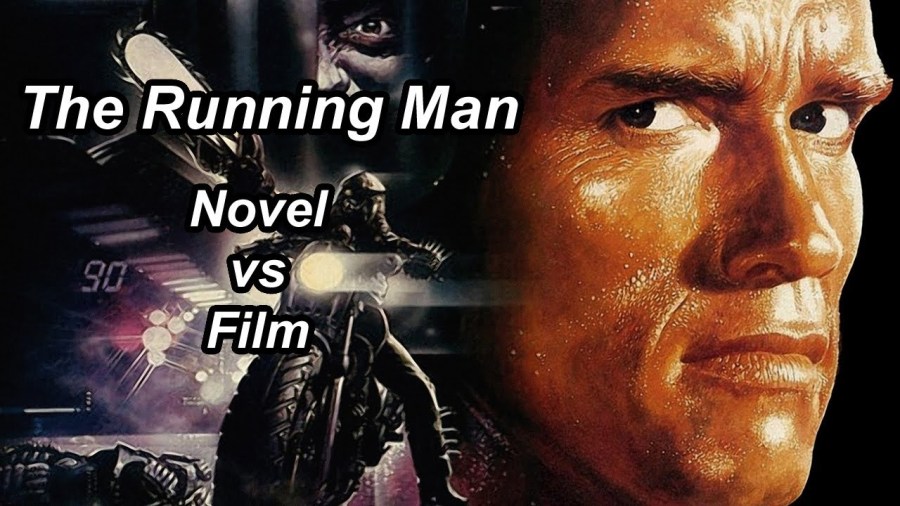
Book vs Movie: The Running Man – What’s The Difference?

maxresdefault

Given the impending authoritarian regimes and mega-media corporations forming, CineFix decided that this month’s What’s the Difference? would look at our near future. Reality TV will soon bring us The Running Man.

Back when I first saw Arnold Schwarzenegger in The Running Man the title sequence credited the source material as being written by Richard Bachman. One of the people with me, turned to us all with one of those know-it-all looks and said, “That’s really Stephen King.” So as we watched Arnie take down hulking professional killers with his trademark killer puns, we wondered if he was correct. Spoiler: he was.

Decades later I finally got around to reading and enjoying the novel. The movie and the novel were starkly different in so many ways. For starters, no half-starved, poverty stricken Running Man contestant is going to look like Arnie. But many of the themes are the same, if explored in differing ways.

This made The Running Man more than just a standard action film. By exploring the themes of totalitarianism, class subjugation, and media control while Arnie slices a guy in half with a chainsaw, we got a movie that was subversive and satirical. While not on the same level of social commentary as King’s novel, it does stand as an example of how you can do a loose adaptation of source material as an action movie but retain the exploration of themes.

And watch a guy with no pants get electrocuted when the fire sprinklers are set off. Way better than reading the description of Ben Richards’ entrails getting caught on plane seats.

Book Review: Raw Wounds by Matt Hilton

Raw Wounds (Tess Grey & Po Villere, #3)Raw Wounds by Matt Hilton

My rating: 4 of 5 stars

Blood is thicker than water, unless you stab a relative, then it needs to be washed off with water.

Tess and Po have stumbled upon a potential murder victim and are all set to investigate this puzzling crime when Po receives a call. His dying mother wants to see him. His mother’s husband swore an oath to kill him. The rest of the family is ready to help. Except his sister, who has just gone missing near a new oil pipeline development, who Po has just been tasked to find.

Having been a long time fan of the Joe Hunter series by Matt Hilton, I was keen to read this new series from Matt. Much like the Hunter series, Matt has given us a solid crime thriller with plenty of action. The hard moulded Po is a lived in character, and Tess feeling like someone who is still trying to adjust to her new life as an ex-cop. They feel like good characters to follow for more adventures.

I received a review copy of this book in exchange for an honest review.

View all my reviews

Interpreting Music Review Terminology

Manyguitars_550x368

Last week I posted a handy guide to Book Review Terminology. Book reviews aren’t the only area that has incomprehensible jargon. Music reviews are often troubling, they use industry jargon that not everyone understands, especially not the people using the jargon. So I have quickly summarised the commonly used phrases and interpreted them.

Solid album: every song sounds the same.
Standout tracks: the only decent songs.
The album grows on you: hated this album the first time I listened to it and after having to listen to it several times to complete the review have found I can tolerate it.
Intricate melodies: pretentious wank.
Outstanding musicianship: lots of solos.
Impressive guitar work: endless guitar masturbation.
Impressive vocal work: wow, an actual singer for a change. They didn’t even use autotune. Now if only they’d work on writing decent lyrics.
Concept album: lots of pretentious filler.
Soulful lyrics: singer recently dumped by their partner.
Soulful melodies: all band members/artist depressed.
Heartfelt emotion: band members/artist suicidal.
Catchy lyrics: I hate this album and all the songs on it, but I can’t purge the choruses from my brain.
Best album of the year: only new album I have.
The best release from this artist/band: it’s about time they put out something decent.
Epic: too long.
Pop sensibilities: commercial radio fodder.
Proponents of (insert name) style: I hate this sort of music.
Founders of (insert name) style: the artists that everyone else copied.
Challenging: annoying.
Diverse styles/sounds: imitates everything popular at the moment.
Critically acclaimed: only pretentious and annoying people will like it.
Commercially successful: listen to it on the radio instead.
New sensation: you’ll have forgotten this artist and their music existed in 6 months.
Uplifting: saccharine.
Back with a vengeance: last album was terrible.
Offers up some great tracks: band/artist only wrote one song then packed in filler.
Career defining: surprisingly good album.
On heavy rotation: has a huge marketing budget to waste.
Staple of radio playlists: inoffensive.
Politically charged lyrics: think they are better than everyone else.
Confrontational: annoying.
Distinguishes itself: will fade into obscurity in a month.
Stamped their mark: all the vapid DJ’s like it.
Most important album/artist of the year: utter crap that is inexplicably selling well.
Taken (insert country) by storm: some DJ overseas thinks that it’s good.
Radio friendly: bland.

Hope that clears things up a bit.

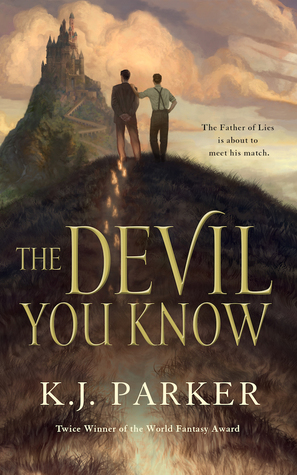
Book review: The Devil You Know by KJ Parker

The Devil You KnowThe Devil You Know by K.J. Parker

My rating: 4 of 5 stars

The greatest trick the devil ever pulled? Never messing with a philosopher.

Saloninus is the greatest philosopher of all time. But nearing the end of his life he wants another 20 years to complete his final works. So he does a deal with the devil. But the devil is suspicious. They might have an airtight contract for Saloninus’ soul, but there is something amiss. Is the devil about to be swindled by the greatest thinker?

A couple of years ago my uncle recommended KJ Parker to me. I’ve finally gotten around to reading one of Parker’s books. My uncle clearly has good taste.

This was an interesting and often humorous tale. After a recent letdown with an odious fantasy novel, this was refreshing. Briskly paced, world building without the laborious exposition, and characters that felt like real people, topped off a solid and interesting story. I’ll have to schedule some more KJ Parker reading for the near future.

View all my reviews

Interpreting Book Review Terminology

e6a8aaba01fd70671c2cdccb666a14b5
Have you ever read a book review and been baffled by the jargon the reviewer uses? Like any profession, book reviewers have their own jargon that is meaningless and annoying to anyone not steeped in the mire of that profession. Since I’m a scientist and science communicator, I’m very familiar with how terrible the media are at explaining science. I’m also familiar with interpreting jargon for an audience. So allow me to elucidate.
.
Page-turner: Meets the bare minimum standards for a book.
Gripping: I got this from a library where kids are allowed to play.
Poignant: Something sad happened in this book, most likely a character gets cancer.
Compelling: I spent so much time reading this book I had to finish it despite wanting to hurt myself after every sentence.
Nuanced: I have no idea what this book was about but I liked it.
Lyrical: Should be a poem instead so that it isn’t as long and self-involved.
Tour de force: The book is too long and waffly.
Readable: Boring but better than watching TV.
Haunting: Either used to describe a book that made the reviewer actually think, or, more likely, is meant to make you think but is just pretentious.
Deceptively simple: Could have been written by a 10 year old.
Rollicking: Something actually happens in this book.
Fully realised: The book has a beginning, middle and end.
Timely: Makes passing reference to something that happened 2 years ago.
X meets Y meets Z: The reviewer hasn’t read the book so is quoting the sales blurb.
Sweeping: Long.
That said: I’ve just insulted this entire book but it is popular for some unknown reason (e.g. Twilight).
Riveting: Was able to finish reading it.
Unflinching: Unpleasant.
Powerful: I read the hardcover.
Unputdownable: Reviewer is unfamiliar with English.
Masterfully or Masterful: The author is familiar with English.
Beautifully written: A lot of long words were used.
Startling: Reviewer was surprised the book was published.
Bold: Controversial.
Accessible: Written for kids.
Memorable: Reviewer didn’t have to look up the author or title to write the review.
Epic: Really, really, long.
A tale of loss and redemption: Someone dies, the protagonist gets over it, the end.
Sensuously, seductively, and/or lushly described: Painstakingly boring descriptions of mundane details.
Must read: Bestseller.
What it is to be human: Someone falls in love or someone dies.
Luminous: Has a pretty cover.
Evocative: Not boring or pedantic.
Poetic: Wordy.
Thought provoking: Reviewer is sure the book is cultural or intellectual but didn’t quite get it.
Rollicking roller-coaster: Kids book, or should be.
Provocative: Annoying.
Lends itself to X: Reading the book X was better.
Opinionated: The reviewer disagrees with everything the author has ever written.
Emotional roller-coaster: Nominated for some literary award.
Only minor quibbles: The book sucked.
Stays in your mind long after the last page is turned: Had a bad ending.
Writing at the peak of his/her powers: Much better than the author’s other books.
At once: The reviewer is about to use more than one of these terms in a sentence.
.
Also, lets not forget the various terms that are used to tell you what the genre of the book is, rather than just say what the genre is:
Explicit, steamy, romp, raunchy: Erotica or has sex in it.
Charged, taut, woven, layered: Political thriller.
Heart-warming, life-affirming: Romantic drama.
Seamy, gritty, underworld: Crime.
Taut, fast-paced, dynamic: Thriller.
Epic: Fantasy.
.
Hope this clears things up a bit.

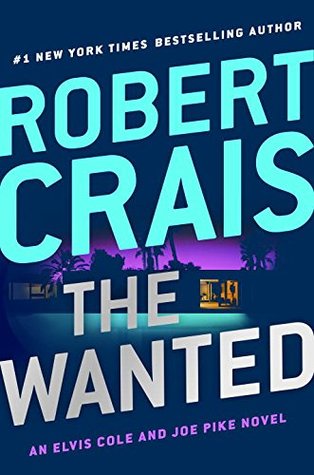
 

Book review: On Generation and Corruption by Aristotle

On Generation and CorruptionOn Generation and Corruption by Aristotle

My rating: 3 of 5 stars

I’m not going to review this book. It’s a few thousand years old, I don’t really have anything to add.

What I found interesting about this book was what it got wrong. Obviously Aristotle is one of the most influential thinkers of all time, he was one of the earlier people to grapple with determinism (Democritis and Leucippus got there first). But in Aristotle’s arguments on the Four Causes and the Four Elements, it was interesting that he rejected Leucippus’ and Democritus’ Atomism, a theory that was ultimately proven correct. Which got me to thinking.

How would anyone describe fire – one of the four elements – without our modern knowledge? How would we explain or seek to understand (rationalise) the workings of fire without chemistry, physics, and all of that other knowledge we take for granted?

Reading the arguments melding the four causes and elements into an understanding of change and decay in the modern age, it is easy to point and laugh. Stupid philosophers can’t science! But as I was reading I realised I could counter the arguments only based upon the accumulated knowledge of the natural world. If I was to remove that knowledge and just go by observation, could I do better? The answer is clearly no. At best I could come up with different, but probably not better. Because I’m definitely in the same league as one of the greatest thinkers of all time….

This realisation then had me thinking about how we don’t value our modern age and modern knowledge as much as we should. As Douglas Adams noted, we are surrounded by wonders of technology and science, but could we explain it and rebuild it, or would we have to settle for being a sandwich maker from the stars?

View all my reviews

Book review: Dark Intelligence by Neal Asher

Dark Intelligence (Transformation, #1)Dark Intelligence by Neal Asher

My rating: 3 of 5 stars

If AI essentially become gods does that make humans the prime mover?

Thorvald Spear died 100 years ago in the war with the Prador. Fortunately, this is the future, so death is less final than it used to be. But Spear is less than happy with how he died at the hands of the black AI, Penny Royal, and decides to destroy it. Along the way he manages to piss off Isobel Satomi, who has also got a carapace to pick with Penny Royal. So she adds Spear to her list of things to destroy. Meanwhile, Penny Royal is up to something, and everyone wants to know what.

This was my first outing with Neal Asher and his Polity universe. Asher was recommended to me by a fellow blogger – Bookstooge – so I found this recent series in the library. There is much I enjoyed about this book, and by extension the universe Asher has created. The details that give this universe a lived in feel, the cyberpunk sensibilities, the interesting sci-fi technology, are all fantastic. The story and characters are also interesting. So why only 3 stars?

There were two things that really stopped me enjoying this novel more: the length; and the anachronisms.

Sci-fi has a habit of being long because someone decided that that was okay for spec-fic genres. Dark Intelligence made me notice that this was a long book. Usually if you are really enjoying a book, the length goes unnoticed. So I had the sense that there was too much padding, unnecessary exposition, and side plots. It all fits together nicely, but I’m sure that this could come in much shorter without losing anything.

The second problem I had was with the constant anachronisms. Sounds being described as like a domino being slapped on the board… because dominoes is so popular right now, let alone a few centuries into the future. The Polity universe is filled with hyper-intelligent AIs that can do just about anything… but apparently cars still need a human to drive them. Tesla had that covered two years ago. After noticing one anachronism the floodgates opened, to the point where I started to question if this was Asher having a joke. But I doubt this is the case, since he criticised Greg Bear for doing the same thing in a book review.

Perhaps I’ll enjoy The Skinner more, which Bookstooge originally recommended.

View all my reviews

The Art of Comics

Do you like comics? I’m not talking about movies based on comics. I’m not talking about comic fandom that can only be solved Utopia style. I’m talking about the art of storytelling that only the mix of art and narrative can manage.

How Utopia deals with comic fans:

I have previously discussed how some fail to give due respect to comics and graphic novels. The TL/DR is that literary snobs don’t like non-worthy genres to be discussed. I mean, how dare someone dilute words with pictures! Yet the comic format allows for a form of storytelling that other mediums would love to have. Literally showing can condense a novel to a few dozen pages whilst retaining all of the important details, as I discussed in my review of the Parker comics. Text can be used in a way that neither movies nor novels can utilise. An example is the way authors construct their ideas into sentences, paragraphs, and chapters to transition between ideas and moments. When you add the visual artwork you can add effect and impact to those transitions, ideas, and moments. You can’t do that in other mediums. Well, unless you’re Edgar Wright merging movies and comics.

The way the art is used to tell a story is an often overlooked aspect of comics and graphic novels. This is despite the fact that the art is their most distinguishing feature. That and the impossible physiques covered in spandex.

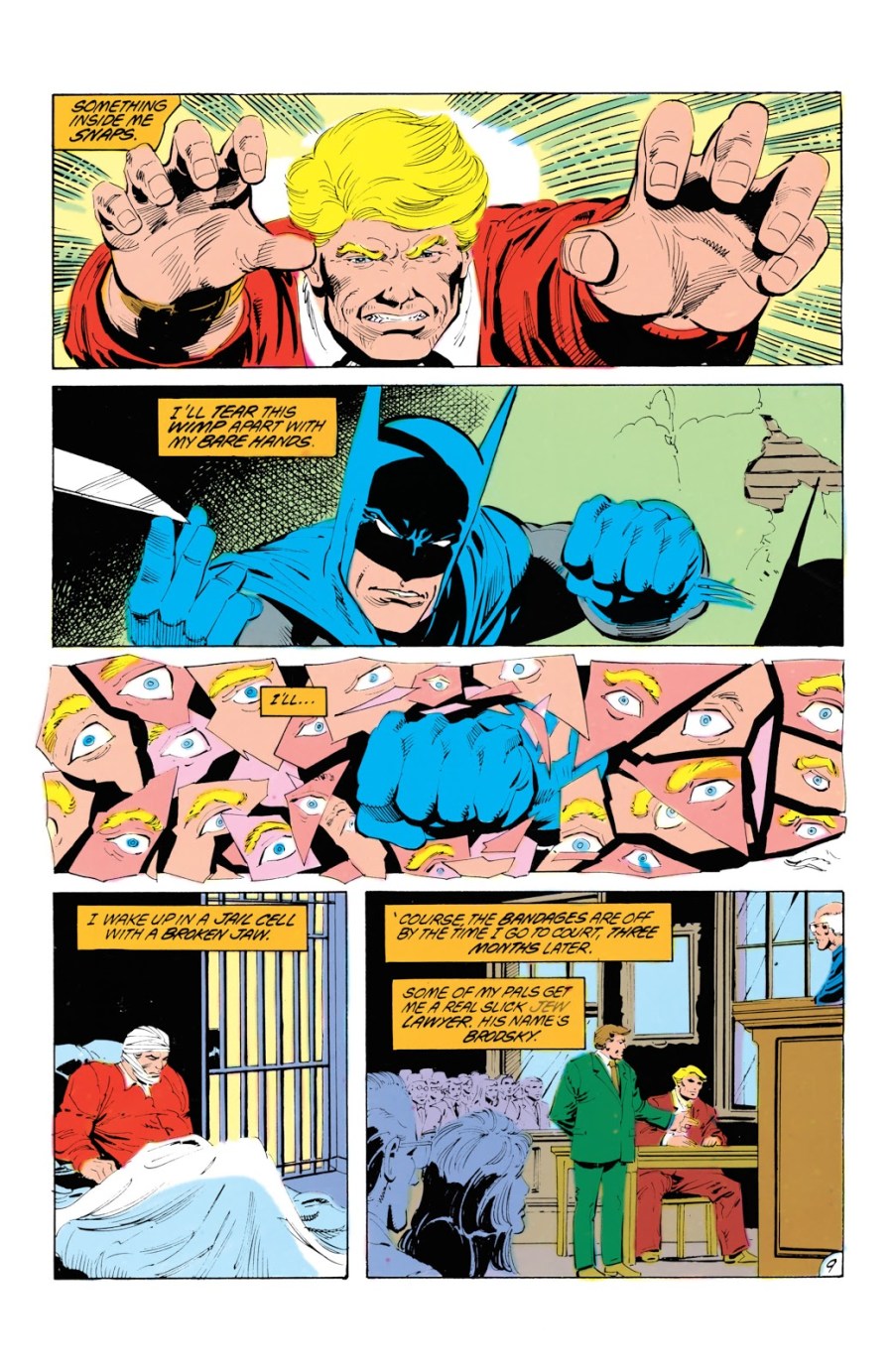
As an example, I’d like to share a page from a comic I bought when I was 10.* On this page is a panel that has stuck with me as an example of the combination of art and narrative. Comics can do this so easily. It would make movies jealous – unless they have the CGI budget. No big illustrated fight scene. No words like ZAP or KAPOW as a blow is struck. And within the context of this larger story, the minimalism is an important narrative device.

rco010
From Batman #422 – Just Deserts (1988)

Obviously, this is just one example that lead to my formative appreciation of the comic book medium.* As much as many formative appreciations of comic books are based around the erotic artwork… sorry, lost my train of thought.

For another example of the combination of art and story, Nerdwriter made a particularly good video discussing Maus and how it is constructed as a story and piece of art. Every frame, every image, the whole page, has meaning.

When it comes to discussing the literary and artistic merit of comics the discussion often never moves past the capes, spandex, and insecurity inducing bulges. Some articles have argued that if we let graphic novels into literature we have to let in everything. They must defend Fort Literature from the invading Lesser Works. But comics are far more than the superficial observations of those dismissing them.

Well, at least I think they are cool.

*Please appreciate this post. It took me ages to figure out which comic I had owned. During high school, we were asked to bring in a comic book to be part of a creative writing project in English class. The class never eventuated and the comics were never returned to us. As a result, I couldn’t remember the details of this comic, and since there are a lot of Batman comics, it took a lot of effort to track down.

This also opened an old wound created by that high school English class. The wound of crushed creativity. The promise of being taught creative writing that went unfulfilled for decades. But thank goodness we got to learn how to write essays about ee cummings in Lit class instead.

Creativity Explained

file-20180114-101518-1wckavo

Last week I reblogged an article about some new research into what makes us creative. This week I’m sharing a video from one of my favourite YouTube channels, which essentially covers the same work. But this one is a video!

Since this is going to be a three part series, I’ll update this post as the other videos are released.

Part 2:

Further reading:

Kidd, C., & Hayden, B. Y. (2015). The psychology and neuroscience of curiosity. Neuron, 88(3), 449-460.

De Pisapia, N., Bacci, F., Parrott, D., & Melcher, D. (2016). Brain networks for visual creativity: a functional connectivity study of planning a visual artwork. Scientific reports, 6.

The Real Neuroscience of Creativity – Scientific American.

Eagleman, D., & Brandt, A. (2017). The Runaway Species: How human creativity remakes the world.

Catapult. Durante, D., & Dunson, D. B. (2018). Bayesian inference and testing of group differences in brain networks. Bayesian Analysis, 13(1), 29-58.

Li, W., Yang, J., Zhang, Q., Li, G., & Qiu, J. (2016). The Association between Resting Functional Connectivity and Visual Creativity. Scientific reports, 6.

Bendetowicz, D., Urbanski, M., Aichelburg, C., Levy, R., & Volle, E. (2017). Brain morphometry predicts individual creative potential and the ability to combine remote ideas. Cortex, 86, 216-229.