Book review: Blackwater by Jeremy Scahill

Blackwater: The Rise of the World's Most Powerful Mercenary ArmyBlackwater: The Rise of the World’s Most Powerful Mercenary Army by Jeremy Scahill

My rating: 5 of 5 stars

Let’s privatise the military. How could that possibly go wrong?

Blackwater: The Rise of the World’s Most Powerful Mercenary Army outlines the political landscape of Blackwater’s founding, the personal history of several key players – particularly Erik Prince – and the actions and intentions that made the company so infamous. It attempts to explain and document how mercenaries went through a rebranding to become the operators of choice in conflict zones around the world.

Okay, so I thought I had read enough news articles and the like to have some idea of what Blackwater was about. Mercenaries and the name Blackwater became something of a shorthand for “loose cannons”, becoming the villains in movies and TV shows. But as Scahill outlines, the reality and totality are so much worse than I’d thought. Blackwater and several other companies are discussed, along with the players who made this all possible. You’ll recognise many of the politician’s names, but maybe less so the “contractors”. This was disturbing reading.

They couldn’t get a coalition of the willing, so they turned to a coalition of the billing.

There were a few very important points that were made. The first was how senior political figures decided they wanted to privatise the military and associated intelligence work. This is such a terrible idea that you have to be pretty ideologically bent-out-of-shape to think it is good. The most troubling reason for this being terrible is the lack of accountability this gives these newly privatised people with guns, bombs, and shady contacts. As numerous leaks have shown over the years, the military is already far too unaccountable.*

Which brings me to the second point, that once they are privatised, the companies lobby hard to remain unaccountable, saying they don’t fall under military rules because they are private citizens, and that they don’t fall under civilian rules because they are acting as part of a military force. In essence, they can literally commit murder and they have been positioned by their lobbyists and key politicians to never be even investigated for the crime.

Those points should disturb everyone. You may not see a problem with war profiteering, or religious fundamentalists pushing for war and creating conflict (or at least involving themselves in them), or free marketeers wanting to privatise everything, or private companies hiring “shoot-first-never-answer/ask-questions” mercenaries to guard their kitchen supplies. But I think we can all agree that you have to be accountable for your actions, and Blackwater (et al.) has not been.

After reading this book you’d think Erik Prince would suffer some consequences…. Nope. He’s still going.

The only complaint I have about Scahill’s book is that it was somewhat repetitive. Several points were raised repeatedly, not to highlight them, but because the surrounding issues or players were being discussed again.

After reading this I can only hope that the various players involved aren’t allowed to have positions of power and influence ever again.**

* Because schools, hospitals, cafes, etc are totally legit military targets and not war crimes.
** My hopes will remain unfulfilled, I’m afraid.
View all my reviews

How much do we spend on reading?

A few years ago I published a table from the US Bureau of Labor Statistics.

Wow, you sure know how to party!

Thanks.

Anyway, that table highlighted how much Americans spent on reading per year. Because I’m a Nerdus scientificus, for fun I decided to collate the stats in a spreadsheet and create some graphs.

You are just one big party animal, aren’t you!

I certainly am.

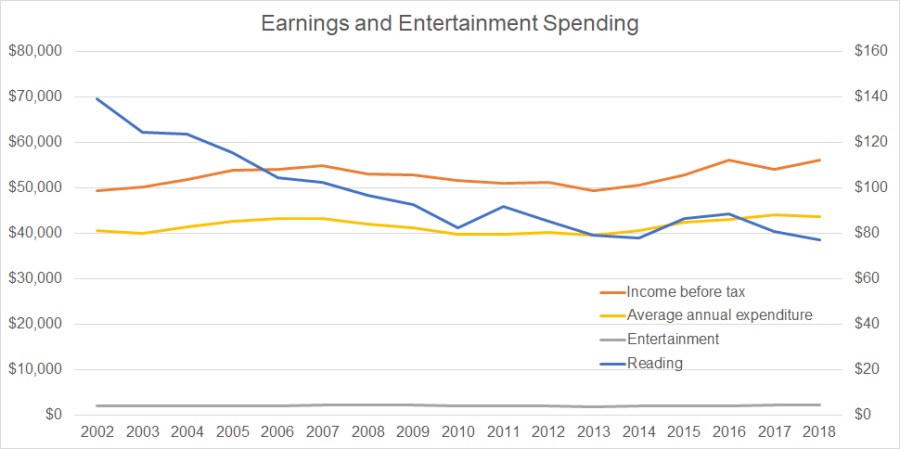
So the first chart is a summary of inflation-adjusted US income, expenditure, entertainment spend, and reading spend by the average “consumer unit”. A consumer unit is obviously the economists’ way of referring to a living, breathing, thinking, cog in the economic machine. Apply the appropriate conversion factors for your country.*

Untitled-1

As you can see, US income and spending haven’t really changed in two decades in real terms. That’s right, despite more wealth having been created in the economy since 2000, the average cog in the machine hasn’t seen a change to their take-home pay. Sidenote: I noticed union membership is rather low in the US as well. Might be related.

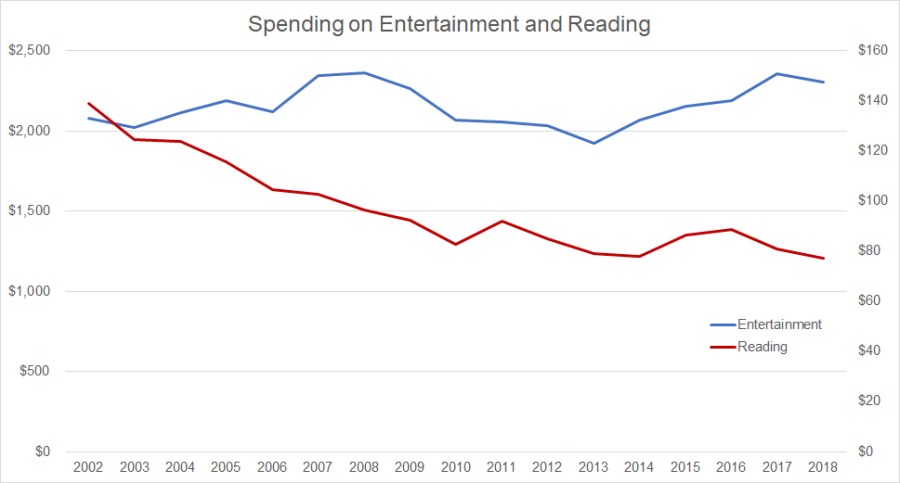
Over that same time period, the spending on reading has declined. The line for entertainment wasn’t particularly clear in the above chart, so I made this second one.

Untitled-2

It could be argued that entertainment spend is roughly static over time, while reading spend is clearly declining in real terms. But the question is, what does this mean?

The obvious conclusion that Guardian columnists and other industry wonks will make is that (choose one or all to write your opinion column today!):

  • Kids these days are playing Facepage and Tweeters rather than reading books.
  • People have short attention spans and can’t handle reading decent books.
  • Too many people are Netflixing and Chilling.
  • Something derisive about gaming.
  • Blame falling education standards or immigrants or something.

Yes, the media landscape is more diverse now. This is a true fact, not an alternative one. But that doesn’t really explain the decline. Because reading also became cheaper over that time period. Amazon entered the market, heavily discounting paper books and shipped directly from the warehouse. E-books became a thing, which again changed the cost of buying books.

So you have to question how good a metric spending is to reading. Unless you are writing an industry opinion piece.

I also mentioned the lack of change in household income in real terms. It would be interesting to dig up some figures on financial stress for the average household over this same time period. And I’d posit that entertainment is more likely to involve passive forms, like television, than active forms like reading when stress is higher.

Another metric I’ve discussed before is the reported reading figures. Some of those figures suggest people are actually reading more now, while other figures of how much that is are less encouraging.

Ideally, the industry figures would be more transparent. That way someone could actually crunch the data and to track average individual book consumption and reading totals over time. Then we could put some opinion columnists out of work.

* By this I mean look at the currency conversions and think about whether you reckon your country-people would spend more or less of their household earnings on reading than an average American. More. The answer is going to be more. We’ve seen their leaders.

Book review: The Entrepreneurial State by Mariana Mazzucato

The Entrepreneurial State: Debunking Public vs. Private Sector MythsThe Entrepreneurial State: Debunking Public vs. Private Sector Myths by Mariana Mazzucato

My rating: 5 of 5 stars

Government: We invented this.
Private company: Can we have it?
G: Sure. Just remember to pay you taxes.
P: Lol, our what?

The Entrepreneurial State is Mariana Mazzucato’s detailed effort to debunk some of the often claimed myths about government’s role in innovation. Her argument is that it is the public sector, not the private sector, that is often the innovators, risk-takers, and entrepreneurs in the economy. And because ideology has pushed for the state/government’s role to be smaller, we run the risk of not having the next generation of innovations/technologies.

I recently read Mariana’s The Value of Everything and wanted to read this earlier work. Similar to her arguments about how we measure the economy, Mariana’s arguments about innovation are well made, have plenty of references, piles of evidence, some great examples, and leave you with the head-scratching amazement that we need this book.

I’m sure that anyone who has worked in the public or private sector would read some of the examples in this book and be immediately reminded of some from their own field. Whether it be the government contract their company was gifted, or the publicly funded research that is commercialised, or the public infrastructure support given for that new project, we can probably all think of examples where entire industries or technologies wouldn’t have happened without governments taking the first step.

So how is it that myths (listed below) about the economy and who the entrepreneurs are persist?

Myths about Drivers of Innovation and Ineffective Innovation Policy
Myth 1: Innovation is about (private) R&D
Myth 2: Small (government) is beautiful
Myth 3: Venture capital is risk-loving
Myth 4: We live in a knowledge economy—just look at all the patents!
Myth 5: Europe’s problem is all about commercialization
Myth 6: Business investment requires ‘less tax and red tape’

There is only so much ideology that can stand in the way of reality. Unfortunately, I suspect that there is plenty of ideology floating around like an iceberg during a maiden voyage.*

An excellent book that is well worth reading.

We live in an era in which the State is being cut back. Public services are being outsourced, State budgets are being slashed and fear rather than courage is determining many national strategies. Much of this change is being done in the name of rendering markets more competitive, more dynamic. This book is an open call to change the way we talk about the State, its role in the economy and the images and ideas we use to describe that role. Only then can we begin to build the kind of society we want to live in, and want our children to live in, in a manner that pushes aside false myths about the State and recognizes how it can, when mission-driven and organized in a dynamic way, solve problems as complex as putting a man on the moon and solving climate change. And we need the courage to insist—through both vision and specific policy instruments—that the growth that ensues from the underlying investments be not only ‘smart’, but also ‘inclusive’.

* You only have to read some of the 1-star reviews for this book to find evidence of this ideology in action.

View all my reviews

Book review: Mort by Terry Pratchett

Mort (Discworld, #4)Mort by Terry Pratchett

My rating: 5 of 5 stars

I’m not going to make a joke about learning a trade being a killer idea.

Mort is a tall skinny kid who just wants to know how the world works. Death has been flat out since the beginning of time. So when Mort’s dad decides it is time for him to learn a trade, Death offers him an apprenticeship to help cover some of the work. Hopefully, Mort doesn’t mess it up.

I quite like Death. As in the character. Death and his granddaughter Susan are two of my favourite Discworld characters. So it was definitely time to read the earlier Death instalments in the series. Worth it!

I was only a few pages into Mort when I found myself chuckling. Out loud. Normally I can keep that stuff to myself. But I couldn’t help it.

There doesn’t need to be much more said than that. Entertaining and chuckle out loud funny.

View all my reviews

Book review: The Stars Are Legion by Kameron Hurley

The Stars Are LegionThe Stars Are Legion by Kameron Hurley

My rating: 3 of 5 stars

Gender reveal parties would be more interesting if you heard, “I’m pregnant with a cogwheel.”

The two most powerful civilisations in the Legion, the Katazyrnas and the Bhavajas, are fighting for possession of the Mokshi world-ship. In the Legion, only the Mokshi is capable of escaping the decay infecting the world-ships. Zan is revived once more in the hopes of leading a force to capture the Mokshi. With little memory of any previous attempts, Jayd and Sabita hint at a larger plan they have in play. A plan that would see Zan and Jayd take on the Lords of the Katazyrnas and the Bhavajas.

Last year I picked up Hurley’s collection of essays, The Geek Feminist Revolution. Since I enjoyed that book, I decided to read one of her novels. After leaving this review for several days, I’m still not exactly sure what to say about The Stars Are Legion.

The obvious place to start with is the world-building, what with how much of the novel is dedicated to it. Hurley manages to use Zan’s journey to world-build very effectively. It would be easy to point at the amnesia and epic journey tropes and shake your head admonishingly, but I felt that it worked well. The characters are similarly complex and develop in interesting ways, even if they are all damaged and murderous.* And there is never a dull moment where the characters aren’t in mortal danger.

I think the reason I’m not sure how I feel about The Stars Are Legion is that several factors scratched away at me as I was reading. Damaged characters can be hard to connect with. The fact that I’m calling the hero’s journey the world-building shows that I wasn’t quite invested in the journey/action. And I also found I knew several “reveals” before they happened.** These issues made me more along for the ride rather than strapped in and engaged.

That said, this was a refreshingly different kind of sci-fi novel for me. There is a lot to enjoy for those who like darker stories and characters.

* And they are all female. Every character. Which was a pretty cool idea that was a neatly integrated part of the world-building. Gotta be honest, this was satisfyingly unique.
** In fairness, this could just be that these “reveals” were established well rather than cynically concealed within a barrel of red herrings or subverted in a way that throws the plot out the window.

View all my reviews

Book vs Movie: Eyes Wide Shut – What’s the Difference?

If you like Christmas movies, then CineFix have a book and movie for you in this month’s What’s the Difference?

sddefault

At the risk of offending Kubrick fans, I must confess that I do not care for his movies.

Now, before you launch into a flurry of keyboard mashing, I’m not saying that Kubrick is a bad filmmaker. It is clear that he was an amazing visual storyteller. But as I’ve mentioned before, I’ve always found Kubrick films to be somewhat bland.

That said, I can appreciate what he is trying to do with his films… Usually, this appreciation comes after some wonks with a film degree walk me through it (see video below). But that doesn’t really increase my enjoyment of his films.

As to the book, I’ve not read this one. It doesn’t sound like the sort of novel I would normally read, but would probably offer a more clear understanding of the themes of the story.

The top 10 books people claim to read but haven’t

There’s a famous quote from one of my favourite thinkers, Bertrand Russell, on reading. He posits that the two reasons for reading are for enjoyment and that you can boast about having read something.

quote-there-are-two-motives-for-reading-a-book-one-that-you-enjoy-it-the-other-that-you-can-boast-bertrand-russell-263575

Let’s face it, he was correct.

I’ve previously discussed the reading statistics that show we primarily read for enjoyment but also seem to feel obliged to read other books (particularly literary titles). Actually, I’ve discussed this issue a lot. The anecdata back this up, with early e-reader adopters being the romance and erotica fans who could now read on the bus to work. We just don’t like to be seen enjoying the books we enjoy.

So it should come as no surprise that people like to pretend they’ve read certain books. The Guardian posted this survey of readers (although I can’t find the source) listing off everyone’s favourite reading cred books, you know, the ones you claim to have read but fell asleep at page 2.

A recent survey of 2,000 people suggests that the majority of people pretend to have read classic books in order to appear more intelligent, with more than half of those polled displaying unread books on their shelves and 3% slipping a highbrow cover on books they’d rather not be seen reading in public.

The books most likely to be lied about are, naturally, the books most often filmed, talked about and studied in school (some of the respondents must have been lying since GCSE onwards). Are any of them in your pretend-I’ve-read/never-finished pile, or do you save your literary fibbing for Finnegans Wake and Infinite Jest? Share your guilty secrets below.

1) 1984 by George Orwell (26%)

I have actually read 1984. Some people like to announce that 1984 is our current reality, which shows they haven’t read it or are fond of hyperbole. I enjoyed it, but I can see how people would battle to read this one. Worth a read if only to see how people seem to mash 1984 and Brave New World together.

2) War and Peace by Leo Tolstoy (19%)

I got to about page 8 of War and Peace. I have no intention of revisiting it. People always talk about battling through it in small chunks because it is such an important and blah blah blah book. If it was really important it wouldn’t have been so boring as to necessitate reading it in small chunks.

3) Great Expectations by Charles Dickens (18%)

I watched the old black and white film, does that count? No? Oh well, I don’t care.

4) The Catcher in the Rye by JD Salinger (15%)

I’ve read this novel many times and hated it every single time.

Why reread a novel you hate?

Well, reader surrogate, The Catcher in the Rye is one of those “classics”. You’re meant to love it, or feel moved, or something. Smart people like it, so I must, ipso facto, be a dummy for not enjoying the brilliance of this book. So every 5 or so years I feel the urge to see if I missed something the other times I read it.

I don’t think I missed anything.

Although, John Green did manage to convince me of its literary merits via Crash Course Literature, not that I’ll bother revisiting this novel.

5) A Passage to India by EM Forster (12%)

I can honestly say I’ve never heard of this book.

6) Lord of the Rings by JRR Tolkien (11%)

Okay, okay, I’ll come clean. I only read this book after seeing the first movie in the theatre. In my defence, I tried reading the Hobbit when I was younger and then realised I had so much more to live for and stopped reading.

I really enjoyed the book, but it was long and waffly and I can see why others wouldn’t actually finish it. The narrative structure in parts is also poorly done. In a modern book, those separate threads would be told concurrently rather than one thread at a time with big jumps backward for the next thread. Unlike some 1,000 page novels, this one is worth a look.

7) To Kill A Mocking Bird by Harper Lee (10%)

I don’t claim to have read this one, but I haven’t actually gotten around to reading it yet either. I’ve even got two copies, a DTB and an ebook.

8) Crime and Punishment by Fyodor Dostoevsky (8%)

[Insert joke about book title being equivalent to reading said book]

9) Pride and Prejudice by Jane Austen (8%)

I’m going to read the zombie version. I know, I know. Sacrilege.

10) Jane Eyre by Charlotte Bronte (5%)

I’m not really interested in reading this. My wife isn’t a fan, but my sister is. No offence to my sister, but I’m taking my wife’s recommendation not to bother.

Bonus: Infinite Jest.

I recently started reading Infinite Jest and gave up. I mean, a book weighing in at one thousand pages had better have a gripping/engaging first chapter to encourage me. Wallace was lauded for this novel, but I think it needed to get to the damned point.*

tldr

The point I’d like to make is that there is no reason to read any of these books. Sure, some of them are great. You might enjoy some or all of them. You might hate some or all of them. But you don’t need to pretend to have read them.

And it is worth noting that many literary influences transcend their medium. You don’t necessarily have to read a book to have a working knowledge of the plot or themes. I’m reminded of a scene from Star Trek where one character criticises Picard for chasing his white whale. Picard acknowledges the point by quoting a relevant line from the book, a book that character hadn’t read. In that moment, despite Picard’s encyclopedic knowledge of the book, he needed someone else to point out the moral of the story.

Enjoy reading. Don’t feel as though you have to read.

* I’m not the only one who thought this:

David Foster Wallace’s Infinite Jest was a definitely finite jest: I think there might have been a good novel encased somewhere in all that dross of self-indulgence, like a Michaelangelo statue trapped in a slab of marble, but Wallace’s editor evidently couldn’t be bothered to chisel the thing out.

Book review: Zoo City by Lauren Beukes

Zoo CityZoo City by Lauren Beukes

My rating: 4 of 5 stars

Sometimes the albatross around your neck is alive.

Zinzi December is scraping by finding lost things and writing email scams to pay off her debts. Her life as a Zoo, someone magically saddled with an animal for their misdeeds (a sloth), in South Africa is a struggle to stay afloat. When one of her clients is murdered she is offered a job finding a lost teen pop-idol. The money is too good. The job isn’t.

It’s been a few years since I met Lauren at a writers festival. In that time I’ve read several of her books, including The Shining Girls and her collection of short stories. She always manages to bring something fresh to the page. If I was to tell you that characters in this book have a spirit animal magically tied to them you’d immediately think His Dark Materials. Well, no, nothing like that at all. In The Shining Girls, there was time travel. Nope, not in the way you’re thinking. And that is the skill Lauren brings to the page.

Zoo City is a compelling read. The world feels dirty and nasty inhabited with characters who are hustling or surviving. And the missing person case is a great excuse to traipse through this world. But this strength is also why some people may not enjoy the book. After spending some time in Zoo City you feel in need of a shower and there is a sense of hopelessness or nihilism. Best to know that going in or this could turn you off.

I’m looking forward to reading Lauren’s other novels.

View all my reviews

Book review: Tripwire by Lee Child

Tripwire  (Jack Reacher, #3)Tripwire by Lee Child

My rating: 3 of 5 stars

I’m going to refrain from making any applause or hot jokes. We need that like a nail in the head.

Reacher is digging swimming pools in Florida when a private detective comes looking for him. Later that day two thugs come looking for him as well and he finds the detective dead. This motivates Reacher to go to New York to find out what is going on. Who is looking for him? And what has that got to do with MIA Vietnam soldiers?

This was the second time I’ve read Tripwire. The first time I thought it was enjoyable but not one of the best in the series. I think that judgement still holds but is slightly less enjoyable for a second read. I think part of the problem was that this is a much earlier novel in the series so it felt somewhat less polished in its execution compared to the tight prose Lee is known for. But Tripwire is also early enough in the series that some of the superhuman aspects of Reacher have not yet surfaced.*

Something else I noticed was the ending. It would not surprise me if Tripwire marks the end of Lee’s first publishing contract. There is a feeling that he was writing a potentially final instalment. It’s a bit funny when you know how many more Reacher adventures there are and how at odds Tripwire’s ending is with that.

I wonder how I will feel about Bad Luck And Trouble or 61 Hours now?**

Tripwire was enjoyable but certainly not peak Reacher.

* Which is ironic given the ending. Although, that ending is very plausible. There was a well-known bodybuilder who experienced a similar incident with the same results for the same reasons.

** I’ve re-read a few books of late (E.g. Ice Station). Some haven’t been as entertaining, but others have been just as good, if not better upon a second (or third, in several cases fourth and fifth) read(s). I am noticing a pattern to which ones are better and which aren’t. This may be something I will have to assess in greater detail at some stage.

View all my reviews

Book review: Thirteen by Richard K Morgan

ThirteenThirteen by Richard K. Morgan

My rating: 3 of 5 stars

When society stops being violent someone will try to genetically re-engineer violence.

Carl Marsalis is a specialist bounty hunter. Genetically engineered and indoctrinated from birth to be a dangerous weapon, he now hunts others like him. After landing in prison in the wrong part of the former USA – Jesusland – he is seconded to track down someone who is killing his way across the former USA after eating his way through the crew of a Mars-to-Earth flight. But the cannibal seems to be a step ahead of the game and not picking targets at random. It’s as though he has help and is possibly working for someone as their hitman.

After recently finishing the Altered Carbon series, I decided to see what other Morgan novels I could get my hands on. Thirteen promised to be similar to Altered Carbon. The setting was similarly cyber-punk, the mystery/detective narrative is front and centre, and Marsalis likes to get violent and have sex with any and all female characters.

But where Altered Carbon used those elements in a compelling way, Thirteen was too indulgent with them. The novel feels padded out and runs far too long. This leads to pacing problems, with some sections really bogging down. The charisma of Kovacs is not present in Marsalis, despite their similarities, so you don’t feel the same thrill from him dispatching a bad guy or having the love interest* throw herself at him.

I think I could have forgiven those aspects a bit more if it weren’t for the “conversations” between characters about genetics. These were long discussions that bashed the reader with the point. I’d have had less of a problem with them if they weren’t quite so wrong on the science. The “conversations” amounted to telling us that we are essentially only our genetics. That’s not only nonsense (GxExM is how we discuss genetics in science) but is pretty much spouting modern-day scientific racism.**

That point is particularly ironic given the obvious analogies for racism and backward thinking being drawn. “Look at how backward these religious bigots are. Look at how badly they treat black people. Hey, check out my thinly veiled racism disguised as science!” I don’t know if I missed something, but this really did read to me as admonishing racism whilst justifying it as not something we can get over. If that was Morgan’s point, then it would have been great if he could have done it in about 150 pages less.

With all that said, this was still enjoyable and I am looking forward to reading more from Morgan.

* I’m being overly flippant and critical here. Sevgi Ertekin is a fairly well-developed character but her role does appear to be just the love interest and character motivation.

** Yes, scientific racism is back. Modern-day phrenology comes in many forms. Often it is IQ studies and hereditarianism, sometimes it is labelled Human Biodiversity (HBD), other times it will be straight up eugenicists and white nationalists. Reading about its insidious creep into academia and mainstream discourse is sickening.

View all my reviews

Book review: Game of Mates by Cameron Murray and Paul Frijters

Game of Mates: How Favours Bleed the NationGame of Mates: How Favours Bleed the Nation by Cameron Murray

My rating: 3 of 5 stars

I don’t want to see the final season of Game of Mates, I’ve heard the entire thing falls flat.

Cameron Murray and Professor Paul Frijters set out to expose the inner workings of the Australian economy in Game of Mates. Through a series of case studies, they outline how a few (the Jameses) take from the many (the Bruces) by blurring the line between business and the regulators. Then, knowing that their readers will be suitably gobsmacked and annoyed, call for the masses (Bruces) to make a change.

As with any book about real-life grifting in the halls of power, this book made me annoyed and disillusioned. There is nothing more galling than to have someone show you how the grift is endemic and then realise you kinda knew. We kinda all know. There is no surprise here. And that means there is no “justice”. Cue scene of me staring out the window as rain drips down it.

Murray and Frijters conclude with some ways to stop the grift:

1) Reclaim the value of grey gifts for the public.
Essentially, when the grifters rig the system they gift themselves advantage/money/power. We have to tear that down. One example was Public-Private Partnerships on infrastructure developments, which essentially end up being a gift of public assets to private businesses with a guaranteed profit underwritten by the public.

2) Disrupt (James’) the grifters’ coordination.
This is fairly obvious, stop the revolving door between public and private interests, put in oversight, make sure the oversight isn’t part of the problem, etc.

3) Bust the myths (James) the grifters use.
This isn’t just about addressing the claims cherry-picked “experts” will make, such as promoting projects that aren’t needed (examples are given, there are plenty). This is also about reclaiming the narrative from these grifters. In Australia, this is particularly difficult as many of the media outlets are either owned or have close links to the same people grifting.

4) Fight back.
Disillusion can lead to apathy. That’s what keeps us on the losing end.

Speaking of the losing end, the costs of this game are:

  • New Housing – 70% of the gains from rezoning;
  • Transportation infrastructure – 68% of the investment;
  • Superannuation – 27% gobbled up;
  • Mining – 48% of the profits;
  • Banking – 60% more expensive for the masses;
  • Taxes – 23% extra taxation borne by the masses (I’ve seen a figure suggesting this is a global issue and sees the average person taxed proportionally more);
  • Pharmacies, medicines, and health – 10% more expensive;
  • Higher education – 100% more expensive…

Okay, so clearly this book hit the mark and is enlightening. Why only three stars, I hear someone say? Well, while I appreciate your question, I’m wondering what you’re doing in my house.

I think the problem I had with this book was the polemic style to it. We are told. I listed the figures above, and whilst those numbers are backed up, they are big claims that require fairly solid evidence. I felt the evidence was a bit flimsy. Not wrong, but maybe selective, or misrepresentative.

Another example was around how to stop the revolving door which amounted to banning people from getting a different job in the same industry. That’s probably not as well thought out as it needs to be.

Game of Mates is worth reading but it felt underdone.

View all my reviews

Book review: The Three Secret Cities by Matthew Reilly

The Three Secret Cities (Jack West Jr #5)The Three Secret Cities by Matthew Reilly

My rating: 4 of 5 stars

The world is only days away from destruction. Again. Again.

With only a few hours rest after winning The Great Games, Jack West Jr is thrown back into the fray. The secret ruling elite’s world has been thrown into disarray with only a few days to save the world. They don’t think they need Jack’s help, so they send a secretive order of assassins after him. But without Jack and his team, the chances of saving the world are close to zero.

I finally got around to reading my Xmas present. I have a standing order for Matthew Reilly books that my parents dilligently fulfil. Ever since picking up my first Scarecrow adventure, I’ve been hooked on Reilly’s fast-paced thrill-rides. The Three Secret Cities was once again a fast-paced thrill-ride.

But…

After thoroughly enjoying The Four Legendary Kingdoms I was excited to see what else would happen in this three-part Jack West Jr adventure. One of my earlier criticisms of the Jack West Jr series was that it often felt like stuff just happened, that you were reading a series of explosions without the peril and tension. The Four Legendary Kingdoms didn’t have that feeling. But after finishing The Three Secret Cities that sense of stuff just happening was back.

This left me with a troubling thought: have Reilly’s books always been heavy on the explosions and light on the peril of those explosions, has Reilly lost a step, or am I just not as entertained by Reilly as I once was? I noted in my revisit review of Ice Station that several things suddenly annoyed me and were suddenly distracting. So it is possible that I’m not enjoying Reilly’s novels like I once did.

While this does sound like strong criticism, The Three Secret Cities was still solidly entertaining. I just hope the next instalment has plenty of peril. Suddenly.

View all my reviews

Book review: Whispering Death by Garry Disher

Whispering Death (Inspector Challis, #6)Whispering Death by Garry Disher

My rating: 4 of 5 stars

Cat burglary seems like a career that should involve more standing near open doors deciding whether to go out.

Inspector Hal Challis is reaching the end of a chapter in his life. A new relationship, a career he’s frustrated with, a dying car, and a finished hobby. But the town of Waterloo has become the scene of a series of sexual assaults by a man disguised as a copper, a bank robber is making the rounds, and a cat burglar is making her presence felt. A great time to tell the local press exactly what you think about budget cuts.

If I’m remembering correctly, this is my third Garry Disher novel and second Challis story. Disher is to Australian crime writing what Ian Rankin is to the UK and Michael Connelly is to the US. He is respected, consistent, and knows how to tell a tale. Whispering Death is one of those solid and consistent crime novels.

I’m writing this review a few days after having finished reading Whispering Death. And I think my characterisation of this novel as “solid and consistent” is also partially a criticism as well as praise. It’s an entertaining read and I think many will want to read more about Grace the cat burglar in a future instalment (or spinoff). But I’m also noticing that even though it has only been a few days, I can’t really think of anything that memorable about the book to mention here.*

That said, Disher continues to entertain and I look forward to reading more of his Challis (and Wyatt) series.

* As my wife pointed out to me, this could be a factor of my age. I’m no longer a twenty or thirty-something. A solid book has plenty of other solid books to blend in with in my increasingly fuzzy memory (having kids ruins your brain) compared with a decade or more ago. So as I age and read more, the harder it will be to entertain me. The fewer thrills I will receive from even great authors with great books. Until finally, no longer able to find joy in the simple pleasure of reading, I commit suicide by Dan Brown.

View all my reviews

Book review: The Calculating Stars by Mary Robinette Kowal

The Calculating Stars (Lady Astronaut, #1)The Calculating Stars by Mary Robinette Kowal

My rating: 5 of 5 stars

Sometimes it does take PhDs in math and physics to explain where babies come from.

In 1952 Elma York and her husband are on a weekend retreat when a meteorite wipes out the east coast of the USA. Elma flies them to safety only to realise that this strike was an extinction-level event. The fledgeling space program is thrown into overdrive, with Elma and her husband deeply involved. But in the race to colonize space, a few people are being overlooked for humanity’s future, and Elma wants to see women go into space too.

Quite simply, I loved this book.

There were so many moments where you feel the frustrations, joys, and unfairness of the 1950s. This is a very human tale mixed with the fascinating behind-the-scenes look at the early space program – reimagined, of course. And while this comes across as hard sci-fi, it doesn’t make the plot nor pacing drag.

Normally I’m not a fan of the alternate history tales. Often they feel gratuitous and unnecessary, like dragging in various famous historical figures for cameos – hey look, Mark Twain is on the Enterprise!! But here the alternate history felt like it served the plot and themes well, and not just some stoned writer saying, hey, what if…

Well worth reading.

View all my reviews

Book review: Old Man’s War by John Scalzi

Old Man's War (Old Man's War, #1)Old Man’s War by John Scalzi

My rating: 3 of 5 stars

That feeling when you call someone a young whippersnapper and realise it’s your reflection in the mirror.

Widower John Perry has reached his seventy-fifth birthday and enlisted. The Colonial Defense Force are waging war across the universe and need old feeble bodies to join their fighting forces. After some upgrades and basic training, Perry and his new comrades are sent off to meet strange new people and cultures and kill the sons of bitches as quickly as possible.

When I finished reading I knew exactly what I was going to say about Old Man’s War. My entire review could be summarised as: It was fine. Just fine.

I decided to read Old Man’s War after my mixed feelings from reading Redshirts. To assuage those mixed feelings, I picked up Scalzi’s highest-rated book. And in many respects, it delivered. The “fresh” take on classic sci-fi novels from the likes of Heinlein was entertaining. But unlike those classics, I found myself nitpicking at various ideas and premises rather than being filled with wonder.

One of the premises I found hard to swallow was that in the infinite reaches of space, habitable planets are hotly contested property. Sorry, I just can’t wrap my head around that one. Even Scalzi’s handwaving explanation in the book feels like someone fully cognizant of just how much hand flapping he’s doing.* Given that this is the central conceit for the novel, it felt like there either needed to be better groundwork or less attention drawn to how close that premise circles the plot hole.

In my review of Redshirts, I noted two things that apply to Old Man’s War as well. He said. He said. The first is that this novel is nowhere near as funny as it thinks it is. It’s only upon reflection that I realised that many of the scenes were meant to be funny. Not the ideal time to notice the jokes. The second was the dialogue tags that often felt redundant and only there to remind you that the dialogue that could have been said by anyone had been said by a specific anyone.

This was an okay novel. Old Man’s War was entertaining enough to read but after two novels I’m not sure Scalzi entertains me enough for a third.

* And related to that particular scene was a scene that justified war and implied diplomacy didn’t have a place in this world. I’m not sure if that scene was meant to be ridiculously heavy-handed or if it was meant to be funny. Bit of a fail whichever way it was meant to fall.

View all my reviews

Book review: Manufacturing Consent by Noam Chomsky and Edward Herman

Manufacturing Consent: The Political Economy of the Mass MediaManufacturing Consent: The Political Economy of the Mass Media by Noam Chomsky

My rating: 4 of 5 stars

Don’t believe everything you see in the news… but which bits?

There is a narrative we hold to be true: that the news media are trying to inform us of the facts; that they search high and low for the truth; that they are honest and hardworking; and that they hold truth to power. Manufacturing Consent presents the argument that they often don’t do that at all but instead operate under the Propaganda Model of media.

Almost a decade ago, I attended a panel session about news journalism that billed itself as to how award-winning journalists hunted down and exposed the truth. I walked out about half-way through from disgust. You see, these award-winning journalists had been patting themselves on the back for having done what I regard as the bare minimum of fact-checking on a story and had managed to discover something. These were the people we relied upon for our information.

While that wasn’t the first time (nor the last) that I’d run up against the failings of the media, it was the moment that has come to summarise my view of the media. I think that is why Chomsky and Herman’s thesis in the book feels familiar.* The way media act to perpetuate the status quo and the interests of power and influence is well articulated if unsurprising.

There were a few issues I had with Manufacturing Consent. The first was that the introductory chapters, including the preface written in the early 2000s, and the final chapter were excellent, but the middle case study chapters erred on the side of exhaustively labouring the point. I mean, the history of various conflicts was fascinating, but not exactly what I signed up for when I started reading.

The second issue I had was that this book feels somewhat out-of-date. The examples were from a previous generation of media. While it appears that much of the propaganda model still holds, you have to question if it isn’t far more nuanced now. Media ownership has become even more consolidated, the diversified online media landscape has made attention seeking and funded agenda pushing the norm, partisanship is leveraged for audience retention, media owners and management are more overtly pushing agendas, and lobbyists and other bad faith actors exist in all aspects of public discourse driving narratives. Power is Feeding the Chooks** now more than ever. It feels like the propaganda model and the 5 filters are still highly relevant but in need of an update to capture the new realities.

Another issue was one that was briefly touched upon in the final chapter. The propaganda model tends to assume a level of competence and diligence to journalism and the media. I often use Hanlon’s Razor: Never attribute to malice that which is adequately explained by stupidity. A lot of the reporting being attributed to a propaganda model may actually fall under the lazy, incompetent, and uninterested model instead. Although, that could be seen as part of the 5 filters of media selection – or to paraphrase Chomsky: if they were actually good at journalism they wouldn’t be working there.

My final issue was around solutions: what are they? There aren’t any solutions posed, both from the point of view of a media consumer trying to be well informed and from the point of view of a society wanting a reliable media. Some ideas are alluded to, such as the reports from independent groups covering an issue (e.g. Amnesty and America Watch were mentioned), which also requires an active audience who seek out information (i.e. lateral reading and fact-checking). But I feel as though this was an important set of recommendations to explicitly state.

A very interesting and insightful book that is well worth a read. Be warned that the case studies are more of a history lesson than you’d probably be expecting.

The 5 Filters of the Mass Media Machine

* Although, it may feel familiar because this text has been in the “mainstream” for decades, so much of it will have found its way to me without having read it directly.

** For the non-Aussies, Feeding the Chooks was a term for Press Conferences from one of Australia’s most corrupt politicians. Sir Joh would wait until journalists were desperate for information and then feed them timed propaganda that they wouldn’t question due to deadlines – hence, feeding the chooks. He was an authoritarian who rigged elections (sorry, gerrymandered…), essentially ran a police state, held the press in disdain, was generally racist and homophobic (although, kinda standard for an Aussie conservative from Queensland), and marginalised workers and unions.

Update: I’ve learned that Matt Taibbi wrote a book called Hate Inc. that was originally intended to be a modernising of Manufacturing Consent with Chomsky’s approval. It changed a bit, but addresses some of the issues I raised above.

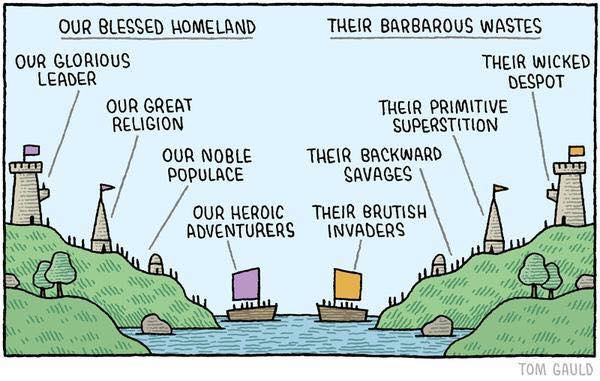
Framing a viewpoint
Media descriptions summarised by Tom Gauld.

View all my reviews