Camels would receive more admiration if they published in the peer-reviewed literature and spat in fewer people’s faces.
Teppic sets out from home to learn a trade. An honourable trade. An important trade. A valued trade. So he attends Ankh-Morpork’s famed assassins’ school. But he has barely graduated when his father dies and he has to return to the family business: king of an ancient land. His new worldliness clashes with the millennia of tradition held in place by the priests of Djelibeybi. These traditions lead to cataclysm and Teppic has to save the land of pyramids before war breaks out. Because war has to break out. It’s tradition.
As I was reading Pyramids – the bit with You Bastard calculating the flares – the sheer scale of the Discworld novels struck me. There are so many little pieces crammed into each book that you wonder how Sir Terry managed to repeat that effort over 40 times. It probably struck me because Pyramids is a more straight-forward narrative with a focus on the character of Teppic. When compared to many of the other Discworld novels I’ve read of late, this one is an “easy read”.
Definitely a 4 mathematical genius camels out of 5 novel.
How can we see the world in each moment, rather than merely as what we think, hope, or fear it is?
How can we base our actions on reality, rather than on the longing and loathing of our hearts and minds?
How can we live lives that are wise, compassionate, and in tune with reality?
And how can we separate the wisdom of Buddhism from the cultural trappings and misconceptions that have come to be associated with it?
Steve Hagen’s Buddhism is Not What You Think is pretty straight forward. He sets out to answer the above four questions whilst addressing the title of the book. And he does this in the introduction. The rest of the book is pretty much just examples to drive the main point home.
There aren’t too many books that wrap their entire argument/premise up quite this quickly. But that probably comes back to the message Hagen is trying to get across about Buddhism and truth. Essentially, we already know truth, but we are too caught up in everything else in life to see it. Thus, Zen practice and Buddhism are about helping get past the distractions.
This was a fairly solid book for advice around Zen practice. But the philosophy aspects I was after were a bit light on.
We often think we know things when in fact it’s only our imagination taking us further and further away from what is actually happening. What we imagine then seems very real to us. Soon we’re caught up in our imaginary longings and loathings. But if you’re here – truly present – you realize there’s nothing to run from or to go after. You can stay calm…Just be with this moment and see what’s going on.
Let’s privatise the military. How could that possibly go wrong?
Blackwater: The Rise of the World’s Most Powerful Mercenary Army outlines the political landscape of Blackwater’s founding, the personal history of several key players – particularly Erik Prince – and the actions and intentions that made the company so infamous. It attempts to explain and document how mercenaries went through a rebranding to become the operators of choice in conflict zones around the world.
Okay, so I thought I had read enough news articles and the like to have some idea of what Blackwater was about. Mercenaries and the name Blackwater became something of a shorthand for “loose cannons”, becoming the villains in movies and TV shows. But as Scahill outlines, the reality and totality are so much worse than I’d thought. Blackwater and several other companies are discussed, along with the players who made this all possible. You’ll recognise many of the politician’s names, but maybe less so the “contractors”. This was disturbing reading.
They couldn’t get a coalition of the willing, so they turned to a coalition of the billing.
There were a few very important points that were made. The first was how senior political figures decided they wanted to privatise the military and associated intelligence work. This is such a terrible idea that you have to be pretty ideologically bent-out-of-shape to think it is good. The most troubling reason for this being terrible is the lack of accountability this gives these newly privatised people with guns, bombs, and shady contacts. As numerous leaks have shown over the years, the military is already far too unaccountable.*
Which brings me to the second point, that once they are privatised, the companies lobby hard to remain unaccountable, saying they don’t fall under military rules because they are private citizens, and that they don’t fall under civilian rules because they are acting as part of a military force. In essence, they can literally commit murder and they have been positioned by their lobbyists and key politicians to never be even investigated for the crime.
Those points should disturb everyone. You may not see a problem with war profiteering, or religious fundamentalists pushing for war and creating conflict (or at least involving themselves in them), or free marketeers wanting to privatise everything, or private companies hiring “shoot-first-never-answer/ask-questions” mercenaries to guard their kitchen supplies. But I think we can all agree that you have to be accountable for your actions, and Blackwater (et al.) has not been.
After reading this book you’d think Erik Prince would suffer some consequences…. Nope. He’s still going.
The only complaint I have about Scahill’s book is that it was somewhat repetitive. Several points were raised repeatedly, not to highlight them, but because the surrounding issues or players were being discussed again.
After reading this I can only hope that the various players involved aren’t allowed to have positions of power and influence ever again.**
* Because schools, hospitals, cafes, etc are totally legit military targets and not war crimes.
** My hopes will remain unfulfilled, I’m afraid.
A few years ago I published a table from the US Bureau of Labor Statistics.
Wow, you sure know how to party!
Thanks.
Anyway, that table highlighted how much Americans spent on reading per year. Because I’m a Nerdus scientificus, for fun I decided to collate the stats in a spreadsheet and create some graphs.
You are just one big party animal, aren’t you!
I certainly am.
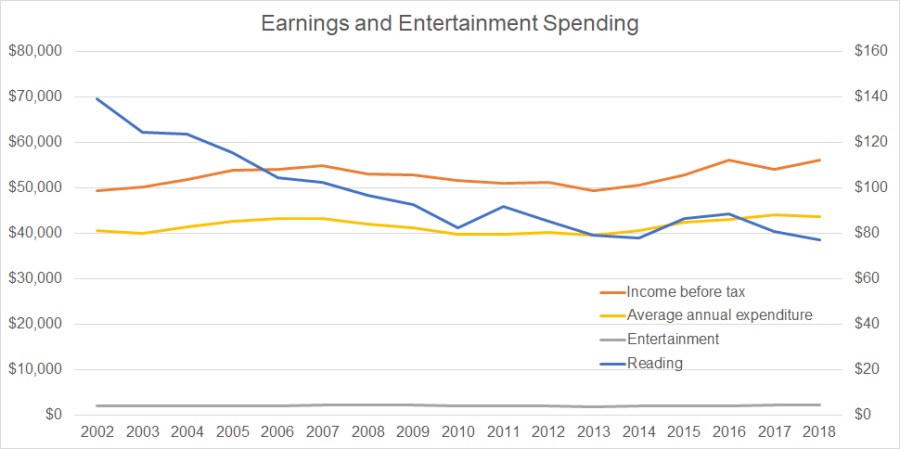
So the first chart is a summary of inflation-adjusted US income, expenditure, entertainment spend, and reading spend by the average “consumer unit”. A consumer unit is obviously the economists’ way of referring to a living, breathing, thinking, cog in the economic machine. Apply the appropriate conversion factors for your country.*
As you can see, US income and spending haven’t really changed in two decades in real terms. That’s right, despite more wealth having been created in the economy since 2000, the average cog in the machine hasn’t seen a change to their take-home pay. Sidenote: I noticed union membership is rather low in the US as well. Might be related.
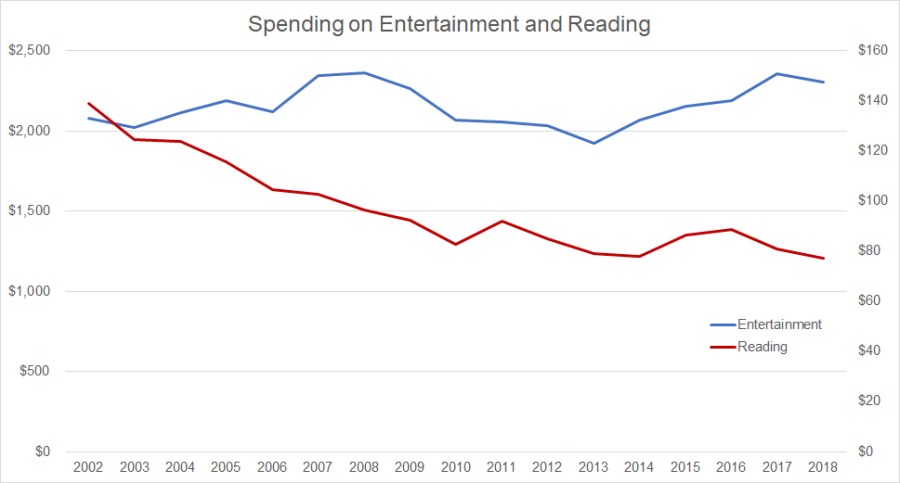
Over that same time period, the spending on reading has declined. The line for entertainment wasn’t particularly clear in the above chart, so I made this second one.
It could be argued that entertainment spend is roughly static over time, while reading spend is clearly declining in real terms. But the question is, what does this mean?
The obvious conclusion that Guardian columnists and other industry wonks will make is that (choose one or all to write your opinion column today!):
Kids these days are playing Facepage and Tweeters rather than reading books.
People have short attention spans and can’t handle reading decent books.
Too many people are Netflixing and Chilling.
Something derisive about gaming.
Blame falling education standards or immigrants or something.
Yes, the media landscape is more diverse now. This is a true fact, not an alternative one. But that doesn’t really explain the decline. Because reading also became cheaper over that time period. Amazon entered the market, heavily discounting paper books and shipped directly from the warehouse. E-books became a thing, which again changed the cost of buying books.
So you have to question how good a metric spending is to reading. Unless you are writing an industry opinion piece.
I also mentioned the lack of change in household income in real terms. It would be interesting to dig up some figures on financial stress for the average household over this same time period. And I’d posit that entertainment is more likely to involve passive forms, like television, than active forms like reading when stress is higher.
Ideally, the industry figures would be more transparent. That way someone could actually crunch the data and to track average individual book consumption and reading totals over time. Then we could put some opinion columnists out of work.
* By this I mean look at the currency conversions and think about whether you reckon your country-people would spend more or less of their household earnings on reading than an average American. More. The answer is going to be more. We’ve seen their leaders.
Government: We invented this.
Private company: Can we have it?
G: Sure. Just remember to pay you taxes.
P: Lol, our what?
The Entrepreneurial State is Mariana Mazzucato’s detailed effort to debunk some of the often claimed myths about government’s role in innovation. Her argument is that it is the public sector, not the private sector, that is often the innovators, risk-takers, and entrepreneurs in the economy. And because ideology has pushed for the state/government’s role to be smaller, we run the risk of not having the next generation of innovations/technologies.
I recently read Mariana’s The Value of Everything and wanted to read this earlier work. Similar to her arguments about how we measure the economy, Mariana’s arguments about innovation are well made, have plenty of references, piles of evidence, some great examples, and leave you with the head-scratching amazement that we need this book.
I’m sure that anyone who has worked in the public or private sector would read some of the examples in this book and be immediately reminded of some from their own field. Whether it be the government contract their company was gifted, or the publicly funded research that is commercialised, or the public infrastructure support given for that new project, we can probably all think of examples where entire industries or technologies wouldn’t have happened without governments taking the first step.
So how is it that myths (listed below) about the economy and who the entrepreneurs are persist?
Myths about Drivers of Innovation and Ineffective Innovation Policy
Myth 1: Innovation is about (private) R&D
Myth 2: Small (government) is beautiful
Myth 3: Venture capital is risk-loving
Myth 4: We live in a knowledge economy—just look at all the patents!
Myth 5: Europe’s problem is all about commercialization
Myth 6: Business investment requires ‘less tax and red tape’
There is only so much ideology that can stand in the way of reality. Unfortunately, I suspect that there is plenty of ideology floating around like an iceberg during a maiden voyage.*
An excellent book that is well worth reading.
We live in an era in which the State is being cut back. Public services are being outsourced, State budgets are being slashed and fear rather than courage is determining many national strategies. Much of this change is being done in the name of rendering markets more competitive, more dynamic. This book is an open call to change the way we talk about the State, its role in the economy and the images and ideas we use to describe that role. Only then can we begin to build the kind of society we want to live in, and want our children to live in, in a manner that pushes aside false myths about the State and recognizes how it can, when mission-driven and organized in a dynamic way, solve problems as complex as putting a man on the moon and solving climate change. And we need the courage to insist—through both vision and specific policy instruments—that the growth that ensues from the underlying investments be not only ‘smart’, but also ‘inclusive’.
* You only have to read some of the 1-star reviews for this book to find evidence of this ideology in action.
This month’s What’s the Difference? looks at the comic book Locke and Key and its new Netflix series adaptation.
Okay, so not a movie as such. Get off my back!
I’ve had Locke and Key sitting in my digital TBR pile for ages. When they released the first omnibus, I got a copy and then proceeded to not read it. This was a problem with earlier digital formats of comics, as they had a habit of not working with the reader programs (I’ve discussed this before with Matt Hawkins’ comic series).
So it was only recently that I got motivated to read the first volume. And it was fine.
There is a lot going on with the story, with the world-building, and establishing the characters. It moves pretty quickly as well. And the art-work is on point to support the story (there’s a bit where an antagonist sees one of the supernatural characters in a photo that could only be in a visual medium). But I kinda wanted to read it as a novel rather than as a comic.
Development of a TV series has been in the works since the end of the second run (around late 2009). Fox had a pilot (2010), Hulu had a pilot (2017), and now Netflix has thrown money at something for Stranger Things fans. I mean, how could they not when it is written by Stephen King’s son?
I’m yet to see the series*, but I have an inkling that Locke and Key will work terrifically as a TV series. There is plenty of material to work with, there is depth (part of why I wanted a novel version, to spell it out), and the supernatural elements will be fun to see brought to life.
* This must be a first. I’ve read the book first and not had a chance to see the adaptation. Probably because we cancelled Netflix…
I’m not going to make a joke about learning a trade being a killer idea.
Mort is a tall skinny kid who just wants to know how the world works. Death has been flat out since the beginning of time. So when Mort’s dad decides it is time for him to learn a trade, Death offers him an apprenticeship to help cover some of the work. Hopefully, Mort doesn’t mess it up.
I quite like Death. As in the character. Death and his granddaughter Susan are two of my favourite Discworld characters. So it was definitely time to read the earlier Death instalments in the series. Worth it!
I was only a few pages into Mort when I found myself chuckling. Out loud. Normally I can keep that stuff to myself. But I couldn’t help it.
There doesn’t need to be much more said than that. Entertaining and chuckle out loud funny.
“Fake it ’till you make it” should probably only be allowed for artists, not scientists, engineers, and medical companies.
Bad Blood is the full expose John Carreyrou started with his Wall Street Journal articles in 2015 on Theranos. For a decade, Theranos founder and CEO Elizabeth Holmes had managed to attract huge amounts of investment, respected board members, and media attention. But in that decade the company had been putting the cart before the horse, promising big whilst still being in the early development phases. The CEO and president (also COO) kept this all under wraps by keeping its own staff in the dark, often resorting to bullying and intimidation.
I first heard about Theranos via a couple of friends who work in medical research. Obviously, I surround myself with other science nerds, so they were dubious of the claims the company and the media were making about their tech. To be honest, I didn’t really pay much attention, nor remember my friends’ pronouncements until I picked up this book from the library.
In many ways, this tale is worse than the “Biggest Corporate Fraud Since Enron” would have you believe. And that tale isn’t necessarily on the page. The author and many of this book’s readers will be shaking their heads at how terrible Theranos was with all its lying, fraud, and bullying of staff. Amazing. Hard to believe. But the thing is that a lot of what was described was just close enough to normal, within standard business practices*, that the fraud managed to run for so long. Using the example of the frequent firings of staff who raised concerns, that would seem just normal enough to not raise a red flag. It doesn’t appear like a CEO and COO trying to cover anything up.
Just close enough to a normal business.
The other thing I noted was the lack of accountability. Sure, the closing chapters cover the lawsuits being brought against Elizabeth Holmes and “Sunny” Balwani, and since Bad Blood was written 9 counts of wire fraud and 2 counts of conspiracy to commit wire fraud have been brought against them. But that is just two of the culpable players in this tale. David Boies and his team of lawyers** spring to mind as having some responsibility here. No charges. Of course.
And wire fraud??? What about the danger patients were put in? What about all the underhanded tactics used against staff and former staff? Why isn’t this behaviour being held accountable in this instance so as to set some sort of precedent across the corporate world?***
There needs to be way more accountability for all involved. Not just for those who lost people money.
If it isn’t clear by now, this is an interesting read and one that will fascinate and annoy you. Carreyrou does a great job expanding on his reporting with an engaging book.
* As other reviewers have pointed out, this story isn’t really that different from a lot of Silicon Valley business tales. Wrapping staff up in non-disclosure agreements, working them for long hours, spying on them, firing them at the drop of a hat (in a country that ties health insurance to employment, and doesn’t believe in a social safety net), that’s all standard practice. Had Theranos been operating in tech rather than medicine, they’d have probably gotten away with it, as medicine has some regulations, unlike a lot of other fields.
** Same lawyers who covered up and intimidated Harvey Weinstein’s victims. They are well known for their nastiness, as mentioned in the book.
*** Not much was made of it in the book, but Holmes was mentored by Silicon Valley’s “best,” including Larry Ellison, who is a textbook example of the amoral, at-all-cost “entrepreneur” the area is so famous for. Which is why I don’t see this as exceptional.
When hiding, try not to get your photo in the newspaper.
Al Rosen is living the dream. He has retired early, he has money, he’s charming and ladies love him, and he’s hiding in Israel from the Detroit mob. An evening with a woman he has just met ends in a hotel fire and his picture in the paper. By the end of the week, a hit team are in the country. But he can’t leave yet, not without his lawyer handing over his money, and his lady friend returning his passport. To survive he’ll need all the help he can get, like the marine Davis.
I don’t think there is any argument that Elmore Leonard was an amazing writer. Pick up anything he wrote and you’ll see it. The writing just flows. The dialogue, to quote one of those stupid pull quotes they stick on the covers of books, just snaps. The Hunted is no exception. I breezed through the book… when I was reading it.
And this is what has left me confused. I’m not exactly sure why I could read this story so easily and yet not find myself compelled to pick it back up. I’ve held off on writing this review because I’ve been expecting an opinion to form at some point.
That leaves me with speculation. I suspect that Leonard’s writing in The Hunted hid a largely uninteresting story. Kinda like a master artist giving your walls a coat of paint. Or maybe my interrupted reading time has pulled me out of the book too often and I’m just not appreciating the story.
To be clear, I’m not saying this is bad or unenjoyable, far from it. I was just expecting more from Leonard, especially considering his skills were on display here.
“All things are for all.” Not sure if that is an Amazon store tagline or an anarchist catchphrase.
Pyotr Kropotkin’s The Conquest of Bread is an outline of the failings of capitalistic systems, a critique of the failings of communist systems, and a proposal for a system free from hierarchies and poverty. Regarded as a classic text of political anarchism, particularly as the criticisms of communism were seen to come true in the twentieth century, Kropotkin is probably more relevant today than when he was writing.
The Conquest of Bread was an interesting read that I couldn’t help but feel was politically current, whilst being socially historical. The overall political message and much of the details Kropotkin goes into are insightful and you can see why the Occupy Movement and Breadtube were inspired by this book. With the rise of higher levels of mechanisation, and with the coming automation of huge parts of the economy, there is much to be said for a rethink of how our society is run based on these ideas.
Socially, however, many of the points are a little dated and/or naive. After reading chapter 9 (The Need for Luxury) I commented that this was definitely written a hundred years ago. While I don’t think he is incorrect, removing status and consumerist ideals does change our wants, it was a statement that did exist in a time when cars didn’t exist. This changed landscape necessitates a slightly different idea of what people want, need, and what will be “normal”.*
There were a couple of points that I disagreed with. Kropotkin was a little simplistic in dismissing “middlemen” as doing nothing. While Bullshit Jobs apply, there is still the need for things like distribution and organisation by middlemen. This is probably because Kropotkin is imagining a system that is much more localised than our current global system. Which leads to my next point on specialisation. While there is something to be said for his ideas around everyone pitching in and learning something of what others do and contribute, Kropotkin doesn’t really appreciate the idea of specialisation and having high levels of skill vs the average person who can do it but sucks at it. His example, which is a critique of Adam Smith’s pin maker, is true to an extent. But our modern technology operates at a much higher level now. There is no way an office worker could go out to the farm and be a farmer for a few days. They could do menial labour on the farm, sure, but farming is highly complex now, and not something you can just do for a few days a year, as he suggests.
I could go further into the problems with his understanding of agriculture, which is… antiquated. But those quibbles don’t detract from the idea of being able to provide food for all. In fact, removing the profit motive from agriculture might alleviate a lot of problems.
A very interesting read that I’d highly recommend.
* It was notable that while “men” were the focus, there were some particularly progressive ideas about women in society. If he had been writing after the advent of the pill, I’d bet the comments would have been downright modern.
Gender reveal parties would be more interesting if you heard, “I’m pregnant with a cogwheel.”
The two most powerful civilisations in the Legion, the Katazyrnas and the Bhavajas, are fighting for possession of the Mokshi world-ship. In the Legion, only the Mokshi is capable of escaping the decay infecting the world-ships. Zan is revived once more in the hopes of leading a force to capture the Mokshi. With little memory of any previous attempts, Jayd and Sabita hint at a larger plan they have in play. A plan that would see Zan and Jayd take on the Lords of the Katazyrnas and the Bhavajas.
Last year I picked up Hurley’s collection of essays, The Geek Feminist Revolution. Since I enjoyed that book, I decided to read one of her novels. After leaving this review for several days, I’m still not exactly sure what to say about The Stars Are Legion.
The obvious place to start with is the world-building, what with how much of the novel is dedicated to it. Hurley manages to use Zan’s journey to world-build very effectively. It would be easy to point at the amnesia and epic journey tropes and shake your head admonishingly, but I felt that it worked well. The characters are similarly complex and develop in interesting ways, even if they are all damaged and murderous.* And there is never a dull moment where the characters aren’t in mortal danger.
I think the reason I’m not sure how I feel about The Stars Are Legion is that several factors scratched away at me as I was reading. Damaged characters can be hard to connect with. The fact that I’m calling the hero’s journey the world-building shows that I wasn’t quite invested in the journey/action. And I also found I knew several “reveals” before they happened.** These issues made me more along for the ride rather than strapped in and engaged.
That said, this was a refreshingly different kind of sci-fi novel for me. There is a lot to enjoy for those who like darker stories and characters.
* And they are all female. Every character. Which was a pretty cool idea that was a neatly integrated part of the world-building. Gotta be honest, this was satisfyingly unique.
** In fairness, this could just be that these “reveals” were established well rather than cynically concealed within a barrel of red herrings or subverted in a way that throws the plot out the window.
What if I told you that we don’t measure most of the things we value in our economy?
Mariana Mazzucato sets out to show that when we talk about the economy we are only talking about certain parts of it (and of our society). She shows how the parts that are included is determined primarily by the history of economic thinking, ideology, and what’s currently making people rich. Mariana then argues that this is flawed and fails to account for several very important aspects of the economy to our current and future detriment.
I’ve read several economics books over the past year that have addressed the failures of the neo-liberal economic ideology. The solid argumentation, countless references, piles of evidence, and rather obviousness of the problems leave me scratching my head as to why these books need to exist. Why isn’t this obvious to the various “experts” who are running our economy?
The Value of Everything is a very solid argument for rethinking the way we diminish the role of government in our economy. The current “get out of the way while we’re making money, but bail us out when we mess up”* approach is clearly wrong. I’ve heard the very charismatic arguments from the likes of Friedman on why free markets are the way to go, and I thought Mariana’s rebuttals to those arguments were good if a bit too charitable.** But it is clear that governments have a long history of being the innovators, investing early, creating the value that business then exploits, and without that, we’re going to see things fall in a heap.
Well worth a read so we can all start to take off our neo-liberal ideological goggles.
* Privatise profits, socialise losses.
** Worth reading this piece on the Virginian School, a more extreme version of Friedman’s Chicago School for some context as to how the “Free Market” is a con to turn the masses into slaves.
See also: Curing Affluenza – this has a similar upbeat “fixing” approach to our current system. Utopia for Realists – takes a different approach and suggests a different system may be needed. Austerity: History of a dangerous idea – similarly documents some of the failures of neo-liberalism and how it is ideologically driven.
Have you ever run across one of those opinion pieces where you understand exactly where the author is coming from but realise they are shaking the wrong end of the stick?
Well, I found one of those pieces on how people have stopped reading novels. Apparently.
The article starts strongly, outlining the evidence for the argument. We get to hear about the “many” conversations that the author has had that confirm their belief.
I’ve gone from writing a regular column on scifi books for The Guardian, to a year without reading novels. What happened?
I keep having the same conversation about novels. I tell people that I don’t think anybody is reading novels any more. Usually, the response is outraged. I have a lot of writer friends. Clearly, none of us like the idea that the readers are drying up. Then I dig a bit and it becomes clear – they haven’t actually read a novel themselves in years.
I’m obviously overwhelmed with this high-quality anecdata. The $122 billion publishing industry, which is expected to grow by 6% by 2023, is bound to just give up now and stop releasing books.
But don’t worry, the author has more evidence…
My primary evidence for the death of the reader is the death of my own reading. It’s been a year since I’ve read a novel. “Well you must just be one of those dumbasses who doesn’t read!” I hear some folks thinking. That would be less worrying, wouldn’t it? But the truth is that, until quite recently, I was a professional reader.
While I was writing my regular column on sci-fi books for The Guardian I was getting through five or six full books a month, and looking at maybe two dozen in part. Plus reading for reviews with SFX magazine and elsewhere. I would trawl through the new releases looking for anything promising. And while doing that, something happened.
I was finding less and less I wanted to read.
So obviously, the author of this piece is clearly and utterly wrong. They do, however, touch on something important I’d like to discuss. But before I do… I need to say something.
These kinds of unresearched posts written by influential opinion havers annoy me. How hard is it to fact check your uninformed pubinion (get it, pub + opinion) before letting it out into the world? Couldn’t you just keep this sort of uninformed blathering confined to a drunken evening with your mates who won’t remember it in the morning? I mean, check any data on reading, any data on books sales, any data from readers, and you’ll see there are plenty of people reading novels.
But sure, one writer for The Guardian (and elsewhere) and a few their mates haven’t read a book lately, so its all over. Sound The Last Post and bring in the flags, we’re done here.
Really makes you want to start hunting people for sport… I kid, I kid.*
I think a big part of the problem with this argument is that the author doesn’t recognise the actual issue. They burnt out on reading a very specific type of sci-fi/fantasy novel. Yes, they might complain about the bad self-published novels ruining the industry – did I mention they used to write for The Guardian? – but it is clear they don’t read very widely. If I was reading half-a-dozen literary sci-fi/fantasy novels a month, I’d probably be removing any sharp objects from my house to alleviate any spur of the moment desires.
Would it have hurt them to branch out and read some non-literary sci-fi/fantasy? Maybe mix in some romance, crime, western, graphic novels, something, anything, just to have a change of pace. For myself, as much as I love sci-fi, I read just as many fantasies, crime, thriller, horror, philosophy, and non-fiction titles.
This is part of why I dislike the book warden and worthy approach to reading. Those “great books” cause burnout. People stop enjoying reading and engage in other forms of entertainment. The article author mentions several of these, such as the competition from digital and social media, and the rise of prestige television. And to some extent this is happening already, people aren’t reading books because the novels they are told are the important or best ones to read aren’t as interesting as gaming, or TV, or movies.
By not identifying the actual problem it becomes very easy to lay the blame in exactly the wrong place. Let’s blame Dan Brown. How dare he entertain people with his terrible books. Let’s blame self-publishing. How dare authors release the equivalent of pulp novels onto the market. Let’s blame all those books I refuse to read as the reason I’m not reading. But the problem is the “great books” mentality and sticking to only one type of “worthy” novel.
The author wants a revolution in the industry to bring about the novel equivalent that “Mad Men or Breaking Bad” were to TV. But I’d suggest they would miss the revolution. They’ve walled themselves off in one specific sub-genre, complaining about how there aren’t enough shows like Twin Peaks and The X-Files, that they missed Deadwood, The Wire, and literally every other show.
Maybe, just maybe, it’s time to acknowledge that there is more to novels than the ones marked “Literary Snob Approved”.**
* Although, you might want to start running, and don’t forget your haversack and hunting knife.
Claire Hansen is a Keeper drawn to the run-down Elysian Fields Guest House. When she arrives, the owner forges her signature on the deeds and does a runner, leaving her in charge of one employee, one permanent guest, one ghost, and one gateway to hell. With the help of her cat, Austin, she might be able to figure out how to close the gateway. Or she might be stuck there forever.
For our wedding anniversary, we went shopping at a specialist sci-fi and fantasy bookstore. My purchase was the Keeper Chronicles. Yeah, we know how to celebrate. We’re kinky. I wasn’t sure what to expect from Tanya Huff, but I was promised a fun story with humour. I think it is fair to say Summon the Keeper delivered on that promise.
The book meanders along, introducing characters, having those characters banter with one another, introducing a few random elements, and generally giving you the feeling that you’re just reading a series of scenes. Then Huff ties everything together in an exciting and fast-paced finale that almost blindsides you. I think that feeling of meandering through the bulk of the story is the only reason I’m not diving straight into the next instalment in the series.
Overall, I enjoyed this paranormal – or is that urban fantasy – novel and will be reading the rest of the Keeper Chronicles in the coming months.
If you like Christmas movies, then CineFix have a book and movie for you in this month’s What’s the Difference?
At the risk of offending Kubrick fans, I must confess that I do not care for his movies.
Now, before you launch into a flurry of keyboard mashing, I’m not saying that Kubrick is a bad filmmaker. It is clear that he was an amazing visual storyteller. But as I’ve mentioned before, I’ve always found Kubrick films to be somewhat bland.
That said, I can appreciate what he is trying to do with his films… Usually, this appreciation comes after some wonks with a film degree walk me through it (see video below). But that doesn’t really increase my enjoyment of his films.
As to the book, I’ve not read this one. It doesn’t sound like the sort of novel I would normally read, but would probably offer a more clear understanding of the themes of the story.
“Study extensively, inquire carefully, ponder thoroughly, sift clearly, and practice earnestly.” Zhu Xi
The Great Minds of the Eastern Intellectual Tradition is a 36 lecture course covering the influential philosophers and thinkers of India, China, Korea, and Japan. Much like the Western version of this series, the aim is to give a brief overview and insight into a range of people and intellectual schools stretching from the ancient times to the modern-day.
When I finished the Great Minds of the Western Intellectual Tradition, I tried to find an equivalent version covering the Eastern Intellectual Tradition. It appears Grant Hardy had been thinking the same thing and put this course together. There is so much material to cover here that you can’t help but be impressed by the endeavour.
Unlike the western version, Hardy is the sole lecturer for this course. That is both a strength and a weakness. Where the other course had some ups and downs in the quality of lectures, Hardy was consistent and maintained a throughline for the series. But it also meant you weren’t presented with a singular expert on any of the topics to offer a range of perspectives and insights. In this way, the material felt a little more shallow.
The strength of this series is the general overview of the Eastern philosophical, religious, and intellectual history. Hardy also recommended some texts (aside from the included course notes) to help with further study. This course is well worth undertaking as a general overview.
From the course overview:
When compared with the West, Eastern philosophical thought is much more inextricably linked with spiritual concepts and beliefs. To help you make sense of the unfamiliar nature of Eastern philosophy and its strong ties with spirituality, Professor Hardy has organized this course into four basic parts.
Part One traces the origins of Eastern philosophy in the cosmological and theological views that arose in India and China beginning around 1200 B.C., including Buddhism, Jainism, Confucianism, and Daoism.
Part Two explores the famous developers of legalism, Mahayana and Chinese Buddhism, yoga, and other intellectual schools that emerged during the age of early Eastern empires and built on the foundations of the past.
Part Three focuses on the great thinkers who flourished starting in the early 12th century, many of whose schools of thought—including Sikhism, Vedanta Hinduism, and Neo-Confucianism—revolutionized cultural notions of society, aesthetics, and faith.
Part Four delves into the modern era, when the convergence of East and West spurred the development of philosophical beliefs that became even more politicized and blended with independence movements and that reacted to ideologies such as Communism and capitalism.
Throughout your chronological journey, you’ll spend a majority of time among the three major countries that form the core of the Eastern intellectual tradition, exploring their unique philosophical themes and spiritual paths.
India: The concepts of reincarnation, cosmic justice, and liberation; a focus on logical analysis and direct insight (often achieved through yoga or meditation); the union of religion and politics; and more.
China: A constant appeal to the past in guiding the present; practical views that highlight harmony, balance, and social order; a keen appreciation of the cycles of nature; a form of politics that balances legal constraints with personal ethics; and more.
Japan: The adaptation and transformation of Confucianism; a distinct philosophy of aesthetics; a focus on group identity and consensus; an openness to adaptation from the Western world; and more.
There’s a famous quote from one of my favourite thinkers, Bertrand Russell, on reading. He posits that the two reasons for reading are for enjoyment and that you can boast about having read something.
Let’s face it, he was correct.
I’ve previously discussed the reading statistics that show we primarily read for enjoyment but also seem to feel obliged to read other books (particularly literary titles). Actually, I’ve discussed this issue a lot. The anecdata back this up, with early e-reader adopters being the romance and erotica fans who could now read on the bus to work. We just don’t like to be seen enjoying the books we enjoy.
So it should come as no surprise that people like to pretend they’ve read certain books. The Guardian posted this survey of readers (although I can’t find the source) listing off everyone’s favourite reading cred books, you know, the ones you claim to have read but fell asleep at page 2.
A recent survey of 2,000 people suggests that the majority of people pretend to have read classic books in order to appear more intelligent, with more than half of those polled displaying unread books on their shelves and 3% slipping a highbrow cover on books they’d rather not be seen reading in public.
The books most likely to be lied about are, naturally, the books most often filmed, talked about and studied in school (some of the respondents must have been lying since GCSE onwards). Are any of them in your pretend-I’ve-read/never-finished pile, or do you save your literary fibbing for Finnegans Wake and Infinite Jest? Share your guilty secrets below.
1) 1984 by George Orwell (26%)
I have actually read 1984. Some people like to announce that 1984 is our current reality, which shows they haven’t read it or are fond of hyperbole. I enjoyed it, but I can see how people would battle to read this one. Worth a read if only to see how people seem to mash 1984 and Brave New World together.
2) War and Peace by Leo Tolstoy (19%)
I got to about page 8 of War and Peace. I have no intention of revisiting it. People always talk about battling through it in small chunks because it is such an important and blah blah blah book. If it was really important it wouldn’t have been so boring as to necessitate reading it in small chunks.
3) Great Expectations by Charles Dickens (18%)
I watched the old black and white film, does that count? No? Oh well, I don’t care.
4) The Catcher in the Rye by JD Salinger (15%)
I’ve read this novel many times and hated it every single time.
Why reread a novel you hate?
Well, reader surrogate, The Catcher in the Rye is one of those “classics”. You’re meant to love it, or feel moved, or something. Smart people like it, so I must, ipso facto, be a dummy for not enjoying the brilliance of this book. So every 5 or so years I feel the urge to see if I missed something the other times I read it.
I don’t think I missed anything.
Although, John Green did manage to convince me of its literary merits via Crash Course Literature, not that I’ll bother revisiting this novel.
5) A Passage to India by EM Forster (12%)
I can honestly say I’ve never heard of this book.
6) Lord of the Rings by JRR Tolkien (11%)
Okay, okay, I’ll come clean. I only read this book after seeing the first movie in the theatre. In my defence, I tried reading the Hobbit when I was younger and then realised I had so much more to live for and stopped reading.
I really enjoyed the book, but it was long and waffly and I can see why others wouldn’t actually finish it. The narrative structure in parts is also poorly done. In a modern book, those separate threads would be told concurrently rather than one thread at a time with big jumps backward for the next thread. Unlike some 1,000 page novels, this one is worth a look.
7) To Kill A Mocking Bird by Harper Lee (10%)
I don’t claim to have read this one, but I haven’t actually gotten around to reading it yet either. I’ve even got two copies, a DTB and an ebook.
8) Crime and Punishment by Fyodor Dostoevsky (8%)
[Insert joke about book title being equivalent to reading said book]
9) Pride and Prejudice by Jane Austen (8%)
I’m going to read the zombie version. I know, I know. Sacrilege.
10) Jane Eyre by Charlotte Bronte (5%)
I’m not really interested in reading this. My wife isn’t a fan, but my sister is. No offence to my sister, but I’m taking my wife’s recommendation not to bother.
Bonus: Infinite Jest.
I recently started reading Infinite Jest and gave up. I mean, a book weighing in at one thousand pages had better have a gripping/engaging first chapter to encourage me. Wallace was lauded for this novel, but I think it needed to get to the damned point.*
The point I’d like to make is that there is no reason to read any of these books. Sure, some of them are great. You might enjoy some or all of them. You might hate some or all of them. But you don’t need to pretend to have read them.
And it is worth noting that many literary influences transcend their medium. You don’t necessarily have to read a book to have a working knowledge of the plot or themes. I’m reminded of a scene from Star Trek where one character criticises Picard for chasing his white whale. Picard acknowledges the point by quoting a relevant line from the book, a book that character hadn’t read. In that moment, despite Picard’s encyclopedic knowledge of the book, he needed someone else to point out the moral of the story.
Enjoy reading. Don’t feel as though you have to read.
David Foster Wallace’s Infinite Jest was a definitely finite jest: I think there might have been a good novel encased somewhere in all that dross of self-indulgence, like a Michaelangelo statue trapped in a slab of marble, but Wallace’s editor evidently couldn’t be bothered to chisel the thing out.
When it was released, the movie was regarded as a saccharine dud. Post-war audiences and critics just weren’t interested. As a result, when the movie studio was due to renew the copyright in 1974, they kinda forgot. TV networks pounced on the free content like a coal billionaire with a SLAPP suit. They loved having a free Xmas movie that they could screen during the non-ratings period holidays. And audiences who had nothing better to do gained an appreciation for a movie that wasn’t a thinly veiled advert or yet another retelling of the life of Jesus on a shoestring budget.
It’s interesting that all it takes to make something a beloved classic is to give it the chance to find its audience. Time and again we see this happen. So much art has fallen through the cracks, not because it wasn’t good, but because it was never given a chance to be read, watched, or appreciated by the people who would enjoy it.
Maybe we need more art entering the public domain far sooner than current copyright laws allow.
If you love Frank Capra’s holiday season classic, It’s A Wonderful Life, then you’re in luck! It’s probably going to be on TV 24/7 for the next month or so. In the meantime, check out how Jimmy Stewart’s “careful what you wish for” cautionary tale was born out of a meager 40 page book entitled The Greatest Gift. Turns out, fleshing out a crazy short story into over two hours of Christmas time magic on screen took quite a lot.
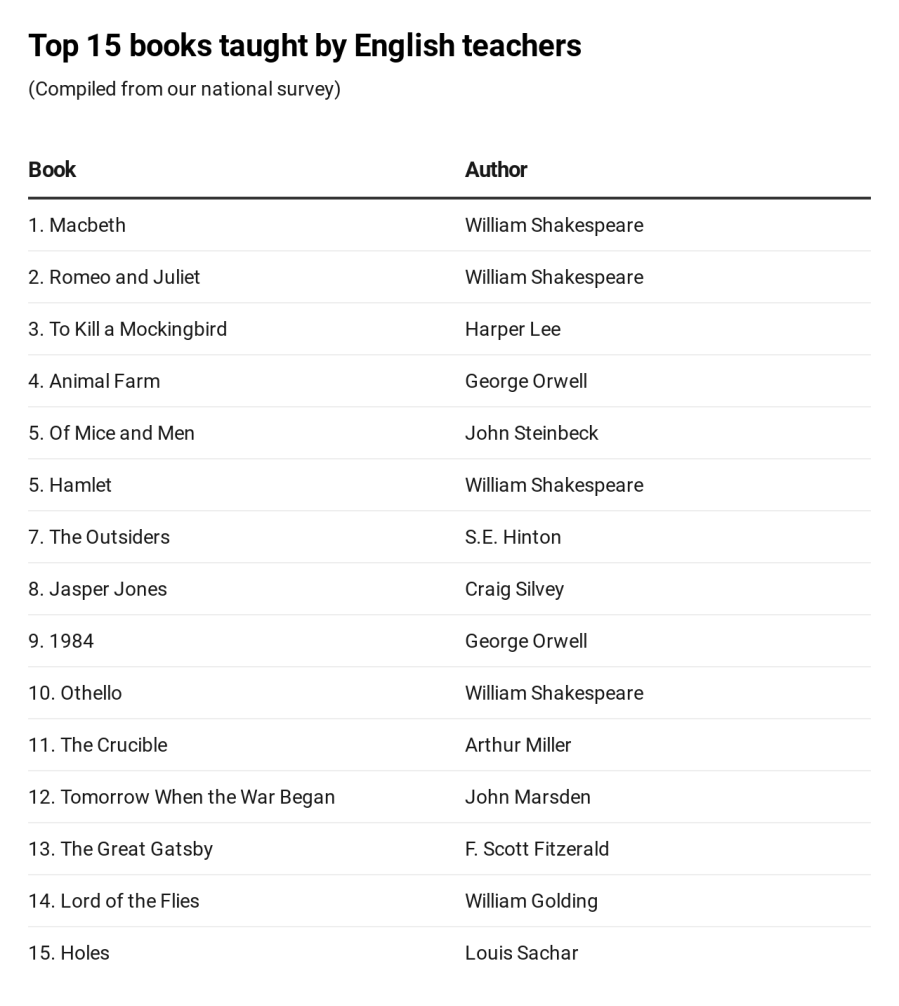
The article itself was a fairly standard call for greater diversity in school texts. It’s an old discussion that is apparently taking a fair bit of time to leak through to the sorts of people who follow The Conversation to post opinionated comments but don’t read their articles. I’ve covered it here with the worthiness, important books, snobbery, guilty pleasures arguments and the PBS It’s Lit series (particularly this episode).
The basic gist of the article is that it would be really nice if some of the additions to the school book list were actually being taught to kids. We’re still seeing the same old “favourites” being taught, mainly because they’ve always been taught so there are plenty of SparkNotes on them.
The audacious dream is to expose kids to more authors, diversity of texts, and some of the other great books that weren’t written by a dude wearing a ruff. I’d hope that this more diverse array of texts will inspire a lifelong love of reading by showing kids that there is more to reading than a couple of 400-year-old plays and some poetry that even poets regard as pretentious.
What was interesting was the response on social media and in the comments.
There aren’t any great female and people of colour authors!! I’d have learned about them in school if there were!! Stop being racist and sexist against white men!!
Arguments like this are, of course, said without a hint of irony.*
These arguments are always frustrating. The traditionalism argument about how great these authors are ignores how those texts make it onto the syllabus in the first place and that literally no one wants to take them off anyway. It also feeds into the larger problem of Book Wardens, who suck all the fun out of reading. I want to make a joke about crusty old vampires ruining reading, but they sparkle now, so they’d make it fabulous.
There is also the reactionary culture warrior aspect to this argument. Quick, someone who knows more about this subject suggested we make a change for the better: Man the keyboards, all caps the objections, haul out the canards!
These brave warriors are the last defenders against those evil thinkers and knowers. Only they can protect society from people who would dare to acknowledge there are other decent books worth reading.
In some respects, they remind me of the Literati who bravely defend Fort Literature from the invading hordes of the Lesser Works. As I’ve pointed outpreviously, the origins of what we call literature versus genre have their origins in the class divide during the Industrial Revolution. Workers got to read one type of magazine, whilst richer managers (but not the capitalists) got a fancier magazine. The stories that were published in the fancier magazines became literary, whilst the rest was genre. So it is quite literally the snobbery of class divides deciding what is literary.
These reactionary culture warriors aren’t necessarily siding with the Literarti so much as reinforcing the status quo. They like the nice ye-old definition of literary and artistic merit we often operate under in society. But it isn’t a good definition as it is more about what a certain group of people like. And that certain group holds the power, which the reactionary culture warriors need to defend at all costs!**
Maybe if these warriors (and literati) were to actually read some of the other great books they might learn something.
* Said on the internet, the greatest information resource in history, no less. But worse, the article and people like myself were pointing out the problems with their arguments. It’s like trying to lead a horse to a glue factory and they are refusing to acknowledge they were too slow for racing.
** The reason why is interesting. For some, it is just about “change bad”. For some, it is about pwning the libs, which as far as I can tell appears to be anyone who has read a book since high school. For others, it is about sucking up to those with power or influence in the hopes they will be rewarded in some way. This seems like an odd position to take given the topic at hand, but it has to be about the only time I’ve seen an Arts Professor lauded for their support of (insert classic literary text here). We live in strange times.
Sometimes the albatross around your neck is alive.
Zinzi December is scraping by finding lost things and writing email scams to pay off her debts. Her life as a Zoo, someone magically saddled with an animal for their misdeeds (a sloth), in South Africa is a struggle to stay afloat. When one of her clients is murdered she is offered a job finding a lost teen pop-idol. The money is too good. The job isn’t.
It’s been a few years since I met Lauren at a writers festival. In that time I’ve read several of her books, including The Shining Girls and her collection of short stories. She always manages to bring something fresh to the page. If I was to tell you that characters in this book have a spirit animal magically tied to them you’d immediately think His Dark Materials. Well, no, nothing like that at all. In The Shining Girls, there was time travel. Nope, not in the way you’re thinking. And that is the skill Lauren brings to the page.
Zoo City is a compelling read. The world feels dirty and nasty inhabited with characters who are hustling or surviving. And the missing person case is a great excuse to traipse through this world. But this strength is also why some people may not enjoy the book. After spending some time in Zoo City you feel in need of a shower and there is a sense of hopelessness or nihilism. Best to know that going in or this could turn you off.
I’m looking forward to reading Lauren’s other novels.








 Tyson Adams