Can you name a book?

creative-bookshelf-18__700

Sounds like a simple challenge, right? Name a book, any book at all.

In the long tradition of asking Americans general knowledge questions on the street and filming their glorious ignorance, I present this video from Jimmy Kimmel.

Before we all laugh and point at the Americans and insult their intelligence, let’s remember that you could do this just about anywhere. Although, Americans do make this stuff easy at times. I’ve previously discussed the reading figures for the US, UK, and Australia. I’m sure those numbers are at least in the same ballpark as other countries, if not outright representative.

Wait, why guess when I can actually use the wonders of the greatest information resource in human history to look that up? Why have an unfounded opinion that I then rant about in indignant outrage, arrogantly assuming I’m right and belittling anyone who does bother to look up the data? To the research!

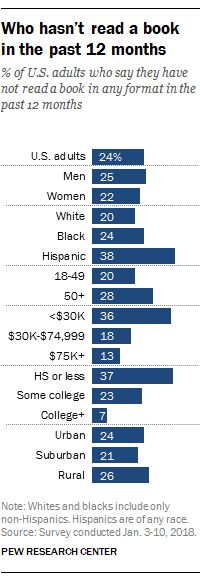
Let’s start with the data that the above video was citing from Pew Research.

ft_18-03-22_nonbookreaders_whohasnt
Source

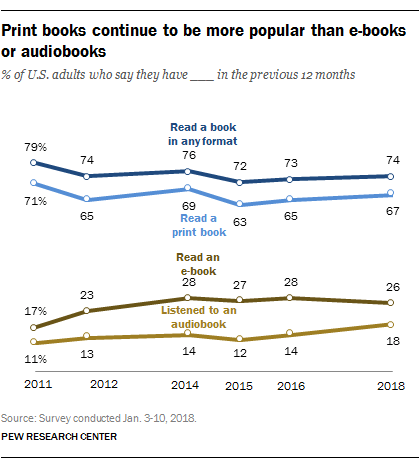
As we can see, the 24% figure is showing that older, poorer, less educated, men (just), and Hispanics read less in the USA. This isn’t a new conclusion, as data from Pew in 2016 shows. The conclusion around the number who don’t read is also similar to the 2016 results of 26% not having read a book in the last 12 months. I’m not sure you can interpret much change over time in the number of people reading, but numbers might be slowly decreasing (although, look at the uptick in audiobooks as that format has come down in price).

ft_18-03-07_bookreading_printbooks
Source

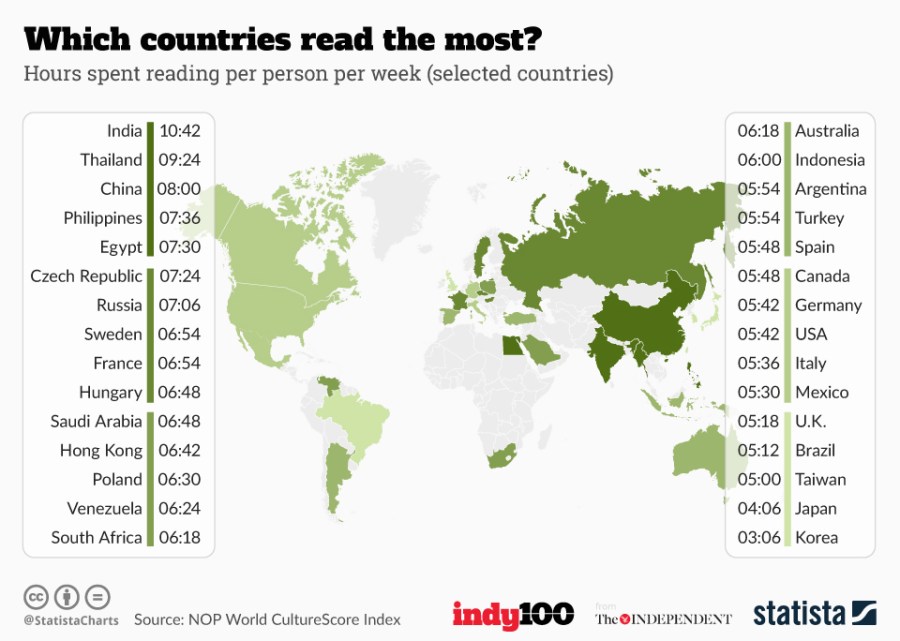
Now we can look at how the USA sits in terms of reading. I’ve previously discussed how Aussies spend roughly 23 minutes per day reading (ABS figures), or an hour a day if you believe the Australian Arts Council report (I suggested there was possible survey bias in that figure). Below you can see that the NOP World Culture Score puts Australia at 6 hours 18 minutes – which I think makes this an “ALL-YOU bench-press” set of numbers.

chartoftheday_6125_which_countries_read_the_most_n
Source: Statista

This chart suggests that the USA is probably typical for English speaking countries, but that many other countries read far more on a weekly basis in terms of hours. Unless reading is code for something else in non-English speaking countries. Maybe they thought they were being asked about how many hours they spent having sex per week.

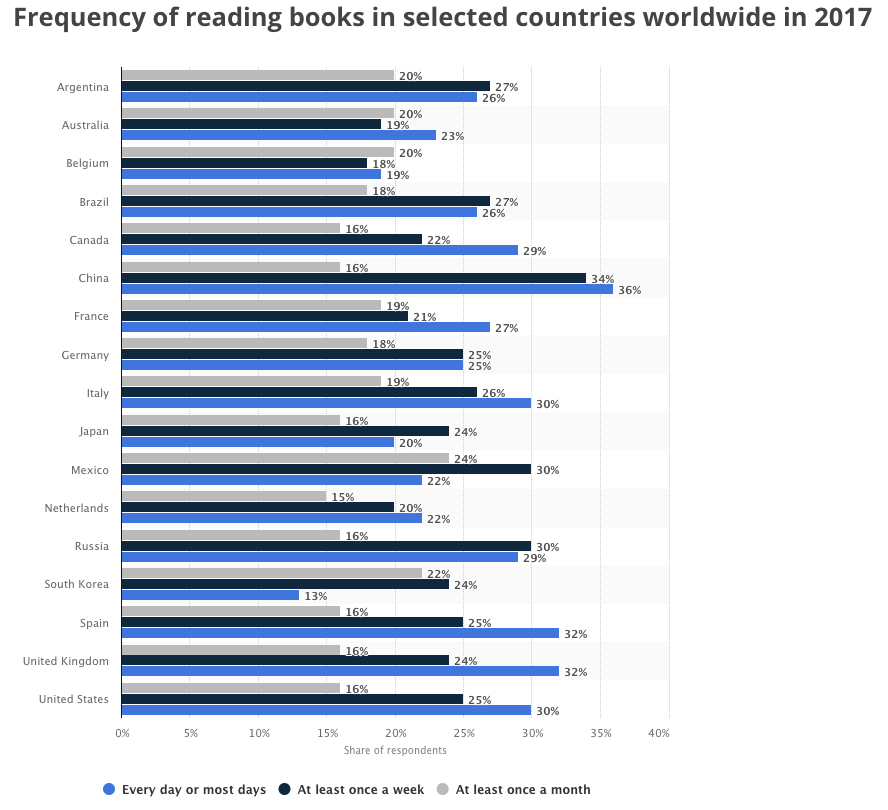
If we then look at the countries and how frequently they read books you can see in the chart below that they were afraid to include the bars for “didn’t read a book”. The high end has only 14% of Chinese people not reading a book, whilst the low end has the Dutch at 43% not reading (USA comes in at 29%, UK 28%, Australia 38% – I demand a recount!!).*

Screen Shot 2018-05-25 at 7.50.23 pm
Source: Statista

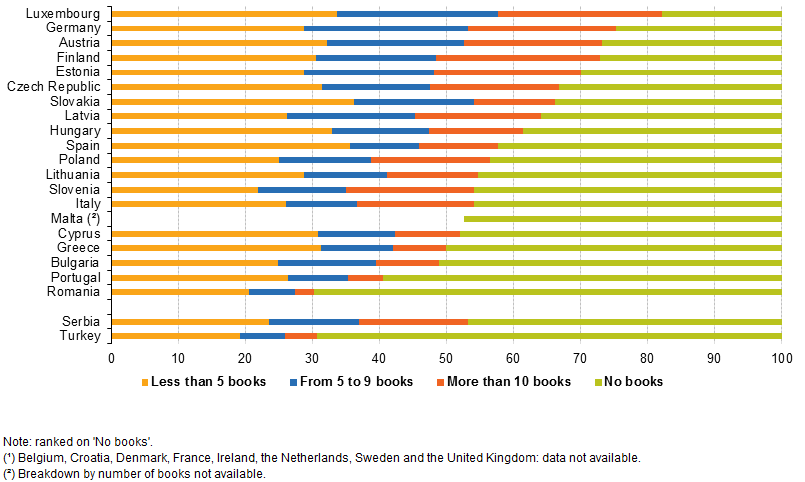
How about the number of books people read, or at least what they claim once they round up?

number_of_books_read_in_the_last_12_months2c_2011
Source: Eurostat
table-2
Source
Screen Shot 2017-10-08 at 6.24.23 PM
Source

What this all shows is that there are plenty of countries where you could ask ten people on the street to name a book and have one or two of them fail. You could ask those ten people what book were they reading today and only three of them could. Isn’t that sad? I reckon people would really enjoy reading if they made time for it. I’ve commented before on why I think people don’t read, suggesting that they don’t because they get told to read literature when they actually enjoy thrillers, sci-fi, and romance.

Maybe it is time to change that before someone sticks a camera and microphone in our faces.

*Be careful with my assumption here. Depending on how the question was asked and any other unreported categories, I may be very wrong in assuming the unreported numbers are non-readers.

My Fellowship at KSP


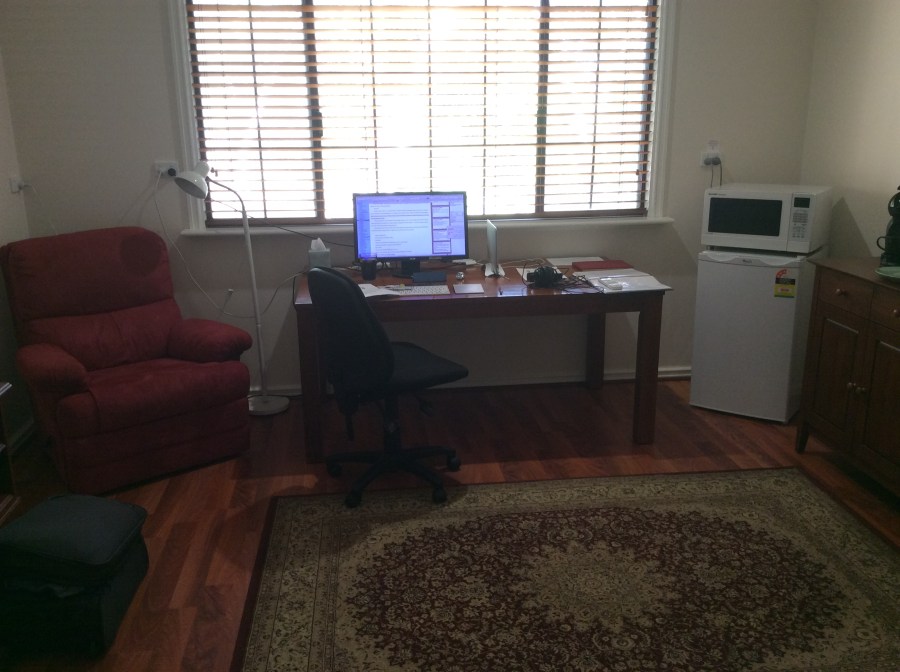
IMG_0836
A room for writing.

It feels like only yesterday, but it’s actually just over a week since I finished my Fellowship at the KSP Writers’ Centre. What’s a Fellowship? I hear you ask. Actually, I didn’t hear you, but I do hear voices in my head – no, I have an adequate sufficiency of matches, so be quiet. Anyway, I applied for a writing retreat to focus on (finishing….) my novel Evil Corp. Twelve-and-a-half days to do nothing but writing in a purpose built hut.

The writing huts are modeled after Katharine Susannah Pritchard’s own writing retreat and are very much focussed on having a room to write in. Your desk faces out onto the garden – I had a view of a gum tree with a beehive in its trunk – you have amenities for snacks and drinks, a chair for quiet contemplation, and a bed for… well, you know what beds can be used for.

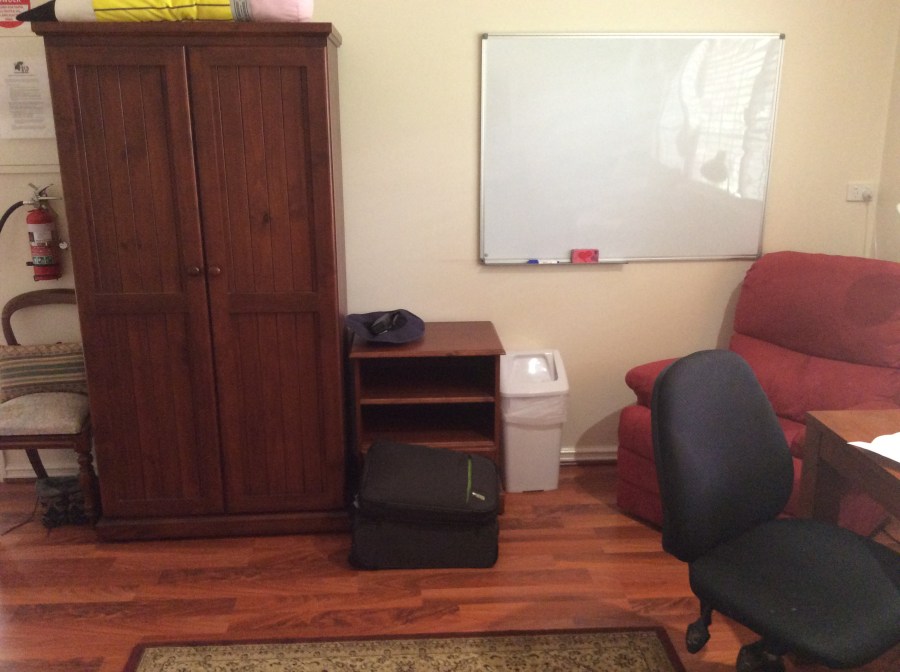
IMG_0838
I had a whiteboard… which I didn’t end up using. And a giant pencil… which I also didn’t use.

The hut was quiet and felt ideally suited to writing. Or painting. Or reading. Or slowly going mad and deciding to live like a hermit. All good options.

IMG_0837
Yes, I brought a guitar.

The best feature was definitely the lack of adjoining accommodation for young children, who slowly steal your hopes and dreams as they consume more of your life than you’d ever imagine, such that you wake up at 40 wondering why you haven’t published a novel yet.

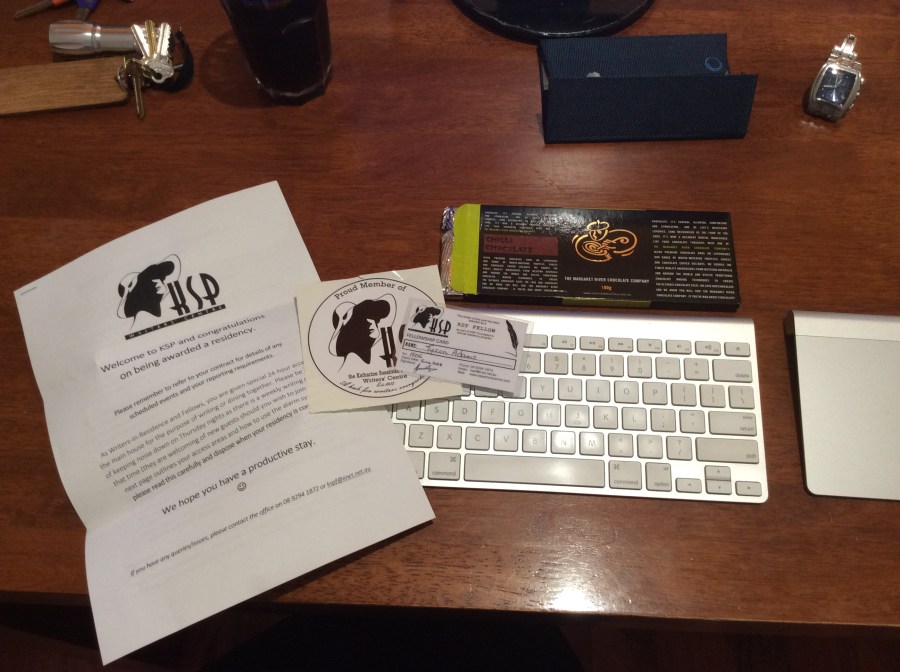
IMG_0835
Welcome Pack: Welcome letter, KSP sticker, KSP Fellow card, CHOCOLATE!

With the welcome letter in hand, my computer set up, I was ready to right write!

Getting my author on

Reading Anne's story at KSP Open day 2018
Not sure if I made this picture blurry by drinking too much caffeine, or if it was the wrong lighting for the camera to focus.

For my stay at KSP I had set a few hard and soft goals. Hard goals were things like: relax and enjoy being able to pursue my hobby uninterrupted for a fortnight; not wake up at 5am because my kids weren’t going to be there; refrain from buying a beret and neck-scarf; write more than 1,000 words per day. Soft goals were things like: wake up before noon; eat properly; get some exercise; try not to feel guilty about leaving my wife alone with our kids; write 20,000 words during my stay. Try to guess which goals I achieved.

I didn’t want to place too much pressure on myself to, say, “finish my novel” or “write 5,000 words a day”, because that would have sucked the fun out of the Fellowship. Having previously won NaNoWriMo, I knew I could write 2,000 words a day for a sustained period, but I was surprised at how having more time to write didn’t necessarily increase output. I’m going to claim that it was higher quality than NaNoWriMo writing though. A low bar I’m willing to jump over. But I did manage to write 20,000 words, do some plotting, create a few characters, outline several chapters for the future, review a couple of books, and come up with two plots for other projects, so it felt productive.

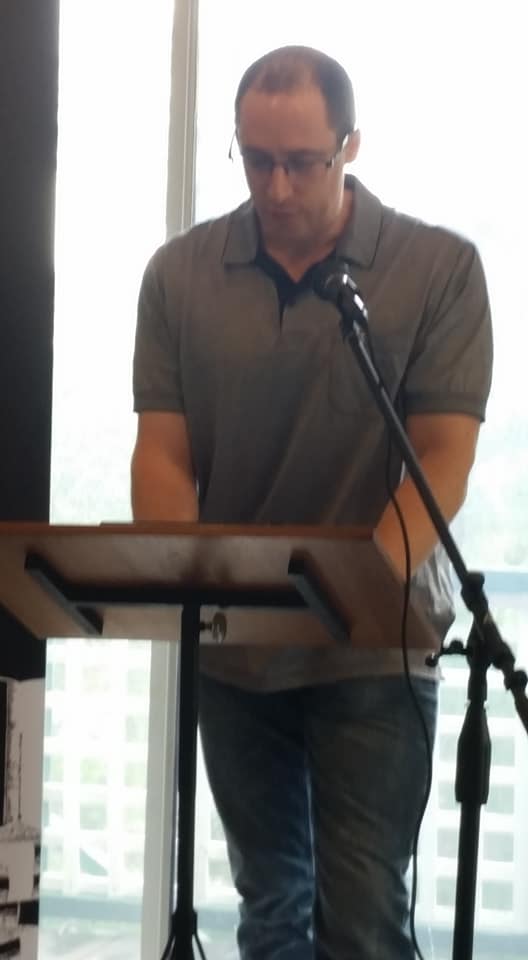
On the first weekend of my Fellowship the KSP Writers’ Centre held their open day. It was a fun event and well attended despite the threats of rain. As the above photo shows, I was asked to do a reading for the event on behalf of one of my writing groups. I read Werespoon by my fellow Fantasy Sci-Fi Horror group author Anne Forbes. Gillian Clarke read on behalf of my other author group, the Thursday Night group.

Another thing that made me feel authorly was mingling with other authors.

Surrounded by other authors

Me Kaaron Warren and Rachel Mead
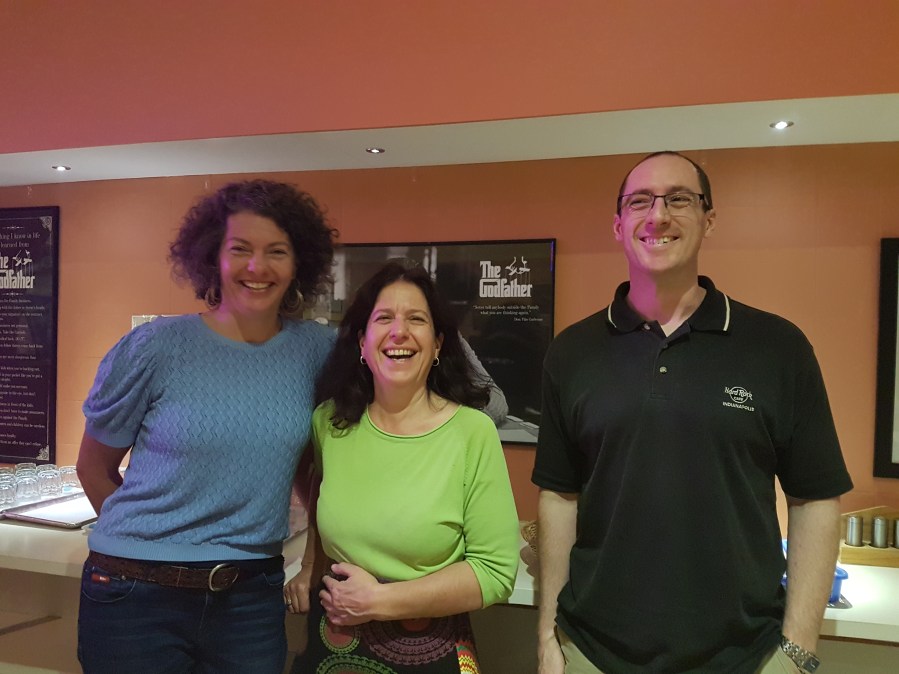
Rachael Mead, Kaaron Warren, me being told to smile more.

Writing is generally regarded as a lonely occupation. Well, unless you take your laptop to a coffee shop so you can tell anyone who has the misfortune of coming too close that you’re an author and that sitting in a coffee shop telling people about your WIP counts as writing. The KSP cabins were decidedly setup for writing. On your own. Uninterrupted. I brought a guitar. But I still managed to hang out with other authors.

Kaaron Warren and Rachael Mead were also at KSP doing a Residency and Fellowship respectively. Kaaron has been publishing stories since before I’d figured out Coco-Pops didn’t need extra sugar. She was shortlisted for an Australian Shadow Award while she was in residence, and just last week released Tide Of Stone. One evening we were discussing awards (she is a judge for the World Fantasy Awards this year) and she casually mentioned being beaten by luminaries Stephen King and KJ Parker… I’m not sure that counts as losing.

Rachael has a PhD in creative writing and, like Kaaron, an impressive list of awards to her name. She has published multiple poetry collections, including one that came out earlier this year, and regularly contributes arts reviews to magazines. She also writes short stories and was working on what appears to have become a collection themed around paramedics during her time at KSP.

Which made me the bumbling rookie trying not to sound like an amateur around the two pros.

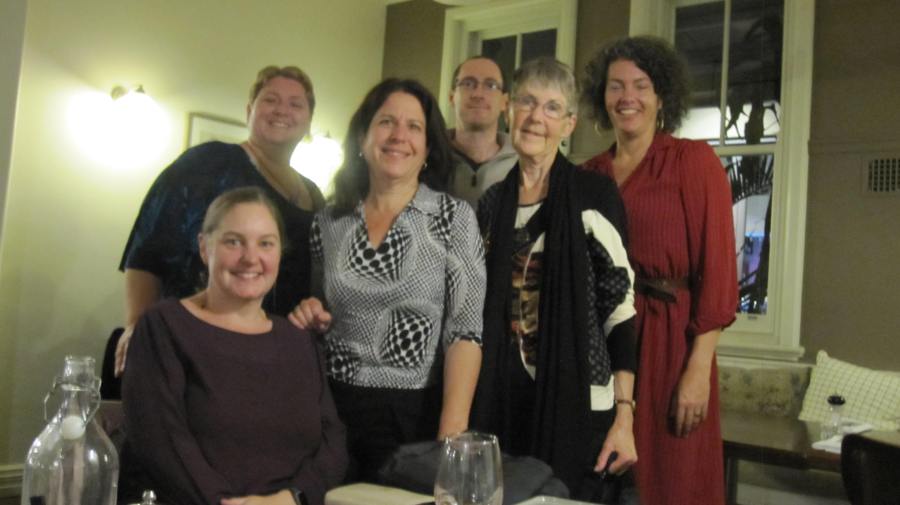
It was invaluable to chat with them over dinner, or at drink-o-clock, or at procrastination time. For example, Rachael helped me with a chapter I was headed in the wrong direction with. But it was also good just to be able to have a chat and socialise, including catching up with an old friend who is a mutual friend of Kaaron’s. If that wasn’t enough wordsmiths to hang out with, we also had a lovely dinner out with some other KSP Fellows. See the blurry photo below that proves kids aren’t necessarily good with technology.

2018-05-10 20.10.41
Dinner with some other KSP Fellows.

Summary

It was great to have the opportunity to feel like a writer and make some progress on (one of) my works in progress. I met some lovely people, got some writing done, and didn’t get woken up by a toddler wanting to find the teddy that is lying right next to them in bed even once. I very much appreciate the board and staff at the KSP Writers’ Centre for awarding me the Fellowship.

What genre is the 2008 book Outliers in? What are some similar books in that genre?

efc6e32f85a3821257e73ea41733271737e761e4853c341459263864ed2e6483

The book Outliers by Malcolm Gladwell is a popular example of fiction.

Outliers is probably most famous for promoting the idea of the 10,000 Hour Rule based on how many hours it will take you to get good at doing something. But like all good fiction, it ignores the reality of how skills are acquired.

Unfortunately, many people have mistakenly assumed that Gladwell’s writing should be classified as non-fiction pop-science, or even worse, factual. This has lead many researchers to waste time and resources showing that the 10,000 Hour Rule is nonsense, and that Outliers is pop-science at its worst – i.e. incredibly influential despite being clearly nonsense.

Reviewers of the book have noted the flaws in calling this book non-fiction*:

In an article about the book for The New York TimesSteven Pinker wrote, “The reasoning in ‘Outliers,’ which consists of cherry-picked anecdotes, post-hoc sophistry and false dichotomies, had me gnawing on my Kindle.”[20]

In a review in The New Republic, Isaac Chotiner called the final chapter of Outliers “impervious to all forms of critical thinking”.[21]

And several researchers have debunked many factual claims made in the book*:

Case Western Reserve University’s assistant professor of psychology Brooke N. Macnamara and colleagues have subsequently performed a comprehensive review of 9,331 research papers about practice relating to acquiring skills. They focused specifically on 88 papers that collected and recorded data about practice times. In their paper, they note regarding the 10,000-hour rule that “This view is a frequent topic of popular-science writing” but “we conducted a meta-analysis covering all major domains in which deliberate practice has been investigated. We found that deliberate practice explained 26% of the variance in performance for games, 21% for music, 18% for sports, 4% for education, and less than 1% for professions. We conclude that deliberate practice is important, but not as important as has been argued”.[24]

Statistical analyst Jeff Sauro looked at Gladwell’s claim that between 1952 and 1958 was the best time to be born to become a software millionaire. Sauro found that, although the 1952–1958 category held the most births, “[a] software millionaire is more than twice as likely to be born outside the 1952 to 1958 window than within it.” Sauro notes that Gladwell’s claims are used more as a means of getting the reader to think about patterns in general, rather than a pursuit of verifiable fact.[25]

In fact, the 10,000 Hour Rule seems to irk people in the social sciences quite a bit. E.g. Practice Does Not Make Perfect – We are not all created equal where our genes and abilities are concerned.

Are there similar authors and similar books using misleading, cherry-picked, and tenuous research to make broad sweeping pop-science claims that make people feel good? Of course. Plenty of them. It is a minefield in the non-fiction section of bookstores, which I think should be more accurately renamed “Boring Fiction”. So I think it would be negligent of me to recommend more books like Outliers or authors like Malcolm Gladwell. Especially when Gladwell has argued that the truly disadvantaged are the rich, is a corporate propagandist who has argued that we need smokers to fund healthcare, and really doesn’t like engaging with critics.

*Quotes taken from Wikipedia.

This answer originally appeared on Quora.

How can someone from Australia, get into an American University such as Harvard?

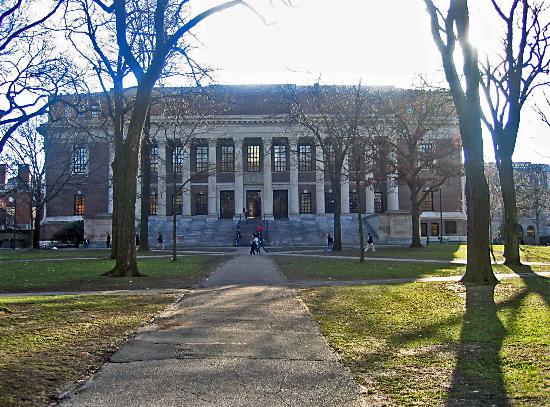
Widener Library, Harvard University

Australians have a proud history as the descendants of convicts. As such, there is no place we can’t break into if we so desire.

The first thing is the loooonnngg plane ride from Australia to the US. Due to US Customs, it is advisable not to bring your B&E equipment with you but rather acquire it from those new-world criminals in the USA.

The second thing is staking out the campus. Surveillance is the key to any decent break-in. You will need good notes from your observations to use in the next step.

The third thing is to have a plan for your break-in. Know your target, ingress point, egress point, contingencies, and make sure you have a cover identity setup just in case things go south.

The final point is to make sure your risk:reward ratio is balanced enough to make the operation worth it. There is nothing worse than putting the time and front money in place for low returns, especially if the penalties are high.

Of course, you could just send in an application to Harvard like every other Aussie student who applies to US universities. Maybe the ex-Harvard Student Association in Australia could be of help.

This post originally appeared on Quora.


Millenials aka Kids These Days

I’m not a fan of the “kids these days” arguments and memes that make their way through social media via the express head shaking admonishment brigade. I’ve written previously how the arguments are recycled garbage, as old people have been complaining about young people since the invention of youths.

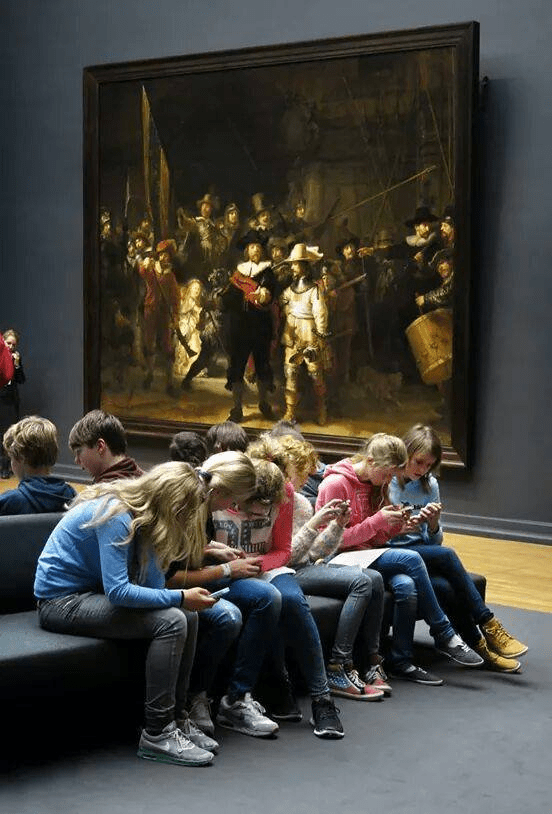
You may have seen this image:

kids on their phones

That’s right: self-involved kids looking at their phones instead of the amazing work of art behind them. How dare they! Shake your fist at the sky.

Of course, they aren’t self-involved narcissists, at least not any more so than other people in society. That is actually a group of students that have just finished admiring the artwork and receiving a lecture on the Rembrandt and are now using the museum guided tour app to learn more. To quote:

Late last year this photograph of children looking at their smartphones by Rembrandt’s ‘The Night Watch’ in the Rijksmuseum in Amsterdam started doing the rounds on the web. It quickly became viral. It was often accompanied by outraged, dispirited comments such as “a perfect metaphor for our age”, “the end of civilisation” or “a sad picture of our society”.

Only they weren’t. It turns out that the Rijksmuseum has an app that, among other things, contains guided tours and further information about the works on display. As part of their visit to the museum, the children, who minutes earlier had admired the art and listened attentively to explanations by expert adults, had been instructed to complete an assignment by their school teachers, using, among other things, the museum’s excellent smartphone app.

I would like to think that all those who liked, posted, shared and tweeted the picture of children on smartphones by Rembrandt’s masterpiece in the erroneous belief that it illustrated everything that is wrong with society feel a tiny bit silly and a little more humble as a consequence. But it won’t happen. The tragic thing is that this — the truth — will never go viral. So, I wonder, what is more likely to bring about the death of civilisation, children using smartphones to learn about art or the wilful ignorance of adults who are too quick to make assumptions?

Whether it be art, technology, manners, or just plain old-fashioned respect for elders, people seem far too quick to complain about kids these days. It always seems to have been better in the good old days, as long as you ignore the wars, child death rate, education levels, work and social rights, equality, food…. actually I’ll stop that list now before I run the point into the ground. So take any of these arguments, images, and claims with huge pinches of salt, as there is probably a parallel version from a previous generation.

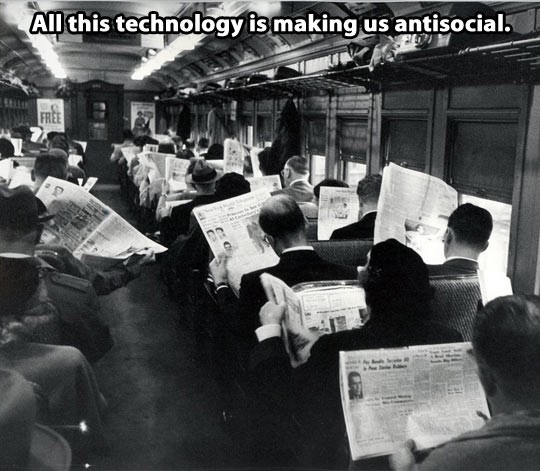
tech making us antisocial

2,500 years of kids these days.

Update: Hey look, someone actually did some science to show I was correct.

Average Movie Superhero

the-rock-vin-diesel-wrestlemania-33
With the recent spate of superhero movies, it is easy to forget that not every movie has a superhero in it. Even the superhero films aren’t always about someone on steroids (Captain America) or weather presenters (Thor) but are instead about your everyday billionaire playboy (Batman, Ironman, Arrow). So it is easy to forget that feats of superhuman strength are not meant to be the norm in films.

Think about the scenes where the everyday hero is clutching the edge of a building by his fingertips – and I’m sure someday I’ll be able to write their instead of his. Valiantly they hold on to the ledge with one hand whilst the love interest or bad guy is dangling from their other hand. Of course, the hero never loses his grip on the ledge, but the bad guy may slip from his grasp.

We accept that scene as plausible because we have been brainwashed into thinking that the average person can hold their own bodyweight with a single hand for extended periods. Double their bodyweight? They can hold that for the length of a dramatic moment – a period of time that is impossible to measure in real time since dramatic speeches and slow motion really mess with reality.

The problem is that outside of gymnasts, rock climbers, or people who crush rocks with their bare hands for a living, the Average Joe wouldn’t even be able to hold their own weight with a single hand for more than a few seconds. Good luck having any unbroken fingers if they caught themselves from a fall.

Elite grip strength can be measured a few ways, but the Captains of Crush grippers are one easy way to distinguish strong hands. The #1 requires 64kg (140lbs) of force to close, while the #3 gripper takes 127kg (280lbs) and is regarded as world class grip strength. Just for shits and giggles they made a #4 gripper that requires 166kg (365lb) of force to close and has been officially closed by 5 people. Ever.

So let’s just assume that our generic action movie has an everyday hero who weighs a buff 80kg and his falling love interest is a sexy 55kg – because stereotypes. That’s 135kg hanging from the hero’s fingertips, a weight that even a really strong person wouldn’t have the grip strength to support. Two normal sized adults are not going to be hanging onto that ledge for any length of time.

Which brings us to the next amazing feat of strength in this scenario: lifting that falling love interest back to safety. For a strong person, lifting their 55kg love interest should be easy. Patrick Swayze managed it in Road House. A buff 80kg hero could probably clean and jerk a dumbbell weighing that much…. assuming they work out, have some chalk on their hands, were able to get some leg drive happening, had decent technique, and that the dumbbell wasn’t particularly unwieldy. But most falling love interests are a tad unwieldy, not designed for easy lifting – no obvious knurled handles – and there isn’t a lot of leg drive happening when you’re dangling from the side of a building by your fingertips. Yet without fail, the hero manages to get them both to safety. Well, unless it is one of those tragic character defining moments, in which case the hero will be in the same situation later and will find the determination to succeed the second time. Sucks to be the first love interest in that scenario.

Interesting to think about just how many amazing feats of strength are passed off as normal in movies.

A Book a Day: Six health benefits of reading

healthbenefitsreading_1600x800

Penguin Australia recently published an article suggesting reading was awesome for your health. Previously I have posted science-backed articles on the benefits of reading (1, 2), so more science telling us that readers are awesome never goes astray. Although, as much as I love some good old confirmation bias, I can’t just share that article without some commentary from the further reading. I mean, the article title is a play on An apple a day keeps the doctor away… that can’t pass without some mockery.

Reading can provide hours of entertainment and pleasure, impart knowledge, expand vocabulary and give insight into unknown experiences. Additionally, research has shown that it has a variety of physical, mental and emotional health benefits. If you need another excuse to pick up a book, here are six ways reading can benefit your health.

And if those six reasons don’t encourage you to pick up a book, then think of them as six ways you’ll be superior to other people.

Improve brain function

Neuroscientists at Emory University in America conducted a study and discovered that reading a novel can improve brain function on a variety of levels. The study showed that when we read and imagine the settings, sounds, smells and tastes described on the page, the areas within the brain that process these experiences in real life are activated, creating new neural pathways.So next time you’re indulging in an armchair adventure with a great book, you could technically claim you’re working out – your brain, that is.

This study was rather small, consisting of 21 university aged participants who had 19 days of baseline brain scans before 9 days of scans as they read Robert Harris’ Pompeii novel. Warning: they had no null group in this study, only the baseline comparison, so any conclusions drawn should be done next to a salt shaker. It does, however, draw similar conclusions to previous research I’ve discussed.

Obviously, stimulating the brain by engaging with a story is going to light up parts of the brain, but there is the implication that using our brains in this way will strengthen pathways. Calling it a workout for the brain is probably a stretch because it isn’t like our brain sits around doing nothing the rest of the day. But for me, the more interesting thing is the shared response among participants. It proves Steven King’s adage true about writing being a form of telepathy.

The big unanswered questions here are how does this compare to any other shared activity, and how does it compare to other similar activities. I’d bet crypto money – always best to keep bets symbolic – that any other activities would see similar responses.

Increase longevity and brain health in old age

Researchers at Yale University School of Public Health found that, ‘reading books tends to involve two cognitive processes that could create a survival advantage.’ According to their results ‘a 20% reduction in mortality was observed for those who read books, compared to those who did not read books.’And the longer you live, the more time you have to get through your to-be-read pile.

This study nags at my skeptic-sense. Nothing immediately jumps out and screams “This study is nonsense, don’t believe it!” but I can’t help but feel like it is. They sampled 3,635 people in the USA and compared readers to non-readers for longevity. Don’t worry, they factored in stuff like age, sex, race, education, comorbidities, self-rated health, wealth, marital status, and depression. But I’m still left with the nagging sound of my statistics lecturer telling the class that correlation doesn’t equal causation. See this example about storks and babies!

My suspicion is that there is something unmeasured that is confounded with reading that is the actual causal factor. This factor is probably also available from other activities, thus other activities will also increase your lifespan. Just my suspicion. Happy to be proven wrong.

Reduce tension levels

A 2009 study by the University of Sussex found that reading for just six minutes can reduce tension levels by up to 68 per cent.3 Researchers studied a group of volunteers – raising their tension levels and heart rate through a range of tests and exercises – before they were then tested with a variety of traditional methods of relaxation. Reading was the most effective method according to cognitive neuropsychologist Dr David Lewis. The volunteers only needed to read silently for six minutes to ease tension in the muscles and slow down their heart rate. If ongoing stress is an issue take a look at these simple stress management tips.

This claim is hard to pin down. It’s not like other studies haven’t shown reading (and yoga, humour, cognitive, behavioural, and mindfulness) have impacts upon stress levels. But unlike the linked studies, Lewis’ study hasn’t been published. The source in the Canadian National Reading Campaign links to The Reading Agency in the UK which cites an article in The Telegraph. Now, I suspect that this was probably one of those studies done for a report that no one has read because the only publicly available material on it is the press release. But it could also be rubbish research that didn’t get published because of claims like 300% and 700% better than other activities sound like made-up numbers.*

Increase emotional intelligence & empathy

Numerous studies have shown that reading books can promote social perception and emotional intelligence.2 Studies have also found that when a person is reading fiction, they showed greater ability to empathize. Similar to the visualization of muscle memory in sports, reading fiction helps the reader use their imagination to put themselves in someone else’s shoes.For books that’ll test your empathy, push your moral boundaries and ask ‘what would you do?’, take a look at this collection.

I don’t know why they referenced the same two studies again as they didn’t look directly at the issue of emotional intelligence and empathy. I’ve seen better studies, such as the one I mentioned in my piece on Literary Fiction In Crisis, and this one that literary people like to wave around because they can’t afford a Ferrari. So while this appears to be true enough, it is worth understanding why (read this one and see how lots of books have differing levels of literary merit).

Improve sleep

While some scientists believe reading before bed can inhibit sleep due to heightened brain activity, researchers at Mayo Clinic recommend reading as part of a relaxing bedtime ritual that can help promote sound sleep.4 This, coupled with the tension-relieving benefits of reading, can vastly improve both the quality and quantity of your sleep. You may want to stay away from page-turning crime and thriller novels though – you could be up all night…

Clearly these people don’t read thrillers. Am I right people? Huh?

Anyway, it is worth reading what the Mayo Clinic actually said:

Prevention
Good sleep habits can help prevent insomnia and promote sound sleep:
Create a relaxing bedtime ritual, such as taking a warm bath, reading or listening to soft music.

That’s right, it wasn’t that reading helped you sleep, it was that it could be part of a relaxing bedtime ritual. Could. They didn’t recommend it so much as used it as an example of a relaxing activity that wasn’t playing on the computer or watching TV (i.e. screen based). So this is overstating things a bit.

Improve overall wellbeing

Researchers at Italy’s University of Turin published an analysis of ten studies of bibliotherapy: the use of books as therapy in the treatment of mental or psychological disorders. Their findings showed that participants in six of the studies saw significant improvements in their overall wellbeing for up to three years after partaking in a course of reading therapy.5 With that in mind, here are some books to help you achieve mindfulness and find happiness in the everyday.

Worth reading the actual link on this one. In summarising they have made this sound like wellbeing benefits were being measured in most of the studies out to three years when only one of the ten studies did. This could just be me nitpicking, but it does overstate the results in my opinion.

As with many of my posts breaking down a sciency article, you can see that at best the claims are overstated, or as I’ve summed up previously I think you’ll find it is more complicated than that. And as much as I like reading – and I’m sure many of you reading this do as well – too often this sort of science isn’t actually helpful.

Sure, reading is awesome, but if you’re going to stick someone in an MRI to prove it, how about comparing it to other activities and including a nill treatment. That’s called good science! Readers don’t actually need some scientist to tell them their hobby is awesome (or maybe they do), and they especially don’t need overstated claims about that science in articles, it goes astray.

* Seriously, check out this “abstract” quote:

Abstract: Tested against other forms of relaxation, reading was proved 68% better at reducing stress levels than listening to music; 100% more effective than drinking a cup of tea, 300% better than going for a walk and 700% more than playing video games. Reading for as little as 6 minutes is sufficient to reduce stress levels by 60%, slowing heart beat, easing muscle tension and altering the state of mind. ‘Galaxy Commissioned Stress Research’, Mindlab International, Sussex University (2009)

1 https://www.ncbi.nlm.nih.gov/pmc/articles/PMC3868356/#s007title
https://www.sciencedirect.com/science/article/pii/S0277953616303689
3 Dr. David Lewis “Galaxy Stress Research,” Mindlab International, Sussex University (2009)
4 https://www.mayoclinic.org/diseases-conditions/insomnia/symptoms-causes/syc-20355167
5 https://academic.oup.com/eurpub/article/27/suppl_3/ckx186.244/4555858


Appealing to the echo chamber with memes

Don’t you just hate seeing a misleading meme that was clearly aimed at reinforcing an audience’s biases? Isn’t it just terrible how easily misinformation can be spread in this manner? Isn’t it funny how memes stop us thinking too hard about the content such that we don’t fact check them?

Well, I hope I’m not alone. Or we’re all doomed. Doomed, I say.

Now I could discuss any one of hundreds of memes that circulate daily in political discussions. But, as a heavy hitter who has addressed the issue of memes before, I’m going to be tackling serious misinformation.

28167067_1792505891051286_61280214214698353_n

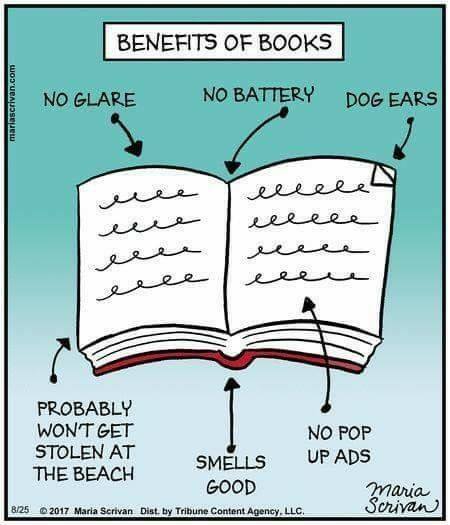
That’s right, this meme on the benefits of books is serious misinformation.

Now, before people start thinking I’m being melodramatic in calling a non-political meme that is just a bit of fun about books, remember, books are a $124 billion industry. So when people are talking about the format wars with memes like the one above, it is serious… Well, as serious as any discussion of an entertainment and leisure industry can ever be. Particularly if we take the existentialist view of the world.

I could, of course, have used a different meme. One with anti-science messaging, or a misleading political message designed to further divide public discourse, or one about cats, everyone loves cats. But if I did that, people would take one look at the meme and have either agreed or disagreed, and would be uninterested in anything else discussed. And this is part of the problem. Memes, like a lot of modern discourse, are designed to get you nodding your head in agreement before you think too hard. They allow you to outsource your thinking and fill in your knowledge on a topic by appealing to you with relatable content.

This meme is styled in a friendly cartoon manner. It has a whimsical font. Whimsical! It could be flirting with your partner and you wouldn’t mind. It is also appealing directly to the people who like their books to be made of the flattened entrails of trees, with relatable jokes about how terrible e-books are. But don’t think. It doesn’t want you to think.

Let’s take these points one by one.

Glare:
Books have glare. If you’ve ever sat out in the sun and read a book on white paper you’d have noticed how much squinting is involved. Either that or you had a patch of white scarred onto your retinas. Books also don’t fare well without a decent light source. Soft light causes just as much squinting.

No battery:
Neither does a shovel. Lots of things don’t have batteries, including my computer that plugs straight into the wall. The idea that an e-reading device (Kindle, iPad, etc) requires a power source, unlike the “superior” book, isn’t a like-for-like comparison. A Kindle holds thousands of books and can access libraries and stores directly. A smartphone can tell you the time. Let’s see a paper book do that.

Dog ears:
Nope. No self-respecting reader and book lover dog ears books. This is sacrilege. It would be like promoting the ability of books to retain coffee stains.

No pop-up ads:
None on my Kindle or iPad either. You’re reading wrong. Oh, and books have ads in them, usually for other books by the same publisher and/or author.

Smells good:
Clearly never borrowed a book from a library. I’ve borrowed some, even own one, that smells like it has been swimming in vomit at some stage. This is actually a reaction from the chemicals used in production. And e-reading devices smell just fine. As long as they don’t get left to swim in vomit at any stage.

Probably won’t get stolen at the beach:
Probably says more about the meme creator’s selection of reading material than anything. Maybe read less Twilight and more Kerouac to have your book stolen.

The trick to memes is that they slip the misinformation past you while you aren’t concentrating. Whether it be a misattributed quote or some cherry-picked statistics, it is easy to deceive people when they are busy looking at a pretty picture.

In the case of the paper books (DTBs), the “benefits” are dubious as soon as you think about them for more than two seconds. And notice that they aren’t benefits, like improved empathy, or greater cognition, or better communication abilities (see the rest of the list). Instead, the list is all about bashing e-books.

When the format wars discussion starts, everyone rolls out their usual banal reasoning for their preferred format. Without fail someone will talk about the smell of dead tree books (DTB), or the feel of eviscerated tree flesh in their fingers, or refer to some dodgy research that denigrates e-books. For some reason, the reading world is filled with technophobic troglodytes intent on proving that their old-fashioned way of doing things is better. This meme is no different, and I’ve addressed this issue before.

Whether it be dodgy “science”, or misleading memes, we need to critically assess the information we receive and share. Otherwise, the errorists win.

What is the name of a kangaroo’s child?

No_Problem_Mate

Kangaroo names really depends upon the mother kangaroo. Mother kangaroos (does or jills) are known to choose names for their joeys based upon:

  • traditional family names
  • popular movie character names
  • favourite fictional characters – typically from movies, but also books

Some of the less common ways jills will choose joey names are:

  • Pick up on joey’s cues (leads to a lot of joeys being called Kick and Jump)
  • Go to the bookshop and pick a random name from a random book (although kangaroos aren’t generally allowed in bookstores due to their habit of browsing and not buying anything)
  • Ask the joey (given kangaroos can’t talk I’m not sure this helps)
  • Name associations (for kangaroos who like word games)
  • Get your other joeys to decide (hard if this is the jills’ first joey)
  • Pull the name out of a hat (although kangaroos don’t wear hats)
  • Meaningful moments (which leads to names like Hop Away From Hunter, and Juicy Leaves).

Some rules jills generally abide by in naming:

  • no names of former girlfriends or boyfriends
  • no names used for pets (not that kangaroos have a lot of pets)
  • no names already used by friends or colleagues (they are often in mobs, so best not to double up on names).

Hope this helps.

This post originally appeared on Quora. Yep. Someone used Quora instead of Google for this. They are probably registered to vote too. Just think about that.

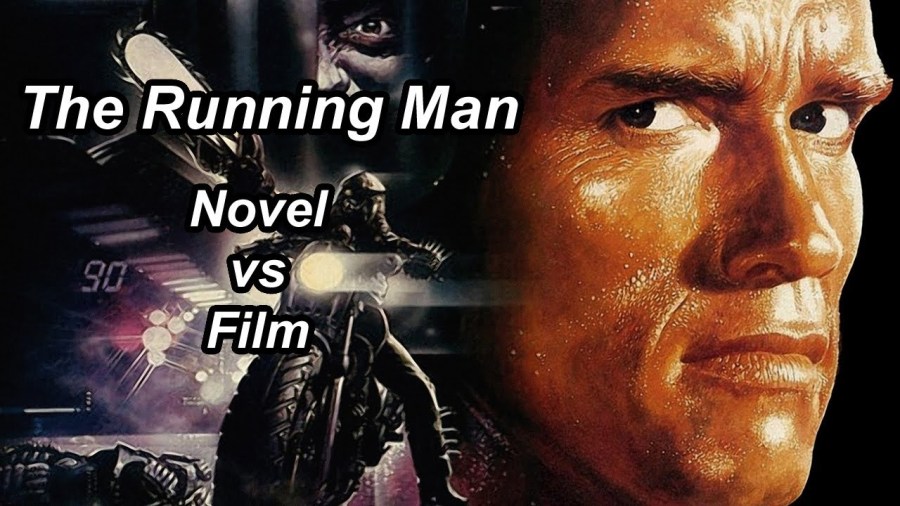
Book vs Movie: The Running Man – What’s The Difference?

maxresdefault

Given the impending authoritarian regimes and mega-media corporations forming, CineFix decided that this month’s What’s the Difference? would look at our near future. Reality TV will soon bring us The Running Man.

Back when I first saw Arnold Schwarzenegger in The Running Man the title sequence credited the source material as being written by Richard Bachman. One of the people with me, turned to us all with one of those know-it-all looks and said, “That’s really Stephen King.” So as we watched Arnie take down hulking professional killers with his trademark killer puns, we wondered if he was correct. Spoiler: he was.

Decades later I finally got around to reading and enjoying the novel. The movie and the novel were starkly different in so many ways. For starters, no half-starved, poverty stricken Running Man contestant is going to look like Arnie. But many of the themes are the same, if explored in differing ways.

This made The Running Man more than just a standard action film. By exploring the themes of totalitarianism, class subjugation, and media control while Arnie slices a guy in half with a chainsaw, we got a movie that was subversive and satirical. While not on the same level of social commentary as King’s novel, it does stand as an example of how you can do a loose adaptation of source material as an action movie but retain the exploration of themes.

And watch a guy with no pants get electrocuted when the fire sprinklers are set off. Way better than reading the description of Ben Richards’ entrails getting caught on plane seats.

Interpreting Music Review Terminology

Manyguitars_550x368

Last week I posted a handy guide to Book Review Terminology. Book reviews aren’t the only area that has incomprehensible jargon. Music reviews are often troubling, they use industry jargon that not everyone understands, especially not the people using the jargon. So I have quickly summarised the commonly used phrases and interpreted them.

Solid album: every song sounds the same.
Standout tracks: the only decent songs.
The album grows on you: hated this album the first time I listened to it and after having to listen to it several times to complete the review have found I can tolerate it.
Intricate melodies: pretentious wank.
Outstanding musicianship: lots of solos.
Impressive guitar work: endless guitar masturbation.
Impressive vocal work: wow, an actual singer for a change. They didn’t even use autotune. Now if only they’d work on writing decent lyrics.
Concept album: lots of pretentious filler.
Soulful lyrics: singer recently dumped by their partner.
Soulful melodies: all band members/artist depressed.
Heartfelt emotion: band members/artist suicidal.
Catchy lyrics: I hate this album and all the songs on it, but I can’t purge the choruses from my brain.
Best album of the year: only new album I have.
The best release from this artist/band: it’s about time they put out something decent.
Epic: too long.
Pop sensibilities: commercial radio fodder.
Proponents of (insert name) style: I hate this sort of music.
Founders of (insert name) style: the artists that everyone else copied.
Challenging: annoying.
Diverse styles/sounds: imitates everything popular at the moment.
Critically acclaimed: only pretentious and annoying people will like it.
Commercially successful: listen to it on the radio instead.
New sensation: you’ll have forgotten this artist and their music existed in 6 months.
Uplifting: saccharine.
Back with a vengeance: last album was terrible.
Offers up some great tracks: band/artist only wrote one song then packed in filler.
Career defining: surprisingly good album.
On heavy rotation: has a huge marketing budget to waste.
Staple of radio playlists: inoffensive.
Politically charged lyrics: think they are better than everyone else.
Confrontational: annoying.
Distinguishes itself: will fade into obscurity in a month.
Stamped their mark: all the vapid DJ’s like it.
Most important album/artist of the year: utter crap that is inexplicably selling well.
Taken (insert country) by storm: some DJ overseas thinks that it’s good.
Radio friendly: bland.

Hope that clears things up a bit.

Interpreting Book Review Terminology

e6a8aaba01fd70671c2cdccb666a14b5
Have you ever read a book review and been baffled by the jargon the reviewer uses? Like any profession, book reviewers have their own jargon that is meaningless and annoying to anyone not steeped in the mire of that profession. Since I’m a scientist and science communicator, I’m very familiar with how terrible the media are at explaining science. I’m also familiar with interpreting jargon for an audience. So allow me to elucidate.
.
Page-turner: Meets the bare minimum standards for a book.
Gripping: I got this from a library where kids are allowed to play.
Poignant: Something sad happened in this book, most likely a character gets cancer.
Compelling: I spent so much time reading this book I had to finish it despite wanting to hurt myself after every sentence.
Nuanced: I have no idea what this book was about but I liked it.
Lyrical: Should be a poem instead so that it isn’t as long and self-involved.
Tour de force: The book is too long and waffly.
Readable: Boring but better than watching TV.
Haunting: Either used to describe a book that made the reviewer actually think, or, more likely, is meant to make you think but is just pretentious.
Deceptively simple: Could have been written by a 10 year old.
Rollicking: Something actually happens in this book.
Fully realised: The book has a beginning, middle and end.
Timely: Makes passing reference to something that happened 2 years ago.
X meets Y meets Z: The reviewer hasn’t read the book so is quoting the sales blurb.
Sweeping: Long.
That said: I’ve just insulted this entire book but it is popular for some unknown reason (e.g. Twilight).
Riveting: Was able to finish reading it.
Unflinching: Unpleasant.
Powerful: I read the hardcover.
Unputdownable: Reviewer is unfamiliar with English.
Masterfully or Masterful: The author is familiar with English.
Beautifully written: A lot of long words were used.
Startling: Reviewer was surprised the book was published.
Bold: Controversial.
Accessible: Written for kids.
Memorable: Reviewer didn’t have to look up the author or title to write the review.
Epic: Really, really, long.
A tale of loss and redemption: Someone dies, the protagonist gets over it, the end.
Sensuously, seductively, and/or lushly described: Painstakingly boring descriptions of mundane details.
Must read: Bestseller.
What it is to be human: Someone falls in love or someone dies.
Luminous: Has a pretty cover.
Evocative: Not boring or pedantic.
Poetic: Wordy.
Thought provoking: Reviewer is sure the book is cultural or intellectual but didn’t quite get it.
Rollicking roller-coaster: Kids book, or should be.
Provocative: Annoying.
Lends itself to X: Reading the book X was better.
Opinionated: The reviewer disagrees with everything the author has ever written.
Emotional roller-coaster: Nominated for some literary award.
Only minor quibbles: The book sucked.
Stays in your mind long after the last page is turned: Had a bad ending.
Writing at the peak of his/her powers: Much better than the author’s other books.
At once: The reviewer is about to use more than one of these terms in a sentence.
.
Also, lets not forget the various terms that are used to tell you what the genre of the book is, rather than just say what the genre is:
Explicit, steamy, romp, raunchy: Erotica or has sex in it.
Charged, taut, woven, layered: Political thriller.
Heart-warming, life-affirming: Romantic drama.
Seamy, gritty, underworld: Crime.
Taut, fast-paced, dynamic: Thriller.
Epic: Fantasy.
.
Hope this clears things up a bit.


The Art of Comics

Do you like comics? I’m not talking about movies based on comics. I’m not talking about comic fandom that can only be solved Utopia style. I’m talking about the art of storytelling that only the mix of art and narrative can manage.

How Utopia deals with comic fans:

I have previously discussed how some fail to give due respect to comics and graphic novels. The TL/DR is that literary snobs don’t like non-worthy genres to be discussed. I mean, how dare someone dilute words with pictures! Yet the comic format allows for a form of storytelling that other mediums would love to have. Literally showing can condense a novel to a few dozen pages whilst retaining all of the important details, as I discussed in my review of the Parker comics. Text can be used in a way that neither movies nor novels can utilise. An example is the way authors construct their ideas into sentences, paragraphs, and chapters to transition between ideas and moments. When you add the visual artwork you can add effect and impact to those transitions, ideas, and moments. You can’t do that in other mediums. Well, unless you’re Edgar Wright merging movies and comics.

The way the art is used to tell a story is an often overlooked aspect of comics and graphic novels. This is despite the fact that the art is their most distinguishing feature. That and the impossible physiques covered in spandex.

As an example, I’d like to share a page from a comic I bought when I was 10.* On this page is a panel that has stuck with me as an example of the combination of art and narrative. Comics can do this so easily. It would make movies jealous – unless they have the CGI budget. No big illustrated fight scene. No words like ZAP or KAPOW as a blow is struck. And within the context of this larger story, the minimalism is an important narrative device.

rco010
From Batman #422 – Just Deserts (1988)

Obviously, this is just one example that lead to my formative appreciation of the comic book medium.* As much as many formative appreciations of comic books are based around the erotic artwork… sorry, lost my train of thought.

For another example of the combination of art and story, Nerdwriter made a particularly good video discussing Maus and how it is constructed as a story and piece of art. Every frame, every image, the whole page, has meaning.

When it comes to discussing the literary and artistic merit of comics the discussion often never moves past the capes, spandex, and insecurity inducing bulges. Some articles have argued that if we let graphic novels into literature we have to let in everything. They must defend Fort Literature from the invading Lesser Works. But comics are far more than the superficial observations of those dismissing them.

Well, at least I think they are cool.

*Please appreciate this post. It took me ages to figure out which comic I had owned. During high school, we were asked to bring in a comic book to be part of a creative writing project in English class. The class never eventuated and the comics were never returned to us. As a result, I couldn’t remember the details of this comic, and since there are a lot of Batman comics, it took a lot of effort to track down.

This also opened an old wound created by that high school English class. The wound of crushed creativity. The promise of being taught creative writing that went unfulfilled for decades. But thank goodness we got to learn how to write essays about ee cummings in Lit class instead.

Creativity Explained

file-20180114-101518-1wckavo

Last week I reblogged an article about some new research into what makes us creative. This week I’m sharing a video from one of my favourite YouTube channels, which essentially covers the same work. But this one is a video!

Since this is going to be a three part series, I’ll update this post as the other videos are released.

Part 2:

Further reading:

Kidd, C., & Hayden, B. Y. (2015). The psychology and neuroscience of curiosity. Neuron, 88(3), 449-460.

De Pisapia, N., Bacci, F., Parrott, D., & Melcher, D. (2016). Brain networks for visual creativity: a functional connectivity study of planning a visual artwork. Scientific reports, 6.

The Real Neuroscience of Creativity – Scientific American.

Eagleman, D., & Brandt, A. (2017). The Runaway Species: How human creativity remakes the world.

Catapult. Durante, D., & Dunson, D. B. (2018). Bayesian inference and testing of group differences in brain networks. Bayesian Analysis, 13(1), 29-58.

Li, W., Yang, J., Zhang, Q., Li, G., & Qiu, J. (2016). The Association between Resting Functional Connectivity and Visual Creativity. Scientific reports, 6.

Bendetowicz, D., Urbanski, M., Aichelburg, C., Levy, R., & Volle, E. (2017). Brain morphometry predicts individual creative potential and the ability to combine remote ideas. Cortex, 86, 216-229.

Writing in Western Australia

dsc_0019-3

Two months ago (November 2017) the Western Australian Government released its Writing Sector Review. Okay, most of the readers here are international, so you’re probably shrugging your shoulders and reaching for an atlas – atlases are still a thing, right? But after my recent post on support for the arts (I was in favour as long as the support was for all authors, not just those deemed worthy/literary enough), I thought this review highlighted many of the same points and might be interesting.

Okay, that’s probably my West Aussie bias talking. But if it is a problem, just mentally substitute your local area name in place of Western Australia. The points raised appear to be universal. Well, Earthiversal. Well, Writerversial.

The Department of Culture and The Arts had nine recommendations in their report:

Recommendation 1: Maintain current levels of State Government funding to the writing sector
This point is at odds with the rest of the list. Lots of new stuff to fund but no extra funding to go with it. But I guess this is why they are writers and not economists.

Recommendation 2: Create a hub for writing and creative thinking at the State Library of Western Australia building
This makes sense, especially if this extends resources out to the larger library network in the state. And a coffee machine, this needs a coffee machine to be a creative hub.

Recommendation 3: Conduct a distinctive annual Western Australian Premier’s Book Awards The Western Australian Premier’s Book Awards
This is something that used to happen but became biennial. I’ll have more to say on this point, mark my words.

Recommendation 4: Use investment in the writing sector to achieve synergies with existing Statewide library services to extend and enhance community engagement in the reading of Western Australian writers
Honestly, why wasn’t this already a thing? “Sorry, we don’t have room for you West Aussie authors on the shelves, James Patterson just published 12 new books.”

Recommendation 5: Foster professional development for writers to enable them to navigate the increasingly complex areas of rights and multimedia opportunities
This is already available, but an expansion would be welcome news to all of the state scribblers. The isolation of Western Australia from the rest of Australia, let alone the rest of the world, is something that needs to be addressed. I wonder if there is a worldwide… network that could be used in some way to facilitate this.

Recommendation 6: Foster an environment to maximise the potential of Western Australian writers to be published
Like reminding the rest of the world that we exist. Or giving us decent internet. Or a can with a string attached.

Recommendation 7: Enhance data collection about Western Australian writing to provide benchmarks and evidence for policy development
Enhance? Starting would be good. As noted in the report, the Australia Bureau of Statistics stopped collecting data in 2003-04. Also great to see a report admitting they didn’t have evidence to base their recommendations upon.

Recommendation 8: Provide support for screenwriting and playwriting
Aside from all of those tax breaks that film and theatre already get….

Recommendation 9: Establish writer-in-residence opportunities at National Trust properties (Source)
This is a specific focus thing about promoting literature with a local history emphasis. I’m sure that will make someone happy. Like sleep medicine specialists.

The overall emphasis of the report is that Western Australia isn’t a cultural backwater yet it is treated as one. So the state government should do something about that by promoting locals writers, local stories, and more people to wear neck scarves and beret caps.

This is very similar to the calls from The Guardian last month, which I covered in my recent post, Literary Fiction in Crisis. The government should be doing more to support, develop, and nurture artists. The publishing industry is somehow not being asked to do this. Apparently, they are all tapped out, and definitely not owned by the biggest and most profitable media organisations.

There are a couple of big assumptions built into this report. The first most obvious one is that Western Australia isn’t a cultural backwater. Having lived here my entire life, I can confirm we are a backwater, and not just culturally. I think we need to accept this fact. Maybe if we grabbed a couple of cold beers and watched some sport it would help us get over ourselves.

The second big assumption is that writers in Western Australia are worth funding. Why? What exactly is the government trying to promote with this funding? Is there a return on investment intended? These things aren’t really defined, just asserted as true. Now, don’t get me wrong, everyone loves a government handout, just ask the banks who nearly destroyed the world’s economy. But I’d like to think that this funding is a bit better justified than it appears.

The other big assumption is that support should be directed at literary works. This is a common theme to these reports and the articles I discussed previously.  The report recommends the Premier’s Book Awards be annual again, which they want to be used to promote West Aussie authors and Western Australia as a successful writing habitat – possibly with the inclusion of an emphasis on “emerging” and “developing” authors. I note that they aren’t proposing to support genre authors, nor have awards to promote them.

Why wasn’t there a conclusion that the Premier’s Book Awards should include Spec-Fic, Crime, Thriller, Romance, and YA segments? Are these not worthy? Do these genres lack enough subplots about recovering from cancer and relationships with cats? Because we can fix that.

As I noted in my Literary Fiction in Crisis piece, we could acknowledge that arts are an important aspect of our culture and support ALL artists with grants – not just the “important” literary ones. The initiatives that are meant to grow and sustain the writing sector always seem to be only for part of the writing sector. IF writing is to receive government assistance then it would be nice to see it not playing favourites without some damned good justifications. Until then it appears that some animals are more equal than others.

Edit: A recent article touched on a point about art vs sport and the taxation of people in those fields in Australia. Interesting what we promote as important.

5.1 CONCLUSIONS

In framing initiatives that will grow and sustain the writing sector, the following issues arising from the research and consultation process have influenced the consultants’ advice.

 The creative process – the act of writing – is severely hampered by lack of time and money

 Market development is a critical issue for everyone working in this sector in Australia, and one which WA needs to address with some urgency. WA’s isolation from decision-makers and peergroups exacerbates this

 Proximity to Asia and the alignment of significant time zones offers a considerable opportunity for WA writers (and to the creative industries in WA more generally)

 Market forces are causing publishers to become more conservative and mean they are not building writers careers in the same way. How is this gap to be filled?

 Collaboration between allied and sometimes competing parties is an emerging model in Australia and internationally. With the disruption of internet and digital technologies there is a greater need for publishers to cooperate and negotiate with other firms, including competitors, or others such as games, software and media companies in order to create new products.

 For emerging and small publishers, distribution can be a major hurdle

 Self-publishing without an experienced guiding hand is a minefield for new writers

 While authors still seek traditional publisher relationships there has been an increase in publishing innovation and technology driving new models. Australian publishers are experimenting across digital platforms with changes to royalty and subscription agreements, and providing free ebook downloads which helps make niche publishing projects viable

 Digital opportunities are encouraging a more direct relationship between writers and readers, publishers and readers, booksellers and readers

 Sales opportunities in the digital marketplace do not fundamentally alter the economics of publishing but have provided more opportunities for scholarly publishers

 The WA writing sector is supported by a range of community-based writers’ centres, facilitating organisations and by writingWA

 Throughout WA there are also 231 public libraries which provide a nexus for writers and readers in a geographically challenging state.

 There is a strong regional literary festival culture in regional WA – often initiated or supported by the public library. Geraldton, Kununurra, Avon Valley, Broome, Margaret River and Mandurah Festivals are all initiatives of, or have strong links with, their public libraries, and funding from DCA, DRD and Royalties for Regions, delivered via writingWA

 The history and capacity for publishing Aboriginal stories by Aboriginal people is a strength of WA writing

 There is a need to increase the diversity of voices and participants in the writing community

 Recent and current infrastructure developments, plus the proposed reconfiguration of SLWA offer opportunities for increased writing-based activity and activation

 Changes to governance arrangements at Screenwest and its greater emphasis on the telling of WA stories offer opportunities for writers

Literary Fiction in Crisis

man-smoking-jacket

Literary Fiction in Crisis was the headline lede for a series of articles in The Guardian last month. Long known as a balanced and inclusive arts publication (/sarcasm) they sought to highlight a serious problem and a solution for literary fiction.

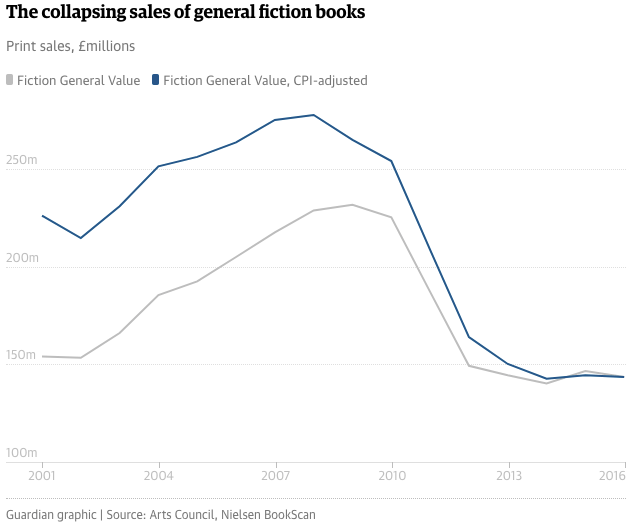
In case you haven’t heard, people aren’t reading literary fiction. Book sales are dropping. I covered this in my post on Australian Fiction, and US Fiction, and the Guardian article covered the UK figures in its first piece in the series.

Screen Shot 2018-01-03 at 11.40.25 AM

Let’s try not to think too hard about sales being in value terms and not volume. I mean, ebooks aren’t usually priced cheaper or anything and would hardly contribute to this revenue figure whilst being more profitable. Clearly, we need to get onto blaming the real culprits. Stupid kids these days are playing Tweeters and Facepage instead of buying books.

One reason suggested by the report for the decline in literary fiction sales is the recession, happening at the same time as the rise of cheap and easy entertainment. “In comparison with our smartphones, literary fiction is often ‘difficult’ and expensive: it isn’t free, and it requires more concentration than Facebook or Candy Crush,” the report’s authors write.

Won’t someone thinking of the starving artists!!

The researchers looked at the 10,000 bestselling fiction titles over the last five years and found: “Outside of the top 1,000 authors (at most), printed book sales alone simply cannot provide a decent income. While this has long been suspected, the data shows unambiguously that it is the case. … What’s more, this is a generous assessment. After the retailer, distributor, publisher and agent have taken their cut, there won’t be a lot of money left from 3,000 sales of the 1,000th bestselling title. That we are returning to a position where only the best-off writers can support themselves should be a source of deep concern.”
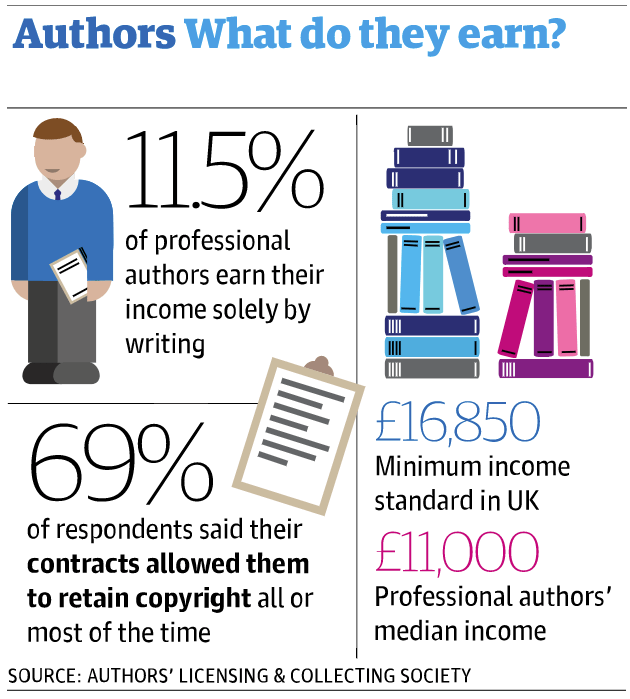
OMG, you’re telling me that artists have to have day jobs?* Oh the humanity! Surely this must be a new thing… Unless it has literally always been a thing. If only there was a graphic somewhere that could highlight the proportion of authors who make a living writing…

Screen Shot 2018-01-03 at 12.40.34 PM
Source: A 3.5 year old Guardian article…

The second article covers some of the same ground before highlighting a couple of important points.

This continuity imperative has long been built into the foundations of commercial publishers, who expect many of their most successful writers to cough up a book a year. And as publishing has become more centralised, with much of its power now concentrated in three giant conglomerates, it has become more ruthless.

The brutal truth is that through the 1980s and 90s it was possible for the literary novelist to make a living on advances that didn’t “earn out”. They were supported by an old-fashioned value system that sanctioned the write-off of losses for the kudos of association with an “important” writer and a belief that literary value could be offset against the profits of more pragmatic publishing.

These points are ones which are not made often enough. In an industry that runs on the work of part-timers (88.5%), the proceeds to these employees are decreasing, the time commitments are increasing, and the investment in their careers is decreasing. Where are the three articles criticising this problem?

Of course, we need to steer the ship away from that iceberg of issues. The second article instead makes the argument that the UK Arts Council should fund more authors (and let’s assume the implication is that other governments around the world should do the same).

Unlike the performing arts, publishing has always been a largely commercial sector that has had to square its own circles. This is reflected in the fact that it gets only 7% of the funding cake handed out by the Arts Council, compared with 23% to theatre and 11% to dance.

Personally, I want to see Arts Council funding to be decided in a Thunderdome. It would be great to see starving artists facing off against one another for grants. The fit and agile dancers doing battle against the people who spend all day sitting and typing. They could stream it on Pay Per View and raise some extra arts funds.

There will be those who argue that this just shows that literary fiction is a hangover from the past, and the poor dears should knuckle down and resign themselves to writing what people actually want to read. But few would dare to make the same argument about experimental theatre or dance.

Yes, I’d argue this. And I would dare to make the same argument for theatre and dance. Thun-der-dome, Thun-dur-dome, Thun-der-dome!

The third article in this series makes just this argument – just to be clear, for writing what people want to read, not fighting in the Thunderdome. It doesn’t mince words and goes straight for the jugular.

Following the announcement from Arts Council England that sales of literary fiction are plummeting, it is suggested that arts subsidies be deployed to help writers survive. I have another idea. They should write better books.
This article goes on to imply that literary authors could put some effort into writing stuff people want to read, mainly via utilising compelling plots, which the author feels is a major flaw in literary works. I think he misses an important point. Authors can write whatever they want. But I do agree that authors can’t expect to earn a living from this unpopular writing, nor have people like it, nor have it be accepted as appropriate (e.g. racism). Pleasing a small club of literary snobs with worthy books doesn’t entitle authors to a full-time career.

Of course, nobody is proposing supporting genre authors. They aren’t writing important fiction and are thus not real authors. They deserve to starve! This is the main issue I have with the argument to fund literary fiction. Somehow we’ve glossed over all the authors who aren’t making a living writing genre, as though they have nothing to contribute to society, and are thus unworthy of arts funding. Admittedly, a very good study, mentioned in the second article, does show there are clear empathy differences between readers of genre and literary novels** – although why is still a question to be answered. So there is an argument to be made for literature support.
As I see it, there are a few paths we could tread. The reading industry could acknowledge that most authors are part-timers and do more to support this reality while they balance a day job with their art. Or we can acknowledge that arts are an important aspect of our culture and support ALL artists with grants – not just the “important” literary ones. This latter option could be easily and justifiably funded by taking government funding out of popular high-level sports – i.e. no more free stadiums for you football! Let’s just hope that sports don’t go up against arts in the Thunderdome.
*Side note: we could probably even refer to the artistic projects as the Side Hustle. This piece by Zen Pencils is quite good and captures the idea behind the author dream.

**Worth reading this paper, which I’ve linked directly. I expected this to be a small sample, poorly analysed, poorly reasoned, paper that was written to elevate snobbery with pseudoscience. It was actually a very solid study. Although, it is worth noting that literary merit was on a spectrum, so literary could be found in many titles. This included Raymond Chandler in the top third of literary titles, which surprised me (last spot was James Patterson, which should surprise no one).

Edit: A recent article touched on a point about art vs sport and the taxation of people in those fields in Australia. Interesting what we promote as important.

Edit: A Twitter thread about the origins of what we call literature versus genre caught my eye. The basic summary is that after the industrial revolution you had class divides between readers. Workers got to read one type of magazine, whilst richer managers (but not the capitalists) got a fancier magazine. The stories that were published in the fancier magazines became literary, whilst the rest was genre. So when I say that literature is based on snobbery, it is quite literally the snobbery of class divides in “Western culture”.

See also: Author Earnings

The Emu War

emu-war

From Veritable Hokum. Check them out!

And yes, this Emu War actually happened. Roughly 20,000 emus migrated into the Eastern Wheatbelt area, discovering newly cleared farmland filled with crops and watering points for sheep. They liked this supply of food and water and were ambivalent toward the soldier settler (and other) farmers’ tough run of grain prices and droughts.

Since these were ex-soldiers facing ruin (from drought, grain prices, broken subsidy promises, and emus – blame the killer emus!), they liked the idea of using machine-guns (2 Lewis Guns) against the birds in the same way they’d used them against opposing infantry in WW1. This didn’t go anywhere near as well as expected. Emus are faster, harder to kill outright, and generally not running straight at a machine-gun embankment; so their casualties were low.

Two attempts were made at an emu cull, but ultimately the government decided to offer a bounty on emus instead. Later they went with the tried and trusted move of building a fence to keep the emus out of agricultural areas (along with dingoes, wild dogs, rabbits, kangaroos – although the latter laugh at attempts to build a fence they can’t jump over).

Top 10 Posts of 2017

maxresdefault

Everyone seems to be doing these Top 10 Posts listicles on their blogs, and I’m nothing if not a joiner.

Actually, that isn’t true. I’m not a joiner at all. But I do want to do a listicle. I’m not exactly sure why I want to do a listicle, but it is probably to do with procrastinating from doing something hard.

If we go by the blog stats, this was a pretty good year. 2016 technically had more visitors and views than 2017 (just), but it was buoyed by one post going viral in December. Every month for 2017 has outperformed 2016 in every metric (except of course the viral December post). I wrote 114 posts in 2017, 66 book reviews, had +25k visitors, and +30k views. Not huge numbers, but I’m pleased that the page is continuing to grow, especially in the areas of likes and comments. A big thank-you goes out to my followers and regular readers, new and old.

So let’s see what the most popular posts were.

1) The Actual 10 Most Deadly Animals In Australia

Recognise this one from last year? Originally written for one of those comedy list sites, I’m glad so many have enjoyed this post.

2) Do People In Australia Ride Kangaroos?

One of my trademark snarky Quora answers. Its popularity both last year and this year shows that I need to write more articles about Australian animals.

3) Shark Attack

This is one of my older posts discussing the overblown coverage of shark attacks. I actually prefer the post I wrote a few years after this one, but probably need to revisit this topic with more recent stats. Which people can ignore in favour of the older post that pops up first in their search…

4) Book vs Movie: A Clockwork Orange – What’s the Difference?

Finally, a post written in 2017 on the list. This is part of my long-running series that piggybacks on the CineFix videos. I do enjoy sharing the videos and discussing book adaptations.

5) Book vs Movie: The Bourne Identity – What’s the Difference?

And we’re back to posts from other years… This is one of my favourite book adaptation posts. When I first read The Bourne Identity I couldn’t get over how dissimilar the book and movie were. I didn’t understand why anyone would bother to pay the author money to proceed to not use their source material. Essentially, this book and movie are partly the inspiration for my discussions on book adaptations.

6) Why Being Smart Sucks

Whilst perennially popular, I didn’t write this one, just added some colour commentary. Wish I could claim more credit on this piece.

6) Book vs Movie: The Warriors – What’s the Difference?

Another book adaptation post. These were popular this year.

7) Book vs Movie: 2001 A Space Odyssey – What’s the Difference?

Seriously, I must have hit a search engine algorithm or had people scrolling back through previous instalments or something.

8) 20 Proven Benefits of Being An Avid Reader

This article was a repost of a listicle, but unlike the original list, I’ve actually included links to references. Not that you’d know it since they have deleted the original.

9) Fast and Furious Series

After watching Vin Diesel leap a souped-up V8 over a decidedly murky shark-filled estuary, I felt the need to write this post. I wrote another more recently summarising the series thus far. This will probably become a regular series given people keep going to watch these films.

10) Is Sport King In Australia?

When I pitched this article the response was a deafening silence. I decided to write it as a blog post instead. It then became my most down-voted item on Reddit. Apparently, we don’t talk about sports negatively. Especially not if you back it up with facts. I’m glad people here have once again enjoyed it.

Here’s to 12,018: I hope everyone has a good year!