Banned books

Recently in Australia, there was a lot of moralising outrage about books being banned in school libraries. Was this Political Correctness Gone Mad?

No. No, it wasn’t.

Yes, that’s right, the moral outrage brigade hadn’t even bothered to check any details. That shouldn’t be particularly surprising to anyone who, you know, thinks, but what I did find interesting is the sort of hyperbole used on this issue that never seems to make it to the actual censorship that exits.

I’ve previously discussed the Banned Books Week, an awareness-raising campaign in the USA. Since the USA is a big and influential book market, there are flow-on effects of books being challenged and banned there – although the Streisand Effect can apply here and be a net positive, just ask Dan Brown. Australia also has a censorship board and historical lists of previously banned books have been made public.

When you read through the lists of books that were previously banned in Australia but are now available, you can see how we aren’t/weren’t allowed to talk about sex. We also don’t talk about Aboriginal history. Not talking about sex is still a common theme in today’s Australian censorship standards:

Publications will be refused classification (RC) that:

  1. describe, depict, express or otherwise deal with matters of sex, drug misuse or addiction, crime, cruelty, violence or revolting or abhorrent phenomena in such a way that they offend against the standards of morality, decency and propriety generally accepted by reasonable adults to the extent that they should not be classified; or
  2. describe or depict in a way that is likely to cause offence to a reasonable adult, a person who is, or appears to be, a child under 18 (whether the person is engaged in sexual activity or not); or
  3. promote, incite or instruct in matters of crime or violence

Publications (except RC publications) will be classified as Category 2 Restricted that:

  1. explicitly depict sexual or sexually related activity between consenting adults in a way that is likely to cause offence to a reasonable adult; or
  2. depict, describe or express revolting or abhorrent phenomena in a way that is likely to cause offence to a reasonable adult and are unsuitable for a minor to see or read

Publications (except RC publications and Category 2 restricted publications) will be classified as Category 1 Restricted that:

  1. explicitly depict nudity, or describe or impliedly depict sexual or sexually related activity between consenting adults, in a way that is likely to cause offence to a reasonable adult; or
  2. describe or express in detail violence or sexual activity between consenting adults in a way that is likely to cause offence to a reasonable adult; or
  3. are unsuitable for a minor to see or read. Source.

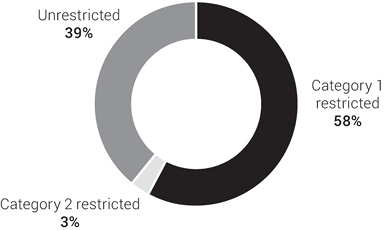
Now obviously the classifications could be very broadly interpreted and implemented. Plenty of books have themes around drug use and abuse, crime is an entire genre, cruelty is in any political memoir, and violence could be retitled thriller. We don’t tend to see those titles banned or restricted. So what does get restricted? As an example, American Psycho has a Category 1 restriction on it and is sold in shrink-wrapping… you know, just in case the words leak out and accidentally encourage someone to take up cannibalism or investment banking.

The number of books impacted by an RC classification is minimal. The 2016-17 figures show none were banned, as compared to video games which had 2 titles banned.

2017-figure01
Publications Classified in 2016-17. Source.

But it does show that a large number of titles were restricted in some way. This is without even touching on the censorship that occurs in access to titles, such as which titles are stocked in stores, which sites can be accessed to buy books, and what ends up in libraries. The restricted categorisation is clearly going to have impacts on where those titles will be available. So I wonder where the moral outrage is over this. Isn’t this Political Correctness Gone Mad? Or is it okay because the people who got outraged in the above video would be the “reasonable adults” who would be offended by these restricted titles?

Or maybe this would all require too much reading on behalf of those wanting to complain about books being banned.


Book Review: The Republic by Plato

The RepublicThe Republic by Plato

My rating: 4 of 5 stars

Old white guys sit around discussing how to set up a totalitarian military state with them as the rulers.

Plato’s famous text covers a lot of ground as it tries to establish what justice is. It covers politics, personal and political ethics, idealised states (democracy ranks third out of four), education, and virtue. The Republic is a heady read, whilst being fascinating.

The strawman style to the interlocuter dialogue did annoy me as a reader. Whilst it was in service of making a larger point, it did make the discourse feel more shallow than it is. Plato’s thinking was also amazingly progressive for an age that predates the enlightenment by the best part of a millennium. But this thinking was also confined by the times.

Plato, along with Socrates and Aristotle, were the drivers behind western society. Books like The Republic put forward a lot of ideas for discussion and dissection, opening the dialogue that would lead to progress. That alone makes The Republic worth reading, but I also found it was worth reading if only to see much of it in context rather than discussed second-hand. E.g. The famous allegory of the cave takes on a slightly different light when not viewed in isolation.

For a more detailed understanding:
https://plato.stanford.edu/entries/plato-ethics-politics/

View all my reviews

Reading is awesome even when you don’t do it…

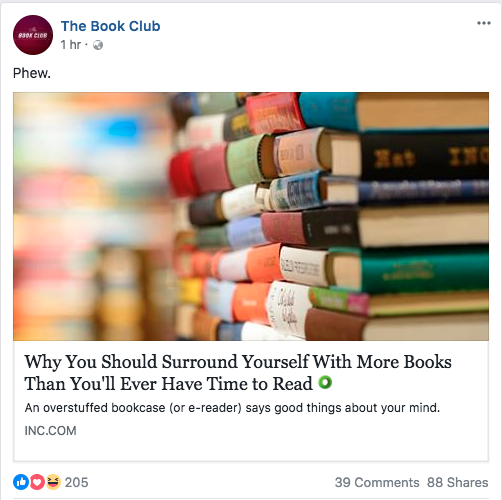
Scrolling through my feed I came across this little gem:

Screen Shot 2018-05-07 at 8.29.58 am

How could I not click on this article? I have several years supplies of paper books on my shelf to read, and even more on my e-reader. Justifying this state of affairs is clearly something I need.

Pity the article is rubbish.

The first hint that this story is nonsense is how they start by commending readers as smart – softening everyone up a bit. They list a few famous people who read and say you too can be just like them if you read. Somehow reading = lifelong learning, so you’ll be happier, earn more, stay healthier, and become president – I’m tempted to dive into those claims for a fact check, but one piece at a time. I’m willing to accept the claim that reading = lifelong learning… for now.

Lifelong learning will help you be happier, earn more, and even stay healthier, experts say. Plus, plenty of the smartest names in business, from Bill Gates to Elon Musk, insist that the best way to get smarter is to read. So what do you do? You go out and buy books, lots of them.

Then it suddenly announces you don’t have to read.

But if it’s simply that your book reading in no way keeps pace with your book buying, I have good news for you (and for me; I definitely fall into this category): Your overstuffed library isn’t a sign of failure or ignorance, it’s a badge of honor.

Oookaaaayyy. Please explain to me how not reading is just like reading.

That’s the argument author and statistician Nassim Nicholas Taleb makes in his bestseller The Black Swan. Perpetually fascinating blog Brain Pickings dug up and highlighted the section in a particularly lovely post. Taleb kicks off his musings with an anecdote about the legendary library of Italian writer Umberto Eco, which contained a jaw-dropping 30,000 volumes.

Did Eco actually read all those books? Of course not, but that wasn’t the point of surrounding himself with so much potential but as-yet-unrealized knowledge. By providing a constant reminder of all the things he didn’t know, Eco’s library kept him intellectually hungry and perpetually curious. An ever-growing collection of books you haven’t yet read can do the same for you, Taleb writes.

An antilibrary is a powerful reminder of your limitations — the vast quantity of things you don’t know, half-know, or will one day realize you’re wrong about. By living with that reminder daily you can nudge yourself toward the kind of intellectual humility that improves decision-making and drives learning.

This is what is commonly referred to as a non-sequitur, or a bullshit argument. Nassim Taleb is notorious for these sorts of nonsense arguments. That and blocking people on Twitter* for not agreeing with him and praising the ground he deadlifts upon.

It is hard to decide where to start with this. The irony of suggesting you need to surround yourself with knowledge in an article on the internet is amazing. Even if we take it, as Taleb implies, as requiring a physical reminder, we already have libraries, bookshops, universities, experts, friends, enemies, who all exist with knowledge we don’t have. It isn’t about the reminder, it is about awareness.

I’m not sure you can take people seriously when they talk about knowledge in terms of what you don’t know. One list is considerably larger than the other. If I was to provide a resume of what I didn’t know it would run to libraries worth in length. Who would suggest we think in those terms?

“People don’t walk around with anti-résumés telling you what they have not studied or experienced (it’s the job of their competitors to do that), but it would be nice if they did,” Taleb claims.

Of course he would suggest that. I guess I’ll mail Taleb a résumé of the Dewey codes** for the stuff I don’t know to become his deadlift partner.

How do they rationalise this anti-library?

Why? Perhaps because it is a well-known psychological fact that it’s the most incompetent who are the most confident of their abilities and the most intelligent who are full of doubt. (Really. It’s called the Dunning-Kruger effect.) It’s equally well established that the more readily you admit you don’t know things, the faster you learn.

So stop beating yourself up for buying too many books or for having a to-read list that you could never get through in three lifetimes. All those books you haven’t read are indeed a sign of your ignorance. But if you know how ignorant you are, you’re way ahead of the vast majority of other people.

Actually, the Dunning-Kruger Effect is about how people with low cognitive ability are exactly those who lack the ability to realise they are of low cognitive ability so they will rank themselves more highly. High cognitive ability people incorrectly assume others are at their level, so will rank themselves lower (see also Imposter Syndrome). You can see from this explanation of the effect why surrounding yourself with knowledge doesn’t really achieve anything.

It’s about awareness.

You would have to be aware that your knowledge is lacking, not just have a reminder of it. If you are ignorant or arrogant then you won’t benefit from the stacks of books around you. We are already surrounded by knowledge in our society – I mean, we’re on the internet here, you can look up literally anything and potentially get the correct answer… potentially. But this article – and Taleb himself – are proposing a form of arrogance. Surround yourself with books and you’ll be better than the vast majority of people.

I’m not saying you shouldn’t buy heaps of books, I myself already own more than I’ll probably be able to read in a lifetime. But don’t be fooled by these sorts of feel-good pieces that give you a pseudo-justification for doing so. It doesn’t say good things about your mind, nor make you better, it just says you like books and would like the authors to be able to afford to eat this week.

* Seriously, check out his profile or this search to see how often he justifies blocking people. As someone whom he has blocked, I can say that he really hates engaging in discourse. Oh, and the reason I was blocked was that he Tweeted about disease resistance in plants and how it works, except he got it massively wrong. When I pointed this out I was immediately blocked.
**Get it? The joke is that there are more library classification systems than just Dewey Decimal. I’m hilarious!

Book vs Movie: Dr Strangelove – What’s the Difference?

dr-strangelove-whats-the-difference-image-5239079

This month’s What’s the Difference? from CineFix delves into one of the few Stanley Kubrick films I’ve enjoyed.

Everyone remembers Dr Strangelove but very few remember Red Alert, the novel that was the basis for Kubrick’s adaptation. Peter George’s book was an early nuclear war thriller and having got there first tended to be copied (or is that emulated?) by many other authors. This was an important point since Kubrick and George decided to sue the production of another movie based upon a nuclear war thriller that was deceptively similar to Red Alert. I’m not exactly sure why this was important as George teamed up with Terry Southern to change the super-cereal novel into a timeless satire.

Did you know that Dr Strangelove was originally going to end with a pie fight? Apparently, the farcical element involved in that was deemed too silly for a poignant satire, despite how metaphorical it was to the destruction of the human race. I guess many would have missed that point. Comedy needs to take itself more seriously if people are to get the point.

I think Dr Strangelove is a great example of a movie being better than the book. The way it does this is by not taking the source material seriously. What would have been another by-the-numbers thriller was elevated by satirising war. Landing not long after the Cuban Missile Crisis, the film managed to capture sentiments of the absurdity of mutually assured destruction and the ineptness of the cabals of military and political elites deciding fates.

Plus, Peter Sellers.

Can you name a book?

creative-bookshelf-18__700

Sounds like a simple challenge, right? Name a book, any book at all.

In the long tradition of asking Americans general knowledge questions on the street and filming their glorious ignorance, I present this video from Jimmy Kimmel.

Before we all laugh and point at the Americans and insult their intelligence, let’s remember that you could do this just about anywhere. Although, Americans do make this stuff easy at times. I’ve previously discussed the reading figures for the US, UK, and Australia. I’m sure those numbers are at least in the same ballpark as other countries, if not outright representative.

Wait, why guess when I can actually use the wonders of the greatest information resource in human history to look that up? Why have an unfounded opinion that I then rant about in indignant outrage, arrogantly assuming I’m right and belittling anyone who does bother to look up the data? To the research!

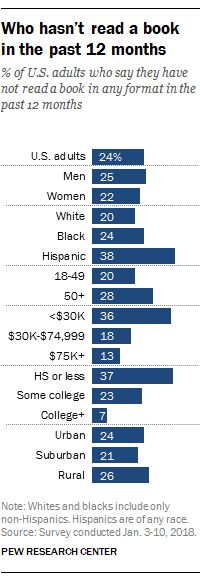
Let’s start with the data that the above video was citing from Pew Research.

ft_18-03-22_nonbookreaders_whohasnt
Source

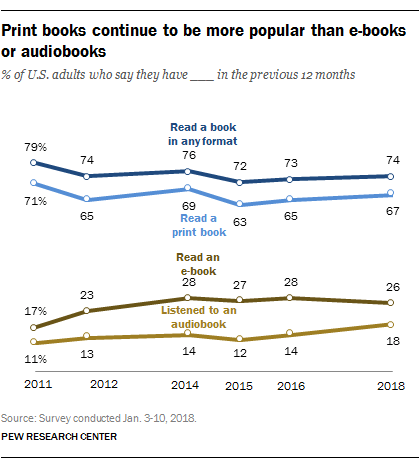
As we can see, the 24% figure is showing that older, poorer, less educated, men (just), and Hispanics read less in the USA. This isn’t a new conclusion, as data from Pew in 2016 shows. The conclusion around the number who don’t read is also similar to the 2016 results of 26% not having read a book in the last 12 months. I’m not sure you can interpret much change over time in the number of people reading, but numbers might be slowly decreasing (although, look at the uptick in audiobooks as that format has come down in price).

ft_18-03-07_bookreading_printbooks
Source

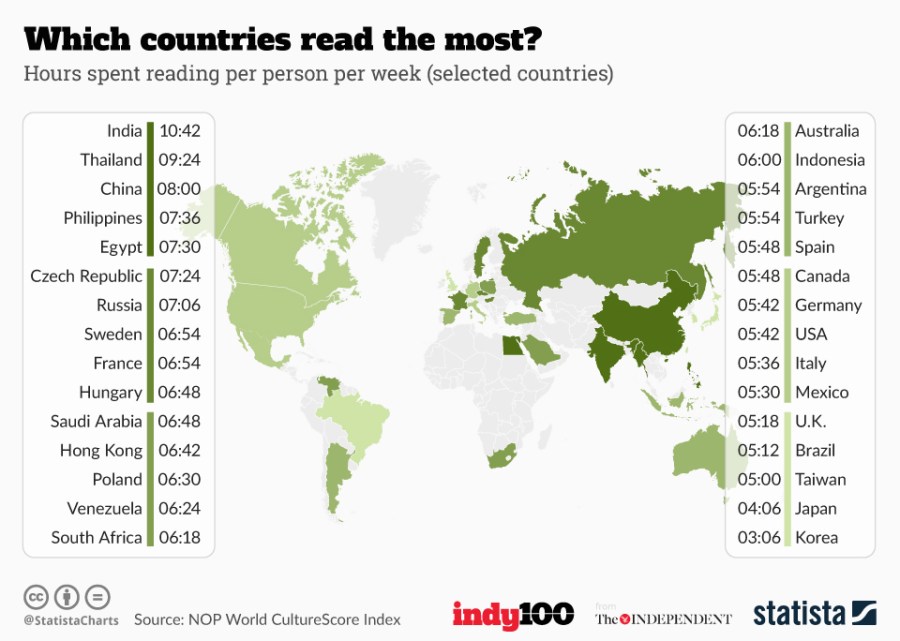
Now we can look at how the USA sits in terms of reading. I’ve previously discussed how Aussies spend roughly 23 minutes per day reading (ABS figures), or an hour a day if you believe the Australian Arts Council report (I suggested there was possible survey bias in that figure). Below you can see that the NOP World Culture Score puts Australia at 6 hours 18 minutes – which I think makes this an “ALL-YOU bench-press” set of numbers.

chartoftheday_6125_which_countries_read_the_most_n
Source: Statista

This chart suggests that the USA is probably typical for English speaking countries, but that many other countries read far more on a weekly basis in terms of hours. Unless reading is code for something else in non-English speaking countries. Maybe they thought they were being asked about how many hours they spent having sex per week.

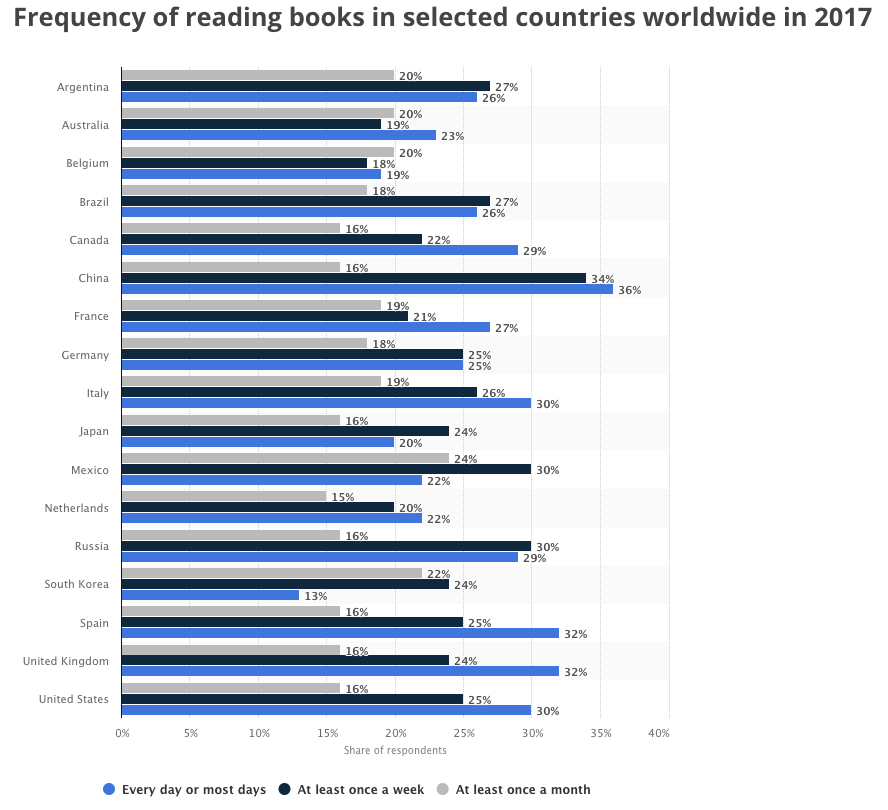
If we then look at the countries and how frequently they read books you can see in the chart below that they were afraid to include the bars for “didn’t read a book”. The high end has only 14% of Chinese people not reading a book, whilst the low end has the Dutch at 43% not reading (USA comes in at 29%, UK 28%, Australia 38% – I demand a recount!!).*

Screen Shot 2018-05-25 at 7.50.23 pm
Source: Statista

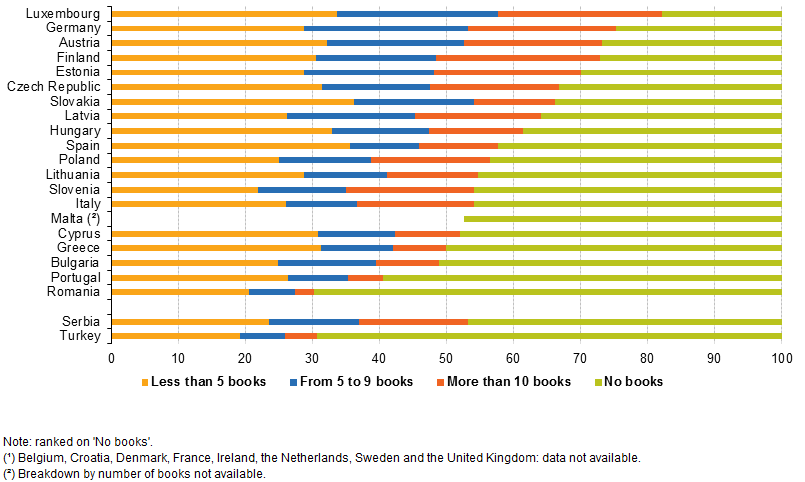
How about the number of books people read, or at least what they claim once they round up?

number_of_books_read_in_the_last_12_months2c_2011
Source: Eurostat
table-2
Source
Screen Shot 2017-10-08 at 6.24.23 PM
Source

What this all shows is that there are plenty of countries where you could ask ten people on the street to name a book and have one or two of them fail. You could ask those ten people what book were they reading today and only three of them could. Isn’t that sad? I reckon people would really enjoy reading if they made time for it. I’ve commented before on why I think people don’t read, suggesting that they don’t because they get told to read literature when they actually enjoy thrillers, sci-fi, and romance.

Maybe it is time to change that before someone sticks a camera and microphone in our faces.

*Be careful with my assumption here. Depending on how the question was asked and any other unreported categories, I may be very wrong in assuming the unreported numbers are non-readers.

Book Review: Electric Dreams by Philip K Dick

Philip K. Dick's Electric DreamsPhilip K. Dick’s Electric Dreams by Philip K. Dick

My rating: 3 of 5 stars

Sometimes you learn that aliens are better than people, so don’t be a jerk and you could stop an invasion.

Electric Dreams is a small sampling of an array of Philip K Dick short stories that were used as the basis for 10 episodes of a TV series of the same name. Dick wrote a huge number of short stories in his career – publishing 121 in a 30-year career, alongside 44 novels. So this selection (collection?) is probably best described as a taste-tester of PKD.

I find it hard to classify PKD as an author. What I have read of his works so far have left me thinking things like: “I was expecting more from this classic”*; “More interesting than engaging”; “Oh look, Deckard realised he lacks empathy so suspects he might be an android.”*** While I think PKD deserves to be acknowledged as a highly influential author I feel this is mainly for his ideas rather than their execution.

This collection was enjoyable on the ideas front and makes for a good sampler of PKD’s work.

*We Can Remember It For You Wholesale
**The Minority Report
***Really? You don’t know what book that is referring to? Would it help if I quoted some lines from the movie?

View all my reviews

Book Review: The Hoodoo Man by Steve Harris

The Hoodoo ManThe Hoodoo Man by Steve Harris

My rating: 5 of 5 stars

Budgie as a weapon? Sure, why not.

Danny Stafford was an ordinary kid until his brother shot him in the face. It was an accident that changed Danny, but it isn’t until his 30s that the change fully takes hold. Now in a stable relationship, renovating a house, and working a dead-end job, Danny’s life is turned upside down. And that’s before the Hoodoo Man starts coming for him.

Back in my formative years, the local librarian introduced me to the adult section of the library after I’d read everything on offer for young adults and kids. This novel, The Hoodoo Man, was the first she pulled off of the shelf for me to try. A brand new horror novel by a UK author. Bit of a leap. But I was hooked. I clearly remember devouring this book, to the point that I missed at least one meal.

Twenty-six years later I wanted to test if my memory of this novel held up. Was The Hoodoo Man as good all these years later, or was I just an impressionable kid who had just discovered his first horror novel? Oh, it stands up alright. It has aged very well and I wasn’t disappointed at all. My immediate response upon finishing was to exclaim “Well, I’m going to have to find more of Steve Harris’ books.”

This is where this story becomes interesting. The Hoodoo Man was Steve’s third novel and it was his most successful, it put him on the map, and became his website’s name. But his career was all but over by the time his seventh novel was released and he retired at the end of the 90s. His career came to an end after his publisher was bought out and he was dumped. He had one completed novel he was shopping around, another in the works, and a third that had originally been intended as his sixth novel but was deemed too terrifying*. Harris’ novels went out of print and after no success in finding a new publisher, he retired from writing and ran to the hills**.

In this day and age, a writer in this situation would probably take their back-catalog and self-publish, then release their new material. Of course, a publisher would be unlikely to let an author go out of print. But it does make me wonder how many authors are in a sense lost to us because of the machinations of the publishing world. I guess they won’t be getting any money from me*** hunting down Harris’ back-catalog in the secondhand stores.

*The Switch was an attempt by Steve to bring the reader as close to feeling actual pain as possible. Back when his website was active I read an excerpt and can confirm that he succeeded. I have never looked at liver the same since.
**This bad reference to Iron Maiden’s bass player of the same name brought to you by the number 666.
***Obviously, Steve won’t be either.
http://www.shadow-writer.co.uk/kinter…

View all my reviews

Book Review: Riot Act by Zoe Sharp

Riot Act (Charlie Fox, #2)Riot Act by Zoë Sharp

My rating: 4 of 5 stars

Those in council housing shouldn’t throw stones. Molotov cocktails are much better.

Charlie Fox is dog and house sitting in a rough neighbourhood for her friend. After some kids manage to seriously injure her neighbour during a robbery, a vigilante mob and a security group move into the area. Ulterior motives abound and Charlie is stuck in the middle of it all as the violence is let loose.

It has been awhile since I’ve picked up a Zoe Sharp thriller. After reading a couple several years ago I went on a spending spree, but haven’t gotten to them until now. I do enjoy reading a female lead thriller written by a female author. Zoe brings something very different to the story that you don’t get from her contemporaries in the genre – her writing has been compared to Lee Child, similar to how all comedy shows are compared to The Office.

Riot Act keeps the intrigue and action coming in steady measures. This was an enjoyable thriller.

View all my reviews

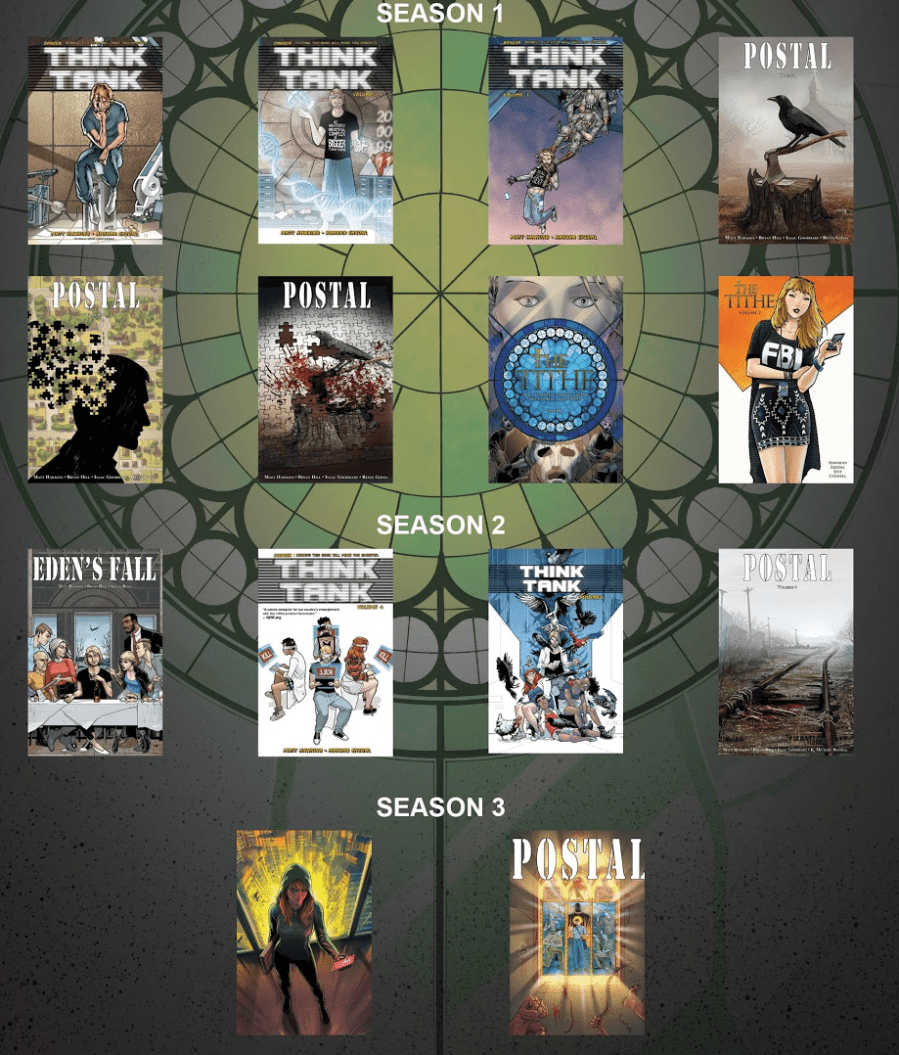
Book Review: Edenverse by Matt Hawkins

Screen Shot 2018-04-19 at 8.19.16 PM
Edenverse: Think Tank, Postal, The Tithe, Eden’s Fall, Samaritan by Matt Hawkins

My rating: 4 of 5 stars

Smart people take on the government. Because they should.

Back in 2012, I stumbled upon the first instalment of Think Tank from indie comic publisher Top Cow. This was back when online stores selling e-comics were still not completely up with technology. I bought Issue #1 and then tried to read it. It wouldn’t download to my comic reading app. I tried to send it to my iPad. It didn’t like the strange format. I tried reading it in the store’s very own comic app. It suggested my iPad and computer were too new.

I won’t go into the details of exactly how I read that first issue (hint: comic files are just a bunch of pictures if you can slice them open), but even with all of the frustration of this first purchase I still enjoyed the story.

Dr. David Loren is many things: child prodigy, inventor, genius, slacker… mass murderer. When a military think tank’s smartest scientist decides he can no longer stomach creating weapons of destruction, will he be able to think his way out of his dilemma or find himself subject to the machinations of smaller men?

So started a five-year avid following of one of the more interesting techno-thriller series I’ve come across. Unfortunately, I switched from buying individual issues to the collected volumes, which were entirely more reliable in those early years of e-comics. I say unfortunately because as a result, I didn’t realise that Think Tank was part of an expanded universe – something the last few pages of regular issues highlights with previews.

Now I’m caught up. In particular, The Tithe and Samaritan are excellent additions to the Think Tank universe (Edenverse, named after the town in the Postal series). Matt Hawkins and illustrator Rahsan Ekedal have pulled together a collection of political machinations, high-tech possibilities, real-world issues, and social commentary for a brilliant collection of comics. Seriously, they have references for the topics, tech, and background at the end of each book, something that tickles my inner scientist with delight.

I highly recommend these series to comic fans, especially those who like techno-thrillers or crime-thrillers.

View all my reviews

Book review: How to Build a Universe by Brian Cox and Robin Ince

How to Build a Universe: An Infinite Monkey Cage AdventureHow to Build a Universe: An Infinite Monkey Cage Adventure by Brian Cox

My rating: 5 of 5 stars

I’m going to bake some chocolate muffins from scratch, so this book should be useful.

Professor Brian Cox, Robin Ince, and Alexandra ‘Sasha’ Feachem are the team behind the popular The Infinite Monkey Cage, a BBC science show that pairs scientists and comedians for laughs and education. From 2009 they have produced +100 shows covering all sorts of topics. This book encapsulates some highlights and essays around their favourite topics and common science communication issues* they have covered in that time.

From the opening forewards to the covering of Schrodinger’s Strawberry I was heartily entertained. As a science nerd and fan of comedy, this book seems to have been written specifically for me. It actually left me feeling a bit annoyed that I haven’t, as yet, listened to The Infinite Monkey Cage show, despite having been aware of it for quite some time. So I guess I’ll be rectifying that soon.

What I like most about this approach to science is that it doesn’t seek to sex up science (or dumb down, depending upon the preferred flavour of marketing), but instead make it accessible and entertaining. There is a line between those two that too often those in the media can’t tell the difference between. Science is interesting, but it is complicated, it is often dry, and communicating scientific knowledge as done here is hard to do.

* Yes, I do mean how people aren’t willing to honestly engage with science, either through pseudoscience co-opting, or denial of evidence, or wanting certainty instead of the probability that science offers.

View all my reviews

A Book a Day: Six health benefits of reading

healthbenefitsreading_1600x800

Penguin Australia recently published an article suggesting reading was awesome for your health. Previously I have posted science-backed articles on the benefits of reading (1, 2), so more science telling us that readers are awesome never goes astray. Although, as much as I love some good old confirmation bias, I can’t just share that article without some commentary from the further reading. I mean, the article title is a play on An apple a day keeps the doctor away… that can’t pass without some mockery.

Reading can provide hours of entertainment and pleasure, impart knowledge, expand vocabulary and give insight into unknown experiences. Additionally, research has shown that it has a variety of physical, mental and emotional health benefits. If you need another excuse to pick up a book, here are six ways reading can benefit your health.

And if those six reasons don’t encourage you to pick up a book, then think of them as six ways you’ll be superior to other people.

Improve brain function

Neuroscientists at Emory University in America conducted a study and discovered that reading a novel can improve brain function on a variety of levels. The study showed that when we read and imagine the settings, sounds, smells and tastes described on the page, the areas within the brain that process these experiences in real life are activated, creating new neural pathways.So next time you’re indulging in an armchair adventure with a great book, you could technically claim you’re working out – your brain, that is.

This study was rather small, consisting of 21 university aged participants who had 19 days of baseline brain scans before 9 days of scans as they read Robert Harris’ Pompeii novel. Warning: they had no null group in this study, only the baseline comparison, so any conclusions drawn should be done next to a salt shaker. It does, however, draw similar conclusions to previous research I’ve discussed.

Obviously, stimulating the brain by engaging with a story is going to light up parts of the brain, but there is the implication that using our brains in this way will strengthen pathways. Calling it a workout for the brain is probably a stretch because it isn’t like our brain sits around doing nothing the rest of the day. But for me, the more interesting thing is the shared response among participants. It proves Steven King’s adage true about writing being a form of telepathy.

The big unanswered questions here are how does this compare to any other shared activity, and how does it compare to other similar activities. I’d bet crypto money – always best to keep bets symbolic – that any other activities would see similar responses.

Increase longevity and brain health in old age

Researchers at Yale University School of Public Health found that, ‘reading books tends to involve two cognitive processes that could create a survival advantage.’ According to their results ‘a 20% reduction in mortality was observed for those who read books, compared to those who did not read books.’And the longer you live, the more time you have to get through your to-be-read pile.

This study nags at my skeptic-sense. Nothing immediately jumps out and screams “This study is nonsense, don’t believe it!” but I can’t help but feel like it is. They sampled 3,635 people in the USA and compared readers to non-readers for longevity. Don’t worry, they factored in stuff like age, sex, race, education, comorbidities, self-rated health, wealth, marital status, and depression. But I’m still left with the nagging sound of my statistics lecturer telling the class that correlation doesn’t equal causation. See this example about storks and babies!

My suspicion is that there is something unmeasured that is confounded with reading that is the actual causal factor. This factor is probably also available from other activities, thus other activities will also increase your lifespan. Just my suspicion. Happy to be proven wrong.

Reduce tension levels

A 2009 study by the University of Sussex found that reading for just six minutes can reduce tension levels by up to 68 per cent.3 Researchers studied a group of volunteers – raising their tension levels and heart rate through a range of tests and exercises – before they were then tested with a variety of traditional methods of relaxation. Reading was the most effective method according to cognitive neuropsychologist Dr David Lewis. The volunteers only needed to read silently for six minutes to ease tension in the muscles and slow down their heart rate. If ongoing stress is an issue take a look at these simple stress management tips.

This claim is hard to pin down. It’s not like other studies haven’t shown reading (and yoga, humour, cognitive, behavioural, and mindfulness) have impacts upon stress levels. But unlike the linked studies, Lewis’ study hasn’t been published. The source in the Canadian National Reading Campaign links to The Reading Agency in the UK which cites an article in The Telegraph. Now, I suspect that this was probably one of those studies done for a report that no one has read because the only publicly available material on it is the press release. But it could also be rubbish research that didn’t get published because of claims like 300% and 700% better than other activities sound like made-up numbers.*

Increase emotional intelligence & empathy

Numerous studies have shown that reading books can promote social perception and emotional intelligence.2 Studies have also found that when a person is reading fiction, they showed greater ability to empathize. Similar to the visualization of muscle memory in sports, reading fiction helps the reader use their imagination to put themselves in someone else’s shoes.For books that’ll test your empathy, push your moral boundaries and ask ‘what would you do?’, take a look at this collection.

I don’t know why they referenced the same two studies again as they didn’t look directly at the issue of emotional intelligence and empathy. I’ve seen better studies, such as the one I mentioned in my piece on Literary Fiction In Crisis, and this one that literary people like to wave around because they can’t afford a Ferrari. So while this appears to be true enough, it is worth understanding why (read this one and see how lots of books have differing levels of literary merit).

Improve sleep

While some scientists believe reading before bed can inhibit sleep due to heightened brain activity, researchers at Mayo Clinic recommend reading as part of a relaxing bedtime ritual that can help promote sound sleep.4 This, coupled with the tension-relieving benefits of reading, can vastly improve both the quality and quantity of your sleep. You may want to stay away from page-turning crime and thriller novels though – you could be up all night…

Clearly these people don’t read thrillers. Am I right people? Huh?

Anyway, it is worth reading what the Mayo Clinic actually said:

Prevention
Good sleep habits can help prevent insomnia and promote sound sleep:
Create a relaxing bedtime ritual, such as taking a warm bath, reading or listening to soft music.

That’s right, it wasn’t that reading helped you sleep, it was that it could be part of a relaxing bedtime ritual. Could. They didn’t recommend it so much as used it as an example of a relaxing activity that wasn’t playing on the computer or watching TV (i.e. screen based). So this is overstating things a bit.

Improve overall wellbeing

Researchers at Italy’s University of Turin published an analysis of ten studies of bibliotherapy: the use of books as therapy in the treatment of mental or psychological disorders. Their findings showed that participants in six of the studies saw significant improvements in their overall wellbeing for up to three years after partaking in a course of reading therapy.5 With that in mind, here are some books to help you achieve mindfulness and find happiness in the everyday.

Worth reading the actual link on this one. In summarising they have made this sound like wellbeing benefits were being measured in most of the studies out to three years when only one of the ten studies did. This could just be me nitpicking, but it does overstate the results in my opinion.

As with many of my posts breaking down a sciency article, you can see that at best the claims are overstated, or as I’ve summed up previously I think you’ll find it is more complicated than that. And as much as I like reading – and I’m sure many of you reading this do as well – too often this sort of science isn’t actually helpful.

Sure, reading is awesome, but if you’re going to stick someone in an MRI to prove it, how about comparing it to other activities and including a nill treatment. That’s called good science! Readers don’t actually need some scientist to tell them their hobby is awesome (or maybe they do), and they especially don’t need overstated claims about that science in articles, it goes astray.

* Seriously, check out this “abstract” quote:

Abstract: Tested against other forms of relaxation, reading was proved 68% better at reducing stress levels than listening to music; 100% more effective than drinking a cup of tea, 300% better than going for a walk and 700% more than playing video games. Reading for as little as 6 minutes is sufficient to reduce stress levels by 60%, slowing heart beat, easing muscle tension and altering the state of mind. ‘Galaxy Commissioned Stress Research’, Mindlab International, Sussex University (2009)

1 https://www.ncbi.nlm.nih.gov/pmc/articles/PMC3868356/#s007title
https://www.sciencedirect.com/science/article/pii/S0277953616303689
3 Dr. David Lewis “Galaxy Stress Research,” Mindlab International, Sussex University (2009)
4 https://www.mayoclinic.org/diseases-conditions/insomnia/symptoms-causes/syc-20355167
5 https://academic.oup.com/eurpub/article/27/suppl_3/ckx186.244/4555858


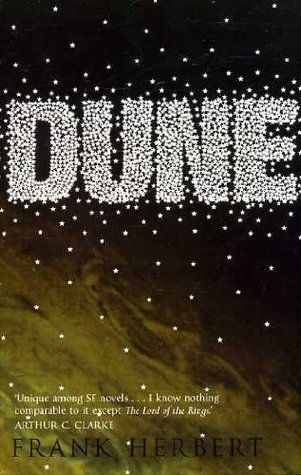
Book review: Dune by Frank Herbert

Dune (Dune Chronicles, #1)Dune by Frank Herbert

My rating: 4 of 5 stars

Tangential foreshadowing from the Collected Sayings of Maud’Dib by the Princess Irulan.

After his dad is asked to take over keeping the oil supply flowing out of the Middle East, Paul, a promising MMA fighter, witnesses the death of his family and friends, narrowly escaping into the desert with his pregnant mother. Befriending a small band of freedom fighters, Paul becomes their holy leader and prophesied deliverer. Meanwhile, the military-industrial-complex of the infidel are trying to apply their bootheel to the impoverished desert people. Can Paul use guerrilla tactics to overthrow the infidel, become Emporer and bring jihad to the west?*

Okay, so Dune does predate the general cluster-truck that is the Middle East conflict, but you do have to wonder if Herbert was munching on a bit of spice for inspiration when writing.

Unlike some other sci-fi classics, Dune does hold up as a novel in the modern day. There are some aspects that mark this as a book of the 60s (e.g. anything related to women) but it isn’t as jarring thanks to the complex worldbuilding. A lot has been poured into this novel that had me marveling at the efforts involved for one book. And yes, I know about the sequels and expanded universe novels, but this was clearly written as an open-ended standalone.

I have previously tried the expanded universe books that were co-written by Kevin J Anderson and Herbert’s son Brian. They did not grab me. The amazing worldbuilding that defined many of the concepts of space opera sci-fi** didn’t appear to have enough legs for those novels. I’m glad I picked up the original Dune to understand what the fuss was all about.

https://www.goodreads.com/review/show…

** https://www.goodreads.com/review/show…

https://www.newyorker.com/books/page-turner/dune-endures

https://www.theguardian.com/books/2015/jan/30/frank-herbert-dune-at-50-sci-fi-masterpiece

View all my reviews

Book Review: I Kill Giants by Joe Kelly

I Kill Giants

I Kill Giants by Joe Kelly

My rating: 5 of 5 stars

Welcome to Superheroes Annonymous. Barbara, would you like to tell us why you’re here?
854547-_sy540_

I really enjoyed this comic. Barabara isn’t a nice character, she is a loner, outsider, and she is battling personal problems, so she takes this out on everyone around her. Layered over this is the ambiguous threat of Giants who are coming to destroy everything she holds dear.

[Spoiler] I liked the ambiguity of whether the Giants are just a fantasy world and an analogue for the troubles Barbara is battling. We see her face those troubles and grow, and (hopefully) become a better person, if one still dealing with loss. [/spoiler]

This isn’t a story for everyone, but it will pull at the heartstrings if you give it a chance.

View all my reviews

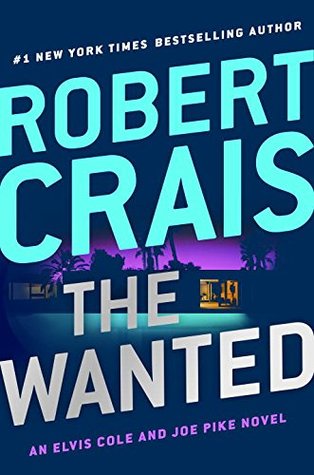
Book review: The Wanted by Robert Crais

The Wanted (Elvis Cole, #17; Joe Pike, #6)The Wanted by Robert Crais

My rating: 4 of 5 stars

There’s a question at the end of this book: “Is your name really Elvis?” The response should have been, “♪ Uh-hu-hu-huh. ♪”

Elvis Cole is called in to figure out how a worried mother’s son came by a luxury watch. Elvis and Joe Pike proceed to investigate a series of high-end burglaries, a spate of murders, and why two professional cleaners are looking for the teen boy. They even get to shoot people for a change.

I do enjoy picking up the occasional Robert Crais novel. They are entertaining and well paced, and offer up a slightly different take on the crime-thriller novel. Admittedly, I actually prefer Crais’ earlier books in the series as they had more humour, but his later novels are worth a read too.

What stops me recommending this novel more than the 4 stars I’ve given it is that, like any long-running series, there is a paint-by-numbers feel to the story. It is actually impressive that Crais hasn’t resorted to a more obvious formula yet, but that could be a reflection of my not reading every Cole and Pike novel.

The Wanted is another solid Cole and Pike novel, and highly enjoyable.

I received an Advanced Review Copy in exchange for an honest review.

View all my reviews

Appealing to the echo chamber with memes

Don’t you just hate seeing a misleading meme that was clearly aimed at reinforcing an audience’s biases? Isn’t it just terrible how easily misinformation can be spread in this manner? Isn’t it funny how memes stop us thinking too hard about the content such that we don’t fact check them?

Well, I hope I’m not alone. Or we’re all doomed. Doomed, I say.

Now I could discuss any one of hundreds of memes that circulate daily in political discussions. But, as a heavy hitter who has addressed the issue of memes before, I’m going to be tackling serious misinformation.

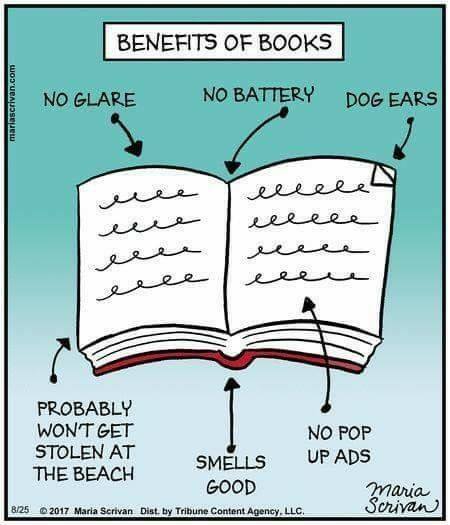
28167067_1792505891051286_61280214214698353_n

That’s right, this meme on the benefits of books is serious misinformation.

Now, before people start thinking I’m being melodramatic in calling a non-political meme that is just a bit of fun about books, remember, books are a $124 billion industry. So when people are talking about the format wars with memes like the one above, it is serious… Well, as serious as any discussion of an entertainment and leisure industry can ever be. Particularly if we take the existentialist view of the world.

I could, of course, have used a different meme. One with anti-science messaging, or a misleading political message designed to further divide public discourse, or one about cats, everyone loves cats. But if I did that, people would take one look at the meme and have either agreed or disagreed, and would be uninterested in anything else discussed. And this is part of the problem. Memes, like a lot of modern discourse, are designed to get you nodding your head in agreement before you think too hard. They allow you to outsource your thinking and fill in your knowledge on a topic by appealing to you with relatable content.

This meme is styled in a friendly cartoon manner. It has a whimsical font. Whimsical! It could be flirting with your partner and you wouldn’t mind. It is also appealing directly to the people who like their books to be made of the flattened entrails of trees, with relatable jokes about how terrible e-books are. But don’t think. It doesn’t want you to think.

Let’s take these points one by one.

Glare:
Books have glare. If you’ve ever sat out in the sun and read a book on white paper you’d have noticed how much squinting is involved. Either that or you had a patch of white scarred onto your retinas. Books also don’t fare well without a decent light source. Soft light causes just as much squinting.

No battery:
Neither does a shovel. Lots of things don’t have batteries, including my computer that plugs straight into the wall. The idea that an e-reading device (Kindle, iPad, etc) requires a power source, unlike the “superior” book, isn’t a like-for-like comparison. A Kindle holds thousands of books and can access libraries and stores directly. A smartphone can tell you the time. Let’s see a paper book do that.

Dog ears:
Nope. No self-respecting reader and book lover dog ears books. This is sacrilege. It would be like promoting the ability of books to retain coffee stains.

No pop-up ads:
None on my Kindle or iPad either. You’re reading wrong. Oh, and books have ads in them, usually for other books by the same publisher and/or author.

Smells good:
Clearly never borrowed a book from a library. I’ve borrowed some, even own one, that smells like it has been swimming in vomit at some stage. This is actually a reaction from the chemicals used in production. And e-reading devices smell just fine. As long as they don’t get left to swim in vomit at any stage.

Probably won’t get stolen at the beach:
Probably says more about the meme creator’s selection of reading material than anything. Maybe read less Twilight and more Kerouac to have your book stolen.

The trick to memes is that they slip the misinformation past you while you aren’t concentrating. Whether it be a misattributed quote or some cherry-picked statistics, it is easy to deceive people when they are busy looking at a pretty picture.

In the case of the paper books (DTBs), the “benefits” are dubious as soon as you think about them for more than two seconds. And notice that they aren’t benefits, like improved empathy, or greater cognition, or better communication abilities (see the rest of the list). Instead, the list is all about bashing e-books.

When the format wars discussion starts, everyone rolls out their usual banal reasoning for their preferred format. Without fail someone will talk about the smell of dead tree books (DTB), or the feel of eviscerated tree flesh in their fingers, or refer to some dodgy research that denigrates e-books. For some reason, the reading world is filled with technophobic troglodytes intent on proving that their old-fashioned way of doing things is better. This meme is no different, and I’ve addressed this issue before.

Whether it be dodgy “science”, or misleading memes, we need to critically assess the information we receive and share. Otherwise, the errorists win.

Book review: How to be a Stoic by Massimo Pigliucci

How to Be a Stoic: Using Ancient Philosophy to Live a Modern LifeHow to Be a Stoic: Using Ancient Philosophy to Live a Modern Life by Massimo Pigliucci

My rating: 5 of 5 stars

I’m still unclear if reading for pleasure is virtuous. I’m going to pretend that it is.

The former biologist and current philosopher, Massimo Pigliucci, guides us through stoicism and lots of conversations with his imaginary friend, Epictetus. I probably shouldn’t write book blurbs, because this was way more interesting than my previous sentence implies.

Before reading this book, my only understandings of stoicism came from Bertrand Russell. That is to say, I had a snarky and somewhat dismissive understanding of stoicism because Russell wasn’t a fan. Massimo dispelled my misunderstandings and also showed how stoicism could be applied to modern life. Book title goal achieved!

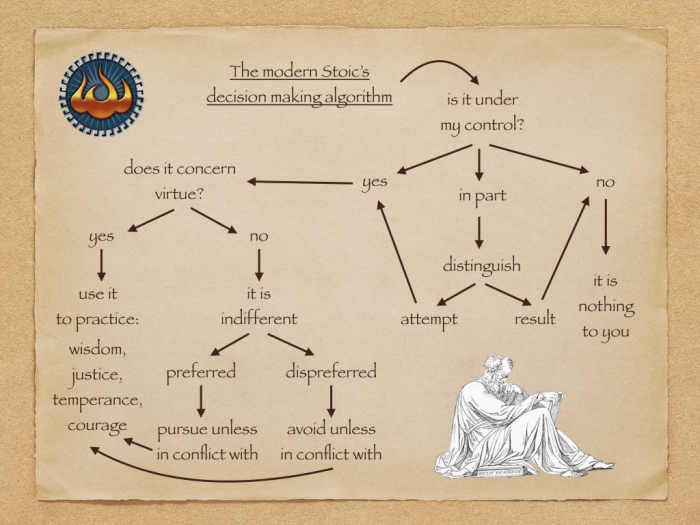
There are two highlights from this book. The first is that Massimo has managed to communicate his philosophy clearly and in a way that I think most people would be able to understand and engage with. The second is that he also manages to upsell readers on the idea of becoming a stoic. I’m not saying I’m rushing out to join Cult Stoic, but there are a lot of good ideas here for people to learn.

stoic-decision-making

View all my reviews

Further reading:
https://howtobeastoic.wordpress.com/
https://howtobeastoic.wordpress.com/2017/05/11/bertrand-russell-got-stoicism-seriously-wrong/
https://www.reddit.com/r/Stoicism/comments/zblu2/criticisms_of_stoicism_from_bertrand_russells/
https://philosophy.stackexchange.com/questions/9271/how-might-one-counter-bertrand-russells-criticism-of-stoicism-as-not-true-and

What Makes A Good Story?

if-you-didnt-read-the-title-first_fb_526920

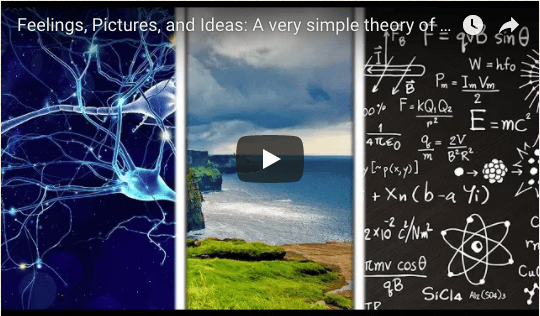
Recently a YouTuber discussed what makes for a good story, based upon three important pillars: pictures, feelings, and ideas. Or as he put it:

Hello and welcome to another instalment of “X lectures you on matters he himself knows nothing about”.

Screen Shot 2018-03-01 at 10.17.55 PM
Video removed, see why further down.

Like with everything that has a simple explanation (and even some complicated ones), I think the response to these sorts of posited arguments is “I think you’ll find it is a little bit more complicated than that.” But this one was funny, so points for effort.

A lot has been written on how to tell good stories. Seriously, every second creative person in history has a list of rules or advice. So here is a list of seven things that make for good stories, because seven is more than three, and it was on the first page of my Google search:

  • A central premise.
  • Strong three-dimensional characters who change over time.
  • A confined space — often referred to as a crucible.
  • A protagonist who is on some sort of quest.
  • An antagonist of some sort bent on stopping the hero.
  • An arch in everything — everything is getting better or worse.
  • And perhaps most important — Conflict. (Source: from Inducing Reality: The Holy Grail of Storytelling by Ken “frobber” Ramsley)

I think Ramsley’s explanation is more of a traditional checklist of things you need in your storytelling. X’s, in contrast, is a more generalist feel of where a story sits on one of those trinity diagrams. Neither, in my opinion, is right. And as a creative person, I’m now going to make a list of rules and advice….

Joking. Joking. Because I don’t think it works like that. I think that what makes a story good is the execution of the various story elements, done at the right time, finding the right audience, and being interesting enough to be remembered.

As an example, Star Wars is regarded as good, despite containing clunky dialogue, wooden acting, and passable directing. Why is it good? Because it hits all the story elements of the hero’s journey, it was one of the first space operas that hit the baby boomer generation and their kids, and had cool ideas like light sabres, space battles, The Force, and merchandising before that was really a big thing, to be remembered.

I’ve previously discussed how the luck factor of being a good story works. One example I cited was of Moby Dick and how it became good literature by accident/chance. Essentially one person dug it up, liked it, wrote favourably on it, and the rest is history. Shakespeare is in a similar boat, as his works were collected posthumously by 5 fans (750 copies, 250 surviving). These are examples of how finding the right audience is important, and how timing may not coincide with when something is made. How many other potentially good works were lost because they didn’t have an advocate who chanced upon them?

Of course, that’s just my thoughts. It’s probably more complicated than that.

Edit: When I originally posted this discussion on what makes a story good, I linked to a video by a YouTuber. Via Twitter I have learnt that this YouTuber sexually abused his former partner. Please take a moment to read her story in the links.

This isn’t behaviour any of us should condone, nor support. In this instance, I was sharing his video and promoting his profile – hence why his user name and video have been removed from this post. I was wrong to tacitly support abuse in this way. By not standing against abuse you might as well be condoning it.