Is this the real life? Is this just fantasy? Caught in a landslide, no escape from reality. Open your eyes, look up to the skies and see… Some really awesome stories.
This month’s It’s Lit with Lindsay Ellis covers the much-maligned genre of fantasy.
Fantasy is a lens to explore what we as a society find important to our pasts, our presents, and future. Fantasy and science fiction often fall under the umbrella of “speculative fiction” – as a result they are often grouped together, especially in bookstores. But science fiction is a forward-looking genre propelled by the possibilities of technology (and the things that worry us about it), fantasy is … more backward looking.
Witches ride on brooms and wizards hold a staff in their hands. Nothing phallic about that.
Eskarina “Esk” Smith was born the eighth son of the eighth son and was bequeathed Drum Billet’s wizarding abilities and staff. Minor mixup. Esk is a girl. But too late for any take-backs, Esk’s magical talents have her training with Granny Weatherwax in witching. This isn’t enough for Esk as she is meant to be a wizard, she has the staff and everything, so she journeys to the Unseen University for training.
I’ve come at the Witches instalments of Discworld backward. The first one I read was The Shepherd’s Crown, Pratchett’s last novel before his death, in which Granny Weatherwax dies.* So to come to the first was overdue. I was somewhat disappointed with The Shepherd’s Crown – probably because it was unfinished in terms of Pratchett’s usual revision process – but not so with Equal Rites. This was highly enjoyable and tackled some interesting tropes of fantasy, as well as plotting the rise of grrl power on the Disc.
*That isn’t a spoiler, it’s pretty much the first chapter.**
**Not that Sir Terry was a big fan of using chapters, but you take my meaning.
Wizards with synesthesia hearing octarine would be an interesting experience.
Twoflower arrives in Ankh-Morpork with his sapient luggage filled with gold. After years in inn-sewer-ants he is looking to become the first tourist on the disc. Rincewind makes his acquaintance thanks to his gift for languages, and they bumble into adventure.
Having read some of the last instalments in the Discworld novels I thought it was time to go back to read the earlier instalments. The writing in the books has changed over the course of the series. Most of the Discworld novels I’ve read so far have been directly satirising a modern-day topic or institutions, but The Colour of Magic is much more concerned with satirising fantasy novels themselves.
It is hard to give this novel a higher rating, however, as it does what all annoying fantasy series do: continue in the next book. Yes, great joke, but it does mean that until I’ve read The Light Fantastic there are no five stars from me.
Welcome to Superheroes Annonymous. Barbara, would you like to tell us why you’re here?
I really enjoyed this comic. Barabara isn’t a nice character, she is a loner, outsider, and she is battling personal problems, so she takes this out on everyone around her. Layered over this is the ambiguous threat of Giants who are coming to destroy everything she holds dear.
[Spoiler] I liked the ambiguity of whether the Giants are just a fantasy world and an analogue for the troubles Barbara is battling. We see her face those troubles and grow, and (hopefully) become a better person, if one still dealing with loss. [/spoiler]
This isn’t a story for everyone, but it will pull at the heartstrings if you give it a chance.
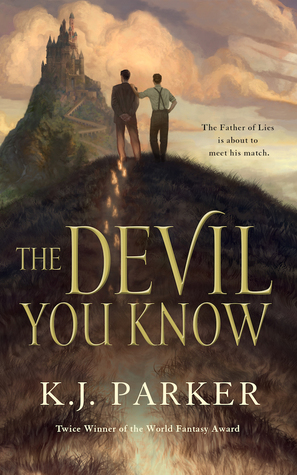
The greatest trick the devil ever pulled? Never messing with a philosopher.
Saloninus is the greatest philosopher of all time. But nearing the end of his life he wants another 20 years to complete his final works. So he does a deal with the devil. But the devil is suspicious. They might have an airtight contract for Saloninus’ soul, but there is something amiss. Is the devil about to be swindled by the greatest thinker?
A couple of years ago my uncle recommended KJ Parker to me. I’ve finally gotten around to reading one of Parker’s books. My uncle clearly has good taste.
This was an interesting and often humorous tale. After a recent letdown with an odious fantasy novel, this was refreshing. Briskly paced, world building without the laborious exposition, and characters that felt like real people, topped off a solid and interesting story. I’ll have to schedule some more KJ Parker reading for the near future.
Us readers know how awesome we are. And if we ever socially interacted with people everyone would realise that. We also want to know that we’re not alone. In a holistic sense. Obviously alone in the physical sense because otherwise, someone would try to interrupt our reading.
Sensing our need for connection to a nationwide community of book nerds, The Australian Arts Council commissioned a report to figure out who was reading books. The report surveyed 2,944 people to see who read, how much, how they found books, and whether they preferred waiting for the movie adaptation. Let’s see what they found.
Firstly they wanted to establish how often people read and how that compared to other leisure activities. Reading was obviously less popular than dicking around on the internet and watching TV, but apparently beat out exercise. Although they excluded sport, and Aussies have a funny definition of sport. But this finding is similar to 2006 ABS figures that suggest Aussies spend 23 minutes per day reading, versus 21 minutes for sport and outdoor activities, and 138 minutes for Audio/Visual Media (Table 3.3).
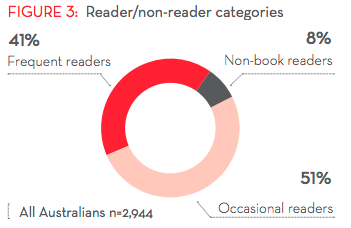
Next are the reader categories. Non-readers were actually a small group, mostly male and more likely to have less education (although I wouldn’t read too much into that last detail). Occasional readers made up half the population and were defined as reading 1 to 10 books in the last 12 months. Frequent readers were a surprisingly large segment, were defined as reading more than 10 books in a year, and were mostly female, older, better educated, and clearly better looking with tonnes of charisma.
Reading is to intellectuals what the bench press is to lifters. On the surface, they might appear to be a good representation, but most exaggerate how much to appear better than they really are. Oh, and they generally aren’t fooling anyone… So I’m a little suspicious of the popularity of reading suggested by the above figures.
For one, only 34% of Aussies have visited a library in the last 12 months (2009-2010 ABS data) and 70% of them attended at least 5 times. Yet this new survey suggests 39% of people borrowed one or more books from a library in the last month. That’s roughly comparative figures of 24% from the ABS and 39% from this survey.
I’m suspicious. This survey might not be as representative as claimed. Or reading may have suddenly risen in popularity since 2010… Doubtful given that both the ABS and this survey suggest otherwise. ABS suggested the amount of time spent reading had decreased by 2 hours between 1997 and 2006, whilst this survey suggested the book reading times were roughly the same as 5 years ago (Figure 8 – not presented).
The next figure of average reading rates either suggests Aussies are reading quite a bit, or inflating their numbers like an “all you” bench press. The average Aussie is reading 7 hours a week (5 of those for pleasure) and getting through 3 books a month (36 a year: not bad). Occasional readers are reading one book a month from 5 hours a week, compared to the Frequent readers who are reading 6 books a month from 11 hours per week (72 books a year: nice).
But I’m not sure how accurate these claims are. I cited ABS figures above that suggested Aussies spend 23 minutes per day reading, or 2hrs 41mins (161 minutes) per week. So either one of these two samples is unrepresentative, or some people just love to inflate how much they read. I’m leaning toward the latter.* But you can trust me on my bench press numbers. Totally accurate and “all me”.
The final figure I found interesting was of favourite reading genre. When you included non-fiction and fiction genres there were two clear winners: Crime/Mystery/Thrillers; and Science Fiction/Fantasy.
These are our favourites yet our bookstores would suggest that Sci-fi and Fantasy are niche and only deserving of a shelf at the back of the store. Cookbooks, memoirs, literature, and the latest contemporary thing that isn’t quite literature but isn’t exciting enough to be genre, are typically dominating shelves in stores. This would annoy me more if I wasn’t already suspicious of how representative this survey was, or how honest the respondents were being.
It could well be that people enjoy reading Thrillers and Fantasy but feel compelled to read other things. Maybe people are brow-beaten by the literary snobs to read only the worthy stuff and not the guilty pleasures. Maybe the snobs in Fort Literature have successfully turned favour against the invading Lesser Works. This might not be the case though, as 51% in this survey say they are interested in literary fiction but only 15% actually read it.
It could be that people are borrowing books from libraries or friends. Borrowing books is popular with 41% borrowing one or more books per month, mostly from friends (43%) and libraries (39%). But 39.5% bought at least one book in the last month (92% of 43% buying for themselves). So the tiny niche sections in bookstores for the most enjoyed genres still doesn’t make much sense.
I’m not sure what to make of all this. I mean, aside from Yay, Reading!
For comparison, the USA Pew Research’s 2016 annual survey of readers data is presented below. This suggests that Aussies read more than Americans. Assuming people are being honest.
This slideshow requires JavaScript.
“Key” insights from the Aussie research:
• We value and enjoy reading and would like to do it more – 95% of Australians enjoy reading books for pleasure or interest; 68% would like to read more, with relaxation and stress release the most common reason for reading; and almost three-quarters believe books make a contribution to their life that goes beyond their cost. Over 80% of Australians with children encourage them to read.
• Most of us still turn pages but many are swiping too – While print books still dominate our reading, over half of all readers in-clude e-books in the mix, and 12% audio books. Most Australians (71%) continue to buy books from bricks-and-mortar shops, while half (52%) are purchasing online. Word of mouth recommendations and browsing in a bricks and mortar bookshop are our preferred ways to find out what to read next. At the same time, nearly a third of us interact with books and reading through social media and online platforms.
• We are reading more than book sales data alone suggests – each month almost as many people borrow books (41%) as those who buy them (43%) and second-hand outlets are the third most popular source for buying books (39%), after major book chains (47%) and overseas websites (40%). Those who borrow books acquire them almost as frequently from public libraries as they do by sharing among friends.
• We value Australian stories and our book industry – 71% believe it is important for Australia children to read books set in Australia and written by Australian authors; and 60% believe it is important that books written by Australian authors be published in Australia. While there is a common perception among Australians that books are too expensive, more than half believe Australian literary fiction is important. Almost two-thirds of Australians believe books by Indigenous Australian writers are important for Australian culture.
• We like mysteries and thrillers best – the crime/mystery/thriller genre is the most widely read and takes top spot as our favourite reading category. We also love an autobiography, biography or memoir. (Source)
* I’m biased toward the ABS survey results over the Australian Arts Council for a few reasons. The first is that the ABS data is part of a larger Time Use Survey (How Australians Use Their Time, 2006, cat. no. 4153.0), so this removes a few biases in how people would answer questions (i.e. ask people specifically about how awesome books are, you’re going to talk up your reading more). It is also the larger survey covering 3,900 households. The methodology was also more likely to produce better data since respondents were filling in a daily diary and being interviewed. The Arts Council methodology wasn’t bad, but the survey was developed by interest groups, so the questions were presuming some things.
I recently reblogged an article from The Conversation about how awesome the Harry Potter books are, but how snobby (some?) literary people are about them. The vitriol and chastisement of the Harry Potter books remind me of a time when I too was not on the Potter bandwagon. Oh, how wrong I was.
And once again we come to my favourite book chest thumping topic. How worthy is Harry Potter and how wrong have the snobby people been about it?
I think it is worth addressing a few of the arguments that are levelled at JK Rowling and genre fiction in general. Let’s use Rowling as a stand-in for all genre authors. Because all genre authors are just as successful and beloved…
Mostly the arguments revolve around Rowling not having the correct goals in her writing. Of course, these supposed goals are rather arbitrary and change depending upon who is deciding what Rowling’s goals should be. Because apparently writing an entertaining book series that sells hundreds of millions of copies, has devoted fans, promotes laudable social principles, and got some kids reading books who wouldn’t have otherwise isn’t enough for some people. They also tend to expect the world from the Harry Potter books, something that I’ll delve into further below.
Take for example this piece by Nicholas Lezard in The Guardian:
Do I need to explain why that is such second-rate writing?
If I do, then that means you’re one of the many adults who don’t have a problem with the retreat into infantilism that your willing immersion in the Potter books represents. It doesn’t make you a bad or silly person. But if you have the patience to read it without noticing how plodding it is, then you are self-evidently someone on whom the possibilities of the English language are largely lost. Source.
Ugh. I’ve got two words for you, Nicholas Lezard, and they are what your mum should have said to your dad on that fateful day.
There is so much to unpack in that small quote. Lezard starts by insulting fans of the books, then says he isn’t insulting them, then insults them again. Someone who could write a paragraph such as this is self-evidently someone upon whom the possibilities of the English language are largely lost. He’s insulting the use of speech identifier verbs whilst failing to understand the audience and style being utilised. If you expect YA to be using the same style as the Man-Booker winners you’re gonna have a bad time.
But why insult fans, young and old, of the series? Why insult Rowling? Although she is probably insulated from such lowly criticism in her gold-lined money castle. He didn’t like something, he can critique it, but he is forgetting that a literary critique stands on the argument, not insulting people for disagreeing with him.
This speaks poorly of Lezard and other such critics. In a previous post, I discussed literary people defending Fort Literature from the invading Lesser Works. But this is Lezard leading a charge against the peaceful village inhabited by the Lesser Works. He has marked himself the despotic bigoted scourge of Fiction Land, seeking to crush all those who would dare be different from him.
Other critics of Harry Potter have argued that the series didn’t do enough to change the world. This piece comes from the unsupported opinions at The New York Times:
But in keeping with the intricately plotted novels themselves, the truth about Harry Potter and reading is not quite so straightforward a success story. Indeed, as the series draws to a much-lamented close, U.S. statistics show that the percentage of youngsters who read for fun continues to drop significantly as children get older, at almost exactly the same rate as before Harry Potter came along. Source.
Of course, the problem with this argument is that it requires one series by one author to change the lives of all kids worldwide… The article itself cites the series as having sold 325 million copies worldwide in the decade since the first book’s release (a third of that in the USA alone). Out of the 1.9 billion kids and 7 billion people in the world that means only 17% of kids, or 4.6% of people have bought a Harry Potter book (because nobody ever bought the whole series, or two copies of one of the books, or saw a copy in a library). To put that 325 million copies for the entire series in perspective, roughly 175 million people paid to see A film in the cinema that was tenuously about cars. A similar number paid to see the final Harry Potter film. Let’s face it: reading isn’t that popular.
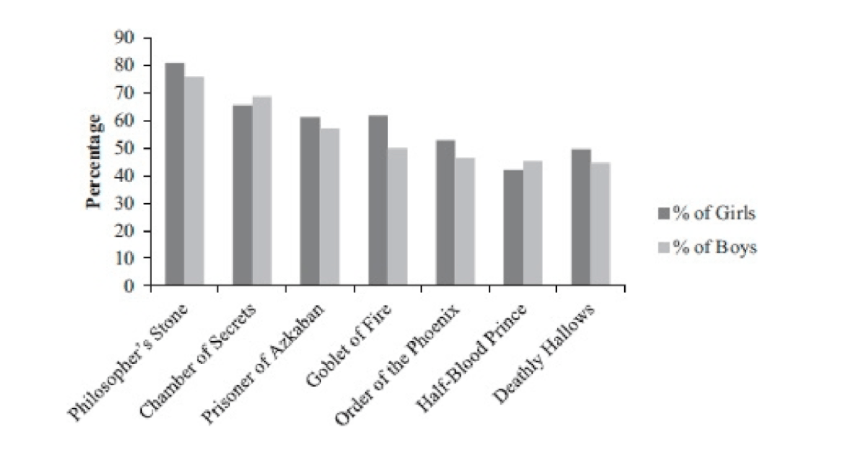
Let’s break this amazing phenomenon down a bit further. There have been several studies that have looked at readers, particularly kids, and how many of them have read the books.
Source
This is a small survey of children (N = 233) looking at Harry Potter fans, but is consistent with other studies and with a Waterstones reader survey the researchers used to validate the small study. You can see that most kids had read the first book, but that quickly dropped off as the series continued. The studies showed that only 25-35% of kids had read all 7 books in the series, with the average fan reading 3.98 books in the series.
Another thing to note is that studies have also found that 46% and 49% had read a Harry Potter book. Or to put it another way, over 50% of kids hadn’t read any Harry Potter books, and many had only tried one (usually the first one). The most popular book series of all time still isn’t read by a majority of people.
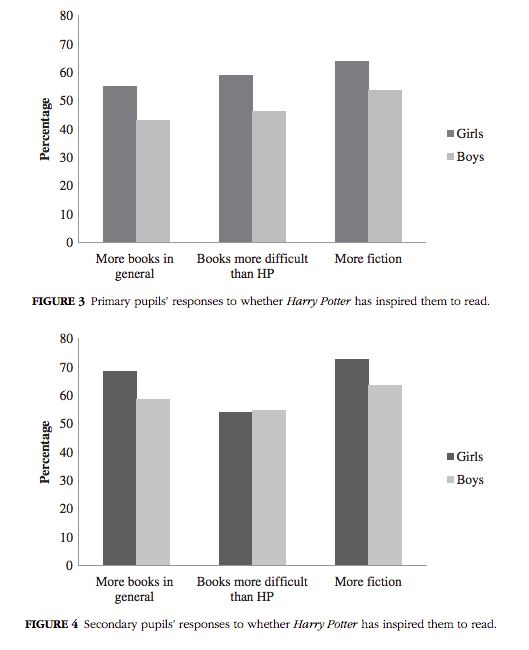
This study was of only 650 kids, but it does illustrate that particularly amongst secondary school kids that they were inspired to read. More books, more difficult books, and more fiction – and if someone can point out the difference between non-fiction and fiction I’d much appreciate it.
Another study of a similar size found supporting results:
Many, though not all, of our enthusiasts consider the Potter books a major contributor to both their self-identification as readers and their wider literacy development. Perhaps the most striking change they reported was the confidence and motivation to try more challenging books or more books in general. Thus, the Potter books—particularly the thicker ones—acted as a “Portkey” or “gateway,” transporting readers into the world of more mature fiction. Source.
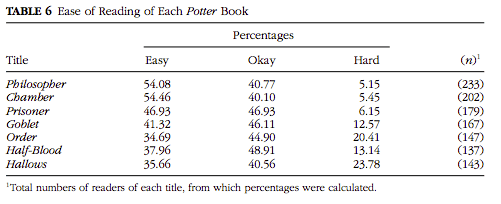
The increasing complexity and length of the books were cited in both studies as giving people confidence to grow as readers. But it was also noted that one of the reasons given for not reading all of the books in the series was also the increasing complexity and length. In other words, you can’t please everyone, especially not kids. Unless you have ice-cream. And the kids aren’t lactose intolerant.
So the problem isn’t that the books are second-rate, nor that they aren’t encouraging people (kids are people too) to read. The problem is that even the most popular book series ever is going to have a limited impact. Rowling has managed to connect with a huge audience – for a book – which has had positive impacts on readers, such that they are more likely to go out and read more books, even the more complex books that keep the literary snobs in a job.
It is a big ask to expect one book series to have improved literacy rates. At the risk of labouring the point – any further – most people don’t read, and most people who do read won’t have read Harry Potter. The problem isn’t Rowling failing to inspire people enough. It isn’t that she wasn’t a good enough writer. The problem is that people love to make lazy attacks on genre fiction. They don’t want to admit that reading is not that popular and that what we have been doing is probably not encouraging new readers. At least Rowling was on the right track.
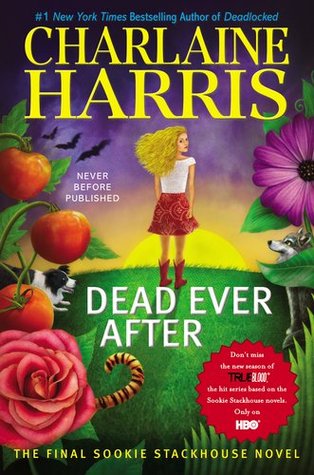
Did you hear the one about the Vampire, the Were, the Shifter, and the Barmaid?
In this final Sookie Stackhouse novel, Sookie discovers she has many enemies. One group decide to frame her for murder. Another group decide to just murder her. Another decides to steal her boyfriend. Her friends have other ideas about letting any of that happen without a fight.
I haven’t been closely following Charlaine Harris’ series. I’ve enjoyed all the instalments I’ve read so far, and Dead Ever After was no exception. Although, I was surprised to discover this was the final novel in the Sookie Stackhouse series.* This felt like any other instalment in the series to me.
Apparently fans of the series were annoyed with the less than satisfactory ending. A lot of one star reviews have been thrown at this book. One thing seems clear, Sookie didn’t end up with the right guy. Apparently. So if you are an invested fan, this book will probably be used to heat your home in winter. For the less invested fans, this will be regarded as a solid instalment to the series.
*Yes, I can see the tagline on the bottom of the cover. Kinda hard to read when it is thumbnail sized though.
It’s 20 years on June 26 since the publication of Harry Potter and the Philosopher’s Stone, the first in the seven-book series. The Philosopher’s Stone has sold more than 450 million copies and been translated into 79 languages; the series has inspired a movie franchise, a dedicated fan website, and spinoff stories.
Goodreads
I recall the long periods of frustration and excited anticipation as my son and I waited for each new instalment of the series. This experience of waiting is one we share with other fans who read it progressively across the ten years between the publication of the first and last Potter novel. It is not an experience contemporary readers can recreate.
The Harry Potter series has been celebrated for encouraging children to read, condemned as a commercial rather than a literary success and had its status as literature challenged. Rowling’s writing was described as “basic”, “awkward”, “clumsy” and “flat”. A Guardian article in 2007, just prior to the release of the final book in the series, was particularly scathing, calling her style “toxic”.
My own focus is on the pleasure of reading. I’m more interested in the enjoyment children experience reading Harry Potter, including the appeal of the stories. What was it about the story that engaged so many?
Before the books were a commercial success and highly marketed, children learnt about them from their peers. A community of Harry Potter readers and fans developed and grew as it became a commercial success. Like other fans, children gained cultural capital from the depth of their knowledge of the series.
My own son, on the autism spectrum, adored Harry Potter. He had me read each book in the series in order again (and again) while we waited for the next book to be released. And once we finished the new book, we would start the series again from the beginning. I knew those early books really well.
‘Toxic’ writing?
Assessing the series’ literary merit is not straightforward. In the context of concern about falling literacy rates, the Harry Potter series was initially widely celebrated for encouraging children – especially boys – to read. The books, particularly the early ones, won numerous awards and honours, including the Nestlé Smarties Book Prize three years in a row, and were shortlisted for the prestigious Carnegie Medal in 1998.
The seven books of the Harry Potter series, released from 1997 to 2007. Alan Edwardes/Flickr, CC BY-NC-ND
Criticism of the literary merit of the books, both scholarly and popular, appeared to coincide with the growing commercial and popular success of the series. Rowling was criticised for overuse of capital letters and exclamation marks, her use of speech or dialogue tags (which identify who is speaking) and her use of adverbs to provide specific information (for example, “said the boy miserably”).
The criticism was particularly prolific around the UK’s first conference on Harry Potter held at the prestigious University of St Andrews, Scotland in 2012. The focus of commentary seemed to be on the conference’s positioning of Harry Potter as a work of “literature” worthy of scholarly attention. As one article said of J.K. Rowling, she “may be a great storyteller, but she’s no Shakespeare”.
Even the most scathing of reviews of Rowling’s writing generally compliment her storytelling ability. This is often used to account for the popularity of the series, particularly with children. However, this has then been presented as further proof of Rowling’s failings as an author. It is as though the capacity to tell a compelling story can be completely divorced from the way a story is told.
Daniel Radcliffe in his first outing as Harry Potter in the Philosopher’s Stone, 2001. Warner Brothers
Writing for kids
The assessment of the literary merits of a text is highly subjective. Children’s literature in particular may fare badly when assessed using adult measures of quality and according to adult tastes. Many children’s books, including picture books, pop-up books, flap books and multimedia texts are not amenable to conventional forms of literary analysis.
Books for younger children may seem simple and conventional when judged against adult standards. The use of speech tags in younger children’s books, for example, is frequently used to clarify who is talking for less experienced readers. The literary value of a children’s book is often closely tied to adults’ perception of a book’s educational value rather than the pleasure children may gain from reading or engaging with the book. For example, Rowling’s writing was criticised for not “stretching children” or teaching children “anything new about words”.
Many of the criticisms of Rowling’s writing are similar to those levelled at another popular children’s author, Enid Blyton. Like Rowling, Blyton’s writing has described by one commentator as “poison” for its “limited vocabulary”, “colourless” and “undemanding language”. Although children are overwhelmingly encouraged to read, it would appear that many adults view with suspicion books that are too popular with children.
There have been many defences of the literary merits of Harry Potter which extend beyond mere analysis of Rowling’s prose. The sheer volume of scholarly work that has been produced on the series and continues to be produced, even ten years after publication of the final book, attests to the richness and depth of the series.
A focus on children’s reading pleasure rather than on literary merit shifts the focus of research to a different set of questions. I will not pretend to know why Harry Potter appealed so strongly to my son but I suspect its familiarity, predictability and repetition were factors. These qualities are unlikely to score high by adult standards of literary merit but are a feature of children’s series fiction.
I have written previously (here, here) about how people like to pretend they have read something they haven’t. To summarise my take on this phenomenon: Stop it!
People claim to have read books (1, 2, 3, 4) and watched movies they haven’t in order to appear more intelligent. From the new list that I will discuss below, you have to question who they are trying to impress by claiming to have read Dan Brown and Stieg Larsson.
Impressing people is what this is all about. We all have an inability to admit we like (or dislike) stuff because others may have a subjectively different taste and ridicule us. We even come up with the fake term “guilty pleasure” to describe something we like but are ashamed of for some reason. There shouldn’t be guilty pleasures, only pleasures… unless that pleasure is illegal or immoral or both – such as the movies of Uwe Bole.
This new list of lied about books comes from a poll of 2,000 UK adults. In it 41% of respondents admitted they fibbed about what, and how much, they read. This was part of The Reading Agency‘s look at reading habits. It found that 67% of respondents would like to read more, but 48% claimed they were too busy to read… but caught the game on the TV and did you see those new cat videos? Another interesting point was that 35% said they struggle to find a book they really like, and 26% want recommendations from someone they know. I.e. reviews are important.
As you will see from the list, most of these books have been turned into movies. That was probably why people lied. They wanted to impress people in a discussion but couldn’t just admit that they had only watched the movie. Hint: us readers can tell you haven’t read the book.
1. James Bond novels by Ian Fleming
I can’t claim to have read many of the James Bond novels – one, I’m pretty sure I’ve only read one. But I have watched most of the movies at least once. For my own part, the reason I haven’t read more of the books is partly lack of interest, and partly making time to catch up on older novels. There are a lot of influential authors and novels I’m yet to have a chance to read. Plus I’ve heard that the books have far fewer explosions.
2. The Lord of the Rings by J.R.R. Tolkien
Admittedly I read the novel after the first movie came out – or possibly only finished it after the first movie came out. I’ve covered this book recently as part of my Book vs Movie discussions (1, 2, 3). I don’t think you can blame people for watching the movies instead of reading the book. The book is long, waffly, and at times difficult to parse. The movies are only long and awesome.
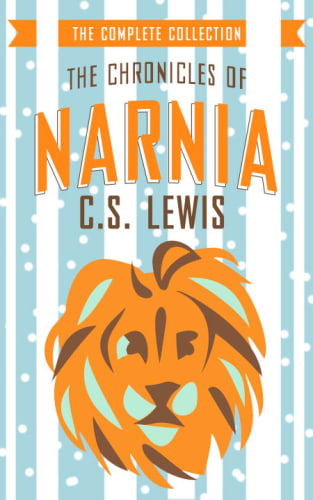
3. The Chronicles of Narnia by C.S. Lewis
I’ve only read six of the seven Narnia novels. I read this series when I was young and pretty much lost interest before reading The Last Battle. The first two novels (chronological, not published) are well worth reading, but I can understand people not bothering to read the rest. I can also understand people having watched the movies and decided not to read the books. The movies are only okay, which is generally not enough to encourage most people to read books.
4. The DaVinci Code by Dan Brown
Apparently The DaVinci Code is one of the most read books of all time…. if you just go by book sales. I have a love-hate relationship with Dan Brown’s Artefact McGuffin Adventures. While I have read two of Brown’s novels, I actually prefer other authors who write superior Artefact McGuffin Adventures. Can’t really blame people for watching Tom Hanks run around historical places instead of reading about Robert Langdon.
5. The Hunger Games by Suzanne Collins
I can honestly say I haven’t read this book, nor been interested in doing so, despite the paperback being on our shelves. The movies didn’t exactly inspire me either. The main reason I haven’t tackled it is that my wife only thought it was okay and similar to Divergent by Veronica Roth.
6. Trainspotting by Irvine Welsh
I didn’t even realise the movie was based on a book until relatively recently. I’m sure most people will have seen the movie and assumed the book is pretty similar.
7. The Wonderful Wizard of Oz by L. Frank Baum
Another book I haven’t read and one I’m not really interested in reading – nor the rest of the series for that matter. I’m not sure why anyone would claim to have read this book when they haven’t, unless they want to say “Oh, the books are so much darker” when the movie is being discussed.
8. Bridget Jones’s Diary by Helen Fielding
Another novel that is on our shelves thanks to my wife. The impression I have of the main character is that I would probably not enjoy this, especially since I try to be out of the room when people are watching the movies.
9. The Girl With the Dragon Tattoo by Stieg Larsson
Ugh. I read part of this book before shredding it and using the remains to create a nest for a family of rats. Even the Wikipedia synopsis of the novel bores me to tears. Any “thriller” that starts with ten pages of descriptions of flowers, followed by a few more pages discussing home renovations had better make them giant mutated flowers with Uzis that are renovating the home with explosives. If only people would stop talking about this book so that people would stop talking about it as though it was good.
10. The Godfather by Mario Puzo
I bought The Godfather from a bargain bin next to a pile of remaindered books. The only reason I decided to buy and read it was that the movie was/is a classic. It is probably fair to say that most people only ever considered reading this because of the movie, so it is no surprise that people inflate that from considering to have read.
11. One Flew Over the Cuckoo’s Nest by Ken Kesey
I have neither read this book nor watched the film. My entire understanding of this book comes from Thug Notes. That’s enough for me.
12. Gone Girl by Gillian Flynn
This book certainly isn’t for everyone. When I reviewed it I called it literary crime fiction, which puts it between genre fiction that people like reading, and award-winning stuff people only pretend to like reading.* That means it could attract people from both audiences, or annoy both audiences – yes, I am assuming that those two audiences are disparate entities that share nothing in common. So I could see why some people would claim to have read this novel, what with the awards, and praise, and movie forcing them to either admit something about their reading habits or to make some facile excuse for not having read it yet.
13. The Kite Runner by Khaled Hosseini
This book has the dubious honour of being a novel I was only aware existed as a result of it appearing on these lists of books people claim to have read but haven’t. Maybe this book doesn’t actually exist but is inserted into these reading lists as an internal check for the survey of readers. Let’s see who notices that this book is fictional fiction.
As you can see, it is easy to admit which books you have and haven’t read. Some books you may not want to read. Some you may not have had a chance to read yet. Some you might only be aware of due to the movie adaptation. The main thing is to acknowledge the truth so that entertaining books are promoted (review books, but do it the right way), rather than dreck that people haven’t read but assume is entertaining. And if you want to continue to lie about books you’ve read, here is a summary of some classic novels:
This slideshow requires JavaScript.
*Yes, that is me being snobby. Yes, I am meant to be against that judgmental stuff. Yes, I am a hypocrite at times.
A few weeks earlier, Mercy killed one vampire too many, and now Marsilia and her vampire seethe have found out. Out of the blue pops her old out-of-state college friend with a ghost problem that she hopes Mercy can help with. What convenient timing.
It is refreshing to read a fantasy series that doesn’t get bogged down in world building waffle. Aside from being written as though they are standalone novels – whilst being a continuing adventure – there isn’t any fat on this lean series. And as the series has progressed it hasn’t fallen into a rut, nor become formulaic. I’m already halfway through the next in the series and enjoying each Mercy Thompson outing as much as the first.
“YOUR CANDLE…WILL FLICKER FOR SOME TIME BEFORE IT GOES OUT – A LITTLE REWARD FOR A LIFE WELL LIVED…YOU HAVE LEFT THE WORLD MUCH BETTER THAN YOU FOUND IT…NOBODY COULD DO ANY BETTER THAN THAT”
Tiffany Aching has a lot on her plate. She is the witch of two areas, she has some big boots to fill after the passing of Granny Weatherwax, and trouble is brewing with the elves. The elves love a bit of mischief, and with the passing of Granny Weatherwax, the barrier between their world and the Disk is weaker. With iron and steam now coming to the lands, they want to strike before they lose a place on the Disk. Only the Witches and Nac Mac Feegles stand in their way.
This was Terry Pratchett’s final instalment in The Discworld novels. There will be no more. As such, I really wanted this to be better than it was. Unlike other novels in the series, this lacked the levels of humour and satire you would expect from Pratchett. Where he was normally brilliant, this was only okay. Of course, okay for a Pratchett novel is still better than most novelists could ever hope to achieve.
I wouldn’t make much of a supervillain. My weakness is chocolate. And quality whiskey. And a beautiful guitar. And a great novel. And…. this would make a long list of things to kill me with.
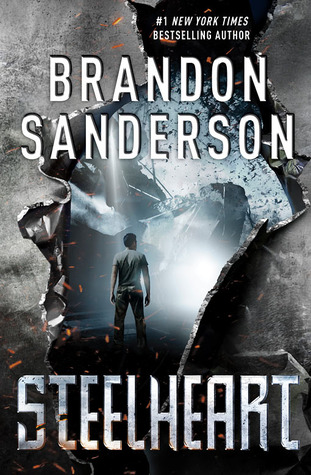
Steelheart is the first book in the Reckoners series by Brandon Sanderson. David was only a child when the Epics (supervillains) appeared. He also has a secret: he saw the greatest of the Epics bleed. The supposedly invincible and invulnerable Steelheart is now the Dictator of Newcago and David wants to avenge his father’s death at the hands of Steelheart.
After enjoying the Mistborn series I have been trying other Sanderson book series, expecting more great novels from him. I struck out with The Way of Kings, which could best be described as using 100 words when 10 would suffice, but Steelheart promises an exciting series.
Leaving aside the (acknowledged) improbable superpowers and raised middle finger to physics, the novel manages to be engaging and intriguing. In this David versus Goliaths tale there is plenty of suspense and fear that the heroes may not triumph. The series is intended as a Young Adult adventure, but YA is the new A must read, so don’t be put off by that.
Can’t wait to read the rest of the series and see how the handwavium works.
There are so many great fantasy fiction novels out there, I’m just going to list a few of my favourites.
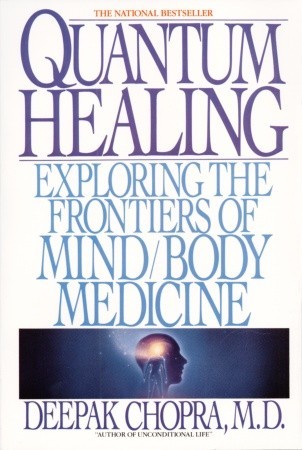
Deepak Chopra: Quantum Healing
Let’s face it, Chopra has been a bestselling fantasy author for decades now, so I could have named any of his books. He never fails to churn out the most epic of fictional nonsense, but Quantum Healing has to be his most mind-boggling work.
Various: Climate Change: The Facts
Okay, I’m cheating a bit here, as this treads into science fiction territory, but as a work of fantasy, it also holds its own. This collection of short stories is by a who’s who of fantasy authors on the theme of an alternate reality where climate change isn’t real.
Jeffrey Smith: Seeds of Deception
From everyone’s favourite flying yogi comes his groundbreaking fantasy novel about conspiracies, genetics, food, and how to ignore several fields of science and scientists by shouting la-la-la-la. Also qualifies as a comedy due to being so laughable.
An homage to Roald Dahl’s George’s Marvellous Medicine, this piece of fantasy is notable for being written as though the author were a child who never learnt English. Such an amazing piece that is sure to have you queueing for the iron lung.
Hell is being surrounded by famous people, apparently.
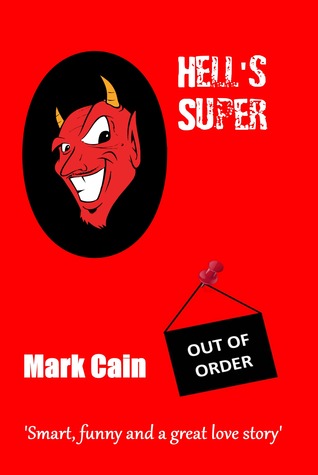
Hell’s Super follows Steve Minion, the only non-famous person in hell as far as I can tell, as he tries to fix all the problems that come up in hell. Whether it be replacing a broken light bulb on the sign leading into hell (Abandon all hope ye who enter here), or stopping a civil uprising, Steve is tasked with fixing the problem because he sucks at fixing things: it’s hell, it’s his punishment. His sidekick is Orson Welles and he is dating Florence Nightingale: enough said.
I picked up Mark Cain’s Hell’s Super as it promised to be a novel in the vein of Terry Pratchett or Good Omens: some satire, some straight laughs, some silly fun. It had those elements but for me it rarely rose above mildly entertaining. Having recently re-read Good Omens, a book Hell’s Super is compared to in the back cover blurb, I can safely say that the Pratchett and Gaiman novel is not being knocked off the Best Novel of All Time podium any time soon. Too much of the humour and plot relies on utilising famous people and irony (especially in the punishments) to be classed as Pratchett-esque satire and humour. It also didn’t help that the plot twists were obvious given the setting.
That said, this is an entertaining novel with enough humour to amuse. I think the comparisons drawn to Good Omens, Terry Pratchett, and Douglas Adams in the blurb set up too-high an expectation for me. Knowing that, you may enjoy it more as a result.
AT LAST, SIR TERRY, WE MUST WALK TOGETHER. Terry took Death’s arm and followed him through the doors and on to the black desert under the endless night.
It has been a while since I journeyed from Roundworld to Discworld and with Sir Terry’s passing, it seemed like the right time. The trouble with picking a Discworld novel to read is which of the 41* to choose. I settled upon Raising Steam, the ode to the very British obsession with steam trains.
Two things struck me when reading Raising Steam. First was that the TV miniseries adaptation of Going Postal was perfectly cast. Reading I couldn’t help but see Charles Dance as Vetinari and Richard Coyle as Moist (Slightly Damp). This gives me great hope for the forthcoming adaptation of the best novel of all time, Good Omens. The second thing was that as a non-British person I feel like I’m missing many of the jokes. There are so many references throughout the novel that hint at jabs being taken at various cultures, peoples, politicians, and institutions. Some are obvious, like the French and Aussie ones, but others I’m guessing I’d have to have been to the UK to understand.
This is all another way of me saying that there is no such thing as a bad Discworld novel. Goodbye, Sir Terry, thanks for the legacy.
*41 later in 2015, 40 as of this review’s writing.
There are some big advantages to coming to a series late, like being able to read the entire series back-to-back rather than wait those long painful months until the next exciting instalment. I guess that makes me a “binge” reader.
Brandon Sanderson’s Mistborn series is classic fantasy in just about every respect. Normally I’d give a brief overview of the book, but I’m doing this review for the entire trilogy. And as this is a fantasy series I don’t really have the space for a brief overview of a trilogy. Don’t ask me to write that much, not today, Lord-Ruler not today. Oh okay. [spoiler] The story follows Vin from street thief, to powerful warrior, to god. [/spoiler] H’uh, did that easily, didn’t I?
Mistborn: The Final Empire was first published 9 years ago in 2006, with The Well of Ascension following in 2007, and then The Hero of Ages in 2008; so I’m only a few years behind the times. But this gives me a decided advantage over the people who were hooked on this series back in ’06. As I mentioned above, I read this series back to back, something I rarely do but something that well written fantasy series inspire me to do.
I really enjoyed the series but couldn’t quite bring myself to give this 5 stars. There is a lot to like about the world Sanderson has created – the metal burning being the basis of magic skills being pretty cool – and there were several characters I enjoyed following – notably Vin and Sazed. The first book suffers a little from Sanderson’s pedantic world-building, the second book is tightly written, enjoyable, but felt like it had a false ending before the actual finish, then the final book really delivered on the series. So I’m giving the Mistborn series 4.5 stars and recommending reading the trilogy back to back.
My mother bought me The Great Zoo of China for Christmas, which makes her the best mother in the world. Well, unless your mother bought you a copy as well, in which case the title of best mother in the world would have to be shared.
CJ is a herpetologist specialising in large animals like crocodiles, and being a Matthew Reilly novel, she also specialises in avoiding dying every page or two. She is recruited by National Geographic to take a press junket trip to a new zoo in China. The Chinese government have developed an amazing new zoo that is set to wow the world, assuming their main attractions don’t try to escape and eat everyone. What could go wrong during the promotion junket for a zoo filled with dragons?
Yep. Dinosaurs, sorry, Dragons.
I’ve seen some reviews that suggest Matt’s novel is just a rip off of Michael Crichton’s Jurassic Park. I agree completely. I also like to ignore that Jurassic Park is a rip off of Sir Arthur Conan Doyle’s The Lost World, which is in turn a rip off of Jules Verne’s Journey to the Centre of the Earth, or possibly Off On A Comet – if you want to count dragons as dinosaurs. Because every idea is 100% original and comments complaining about rip-offs don’t primarily show the complainer’s ignorance.
Ignoring that point – because who cares? – Matt’s latest novel is all of the elements we’ve come to love from him. The story is fast paced, life and death, adventurous fun. I really enjoyed The Great Zoo of China: enough said.












 A focus on children’s reading pleasure rather than on literary merit shifts the focus of research to a different set of questions. I will not pretend to know why Harry Potter appealed so strongly to my son but I suspect its familiarity, predictability and repetition were factors. These qualities are unlikely to score high by adult standards of literary merit but are a feature of children’s series fiction.







 Tyson Adams