Banned books

Recently in Australia, there was a lot of moralising outrage about books being banned in school libraries. Was this Political Correctness Gone Mad?

No. No, it wasn’t.

Yes, that’s right, the moral outrage brigade hadn’t even bothered to check any details. That shouldn’t be particularly surprising to anyone who, you know, thinks, but what I did find interesting is the sort of hyperbole used on this issue that never seems to make it to the actual censorship that exits.

I’ve previously discussed the Banned Books Week, an awareness-raising campaign in the USA. Since the USA is a big and influential book market, there are flow-on effects of books being challenged and banned there – although the Streisand Effect can apply here and be a net positive, just ask Dan Brown. Australia also has a censorship board and historical lists of previously banned books have been made public.

When you read through the lists of books that were previously banned in Australia but are now available, you can see how we aren’t/weren’t allowed to talk about sex. We also don’t talk about Aboriginal history. Not talking about sex is still a common theme in today’s Australian censorship standards:

Publications will be refused classification (RC) that:

  1. describe, depict, express or otherwise deal with matters of sex, drug misuse or addiction, crime, cruelty, violence or revolting or abhorrent phenomena in such a way that they offend against the standards of morality, decency and propriety generally accepted by reasonable adults to the extent that they should not be classified; or
  2. describe or depict in a way that is likely to cause offence to a reasonable adult, a person who is, or appears to be, a child under 18 (whether the person is engaged in sexual activity or not); or
  3. promote, incite or instruct in matters of crime or violence

Publications (except RC publications) will be classified as Category 2 Restricted that:

  1. explicitly depict sexual or sexually related activity between consenting adults in a way that is likely to cause offence to a reasonable adult; or
  2. depict, describe or express revolting or abhorrent phenomena in a way that is likely to cause offence to a reasonable adult and are unsuitable for a minor to see or read

Publications (except RC publications and Category 2 restricted publications) will be classified as Category 1 Restricted that:

  1. explicitly depict nudity, or describe or impliedly depict sexual or sexually related activity between consenting adults, in a way that is likely to cause offence to a reasonable adult; or
  2. describe or express in detail violence or sexual activity between consenting adults in a way that is likely to cause offence to a reasonable adult; or
  3. are unsuitable for a minor to see or read. Source.

Now obviously the classifications could be very broadly interpreted and implemented. Plenty of books have themes around drug use and abuse, crime is an entire genre, cruelty is in any political memoir, and violence could be retitled thriller. We don’t tend to see those titles banned or restricted. So what does get restricted? As an example, American Psycho has a Category 1 restriction on it and is sold in shrink-wrapping… you know, just in case the words leak out and accidentally encourage someone to take up cannibalism or investment banking.

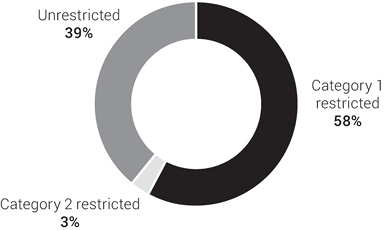
The number of books impacted by an RC classification is minimal. The 2016-17 figures show none were banned, as compared to video games which had 2 titles banned.

2017-figure01
Publications Classified in 2016-17. Source.

But it does show that a large number of titles were restricted in some way. This is without even touching on the censorship that occurs in access to titles, such as which titles are stocked in stores, which sites can be accessed to buy books, and what ends up in libraries. The restricted categorisation is clearly going to have impacts on where those titles will be available. So I wonder where the moral outrage is over this. Isn’t this Political Correctness Gone Mad? Or is it okay because the people who got outraged in the above video would be the “reasonable adults” who would be offended by these restricted titles?

Or maybe this would all require too much reading on behalf of those wanting to complain about books being banned.


Book Review: The Republic by Plato

The RepublicThe Republic by Plato

My rating: 4 of 5 stars

Old white guys sit around discussing how to set up a totalitarian military state with them as the rulers.

Plato’s famous text covers a lot of ground as it tries to establish what justice is. It covers politics, personal and political ethics, idealised states (democracy ranks third out of four), education, and virtue. The Republic is a heady read, whilst being fascinating.

The strawman style to the interlocuter dialogue did annoy me as a reader. Whilst it was in service of making a larger point, it did make the discourse feel more shallow than it is. Plato’s thinking was also amazingly progressive for an age that predates the enlightenment by the best part of a millennium. But this thinking was also confined by the times.

Plato, along with Socrates and Aristotle, were the drivers behind western society. Books like The Republic put forward a lot of ideas for discussion and dissection, opening the dialogue that would lead to progress. That alone makes The Republic worth reading, but I also found it was worth reading if only to see much of it in context rather than discussed second-hand. E.g. The famous allegory of the cave takes on a slightly different light when not viewed in isolation.

For a more detailed understanding:
https://plato.stanford.edu/entries/plato-ethics-politics/

View all my reviews

Book vs Movie: When the Book Is Better

'We are making a film of the book.'

PBS Digital Studios have a new video series It’s Lit! which is part of The Great American Read, an eight-part series that explores and celebrates the power of reading. Featuring one of the premiere video essayists in Lindsay Ellis, this series should be brilliant.

The first video briefly discusses a topic I’ve frequently discussed here, what makes a good adaptation and why the book is so often regarded as better.

Lindsay has very concisely summarised why movies so often don’t make for good or faithful adaptations of the source material. But she also touches on why they can sometimes improve the book, or make an adaptation that uses the source material in an interesting way to tell a different story.

If you aren’t already subscribed to Lindsay or PBS Digital Studios, you may want to do so now.

Reading is awesome even when you don’t do it…

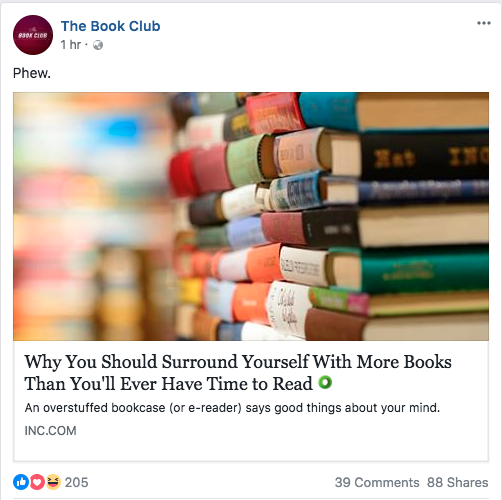
Scrolling through my feed I came across this little gem:

Screen Shot 2018-05-07 at 8.29.58 am

How could I not click on this article? I have several years supplies of paper books on my shelf to read, and even more on my e-reader. Justifying this state of affairs is clearly something I need.

Pity the article is rubbish.

The first hint that this story is nonsense is how they start by commending readers as smart – softening everyone up a bit. They list a few famous people who read and say you too can be just like them if you read. Somehow reading = lifelong learning, so you’ll be happier, earn more, stay healthier, and become president – I’m tempted to dive into those claims for a fact check, but one piece at a time. I’m willing to accept the claim that reading = lifelong learning… for now.

Lifelong learning will help you be happier, earn more, and even stay healthier, experts say. Plus, plenty of the smartest names in business, from Bill Gates to Elon Musk, insist that the best way to get smarter is to read. So what do you do? You go out and buy books, lots of them.

Then it suddenly announces you don’t have to read.

But if it’s simply that your book reading in no way keeps pace with your book buying, I have good news for you (and for me; I definitely fall into this category): Your overstuffed library isn’t a sign of failure or ignorance, it’s a badge of honor.

Oookaaaayyy. Please explain to me how not reading is just like reading.

That’s the argument author and statistician Nassim Nicholas Taleb makes in his bestseller The Black Swan. Perpetually fascinating blog Brain Pickings dug up and highlighted the section in a particularly lovely post. Taleb kicks off his musings with an anecdote about the legendary library of Italian writer Umberto Eco, which contained a jaw-dropping 30,000 volumes.

Did Eco actually read all those books? Of course not, but that wasn’t the point of surrounding himself with so much potential but as-yet-unrealized knowledge. By providing a constant reminder of all the things he didn’t know, Eco’s library kept him intellectually hungry and perpetually curious. An ever-growing collection of books you haven’t yet read can do the same for you, Taleb writes.

An antilibrary is a powerful reminder of your limitations — the vast quantity of things you don’t know, half-know, or will one day realize you’re wrong about. By living with that reminder daily you can nudge yourself toward the kind of intellectual humility that improves decision-making and drives learning.

This is what is commonly referred to as a non-sequitur, or a bullshit argument. Nassim Taleb is notorious for these sorts of nonsense arguments. That and blocking people on Twitter* for not agreeing with him and praising the ground he deadlifts upon.

It is hard to decide where to start with this. The irony of suggesting you need to surround yourself with knowledge in an article on the internet is amazing. Even if we take it, as Taleb implies, as requiring a physical reminder, we already have libraries, bookshops, universities, experts, friends, enemies, who all exist with knowledge we don’t have. It isn’t about the reminder, it is about awareness.

I’m not sure you can take people seriously when they talk about knowledge in terms of what you don’t know. One list is considerably larger than the other. If I was to provide a resume of what I didn’t know it would run to libraries worth in length. Who would suggest we think in those terms?

“People don’t walk around with anti-résumés telling you what they have not studied or experienced (it’s the job of their competitors to do that), but it would be nice if they did,” Taleb claims.

Of course he would suggest that. I guess I’ll mail Taleb a résumé of the Dewey codes** for the stuff I don’t know to become his deadlift partner.

How do they rationalise this anti-library?

Why? Perhaps because it is a well-known psychological fact that it’s the most incompetent who are the most confident of their abilities and the most intelligent who are full of doubt. (Really. It’s called the Dunning-Kruger effect.) It’s equally well established that the more readily you admit you don’t know things, the faster you learn.

So stop beating yourself up for buying too many books or for having a to-read list that you could never get through in three lifetimes. All those books you haven’t read are indeed a sign of your ignorance. But if you know how ignorant you are, you’re way ahead of the vast majority of other people.

Actually, the Dunning-Kruger Effect is about how people with low cognitive ability are exactly those who lack the ability to realise they are of low cognitive ability so they will rank themselves more highly. High cognitive ability people incorrectly assume others are at their level, so will rank themselves lower (see also Imposter Syndrome). You can see from this explanation of the effect why surrounding yourself with knowledge doesn’t really achieve anything.

It’s about awareness.

You would have to be aware that your knowledge is lacking, not just have a reminder of it. If you are ignorant or arrogant then you won’t benefit from the stacks of books around you. We are already surrounded by knowledge in our society – I mean, we’re on the internet here, you can look up literally anything and potentially get the correct answer… potentially. But this article – and Taleb himself – are proposing a form of arrogance. Surround yourself with books and you’ll be better than the vast majority of people.

I’m not saying you shouldn’t buy heaps of books, I myself already own more than I’ll probably be able to read in a lifetime. But don’t be fooled by these sorts of feel-good pieces that give you a pseudo-justification for doing so. It doesn’t say good things about your mind, nor make you better, it just says you like books and would like the authors to be able to afford to eat this week.

* Seriously, check out his profile or this search to see how often he justifies blocking people. As someone whom he has blocked, I can say that he really hates engaging in discourse. Oh, and the reason I was blocked was that he Tweeted about disease resistance in plants and how it works, except he got it massively wrong. When I pointed this out I was immediately blocked.
**Get it? The joke is that there are more library classification systems than just Dewey Decimal. I’m hilarious!

Book vs Movie: Dr Strangelove – What’s the Difference?

dr-strangelove-whats-the-difference-image-5239079

This month’s What’s the Difference? from CineFix delves into one of the few Stanley Kubrick films I’ve enjoyed.

Everyone remembers Dr Strangelove but very few remember Red Alert, the novel that was the basis for Kubrick’s adaptation. Peter George’s book was an early nuclear war thriller and having got there first tended to be copied (or is that emulated?) by many other authors. This was an important point since Kubrick and George decided to sue the production of another movie based upon a nuclear war thriller that was deceptively similar to Red Alert. I’m not exactly sure why this was important as George teamed up with Terry Southern to change the super-cereal novel into a timeless satire.

Did you know that Dr Strangelove was originally going to end with a pie fight? Apparently, the farcical element involved in that was deemed too silly for a poignant satire, despite how metaphorical it was to the destruction of the human race. I guess many would have missed that point. Comedy needs to take itself more seriously if people are to get the point.

I think Dr Strangelove is a great example of a movie being better than the book. The way it does this is by not taking the source material seriously. What would have been another by-the-numbers thriller was elevated by satirising war. Landing not long after the Cuban Missile Crisis, the film managed to capture sentiments of the absurdity of mutually assured destruction and the ineptness of the cabals of military and political elites deciding fates.

Plus, Peter Sellers.

Can you name a book?

creative-bookshelf-18__700

Sounds like a simple challenge, right? Name a book, any book at all.

In the long tradition of asking Americans general knowledge questions on the street and filming their glorious ignorance, I present this video from Jimmy Kimmel.

Before we all laugh and point at the Americans and insult their intelligence, let’s remember that you could do this just about anywhere. Although, Americans do make this stuff easy at times. I’ve previously discussed the reading figures for the US, UK, and Australia. I’m sure those numbers are at least in the same ballpark as other countries, if not outright representative.

Wait, why guess when I can actually use the wonders of the greatest information resource in human history to look that up? Why have an unfounded opinion that I then rant about in indignant outrage, arrogantly assuming I’m right and belittling anyone who does bother to look up the data? To the research!

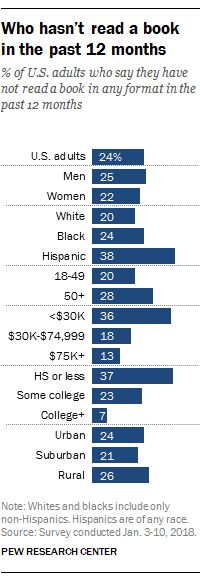
Let’s start with the data that the above video was citing from Pew Research.

ft_18-03-22_nonbookreaders_whohasnt
Source

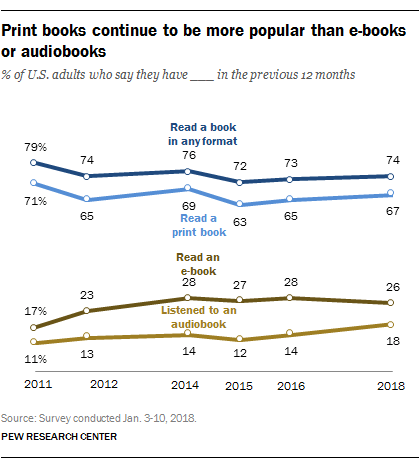
As we can see, the 24% figure is showing that older, poorer, less educated, men (just), and Hispanics read less in the USA. This isn’t a new conclusion, as data from Pew in 2016 shows. The conclusion around the number who don’t read is also similar to the 2016 results of 26% not having read a book in the last 12 months. I’m not sure you can interpret much change over time in the number of people reading, but numbers might be slowly decreasing (although, look at the uptick in audiobooks as that format has come down in price).

ft_18-03-07_bookreading_printbooks
Source

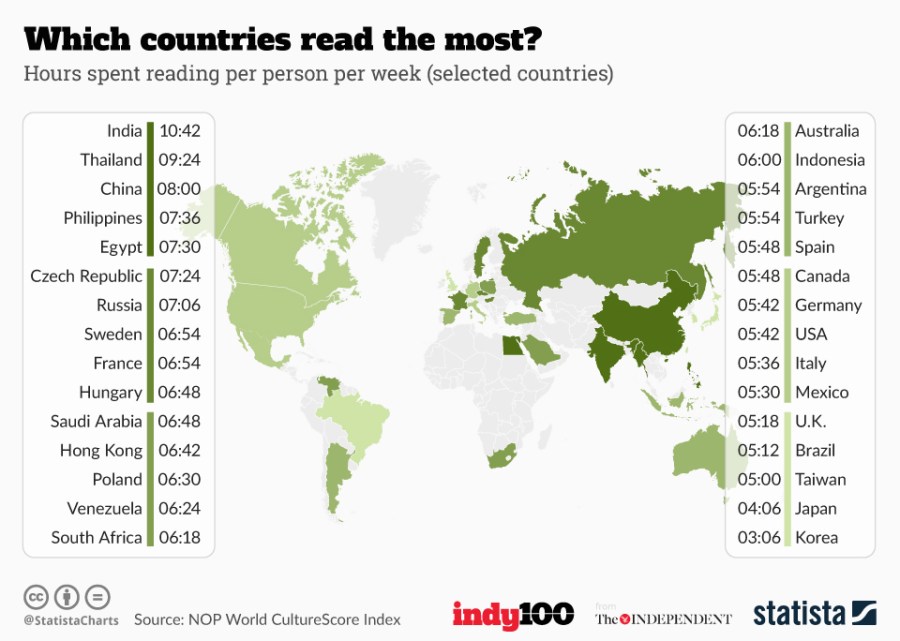
Now we can look at how the USA sits in terms of reading. I’ve previously discussed how Aussies spend roughly 23 minutes per day reading (ABS figures), or an hour a day if you believe the Australian Arts Council report (I suggested there was possible survey bias in that figure). Below you can see that the NOP World Culture Score puts Australia at 6 hours 18 minutes – which I think makes this an “ALL-YOU bench-press” set of numbers.

chartoftheday_6125_which_countries_read_the_most_n
Source: Statista

This chart suggests that the USA is probably typical for English speaking countries, but that many other countries read far more on a weekly basis in terms of hours. Unless reading is code for something else in non-English speaking countries. Maybe they thought they were being asked about how many hours they spent having sex per week.

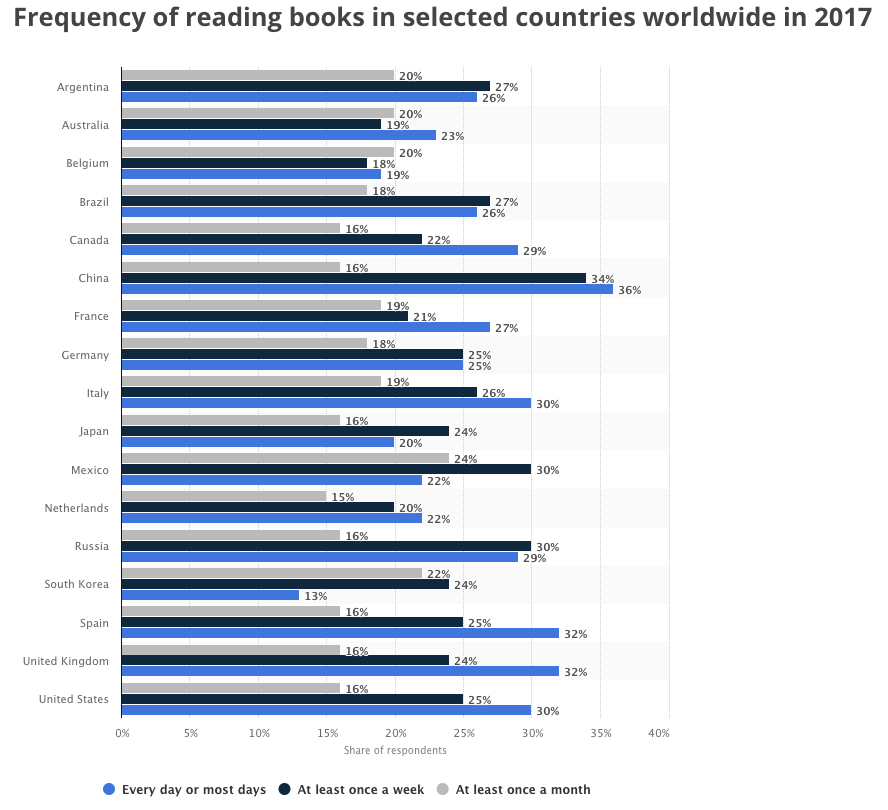
If we then look at the countries and how frequently they read books you can see in the chart below that they were afraid to include the bars for “didn’t read a book”. The high end has only 14% of Chinese people not reading a book, whilst the low end has the Dutch at 43% not reading (USA comes in at 29%, UK 28%, Australia 38% – I demand a recount!!).*

Screen Shot 2018-05-25 at 7.50.23 pm
Source: Statista

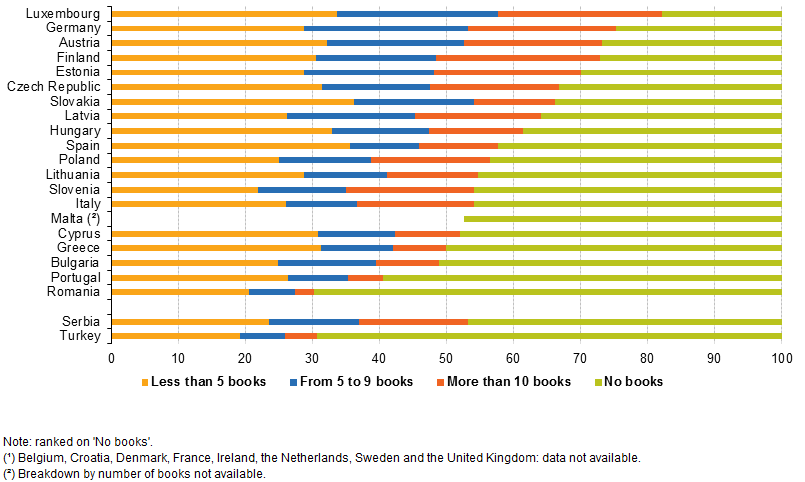
How about the number of books people read, or at least what they claim once they round up?

number_of_books_read_in_the_last_12_months2c_2011
Source: Eurostat
table-2
Source
Screen Shot 2017-10-08 at 6.24.23 PM
Source

What this all shows is that there are plenty of countries where you could ask ten people on the street to name a book and have one or two of them fail. You could ask those ten people what book were they reading today and only three of them could. Isn’t that sad? I reckon people would really enjoy reading if they made time for it. I’ve commented before on why I think people don’t read, suggesting that they don’t because they get told to read literature when they actually enjoy thrillers, sci-fi, and romance.

Maybe it is time to change that before someone sticks a camera and microphone in our faces.

*Be careful with my assumption here. Depending on how the question was asked and any other unreported categories, I may be very wrong in assuming the unreported numbers are non-readers.

Book Review: Electric Dreams by Philip K Dick

Philip K. Dick's Electric DreamsPhilip K. Dick’s Electric Dreams by Philip K. Dick

My rating: 3 of 5 stars

Sometimes you learn that aliens are better than people, so don’t be a jerk and you could stop an invasion.

Electric Dreams is a small sampling of an array of Philip K Dick short stories that were used as the basis for 10 episodes of a TV series of the same name. Dick wrote a huge number of short stories in his career – publishing 121 in a 30-year career, alongside 44 novels. So this selection (collection?) is probably best described as a taste-tester of PKD.

I find it hard to classify PKD as an author. What I have read of his works so far have left me thinking things like: “I was expecting more from this classic”*; “More interesting than engaging”; “Oh look, Deckard realised he lacks empathy so suspects he might be an android.”*** While I think PKD deserves to be acknowledged as a highly influential author I feel this is mainly for his ideas rather than their execution.

This collection was enjoyable on the ideas front and makes for a good sampler of PKD’s work.

*We Can Remember It For You Wholesale
**The Minority Report
***Really? You don’t know what book that is referring to? Would it help if I quoted some lines from the movie?

View all my reviews

Book Review: The Hoodoo Man by Steve Harris

The Hoodoo ManThe Hoodoo Man by Steve Harris

My rating: 5 of 5 stars

Budgie as a weapon? Sure, why not.

Danny Stafford was an ordinary kid until his brother shot him in the face. It was an accident that changed Danny, but it isn’t until his 30s that the change fully takes hold. Now in a stable relationship, renovating a house, and working a dead-end job, Danny’s life is turned upside down. And that’s before the Hoodoo Man starts coming for him.

Back in my formative years, the local librarian introduced me to the adult section of the library after I’d read everything on offer for young adults and kids. This novel, The Hoodoo Man, was the first she pulled off of the shelf for me to try. A brand new horror novel by a UK author. Bit of a leap. But I was hooked. I clearly remember devouring this book, to the point that I missed at least one meal.

Twenty-six years later I wanted to test if my memory of this novel held up. Was The Hoodoo Man as good all these years later, or was I just an impressionable kid who had just discovered his first horror novel? Oh, it stands up alright. It has aged very well and I wasn’t disappointed at all. My immediate response upon finishing was to exclaim “Well, I’m going to have to find more of Steve Harris’ books.”

This is where this story becomes interesting. The Hoodoo Man was Steve’s third novel and it was his most successful, it put him on the map, and became his website’s name. But his career was all but over by the time his seventh novel was released and he retired at the end of the 90s. His career came to an end after his publisher was bought out and he was dumped. He had one completed novel he was shopping around, another in the works, and a third that had originally been intended as his sixth novel but was deemed too terrifying*. Harris’ novels went out of print and after no success in finding a new publisher, he retired from writing and ran to the hills**.

In this day and age, a writer in this situation would probably take their back-catalog and self-publish, then release their new material. Of course, a publisher would be unlikely to let an author go out of print. But it does make me wonder how many authors are in a sense lost to us because of the machinations of the publishing world. I guess they won’t be getting any money from me*** hunting down Harris’ back-catalog in the secondhand stores.

*The Switch was an attempt by Steve to bring the reader as close to feeling actual pain as possible. Back when his website was active I read an excerpt and can confirm that he succeeded. I have never looked at liver the same since.
**This bad reference to Iron Maiden’s bass player of the same name brought to you by the number 666.
***Obviously, Steve won’t be either.
http://www.shadow-writer.co.uk/kinter…

View all my reviews

Book review: How to be a Stoic by Massimo Pigliucci

How to Be a Stoic: Using Ancient Philosophy to Live a Modern LifeHow to Be a Stoic: Using Ancient Philosophy to Live a Modern Life by Massimo Pigliucci

My rating: 5 of 5 stars

I’m still unclear if reading for pleasure is virtuous. I’m going to pretend that it is.

The former biologist and current philosopher, Massimo Pigliucci, guides us through stoicism and lots of conversations with his imaginary friend, Epictetus. I probably shouldn’t write book blurbs, because this was way more interesting than my previous sentence implies.

Before reading this book, my only understandings of stoicism came from Bertrand Russell. That is to say, I had a snarky and somewhat dismissive understanding of stoicism because Russell wasn’t a fan. Massimo dispelled my misunderstandings and also showed how stoicism could be applied to modern life. Book title goal achieved!

There are two highlights from this book. The first is that Massimo has managed to communicate his philosophy clearly and in a way that I think most people would be able to understand and engage with. The second is that he also manages to upsell readers on the idea of becoming a stoic. I’m not saying I’m rushing out to join Cult Stoic, but there are a lot of good ideas here for people to learn.

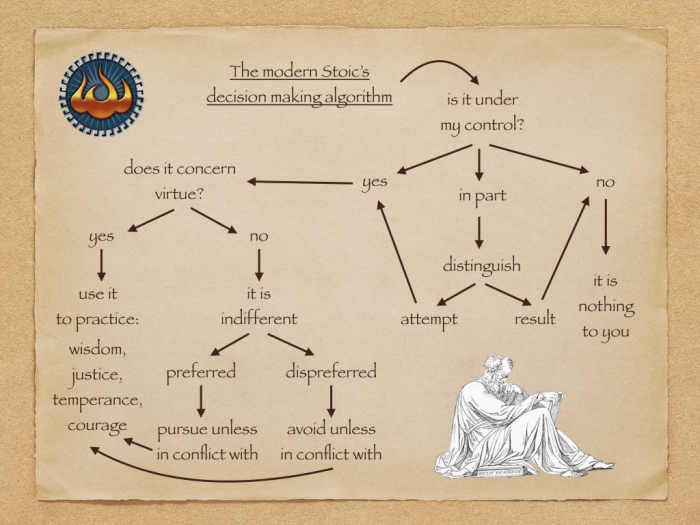
stoic-decision-making

View all my reviews

Further reading:
https://howtobeastoic.wordpress.com/
https://howtobeastoic.wordpress.com/2017/05/11/bertrand-russell-got-stoicism-seriously-wrong/
https://www.reddit.com/r/Stoicism/comments/zblu2/criticisms_of_stoicism_from_bertrand_russells/
https://philosophy.stackexchange.com/questions/9271/how-might-one-counter-bertrand-russells-criticism-of-stoicism-as-not-true-and

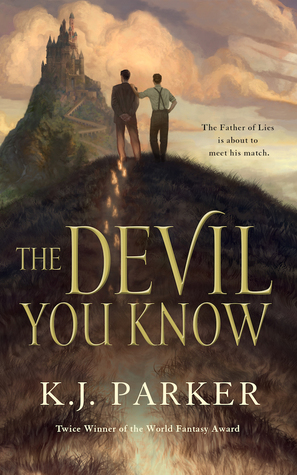
Book review: The Devil You Know by KJ Parker

The Devil You KnowThe Devil You Know by K.J. Parker

My rating: 4 of 5 stars

The greatest trick the devil ever pulled? Never messing with a philosopher.

Saloninus is the greatest philosopher of all time. But nearing the end of his life he wants another 20 years to complete his final works. So he does a deal with the devil. But the devil is suspicious. They might have an airtight contract for Saloninus’ soul, but there is something amiss. Is the devil about to be swindled by the greatest thinker?

A couple of years ago my uncle recommended KJ Parker to me. I’ve finally gotten around to reading one of Parker’s books. My uncle clearly has good taste.

This was an interesting and often humorous tale. After a recent letdown with an odious fantasy novel, this was refreshing. Briskly paced, world building without the laborious exposition, and characters that felt like real people, topped off a solid and interesting story. I’ll have to schedule some more KJ Parker reading for the near future.

View all my reviews

Interpreting Book Review Terminology

e6a8aaba01fd70671c2cdccb666a14b5
Have you ever read a book review and been baffled by the jargon the reviewer uses? Like any profession, book reviewers have their own jargon that is meaningless and annoying to anyone not steeped in the mire of that profession. Since I’m a scientist and science communicator, I’m very familiar with how terrible the media are at explaining science. I’m also familiar with interpreting jargon for an audience. So allow me to elucidate.
.
Page-turner: Meets the bare minimum standards for a book.
Gripping: I got this from a library where kids are allowed to play.
Poignant: Something sad happened in this book, most likely a character gets cancer.
Compelling: I spent so much time reading this book I had to finish it despite wanting to hurt myself after every sentence.
Nuanced: I have no idea what this book was about but I liked it.
Lyrical: Should be a poem instead so that it isn’t as long and self-involved.
Tour de force: The book is too long and waffly.
Readable: Boring but better than watching TV.
Haunting: Either used to describe a book that made the reviewer actually think, or, more likely, is meant to make you think but is just pretentious.
Deceptively simple: Could have been written by a 10 year old.
Rollicking: Something actually happens in this book.
Fully realised: The book has a beginning, middle and end.
Timely: Makes passing reference to something that happened 2 years ago.
X meets Y meets Z: The reviewer hasn’t read the book so is quoting the sales blurb.
Sweeping: Long.
That said: I’ve just insulted this entire book but it is popular for some unknown reason (e.g. Twilight).
Riveting: Was able to finish reading it.
Unflinching: Unpleasant.
Powerful: I read the hardcover.
Unputdownable: Reviewer is unfamiliar with English.
Masterfully or Masterful: The author is familiar with English.
Beautifully written: A lot of long words were used.
Startling: Reviewer was surprised the book was published.
Bold: Controversial.
Accessible: Written for kids.
Memorable: Reviewer didn’t have to look up the author or title to write the review.
Epic: Really, really, long.
A tale of loss and redemption: Someone dies, the protagonist gets over it, the end.
Sensuously, seductively, and/or lushly described: Painstakingly boring descriptions of mundane details.
Must read: Bestseller.
What it is to be human: Someone falls in love or someone dies.
Luminous: Has a pretty cover.
Evocative: Not boring or pedantic.
Poetic: Wordy.
Thought provoking: Reviewer is sure the book is cultural or intellectual but didn’t quite get it.
Rollicking roller-coaster: Kids book, or should be.
Provocative: Annoying.
Lends itself to X: Reading the book X was better.
Opinionated: The reviewer disagrees with everything the author has ever written.
Emotional roller-coaster: Nominated for some literary award.
Only minor quibbles: The book sucked.
Stays in your mind long after the last page is turned: Had a bad ending.
Writing at the peak of his/her powers: Much better than the author’s other books.
At once: The reviewer is about to use more than one of these terms in a sentence.
.
Also, lets not forget the various terms that are used to tell you what the genre of the book is, rather than just say what the genre is:
Explicit, steamy, romp, raunchy: Erotica or has sex in it.
Charged, taut, woven, layered: Political thriller.
Heart-warming, life-affirming: Romantic drama.
Seamy, gritty, underworld: Crime.
Taut, fast-paced, dynamic: Thriller.
Epic: Fantasy.
.
Hope this clears things up a bit.

 

Literary Fiction in Crisis

man-smoking-jacket

Literary Fiction in Crisis was the headline lede for a series of articles in The Guardian last month. Long known as a balanced and inclusive arts publication (/sarcasm) they sought to highlight a serious problem and a solution for literary fiction.

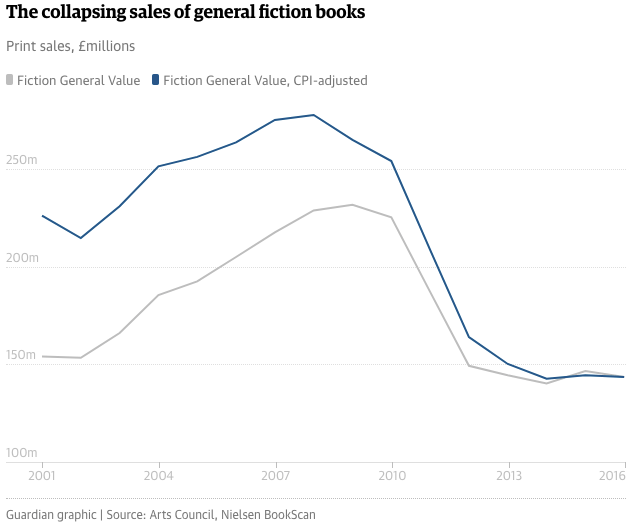
In case you haven’t heard, people aren’t reading literary fiction. Book sales are dropping. I covered this in my post on Australian Fiction, and US Fiction, and the Guardian article covered the UK figures in its first piece in the series.

Screen Shot 2018-01-03 at 11.40.25 AM

Let’s try not to think too hard about sales being in value terms and not volume. I mean, ebooks aren’t usually priced cheaper or anything and would hardly contribute to this revenue figure whilst being more profitable. Clearly, we need to get onto blaming the real culprits. Stupid kids these days are playing Tweeters and Facepage instead of buying books.

One reason suggested by the report for the decline in literary fiction sales is the recession, happening at the same time as the rise of cheap and easy entertainment. “In comparison with our smartphones, literary fiction is often ‘difficult’ and expensive: it isn’t free, and it requires more concentration than Facebook or Candy Crush,” the report’s authors write.

Won’t someone thinking of the starving artists!!

The researchers looked at the 10,000 bestselling fiction titles over the last five years and found: “Outside of the top 1,000 authors (at most), printed book sales alone simply cannot provide a decent income. While this has long been suspected, the data shows unambiguously that it is the case. … What’s more, this is a generous assessment. After the retailer, distributor, publisher and agent have taken their cut, there won’t be a lot of money left from 3,000 sales of the 1,000th bestselling title. That we are returning to a position where only the best-off writers can support themselves should be a source of deep concern.”

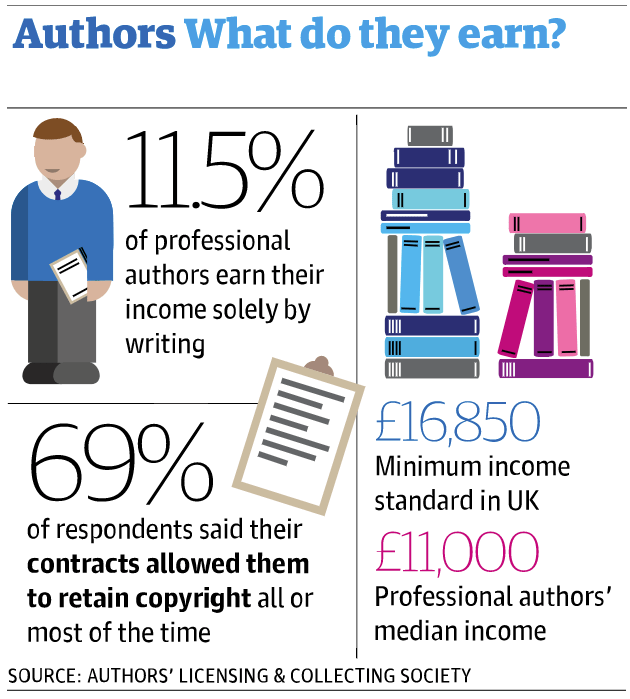
OMG, you’re telling me that artists have to have day jobs?* Oh the humanity! Surely this must be a new thing… Unless it has literally always been a thing. If only there was a graphic somewhere that could highlight the proportion of authors who make a living writing…

Screen Shot 2018-01-03 at 12.40.34 PM
Source: A 3.5 year old Guardian article…

The second article covers some of the same ground before highlighting a couple of important points.

This continuity imperative has long been built into the foundations of commercial publishers, who expect many of their most successful writers to cough up a book a year. And as publishing has become more centralised, with much of its power now concentrated in three giant conglomerates, it has become more ruthless.

The brutal truth is that through the 1980s and 90s it was possible for the literary novelist to make a living on advances that didn’t “earn out”. They were supported by an old-fashioned value system that sanctioned the write-off of losses for the kudos of association with an “important” writer and a belief that literary value could be offset against the profits of more pragmatic publishing.

These points are ones which are not made often enough. In an industry that runs on the work of part-timers (88.5%), the proceeds to these employees are decreasing, the time commitments are increasing, and the investment in their careers is decreasing. Where are the three articles criticising this problem?

Of course, we need to steer the ship away from that iceberg of issues. The second article instead makes the argument that the UK Arts Council should fund more authors (and let’s assume the implication is that other governments around the world should do the same).

Unlike the performing arts, publishing has always been a largely commercial sector that has had to square its own circles. This is reflected in the fact that it gets only 7% of the funding cake handed out by the Arts Council, compared with 23% to theatre and 11% to dance.

Personally, I want to see Arts Council funding to be decided in a Thunderdome. It would be great to see starving artists facing off against one another for grants. The fit and agile dancers doing battle against the people who spend all day sitting and typing. They could stream it on Pay Per View and raise some extra arts funds.

There will be those who argue that this just shows that literary fiction is a hangover from the past, and the poor dears should knuckle down and resign themselves to writing what people actually want to read. But few would dare to make the same argument about experimental theatre or dance.

Yes, I’d argue this. And I would dare to make the same argument for theatre and dance. Thun-der-dome, Thun-dur-dome, Thun-der-dome!

The third article in this series makes just this argument – just to be clear, for writing what people want to read, not fighting in the Thunderdome. It doesn’t mince words and goes straight for the jugular.

Following the announcement from Arts Council England that sales of literary fiction are plummeting, it is suggested that arts subsidies be deployed to help writers survive. I have another idea. They should write better books.

This article goes on to imply that literary authors could put some effort into writing stuff people want to read, mainly via utilising compelling plots, which the author feels is a major flaw in literary works. I think he misses an important point. Authors can write whatever they want. But I do agree that authors can’t expect to earn a living from this unpopular writing, nor have people like it, nor have it be accepted as appropriate (e.g. racism). Pleasing a small club of literary snobs with worthy books doesn’t entitle authors to a full-time career.

Of course, nobody is proposing supporting genre authors. They aren’t writing important fiction and are thus not real authors. They deserve to starve! This is the main issue I have with the argument to fund literary fiction. Somehow we’ve glossed over all the authors who aren’t making a living writing genre, as though they have nothing to contribute to society, and are thus unworthy of arts funding. Admittedly, a very good study, mentioned in the second article, does show there are clear empathy differences between readers of genre and literary novels** – although why is still a question to be answered. So there is an argument to be made for literature support.

As I see it, there are a few paths we could tread. The reading industry could acknowledge that most authors are part-timers and do more to support this reality while they balance a day job with their art. Or we can acknowledge that arts are an important aspect of our culture and support ALL artists with grants – not just the “important” literary ones. This latter option could be easily and justifiably funded by taking government funding out of popular high-level sports – i.e. no more free stadiums for you football! Let’s just hope that sports don’t go up against arts in the Thunderdome.

*Side note: we could probably even refer to the artistic projects as the Side Hustle. This piece by Zen Pencils is quite good and captures the idea behind the author dream.

**Worth reading this paper, which I’ve linked directly. I expected this to be a small sample, poorly analysed, poorly reasoned, paper that was written to elevate snobbery with pseudoscience. It was actually a very solid study. Although, it is worth noting that literary merit was on a spectrum, so literary could be found in many titles. This included Raymond Chandler in the top third of literary titles, which surprised me (last spot was James Patterson, which should surprise no one).

Edit: A recent article touched on a point about art vs sport and the taxation of people in those fields in Australia. Interesting what we promote as important.

Edit: A Twitter thread about the origins of what we call literature versus genre caught my eye. The basic summary is that after the industrial revolution you had class divides between readers. Workers got to read one type of magazine, whilst richer managers (but not the capitalists) got a fancier magazine. The stories that were published in the fancier magazines became literary, whilst the rest was genre. So when I say that literature is based on snobbery, it is quite literally the snobbery of class divides in “Western culture”.

See also: Author Earnings

Book review: Afterlife by Marcus Sakey

AfterlifeAfterlife by Marcus Sakey

My rating: 4 of 5 stars

If you kill enough people you become a god. Still makes you a jerk though.

Agents Will Brody and Claire McCoy are hunting a serial killer. But he is unlike any serial killer who has ever come before. He is always a step ahead. He has power. And he has help. I could give more away, but the title gives you the idea.

Afterlife is an intriguing book. The ideas underpinning this supernatural speculative fiction story are as original as you will see. And mixed with this are two interesting characters and their relationship. It hangs together nicely whilst not becoming bogged down with the sort of world-building that spec-fic can bore readers with.

That said, I almost gave up on this book. The first chapter didn’t grab me at all. It isn’t until later in the novel that you understand why that chapter is there at all. Similarly the semi-ambiguous ending may also throw some people given the setup prior to the penultimate chapter. These points, particularly the first one, could discourage people. Normally I don’t say this – since I’m big on giving up on books ASAP to make room for good books – but stick with this for a few chapters. Don’t be put off by the opener, it will make sense soon.

NB: I was provided a review copy of this novel in exchange for an honest review.

View all my reviews