Book review: Bleak Harbor by Bryan Gruley

Bleak Harbor: A NovelBleak Harbor: A Novel by Bryan Gruley

My rating: 3 of 5 stars

If you received a dollar for everytime someone said “X business is a license to print money” you’d have the first instance of that statement being true.

On the day before the Dragonfly Festival in Bleak Harbor, Danny Peters goes missing. Pete Peters, his stepdad, is having a quick beer after work at his medicinal marijuana shop before he and Danny go fishing when he receives a strange text message. Carey Peters is halfway through her long commute, thinking of her work problems, when she receives the message. At first, they aren’t sure if Danny has run off again or if something more sinister has happened until they receive the photo. But which of their secrets has gotten Danny in trouble?

From the very start, we see that this mystery will be built upon the layers of secrets Danny’s parents have been keeping. The twists and turns this gives us are tightly woven together. Pete and Carey feel like painfully human characters stumbling through life and now stumbling through the disappearance of their son. Danny is a refreshing and interesting portrayal of someone with autism, steering clear of the usual cliches and errors.

But I really did find it hard to engage with this novel. I liked Danny, but Pete and Carey weren’t particularly interesting or charismatic. It is hard to follow along with their trials and tribulations when you just want to slap them and tell them to talk to one another. As a result, it was hard to give this more than three stars despite how well the mystery was structured and the book was written.

I received an advance review copy of this book in exchange for a fair review.

View all my reviews

Book review: Choke by Stuart Woods

ChokeChoke by Stuart Woods

My rating: 3 of 5 stars

Given the title, you’d think at least one person would be strangled in this story.

Former Wimbledon contender and now tennis club pro, Chuck Chandler, has moved to Key West after sleeping with the wrong person’s wife. Learning from his recent lesson, he starts sleeping with someone else’s wife. This does not end well and he’s soon in the frame for murder. A retired NYC homicide detective, Tommy Sculley, is seeing out his days as the Key West detective training a local rookie. He thinks there is more to this murder than Chuck’s philandering would suggest. A lot more.

In my efforts to explore my local library’s offerings, I came across NYT Bestselling Author Stuart Woods. I didn’t really have any expectations and was rewarded with as much. The twist was something I figured out before the first murder. Admittedly, I didn’t pick the entirety of the finale, but those extra details were window dressing. Figuring out the twist that early would have been fine if the rest of the novel was more compelling, but it just wasn’t. An example of this is that the two main characters – Chuck and Tommy – aren’t particularly interesting. How can you make a philandering tennis pro boring?

To summarise, Choke was only okay. It was just interesting enough to keep you reading but once you’ve finished you can’t think of anything noteworthy about it. Well, except that the local tennis pro is probably trying to have sex with your wife.

View all my reviews

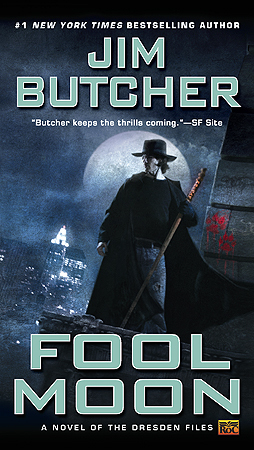
Book Review: Fool Moon by Jim Butcher

Fool Moon (The Dresden Files, #2)Fool Moon by Jim Butcher

My rating: 4 of 5 stars

The chief said, ‘I’m going to need your badge, your gun, and your ability to turn into a werewolf.’

Harry Dresden is living on the memory of ramen noodles and hasn’t heard from his contact at the Chicago Police in ages. But with the full moon dawning, a spate of murders leads Lieutenant Murphy to call on his wizard skills. With the FBI sticking their nose in, Murphy under investigation, and a pack of werewolves on the prowl, Harry is up to his neck in trouble before the moon has risen.

Jim Butcher really does love to make Harry suffer. He is obviously a big believer in creating a large stack of insurmountable odds for each of Dresden’s adventures. This is both entertaining and frustrating. Entertaining because it keeps the suspense up. Frustrating because you kinda want there to be fewer fires layered under the frypan Dresden falls out of. Or to put it another way, you start asking, ‘Isn’t it time to kill the bad guys yet?’ Or to put it another way, the damned suspense nearly killed me.

This was another enjoyable Dresden adventure. I’m looking forward to my next one.

View all my reviews

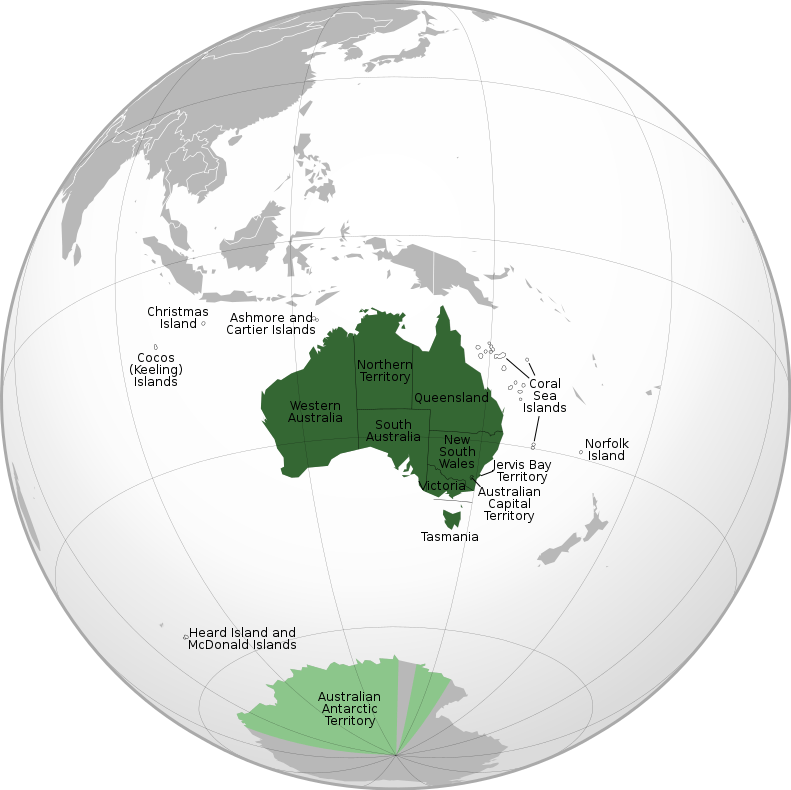
How many famous states does Australia have?

791px-australia_states_and_territories_labeled-svg
Source.

All of the Australian states and territories are famous, but for varying reasons. I’ll focus on the six main states and the two mainland territories, because I don’t know anything about the other places.

Australian Capital Territory (ACT): famous for being infested with politicians and bureaucrats. In keeping with tradition, the Aboriginal lands of Kamberra – meaning ‘meeting place’ – were stolen and renamed Canberra when we built our nation’s capital there.

New South Wales (NSW): famous for containing Sydney, the only Aussie city foreigners know, and the only part of Australia Sydney-siders think exists. Also, a great place for backpackers to rest for eternity in a state forest.

Northern Territory (NT): made famous, for better or worse, by Crocodile Dundee. Also famous for the highest (or nonexistent for a short while) speed limits on highways that results in four times the road death toll.

Queensland (QLD): famous for being approximately 50 years behind the rest of the country and being incredibly proud of that fact. See Katter Australia Party and Pauline Hanson’s One Nation for a clearer picture.

South Australia (SA): famous for their banking and barrels. Adelaide is okay.

Tasmania (Tas): famous for having lots of trees and people trying to save them. Also famous for gun control.

Victoria (Vic): famous for not being New South Wales. The state capital, Melbourne, is similarly famous for not being Sydney.

Western Australia (WA): famous for being so far away from everywhere else. Also has lots of mines and people wearing hi-vis clothing.

This post originally appeared on Quora.

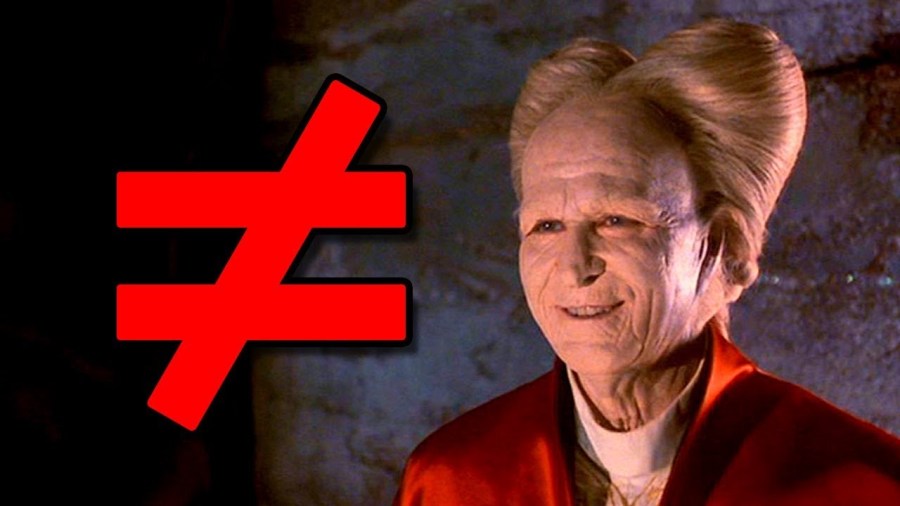
Book vs Movie: Dracula – What’s the Difference?

maxresdefault1

Since the annual American lolly festival is almost upon us, Cinefix is covering one of the classics. Bram Stoker’s Dracula and Francis Coppola’s 1992 Dracula.

Time for some straight talk. I don’t know how you discuss this particular adaptation without mentioning just how bad Keanu Reeves is in this film. Embarrassingly bad.

I actually tried to rewatch Dracula a couple of years ago and just couldn’t bring myself to sit through it all. Despite it being a bit of a who’s who of actors in the cast – and people like Tom Waits – it all feels so camp and silly. Even when I first saw it in high school, I remember Dracula being only average – with possibly the best visual explanation of the link between Dracula and Vlad the Impaler ever.

It is harder for me to talk about the book as I read it so long ago. And, let’s be honest here, I’ve since read way too many Anne Rice novels to not get the details confused. I read Dracula and Frankenstein at roughly the same time; because gothic horror novels are what pre-teen kids should be reading. Neither stood out for me as novels, but it is amazing how influential they have both been to genre fiction.

I wonder if there will be any modern equivalent. A novel that establishes an entire genre that is continuously reimagined, refined, and redefined such that we get analogues ranging from True Blood (coming out of the closet analogy) to Buffy (girl power).

Book review: The Carpet People by Terry Pratchett

The Carpet PeopleThe Carpet People by Terry Pratchett

My rating: 4 of 5 stars

‘Don’t do that! You’ll disturb the carpet people.’

The Munrungs have just had their village destroyed by fray, a natural phenomenon from above The Carpet. In the aftermath, Glurk and Snibril try to help their village flee the attacking Mouls, a people who regard all others as animals and rather good eating. It is then they realise that fray is pushing a path of destruction through The Carpet and that the Mouls are attacking every city and town in its wake. Can they save civilisation so that people don’t go back to hitting each other?

While I was reading this novel I kept having to remind myself that it was the heavily revised edition written by the 40-something Pratchett, not the 20-something of the original edition. This was Pratchett’s first novel and as an ode to fantasy fiction had just the right amounts of absurdism and humour, which I can’t see a 20-something nailing. If Pratchett was this good out of the gate then every other author would be left weeping into the keyboard. Hopefully, someone who has read both versions can point out the differences.

This is, of course, not a Discworld novel. Apparently, all reviewers have to point this out for some reason. As such, Pratchett’s style, particularly his satire, is less pronounced here. While I thoroughly enjoyed reading The Carpet People, for long-time Discworld fans this may feel a little light or insubstantial. Or maybe they just feel guilty about having vacuumed their house.

View all my reviews

Paw Patrol – Too Serious

250px-paw_patrol_logo

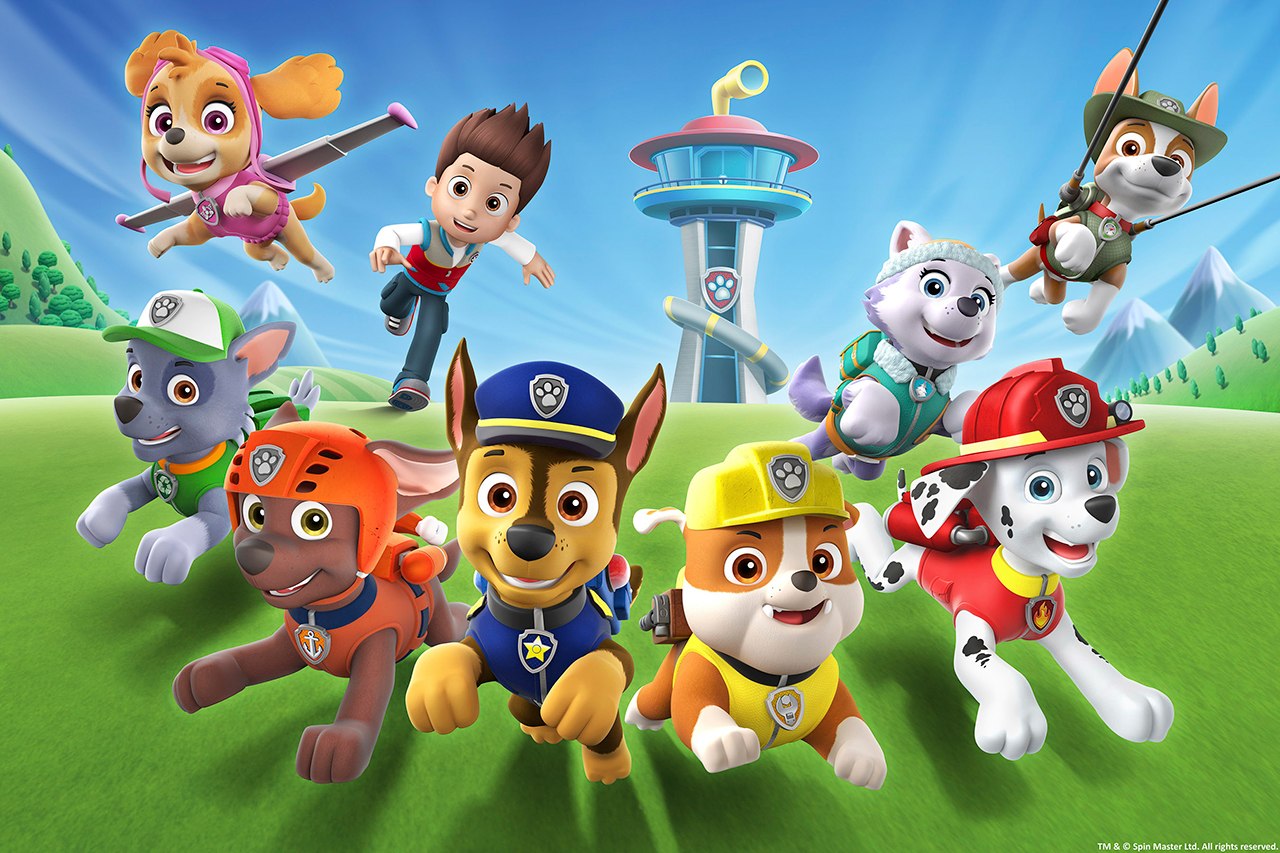
Recently my family went to the Paw Patrol movie. My youngest is a (relatively) big fan and as a result, I found myself finally sitting down and watching a complete Paw Patrol adventure. And I’m left with some very important questions.

For those who aren’t aware, Paw Patrol is a rescue team that spans police, fire, construction, recycling, aquatic, and aviation – with later seasons adding snow and forest services and a robotic helper. This rescue team are based in the aptly named Adventure Bay and run by Ryder and his team of puppies.

Oh, was that not clear? The rescue team are composed of puppies with a series of catchphrases and dog houses that convert into vehicles. These catchphrases are very important to the show as they comprise roughly 60% of each episode; there is very little new content in any given adventure.

Ryder
“No job is too big, no pup is too small!”
Chase
“Chase is on the case!”
Marshall
“I’m fired up!”
Skye
“Let’s take to the sky!”
Rocky
“Don’t lose it, Reuse it!”
Rubble
“Rubble on the double!”
Zuma
“Let’s dive in!”
Everest
“Ice or snow, I’m ready to go!”
Tracker
“I’m all ears!”/”Todo Oidos!”

1046364-nick-renews-paw-patrol-blaze-rusty-rivets-top-wing

This brings me to the crux of the issue with Paw Patrol. Adventure Bay is riddled with people in need of rescue, and in later seasons there are even nefarious plots by royalty and rival mayors to cause havoc. So it is odd that this bustling town has decided to entrust major rescue efforts, law enforcement, and fire management to a 10-year-old and his team of puppies.

I’m not sure it is wise to allow Ryder to operate with such autonomy given his age. And as much as the pups have proved themselves capable, surely they are also too young and inexperienced for such important roles.* You have to question who allowed Ryder to establish the Paw Patrol and why he is allowed to continue.

Obviously, it helps that the mayor – one Mayor Goodway and her purse chicken Chickaletta – are often in need of assistance due to their own incompetence. This would certainly make Ryder and his pups endearing to Goodway. She seems willing to overlook Ryder’s repeated risk-taking and near catastrophic failures, even when it inspires others to wreak havoc. Would this fly in any other town?

Ryder also seems to have a suspiciously large amount of resources for a 10-year-old. The custom transforming dog houses are a marvel of technology that must have cost a fortune to make. Even if we are to believe that Ryder builds them all himself, this would require funds from somewhere, and knowledge that would have any tech company begging him to come and work for them. But new adventures see new technology introduced, seemingly overnight. Where does Ryder find time to design, engineer, and build aerial, submersible, etc, versions of equipment for his pups?** And when did he find time to be on the cutting edge of robotics and AI to create a robotic assistant dog?

I would contend that Ryder’s activities are not as altruistic as first appears. He seems to have infiltrated Adventure Bay and bribed his way to power using money and goodwill. The mayor looks the other way whilst he trains a team of puppies to do his bidding. His recklessness is all fun and games for the moment, but we will no doubt see Ryder’s true colours when one of the rescues fails and he has to show accountability.

Let us hope that on that day his puppies are able to be true heroes and save Ryder from himself.

*Sidenote: what happens when they are no longer puppies? Do they age out of the Paw Patrol team? Are they suddenly unemployed? Are there nearby towns/cities that take dogs with transforming dog houses, or are they abandoned to become strays? Will we one day see former Paw Patrol members return to Adventure Bay as bitter and twisted dogs bent on exacting revenge upon their former master who abandoned them?

**And I haven’t even touched on his ability to defy the laws of physics with some inventions. E.g. Marshall seems to have an unlimited supply of fire suppressant in a backpack that he can comfortably carry. Is it powered by as yet undiscovered physics, or does it tap into a well of magic? Why isn’t he sharing this technology with the world?

Update: According to reliable news sources, Chase has been in an officer-involved shooting. It has been confirmed that Zuma, the black Lab, was shot 17 times in the back after Chase mistook Zuma’s bone for a gun.

Update: The Misogyny and Authoritarianism of ‘Paw Patrol’.

Video: Paw Patrol examined as copaganda by Skip Intro.

Book Review: Humans Need Not Apply by Jerry Kaplan

Humans Need Not Apply: A Guide to Wealth and Work in the Age of Artificial IntelligenceHumans Need Not Apply: A Guide to Wealth and Work in the Age of Artificial Intelligence by Jerry Kaplan

My rating: 4 of 5 stars

ABS brakes were the first step. The last will be us humans in observation cages next to the monkeys.

Jerry Kaplan is an expert in Artificial Intelligence and Computational Linguistics and attempts to guide the reader through what impacts AI and Robots will have on our future. In doing so, he raises many of the economic, ethical, and societal problems we are going to have to start addressing.

I first became aware of this book via CGP Grey’s short documentary of the same name (see below). To say there is a storm coming is an understatement. Kaplan guides us through the technological aspects of this topic with knowledge and skill. Where this book falls down is in his blind adherence to free-market solutions – ironically whilst pointing out several examples of where the free-market has failed in the past.

For example, some of his ideas about education are problematic. What he proposes with “job mortgages” is essentially traineeships and cadetships* that in my parents’ and grandparents’ generations were paid for by employers, with his modern twist being that employees should take out a job mortgage for. In other words, all of the cost and risk is moved from employers to employees.** How can anyone suggest that sort of thing as though they aren’t talking about slavery or indentured servitude?*** Sci-fi has been imagining that sort of scenario for decades and they weren’t calling it a good idea.

His comments about how rich people being in charge isn’t all bad, like back in ancient Eygpt… Because monarchies worked so well for everyone, who was a monarch.

Another gem was the idea that the free market could be in charge of wealth redistribution… Because it does such a great job of that right now. Now, in fairness, his plan was actually pretty good, but there were built in assumptions he didn’t really question despite laying out the framework with his discussion of automation taking our jobs.

Kaplan spent most of his book outlining what amounts to a post-scarcity world, a world where human “work” would essentially cease to exist, and thus cost, value and products become meaningless. How can you maintain our current economic system in that world? Don’t we need to be rethinking about what utopia we wish to design and the machines that will make that happen?

The final chapter has some interesting questions and ideas about what role humans can play in a world that the robots run and own. Whilst the ideas aren’t new, since science fiction has been prodding that topic for the best part of 70 years, he has grounded them in reality. If there is one takeaway from this book, it is that we all need to start planning the future now.

Overall, this was a fascinating book that is well worth reading.

* A point he acknowledges he is updating to be free-market and more “beneficial”
** It could be argued that this has already happened and Kaplan is just taking it one step further.
*** Again, a point he acknowledges with reference to AIs becoming free of ownership.

https://www.reddit.com/r/Futurology/c…
https://www.theguardian.com/culture/2…

View all my reviews

Are good books made into bad films?

maxresdefault

The short answer is no.

The longer answer is Berkson’s Paradox/Fallacy applies.

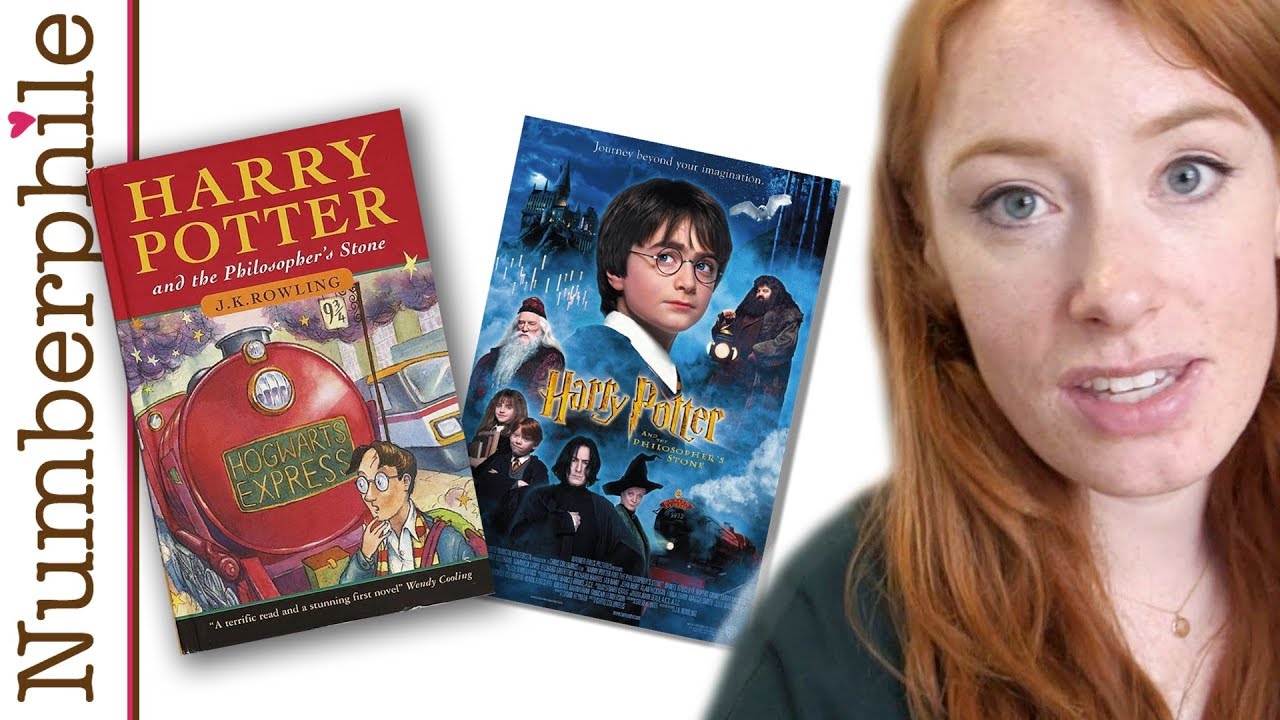
The even longer answer is explained in this video from Hannah Fry and Numberphile:

Comparing the book to the movie has been a long-standing blog topic of mine, which made this maths video pretty cool*. I’ve since developed a category list that relates to what Hannah discussed in the video about what gets made into movies.

  1. It is very unlikely that your novel will be published.
  2. It is very unlikely that your published novel will be optioned to be made into a movie (or TV show).
  3. It is very unlikely that the movie adaptation will actually be made.
  4. Most movies are average, so it is very unlikely that the movie adaptation will be above average.
  5. If the movie is above average, it is very unlikely that the movie will bear any resemblance to the book it was adapted from.
  6. Pointless arguments will ensue from the previous two points.

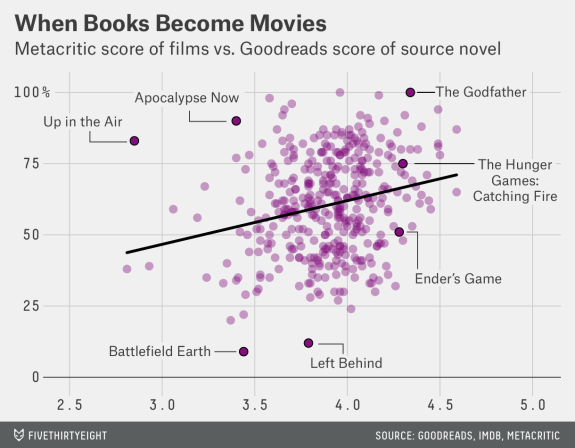
The Metacritic vs Goodreads analysis mentioned in the video is interesting and worth a read.

hickey-datalab-bestadaptations

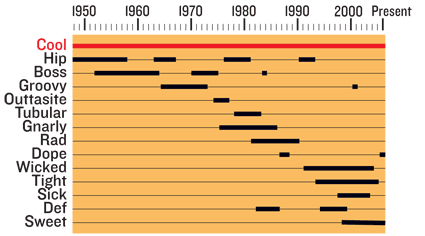
*As always, I’m working from a definition of cool that includes the nerdy stuff I like.**

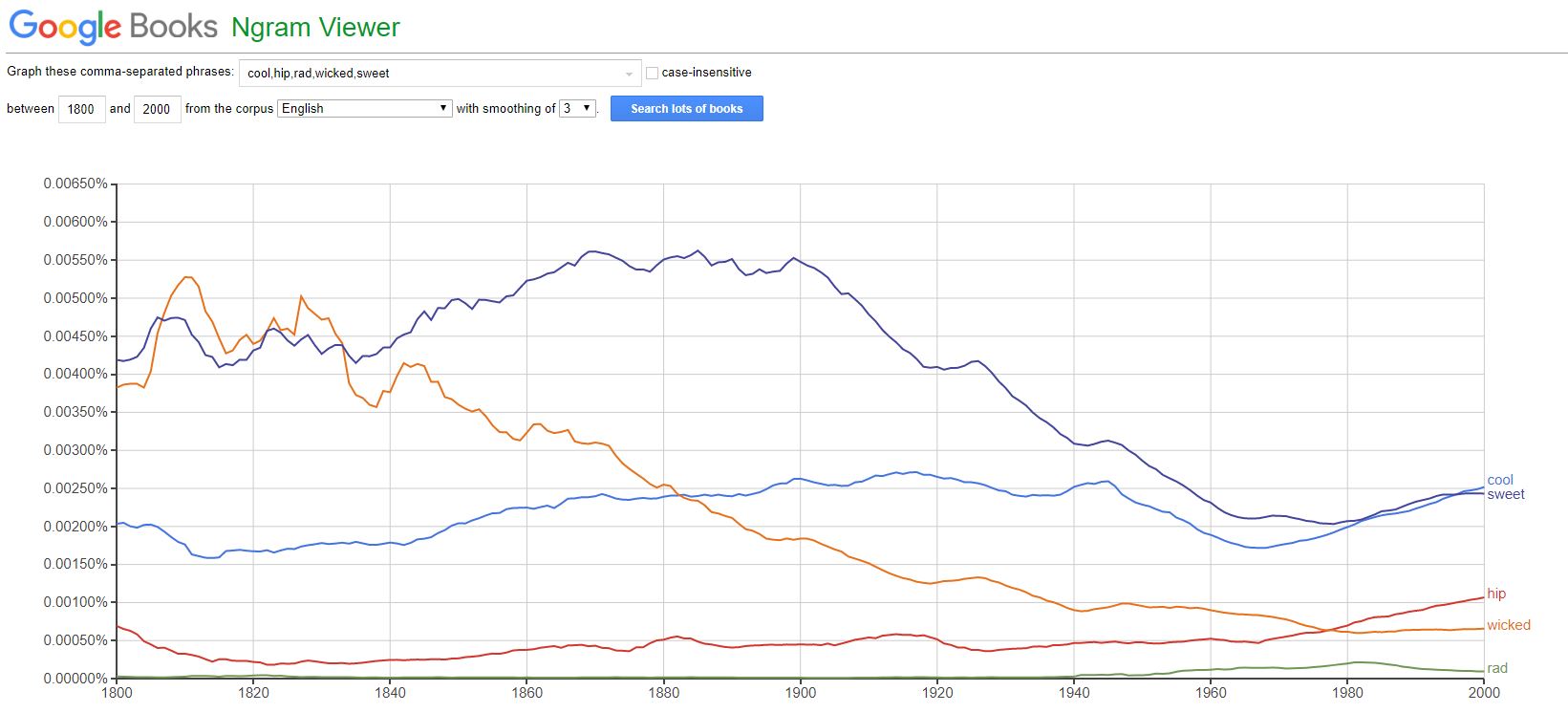
**Did you know that cool has always been cool?***

next_essay_chart
Source.

*** Well, unless you use Ngram Viewer to check Google Books for word usage over time like some sort of nerd…

Ngram Cool

Book review: The Fifth Elephant by Terry Pratchett

The Fifth Elephant (Discworld, #24; City Watch, #5)The Fifth Elephant by Terry Pratchett

My rating: 5 of 5 stars

Do sugar lumps disappear or were they never there in the first place?

Sam Vimes is making sure The Watch is moving with the times and keeping Ankh-Morpork in line when Lord Vetinari summons him for a new job: ambassador. He is despatched to Uberwald for the upcoming coronation of the Low King. It isn’t long before he is using diplomacy to take care of bandits, solve a mystery, break traditions, and stop a coup. As Vimes says, “So this is diplomacy. It’s like lying, only to a better class of people.”

The first Discworld novel I read was Guards! Guards! so the City Watch series are always among my favourites. The Fifth Elephant is more plot orientated than some other Discworld novels, so it feels more streamlined and ordered than some others. That doesn’t mean that the humour or satire are lacking, even if they can be a bit subtle at times (e.g. feudalism vs capitalism commentary is rife but takes a backseat to the plot).

I really enjoyed this novel. Nothing more to say really.

View all my reviews

Everything he does, he does it for us. Why Bryan Adams is on to something important about copyright

Rebecca Giblin, Monash University

Last Tuesday Bryan Adams entered the copyright debate.

That’s Bryan Adams the singer and songwriter, the composer of “(Everything I Do) I Do It for You”, and “Summer of ’69”.

Authors, artists and composers often have little bargaining power, and are often pressured to sign away their rights to their publisher for life.

Adams appeared before a Canadian House of Commons committee to argue they should be entitled to reclaim ownership of their creations 25 years after they sign them away.

No control until after you are dead

In Canada, they get them back 25 years after they are dead when the rights automatically revert to their estate. In Australia, our law used to do the same, but we removed the provision in 1968. In our law, authors are never given back what they give away.

Some publishers voluntarily put such clauses in their contracts, but that is something they choose to do, rather than something the law mandates.

Australia’s copyright term is long. For written works it lasts for 70 years after the death of the author. It was extended from 50 years after death as part of the Australia-United States Free Trade Agreement.

What copyright is for

Copyright is a government-granted limited monopoly to control certain uses of an author’s work.

It is meant to achieve three main things: incentivise the creation of works, reward authors, and benefit society through access to knowledge and culture.

Incentive and reward are not the same thing.

The incentive needn’t be big

The copyright term needed to provide an incentive to create something is pretty short.

The Productivity Commission has estimated the average commercial life of a piece of music, for example is two to five years. Most pieces of visual art yield commercial income for just two years, with distribution highly skewed toward the small number with a longer life. The average commercial life of a film is three to six years. For books, it is typically 1.4 to five years; 90% of books are out of print after two years.

It is well accepted by economists that a term of about 25 years is the maximum needed to incentivise the creation of works.

But the rewards, for creators, should be

The second purpose is to provide a reward to authors, beyond the bare minimum incentive needed to create something. Quite reasonably, we want to give them a bit extra as thanks for their work.

But, in practice authors, artists and composers are often obliged to transfer all or most of their rights to corporate investors such as record labels or book publishers in order to receive anything at all.

In the film and television industries it is not unusual for creators to have to sign over their whole copyright, forever – and not just here on Earth but throughout the universe at large.


Read more:
Life plus 70: who really benefits from copyright’s long life?


It means investors don’t just take what is needed to incentivise their work but most of the rewards meant for the author as well.

This isn’t new. Creators have been complaining since at least 1737 that too often they have no choice but to transfer their rights before anyone knows what they are worth.

Other countries do it better

In recognition of these realities, many countries, including the US, have enacted author-protective laws that, for example, let creators reclaim their rights back after a certain amount of time, or after publishers stop exploiting them, or after royalties stop flowing. Other laws guarantee creators “fair” or “reasonable” payment.

Australia stands out for having no author protections at all.


Read more:
Australian copyright laws have questionable benefits


Canada’s law already protects authors by giving rights back to their heirs 25 years after they die. Bryan Adams’s proposal is to change one word in that law. Instead of copyright reverting to the creator 25 years after “death”, he wants it to revert 25 years after “transfer”.

Copyright is meant to be about ensuring access

Handing rights back to creators after 25 years would not only help them secure more of copyright’s rewards, it would also help achieve copyright’s other major aim: to promote widespread access to knowledge and culture.

Right now our law isn’t doing a very good job of that, particularly for older material.

Copyright lasts for so long, and distributors lose financial interest in works so fast, that they are often neither properly distributed nor available for anyone else to distribute.


Read more:
Australian copyright reform stuck in an infinite loop


In the book industry my research into almost 100,000 titles has found that publishers license older e-books to libraries on the same terms and for the same prices as newer ones. That includes “exploding” licences which force books to be deleted from collections even if nobody ever borrows them.

Publishers are interested in maximising their share of library collections budgets, not ensuring that a particular author continues to get paid or a particular title continues to get read.

As a result libraries often forgo buying older (but still culturally valuable) books even though they would have bought them if the publisher cared enough to make them available at a reasonable price.

Restricting access to books is not in the interests of authors or readers.

… and directing rewards where they are needed

If rights reverted after 25 years, as I have proposed and as Adams now proposes, authors would be able to do things like license their books directly to libraries in exchange for fair remuneration – say $1 per loan.

If authors weren’t interested in reclaiming their rights, they could automatically default to a “cultural steward” that would use the proceeds to directly support new creators via prizes, fellowships and grants – much like Victor Hugo envisaged with his idea of a “paid public domain” back in 1878.

We could do it all without changing the total copyright term imposed on us by the Australia-US Free Trade Agreement and other treaties. We could get creators paid more fairly while keeping Australian culture alive.

Reversion is the key.The Conversation

Rebecca Giblin, ARC Future Fellow; Associate Professor, Monash University

This article is republished from The Conversation under a Creative Commons license. Read the original article.

Book review: Stone Cold by Robert B Parker

Stone Cold (Jesse Stone, #4)Stone Cold by Robert B. Parker

My rating: 3 of 5 stars

I wonder if new sex partners actually enjoy being told how much you love your ex?

In the affluent town of Paradise, someone has decided to start killing people. Two shots to the chest. The victims are unconnected and there are no clues for Jesse Stone to investigate. As the pressure mounts, he has to balance the murder investigation against getting justice for the rape of a high school girl, and his love life. Especially when one of Jesse’s sex partners becomes a victim of the serial killer.

I’ve been meaning to read some of Robert B Parker’s novels for quite some time. Parker was regarded as one of the best detective crime novelists in contemporary (American*) fiction, like Michael Connelly or James Lee Burke. I can see the similarities between Parker and Connelly, both having a relatively bleak and realism to their investigative tales. The life of an investigation is important to Parker and Connelly’s narratives, which often involves waiting on the lab results, or going home without having solved the crime, or going on a drive to chase a dead-end – a Connelly staple. Parker tends to pare back the prose, however, which made this feel like quite a short and fast-paced novel.

I’m not sure if Stone Cold is a good representation of Parker’s writing or not, but this was only a serviceable crime novel. Nothing really elevated it above okay to my mind.

*An important caveat that is often left out of these accolades for American authors.

View all my reviews

Book review: Torment by Hank Janson

TormentTorment by Hank Janson

My rating: 4 of 5 stars

Dames: amiright?!

Hank Janson spots an old friend who has a new mentalist act they claim is really clairvoyance. He offers to promote the friend and his female assistants’ act via a test. Meanwhile, a woman approaches Janson about helping her find her sister’s killer. Also meanwhile, another woman approaches Janson about helping her brother with a pornography conviction. Then finally, the police contact Janson about covering a gruesome suicide – no women needing help with this one, so he was a bit disappointed. How are all of these things linked? Janson intends to find out.

A friend from my writers’ group recommended the Hank Janson novels to me last year. Janson was the pseudonym of Stephen D Frances and was used as the main character in a series of highly successful pulp crime novels in the 40s and 50s. It is immediately obvious why these novels were popular: fast-paced, women wanting Janson, intriguing plot, women wanting Janson, noir sensibilities, and women wanting Janson.

Noir, particularly crime noir, doesn’t date as badly as some other genres. Even with the dated attitudes and ideas, Torment didn’t make you start shaking your finger in admonishment of the -isms on display. For example, a subplot about going to prison for possessing (run-of-the-mill) porn might seem ridiculous today, but it doesn’t feel odd here.

These re-released 50th Anniversary Janson novels by Telos Publishing are worth a read for anyone chasing a crime noir or great pulp crime novels from yesteryear.

View all my reviews

Book review: Ice Station by Matthew Reilly

Ice Station (Shane Schofield, #1)Ice Station by Matthew Reilly

My rating: 4 of 5 stars

Suddenly I have a sudden urge to suddenly write a review of this book. Very sudden.

Shane “Scarecrow” Schofield has been dispatched to Wilkes Station after receiving their distress call. Some of the Wilkes science team have mysteriously disappeared after finding an unidentified “alien” craft deep under the ice. His crack team of Marines arrive to find they aren’t the only ones who responded. Clearly, more than one nation are interested in securing the craft, less so rescuing the scientists. With no support, and enemies coming from everywhere, Scarecrow will have to stay alive long enough to be in even more danger.

I can’t remember exactly when I first read Ice Station, but it must have been roughly a decade ago. It has been interesting to revisit a novel I enjoyed from an author who reinvigorated my love of reading. Some books lose their magic the second time around, and Ice Station, despite its fun and fast-paced narrative, wasn’t the novel I remembered.

Ice Station was still entertaining but the flaws stuck out this time. I found myself laughing a little bit every time Reilly used the word sudden or suddenly. I’m not sure if I’m being too harsh or too forgiving – I derided a book for using a phrase I saw in this book – so I’ll have to revisit all of Reilly’s novels to check.

View all my reviews

Book vs Movie: Fear and Loathing in Las Vegas – What’s the Difference?

maxresdefault2

This month’s What’s the Difference? from Cinefix covers Fear and Loathing in Las Vegas.

This month I’m just sharing.

Yep, that means I’ve neither read the book nor watched the movie.

Feel superior in the comments.

20 years ago a new generation was introduced to the peak of Gonzo Journalism with Terry Gilliam’s adaptation of Hunter S. Thompson’s Fear and Loathing in Las Vegas. Really great filmmakers have tried and failed to bring the savage journey into the American Dream, so what makes Terry Gilliam’s version so successful? Time to get cracking and ask What’s the Difference?!

Book review: Zen in the Age of Anxiety by Tim Burkett

Zen in the Age of AnxietyZen in the Age of Anxiety by Tim Burkett

My rating: 4 of 5 stars

Clear your mind, relax, and read this review.

Zen in the Age of Anxiety is a guidebook and teaching manual that focuses on how to deal with stress, anxiety, and address the underlying mental behaviours that cause them. Burkett lays out the teachings and key points with easy to follow explanations and a series of anecdotes from his +50 years as a Zen practitioner and draws on his background in psychology.

This was a very interesting book. I originally borrowed a copy from the library because I’d previously read Lao Tzu’s Dao De Jing. Okay, a bit of a leap between the two, but Zen teachings have their roots in Buddhism, which in turn has roots in the Dao (Tao), something Burkett mentions in passing. There are a lot of helpful insights and practices in this book that could help most people in their lives. At the very least, it was interesting to read something with such a different perspective on life.

My only gripe was a minor one. A lot of practices and philosophies, especially those with “Eastern” origins, tend to be tied up with spiritualism and mysticism. As a result, there tends to be a blending of nonsense (both ancient and modern) with the good stuff. As an example, in a later chapter, there is an example given that involves an analogy with how vaccines and homoeopathy work. Except that it incorrectly describes how vaccines work, and incorrectly describes homoeopathy as working at all. So best to use a critical eye when reading.

View all my reviews

How Is Tech Changing the Way We Read?

maxresdefault1

With the rise of social media and smartphone use, we are all reading fewer books than we once did. All, not just those pesky millennials. Some people are worried about what this means for the future of literature and, well, our brains. But is it true that we are really reading less? And should I care?

Above The Noise recently did a video in which Myles covers some of the research on reading.

I always appreciate it when a Youtuber or Journalist manages to discuss a topic without devolving into head-shaking admonishment, especially when it comes to the topic of reading and books. Too often these sorts of videos and articles cite bad research or buy into industry propaganda.

I’ve previously discussed the misrepresentations made about reading ebooks, the overstating of the benefits of reading – when there are some well-researched benefits documented –  and even the way we write. And the Pew Research into reading was one of several references I’ve used in my discussion of Who Reads, something I cover quite a bit here.

And yet, there were still some things in the video that I hadn’t been aware of. So I think it is worth sharing. Enjoy.

From the video:

Reading has been an important part of the human experience for thousands of years, but believe it or not, that’s not a long time on the evolutionary timescale. Before the internet, it made sense to read long texts in a linear fashion, but that’s now changing as people are adapting to skimming shorter texts on their computers or phones. But what does this mean for the future of books?

What is literary reading?

Literary reading is, quite simply, the reading of any literature. This includes novels, short stories, poetry, and plays.

Are we reading less?

The rate at which Americans are reading literature for fun is down around 14% from the early 1980s. This doesn’t necessarily mean we are reading less, however. Many people still have to read for school or work. Then there are all the words, sentences, and messages we read on the internet from emails to texts to tweets. Some people believe that this means we are possibly reading more individual words than ever. It’s just being done in a different way. I’ve also discussed the decline of literature.

And this is changing our brains?

Some neuroscientists believe that scanning shorter texts the way we do on the internet, often jumping from hyperlink to hyperlink, is actually changing the wiring in our brains. We are becoming better at searching for key terms and scanning for information, but this means it can become more difficult to read a longer text all the way through without missing major points.

SOURCES:
Children, Teens, and Reading
The long, steady decline of literary reading
Who doesn’t read books in America?
Serious reading takes a hit from online scanning and skimming, researchers say