Book Review: Space Team by Barry J Hutchison

Space Team (Space Team, #1)Space Team by Barry J. Hutchison

My rating: 5 of 5 stars

This is a Space Review of a Space Book.

Cal Carver is all charm. That’s why as a low-level crook the warden decides he should spend the night in a cell with the most ruthless cannibal on the planet. This would have been a concern if he wasn’t accidentally recruited for a team whose goal is to stop a pathogenic outbreak that could start a war. In space! Cal is teamed up with a by-the-book rookie, a mechanoid whose abilities are dialled in, a humanoid wolf, and a Splurt. Together they are Space Team… when they aren’t trying to kill each other.

This was lots of fun. As Hutchinson notes in his author comments, this story was meant to be entertaining escapism. No deeper meanings, nothing serious, just fun. And it succeeds masterfully. The pacing is quick, the jokes come thick and fast, and the adventure keeps you entertained.

I’ll be reading more from Barry and this series for sure.

View all my reviews

Loving reading and book wardens

When do people start to hate reading?

For us readers, the answer is “Never! How could you ask such a silly question? What’s wrong with you? Do you even book, bro?” But the reality is that a significant chunk of the population have not read a book in the last year, and/or aren’t regular readers. We have to admit: some people don’t like reading.*

I have a pet hypothesis** on this. During school, mainly high school, kids start to hate reading. This is because teachers, academics, literary people, policy makers, and general busybodies, start to decree what kids should and shouldn’t be reading. As a result, kids are “forced” to read books that they aren’t interested in or that have won an award or are a “classic” or that fill a certain level of appropriate snootiness that appeases book snobs.

Or as Blackadder put it:

In the academic text – From Striving to Thriving: How to Grow Confident, Capable Readers – Stephanie Harvey and Annie Ward discuss this issue. They outline this problem and have summarised reluctant readers with a cartoon from Dav Pilkey (of Captain Underpants fame).

dhwb8aivqaalz80
Cartoon by Dav Pilkey in From Striving to Thriving by Stephanie Harvey and Annie Ward

One of the authors, Annie Ward, presented at a readers summit recently and one of her slides has made it to social media. It covers some key points for how educators become “book wardens” who restrict reading and undermine reading ownership and choice. Book Wardens tend to:

Sound familiar?

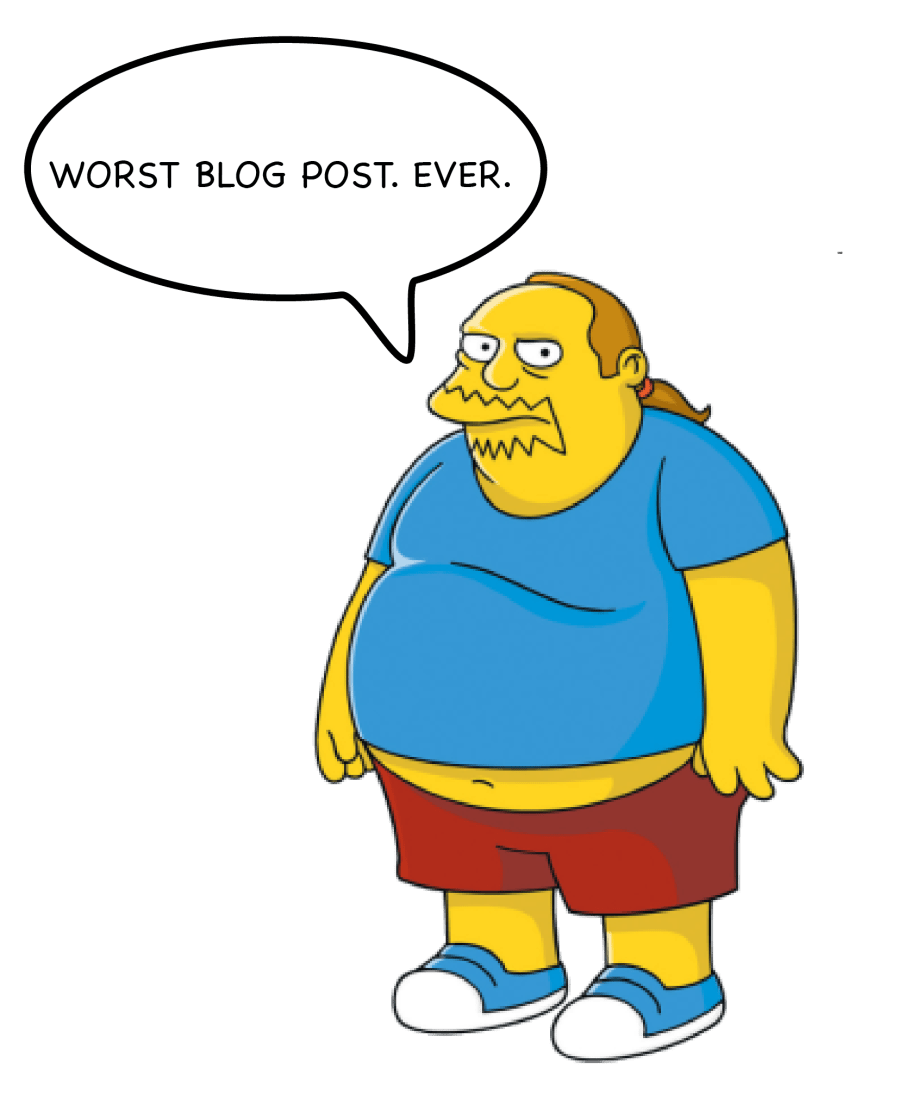
While I have frequently focussed on the snobbery aspect to this problem, particularly from the reading/publishing industry itself, there is more to this. Take for example “just right” books and adults. What image do we conjure up when someone mentions comic book readers? Pimply teenage boy? An obese virgin loser who still lives with his parents? You know, this guy:

img_6115

The problem with that series of assumptions is that it is a form of reading snobbery. How could a comic be entertaining to anyone who isn’t a loser? Or similar statements that you’ll hear from people who have never read a comic book and battle to wrap their head around the art form.

In other words, even as adults, we are encouraging people not to read.

But don’t worry, as Dav’s second-page shows, we can all make a difference to people by encouraging them.***

9781338051964_si06_588x745

*A quarter of people (24-26%) haven’t read a book recently. I’ve previously discussed the reading figures for the USUK, and Australia and it is interesting how the figures come together. Suffice to say, reading is not a favourite hobby for most people.

**Hypothesis because a theory is something pretty solidly supported, whereas a hypothesis is a question you want to answer. Join me in my scheme to change the values that will stop the positive feedback of the colloquial usage of theory today!

***Although in fairness, the literary snobs are trying to encourage people to read. Their failing is that they think what they like should be what everyone reads. They have us talking about guilty pleasures and judging what we read by their standards rather than just letting us read stuff we enjoy.

8cf0bc8be9f426c74d4f7ed5eadd7792

Where’s my hoverboard?

Ever wanted a six-minute overview of American science fiction? Well, here is Lindsay Ellis doing just that.

The History of Science Fiction!

Stories, tales, and myths from all around the world posing speculative questions around technologies have existed long before Ray Bradbury and Frank Herbert, from the time-traveling Japanese fairy tale “Urashima Tarō” to some of the speculative elements of 1001 Arabian Nights. But there are a few eras that begin to shape what we’ve come to know as science fiction today. Hosted by Lindsay Ellis.

Vote on your favorite book here: https://to.pbs.org/2Jes2X5

It’s Lit! is part of THE GREAT AMERICAN READ, a eight-part series that explores and celebrates the power of reading. This all leads to a nationwide vote of America’s favorite novel. Learn More Here: https://to.pbs.org/2IXQuZE

Correction: At 1:49, we accidentally said that Mary Shelley’s Frankenstein was published in 1918, when it was published in 1818.

Also, recently I called Mary Shelley’s Frankenstein a horror novel, whereas here it is called a science fiction novel. Technically it is both a science fiction and a horror novel. Moreover, it was written as a Gothic novel, a genre which is mostly known by its sub-genre of Gothic Horror. So while you could say Frankenstein is both science fiction and horror, you’d probably lean more toward horror if you had to pick between the two whilst ignoring the Gothic genre label.

Because accurate genre labels are very important. And novels are always composed of only one genre. Apparently.

Book Review: Burn by James Patrick Kelly

BurnBurn by James Patrick Kelly

My rating: 3 of 5 stars

On the Upside, no one will take your calls.

Prosper Gregory “Spur” Leung wakes up in a hospital. All he can remember is the fire and his skin burning. After the docbot patches him up he makes a few calls and heads home to his farm on the utopia of Walden – a planet being gradually terraformed to forest, orchards, and farms. Those few calls make the homecoming… interesting.

Every time I put this book down I made the same comment, ‘I don’t know what this book is about.’ Even now that I’ve finished I’m still at a loss as to what the point of it all was. In the background, there are some ideas. In the foreground, there is a naive protagonist you could use to explore those ideas, but I’m not sure the ground overlapped at any point.

That isn’t to say that this book isn’t well paced, exciting, and entertaining; it is. There are some interesting themes as well, like environmentalism and competing interests. I breezed through and enjoyed reading the book, but can’t help but feel that the story was missing something.

I received an advanced review copy of this book in exchange for an honest review.

View all my reviews

Book review: The Colour of Magic by Terry Pratchett

The Colour of Magic (Discworld, #1)The Colour of Magic by Terry Pratchett

My rating: 4 of 5 stars

Wizards with synesthesia hearing octarine would be an interesting experience.

Twoflower arrives in Ankh-Morpork with his sapient luggage filled with gold. After years in inn-sewer-ants he is looking to become the first tourist on the disc. Rincewind makes his acquaintance thanks to his gift for languages, and they bumble into adventure.

Having read some of the last instalments in the Discworld novels I thought it was time to go back to read the earlier instalments. The writing in the books has changed over the course of the series. Most of the Discworld novels I’ve read so far have been directly satirising a modern-day topic or institutions, but The Colour of Magic is much more concerned with satirising fantasy novels themselves.

It is hard to give this novel a higher rating, however, as it does what all annoying fantasy series do: continue in the next book. Yes, great joke, but it does mean that until I’ve read The Light Fantastic there are no five stars from me.

View all my reviews

Are e-readers filled with garbage?

man-smoking-jacket

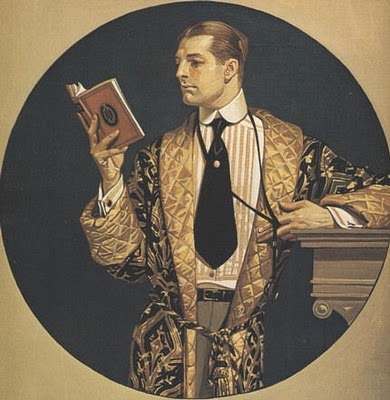
Every now and then I like to look back through older posts on my blog. It’s a form of masochism built upon equal parts fascination with forgotten ideas and revulsion at missed typos and awkwardly phrased run on sentences that really don’t know when to end, that should have ended sooner, and aren’t something I do anymore. One snarky post caught my eye and I thought I should retread that ground.

The post was based upon an article in The Guardian, one of the last bastions of book snobbery that manages to not trip over its own superiority complex – sometimes. The article had decided that all of these new-fangled e-readers weren’t filled with the right kinds of books.

Kindle-owning bibliophiles are furtive beasts. Their shelves still boast classics and Booker winners. But inside that plastic case, other things lurk. Sci-fi and self-help. Even paranormal romance, where vampires seduce virgins and elves bonk trolls.

Ahh, good, they’ve figured out what people actually enjoy reading. Do go on.

The ebook world is driven by so-called genre fiction, categories such as horror or romance. It’s not future classics that push digital sales, but more downmarket fare. No cliche is left unturned, no adjective underplayed.

“So-called” genre fiction categories of horror and romance… This article was published by a so-called newspaper.

At this point, you can see why I originally wrote about this article. Like many of these worthiness arguments, the article is quick to deride any genre book, particularly e-books in this case, as not having “classic” potential. You know, classics like The Godfather (crime), Lord of the Rings (fantasy), The Hitchhiker’s Guide to the Galaxy (science fiction), Frankenstein (horror), or Pride and Prejudice (romance). Why would anyone ever read dreck like genre fiction?

As I’ve said before, I could easily write a post-a-week pulling apart one of these articles. They are very common and rely on the same handful of bad arguments. In my original response to the article, I wrote that literary fiction – the preferred genre of the authors of these sorts of articles – and biography markets have been kept afloat by this sort of snobbery. People like to be seen reading high-brow stuff, and people like to give worthy books to friends and family. Not one person has ever bought a political memoir to read, they are always a Father’s Day gift. And as the article states, e-book readers don’t have to let people see what they are reading, so they don’t have to pretend any longer.

The reading public in private is lazy and smuttyE-readers hide the material. Erotica sells well. My own downmarket literary fetish is male-oriented historical fiction (histfic). Swords and sails stuff. I’m happier reading it on an e-reader, and keeping shelf space for books that proclaim my cleverness.

Well, maybe people will pretend just a bit longer…

Since this was an article from 2012, the talk of e-books was as they were ascending in popularity. Growth in the e-book market has since slowed, with the market being 20% of the total sales for the major publishers, down from a high of 28% five years ago. Of course, in the fiction market e-books are more like 50% of sales for the Big 5 publishers. And those publishers are having trouble with new fiction titles, as they haven’t had any “big titles” selling well, instead relying on genre fiction backlists and the sudden interest in political books… Wait, what?

It puzzles me why the author of this article insisted that e-readers are filled with garbage, particularly since the arguments supporting the claim lack evidence. A large chunk of book sales from major publishers are e-books, so it can’t all be the dreck titles, can it? What proof do we have that e-readers only contain Twilight fan-fiction and Dan Brown* novels? The proof we are offered is that anything genre is garbage: checkmate person who reads books! So maybe these article writers at The Guardian are onto something, maybe e-readers like the Kindle are filled with garbage.

Guardian on Amazon


*Sorry Dan**, you and James Paterson are my go-to punching bags here. If I’ve offended you or James by suggesting your books aren’t high-quality writing, then I’m quite happy to edit out those comments from my blog for a small six or seven figure fee. Just post me one of the bags of money you use as a pillow, that should cover it.

**Language expert take on Dan Brown novels: “A renowned male expert at something dies a hideous death and straight away a renowned expert at something quite different gets a surprise call and has to take an unexpected plane flight and then face some 36 hours of astoundingly dangerous and exhausting adventures involving a good-looking (and of course expert) member of the opposite sex and when the two of them finally get access to a double bed she disrobes and tells him mischievously (almost minatorily) to prepare himself for strenuous sex. Where are we?” And another.


Book vs Movie: American Pyscho – What’s the Difference?

5b38alyz-640

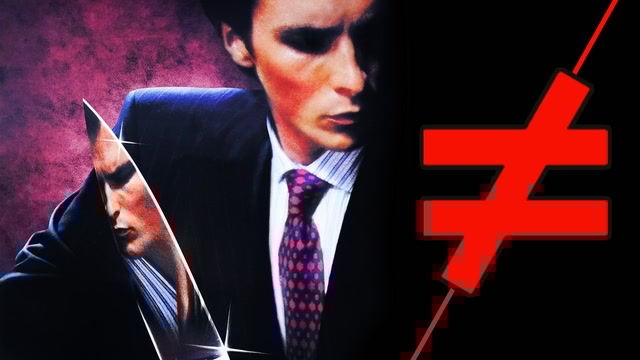
This month’s What’s the Difference? from Cinefix tackles the disturbing book and the amazing movie, American Pyscho.

I can’t remember the exact reason, but after hearing about the novel American Pyscho I decided I should read it. To the library! Where they didn’t have it. To the bookshop! Where they didn’t stock it. To the indie bookshop! Where I was able to find one copy being sold in shrinkwrap.

There’s a point to be made here about the value of indie bookstores. And having all the sick and twisted novels available for sale probably isn’t the point I intended.

And this is a sick and twisted novel. There are some scenes in there that would make a horror fan blanche – break free little rat, break free! The “satire” of the novel doesn’t feel like satire, it feels like gratuitous sadism that is there as an extreme juxtaposition to banality in a lazily made point about yuppies.

Which is why I regard the movie as far superior. It manages to skim through and grab the major elements of the book and put them on screen without becoming horror porn for vore fans – don’t look up that word, you don’t want to know. Ellis may not be a fan of the movie – because it is hard to tell if Bateman got away with it or imagined it – but his complaints are far too typical of the precious artists I’ve commented on in this series many times.

The irony is that many people would say that the movie is still ultra-violent. In which case, don’t read the book. Don’t do it. Or keep some lye on hand.

Update: Wisecrack did a great breakdown of some key differences between the book and film:

christian-bale-american-psycho-plastic-jacket-cover-up-picture
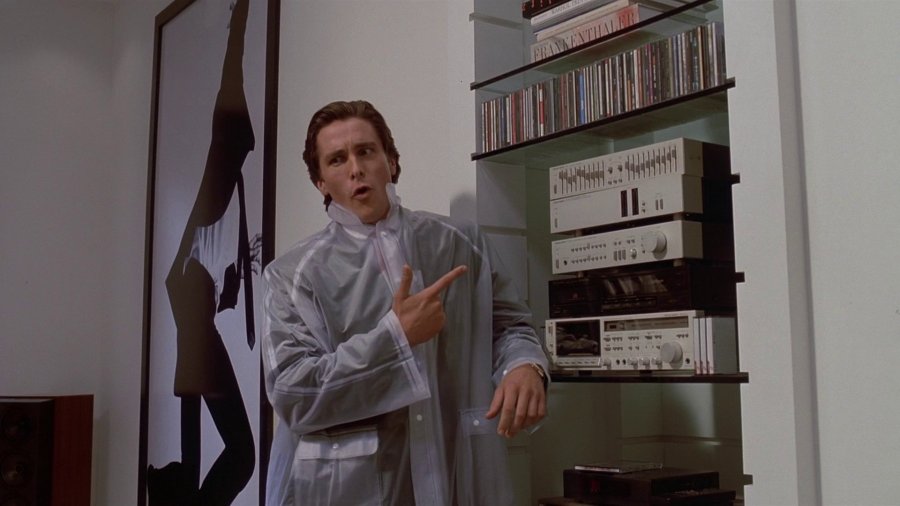
Do you like Huey Lewis and the News?

Book review: A Briefer History of Time by Stephen Hawking

A Briefer History of TimeA Briefer History of Time by Stephen Hawking

My rating: 5 of 5 stars

Well, that was brief.

In the late 1980s, Stephen Hawking became the name synonymous with smart people, science, and computerised voices when he released A Brief History of Time. In the intervening 27 years (this book was published in 2005) a lot of progress has been made in physics and our understanding of the universe, so this is an update on curved space, quantum gravity, black holes, Newtonian physics, relativity, the Big Bang (everywhere stretch), wormholes and time travel, and the search for a grand unifying theory of reality.

Obviously, this all sounds like very complicated stuff that you’ll battle to wrap your head around. I have to admit, when I read A Brief History of Time in my 20s I struggled with it. Imagining 4-dimensional space was confusing, imagining another 6 dimensions on top of that with string theory was just too much for me. So maybe I’m older, wiser, smarter, and have added centimetres to my head circumference, because I found this book clear and easy to understand. Or maybe this updated version is clearer than the original. Or maybe I’m just more familiar with physics now and can kid myself that it isn’t that hard to understand.

Either way, I found this to be a clear, concise, and easy to understand overview of spacetime physics.

View all my reviews

The Evolution of YA Fiction

Young Adult fiction is a term whose meaning has varied wildly over the years. It can apply to coming of age tragedies or serialized adventures of babysitters, or insert really dated twilight joke here. But where did this young adult genre come from? And why did it get so big?

The voting referred to in the video is here, but it is for North American people only. I mean, it is about the Great American Read after all. Which obviously means that the rest of the world’s opinion on that doesn’t count. Neither does South America’s.

Book review: An Introduction to Greek Philosophy by David Roochnik

An Introduction to Greek PhilosophyAn Introduction to Greek Philosophy by David Roochnik

My rating: 4 of 5 stars

If Western Philosophy is just footnotes to Plato, does that mean western society is just all Greek to us?

Professor Roochnik presents 24 lectures as an introductory course to Greek Philosophy… as it says in the title. This was quite a good overview of the pre-Socratics, Socrates, Plato, and Aristotle. Like any lecture, insights are given into the further scholarship that can inform a topic – such as how Plato structures his writing so as to make you think rather than tell you what he thinks – and some points are hammered repeatedly for the sleepy students in the back row.

Having recently read The Republic, the insights this book offered would have been handy beforehand. The advantage of having a philosophy professor step you through philosophy rather than just winging it yourself is well worth it. So as a background pre-reading, this is a good place to start.

I was also reminded during one of the earlier chapters of how much knowledge has been lost to history. We have this common misconception about great works rising to the top and being revered through the ages. But the example of the prolific writer Democritus whose works have largely been lost shows us how even recognised intellectual giants can’t be guaranteed their works will be preserved.

View all my reviews

Book vs Movie: The Lost World – What’s the Difference?

maxresdefault

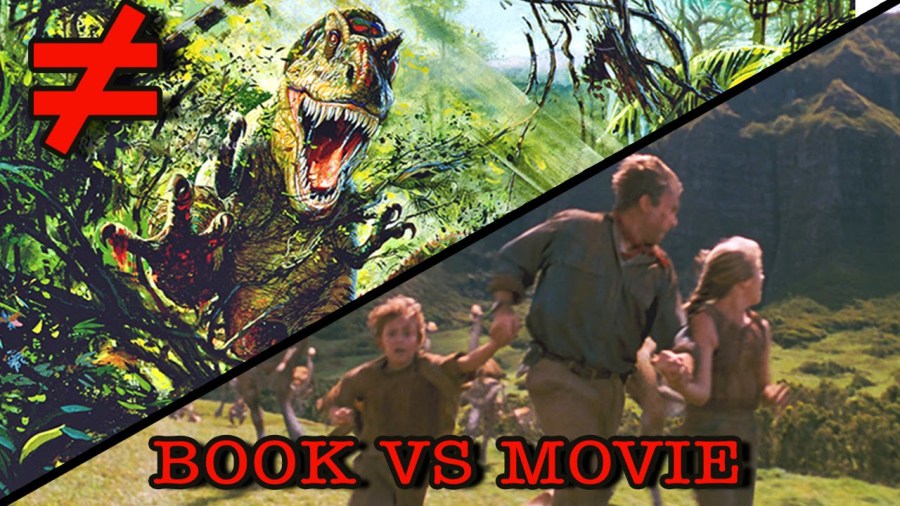
This month’s What’s the Difference from Cinefix compares the book sequel written because the movie adaptation was successful and the director wanted more source material to ignore. Jurassic Park: The Lost World.

Honestly, I can never keep it straight in my head which parts of the novels ended up in which movie. As mentioned in the video, the opening scene of The Lost World was actually from the first book. There are other examples, like the “birdcage” scene in one of the other movies was in the first book… I think.

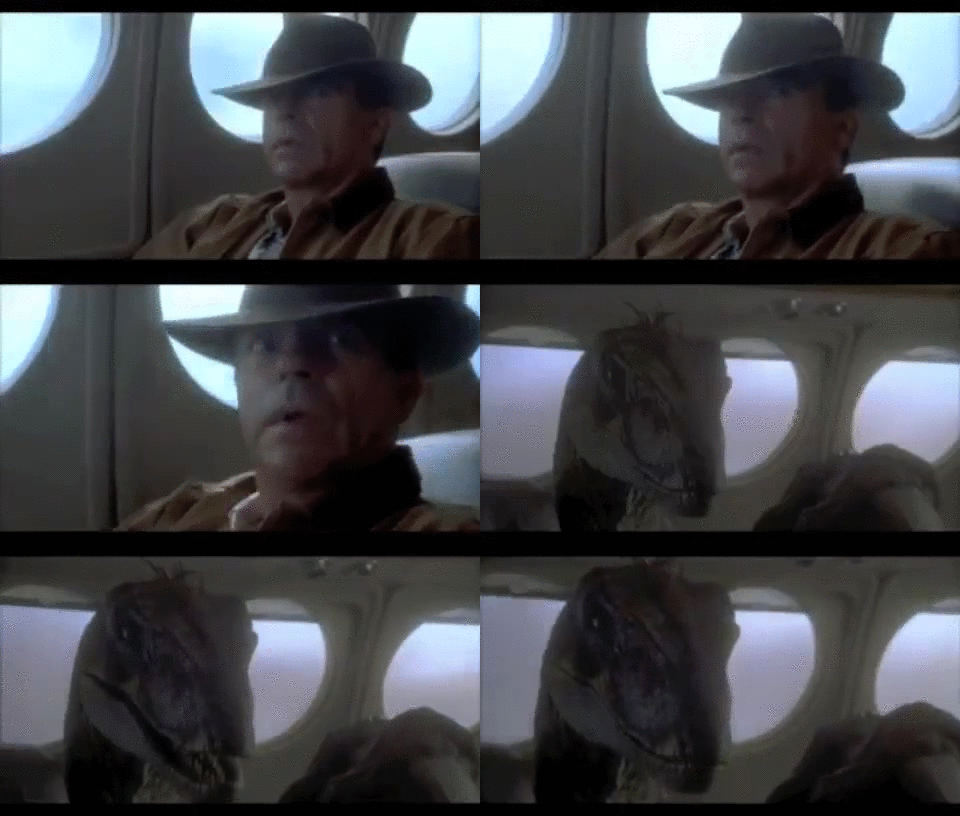
One thing is for certain: Spielberg knows how to make a film. He knows how to build tension, he knows how to establish sights, sounds, and characters so that sequences hang together, and he knows not to have a talking dinosaur in an aeroplane.

nwrb8yd
Yes, this is an actual scene from Jurrasic Park 3. Take a moment.

But The Lost World is an example of one the worst reasons you write or film a sequel: because the first one was successful. I don’t know exactly what Spielberg’s motivations were for the sequel – maybe he was under contract, maybe he needed a new wing on his house – but the film was dull. It was trying to recapture the lightning bottled in the first film. The same can be said of the book. Crichton didn’t originally want to write a sequel and was only convinced by Spielberg saying he’d give him lots of money that he would be keen to direct a movie adaptation of the sequel if one were written.

I’m on record as not being much of a fan of Michael Crichton’s books. He has a tendency to write solid thrillers that act as vehicles for anti-science rants by a raisonneur or mouthpiece. There is nothing wrong with doing this, per se, but science is awesome, so make sure your criticism is on point. Or don’t, depending on whether you want to impress me or someone who thinks chakras are a thing.

Needless to say, I was a fan of the first film, less so the book. The sequels… Put it this way, I haven’t bothered watching the new ones starring Chris Pratt yet.

Book review: Obscura by Joe Hart

ObscuraObscura by Joe Hart

My rating: 4 of 5 stars

In space, everyone goes a bit crazy.

Dr Gillian Ryan is frustrated. She is trying to develop a brain scanning technique in order to help her daughter to avoid the same fate as her late husband. Losian’s disease is thought to be caused by the rapidly increasing environmental destruction and affects memory and concentration. Then a team from NASA show up promising money and technology to help her work if she agrees to go to a space station to figure out what is wrong with their crew. Of course, NASA hasn’t been completely honest with her about where they are going and the risks involved, but that’s okay, she didn’t tell them about her painkiller addiction.

This novel was a lot of fun. Joe Hart has mixed together sci-fi, thriller, and suspense in good measures. The main character’s addiction and frustrations pour out on the page as you wonder if she is going mad or something more nefarious is happening. Added to that is the brisk pacing that doesn’t get bogged down like some novels with similar themes tend to. I don’t know what a hydro is, but after reading this novel I feel like I need one.

Well worth a read for sci-fi and thriller fans.

NB: I received an advanced review copy in exchange for an honest review.

View all my reviews

We don’t know the world

A few years ago I saw a fantastic talk from Hans Rosling about the world and statistics. Okay, I probably lost a few people by implying statistics are fantastic, and now I’ll lose some more by saying statistics ARE fantastic. Unfortunately, Hans is no longer with us, but his son and daughter-in-law – Ola and Anna – are continuing his work with Gap Minder.

Recently they released the results of their 2017 survey of world knowledge. After looking at the results they decided to call it the Misconception Study.* You’ll see why.

That’s right, less than chance. People really don’t know that much about the world.

gms_2017inpage-1024x523

Do you think you could do better? Well, find out! Take the 2018 quiz here. Of course, this is the part where I say that I passed the test. Humble-brag. But in fairness, as I’ve already mentioned, I’ve been following Gap Minder and I like statistics.

Could you pass the test?

*They probably called it that prior, but I’m making a point here, dammit!

When is the future?

I came across a very cool article about when the future is for science fiction. The question is interesting because we often think of THE FUTURE as being a long way away, but as the saying goes, some infinities are larger than others.

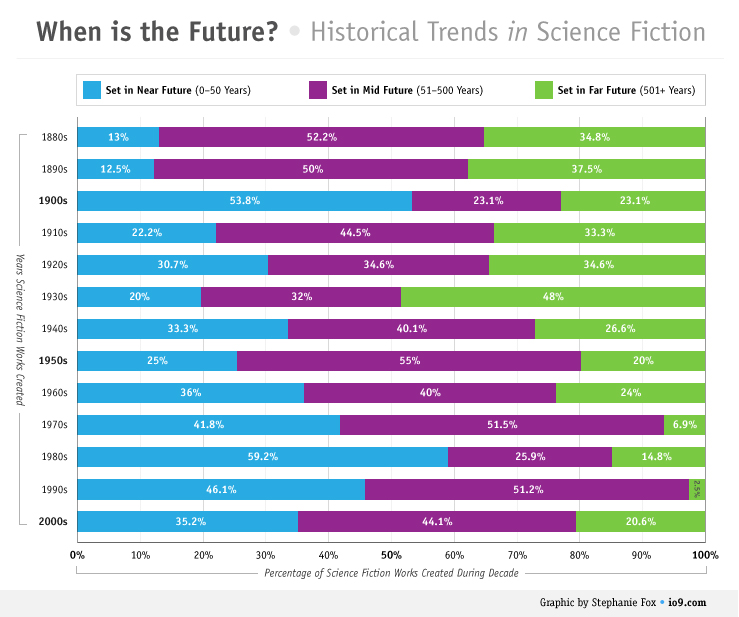
In response to a Tweet, iO9 and researchers Ben Vrignon and Gordon Jackson decided to look at the proportions of science fiction set in the near-future (0-50 years), mid-future (51-500 years) and far-future (+501 years). They took a random sample of 250 science fiction works (books, comics, movies, and TV) created between 1880 and 2010 that were available in the USA in English. Because only the USA matters. Eye rolls are appropriate here.

The results are interesting and broken into decades:

17n10jse1jq77jpg

As you can see, some periods of time emphasise some futures more than others, whilst other periods are more equally spread. The most notable of these is the shrinking of far-future science fiction from the 1970s until the late 1990s. It could be argued that the lack of far-future sci-fi in the 1990s could have been due to the rapid rise of technological change in society, such that everyone viewed the future as being just around the corner. Then after that time, we start to realise the technology just gave us cat memes and we still had a long way to go.

In the original article, they suggest that the changes were due to uncertainty about the future post-2001.

It’s possible that during periods of extreme uncertainty about the future, as the 00s were in the wake of massive economic upheavals and 9/11, creators and audiences turn their eyes to the far future as a balm.

Now it would be remiss of me to draw too many conclusions from this, nor try to offer explanations for any “trends”. We are talking about a dataset that only covers an average of 2 works per year. Two is hardly enough to be representative of any year, and 20 works is at best a smattering of any given decade. E.g. Futurama could be the only representative of far-future sci-fi in the 1990s yet Asimov’s Foundation Series was still going (he wrote his final novel for the series in 1993), the Xeelee Sequence had just started, as had the Hyperion series. Clearly, there were many works not being counted.

It would be interesting to see someone add more data to this analysis and do some breakdowns by media type. Make it so.

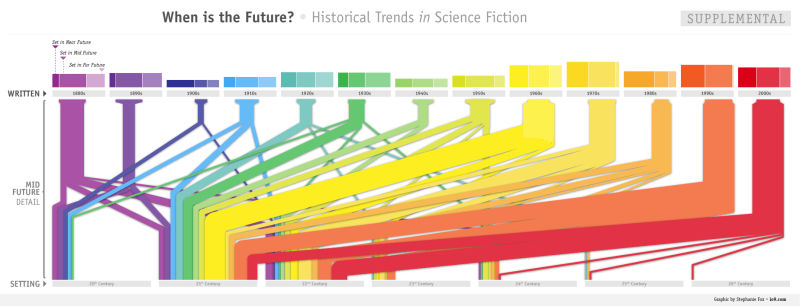
Supplemental Materials: More Detail on Middle Future Dates

One of the interesting discoveries we made was that the mid-future (51-500 years in the future) seems to be the most popular period for science fiction, across the last 130 years. So Stephanie created this chart breaking out our data on mid-future SF so you can get a sense of which periods are most popular — you can see that the 100-200 year future is common.

17n10jyb3rfjzjpg

How literate are we?

An argument that is often raised among the head shaking admonishment brigade, is that there is a woeful level of literacy in society. The argument usually points to comments on social media as examples of falling literacy, or to emoji laden messages, or is writ large in speciously reasoned blog posts like this one.

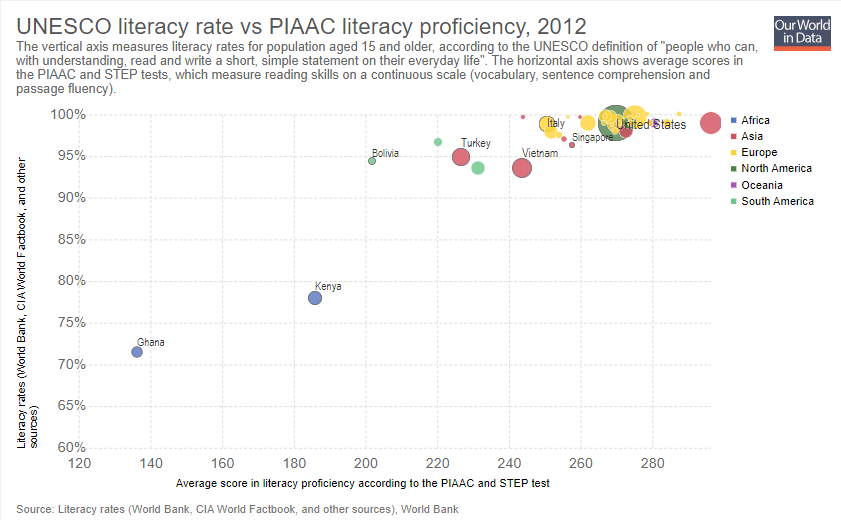
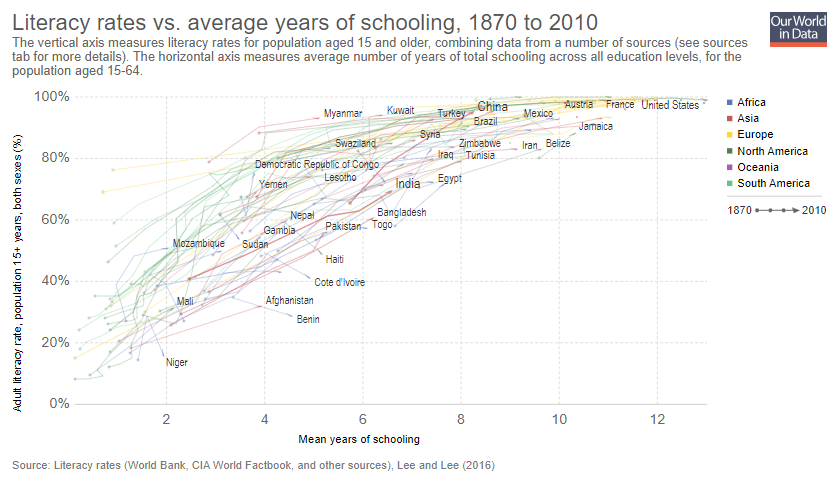
The reality is held within these charts:
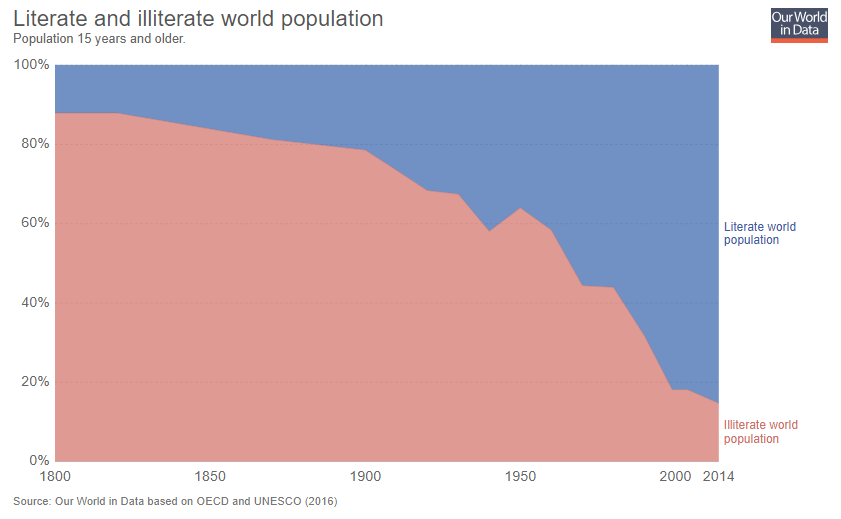
Literate

Literacy scoreLiteracy rates by school year

Yes, as you can see, for over 200 years the world’s literacy rate has been improving. If you go to the source article at Our World In Data you will be able to highlight the 1870-2010 trends. This shows that even quite well-educated nations have improved their literacy rates.

So what exactly are people complaining about? Well, let’s take some of the examples that are often proffered.

I recently reread a number of pulp novels from the sixties and seventies (with an occasional eighties and nineties thrown in for fun) – not literary fiction by any means, just thrillers the likes of which I grew up reading. What immediately struck me is how erudite the books were compared to modern fare. They were written at a much higher grade level than current popular fiction, because, bluntly, the average person was more literate, and the assumption was that folks wanted a little intellectual stimulation with their car chases and explosions – that words with more than a couple of syllables could be salted through a tome without fearing a slew of one star reviews written in Pidgin English bemoaning that the author was trying too hard or must have once seen a thesaurus. Source.

This is, of course, a personal opinion expressed by the blogger rather than hard data. You only have to look at the above charts to see that the average person they are referring to is actually more likely to be literate now than in the 1960’s. I think the blogger has leapt to the assertion that people are less literate now as an explanation for a style change that has occurred. Or just wants to whine about kids these days. Because what blogger doesn’t want to do that?

Now, why would a style change occur in the last 30 (or more*) years? Interestingly, some research suggested that the way we write changes the style of our writing. With the rise of word processors and computers, writers measurably changed their styles.

But has anything else has changed in that time period that could have impacted writing styles? I’m not sure if these are familiar to people or not, but television, gaming, internet, media, are all more popular now than they were 30 years ago. I.e. books now have to compete with more entertainment than ever. So stylistic changes will occur to capture and keep an audience’s attention, lest it strays from the latest literary masterpiece about a dog caring for its cat with terminal cancer to a YouTube video about how white nationalism is okay now for some reason (because of post-modern cultural marxism apparently).

Has reading and writing (literacy) actually changed much, though? It is one thing to say that people have passed the minimum standard level, but it is quite another thing to suggest high levels of literacy are being achieved by more/less people.

Studies on this were actually hard to come by. Yet there is certainly concern about reading and writing proficiency for high-school and university level students:

Three-quarters of both 12th and 8th graders lack proficiency in writing, according to the most recent National Assessment of Educational Progress. And 40 percent of those who took the ACT writing exam in the high school class of 2016 lacked the reading and writing skills necessary to complete successfully a college-level English composition class, according to the company’s data.

Poor writing is nothing new, nor is concern about it. More than half of first-year students at Harvard failed an entrance exam in writing — in 1874. Source.

Given the last sentence in that quote, it is probably more accurate to say that the standards are changing. We now expect more of our literacy because more people are schooled and meeting basic literacy standards. For example, in the USA Master’s degrees are now as common as Bachelor’s degrees were in the 1960’s. People are expecting more of education and setting different standards than were held previously.

As an article on The Conversation concluded on this topic:

In 1997 academic Paul Brock gave an enlightening address to educators in which he carefully recounted the ways each generation has bemoaned the falling literacy standards of the younger generation whilst laying the blame at the feet of modern educational methods.

Apparently, we’ve been doing this since literacy first became a thing back with the Sumerians some 5,000 years ago.

The problem is not that literacy standards are falling, it is that literacy demands are changing – and we are not keeping up.

Schools have their role to play, and they can up their game in order to keep up with the times. But employers must also realise that workplace literacy is their core work, not a supplementary remedial program, and plan their businesses accordingly. Source.

In other words, declining literacy standards are a perennial myth that people love to complain about. Styles have changed. Literacy demands have changed. But that doesn’t mean things are going backwards. Much like kids these days arguments, we can expect to see these same points raised again and again with no evidence to support their claims. Because if there is one thing that never gets old, it is complaining about how things are different now than the good old days.

*The blogger’s larger post talks about a change occurring in the more recent 20-30 year period, despite referencing books from the 1960-70’s. You’ll also notice more links to evidence in my post… just saying.

 

Writer Advice: Alcoholism

ice-tea
Ice Tea or Whisky? Your friends won’t know either, and after the first four, you won’t notice the lemon ruining the flavour.

Tip #1: Ice Tea looks just like whisky.

Do you need to hide just how much you are drinking from friends and family but can’t bring yourself to drink gin or vodka? Then “Ice Tea” might be your new preferred drink.

Tip #2: As long as you drink wine from a glass people will assume you are a connoisseur.

Wine is regarded as a classy drink, so as long as you drink it in a classy way, few will notice that some glasses can fit an entire bottle in them.

Tip #3: Don’t use crystal decanters.

Crystal decanters may look classy but they are expensive and are slowly giving you lead poisoning. Instead, just rub the label off of one of your bottles. A cheap and easy solution that won’t be poisoning you.

Tip #4: Wine and Whisky Clubs are your friends.

Even if no-one else loves you, subscription wine and whisky clubs love sending you a new supply of alcohol direct to your house. There is no longer a need to be reminded just how much you hate the rest of the world by having to venture out to the liquor store when home delivery is now a reality.

Tip #5: These lists always need to be five or ten items long.

Seriously, have you ever noticed that? Never four or seven, always five or ten. Sometimes if people are feeling keen, or have an auto-amalgamating post generator, they will stretch to twenty or thirty. Magazines used to do fifty and one hundred lists. Remember that? Of course, no one really cared to read the whole list. Usually, you’d just scan through for things that would catch your attention and then make note of the number one spot. And then write a comment arguing how the list was rubbish.

Banned books

Recently in Australia, there was a lot of moralising outrage about books being banned in school libraries. Was this Political Correctness Gone Mad?

No. No, it wasn’t.

Yes, that’s right, the moral outrage brigade hadn’t even bothered to check any details. That shouldn’t be particularly surprising to anyone who, you know, thinks, but what I did find interesting is the sort of hyperbole used on this issue that never seems to make it to the actual censorship that exits.

I’ve previously discussed the Banned Books Week, an awareness-raising campaign in the USA. Since the USA is a big and influential book market, there are flow-on effects of books being challenged and banned there – although the Streisand Effect can apply here and be a net positive, just ask Dan Brown. Australia also has a censorship board and historical lists of previously banned books have been made public.

When you read through the lists of books that were previously banned in Australia but are now available, you can see how we aren’t/weren’t allowed to talk about sex. We also don’t talk about Aboriginal history. Not talking about sex is still a common theme in today’s Australian censorship standards:

Publications will be refused classification (RC) that:

  1. describe, depict, express or otherwise deal with matters of sex, drug misuse or addiction, crime, cruelty, violence or revolting or abhorrent phenomena in such a way that they offend against the standards of morality, decency and propriety generally accepted by reasonable adults to the extent that they should not be classified; or
  2. describe or depict in a way that is likely to cause offence to a reasonable adult, a person who is, or appears to be, a child under 18 (whether the person is engaged in sexual activity or not); or
  3. promote, incite or instruct in matters of crime or violence

Publications (except RC publications) will be classified as Category 2 Restricted that:

  1. explicitly depict sexual or sexually related activity between consenting adults in a way that is likely to cause offence to a reasonable adult; or
  2. depict, describe or express revolting or abhorrent phenomena in a way that is likely to cause offence to a reasonable adult and are unsuitable for a minor to see or read

Publications (except RC publications and Category 2 restricted publications) will be classified as Category 1 Restricted that:

  1. explicitly depict nudity, or describe or impliedly depict sexual or sexually related activity between consenting adults, in a way that is likely to cause offence to a reasonable adult; or
  2. describe or express in detail violence or sexual activity between consenting adults in a way that is likely to cause offence to a reasonable adult; or
  3. are unsuitable for a minor to see or read. Source.

Now obviously the classifications could be very broadly interpreted and implemented. Plenty of books have themes around drug use and abuse, crime is an entire genre, cruelty is in any political memoir, and violence could be retitled thriller. We don’t tend to see those titles banned or restricted. So what does get restricted? As an example, American Psycho has a Category 1 restriction on it and is sold in shrink-wrapping… you know, just in case the words leak out and accidentally encourage someone to take up cannibalism or investment banking.

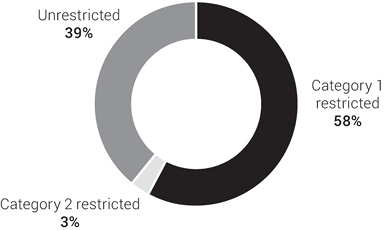
The number of books impacted by an RC classification is minimal. The 2016-17 figures show none were banned, as compared to video games which had 2 titles banned.

2017-figure01
Publications Classified in 2016-17. Source.

But it does show that a large number of titles were restricted in some way. This is without even touching on the censorship that occurs in access to titles, such as which titles are stocked in stores, which sites can be accessed to buy books, and what ends up in libraries. The restricted categorisation is clearly going to have impacts on where those titles will be available. So I wonder where the moral outrage is over this. Isn’t this Political Correctness Gone Mad? Or is it okay because the people who got outraged in the above video would be the “reasonable adults” who would be offended by these restricted titles?

Or maybe this would all require too much reading on behalf of those wanting to complain about books being banned.


Book Review: The Republic by Plato

The RepublicThe Republic by Plato

My rating: 4 of 5 stars

Old white guys sit around discussing how to set up a totalitarian military state with them as the rulers.

Plato’s famous text covers a lot of ground as it tries to establish what justice is. It covers politics, personal and political ethics, idealised states (democracy ranks third out of four), education, and virtue. The Republic is a heady read, whilst being fascinating.

The strawman style to the interlocuter dialogue did annoy me as a reader. Whilst it was in service of making a larger point, it did make the discourse feel more shallow than it is. Plato’s thinking was also amazingly progressive for an age that predates the enlightenment by the best part of a millennium. But this thinking was also confined by the times.

Plato, along with Socrates and Aristotle, were the drivers behind western society. Books like The Republic put forward a lot of ideas for discussion and dissection, opening the dialogue that would lead to progress. That alone makes The Republic worth reading, but I also found it was worth reading if only to see much of it in context rather than discussed second-hand. E.g. The famous allegory of the cave takes on a slightly different light when not viewed in isolation.

For a more detailed understanding:
https://plato.stanford.edu/entries/plato-ethics-politics/

View all my reviews